
Prologue
Prologue
Deep within the heart of the Great Frazes Forest, a vast, untamed land teeming with monsters, lay a peculiar village. Nestled in the forest’s western reaches, it was a place where humans and monsters lived not in fear or opposition, but in harmony. This unusual settlement bore the name Beresdral, and at its helm stood a human named Belamus.
From atop a stone tower piercing the treetops, Belamus surveyed the bustling sprawl below, his expression thoughtful.
“Beresdral’s come a long way…” he murmured, his words carried away by the wind rustling through the leaves.
It had been three years since the chaos with House Astorius had finally died down. In that time, both the village and its leader had changed. Belamus had turned nine, but physically, he looked older, taller, and sturdier than most boys his age. He now stood just shy of one hundred and forty centimeters. If he kept growing at this pace, he might hit one hundred and eighty someday.
Not that I’m obsessed with height, he mused, but hey, if I’m going to grow, might as well go all the way.
His face had matured slightly, his features sharper, more defined. But inwardly, he remained the same. After all, Belamus wasn’t just a precocious child; he was a reincarnated sage who had lived nearly ninety years in his previous life. Nine years in this new one weren’t enough to shake the foundation of who he was.
Beresdral had grown too, dramatically.
What had once been a humble gathering of misfits had flourished into something far more significant. Goblins and orcs from surrounding regions had joined the fold, drawn by the promise of unity and safety. More residents meant more homes, more farmland, and more infrastructure.
The village had expanded so much that it could hardly be called a “village” anymore. In truth, it had the size and spirit of a town. New crops were being cultivated. Evolved monsters were emerging more frequently. Change was everywhere: steady, unstoppable, and alive.
In all that time, no great calamity had struck. No new enemies had reared their heads. The ordeal with House Astorius had hinted at darker forces moving in the shadows, and Belamus had remained vigilant. But so far, nothing had come of it.
Still, he didn’t dare grow complacent.
The stronger Beresdral became, the safer its people would be. That belief anchored Belamus and drove him. And so, even now, as the sun filtered down through the canopy above, Belamus stood tall in his tower, ready to push onward for the town, for its future, and for everyone who called this strange, wondrous place home.
Chapter 1
Chapter 1
“If Beresdral wants to keep growing,” Belamus muttered to himself, “trade will be essential.”
Belamus crossed his arms, focus tightening his expression. He sat alone in his home, deep in thought, unraveling the puzzle of how to take his burgeoning town to the next stage of development. The answer had come to him gradually, but now it was clear: the resources within the Great Frazes Forest alone wouldn’t be enough. To truly enrich Beresdral, the town would need to forge trade routes with cities, nations, and anyone willing to exchange goods.
Right now, there were too many areas where the village was lacking. Most pressing of all was the state of Beresdral’s weaponry and armor. Though the town’s inhabitants technically used iron, the quality was abysmal: poorly forged, brittle, and barely holding together in a real fight. Iron, while abundant and easy to work with, was hardly the pinnacle of martial craftsmanship. There were far superior metals in the world, like mithril and orichalcum, to name two.
Those rare materials were notoriously hard to mine, let alone forge. Only high-ranking mages could manipulate them properly, so they were both rare and expensive. But weapons and armor made from them were vastly superior in every respect. And Belamus happened to have a significant advantage: he possessed the magic to work both mithril and orichalcum. If he could get his hands on enough of the raw material, he could craft weapons that would put anything currently in Beresdral’s arsenal to shame.
Unfortunately, there were no known veins of either metal within the Great Frazes Forest. In truth, Belamus figured that importing both would be far more realistic.
Maybe the art of forging mithril and orichalcum has declined so much that they're actually cheaper now. If that’s the case, I might be able to buy them in bulk and give everyone top-tier gear…
It was a hopeful, convenient notion, but not entirely out of the question. Beresdral had plenty to offer in trade: ripe Merune and Arla fruits, plus other unique resources that might fetch a reasonable price. If the rare metals really were within reach, Belamus would make sure to gather as much as possible.
But to trade, they’d need a trading partner first.
That was where the challenge lay. Humans, as a rule, despised monsters. Opening relations with a human kingdom would be… difficult.
Still, humans weren’t the only race with civilization in this world. There were other nonhuman groups, more open-minded, who didn’t view monsters with the same disdain. Belamus sifted through the vast well of knowledge from his previous life, searching for the best possible candidate. Somewhere out there was a society willing to look past appearances. One he could talk to. One he could build a bridge to.
He just hoped that the bridge would be strong enough to carry Beresdral into a new era.
I’ve heard the elves to the southeast don’t harbor hatred toward monsters… Belamus mulled it over, arms still folded as he sat deep in contemplation. But the elven kingdom isn’t exactly known for its large-scale mining operations. Do they even have access to orichalcum or mithril?
It was possible, he supposed, that a new vein had been discovered in the years since his last life. But even if that were true, establishing a trade route that far would be no small feat. They’d have to construct proper roads, which would take a major infrastructure effort. If Belamus was going to pursue trade with the elves, he’d need to conduct thorough research first. Rushing in would be reckless.
For now, though, no other suitable civilization came to mind. Frustrated but resigned, Belamus decided he’d at least begin research into the elven lands. And just as he resolved to take that first step, the door slammed open with a bang.
“Belamus! It’s urgent!” Ugo’s voice was tight with panic as he rushed inside.
Belamus shot to his feet. “What happened?”
“There’s something strange at the gate,” Ugo said, catching his breath. “I’m not sure what it is. Could be a monster, but it’s injured, and it’s talking. Or trying to. I can’t understand a word it’s saying.”
“A monster?” Belamus narrowed his eyes, his tone heavy with caution.
“Well, I thought it was a monster,” Ugo admitted, scratching his head. “But now I’m not so sure. It… kinda looks like a human. Small, too. Probably a kid. Actually, there are two of them.”
Two children. Belamus’s expression darkened.
It didn’t add up. The Great Frazes Forest was vast and perilous, no place for unaccompanied human children. For them to reach Beresdral on foot, they’d have had to cross terrain even adults struggled with. That alone made the story suspicious. But Ugo’s confusion over the language made it stranger still. Since Liza had come to Beresdral, the villagers had learned at least the basics of the human tongue. Ugo, for all his brawn, was a quick study and could understand more than one would think. For him to be completely baffled by these new visitors’ speech meant something was off.
While it was true that the citizens of different human nations spoke in different dialects, the regions surrounding Beresdral all used the same language as the Astorius domain and Liza’s homeland. Unless the children in question came from an extremely distant land, this wasn’t just a dialect issue. Belamus was beginning to suspect these children weren’t human at all.
He headed toward the gate, senses alert.
As he approached, a voice rang out; it was strained and urgent, but unmistakably that of an adult woman. Ugo had called them children, but this voice held the weight and urgency of someone far older. Belamus didn’t recognize the speaker’s face, but he recognized the language, and in that instant, he understood everything she was saying.
That’s… the halfling tongue.
The moment Belamus recognized the language, everything clicked into place. It belonged to the halflings, one of the lesser-known demi-human races of this world. Halflings stood at less than one-tenth the height of an average human, and their combat abilities were notably weak. Their heads were smaller in proportion, yet their intelligence rivaled that of any scholar. Many halflings refrained from using magic because they had little innate mana, though others used it just fine.
That was everything Belamus remembered about them. But one detail nagged at him: halflings weren’t known for having loud voices. Their speech shouldn’t have carried from the gate all the way to where he’d been standing. Something didn’t quite add up. Still, he set that thought aside and scaled the lookout above the gate to confirm what he was dealing with.
And then he saw them.
Two figures stood just beyond the gate, both female, neither of them halflings. Not quite. One was about the height of a toddler, the other, closer to that of an eight-year-old human child. But even the smaller one was far too big to be a halfling. They didn’t match the profile at all. And yet… they were speaking Halfling.
That was the part Belamus couldn’t explain. He knew of no other race that used the halfling tongue.
In any case, there was no hostility in their postures. The older girl—assuming she was a girl—knelt protectively over the smaller one, holding her close. Her expression was tense but determined, her arms shielding the child from harm. She was the size of a child, yes, but her face told a different story—it was sharper, more mature.
She wasn’t a little girl. She was a mother.
Belamus descended from the gate, his pace measured and cautious. Up close, the resemblance to human children became even more confusing. The woman—because she was a woman, not a girl—appeared to be in her thirties, at least judging by her face. She wore light armor and had a small axe strapped to her back. Clearly, she was no stranger to battle.
The child in her arms, on the other hand, looked far more like a true toddler. She was limp, eyes closed, and showed no signs of waking. Either she was just sleeping, or she was unconscious for some other reason.
Belamus stepped closer. “What happened?” he asked, calmly but firmly.
The woman looked up, startled at first. But then relief softened her features.
“Oh… You understand our language,” she said, her voice steady despite the pallor in her cheeks. “We were traveling through the forest when I was injured… I fear I won’t last much longer.”
She spoke in an eerie calm, as if already resigned to her fate.
Belamus didn’t want to believe her, but when he looked closer, he saw the truth: a deep gash ran across her abdomen, blood soaking through her armor in thick, dark sheets. It was worse than he’d expected—far worse. Even with advanced healing magic, this kind of wound might already be beyond help.
Time was running out.
“Please… I beg of you… Take care of her. Take care of Lady Mimi.” The woman’s voice trembled with desperation, but her gaze was unwavering. “They said she was cursed… and we were cast out of the Kingdom of Crystia. As her knight, it was my duty to protect her. But now… with these wounds… I don’t have much time left.”
She paused, breathing heavily, but pressed on. “All I can do now is believe in your kindness. I entrust her to you. Please. Please protect her. I’m begging you… She’s all I have left.”
She bowed repeatedly, her forehead nearly scraping the ground with each motion. There was no trace of pride in her actions, only urgency and a fierce, unrelenting will to protect. So, she wasn’t the child’s mother after all. She was a knight, and the girl’s name was Mimi.
The woman was at death’s door, yet she wasn’t pleading for her own life. She didn’t care about herself. All that mattered to her was the girl in her arms. That alone moved Belamus deeply.
He stepped forward, voice steady, clear, and firm. “I understand. I’ll do everything I can.”
Upon hearing his words, the woman’s shoulders sagged with relief. “Thank goodness,” she murmured. And then, she collapsed forward.
Belamus knelt beside her, checking for signs of life, but it was too late. Her chest no longer rose. Her breath had stopped.
Silently, he gathered the knight’s body and gently lifted the unconscious Mimi into his arms. She remained limp, her eyes still shut. For a terrifying moment, Belamus feared she too was gone, but a soft, faint beat pulsed beneath her chest. Her heart was still beating. She was alive.
When Belamus returned through the gate into Beresdral, Ugo came running up, his face pale with worry.
“Sh-She didn’t make it, did she?” he asked, voice tight and uncertain, as if afraid to hear the answer.
Belamus shook his head grimly. “I was too late. But the child survived.”
Ugo’s shoulders slumped. “So, they weren’t dangerous after all…?”
“Doesn’t seem like it,” Belamus replied, though a thread of unease curled in his chest.
They may not have been enemies, but someone else might be. If this Lady Mimi had been exiled for a curse, there was a chance others would come hunting for her. Beresdral could be caught in the crossfire.
Have I taken on more than I should have?
The idea nagged at Belamus, but it was too late for second thoughts. He had given his word. He had looked a dying knight in the eye and promised to protect the girl she’d given everything to save.
Belamus carried the unconscious girl to Beresdral’s assembly hall and laid her gently on a prepared cot. Her breathing was shallow but steady. The stillness of her expression made her look as though she was simply sleeping, though he knew her journey had been anything but peaceful.
Next, he turned his attention to her fallen protector. A burial was the obvious course of action, but a quiet doubt tugged at him. After all, the knight had entrusted the girl, Mimi, to him with her dying breath. If she had been more than a guard, if there had been a deeper bond, then burying her without allowing Mimi a chance to say goodbye might be cruel. And yet, confronting death so soon after trauma might only deepen the child’s pain.
He was weighing that uncertainty when the woman’s body began to glow, and a sudden flare of light engulfed the chamber. Belamus shielded his eyes, and when the radiance faded, the knight’s body had vanished. Only her armor, a few scattered belongings, and a brilliant red gemstone glowing softly against the floor remained in its place.
She hadn’t been cremated or otherwise disintegrated by some outside force. This had been something intrinsic to her nature; her body simply ceased to exist after death. Even with all his encyclopedic knowledge from his previous life, Belamus couldn’t name a single race that vanished upon dying. The mystery of her identity only deepened.
He stooped to retrieve the gemstone, and the moment his fingers touched its surface, a pulse of magical energy surged through him.
“Incredible,” he whispered after a moment.
The stone pulsed with immense, tightly woven magical energy. In his past life, Belamus had encountered magical gems before, rare stones that could amplify a mage’s abilities or, in exceptional cases, unlock unique powers. But this gem… this one eclipsed them all. It was denser, more refined, and more potent than anything he’d ever seen.
Without a doubt, this had belonged to the knight. Perhaps it had been her final tool of protection, or a relic of her homeland. Regardless, Belamus instinctively felt that it should stay with the one she died to protect.
He placed it gently against a piece of discarded armor beside the girl’s cot. It would be there for her when she woke up.
“Cute little thing, huh… Is she human?” came a quiet voice behind him.
Belamus turned to find Delarosa watching from the doorway, her tone lightly curious. Word of the girl’s arrival had already spread through Beresdral like wildfire. Delarosa, along with Medello, Navasha, and several others, had trickled into the hall, drawn by curiosity and concern alike.
He’d considered keeping the place locked down; Mimi needed rest, not attention. But seeing the villagers’ hushed tones and gentle movements, he decided to allow their presence under one condition: no noise, no disturbance. Just quiet observation.
“She’s not human,” Belamus said flatly.
“Then what is she?” Delarosa leaned in, wide-eyed with curiosity.
“I don’t know,” Belamus admitted, his tone uncharacteristically uncertain.
“What? Seriously?” Delarosa blinked, leaning forward with exaggerated surprise.
Medello, too, blinked in disbelief. “You mean you don’t know? That’s unusual.”
She had always assumed Belamus knew everything. Encyclopedic knowledge seemed to be part of his being, so this admission caught her off guard.
At that moment, a new voice called softly from the doorway.
“May I come in?” It was Liza, standing just outside the assembly hall with her hands clasped politely.
Belamus nodded. “As long as you don’t make a fuss.”
He didn’t expect that from her—Liza had never been the loud type—but caution felt appropriate, especially now.
Liza stepped inside quietly, her gaze immediately drawn to the unconscious girl lying beneath the blankets. She studied her carefully, brows furrowed.
“She’s not human, is she?” Liza asked quietly, her eyes fixed on the still figure.
“No. That much is clear,” Belamus replied.
“I heard there was someone else with her. What happened?” Liza continued, glancing around the room.
“The woman who brought her here… her body vanished,” Belamus said, his voice low. “All that’s left is her armor.”
He gestured toward the pile of equipment laid respectfully beside the cot. But Liza’s attention wasn’t on the armor; it was on the crimson gemstone resting nearby.
“And that gem?” she asked, her tone sharpening with curiosity.
“It belonged to the woman. It’s imbued with an incredible amount of magical energy,” Belamus said with quiet awe. He watched as Liza stepped closer, her eyes narrowing slightly as she studied the gem.
After a long pause, she placed her fingers gently against her chin, thinking deeply. “I might know what she is.”
Belamus’s eyes sharpened. “You do?”
Liza nodded slowly. “I believe she’s a dwarf.”
It was a name Belamus had never heard before. Liza began to explain.
Dwarves, she said, were a demi-human race known for their short stature—about half the height of humans. Male dwarves were easily identified by their full beards, while females often looked strikingly similar to human women. They were said to live deep underground, hidden from the world, their exact location known to almost no one. Renowned for their craftsmanship and mechanical ingenuity, dwarves possessed both keen intellect and unmatched skill with their hands. Their technology, especially in weapon forging, was rumored to exceed that of humans—enough to make them a potential threat.
“And when a dwarf dies,” Liza continued, “their body transforms into a gemstone saturated with magical energy. Among humans, those gems can be sold for a fortune. That’s why there are foolhardy types who hunt for the dwarves’ underground kingdom, hoping to profit from their deaths.”
Belamus’s gaze returned to the crimson jewel resting beside the armor. So that’s what this is… her final form.
It was a strange, almost tragic reality: that a person’s body could become a coveted magical artifact. But what intrigued him just as much was how Liza had known any of this.
“You seem familiar with dwarves,” he said, his tone cautious. “How?”
“They’re a fairly well-known race,” Liza replied, tilting her head. “I’m surprised you didn’t know about them, Lord Belamus. I thought everything I said was common knowledge.”
“Is that so?” Belamus murmured, one brow arching slightly as he processed the unexpected gap in his knowledge.
“Mhm. Where I grew up, almost everyone had at least heard of dwarves,” Liza said with a small nod, her voice thoughtful. “I’m not exactly an expert on other races myself, so if I know about them, I imagine most people do.”
That answer gave Belamus pause. In his previous life, dwarves had either been unknown or so obscure that they’d escaped even the vast networks of magical and political knowledge he’d once mastered. Perhaps they had only emerged, or been discovered, after his death and reincarnation. Or perhaps the race had always existed, hidden deep underground, out of reach of humanity’s eyes.
It was also possible they were somehow connected to halflings. The language Mimi spoke matched theirs exactly. Could the dwarves be an evolved form of the halflings? Or an entirely different race that just happened to share a language?
“I’d heard of dwarves before,” Liza added, “but this is the first time I’ve actually seen one. They don’t exactly show themselves in public often.”
“Not surprising, if they live underground,” Belamus murmured, his thoughts turning toward darker implications. “But what would drive someone like that to come here? She mentioned something about a curse… and being hunted.”
The dwarf knight had died before she could explain everything, but her last words painted a grim picture: an exile, a curse, and a kingdom that had cast her out. Whatever had happened, it wasn’t peaceful.
The only one who might know the full story now was Mimi. Whether she could tell them, however, was another question entirely.
Belamus glanced toward the girl lying quietly on the cot. Judging by her size, she looked to be about three years old, but dwarves were smaller than humans. She might be older than she appeared. If she were truly three, getting a clear account of events from her would be nearly impossible. If she were closer to ten, she might be able to explain, but even then, there was another risk: if she woke up and found her guardian gone, would she think they had something to do with it?
That misunderstanding could be disastrous. Beresdral was home to humans, goblins, orcs, and other races. Not a single dwarf among them. Would she even trust what they told her? If she didn’t believe them, Belamus knew he’d have no choice but to earn her trust, slowly and patiently. He had already given his word. No matter how long it took, he was prepared to see it through.
And so, he waited.
Hours passed in silence as they watched over the sleeping girl. Then, at last—
“… Nn.”
A soft sound slipped from Mimi’s lips. Her body shifted slightly beneath the blanket, and after a few slow, groggy movements, her eyes cracked open. Half-lidded and unfocused, she blinked at the unfamiliar ceiling, then sat up unsteadily, like someone caught between dream and waking. Her gaze drifted around the room in a daze.
She yawned once, long and drawn out, then mumbled, “Hm? Where am I?”
The question came out half-slurred, her head tilting with puzzled curiosity. She paused like that for several seconds, then her eyes flew wide open.
“Where am I?! Who are you?!” Mimi shouted, her voice cracking as panic surged through her, eyes darting wildly around the unfamiliar room.
The shout echoed through the hall. Whatever fog had clouded her mind was gone now, replaced by sharp panic. She was clearly overwhelmed: confused, frightened, and utterly unprepared to find herself in a strange place surrounded by strangers.
“Easy now,” Belamus said gently, keeping his voice calm and even. “We’re not here to hurt you.”
His reassurance didn’t reach her. Her eyes darted around the room, her breath growing quicker.
“Where’s Kuusha?!” she cried out, panic continuing to rise in her voice. “Where’s Kuusha?!”
“Kuusha,” Belamus repeated, crouching slightly to meet her eye. “That was the woman with you, wasn’t she? The knight?”
Mimi nodded so hard it shook her whole body.
Belamus hesitated. There was no easy way to say this. His eyes drifted toward the armor and the crimson gemstone resting beside it, Kuusha’s only remains. He considered hiding the truth to spare the girl the immediate pain. But if she found out later that he’d lied… the damage to her trust would be far greater. No. She deserved honesty.
“I’m sorry. But she’s gone,” Belamus said quietly, his voice heavy with the weight of truth, each word measured with care.
Mimi followed his gaze. Her eyes locked on the familiar armor first, then slowly shifted to the gem. For a long moment, she didn’t move. Then, wordlessly, she climbed off the cot and walked toward it. She knelt down and picked up the stone, cradling it in both hands.
She stared at it in silence, wide-eyed, expression blank. Like her mind couldn’t quite accept what her eyes already knew.
Belamus watched her, unsure what to say. Even with all the years he’d lived in his past life, there were still moments like this where words failed him. He searched for something that might offer comfort, but nothing felt right.
Then Mimi spoke.
“I remember now,” she whispered. Her voice was quiet, but steady. She didn’t look up; she just stared into the gem as she spoke. “We were being chased. Kuusha got hurt protecting me… it was bad. Really bad. I was screaming and crying, and she tried to calm me down. She made me eat something. I think it was… Remst dust. That’s why I fell asleep.”
She spoke slowly, almost to herself, piecing the memory together one thread at a time.
Belamus felt a quiet breath escape him. If she remembered all that, if she understood what had happened, then maybe she wouldn’t blame them. Maybe she wouldn’t see them as enemies.
As Belamus listened to Mimi speak, it became increasingly clear that she was older than her childlike voice suggested. Still a child, perhaps, but not so young that she couldn’t reason or speak clearly. Her words carried awareness, composure, and intelligence.
“Who are you?” she finally asked warily. “You’re not one of them, that’s for sure, but you’re not one of us either.”
“I’m Belamus,” he replied evenly. “A human.”
Mimi’s expression sharpened, and she reeled back slightly. “A human?! You mean the monsters who kill dwarves and turn them into gemstones for profit?!”
Her accusation rang with venom. Belamus let out a dry, almost resigned chuckle. In his past life, humans—numerous, greedy, and ambitious—had earned the distrust of many races. It seemed that reputation had endured across time. Nothing had changed.
“Some humans are like that,” he admitted calmly. “But I’m not one of them. I promise.”
Mimi didn’t seem convinced. Her eyes narrowed as she studied his face, searching for a lie. For several long seconds, she said nothing. Then, slowly, her suspicion began to fade.
“If you were after my magicite, I’d already be dead. And from the way things look, it’s pretty clear you’re the one who helped me.”
She was assessing the situation logically and calmly. Belamus nodded to himself. Sharp kid.
He decided to explain more. He told her that, in her final moments, Kuusha had begged him to protect Mimi. The girl’s gaze dropped to the crimson gem in her hands.
“She said that?” Mimi whispered. Her voice trembled. She stared down at the gemstone cradled in her palms, eyes shining. A few silent tears slid down her cheeks before she wiped them away with her sleeve.
Then she took a deep, steady breath, and her eyes hardened with quiet resolve. She clenched the gem tightly in her fist.
“If Kuusha gave her life to protect me, then I owe it to her to live. I won’t waste her sacrifice.”
Belamus watched her in silence, quietly impressed. To stand up after such loss, to look forward and not back, took strength. More than most adults could muster.
“Belamus, right?” Mimi asked, her voice steady again. “Can you tell me where we are?”
He nodded and gave her a simple rundown of their location.
“This is Beresdral,” he said. “A town built right here in the Great Frazes Forest. It’s home to all kinds of monsters. But don’t worry, they’re friendly.”
“In the Great Frazes Forest…?” Mimi’s brows knit. “A town? Full of monsters, living together?”
“Exactly,” Belamus said with a faint smile. “Want to see it for yourself?”
Mimi nodded slightly. Together, they stepped outside.
Mimi’s eyes widened at the sight that met her. She looked around, stunned, and murmured under her breath, “This is… an actual town. In the middle of a forest like this? I had no idea something like this existed.”
The streets were clean, and the buildings were solidly built. It didn’t feel like a monster settlement; it felt like a living, breathing community.
They began to walk through Beresdral together, and before long, they passed a group of goblins. Mimi slowed, eyes narrowing with curiosity.
“Those people… they’re not human, are they?” Mimi asked cautiously, her eyes following the goblins with a mix of wariness and wonder.
“They’re goblins,” Belamus said. “First time seeing one?”
“Well, yes and no,” Mimi replied, tilting her head. “I’ve seen goblins before, but these look completely different from the ones I remember.”
“You probably saw unevolved goblins,” Belamus explained. “Every goblin in this village has gone through at least one evolution.”
“Goblins can evolve?” Mimi asked, her voice tinged with genuine surprise. “Huh, that actually explains a lot.”
Just as she seemed to settle into thought, a high-pitched voice rang out behind them.
“Oh! She’s awake!” Delarosa called.
Mimi turned just in time to see Delarosa, Medello, and Navasha bounding toward them, their expressions bright with curiosity and excitement. The three goblin girls wasted no time—they crowded around Mimi, gently patting her head and pinching her cheeks, clearly enchanted by her childlike appearance.
Mimi flinched slightly, overwhelmed. “A-Are they goblins too? I… I don’t understand what they’re saying.”
“They don’t mean any harm,” Belamus assured her. “They just like you.”
“I can tell they’re not hostile,” Mimi muttered, still trying to process the attention. “But… hey, Belamus? How come you can speak Dwarvish? I thought humans had their own language.”
“I do,” Belamus said simply. “But I also speak Goblin, the Halfl—I mean, Dwarvish, and a few others.”
Mimi blinked at him. “That’s… that’s incredible.” Her voice was small, but full of awe.
Belamus continued the walk through Beresdral with Mimi at his side. As they moved through the town, she gradually took in the diverse faces around her: goblins, yes, but also orcs, Imps, Alraune, and other monsters she had only heard of in cautionary tales.
She didn’t react with fear. On the contrary, she looked genuinely impressed.
“Monsters of all kinds, living together, peacefully,” she murmured, eyes drifting from group to group. “They don’t look like bad people at all. I mean, it’s hard to believe this is the same Great Frazes Forest people say is so dangerous. For a place that’s supposed to be terrifying, this town feels… safe.”
Then, closing her eyes for a moment, she added in a softer tone, “After everything that happened, maybe ending up here wasn’t such a misfortune after all.”
Belamus exhaled, relieved. She was adjusting more quickly than he’d expected, and more importantly, she was starting to trust him. That meant he could finally ask the question that had been pressing on him since the moment she’d arrived.
“I’m glad you feel that way,” he said gently. “And if you’re comfortable, could you tell me more about what happened? Why was Kuusha so badly wounded? What led you both here? Just whatever you remember.”
Mimi didn’t answer right away. She looked at Belamus for a long moment, as if weighing something in her mind. Then she gave a quiet nod.
“I still don’t really know what kind of person you are, Belamus,” she said slowly, “but I can tell you’re not bad. You saved my life. That much is clear.”
Her fingers tightened slightly around the gemstone she still carried.
“If you really want to know, then I’ll tell you everything,” Mimi said quietly.
Then, though a flicker of hesitation still lingered in her eyes, Mimi began to speak, opening up about everything that had led her to this moment.
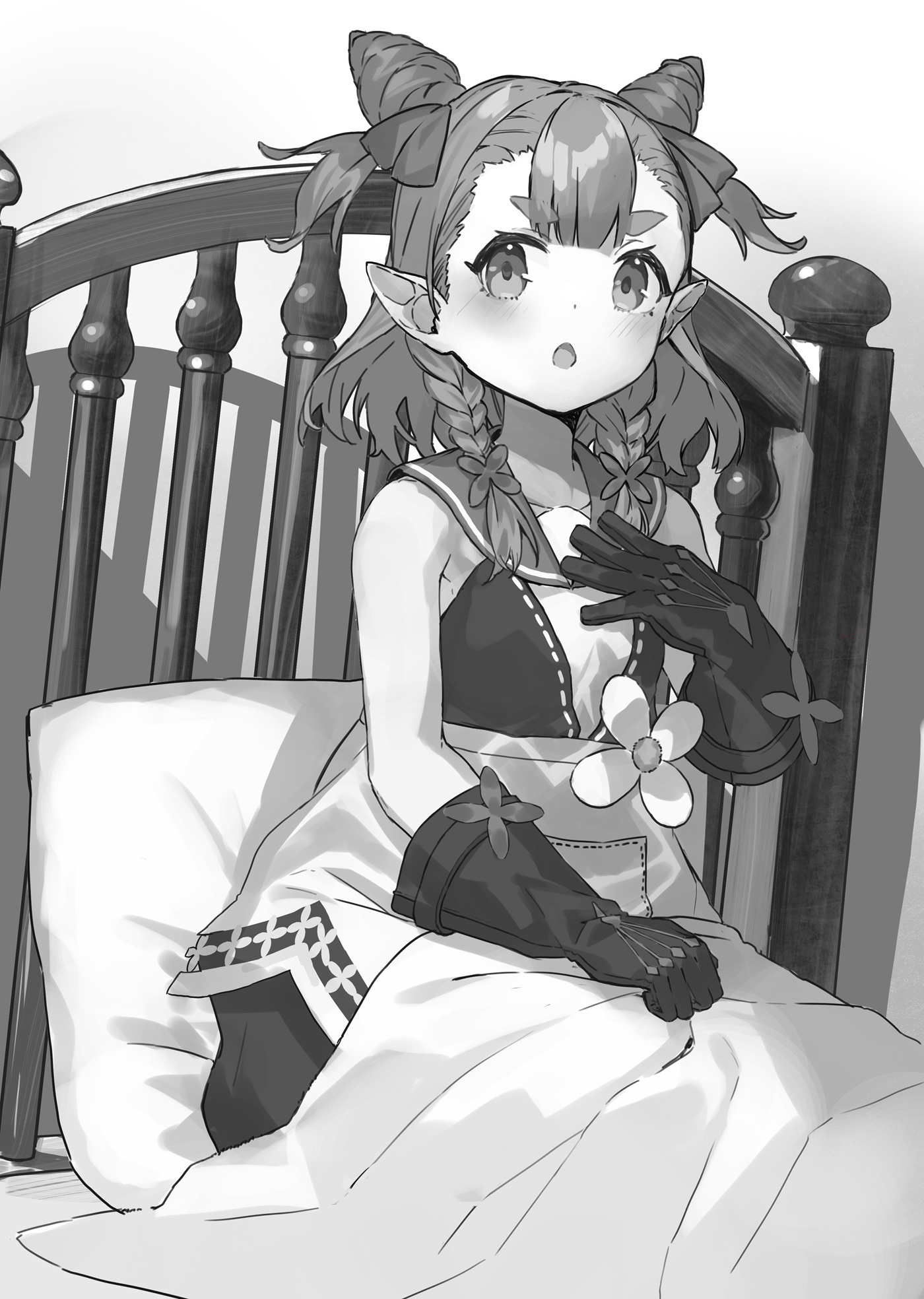
Though the words didn’t come easily at first, Mimi spoke with growing clarity.
“My name is Mimi Crystia. I was born in the underground dwarven kingdom, the Kingdom of Crystia, as its third princess.”
Belamus blinked. “A… princess?”
He’d suspected she might be someone of importance; after all, Kuusha had introduced herself as a knight, not a mother. Still, royalty was a surprise even to him.
“But why would a princess be hunted?” he asked, voice low with concern.
Mimi’s fingers tightened around the gemstone in her hands. Her eyes drifted downward as she spoke.
“A year ago, one of the royal druids declared I was cursed,” she said. “He said that if the curse was left unchecked, it would bring disaster to the kingdom. That it couldn’t be broken… and that the only solution was to kill me.”
Belamus frowned. “A curse?”
As a sage, he was intimately familiar with curses, especially high-level, destructive ones. If someone were truly afflicted with a curse strong enough to threaten a kingdom, it would be obvious to him. And yet, he sensed nothing of the sort from Mimi. No dark aura. No spiritual residue. Nothing.
“I do have some… unusual traits,” Mimi admitted, her voice growing quieter. “Sometimes I see things no one else can. I have dreams, terrible ones, that come true. Not once or twice, but dozens of times now. But… I’ve never hurt anyone.”
Her words came with visible pain. Each sentence darkened her expression further. Clearly, whatever power she held had made her a target, and she didn’t understand why.
“My mother refused to believe I was cursed. She started researching everything she could about it: consulting ancient texts, reaching out to scholars. But then…” Mimi swallowed hard. “They suddenly announced I would be executed.”
Belamus’s eyes narrowed. The suddenness of it, the secrecy… this reeked of political convenience, not divine truth.
“Before they came to take me,” Mimi continued, “my mother gave me the name of someone she believed could help. She told me to run. And she sent Kuusha with me.”
She fell silent for a moment, her gaze returning to the red gem in her palm, Kuusha’s last form, her final gift.
“We escaped from the palace and were headed toward someone who might understand curses,” Mimi said, her voice steady and heavy with memory. “But we weren’t the only ones moving. The kingdom sent pursuers, more than we could handle. The underground realm isn’t that expansive… There wasn’t enough room to lose them. We had no choice but to try and escape to the surface.”
She paused, her fingers unconsciously tightening around the gem in her hands.
“Most of the known exits were heavily guarded. All but one: the gate leading to the Great Frazes Forest. It’s dangerous, so most dwarves avoid it entirely. In fact, barely anyone even knows the gate exists. I thought we’d be safe if we took it,” Mimi explained, her voice low and measured as she recounted the decision that had sealed their fate.
Then her voice faltered. Her gaze dropped to the ground, shadowed by the memory.
“But they’d predicted that too. They were waiting for us,” Mimi said quietly, her eyes darkening with the loss.
She didn’t have to say the rest. Belamus could see the image forming in her mind: the moment Kuusha had shielded her, the moment she had fallen.
He placed a hand gently on her head, his voice soft. “That must have been painful. I’m sorry I made you relive it.”
Mimi said nothing, only kept her eyes low, her small frame tense.
“You’ve been through more than most adults ever go through,” Belamus continued quietly. “You’ve lost your protector. You’re cut off from your homeland. Alone. Hunted. I can’t imagine how overwhelming that must feel.”
Still, she didn’t speak, but her silence spoke volumes.
Belamus nodded to himself.
“Then stay here,” he said. “This town, this place can be your shelter. Consider it a bond of fate. As long as you’re in Beresdral, no one’s going to lay a hand on you.”
Mimi looked up sharply. “You’d really let me stay here? Even though I can’t give you anything in return?”
“I made a promise to Kuusha to protect you,” Belamus said simply. “I intend to keep it. And besides, you can give me something.”
Her expression tightened with suspicion. Then her eyes widened, as though a sudden fear had taken root in her thoughts.
“You… you don’t mean Kuusha’s magicite, do you?” Mimi asked, her voice rising slightly in panic as her grip instinctively tightened around the gem.
Belamus shook his head. “No. That belongs to you. It’s her legacy, and it should stay with you.”
“Then what do you want?” she asked, blinking. “What could I possibly have that you need?”
“Knowledge,” he said, folding his arms thoughtfully. “I want to learn more about the dwarves. Your people. Your kingdom. Your culture. Everything.”
He was newly curious about the hidden nation that lay beneath the earth, and now he had someone from that very world standing before him.
Belamus had also been searching for potential trade partners for some time. Looking at Mimi, with her mannerisms, clarity of speech, and quiet strength behind her eyes, he began to wonder if the dwarves might be the perfect match. From what little he’d seen, their culture didn’t seem primitive in the slightest.
“You want to know about dwarves?” Mimi asked, eyeing him curiously. “I mean, sure, I can tell you. But is that really all it takes to let me stay in your town?”
“Information can be more valuable than gemstones,” Belamus replied evenly. “And knowledge about dwarves, from your people and customs to your kingdom, is of great interest to me. I'd say it’s more than a fair exchange.”
She gave him a long look, then shrugged with a sigh. “I don’t really get why you’re so obsessed with us, but fine. Ask away.”
Permission granted, Belamus didn’t hold back.
“Your kingdom is called Crystia, right? Roughly how many dwarves live there?”
Mimi tilted her head, thinking. “I think… around a million? But I don’t know the exact number.”
“A million?” Belamus blinked, surprised. “That many? Your underground territory must be enormous.”
He’d expected something in the range of a few hundred thousand at most. But a million… Such a population implied sprawling infrastructure and high-level organization. If it was true, that kind of scale would make Crystia an ideal trading partner.
“What’s your staple food?” he asked next, eager to learn more.
Mimi hesitated for only a second. “We eat metal.”
“Metal?” Belamus repeated, brows lifting.
“Yup,” she said with a faint smile. “Other races eat plants or meat, right? Dwarves are different. We eat refined metals.”
He hadn’t expected that. Eating metal? That raised an entirely new set of logistical questions, especially since Beresdral wasn’t exactly a mining capital.
“We don’t have access to high-quality ore here,” he said. “All we can gather right now is some low-grade iron. Would that even be edible for you?”
Mimi’s expression fell ever so slightly. “L-Low grade, huh? Doesn’t sound very tasty,” she muttered, visibly disheartened. “But… I guess I can’t afford to be picky right now.”
Now that I think about it, I could technically create metal with magic, Belamus mused as he watched Mimi’s mood deflate. But like magically produced water, it might not be safe to ingest. It could turn out toxic. It’s too risky to test on her.
Still, seeing her so downcast tugged at him. Maybe once in a while, I could visit a human town and buy her a stash of the metals she likes. That might cheer her up.
Trying to steer the conversation in a more constructive direction, he asked, “Here’s another question: what kinds of metals can be found in the Kingdom of Crystia? I know you dwarves eat them, but surely you also use some for tools or weapons, right?”
“Oh, yeah. We have metals set aside specifically for weapons,” Mimi replied, a bit more animated. “The ones that taste bad or don’t have any nutritional value go into swords and armor.”
Belamus nodded thoughtfully. “Interesting. Tell me, have you ever heard of a metal called orichalcum? It’s extremely hard, nearly impossible to process with conventional methods.”
“Oh, sure. We have that,” Mimi said casually, then made a face. “Can’t eat it. It’s way too hard. We usually just dump it topside because it gets in the way.”
Belamus nearly choked. They just throw it away? If that really was orichalcum, and they were discarding it like trash, then acquiring it might cost him nothing at all.
“And what about magic?” he asked next. “Do dwarves use it?”
“Magic?” Mimi echoed, tilting her head. “You mean that weird power humans and demons use, right? No one in our kingdom knows how to use it. I don’t think anyone’s ever seen it done in person. Even if someone did figure it out, I doubt we’d be able to use it.”
So, the dwarves were far behind in magical arts. That, too, was valuable information.
“But we don’t really need magic,” she added with a small grin. “We’ve got machines.”
“Machines?” Belamus echoed, his brow lifting in interest as he leaned in slightly, curious where this was going.
“Yeah,” she said brightly. “Stuff like drills to dig through rock, or carriages that move on their own without horses. We’ve got tons of things like that.”
“I see,” Belamus murmured. “So instead of advancing magic, the dwarves focused on developing mechanical technology.”
“Pretty much,” Mimi said. “I’ve heard a few things about human nations, and it sounds like some of the tech we’ve already phased out is still being used over there. Magic’s useful, sure, but if you can’t use it, you’re stuck. Anyone can operate our machines.”
Belamus leaned back slightly, impressed. That kind of accessibility was no small thing. In Beresdral, there were many who couldn’t wield magic well. Tools that anyone could use… that could change everything. Even for those without magical aptitude, machines could offer a path to prosperity.
Belamus found himself contemplating the possibilities. If Beresdral shared its magical knowledge, and in return the dwarves offered their mechanical craftsmanship, the foundation for a powerful alliance could take root.
But before any deal could be made, there was a vital question he still had to ask.
“How are humans and goblins perceived in the Kingdom of Crystia?” he asked carefully.
Mimi looked thoughtful. “Humans… they’re feared. And goblins are generally lumped in with monsters. But honestly, if the dwarves back home saw the evolved goblins here in Beresdral, they probably wouldn’t even recognize them as goblins.”
Belamus sighed. “So, we’re feared. That might make diplomacy difficult.”
“Do you really want to trade with my kingdom?” Mimi asked, tilting her head. “Well, if you can prove that humans are safe to interact with, then I think it’s possible.”
“And how would I go about proving that?” Belamus asked, his tone measured but inquisitive, already thinking two steps ahead.
“There’s a strict law in Crystia,” she explained. “No one of another race can enter unless introduced by a known dwarf. It’s always been that way. If I introduced you… it’d be different. But…”
Belamus nodded grimly. “You can’t return while you’re being hunted.”
“Exactly,” Mimi murmured, her voice heavy with regret. “I’m sorry. I want to help, but I can’t.”
Belamus stared at her, thoughtfully. Wait… she said she’s being hunted because of a curse. If he could remove that curse or prove that no curse existed in the first place, her exile might be revoked. The hunters would lose their justification. And she’d be free to return home.
Not only would that solve Mimi’s crisis, but it could open the gates to formal trade with Crystia. And if she were truly a princess, the backing of the royal family would make future dealings far smoother and far more profitable.
It was the perfect way to kill two birds with one stone.
“Mimi,” Belamus said, stepping forward, “I’ll break your curse.”
Her eyes widened. “What?”
“If I can lift it, or prove it was never real, they’ll stop chasing you. You could return to Crystia openly and help us establish trade.”
“I… I mean, that sounds great,” she stammered, clearly overwhelmed. “But can you really do it?”
“When it comes to curses,” Belamus said with quiet confidence, “I know more than most. Let me take a look.”
Mimi hesitated for a heartbeat, then nodded. “O-Okay. I trust you.”
With that, Belamus began his investigation into the so-called curse that had upended Mimi’s entire life. And to investigate a curse, one had to turn to magic.
While truly powerful curses often revealed themselves at a glance with tells like twisted auras or visible corruption, Mimi showed none of those signs. Still, Belamus couldn’t be certain. Dwarves might react differently to curse magic. It was possible that what escaped the human eye could still be hidden deep within her. There was only one reliable way to know for sure.
He raised his hand and invoked the spell: Curse Search.
The moment the incantation took hold, Belamus’s eyes turned pitch-black, the color of the void. His vision shifted. The world around him lost its warmth, replaced by a muted palette where living beings shimmered with color-coded glows.
Green meant clean—no curse.
Red signaled that a curse was present.
Gray… gray was dangerous. That meant a curse of tremendous potency, something ancient and lethal.
He turned his gaze toward Mimi.
Her aura pulsed a gentle, steady green.
Belamus frowned.
So… nothing?
He held the vision for a few seconds longer, scanning carefully. No anomalies. No hidden pulses. Not even the faintest trace of latent malice or dark enchantment.
Could there really be a curse so obscure that even Curse Search couldn’t detect it?
It was unlikely. The spell could identify curses in nearly any species, even ones he hadn’t seen before. Even if it didn’t reveal the type, it would at least register something. But here? Nothing.
Which raised a more troubling question.
If Mimi wasn’t cursed, then why was it declared that she was? Was it a misdiagnosis? Or something far more sinister?
Perhaps she had been caught in the web of some political struggle, a royal scapegoat marked for execution under false pretenses.
If that was the case, things were about to get a lot more complicated.
“Mimi,” Belamus said gently, his blackened irises fading back to normal, “you’re not cursed.”
Her breath caught. “R-Really? So… that letter was right after all?”
“Letter?” Belamus asked, his brows knitting slightly as he caught an unexpected note in Mimi’s voice.
She nodded. “I got a message once. It said I wasn’t cursed at all, that I was actually blessed. The writer claimed to be a scholar who studied the history of Crystia. They told me that if I visited their research facility, they could reveal what was really happening to me. I wasn’t sure if I should go, but… before I could decide, the assassins came. We had to flee.”
“Blessed? Hm…” Belamus murmured, his gaze distant as he turned the word over in his mind, weighing its implications. His expression grew contemplative. A blessing was the opposite of a curse; rather than bringing misfortune, it bestowed benefits. But unlike curses, blessings were exceedingly rare and notoriously difficult to cast. Even in his previous life, Belamus had encountered only a handful. Detecting them was even harder; his magic couldn’t identify blessings, nor could it remove or alter them. They were elusive by nature: undeniably powerful, but functionally invisible.
So maybe that’s it, he thought. They saw something strange in her, a power they didn’t understand, and mistook it for a curse. But even if that’s true… would they listen if we tried to explain?
He needed more information. Specifically, the identity of the person who’d sent Mimi that letter.
“If this researcher exists, where’s their lab?” he asked.
“They’re kind of an oddball,” Mimi said. “They study outside the kingdom, up here on the surface, I think.”
Belamus’s eyes lit up. “Then we can reach them.”
Mimi hesitated. “But what if there are still assassins looking for me out there? I don’t want to get anyone hurt…”
“Assassins aren’t a problem,” Belamus said, his voice firm. “I’m strong.”
Mimi blinked, unconvinced. “E-Even if you’re strong, dwarven assassins aren’t exactly weak, you know. They’re terrifying.”
He considered her warning. It was true that he hadn’t fought many dwarves before. Underestimating them could be fatal. But at the same time, a race that feared humans likely didn’t outclass them in raw power. Not consistently, anyway.
“I’ll be fine,” he said with quiet confidence. “I won’t lose.”
If Mimi could meet that scholar, if her so-called curse could be reclassified as a blessing, everything would change. She could go home. The royal family might even welcome her return. And with her status as a princess restored, Beresdral could establish a formal trade alliance with Crystia—accessing orichalcum, intricate dwarven machinery, and a host of innovations that could transform the town.
Belamus was already envisioning the possibilities.
“Y-You’re really going through with this?” Mimi asked, her voice small and uncertain.
She didn’t yet understand just how strong Belamus was. But she would.
Chapter 2
Chapter 2
Belamus gathered the core members of Beresdral and explained the plan: he would travel to the researcher’s facility to determine whether the power affecting Mimi was truly a blessing.
“I’m coming too!” Delarosa declared the moment he finished, her voice bright with enthusiasm.
In the past, Belamus might have refused her outright; it was too risky, too impulsive. But the years had changed things. Delarosa had grown stronger, faster, sharper. She was no longer the reckless novice she’d once been. Now, she was someone he could rely on.
“All right,” he said with a nod. “Come along.”
“Yess!” she cheered, practically vibrating with excitement.
Navasha and Medello quickly volunteered to join as well, each eager to support the mission.
“I’ll go too,” Liza said calmly, stepping forward. Her skill with a blade made her a valuable addition, and Belamus had no reason to object.
“With five of us, that should be enough,” he said. “Any more, and we’ll start leaving Beresdral vulnerable. The rest of you: hold the town.”
Balbora, Ellency, and Medina each gave firm nods, their expressions resolute.
Then a smaller voice piped up, full of urgency.
“W-Wait! I want to go too!” It was Lilli, the Imp, hands raised high and eyes wide with determination.
“We’ll be fine with five,” Belamus told her gently. “Protecting Beresdral is just as important. I’m counting on you.”
“Y-You’re… counting on me?” she stammered, blinking rapidly. “Understood! I’ll give it everything I’ve got!”
Belamus hid a small smile. He’d gotten much better at handling Lilli over the years. Turning back to Mimi, he asked, “So, where is this research facility located? Is it far from here?”
They needed to know that before preparing, distance would determine how much food and equipment they’d need. Mimi tilted her head, then hesitated.
“Wait… which part of the Great Frazes Forest is Beresdral in, exactly?” Mimi asked hesitantly, glancing around in confusion as she realized she had no sense of where she was.
It was a fair question; if she didn’t know their current location, she couldn’t place her destination. Without missing a beat, Belamus retrieved a detailed map he had personally created of the surrounding region and unrolled it before her.
“The west side, hm…” Mimi murmured, tracing a finger along the edge of the map. “Crystia is north of here, partially beneath the northwestern stretch of the Great Frazes Forest and the underground regions of the Rogas Plains.”
Belamus nodded. “And the research facility?”
“It’s somewhere in a cave in the northwestern woods,” she replied. “The letter said it was about twenty kilometers northeast of the eastern surface gate to Crystia.”
She paused, eyes scanning the map again before glancing up. “Um, do you have paper and something to write with?”
Belamus returned shortly with a parchment sheet and a quill, goods he had bartered from a nearby human settlement. Mimi carefully drew a rough map, sketching the path from Crystia’s eastern gate to the cave where the scholar’s research facility was supposedly hidden.
Belamus studied the lines and distances. “Hmm… It’s farther than I thought. We’ll need to carry more supplies than usual.”
Judging by the terrain and the increasing danger of monsters, the farther north they went, the journey would likely take at least ten days on foot, or possibly more.
“All right,” he said, rolling up the map with a decisive nod. “Let’s begin preparations immediately.”
With their destination now clear, Belamus and the others moved quickly to ready themselves for the long and dangerous road ahead.
Chapter 3
Chapter 3
“All right, let’s move out,” Belamus said firmly.
At dawn the next day, with preparations complete, the group of six set off from Beresdral’s northern gate: Belamus, Delarosa, Medello, Navasha, Liza, and Mimi. Spirits were high, but the air still carried the weight of the unknown.
“Hey, hey! Mimi, are you good in a fight?” Delarosa chirped as they walked, her voice light and curious.
Belamus translated, and Mimi quickly shook her head, eyes wide. “Nope! Not at all! I’ve never even tried to fight!”
“Ohhh, then we’ll all just have to keep you safe!” Delarosa beamed, flashing a rare moment of maturity that caught even Belamus by surprise. Over the years, she’d begun to grow, if only slightly, into someone who could consider others. Belamus nodded approvingly.
Then, as they stepped into the vast, mist-laced forest, Belamus’s tone sharpened: “Don’t stray from me. Not even for a second,” he warned, his tone firm and unwavering as he scanned the dense, unpredictable forest ahead. “If you get separated in this place, it’s not just inconvenient; it could cost you your life.”
“That’s the tenth time you’ve said that,” Delarosa whined, though she stayed close.
Belamus didn’t care if he had to say it a hundred more times. In the Great Frazes Forest, one misstep could mean disappearing forever.
Liza chuckled softly beside him. “I understand your concern. With these girls… I’d be anxious too.”
Belamus gave her a sideways glance. She wasn’t wrong. Even if they’d matured slightly, Delarosa and the others were still prone to spontaneity. One moment of inattention, and they’d be off chasing squirrels or fighting butterflies.
The underbrush ahead rustled sharply; something big and fast.
“Wah! Something’s coming!” Medello yelped.
Belamus’s eyes locked on the source. Bursting through the foliage was a monstrous centipede, its body gleaming crimson and its legs skittering like knives across the ground.
“A Red Centipede,” Belamus muttered. A grotesque creature, all segmented muscle and snapping mandibles.
“Ughh, gross! I hate these things!” Delarosa squealed. Without hesitation, she raised her hand and fired off a burst of flame magic. The fire struck squarely, but the creature didn’t even flinch.
“A-Ah… wha—?” Delarosa blinked, stunned as her fire magic bounced harmlessly off the monstrous centipede’s armored hide.
Without missing a beat, Belamus stepped in beside her. With a flick of his hand and a muttered incantation, he summoned a barrage of light: twenty glowing arrows of pure energy streaked through the air and slammed into the creature’s segmented body. The Red Centipede let out a horrible screech as its limbs spasmed. One hit wouldn’t have done much. But twenty? Even a beast as tenacious as this couldn’t endure that.
It collapsed into a twitching heap.
“Fire magic doesn’t work on this type,” Belamus said casually, lowering his hand.
“Ohhh, I see!” Delarosa exclaimed, eyes wide with admiration. “That makes sense!”
Just as Belamus turned to move on, something caught his eye: Mimi had dropped to her knees, trembling violently.
“I-I can’t… what was that thing…?” she whispered, her voice shaking. “Monsters up here are terrifying…”
Belamus approached carefully. “You all right? It’s dead now.”
“D-Dead?” she echoed, slowly lifting her head. She rose to her feet hesitantly and peeked past him toward the clearing. The mangled corpse of the Red Centipede lay sprawled across the path, its crimson body punctured in dozens of places, still twitching slightly.
Mimi recoiled with a small gasp. “I-Is it really… dead?”
“Does it look alive?” Belamus asked dryly.
“I mean, ugh, even dead it’s disgusting,” she mumbled, clearly unnerved. The way her shoulders hunched and her face paled made it obvious that she really didn’t like centipedes.
“But…” she added quietly, glancing up at him, “you really are strong. I didn’t quite believe it until now.”
Her voice was tinged with awe, eyes wide as she looked around at the others. The group pressed forward through the dense forest, aiming for the research facility. Several more monsters ambushed them along the way, each more dangerous than the last, but Belamus, Delarosa, and the rest fended them off with ease.
Not a single enemy managed to leave a scratch.
Watching them, Mimi could only stare, deeply impressed. “It’s not just Belamus… everyone here is strong…”
There was genuine wonder in her voice now, admiration born from seeing firsthand the power that protected her.
“It’s getting dark,” Belamus noted as the last rays of sunlight vanished beneath the treetops. They’d been walking all day, pushing steadily toward their destination. Now, with night fully fallen, it was time to rest.
“We’ll make camp here for the night. Let’s get set up,” Belamus said, his voice calmly decisive as he scanned the forest clearing for the safest spot.
“Roger!” Delarosa chirped, already bouncing into action.
Belamus began by clearing a space, cutting down trees where necessary to make room for building. Once the area was secure, he raised his hand and cast Magic House, a spell that conjured a sturdy, comfortable structure on the spot.
Mimi blinked in disbelief as a complete house shimmered into existence before her eyes. “Wait, how is this still considered camping?”
She followed the others inside, still trying to wrap her head around the idea of calling it “camping” when they had literal walls and a roof.
During the day, they’d defeated a monster that, thankfully, turned out to be edible. Belamus had wrapped it in Magic Thread and hauled it along behind them until nightfall. Now, with the house set up, he prepared the meat, roasting and stewing it with simple seasoning until the rich aroma filled the clearing.
Everyone sat down to eat.
“Well, I’ll be having this,” Mimi said as she pulled out her own dinner: a chunk of iron about the size of a child’s fist.
She didn’t eat meat. As a dwarf, her diet was strictly metallic.
The rest of the group watched with varying degrees of curiosity as she bit down on the solid lump with a crisp crunch. Despite its density, she munched through it with ease, chewing the metal like it was nothing more than a biscuit.
“Wowww,” Delarosa breathed, staring. “Isn’t that hard?”
Belamus translated and relayed the question, and Mimi grinned.
“Not at all! All dwarves eat metal; it’s completely normal for us,” Mimi said cheerfully, flashing a proud grin as she crunched through another bite of iron like it was candy.
“Huhhh… I wonder what it tastes like,” Delarosa murmured, leaning in with wide, fascinated eyes as if the metal might reveal its secrets just by being watched.
“This batch isn’t great,” Mimi admitted between bites. “But hey, I can’t be picky.” Then she cheerfully crunched her way through the rest of her ration.
After the meal, the group relaxed, their stomachs full and bodies grateful for the pause.
“I’m stuffed!” Delarosa flopped back onto the floor, hands on her belly.
“How much farther is it?” Navasha asked, stretching as she yawned. “We walked forever already.”
“I’ve walked so much my feet are crying,” Medello groaned, slumping beside her with a look of dramatic exhaustion.
“According to the map, we’ve still got a long way to go,” Belamus said, scanning the parchment by the dim light of their campfire.
“It seems so,” Liza agreed with a nod. “And starting tomorrow, we’ll be entering the northern stretch of the forest. The monsters there will be stronger. We’ll need to be extra cautious.”
They were still relatively close to Beresdral, where the threat level remained manageable. But the deeper they pushed north, the more dangerous the Great Frazes Forest would become.
Delarosa waved a hand dismissively. “Please, even if the monsters are a bit stronger, we’ve got Belamus and me. We’ll be fine!”
“That might be true,” Liza replied sharply, “but overconfidence is dangerous. Keep your guard up.”
Her tone was firm, more a warning than a chastisement. Delarosa might have grown stronger, but her impulsiveness still needed tempering.
Mimi, who had been quiet until now, suddenly looked up, her expression tight. “There’s still a chance we’ll run into dwarven assassins.”
That caught Belamus’s attention. “Right… I’ve been meaning to ask: what exactly are these assassins like?”
Mimi glanced around, as if expecting someone to jump out from the trees at any moment. “I mentioned that dwarves create machines, right? Well… the assassins use those in battle. Not just tools for daily life, but combat-grade constructs. They’re fast, precise, and built to kill.”
“Automatons…” Belamus muttered, his eyes narrowing.
This complicates things. Monsters, at least, had patterns, weak points he could exploit with his deep knowledge of magical creatures. But machines? He knew little of their structure or weaknesses. And in combat, ignorance was always dangerous.
Still, he didn’t show his doubt.
No matter what they throw at me, he thought, I have no intention of losing.
He’d survived more battles than he could count, across both this life and the one before it. He’d bested threats with and without preparation. He wouldn’t fall here, not to some mechanical puppet.
As night deepened, the group gradually settled into sleep beneath the comfort of the magical shelter. It was far too luxurious to call “camping,” but none of them were complaining.
Morning came, and with it, another leg of the journey.
The first part of the day was uneventful. A few weak monsters crossed their path, easily dispatched. But the farther north they moved, the stronger the resistance became.
Suddenly, the bushes ahead rustled with strange movement.
“Something weird’s coming!” Delarosa cried, eyes wide.
From the underbrush, a towering insect burst into view: a massive, mantis-like creature with serrated forelimbs and glossy green chitin. It was a monster none of them had encountered near Beresdral. The closest approximation was a praying mantis, but this was far larger, faster, and more aggressive.
“A King Mantis,” Belamus identified immediately.
The beast lunged forward, scythe-like arms raised. Navasha, who had been closest, barely managed to block the attack with her blade, her arms bracing from the impact. A flash of steel followed as Liza darted in from the side and, with precise timing, severed the creature’s head with a single clean stroke.
It collapsed, but the victory was short-lived.
From the surrounding foliage, more King Mantises emerged. Not one or two, but dozens. In moments, the group was surrounded. There were twenty mantises at least, encircling the group in a tightening ring of bladed limbs and gleaming eyes.
Wider-range magic was too risky; any explosive spells would likely injure their own party. They’d have to take them down one by one.
Belamus raised his hand. “Light Arrow!”
He fired with surgical precision, bolts of pure radiance tearing through the heads of the advancing mantises. Delarosa and Medello followed his lead, casting the same spell and cutting through the swarm from the flanks.
Unfortunately, the mantises were fast, blindingly so. A cluster of ten surged forward in unison, and while most were shot mid-leap, three slipped through the barrage and slashed downward with their scythes.
Liza and Navasha were already moving. Steel clashed with claw as they intercepted the attack. In fluid, practiced motions, they parried and countered, severing heads with ruthless efficiency.
One by one, the remaining King Mantises fell, until at last the final insect dropped twitching to the ground.
Mimi had been crouched the entire time, hands over her head, trembling violently. “Th-That was terrifying! There were so many of them…”
She peeked up only once the buzzing had faded, her voice small and shaking.
Liza exhaled, wiping blood from her blade. “It’s clear: the deeper we go, the stronger the monsters become. That group was noticeably faster and more aggressive than anything we’ve fought so far.”
“Huh? Really?” Delarosa asked, tilting her head. “Didn’t feel that different to me. There were just a lot of them.”
She stretched lazily, clearly unfazed, while Mimi continued to tremble behind her.
As they pushed farther north, a new sound cut through the forest: a harsh, rhythmic buzzing, loud enough to rattle their ears.
“Ugh, what is that noise?” Delarosa groaned, covering her ears.
“It’s coming from those bugs,” Medello said, pointing to the ground.
There, nestled in the grass, were small brown insects that looked somewhat like grasshoppers. Each had a round structure on its back that vibrated rapidly, producing an incessant, grating sound.
“That’s a Glaz Insect,” Belamus said after a quick glance, raising his voice slightly to speak over the deafening buzzing. “They’re loud—extremely loud—but completely harmless. No attack power at all. They can’t even reproduce unless they evolve first.”
He spoke with calm authority, recalling the details from his past life. One of his apprentices had specialized in the study of magical creatures and had once rambled extensively about these noisy pests. Their sheer volume and complete lack of threat made them memorable, if nothing else.
“They have a peculiar habit,” he added. “When they evolve, they burrow underground to mate. It’s the only way their species can reproduce.”
Mimi’s ears perked up. “I remember something about that. Glaz Insects are actually really important to dwarves.”
Belamus blinked. “They are?”
He’d never heard that before. In his previous life, dwarves had been virtually unknown. Their societal intricacies were unfamiliar even to someone as well-read as he was.
“Yeah,” Mimi said, nodding. “When male Glaz Insects finish mating underground, they die there. And when that happens, there’s this tiny little bug that feeds on their corpses. It’s called an Iron Worm. They’re about the size of a pinky finger, and get this, they produce iron.”
Belamus’s brows lifted. Now it made sense.
“So, the Iron Worms depend entirely on Glaz Insects to survive,” he mused aloud. “And dwarves, being a species that consumes metal, must depend on the iron those worms create.”
“Exactly,” Mimi said. “Most of the metal dwarves eat every day comes from Iron Worms. If they ever disappeared… a huge part of our population could starve. People have tried to find alternatives, but nothing’s really worked so far.”
Belamus studied the incessantly buzzing insects with newfound respect. Just moments ago, he’d written them off as noisy nuisances. Now, he realized they were a critical part of the dwarven ecosystem, a vital link in a supply chain that literally sustained a species.
So, they’re not just pests, he thought. They’re lifelines.
He furrowed his brow for a moment.
Didn’t they have some kind of special condition for evolving…? The thought tugged at his memory, but the detail eluded him. Well, considering how often they’ve reproduced, it must be a simple condition. Probably something instinctual.
Even so, he made a mental note to refresh his memory. Something so vital deserved proper understanding.
“If Glaz Insects are here,” Mimi said, peering around, “then the ground below must be directly over the Kingdom of Crystia.”
Belamus nodded slowly. “So, we’ve made it this far… And we’ve fought monsters, but no sign of dwarven assassins yet.”
“Maybe they already assume I’m dead,” Mimi replied with a small shrug. “No one would expect a town hidden in the middle of a place like this forest.”
“That would be convenient,” Belamus said, though his tone remained cautious. Then he looked at her, brows furrowing slightly. “But there’s something that’s been bothering me. Even if they believe you’re cursed… why are they so intent on killing you after you’ve left the kingdom? Shouldn’t your exile have been enough?”
Mimi’s lips curved into a bitter smile. “Who knows? Maybe they really believe the curse is that dangerous: that as long as I’m alive, disaster will strike Crystia, no matter where I am.”
“Either that or there’s something else going on,” Belamus murmured. “They might think it’s a curse, or perhaps this is just an excuse for something deeper.”
He let the idea linger but didn’t press it. The truth likely lay ahead, at the researcher’s facility. Until then, all they had were theories. With a sharp nod, he picked up the pace.
Several hours later, the group encountered another threat.
“What is that thing?” Mimi’s voice trembled with unease.
Up ahead, an amorphous, gelatinous creature blocked their path. Its entire body shimmered in swirling blues, reds, greens, and yellows, mottled together in a dizzying marbled pattern.
“A Rainbow Slime,” Belamus said grimly. “Troublesome.”
Among slimes, the lowest tier of magical monsters, Rainbow Slimes were in a league of their own. Stronger, more adaptive, and more annoying than their brethren.
One of the creatures launched a glob of liquid from its body, the same marbled colors swirling in the air. The shot arced toward Delarosa. It was slow and easily avoidable—or so it seemed. She sidestepped cleanly… until the blob abruptly curved midair and slapped against her side.
“Eww! It’s all sticky! Grossss!” she squealed, writhing in place. The fluid didn’t harm her, but the discomfort was immediate. “I can’t move! It glued me to the ground!” she cried out.
Rainbow Slime secretions were highly adhesive. Once hit, a target would be immobilized until either the slime was destroyed or the effect neutralized with specific magic. Simply tearing free was impossible.
Belamus assessed the situation in an instant. Freeing Delarosa from the adhesive slime would take time, and time was a luxury they did not have. It would be faster to eliminate the Rainbow Slime entirely.
He raised a hand, conjuring a volley of Light Arrows, and launched them at the gelatinous creature. But as the radiant bolts struck, he frowned. The damage was negligible. Even his magic, which was normally overwhelming, was barely leaving a mark.
The Rainbow Slime retaliated. Its marbled surface shifted hue, bleeding into a solid, angry red. A second later, it unleashed a wide, sweeping breath of fire.
Belamus responded instantly, creating a shimmering red barrier spell that flared up just in time to absorb the blast. The flames rolled harmlessly over the shield, leaving the group untouched.
“This thing’s tougher than it looks,” he muttered.
Switching tactics, he summoned Shining Spear, a gleaming lance of concentrated light, and hurled it with force and precision. As the spear closed in, the Rainbow Slime’s body shimmered again, changing from red to pure, gleaming white.
The spear struck dead center and did nothing. It bounced off like a pebble hitting steel.
Rainbow Slimes possessed a rare and troublesome ability: adaptive elemental resistance. Their bodies could shift color in response to incoming attacks, granting them full immunity to the corresponding magic element. In their usual marbled state, they showed mild resistance to all elements. But in the face of real danger, they instinctively adapted: white against light, red against fire, and so on.
Apparently, the Light Arrows weren’t seen as a significant threat. But the Shining Spear? That had triggered a complete defensive shift.
“Whoa! Even Belamus’s magic got blocked!” Delarosa shouted from where she was stuck, flailing against the glue.
“Okay, my turn! I’ll slice this thing up!” Navasha moved to draw her weapon, but before she could rush in, Belamus held out a hand to stop her, catching her just as her blade cleared its sheath.
“Wait,” he warned, eyes narrowing. “Rushing in won’t help, not against this thing. Physical attacks won’t work on it.” Belamus held Navasha back with a firm gesture. “We have to use magic.”
“What? But magic didn’t work either!” Delarosa shouted, still stuck to the ground and squirming against the slime’s grip.
“There’s a way.” Belamus glanced toward her, then shifted his gaze. “Delarosa—no, you’re still immobilized. Medello, you’re up. We’ll cast together.”
“Together?” Medello asked, wide-eyed.
“Yes. That slime can’t change colors fast enough to counter two elemental spells at once. It can only resist one at a time. You’re strongest with fire magic, right?” Belamus said sharply, his eyes locked on Medello with cool precision, already calculating the moment of attack.
“Y-Yeah!” Medello nodded, though clearly nervous.
“Then hit it with the strongest fire spell you’ve got. I’ll follow up,” Belamus instructed, his tone firm and unwavering.
“O-Okay!” Medello stammered, nodding quickly as she began gathering the heat of her magic in trembling hands.
Belamus raised his hand, eyes narrowing. “Now!”
On cue, he summoned another Shining Spear, the magical lance glowing brighter than ever. Beside him, Medello cast Fire Blast, a roaring, high-tier flame that scorched through the air toward the Rainbow Slime.
The monster reacted instinctively: its body shimmered red, adjusting to block the fire spell.
It worked. Medello’s flames hit harmlessly, dissipating into sparks against the crimson gelatin.
The moment the Rainbow Slime shifted red, it left itself vulnerable to light.
Belamus’s Shining Spear struck with perfect timing, piercing straight through its semi-liquid form. The creature convulsed violently, then collapsed in on itself, its shimmering mass dispersing into the grass.
The adhesive binding Delarosa evaporated along with it.
“Ughhh, that was gross! I mean, thanks for the rescue, but could you maybe not take so long next time?” she grumbled, wiping the sticky residue from her clothes. Despite her complaints, she was clearly relieved.
After defeating the Rainbow Slime, the group encountered a few more strong monsters along the way, but none that pushed them to their limit. Working as a unit, they repelled every threat.
Eventually, they reached a densely wooded area.
“I think… we’re close,” Mimi said, glancing around with growing anticipation. “It should be around here.”
Alas, finding a hidden facility in the middle of the forest was easier said than done. Even with a rough map, they spent some time circling through the trees, searching.
“Ah! There it is!” Delarosa shouted, pointing toward a rocky hillside.
At the base of the slope, half-hidden by foliage, was a large, steel-reinforced door set into the mouth of a cave.
“A door,” Belamus said, eyes narrowing. “Chances are high this is the place.”
“Do you think it’ll open?” Delarosa asked, tilting her head as she eyed the heavy door with a mix of curiosity and impatience.
They tried pulling at the handle, but it didn’t budge. The door was locked tight.
They could have forced the door open if they really wanted to; Belamus had no doubt about that. But barging into a research facility from which they hoped to glean important information? Kicking down the door was far from ideal.
“Open uuuuup!” Delarosa shouted, pounding her fists against the door with wild enthusiasm.
Belamus sighed, waiting to see if anyone would respond. If not, it might mean the occupant was simply out.
Then, a muffled shout rang out from behind the metal slab: sharp, irritated, and unmistakably in Goblin.
“Loud little pests! Shut up already! This door doesn’t open for riffraff! Go away, you stupid goblins!”
Belamus blinked, frowning slightly. The voice had used goblin speech. That cast doubt on whether the person inside was the dwarf who’d sent Mimi the letter. It might have been some unrelated goblin taking up residence there.
Still, it wasn’t impossible that a dwarf had learned Goblin with enough time and effort. Just to be sure, Belamus tried a different approach.
In fluent Dwarvish, he called out calmly, “We haven’t come to harm you. We only wish to speak.”
A pause. Then a surprised voice, this time replying in the same language.
“That’s Crystian speech… wait, are you a dwarf? But you were speaking Goblin earlier. Are you traveling with goblins?”
Belamus felt a flicker of confirmation. That voice had to belong to the dwarf scholar who’d contacted Mimi.
“I’m a human,” he clarified, “but I’m here with Mimi of Crystia. She’s safe; I’ve been protecting her.”
There was a thud on the other side of the door, like something had been dropped.
“Wh-What did you say? Lady Mimi is with you?! Let me hear her voice, quickly!” the voice behind the door exclaimed, suddenly flustered and far more alert than before.
Belamus turned to Mimi and nodded. She stepped forward, hesitant but composed.
“I’m Mimi Crystia,” she called out. “Were you the one who sent me the letter?”
Silence.
An awkward beat passed, stretching a little too long.
“Come to think of it,” the voice muttered at last, “I’ve never actually heard Lady Mimi’s voice before.”
Belamus and Mimi both slumped forward slightly, exasperated.
“If you didn’t know her voice,” Belamus asked, arching a brow, “why did you ask to hear it?”
“Just on instinct,” the voice behind the door replied sheepishly. “Still, only Lady Mimi would know about that letter. If you truly have the one I sent, pass it through. There should be a slot under the door.”
Mimi reached into her cloak and retrieved the letter. She knelt, slid it through the narrow gap at the base of the door, and waited.
A tense pause followed.
Then, with a resounding clunk, the door began to creak open.
A stout figure stepped forward. He was barely over a meter tall, with an impressive beard that seemed to flow like a waterfall of silver. Deep-set wrinkles marked his face, and though his stature was small, there was a sharpness in his eyes that spoke of long years and sharp intellect.
“Welcome, Lady Mimi,” the dwarf said warmly. “I’ve long wished to meet you. You are every bit as lovely as I imagined.”
He bowed with surprising grace, then turned to take in the rest of the group, his expression faltering the moment he saw the others.
“A h-human? And… goblins?!” He blinked rapidly. “What in blazes is going on?!”
Mimi rushed to reassure him, stepping forward with a flustered wave of her hands. “Wait, um, please don’t panic! They’re the ones who saved me and brought me here safely!”
The dwarf’s expression shifted slowly from shock to disbelief, then to reluctant understanding.
“So… you’re the ones who protected Lady Mimi. I owe you my deepest thanks,” the dwarf said, voice thick with sincerity as he dipped into a second, deeper bow, with genuine formality.
“But for the kingdom to be hunting her… this is far worse than I imagined. Come, standing in the entry like this won’t do. Let’s speak inside.” He straightened slowly, his expression darkening, then stepped aside and waved them in.
The cave’s interior surprised them all.
Despite its rough exterior, the dwelling was meticulously decorated. Rugs lined the stone floor. Wooden chairs and a sturdy desk sat near a small fireplace. Bookshelves crammed with tomes lined the walls. Some were old and cracked, others recently bound. There was even a neatly made bed tucked into an alcove.
“I am Rugen Trobels,” the dwarf introduced himself, resting a hand atop his chest, “a scholar of dwarven history and lore.”
Belamus and the others introduced themselves in turn.
“Belamus. And this is Delarosa, Medello, Navasha, and Liza.”
“A town of monsters, and a human who leads them…” Rugen muttered, thoughtfully stroking his beard. “What a strange world we live in.”
“Rugen, I need to know right away,” Mimi said, her voice trembling slightly with urgency. “That thing you wrote in your letter… that the curse on me is actually a blessing. Is it true?”
The old dwarf nodded gravely. “There’s no doubt about it. Tell me, do you have a mark somewhere on your body? Something unusual, like a strange symbol?”
“Uh… yeah, I do,” she replied, her cheeks turning pink. “It’s… on my stomach. But how do you know that?”
Rugen leaned forward slightly, eyes narrowing behind his bushy brows. “May I see it?”
“Wh-What? Right now? That’s… I mean, it’s embarrassing! If you already know it’s there, isn’t that enough?” Mimi protested, her voice rising a pitch as she clutched the hem of her shirt, visibly flustered.
“Confirmation requires the eye,” he said solemnly. “Without seeing it for myself, I cannot be certain.”
Mimi squirmed, clearly uncomfortable, but eventually let out a resigned sigh. She pulled up the hem of her shirt just enough to reveal a patch of skin on her stomach.
There it was: a strange, leaf-shaped marking etched in her skin like a birthmark, faintly glowing with a subtle hue.
Rugen’s eyes widened. “Yes, that’s it. Without question.”
“What is that thing?” Delarosa asked, leaning closer, her tone more curious than concerned.
“Tell me, Lady Mimi,” Rugen said, turning his gaze back to her. “How long have you had this mark?”
“Um… about two years? It looked so weird that I never showed it to anyone. I just thought… it was embarrassing.” Mimi admitted, her gaze dropping as she fidgeted with her sleeves, cheeks tinged with lingering embarrassment.
Rugen nodded. “Wise of you. That pattern… These days, it is seen as a sign of a curse.”
Mimi blinked. “Wait, seriously? That mark?”
“Yes. Had you revealed it sooner, you would likely have been hunted even earlier than you were.”
“Well, I guess hiding it was a good thing then, but…” she hesitated. “You said ‘these days,’ so it didn’t always mean a curse?”
“No,” Rugen said with a low sigh. “Once, long ago, that mark was revered; it was a symbol of divine blessing.”
Mimi’s expression shifted instantly, confusion giving way to desperate curiosity.
“Tell me everything. Please,” Mimi said urgently, leaning forward with wide, searching eyes that brimmed with both hope and fear of what the truth might reveal.
“I plan to,” Rugen said, stroking his beard. “It’s why I reached out to you in the first place.”
He turned and shuffled over to the bookshelves, scanning the spines before pulling out a thick, leather-bound volume.
“Now then,” he said, “let’s take a look at the truth your kingdom has long forgotten.” Then he carried the book over with great care.
“I am a historian,” Rugen began, settling into his chair with the worn book resting on his lap. “My life’s work has been the study of dwarven history from the time before the Kingdom of Crystia was founded, when our people first carved homes from stone, to the present day. This particular volume was written not long after the kingdom’s formation.”
Belamus examined the book’s aged leather binding. He couldn’t say exactly how old it was, but the wear and the yellowed pages suggested it was no recent account. Rugen gently opened the tome and began to read aloud, his finger tracing the faded script.
“This entry states: ‘Those who bear the leaf-mark, the Blessed Ones, are essential to the well-being of the kingdom. Seek them out and protect them with care. Without their presence, great calamity will befall us.’”
Mimi’s brows drew together in confusion. “Wait. Without me… the kingdom suffers? That’s the opposite of what I was told…”
She had grown up believing her presence was a threat, that her continued existence would doom her homeland. But this ancient record claimed the exact opposite.
“Are there more texts like that?” Belamus asked curiously, his voice level.
“Yes,” Rugen replied. “Several, in fact. This one here,” he said, reaching for a second volume, “is a personal diary from the early days of the kingdom. The writer describes how their child developed the same leaf-shaped mark… and how they held a three-day feast in celebration.”
He flipped through a few pages, then gestured toward a passage. “And this account here speaks of a woman bearing the mark who was honored during a sacred festival. These weren’t isolated beliefs; they were part of early Crystian tradition.”
“Do any of the records explain why the mark is considered a blessing?” Belamus asked.
Rugen shook his head slowly. “Regrettably, no. The deeper meaning, if it was ever written down, has been lost to time. But from what evidence remains, it’s clear: people like Lady Mimi were once treasured, not hunted.”
Mimi looked down at her hands, then glanced up at the old dwarf, voice tinged with disbelief. “Then… if that’s the case, couldn’t you have brought these records to the kingdom yourself? Shown them the truth before they tried to… get rid of me?”
Rugen’s expression turned grim. He closed the book softly. “That… is not something I can do,” he said quietly.
“Why not?” Mimi asked, her voice soft but urgent.
Rugen’s expression darkened. He clasped his hands together, resting them on the closed book in his lap. “Because the kingdom has been systematically erasing records like these for years—no, generations. Anything referencing those with the leaf-shaped mark has been purged from public archives. It’s as if they want the entire notion of the Blessed Ones to vanish from history.”
Mimi’s eyes widened. “But… why would they do that?”
“Once,” Rugen continued, “many people knew of the Blessed Ones. There were stories, celebrations, and entire festivals. Now? No one remembers. That kind of widespread amnesia doesn’t happen naturally. It was deliberate. Long, slow, methodical.”
He stood, stepping toward the wall of books, and gently ran his fingers over the spines. “Even these, the fragments I’ve gathered, took decades of work to recover. I built this archive far from the kingdom just to keep them safe. Had I stored them within Crystia’s borders, I would have been arrested… or worse.”
Belamus frowned. If the ancient records were right, and the bearer of the Leaf Mark was vital to the kingdom’s well-being, then why destroy that knowledge? Why create the illusion of a curse instead of a blessing?
“It makes no sense to erase a truth so essential,” Belamus muttered aloud. “If the original writings were flawed, the kingdom could have simply dismissed them. But they didn’t; they buried them. That implies intent.”
“A conspiracy?” Mimi whispered, the word foreign and heavy on her tongue.
“That is my belief,” Rugen confirmed gravely. “At first, I thought it was merely a protective measure, that perhaps the truth was too dangerous to share. Maybe revealing it would incite panic. I trusted the kingdom then… believed they had good reason.”
He shook his head, his beard rustling softly. “But over time, I learned better. And so I took action, quietly. I entrusted someone worthy with the letter meant for you, Lady Mimi. A risk, but a necessary one.”
He turned again to the shelves, pulling free a thick, leather-bound journal. The title, etched into its cover, read “My Days of Struggle.”
“This is the diary of a man who once held power within the royal court. A century ago, he led an independent faction after being cast out of the palace under mysterious circumstances. His name was Garmatt,” Rugen explained solemnly, his fingers resting on the worn leather cover with a reverence that hinted at the gravity of what lay within.
“Who was he?” Mimi asked.
“A trusted official,” Rugen said. “A man of high rank, deeply respected by the king. But then… something changed. A stranger appeared. A dwarf of unknown origin. He rose quickly—too quickly—gaining favor with the prince and other nobles.”
Though Garmatt never liked the man, he couldn’t deny his brilliance. The stranger who had wormed his way into the royal court possessed a silver tongue and a mind as sharp as any blade. He was persuasive, charismatic, and—worst of all—effective.
He solved problems that had baffled ministers for months, anticipating crises before they bloomed and offering elegant solutions that won him both accolades and influence. Promotion followed promotion, and before long, he stood at the king’s side as a trusted advisor.
With his newfound position, the man began to wield significant power over royal policy. But while others admired him, Garmatt watched with unease.
He’s too capable, he wrote. Too trusted. The king hangs on his every word. If he ever desired the throne, he could take it without a single blade drawn.
But Garmatt’s suspicions had been misplaced, not because the man was innocent, but because his ambitions were of a darker sort.
One day, the advisor proposed something unthinkable.
“The Blessed Ones,” he told the king, “will bring ruin upon this kingdom. We must eliminate them, now, before that future arrives.”
Even in that era, such words were seen as dangerous heresy. The king hesitated. But the man was persuasive—too persuasive. One by one, he won over the court. Ministers, nobles, aides. Even Garmatt, for a time, wondered if there might be truth in his warnings.
That changed the day he found the man’s journal.
“It described a plan,” Rugen said gravely, flipping through the diary’s worn pages. “But this here doesn’t tell the details. Only Garmatt’s reaction was recorded.”
Belamus leaned in. “And what was it?”
“That if the plan was real,” Rugen said slowly, “the man intended to bring catastrophe upon the entire Kingdom of Crystia.”
Catastrophe… The word rang in Belamus’s mind.
It echoed what the old records had warned: that if the Blessed Ones were ever lost, the kingdom would be plunged into calamity.
“After discovering the plan, Garmatt tried to stop it,” Rugen continued, voice heavy with the weight of old secrets. “But the man had already laid his trap. Garmatt was nearly executed; he only just escaped with his life.”
He paused, running his fingers along the cracked spine of the journal. “From the shadows, he founded a resistance. Small in number, but resolute. Their goal was simple: to protect the Blessed Ones… and preserve the truth.”
Mimi leaned forward. “So this secret organization… they were trying to protect people like me?”
Rugen nodded. “They called themselves Gagagamoor. Even now, they’re labeled enemies of the state, dangerous extremists, hunted by the crown. When I worked in the palace, I heard the name. At the time, I dismissed them as nothing more than common rebels.”
Belamus narrowed his eyes. “They still exist?”
“They do,” Rugen confirmed. “Though how many remain or where they’re hiding, I cannot say.”
“Gagagamoor…” Mimi echoed, a faint chill in her voice. “I think… I’ve heard that name before…”
Belamus folded his arms. “So, to summarize: a powerful man rises through the court, manipulates the king, spreads fear about the Blessed Ones, and flips public perception. Suddenly, those meant to protect the kingdom are branded as its doom.”
“That is exactly what happened,” Rugen said grimly.
If the old records were true, Mimi’s survival could determine the fate of the entire kingdom. But the implications went even deeper, and Belamus felt the sharp sting of unease creeping in.
“There’s just one thing,” he said slowly. “How do we know this diary is real? Could it have been fabricated?”
Rugen gave a slow, resolute shake of his head. “Garmatt’s role in founding Gagagamoor is a matter of historical fact. And this diary was recovered from one of their abandoned safehouses, a confirmed site, long since raided and cleared.”
He tapped the cover with a callused thumb. “This book was hidden, too, deep in a hollowed stone behind a false wall. It took me years to find it. No one else ever knew it was there.”
Belamus studied the worn leather cover. If Garmatt truly wrote this… it wasn’t just a record. It was a warning.
“There’s one more thing I’m wondering about,” Belamus said quietly. “Is it possible that Garmatt misunderstood something? He claimed he saw a journal detailing the plan, but… is that really enough to prove the man intended to bring down the kingdom?”
“Garmatt was a capable man,” Rugen replied, his voice firm and thoughtful. “And the fact that multiple others agreed with his view and chose to rise against the kingdom suggests his reasoning wasn’t entirely flawed. To me, what’s far stranger is how someone once seen as essential to preventing calamity is now treated as the source of it. Those born with the Leaf Mark—like Lady Mimi—are condemned as cursed, branded as harbingers of disaster. But from what I’ve read, they weren’t even uncommon in the past. If simply existing caused a catastrophe, the kingdom would have fallen ages ago.”
Belamus found himself nodding. Much of what Rugen said made sense. Garmatt’s journal seemed credible, at least to some extent.
“But, um…” Mimi’s voice wavered as she looked up, concern clouding her eyes. “The man who turned dwarves like me, those with the Leaf Mark, into villains… What was his name? He lived a long time ago, right? So, he’s probably dead now. But then why are people still trying to erase everything about the Leaf Mark?”
“Because the laws he established are still in effect,” Rugen said gravely. “Within the palace, it’s decreed that all records related to the Leaf Mark are false and dangerous. Every trace is to be wiped away. If someone bearing the mark appears, they’re to be erased as well.”
“No… that’s awful…” Mimi whispered, bowing her head as if the weight of those words had crushed her.
As Belamus listened, the truth began to settle around him, heavy and inescapable. The deeper he understood the situation, the more certain he became: Mimi had little hope of returning to the kingdom openly. There was almost no doubt now: she wasn’t cursed. But convincing the kingdom of that would be next to impossible.
Even if they presented old records and explained everything logically, it would all be dismissed as nonsense. Too many documents had been destroyed. No one even knew what kind of calamity was supposed to occur without a “Blessed One.” With such gaps in knowledge, there simply wasn’t enough proof to change anyone’s mind. Even showing them Garmatt’s journal would be useless. The kingdom had already painted its organization—Gagagamoor—as a den of traitors and villains.
Naturally, if Garmatt had founded that organization, he would have been considered a criminal by the kingdom. And no one would take the journal of a branded traitor as legitimate evidence.
Still, there was a chance, however slim, that Belamus could negotiate with the dwarves, especially if Rugen agreed to help. This place merely housed the forbidden texts; it didn’t seem like Rugen himself had been banished from the kingdom. If he had, he wouldn’t have had access to any of these records in the first place.
Even so, Belamus couldn’t ignore the thought of Mimi being permanently exiled from her homeland. It wasn’t something he could accept, not without a fight.
“I understand Mimi’s situation now,” he said, glancing at her with quiet resolve. “But what would it actually take for her to return to the kingdom?”
Rugen folded his arms, voice low. “It’s incredibly difficult… but there is one lead. In fact, it’s the very reason I sent Mimi that letter.”
Belamus frowned. “What do you mean?” The answer was vague, and Belamus needed clarity.
“That organization I mentioned, Gagagamoor, it still exists,” Rugen explained. “Garmatt’s descendants lead it now. I’ve been trying to make contact. They likely know far more about the Blessed Ones than I ever could. I managed to meet with one of their agents. And during that meeting, they gave me a condition.”
He paused, eyes narrowing slightly.
“They told me that if I wanted to meet their current leader, I’d need to bring them someone with the blessing. At the time, I thought it was an impossible demand. But then… I heard rumors. That Mimi had been branded cursed and was facing execution. Normally, a commoner would be killed immediately, but a royal? That would take time. I gambled that if I acted fast enough, I could still reach her in time, and that’s why I sent the letter.”
“So… if we meet with Gagagamoor,” Belamus asked, heart beginning to race, “there’s a chance this could all change?”
“I can’t promise that,” Rugen replied solemnly. “Gagagamoor is still a small, hunted faction. They don’t have real power. But what they do have is information. Even if we can’t sway the palace, we might be able to sway the people. If we can gather enough truth, and if Mimi herself can speak from the heart, some may choose to stand by her.”
Mimi went quiet, her gaze dropping as the weight of those words settled in her mind. Rugen’s words offered no promise of victory. No guarantee she’d ever set foot in her homeland again. And how could someone as young as she was, someone with no confidence, win hearts and change minds, possibly believe she could make a difference?
“Of course, you’re free to walk away and return to that new land Belamus spoke of,” Rugen offered, his tone gently pragmatic. “A place where monsters live in great numbers… It may not be home, but you could survive there. Life would go on. It might get lonely, being the only dwarf, but it’s an option nonetheless.”
Presented with a second path, Mimi seemed torn. And really, who could blame her? Risking her life just to go back might be foolish. Maybe it would be wiser, safer, to follow Belamus back to his town and live quietly. But live nonetheless.
After a long pause, Mimi raised her head.
“I… I want to go back,” she said softly, but with growing resolve. “It might be hard. It might be impossible. But if what you said is true—if something terrible happens without a dwarf like me, someone with the Leaf Mark—then I can’t just disappear. What if I’m the last one left? If the kingdom really is in danger, then I have to stay in Crystia… even if I can’t set foot in the palace again. Please… take me to the leader of Gagagamoor.”
It wasn’t for herself that she made this decision; it was for the kingdom. Belamus could only marvel at her. So young, and yet she carried such selfless resolve. It was genuinely admirable.
“Understood,” he said with a steady nod. “Let’s get you that meeting.”
Rugen’s eyes glinted with approval. “I’ll see to it myself. Though… to be honest, I don’t know if the Blessed One merely needs to live, or if they must be within the kingdom’s borders for the calamity to be avoided. It’s possible you won’t need to return at all.”
“Wha—wait, seriously?” Mimi blurted out, her eyes widening in alarm. The hope that had just begun to solidify wavered; she was caught off guard by Rugen’s uncertainty.
“Well, staying in the kingdom is certainly the safest bet,” he added quickly.
“Ugh, don’t say stuff like that! You’re making this way harder!” Mimi groaned, puffing out her cheeks in frustration.
Even so, despite lingering doubts, she didn’t waver in her decision. She would meet with the leader of Gagagamoor. That much was set.
“Heyyy, are you guys done talkiiing?” Delarosa called out in a singsong voice, finally piping up after sitting through the entire conversation. “You were all chatting in Dwarvish or something… I didn’t understand a word!”
“Yeah, we’ve come to a decision,” Belamus replied, turning to her with a small smile before launching into a simplified explanation of the situation. But even after his translation, Delarosa blinked and tilted her head. “Ehhh… that’s still super confusing.”
Clearly, even the basics were a bit much for her to digest.
“Mimi’s going to meet the leader of Gagagamoor,” Belamus announced firmly. “Given the risks, we should accompany her as her escorts.”
They still didn’t know the specifics of how the meeting would be arranged. But in a world where enemies and assassins could be hiding in plain sight, sending Mimi alone would be far too dangerous.
“Still…” Liza’s brow furrowed, her expression tinged with unease. “From what you’ve said, Lord Belamus, the odds aren’t in our favor. I just hope Mimi can return safely, and that we’ll be able to establish trade with the dwarves when this is all over…”
She seemed to have followed the conversation well enough to grasp the stakes. The tension on her face said as much.
“Now then,” Belamus said, turning to Rugen, “I’ve explained the situation to Delarosa and the others. Tell me, how exactly are we supposed to meet with this Gagagamoor leader?”
Rugen gave a slow nod, as if rehearsing the plan in his mind. “First, I’ll head into the kingdom and meet with one of their agents. Once I’ve made contact, I’ll bring that agent here to meet Lady Mimi. As soon as they see the mark on her abdomen, they’ll recognize her for what she truly is: a Blessed One. If all goes well, that agent will escort us to their base, where we can meet their leader.”
He paused for emphasis.
“I suspect the base is aboveground. Hiding an entire stronghold inside the kingdom’s borders would be no small feat, after all,” he added thoughtfully, stroking his beard.
Belamus frowned slightly. Wouldn’t operating outside the kingdom hinder their ability to act? But after a moment’s thought, the logic became clear: their headquarters were likely outside, while individual operatives maintained hidden outposts inside the kingdom itself.
“If we could convince the Gagagamoor leader to come here instead,” Belamus mused, “Mimi wouldn’t have to leave this place at all. Is that out of the question?”
“Unfortunately, yes,” Rugen replied, letting out a slow sigh. “The current leader is extremely cautious. Rarely leaves the base. Even though the risk of being spotted is low, there are dwarven scouts on the surface. I imagine they’re trying to avoid being tracked.”
Belamus didn’t like the idea of Mimi traveling out in the open. But if that was how it had to be, then so be it.
“When the time comes, I’ll be accompanying Mimi as her bodyguard,” he said. “Is that going to be a problem?”
“For me? Not at all,” Rugen replied. “But I can’t speak for the Gagagamoor agent. Still, I haven’t survived this long without knowing how to protect myself. I may be old, but I’ve still got some tricks left. I’m confident I can get Lady Mimi safely through the Great Frazes Forest.”
“You can fight?” Belamus asked, surprised.
“But of course,” Rugen said with a proud little grin. “Do you think I’d be stashing forbidden books in the heart of the Great Frazes Forest if I couldn’t handle myself?”
Belamus still didn’t know what sort of combat skills Rugen possessed, but something told him the old man wasn’t bluffing.
“That said,” Rugen muttered with a grimace, “if it comes to fighting a dwarven assassin… I doubt I’d hold up.”
If Rugen couldn’t defend against a proper assassin, then the mission was far from secure. Once again, Belamus felt certain that he needed to go with Mimi when the time came.
“For now, I’ll go meet the Gagagamoor agent myself,” Rugen continued. “There’s no need for any of you to come along. Stay here in the research chamber. You’ll find the essentials for daily life already stocked. Feel free to use whatever you need. As for food, there’s some stored, but it’s dwarf rations. If that doesn’t suit you, you’ll have to hunt for yourselves.”
They had brought some provisions of their own, enough to last a few days. But it wasn’t much. If they ran out, they’d either have to head back to Beresdral to resupply—no small journey—or hunt in the forest. Belamus decided that, should it come to that, they’d go hunting. It would be faster and less of a hassle.
Rugen quickly finished his preparations for departure. He slung a large backpack over his shoulders, so full it looked ready to burst. Belamus eyed it, curiosity piqued. Does he really need that much gear?
Rugen noticed his gaze and chuckled. “Wondering about the backpack? Dwarves fight with tools, not just weapons. I’ve got quite the collection packed in here.”
Tools for battle, huh… Belamus was curious about what exactly lay inside, but it didn’t seem right to pester the old dwarf just as he was heading out. So, he held his tongue.
“I’ll be off, then,” Rugen said, giving them all a final nod before stepping out of the cave.
With that, Belamus and the others were left to wait in the dark, cool cavern, hoping Rugen would return safely and soon.
Chapter 4
Chapter 4
Built deep beneath the surface, the Royal Palace of the Kingdom of Crystia was a massive underground castle forged from high-grade steel, a gleaming monument to the unshakable authority of the crown.
“So… you’re telling me you haven’t actually confirmed Mimi’s death with your own eyes?”
Inside a lavish chamber reserved for the chancellor’s affairs, a dwarf sat behind a heavy desk, his expression twisted in fury as he listened to the report from his subordinates.
“We didn’t see Lady Mimi’s death directly, no,” one of the soldiers admitted, his voice tight with nervous tension. “But we struck a fatal blow to her attendant, Kuusha. The Great Frazes Forest is a deathtrap, and Lady Mimi has no means of defending herself. It’s nearly impossible for her to have survived.”
“Fool!” roared Chancellor Lazalit, slamming a heavy fist onto the desk. “That’s nothing but your guess! I want confirmation—absolute, indisputable proof that she is dead! A report that leaves no room for uncertainty!”
The soldier paled. In this court, a misstep often meant punishment. And sometimes, that punishment could be fatal.
“Listen carefully,” the chancellor hissed, voice low and laced with venom. “If that girl remains alive, there’s no telling what kind of disaster might befall this kingdom. She must be eliminated. That order comes from the king himself. Half-baked reports like yours are unacceptable.”
His rage echoed through the chamber, seizing the room in a chilling silence.
Then, hesitantly, one of the younger dwarves raised his hand.
“Chancellor, may I speak?”
“What is it?” the chancellor snapped.
“Lady Mimi has left the country. She’s no longer within Crystia’s borders. Even if she’s still alive… wouldn’t any calamity fall upon the land she’s fled to, rather than our own?”
It was a question whispered with genuine caution. None of them wanted to kill Mimi. Not truly. But when an order came from the king, and the chancellor backed it, disobedience wasn’t an option.
“Are you questioning the legitimacy of my orders and His Majesty’s?” the chancellor growled, his voice as sharp as a blade unsheathed in warning.
“N-No, not at all!” the dwarf stammered, bowing his head so low his beard brushed the floor. “I was merely… curious, that’s all.”
“Hmph.” Lazalit’s lips curled into a sneer, eyes glittering with cold disdain. “Listen well. That curse only brings ruin to this kingdom. So long as Mimi lives, no matter where she hides, disaster will strike soon enough. We must kill her before that happens. Or do you intend to sacrifice tens of thousands of dwarves just to spare one girl’s life?”
They’d all heard the stories before: the whispers of a curse, of a calamity that would befall the land. But truth be told, none of the soldiers had ever truly believed in it. How could they? They’d never seen it. Never felt it. They were being told to place blind faith in something intangible, unprovable. It was absurd.
Unfortunately, orders were orders. And obedience wasn’t optional. To defy command meant punishment—not just for the soldier, but for their parents, their siblings, even their children. No matter how many doubts gnawed at them, no matter how bitter the taste in their mouths, there was only one path forward: to do as they were told.
“Go now,” Lazalit said coolly, his gaze sweeping over the assembled soldiers like a blade. “And make absolutely certain Mimi is dead. With your own eyes.”
With reluctant nods and wordless grunts, the dwarven soldiers turned and filed out of the chamber, dread weighing on their shoulders like iron chains.
Once the door clicked shut behind them, the chancellor’s face shifted, his fury draining away, leaving behind a mask of perfect detachment.
“Well… I sent them,” he murmured, as if commenting on the weather. “But odds are, Mimi’s already dead.”
The words were quiet, almost casual, and beneath them lay a chilling calm.
Lazalit had never been a man ruled by emotion. Anger, panic, and grief were tools, not burdens. Masks to wear when the moment called for them. He could play the part of the righteous, indignant statesman; he had just done so. But true outrage? True wrath? Those emotions never reached him.
“That little scheme I cooked up on a whim… ended up working better than expected,” he mused, fingers steepled beneath his chin. Then came the smile. Slow. Crooked. Poisonous.
“Now then, dear dwarves…” he whispered, each syllable soaked in malice. “Become my magicite.”
Chancellor Lazalit spoke the words without a hint of remorse, his smile as cruel as the fate he’d woven.
Chapter 5
Chapter 5
While Rugen was away, Belamus found himself in the scholar’s vast underground laboratory with time to kill. With no tasks assigned and nothing urgent at hand, he drifted toward the bookshelves that dominated an entire wall. The sheer number of volumes was staggering, but not surprising—Rugen had long dedicated himself to researching dwarven history. Most of the books were dense tomes filled with notes, diagrams, and historical records tracing the rise of the subterranean people.
Curiosity piqued, Belamus decided to delve into the dwarves’ origins. In his previous life, the race hadn’t even existed—or if they had, he’d never encountered them. Where did they come from? Why do they speak the halfling tongue? These questions had gnawed at the back of his mind since the first time he’d met one. If he was going to navigate this world intelligently, he needed answers.
Fortunately, one of the books offered exactly what he sought: a history of dwarven origins. According to its accounts, the dwarves had once lived quietly within the halfling kingdom, a modest and reclusive offshoot of the halfling race. The halflings themselves had viewed them as a kind of subspecies—different, yet familiar. Likewise, the dwarves had recognized their kinship but maintained a sense of separation. From the very beginning, they’d spoken the halfling language, a tradition that persisted through the ages.
Their small numbers and subterranean lifestyle had kept them hidden from all but the most observant halflings, and entirely unknown to the human world. It wasn’t until centuries later, after the halfling kingdom had collapsed, that the dwarves began to flourish. Sheltered in the underground remnants of that lost civilization, they entered an era of rapid expansion.
The text described a time when dwarven society was fragmented, divided into powerful clans. Among them, the Crystia Clan rose to dominance, unifying the others through war and diplomacy. From that unification, the Kingdom of Crystia was born, and with it came a new era of prosperity. Since then, the dwarves had steadily expanded and refined their civilization deep beneath the surface, safe from the chaos above.
So they were born from the ashes of the halfling kingdom… That explains the language. Belamus closed the book, his thoughts drifting. But the halflings themselves—are they truly gone?
He’d only ever visited their lands once, long ago, but Belamus still remembered their charm. The buildings were small, certainly, but their design had been exquisite, delicate architecture crafted with such care that it left a lasting impression. Now that he knew the kingdom no longer existed, a quiet melancholy settled over him. What a loss… he thought. It really was a beautiful place.
“Hey, hey, Belamus! This is amazing!” Delarosa’s shrill voice cut through his thoughts just as he reached for another book. She came bounding over, waving something in her hands with the giddy energy of a child showing off a treasure.
What she held was a long rod with a tip shaped like a pair of shears.
“What is that?” Belamus asked, raising an eyebrow. He had never seen anything quite like it. As he examined it more closely, the “shears” suddenly opened and snapped shut on their own.
“Cool, right? You can make it open and close just by squeezing it!” Delarosa chirped, gleefully demonstrating the mechanism.
It seemed to be a tool designed to grab objects from a distance. Likely dwarven-made.
To a magic user like Belamus, it wasn’t exactly groundbreaking; after all, spells could easily retrieve distant objects, and even without magic, a stool or levitation spell could solve the problem just as well. Still, the simplicity of the mechanism intrigued him.
“This is dwarven craftsmanship, right? Where’d you find it?” Belamus asked, tilting his head with a mix of curiosity and measured skepticism, eyes still fixed on the tool in Delarosa’s hands.
“While you were reading,” Delarosa said proudly, puffing out her chest. “We were exploring a bit. Found it in a room way in the back!”
Apparently, she’d helped herself. Then again, Rugen had told them they were free to use anything inside the lab, so it likely wasn't an issue.
“Wait till you see this!” Now Navasha appeared, lugging something much larger. At first glance, Belamus thought it was a heavy cavalry lance. But as it caught the light, he realized it was something else entirely: a massive, spiral-shaped contraption that resembled a seashell.
Another artifact, the purpose of which was completely unclear.
“Watch this,” Navasha said with a grin, her fingers fumbling around the device. After a moment, she pressed a small switch with a faint click. The moment she did, the device roared to life. In an instant, it began to spin. Fast. Unnervingly fast.
“Hah! Told you it was awesome!” Navasha shouted over the whirring noise, beaming like a child showing off a firework.
“Th-That’s insane!” Delarosa gasped, eyes wide with sparkling admiration.
“This is…” Belamus trailed off; even he was momentarily taken aback.
He stepped closer, watching the spiral shell blur into motion. At that velocity, it looked powerful enough to bore through solid iron. Could it really pierce metal? he wondered. He had no idea how it worked. There were no visible magic circuits, no magical power core. If he had to guess, though, he thought it was probably a mining tool. Maybe even the very thing used to excavate the corridors they were now walking through.
Whatever its purpose, one thing was clear: it wasn’t a toy.
“This is impressive, no doubt,” Belamus said, voice firm now as he stepped in front of the device, “but it’s dangerous. Shut it down. Now.”
“Okay, okay, I got it!” Navasha replied, fumbling at the base of the device again. “To stop it, you just—here!” She pressed the switch again, and the spiraling motion slowed before grinding to a halt.
Belamus gave a small nod of approval, then folded his arms. “Where did you find that?”
“In that back room,” she said casually. “Mimi showed me how it works.”
“You mean… even though you don’t speak the same language?” he asked, raising an eyebrow.
“Yeah! First, she just used it herself, then she started showing me with hand motions and stuff. I kinda figured it out from there!” Navasha explained brightly, her hands mimicking the motions as she spoke, clearly proud of her interpretive skills.
Belamus gave her a long look. You figured out how to use a potentially lethal dwarven mining tool through hand gestures? It sounded ridiculous, but then again, the device’s operation didn’t seem overly complex. Maybe it was that simple.
“There’s a bunch more dwarven tools back there, too,” Delarosa chimed in, tugging at his sleeve. “You should come see them!”
“Hmm,” Belamus murmured, his gaze drifting toward the hallway as the hum of curiosity stirred beneath his calm exterior. He glanced at the books he had yet to read, then back at the now-silent device. As fascinating as the written word was, the opportunity to study authentic dwarven engineering up close was far more enticing.
“I’ll take a look,” he said, setting the book aside.
Delarosa and Navasha grinned and motioned for him to follow. They led him deeper into the laboratory, down a long stone corridor that opened into a wide chamber beyond.
Inside was a treasure trove of dwarven ingenuity: tools, gadgets, and devices of all shapes and sizes, arranged in careful rows. The room felt like a hidden workshop, and Belamus’s eyes lit up with curiosity as he stepped into the heart of it.
“Oh, Belamus. Done with your reading already?” Liza looked up from a nearby workbench, her voice warm and casual as she noticed him approaching.
“Yeah. Those two brought over some dwarven tools that caught my interest,” Belamus replied, glancing toward the corridor.
“Ah, I see,” she said with a nod. “There are some pretty rare tools stored here, actually.”
“I’d like to see them,” he said thoughtfully. “But before that… earlier, I saw a spinning spear. Do you know how it works?”
“Oh, the drill?” Liza tilted her head, a sheepish smile tugging at her lips. “Well, I know how to use it, but not really how it functions. I heard a special kind of stone powered it, called ‘Regronite’ or something like that. Supposedly, it holds a ton of energy. But if you want specifics, you’d have to ask an engineer.”
Regronite. Belamus frowned. The name didn’t ring any bells.
Even if he did ask a dwarven engineer, he wasn’t confident they’d be able to explain it in terms he could easily grasp. The dwarves’ scientific understanding seemed fundamentally different from what he’d known in his previous life. If he wanted to understand their technology, he’d have to start from the ground up.
“Wait a second. Could this be…”
Liza’s voice drifted over from the side of the room. She was staring intently at a narrow, iron tube, some sort of device constructed from dull, forged steel. Belamus had no idea what it was. But judging from her expression, Liza seemed to recognize it.
“Ah, w-wait! Don’t touch that!” Mimi cried out. She rushed forward, waving her hands frantically. Even without words, her urgency was clear. Realizing she’d stumbled on something dangerous, Liza quickly released her grip and stepped back.
“What is it?” Belamus asked, eyeing the object with new caution.
“That’s a gun,” Mimi said gravely. “It’s a deadly weapon. Mishandle it, and someone could easily die.”
“I see… so that’s a gun,” Belamus murmured, his gaze lingering on the weapon with quiet fascination, as if committing every detail to memory.
Belamus had heard of such weapons from Mimi before, though she’d never described their appearance. The design was different from what he’d imagined: more primitive, perhaps, or simply unlike anything from his previous world.
“So then, is it safe to assume dwarven assassins might be armed with those?” Belamus asked calmly, his voice low and measured, as if already running tactical scenarios through his mind.
“Maybe,” Mimi replied with a thoughtful frown. “Guns are powerful, sure, but they’re kind of unstable. Their accuracy isn’t great, and reloading them is slow and clunky. A lot of people still prefer other weapons. Take Kuusha, for example. She was much better with a sword. Never used a gun at all.”
So, guns were dangerous, yes, but they weren’t the definitive weapon of the age. Just another tool in a growing arsenal.
“But even so, it’s still a powerful weapon,” Mimi said softly, her tone edged with concern. “I wouldn’t be surprised if some assassins do choose to use it.”
“I see,” Belamus replied, crossing his arms thoughtfully. “It would be easier to prepare for it if I could see how it’s used. Would you try it out for me?”
“M-Me?” she echoed, blinking in surprise.
“Hmm? Can’t use it?” he asked with a slight tilt of his head, then added, half-teasing, “Ah, of course, it’s not something a third princess would be expected to handle.”
“N-No, that’s not it,” Mimi said quickly, her voice flustered. “Guns are supposed to be the kind of weapon even someone like me, a girl with no physical strength, can use. So yeah, I was made to practice with one. It’s just… I was terrible at it. I could never hit anything.”
Her smile faltered as she spoke, the light dimming in her eyes. Clearly, the memories weren’t fond ones.
“If you’d rather not, I understand,” Belamus said gently.
“No, it’s fine,” Mimi replied, straightening her shoulders. “You’re right. If we might face someone who’s using one, then it’ll be better for you to see how it works.”
She stepped forward and picked up the gun, handling it with a blend of caution and familiarity. Liza, Delarosa, Navasha, and even Medello wandered over, curiosity lighting up their faces.
A practice target stood at the far end of the room, likely something Rugen had set up for his own tests.
“Stand back,” Mimi warned, raising her voice slightly. “It’s dangerous. Keep your distance.”
Carefully, she began the setup process. It took time: several precise motions, deliberate checks, and a few deep breaths. Then, when all was ready, she fired.
The crack of the gunshot tore through the air, echoing like thunder in the enclosed space. The bullet flew past the target, missing completely, and slammed into the stone wall behind it, where it left a clean, round hole.
“Ahh, missed it,” she sighed, wincing. “Put a hole in the wall, though.”
“W-Wow! That sound was incredible!” Delarosa shouted, hands over her ears.
“If it had hit someone, they could’ve been seriously hurt!” Navasha added, eyes wide.
The three goblin girls voiced their reactions in turn, each reflecting a different shade of awe or concern.
“At that speed, I could dodge it,” Liza mused calmly, arms folded.
Belamus rubbed his chin, eyes narrowing. “It’s got serious power… but the preparation takes far too long.”
“Yeah,” Mimi said with a nod. “But from what I’ve heard, newer models are way more efficient. Some can be prepped almost instantly, with better range and higher firepower. This one’s old. I think Rugen has one of the newer types somewhere, probably for monster hunting.”
“I see,” Belamus murmured, his eyes narrowing slightly as he pieced together the implications, the new information settling in his mind.
This changed things. While the weapon’s current flaws were obvious, the next generation posed a different kind of threat. Faster, deadlier, harder to counter. Even now, the raw force of the shot left no doubt: the gun was dangerous.
Belamus weighed the information carefully. A magic barrier would be enough to block a bullet in most cases, but not if he were caught off guard. And in a forest, while sniping would be difficult, ambushes would be far more viable. To stay safe, he’d need to keep a defensive spell active at all times. That would drain a considerable amount of mana, but given his current reserves, he figured he could manage. It’ll be a strain, but not impossible.
“Are there any other weapons I should be worried about?” he asked, his tone even but alert.
“Maybe this one…” Mimi stepped forward, holding a small, palm-sized device with care. “It’s called a hand grenade. It’s a kind of bomb. You light it and toss it, then boom!”
Belamus narrowed his eyes. “How loud a ‘boom’ are we talking about?”
“Oh, it’s loud. Really loud,” Mimi said, her brows creasing as she remembered. “But the sound isn’t the only danger. When it explodes, it scatters sharp fragments in every direction, so even if the blast doesn’t hit you, the shrapnel might. It’s dangerous enough that even the person using it has to be careful, especially in the forest. If it hits a tree by accident and knocks it over, you could get crushed yourself. So, I’m not sure assassins would want to use it there.”
“I see… It wouldn’t be easy to test it safely either,” Belamus muttered, eyeing the device warily.
There were several other tools and weapons he didn’t recognize, too, strange artifacts that didn’t fit into the categories he was familiar with. But when it came to weapons likely to be used by dwarven assassins in a forest setting, the list narrowed significantly.
Still… the sheer variety is incredible.
Dwarven craftsmanship extended far beyond anything Belamus had imagined. And it wasn’t just one or two rare items; if they were producing these kinds of weapons in large quantities, then trade with them could be revolutionary. Guns, grenades, even that massive cannon… If installed at a stronghold, it would become an unbreachable fortress.
Beyond the weapons, there were plenty of other strange and fascinating tools. Devices that didn’t exist in any magical catalog. If magic and dwarven technology could be combined… he could already imagine the inventions that might result.
Belamus felt a surge of excitement. The potential for trade with the dwarves was enormous. But to make that future possible, their kingdom couldn’t be allowed to fall into chaos. That meant protecting Mimi at all costs. He set his resolve. He would help her, with everything he had.
Later, after exploring the many gadgets, Delarosa and the others had an idea. They wanted to get closer to Mimi, so they proposed teaching each other their languages. Since Belamus was fluent in both, he agreed to help, though part of him longed to return to the books still waiting on the shelves. He couldn’t bring himself to turn the girls down.
It quickly became clear, however, that teaching Delarosa and Navasha would be no easy task.
They’re… enthusiastic, Belamus thought diplomatically as he watched them struggle to remember even basic words, but this might take a while.
To his surprise, though, Belamus found that Liza and Mimi were picking up the goblin language with impressive speed. Especially Mimi—her progress was nothing short of astounding. Within days, she had mastered nearly eighty percent of the vocabulary, and though her speech was still a little hesitant, she could already hold casual conversations with Delarosa, Navasha, and Medello without issue.
She really is sharp, Belamus thought, watching her navigate the new language with ease. Or perhaps the dwarves as a race are just naturally intelligent… He glanced around at the many dwarven inventions littering the room and nodded to himself. That would explain a lot.
“Wow, Mimi’s really smart!” Delarosa exclaimed, grinning as she heard Mimi reply in broken but confident goblin. “Can’t believe you’re already talking this well!”
“R-Really?” Mimi said, cheeks flushing with delight. Her shy smile glowed with pride; she was clearly pleased by the praise. But while most of the group celebrated her progress, Liza stood quietly to the side, her expression clouded.
“Ugh… watching Mimi makes me wonder why I even bothered working so hard,” she muttered under her breath. “It took me forever to learn any goblin at all, and she’s already chatting away like it’s nothing…”
Liza had struggled with the language when she’d first come to Beresdral, pouring months of effort into communicating properly. Seeing Mimi glide past her so quickly had clearly shaken her confidence.
Belamus turned toward her, his tone gentle but firm. “No, Liza. You learned fast, too. For most people, this kind of thing takes years.”
“Really?” she asked, raising her eyes slightly. “How long did it take you, Lord Belamus?”
Belamus paused to think, recalling his own learning process in his past life. He had always been sharp, if not quite at Mimi’s level.
“About thirty days, give or take,” he answered with a shrug.
Liza slumped again. “I needed six months… maybe I’m just not cut out for this after all…”
Belamus glanced at her sideways. This is turning into a whole thing. Best let it go, he decided, and said nothing more.
Now that they had seen that Mimi could handle basic conversation, Delarosa and Navasha no longer felt the urgency to study the language themselves. Communication was possible regardless, so the lessons gave way to games and laughter.
As the others played, Belamus returned to what he truly wanted: books. Until Rugen came back, he would dedicate himself fully to reading, eager to uncover whatever knowledge the scholar’s collection held.
Belamus spent every spare moment buried in Rugen’s books, delving into every facet of dwarven civilization he could uncover. He pored over the history of the Kingdom of Crystia, tracing its major wars and political upheavals. He studied the unique traits of the dwarven race, how their physiology, psychology, and culture had evolved underground. He examined their illnesses, their legendary figures, and even their reasons for living beneath the earth rather than on its surface.
He was the type who couldn’t leave a single question unanswered.
The last few years had been consumed by running Beresdral. He hadn’t had the time or freedom to investigate the wider world, and the state of the current era gnawed at his curiosity. Finally getting the chance to study something in depth, even if it was only dwarves, helped quiet the restlessness inside him.
Then, finally—
“I’ve returned,” came a familiar voice at the entrance. Rugen had returned at last.
“Took you long enough!” Delarosa cried, bounding forward. “Welcome back, old man!”
“O-Old man?!” Rugen sputtered, recoiling. “I’ll have you know I’m still in my prime! Don’t go lumping me in with the elderly!”
Despite his grizzled appearance, it was clear Rugen hated being treated his age. Belamus understood the sentiment well. In his past life, even in his sixties, when he still had strength in both mind and body, he’d been treated as if he had one foot in the grave. It had left a complicated taste in his mouth. He hadn’t been the type to snap at people over it, not with age softening his temper. But he could certainly empathize with Rugen’s irritation.
Standing beside Rugen was a dwarf Belamus didn’t recognize: a tall, broad man with a deep scar slashing across his face. He was a full head taller than Rugen and stood nearly one hundred sixty centimeters. Based on what Belamus had read, that was well above the dwarven male average of one hundred thirty-five centimeters—making him an outlier by any standard.
“Let’s see the proof,” the dwarf said abruptly, his voice gruff and to the point.
Without hesitation, Rugen turned to Mimi and gave her a subtle nod.
Face flushing, Mimi hesitated a moment, then sighed and lifted her shirt just enough to reveal the faint, leaf-shaped mark on her stomach. Her embarrassment was obvious, but she knew this wasn’t something she could hide.
Chapter 6
Chapter 6
“There’s no doubt…” the man murmured, voice rough with emotion. “To think you’ve survived this long… truly, I’m grateful.”
He dropped to one knee, his stern demeanor cracking under the weight of relief. Then, standing swiftly, he straightened his shoulders with purpose. “I’ll take you to our hideout. My master is waiting.”
As he turned, ready to lead Mimi away, Rugen held out a hand to stop him.
“Wait. It’s not just Mimi and me who need to go,” Rugen said firmly. “These people should come with us as well.”
The scarred dwarf turned his sharp gaze on the group, eyes narrowing with suspicion. “So, these are the humans and goblins you mentioned. You’re sure they can be trusted?”
“They’re the ones who brought Mimi here safely,” Rugen replied without hesitation. “They’ve proven themselves.”
Even so, the dwarf’s expression remained hard. His eyes lingered on Belamus with open distrust.
Sensing the tension, Belamus stepped forward and spoke with calm dignity. “My name is Belamus. I’m the governor of Beresdral.”
Delarosa and the others followed suit, each offering their name in the dwarven tongue, just enough to show they had made an effort, to show respect.
“Hmph. Speaking our language to play nice?” the dwarf scoffed, folding his arms. “Rugen might trust you, but I’m not so easily won over. What would a human or a goblin gain from helping a dwarf? You expect me to believe there’s no hidden motive?”
“If you doubt me,” Belamus said, his voice steady, “then I’ll tell you everything.”
He took a step forward, meeting the dwarf’s gaze directly.
“First, I made a promise to Kuusha, Mimi’s guardian, on her deathbed. I’m not the sort of person who can turn his back on the final wish of the dying. Second, I’ve grown close to Mimi. It’s only natural to want to protect someone you care about. And finally… I want to establish trade between Beresdral and the Kingdom of Crystia. If her death would bring disaster to your people, then helping her is the only way to preserve that future hope.”
The room fell silent. Belamus stood his ground, his eyes locked on the dwarf’s, unyielding, unflinching. For a long few seconds, the two stared at each other, wills clashing in silence. Then, finally, the dwarf looked away.
“Doesn’t seem like you’re lying,” he muttered. “Hmph. I suppose even humans can surprise me sometimes.”
It was a grudging acceptance, but it was acceptance nonetheless.
“My name is Gregald,” he said at last, voice steadier now. “I’m a field agent in Gagagamoor. My job is to gather intel on the inner workings of the Crystia Kingdom.”
Belamus nodded slightly. That he gave his name and rank meant he had accepted them fully.
“I might be willing to trust you,” Gregald said gruffly, “but letting you come along is a different matter. Hard to judge human age, but if you’re shorter than me, you’ve got to be a kid, right? You expect me to believe someone your size is actually strong?”
“Belamus is strong!” Mimi said quickly, stepping forward with a spark of defiance in her voice.
Gregald glanced at her but didn’t look convinced.
“Well, he’s clearly not weak, I’ll admit that,” he said coolly. “He got Lady Mimi here in one piece, after all. But going up against palace assassins is something else entirely. If he can’t fight at that level, bringing him along will only slow us down.”
“So, I just need to prove I’m strong enough,” Belamus said calmly. “Fine. Let’s take it outside.”
The group moved out of the lab and into the open air, the tension thickening with every step.
“Let’s start with defense,” Belamus suggested, turning to face Gregald. “Attack me however you like.”
Without waiting for a response, he raised one hand and conjured his magical barrier. It shimmered into place around him; though invisible to the eye, it was solid as iron.
“What did you just do?” Gregald muttered, narrowing his eyes. Reaching for his belt, he pulled out a knife. He still had a gun holstered, but he clearly thought better of using it. This was just a demonstration, after all. Gripping the blade tightly, Gregald lunged forward, slashing at Belamus with swift, practiced precision.
The knife halted in mid-air, just centimeters from Belamus’s body, as if stopped by an unseen wall.
“What the hell?” Gregald muttered, eyes narrowing as he stared at the invisible force that had stopped his blade cold, his grip tightening in disbelief.
“That would be a magic barrier,” Belamus said calmly. “You won’t be cutting through it with a knife. Especially not if you’re holding back.”
Gregald stiffened. He hadn’t expected to be read so easily, but Belamus had caught it instantly. The dwarf hadn’t truly gone in for a kill; he’d held back, just enough to avoid causing real harm. Belamus saw right through him.
This time, Gregald didn’t hold back. He lunged forward with real intent, his blade slicing through the air in a swift, deadly arc. But even then, despite the full weight behind the swing, the knife met the same invisible wall and stopped dead, unable to breach the barrier. It didn’t even ripple.
“Next is offense—” Belamus began, but Gregald raised a hand, cutting him off.
“No. That’s enough,” he said with a grunt, stepping back. “I can see it now. Your control over magic is advanced, far beyond average. If your barrier’s that solid, then your offensive spells must be just as dangerous.”
There was no bitterness in his voice, only the blunt, straightforward acknowledgment of a warrior recognizing another’s strength.
One by one, the others stepped up. Delarosa and Medello each demonstrated their command over magic, launching elemental spells that burst with controlled precision. Navasha and Liza followed, showing off their blade skills: quick, fluid movements that revealed clear training and discipline.
Gregald observed them all with the sharp eye of a veteran. And slowly, his scowl shifted into something closer to awe.
“To think such capable fighters would come out of a place like Beresdral,” he murmured, half to himself. “That town might be more dangerous than I realized…”
“There’s no need to worry,” Belamus said with a small smile. “We don’t seek conflict with anyone. So long as we’re not provoked, you’ll never have to fear us.”
“Good,” Gregald replied under his breath, the tension easing from his shoulders.
“All right then. Let’s move. Follow me,” Gregald said, his voice firm but no longer guarded, as he turned on his heel with the steady confidence of a soldier leading comrades, not strangers.
The group fell in behind him, setting out toward the hidden dwarven stronghold.
Chapter 7
Chapter 7
After being scolded—no, furiously reprimanded—by Chancellor Lazalit, the dwarven assassins had been forced into high gear. Their search for Mimi was no longer methodical or discreet. It was desperate. Urgent.
Officially, they were members of the Royal Palace’s elite covert unit. Unofficially, they were assassins, professionals trained to carry out the kingdom’s darkest commands, no matter how dirty or morally gray. Orders from above were never questioned. Not aloud.
“This is definitely where Kuusha fell,” said Linden, the unit’s captain, crouched near a patch of dried blood in the forest underbrush.
The current team consisted of five operatives. Each one had been handpicked, not just from among the special forces but from within the elite. They were the best of the best.
“Judging by the trail,” Linden continued, pointing through the trees, “they went that way.”
“Captain…”
The voice came from behind him. It was quiet, hesitant.
Linden turned his head. “What is it, Rumalus?”
Rumalus stood a few paces back, shoulders tense, face troubled.
“I just… I still can’t bring myself to accept this mission,” he said, eyes fixed on the ground. “Lady Mimi hasn’t done anything wrong. Nothing. And yet… we’re supposed to kill her? The chancellor says the kingdom will suffer calamity even if she’s outside our borders, but… is that really true?”
Linden exhaled through his nose. “You’re not the only one who’s reluctant. None of us is happy about this. But we don’t have a choice.”
“Why not?” Rumalus shot back. “Can’t we just say we tried? Lie a little? Say we killed her but couldn’t recover the body?”
Linden’s expression darkened. “You’re still young,” he said quietly. “You don’t understand what that man is really like.”
“You mean the chancellor? I know he’s intimidating, but… what do you mean, really like?”
“There’s no lying to him. None. If he even suspects you’ve deceived him, we’re dead. Doesn’t matter how long we’ve served the kingdom or how loyal we’ve been. He’ll have us executed without hesitation. And not just us, Rumalus. Our families, too. Women. Children. No one’s off limits.”
His voice dropped lower, colder.
“If you want to keep breathing, and if you want your loved ones to stay safe, then you do the job. No matter how distasteful it is. You do the job. Or are you telling me you’re ready to die for your principles?”
“N-No, that’s not what I meant,” Rumalus stammered, visibly paling.
“Then don’t say another word,” Linden snapped, his glare cutting deep.
Chastened, Rumalus looked away, shoulders slumped, shame flickering across his face. He said nothing further, but the doubt still lingered in his eyes.
Though faint, the traces of Kuusha’s blood were still there: subtle smears and specks clinging to roots and undergrowth. The elite dwarven unit pressed on, following every thread of evidence with an almost terrifying precision.
Then, suddenly—
“What is this?”
Linden halted. His voice was quiet and cautious.
Before them, deep in the forest, stood a wall. Not a natural formation; it was unmistakably created by someone. A defensive structure. A perimeter.
None of them had ever heard of a town existing in this part of the forest. No maps listed it. No rumors even hinted at it. And it wasn’t clear whether the place was inhabited or abandoned.
As they watched from the cover of the trees, movement caught their eye: figures patrolling the top of the wall. Goblins.
“Is this… a goblin town?” Linden muttered, disbelief creeping into his voice.
“There’s no way they built something like that on their own,” one of the others said, narrowing his eyes.
“No,” another corrected, “look closer. They’re Hobgoblins. Evolved. In that state, their intelligence is much higher. They could build something like this. They might even be capable of forming a society.”
The sight of the town changed everything. Up until now, they’d assumed Mimi was dead. Realistically, it had seemed the most likely outcome. But now? After discovering a fortified settlement in the middle of the forest, guarded by evolved goblins? The possibility that their target had survived suddenly didn’t seem so far-fetched.
In dwarven society, the image of goblins wasn’t quite as vicious as it was in human culture. While they were still considered dangerous monsters, there was less of a blanket assumption that they were incapable of reason. It wasn’t unthinkable that intelligent goblins might have taken Mimi in.
“But if that’s the case,” Rumalus said, stepping forward, “we’ve got a real problem. Just look at the size of that wall. That kind of structure couldn’t be built by a small group. There must be a sizable population inside. There are only five of us; we can’t take this place by force.”
Despite the grim words, a faint note of hope colored his voice.
“This isn’t the time to be happy,” Linden said sharply. “If Mimi is being sheltered in there, and we return to say the mission’s impossible… what do you think happens next?”
“What do you mean? I mean, if it’s not possible, then surely they’ll understand…” Rumalus said, his voice rising slightly, clinging to a sliver of hope he already knew was foolish.
“They won’t,” Linden cut in coldly, his eyes like flint. “Failure equals death. That’s how we’re supposed to think. So, start thinking that way.”
The color drained from every face.
“But I wonder if there’s any way for us to make this work,” Linden said, his tone dropping to something more measured. “We’ll talk. Think it through. There has to be a solution.”
With that, the elite dwarven operatives gathered in a tight circle beneath the trees, their expressions tense as they began to exchange ideas, desperately seeking a way to fulfill the mission without digging their own graves. Any reckless plans involving a suicidal charge were immediately rejected. Rumalus, still clinging to hesitation, once again suggested they simply report that Mimi had died, but that too was dismissed. Lying would never work. The chancellor would find out. He always did.
Then, cautiously, one of the soldiers raised a hand…
“What if the goblins inside actually helped Lady Mimi? If that’s the case… wouldn’t they be at least somewhat willing to treat us peacefully as well?” he said, his voice quiet and thoughtful, as if trying to balance hope against the weight of their grim reality.
All eyes turned to him as he laid out the idea. If these goblins had gone so far as to protect Mimi, they might be open to receiving others, especially if those others didn’t pose a threat. They wouldn’t reveal their true identities as assassins, of course. That would be suicide. Instead, they would pose as knights sent to rescue her. Injuries could be faked to add credibility. If they played the part well enough, they might be allowed inside.
Fortunately, members of the royal special forces were trained in multiple languages. Among the five operatives here, not all were fluent, but one—Linden—could speak goblin well enough to hold a convincing conversation. That was all they needed. Once inside, they’d wait for the right moment, eliminate Mimi, retrieve her magicite, and escape.
“But what if the goblins kill dwarves on sight?” one of them asked grimly. “That’s a real possibility. This could be suicide.”
“We’ll have to accept a certain level of risk,” another said. “We’re trained for this. If things go wrong, we’re capable of retreating. And if they are hostile to dwarves, then Mimi’s likely already dead. That’s valuable intel too.”
Linden narrowed his eyes. “We wouldn’t be able to prove it. Even if hostility suggests she’s been killed, we’ll need more than an assumption. We have to be absolutely certain of her death before we return.”
“I understand that,” the soldier replied. “But at the very least, we need to confirm if she’s in there. If things fall apart, we improvise from there.”
Linden fell silent, considering the strategy. He didn’t like it. Too many unknowns. Too many ways it could go wrong. But the truth was, he didn’t have a better plan.
This one wasn’t foolproof. But it was something.
“All right,” he said finally, voice resolute. “Let’s do it.”
And with that, the mission shifted from execution to infiltration.
“If we show up with someone who’s injured, it might earn their sympathy and get us through the gate,” one of the soldiers suggested, voice measured, “but the downside is obvious: if the goblins turn hostile, it’ll be harder to retreat.”
“In other words,” Linden replied, crossing his arms, “whoever plays the wounded one has to be ready to be used as bait.”
“Preferably someone fast enough to escape even while injured,” another added.
A beat of silence. Then—
“So that means me, doesn’t it?” Rumalus muttered, his shoulders sagging as he let out a quiet sigh, already regretting where this conversation was going. Among the five of them, he was unquestionably the fastest. Even by special forces standards, his speed was exceptional, an entire tier above the rest. That gift now painted a target on him.
Of course, he hated it.
He already had reservations about the mission. Doubts. Regrets. Now he was being asked to play the role most likely to get him killed. He’d always known a soldier in the special forces wouldn’t die peacefully, but this? This felt particularly cruel.
Still… an order was an order.
“Rumalus,” Linden said calmly. “You’ll be the one to take the wound.”
“Understood,” Rumalus said quietly, his jaw clenched as he swallowed his protests, burying the fear beneath a soldier’s mask of obedience. He wanted to say no. Desperately. But he resisted, opting instead for forced composure.
“The wound has to be convincing,” Linden continued. “Too light, and they’ll suspect a trap once we’re inside. But too deep, and you’ll bleed out before we can move. We’ll go for a clean hit to the abdomen, not the legs. You’ll need your mobility.”
“Leave it to me,” said one of the others, already drawing his knife.
The dwarves of the special forces were trained not just in assassination and infiltration, but also in torture and field medicine. They knew exactly how deep to cut, how much blood to draw, how much pain a dwarf could take without compromising the mission.
The blade slashed across Rumalus’s lower abdomen. Blood welled up immediately. It was deep enough that any onlooker would be convinced, but it was not fatal.
It was, however, a wound that would send most writhing in agony, maybe even fainting from shock. Rumalus, on the other hand, merely grimaced. His brow twitched and his breath caught, but he didn’t cry out. He had been trained to endure far worse. To resist pain. Never to break under interrogation or torture. Like every elite in the unit, his tolerance was unnatural.
“All right,” Linden said quietly. “Let’s move.”
Without another word, the group began its approach toward the fortified gate.
Chapter 8
Chapter 8
With Belamus gone, Beresdral wasn’t being run by just a single ruler. Instead, the leaders of each race had chosen to govern through collaboration. There was no supreme authority, just a delicate balance of voices and perspectives. Ugo spoke for the goblins, Balbora for the orcs, Ellency for the Alraune, Lilli for the Imps, and Medina for the legion ants. These five formed the heart of the council, making decisions through constant negotiation and debate.
Today was no different. The council sat in their usual circle, mid-discussion about the town’s expansion. Ugo, ever brash and eager to take initiative, leaned forward with his arms crossed, voicing his frustration in Goblin, the lingua franca of their group. “Look, I’m just sayin’. We should start clearing out some of the forest. Expand the town a little. If Belamus comes back and we’ve done jack-all, we’ll look like a bunch of lazy slugs.”
Ellency, calm and measured as always, wasn’t convinced. Her vine-like hair shimmered faintly in the dappled light as she replied, “And if we act without proper planning, we risk triggering something far worse. Unintended consequences.”
Ugo waved off the concern with a grunt. “What consequences? It’s just logging. We’re not summoning demons or diggin’ up ancient ruins here. A few trees won’t bite back.”
Lilli giggled under her breath, but Medina said nothing, only clicking her mandibles thoughtfully. Even Balbora, gruff and usually reluctant to get involved in anything that smelled like politics, was beginning to nod along. It seemed the council was on the verge of approving Ugo’s proposal when a panicked cry tore through the chamber.
“Emergency! The dwarves are back!”
A goblin scout burst in, panting and wide-eyed. Everyone froze.
“Dwarves?” Balbora rumbled, already pushing to his feet.
“You mean the same race as Mimi?” Ellency asked, brow furrowed. “Didn’t she say she was fleeing from them?”
“Exactly,” Lilli said sharply. “So why would more show up now? That doesn’t add up.”
The scout nodded quickly, struggling to get the words out. “Five of them, men. All dressed in black. One looked injured, said they were in trouble and needed shelter.”
“Wait. Said?” Balbora narrowed his eyes. “How the hell did you understand them? Aren’t they dwarves?”
“Huh? Now that you mention it, they were speaking Goblin, weren’t they?” the scout said, his brow furrowing as the memory came back to him. “That’s weird… I guess they use Goblin in the dwarf kingdom, too?”
The others exchanged glances. It wasn’t unheard of—Goblin had become something of a common language around these parts—but it was still unexpected coming from dwarves.
“Well, what do we do?” Lilli asked, her voice quieter now, tinged with uncertainty. “I mean, if one of them’s injured… would it really be right to just turn them away? Feels kinda heartless, don’t you think?”
Balbora grunted in reluctant agreement. “Even if they were the ones chasing after Mimi, she’s not here anymore. If that was their goal, they’ve already lost their reason for coming. There’s no threat.”
Ellency nodded, her expression softening. “Then we have no reason to refuse them. Not unless they start something.”
The decision came quickly after that. With no one raising further objections, the council agreed to open the gates. Whatever motives the dwarves might have, turning away injured travelers, especially when no immediate danger was clear, felt wrong. And so, with wary eyes but open minds, they welcomed the strangers into Beresdral.
Chapter 9
Chapter 9
The dwarven special forces made their way to the gate and explained their situation to the goblin guards, speaking in fluent Goblin. The guards clearly hadn’t been expecting to see dwarves of all things, and their eyes went wide with surprise. But to their credit, they didn’t nock arrows or raise weapons. Instead, one of them told the group to wait, then ran off, presumably to inform whoever was in charge.
Watching the exchange unfold, Linden felt a cautious sense of relief. Not bad. If they meant to treat us as enemies, they wouldn’t bother reporting anything; they’d just attack.
Minutes passed. Then, with a deep creak, the gates began to open.
“Come in!” a voice called out. “We’ll treat the wounded!”
Yes! Linden clenched a fist at his side in a subtly triumphant gesture. Looks like we’re in.
With Rumalus, still injured but stable, supported between two teammates, the unit filed into the settlement. From the outside, the high stone walls had offered no hint of what lay within. But as Linden stepped past the threshold and caught his first glimpse of the interior, he stopped in his tracks.
This… was no mere goblin camp.
The buildings were cleanly constructed, well-maintained, and surprisingly sophisticated. The streets were orderly, and the goblins themselves, whom he had expected to be filthy, primitive creatures, were dressed neatly and moved with purpose. Their civilization might not have rivaled dwarven craftsmanship, but it was far beyond what he’d imagined. Not savage monsters, but people. A functioning society.
The surprises didn’t end there. As they followed their goblin guide deeper into the town, Linden began noticing other races, ones that had no business coexisting peacefully with goblins. A towering orc lumbered past, exchanging nods with a group of passing Imps. An Alraune woman tended to a flowerbed outside what looked like a communal hall. Even stranger, a hulking insectoid creature—some sort of humanoid ant—walked casually among them, completely unbothered by its neighbors.
Linden couldn’t help himself. He turned to their goblin escort and asked the question that had begun to burn in his chest: “What… is this place?”
The goblin glanced back with a grin. “Used to be just a goblin village. Then a human showed up. Thanks to him, the place grew, welcomed other races, and now it’s a real town. Bustling, peaceful… not bad, right?”
A human did this? Built a community where goblins, orcs, and Imps live side by side?
Linden’s mind raced. He’d never heard of anything like it. Dwarves rarely involved themselves with the outside world, but as part of a special operations unit, he had access to intelligence most of his kind never saw. And this was new. Unprecedented.
If we ignore places like this… we might not be prepared when the world changes around us. No… it has already changed.
Even for Linden, one of the most well-informed dwarves in the kingdom, a man trusted with knowledge of the outside world, what he was seeing here defied belief. He had heard rumors, read reports, even studied ancient outpost records, but not once had he come across anything like this: a thriving, multi-species settlement born from a goblin village.
Still, awe wouldn’t help him find who he was looking for. As he moved through the streets, his sharp eyes scanned the crowd, searching for any sign of Mimi. But no matter how closely he looked, she was nowhere to be found.
Eventually, the group was guided into a large building, where Rumalus was promptly laid out and treated. A goblin healer worked swiftly, applying salves and bandages with practiced efficiency.
“Looks like the wound wasn’t as deep as we feared,” the goblin muttered in Goblin. “He’ll pull through.”
The special forces bowed their heads in gratitude. Whatever they’d expected from this strange town, kindness hadn’t been high on the list.
Then, just as the atmosphere began to relax, a calm, graceful voice spoke from the side. An Alraune had entered the chamber, her expression curious but not hostile.
“You appear to be dwarves,” she said. “May I ask why you were found collapsed outside the gates of Beresdral?”
Linden’s gaze sharpened. There it is. A chance to learn what they know.
“We were actually searching for a certain dwarf woman…” he began carefully.
“Mimi, you mean?” the Alraune asked, tilting her head as though the answer had been obvious from the start.
The name came from the Alraune’s mouth before Linden could finish his sentence. His composure cracked.
“You know her?!” he blurted, unable to hold back the rush of relief and disbelief. His voice came out louder than intended, raw with urgency. After all the uncertainty, all the searching, this was confirmation. She’d been here. They’d found the right place.
Then it’s true. Lady Mimi made it to this town alive. And judging by their reaction to us, they must have helped her as well.
Linden quickly gathered himself, choosing his next words with the utmost care. If he played this right, they might learn where she’d gone and whether she was safe.
“The Mimi you helped is no ordinary dwarf. She’s our princess. We are knights sworn to her service, and we’ve been scouring the forest ever since she went missing.”
The Alraune tilted her head slightly, as if pondering the weight of that revelation. But to Linden’s surprise, she didn’t seem suspicious. If anything, she accepted the story without resistance.
“I see… that explains a great deal,” the Alraune murmured, her leafy lashes lowering as she considered his words with quiet understanding.
“Then, where is she now?” Linden asked, trying to keep the edge of urgency out of his voice.
“She’s not here,” the Alraune replied evenly. “But I can tell you she’s safe.”
“She’s not here?” Linden repeated, his voice catching as if the weight of those words had knocked the air from his lungs. The words had struck like a hammer, and Linden felt the ground shift beneath his feet. Not here? But where else could she have gone? He had imagined a joyful reunion, answers, clarity. Instead, uncertainty returned, harsher now for having been momentarily lifted.
“Do you know where she went?” Linden asked, his voice quiet but insistent.
“I wasn’t told the exact destination,” the Alraune replied, gently but without leaving room for doubt. “I understand you’re worried about not being able to see her, but the people traveling with her… they’re very strong. There’s no chance Mimi will come to harm. You don’t need to be concerned.”
That was hardly reassuring. Strength alone didn’t guarantee her safety; in fact, it complicated things. If her escorts were truly that powerful, it meant Mimi’s survival was more certain… but if they did find her, it would also be much harder to eliminate her.
Linden felt the walls closing in around him. This wasn’t going to be easy.
He pressed forward, hoping to glean something, anything, useful. “Why did she leave in the first place?”
“I believe it was to… break a curse? No, wait… not break it. Prove that it wasn’t a curse at all. That it was actually a blessing.”
“A blessing?” Linden echoed, struggling to keep his voice neutral. “You’re saying she left to prove that what we’ve called a curse… was really a blessing?”
The Alraune nodded, not unkindly. “That’s right. From what I heard, she was nearly executed because of it. If the curse was a lie, that’s an injustice. Surely you believe she wasn’t cursed either; after all, you’ve come this far to find her.”
“Y-Yes,” Linden replied, forcing emotion into his voice. “It’s unforgivable, what the kingdom did…”
He delivered the line with a carefully measured tremor, enough to sound heartfelt without giving himself away. If the Alraune suspected him of lying, it didn’t show.
Once the conversation ended, Linden turned back to his team, none of whom understood Goblin, and relayed everything in low, clipped Dwarvish. One by one, their expressions hardened.
“Is it possible she’s lying?” one of them asked, frowning.
“It’s not impossible…” Linden replied cautiously. “But if she is, that would mean she doesn’t trust us. And if that’s the case, getting the truth from her, or anyone here, won’t be easy. Still, she offered quite a bit of detail. My gut tells me she was being honest.”
Another dwarf leaned forward. “This whole ‘blessing-not-a-curse’ angle… Could that help us figure out where she went?”
“It might, but it’s thin,” Linden muttered, crossing his arms. “If her goal is to prove it’s a blessing, she’ll eventually return to Crystia; that’s unavoidable. But the evidence she needs? She could be searching for it anywhere. There’s no guarantee she stayed in the kingdom to find it.”
The group fell silent, the weight of the situation sinking in.
After a long pause, Linden straightened and spoke with quiet resolve.
“For now, there’s only one path forward. We leave the town, pick up her trail, and track her down. It’s the only option we have.”
They thanked the Alraune one last time before taking their leave, Linden assuring her that he would place his trust, at least for now, in the news that Lady Mimi was safe. When she offered to let them stay in town a while longer, just in case Mimi returned, Linden politely declined. There were no guarantees she would ever come back here. If she succeeded in gathering proof, there was every chance she would head straight to Crystia to clear her name.
There was no time to wait.
The gates closed behind them with a low rumble of stone and iron. Outside, a silence settled over the group. Then, from behind Linden, Rumalus spoke hesitantly, his voice low and troubled.
“Captain… if it’s really true that Lady Mimi left town to prove her curse is a blessing… then doesn’t that mean she was never cursed to begin with?”
Linden didn’t turn around. His voice, when it came, was cold steel.
“Don’t finish that thought,” Linden said sharply, not even turning to face him. His voice was clipped, authoritative, and unyielding. “It’s not our place to ask questions.”
“But—” Rumalus started, his voice catching, uncertainty and guilt warring behind his eyes.
“Our duty isn’t to decide what’s right or wrong,” Linden cut in, each word deliberate, final. “We were given a mission. We see it through. Nothing more.”
The words cut off any argument before it could form. Rumalus lowered his gaze, his jaw clenched tight as he bit down on whatever doubts remained. He knew better than to push back.
Without another word, the team spread out along the perimeter of the gate. Before long, they discovered traces: faint scuffs in the dirt, broken grass stalks, the telltale imprint of recent travel. The trail was old but not lost. Without looking back, Linden motioned forward.
“Let’s move. We follow her path, wherever it leads.”
And so, the dwarven special forces disappeared into the forest, their mission far from over.
Chapter 10
Chapter 10
Guided by Gregald, Belamus and his companions made their way across the rugged wilds, steadily advancing toward the remote Gagagamoor hideout. The journey had already taken over a day and a half since they’d left the archive, but the destination still lay far ahead. From the sheer distance and isolation of their route, Belamus could guess why the hideout had been built so deep in the wilderness. Whoever designed it clearly intended it to remain hidden and difficult to locate, even for those who knew what they were looking for.
Along the way, they’d faced several monster attacks, which was no surprise, given the region’s untamed nature. The creatures in these parts were far more dangerous than the ones roaming near Beresdral, tougher and more aggressive. But to Belamus and his party, they were little more than a warm-up. With their current strength, not even the fiercest beasts posed a serious threat.
Gregald had been stunned at first, watching them dispatch enemies with ease. “I didn’t realize you were this strong,” he muttered, unable to hide his amazement.
Mimi, meanwhile, wore a smug grin. “Told you, didn’t I? Belamus and the others are really strong.”
As dusk approached, the group pressed on until nightfall before finally stopping to rest. With no inns or towns for miles, they resorted to camping, but yet again, “camping” was hardly the right word. Thanks to Belamus’s magic, a fully formed shelter now stood at their campsite: sturdy walls, a roof, even a cozy interior. It wasn’t exactly a mansion, but it was leagues above sleeping under the stars.
Gregald stared in quiet awe. “Magic really is something else…”
Rugen, ever the skeptic, folded his arms and scowled at the conjured structure. “I always figured technology was all anyone needed. Thought magic was just a crutch for the lazy. But maybe I was wrong…”
The two dwarves, usually so confident in their engineering prowess, couldn’t help but be impressed. It was one thing to hear tales of magic. Seeing it reshape the world before their eyes was something else entirely.
As the others settled down for the night, Belamus sat near the magical hearth, thoughts turning inward. “There’s something I’ve been wondering,” he said, glancing toward the dwarves. “Why can’t your people use magic? Halflings could use it perfectly well. If dwarves share the same ancestry… shouldn’t it be possible?”
It was a genuine question, not an accusation. He remembered those encounters clearly—halflings wielding magic with confidence and skill. If dwarves had truly descended from the same lineage, their inability to use magic didn’t quite add up. At the very least, it shouldn’t have been impossible. There had to be more to the story, some reason lost to time or hidden by history.
“How do you even know that halflings could use magic?” Rugen narrowed his eyes at Belamus, suspicion flickering behind his thick brows. “Just how many of my books did you read back in the archive?”
He didn’t sound angry, just genuinely curious, and perhaps a little unsettled.
“In fairness,” he went on, stroking his beard, “the old records do mention halflings using magic. But dwarves… well, we developed along a very different path. We never built a culture around magic. Living underground as we do, cut off from the surface and other races, we had little reason to. And honestly, most dwarves are like me: we believe that with enough engineering, magic is just unnecessary.”
Rugen glanced at the conjured shelter again, his tone softening.
“That said… If dwarves could use magic the way you do, there’s no telling how much further our society might’ve progressed,” he admitted, folding his arms as if to shield his pride, even while wonder crept into his voice.
Belamus nodded slowly, absorbing the logic. “I see. Living in isolation beneath the earth would certainly limit cross-cultural influence.”
It made sense. Cultural divergence could explain the absence of magical traditions, even if the potential had once existed.
Mimi tilted her head. “Wait, so… does that mean dwarves can’t use magic because no one ever taught them how?”
The idea hung in the air for a moment.
“It’s hard to say,” Rugen said. “From what I’ve heard, even among humans, there are those who are talented with magic and those who simply can’t use it at all. Just because one dwarf couldn’t use magic doesn’t mean none can. But it’s not something easily proven either way.”
“So, it’s still a mystery, huh…” Mimi grinned, her eyes sparkling with mischief. “Hey, Belamus, will you teach me how to use magic?”
He blinked at her, mildly surprised by the sudden request. “I don’t mind… but not now. Let’s wait until we’ve dealt with the hideout and returned safely.”
“Okay!” She gave him a firm nod. “You promise, though?”
“I promise,” he said with a faint smile.
As the sun dipped beneath the horizon and shadows stretched across the forest floor, the group began preparing their evening meal. Belamus had just begun to gather his thoughts for the night when something, an eerie twinge at the back of his mind, made him pause.
That feeling again. Like eyes in the dark. Watching.
Delarosa noticed his sudden change in expression and stepped toward him, concern etched across her face. “What’s wrong?”
The sensation vanished as quickly as it had come, like a whisper carried off by the wind.
“It’s nothing,” Belamus replied, though a faint furrow remained between his brows.
They ate in silence after that, then slept and resumed their journey at dawn. But even as the morning sun bathed the trees in golden light, Belamus couldn’t shake the unease gnawing at the edge of his thoughts.
Was it really just my imagination? he wondered, eyes scanning the horizon. His instincts rarely betrayed him. And Belamus was not the kind of man to mistake a breeze for a predator.
If that presence I felt last night wasn’t just my imagination… then whoever it was managed to let their gaze brush over me for only a second. No more than a flicker. That kind of precision doesn’t come by accident.
They’re good—experienced. A professional.
Could be one of those dwarven assassins I’ve heard about…
Belamus weighed the situation carefully. If someone really was watching me last night and is still tailing us now, then this could become a serious problem. Acting quickly would be ideal, but without knowing the watcher’s exact location, he was essentially grasping at shadows.
Still… maybe there’s another way.
What if I lure them out?
A plan began to form in his mind. If someone was keeping the group under surveillance, they were waiting for a moment of weakness to reveal itself. Belamus suspected their target was likely Mimi. That made sense. She was powerful yet emotionally open, perhaps the least guarded. But with so many allies around her, the enemy couldn’t make a move. Not without risking exposure. That told Belamus something crucial: they were cautious, calculating. Not the reckless type.
To draw someone like that out, isolation would be key.
If just one person broke off from the group, alone and vulnerable, it might be enough to tempt the watcher into striking. Then, once their cover was blown, the rest of the enemy network could be flushed out. That lone figure would be attacked, captured, and interrogated. They’d be forced to reveal where Mimi and the others were headed, who the strongest combatants were, and what defenses they could expect. With that intel, it wouldn’t be hard to set up an ambush and finish what they’d come to do.
Of course, the bait would have to be Belamus himself.
He was the only one equipped to survive the risk, and the only one capable of controlling the encounter if things went sideways. But there were complications. Their enemy wasn’t impulsive. There was every chance they might ignore the bait entirely and go straight for Mimi the moment Belamus was out of sight.
That, he couldn’t allow. But then again… Delarosa had grown significantly stronger. Her spell work had reached a high level, more than high enough to construct durable magical barriers and protect the others in his absence. Even if the worst came to pass, she could likely buy enough time for Belamus to return and turn the tide.
There’s always the chance this won’t work, he admitted to himself. But even then, there’s no real downside. It’s still worth the attempt.
He’d made up his mind.
Belamus decided not to share the plan's details with the others. If they knew, someone might give it away with a glance or a word, however innocent. And if the enemy was watching, any break in their natural behavior could tip them off. No… this was something he had to carry out alone.
“I think I left something back at the last campsite,” Belamus said casually, already rising to his feet. “I’ll go retrieve it. Wait here for me.”
“You forgot something? I’ll come with you,” Mimi offered, already moving to stand.
“No need. I’ll be fine on my own,” he replied, firm but still calm. “Delarosa, put up a barrier in my absence, just in case.”
“On it!” she chimed, cheerful as ever.
“Wait, hold on. It’s too dangerous to go alone,” Gregald objected, stepping forward with a furrowed brow. “What if it’s a trap?”
“I’ll be fine,” Belamus reassured him. “It’s not far, and there’s no reason for all of us to go. The mistake was mine, so I’ll handle it. I’d rather not trouble the rest of you for something so minor.”
Gregald hesitated. He wasn’t convinced, but he also knew exactly how strong Belamus was. After a moment’s silence, he grunted. “Tch… fine. But don’t let your guard down.”
Belamus gave a faint nod, then turned and began walking, his steps deliberate, his senses razor-sharp. He headed back toward the previous campsite where he’d conjured their temporary shelter. But his focus wasn’t on recovering anything; his attention was on the wind, the branches, the soil beneath his boots, and every shift of sound or subtle movement around him.
If they’re going for Mimi instead… I need to know immediately.
Then—there. A sound, distant but distinct. A footfall, maybe. Something moving through the underbrush. It was drawing closer.
He slowed his pace and shifted into a defensive stance, summoning a shimmering magical barrier around him with a brief incantation. Whether it was a monster or something worse, he would be ready.
Suddenly, they appeared.
Five dwarves in dark, unobtrusive clothing emerged from the shadows, fanning out around him with silent precision. There was no mistaking their presence; these were assassins. The ones Mimi warned us about.
Belamus could tell at a glance that they were no mere thugs. They moved like predators, patient and practiced. They all dual-wielded knives, but as he’d anticipated, there were no guns. The dwarves wouldn’t risk alerting the rest of the group. Stealth was key.
One of them lunged without warning—fast, far faster than most would expect from a dwarf. A heartbeat later, the others followed, converging in a deadly synchronized assault. It was a well-rehearsed maneuver, designed to overwhelm even a skilled opponent with sheer timing and angles.
On anyone else, it might have worked.
Belamus didn’t even flinch. The magical barrier surrounding him flared to life, catching the flurry of blades with crystalline force. Sparks danced against the shimmering wall of light as every strike was cleanly deflected. Not a single blade reached him.
The assassins had made a mistake. A small one, barely a crack in their formation, but Belamus saw it, and that was all he needed. He loosed a Light Arrow, not toward the heart or head, but down low, straight for the legs. He wasn’t aiming to kill. If these men were after Mimi, then someone had sent them, and he needed answers, not corpses.
The glowing projectile struck one of the dwarves squarely in the thigh, dropping him with a grunt. The moment it hit, the others bolted. No hesitation. No dramatic cries of vengeance. Just a clean, practiced retreat. Belamus watched them vanish into the tree line, lips tightening.
They’ve done this before.
This wasn’t some reckless band of heavies—they were trained, experienced, and pragmatic enough to abandon a fallen comrade the second the tide turned. But that didn’t come from ruthlessness alone. It came from trust. Trust that the one they left behind wouldn’t talk. Belamus frowned, the thought unsettling. They’ve probably been conditioned to resist torture.
He hated where his mind went next. Back to the war. Back to a different life, another name. Back when he’d done things—interrogations, methods he’d rather never remember. He still could, if he let himself. The screams, the blood, the blank-eyed silence that came after. He didn’t want to go back to that. He couldn’t. Not now.
He also couldn’t let them walk away without learning who was behind this. If he couldn’t root out the rest of the dwarves following them, he’d never find Gagagamoor’s hideout. Without that, there was no way to guarantee Mimi’s safety. Gregald certainly wouldn’t tolerate letting enemies get that close to their base. No matter how Belamus felt about it, this couldn’t end with silence.
He approached the downed dwarf, conjuring a strand of glowing Magic Thread that wound itself tightly around the man’s limbs. The wound in his leg was deep, leaking blood into the grass, but the dwarf showed no sign of pain. His expression was unreadable, but seemingly calm and detached. Belamus narrowed his eyes. That kind of composure wasn’t natural. It was trained. Conditioned.
“You’re after Mimi, aren’t you?”
The dwarf said nothing. Just stared back, unblinking.
Belamus studied him a moment longer, then began his barrage. “Where did they run off to? Were those your only allies, or are there more? How many of you are there in total? Who’s giving you orders? Where’s your commander now? Is there anyone from your team I should be especially wary of? What weapons do they use? What’s their preferred fighting style?”
Still nothing. Not a word. Not a flicker of emotion. Belamus let out a slow breath and raised one hand.
A second Light Arrow crackled into being, streaking past the dwarf’s face with a high-pitched hiss. It missed by inches, but it wasn’t meant to hit.
“You won’t live long enough to rejoin your allies unless you start talking,” Belamus said coldly, his voice sharp as drawn steel, and just as merciless. Belamus let the threat hang in the air like the final toll of a bell. It was a clear warning—implied execution—but the dwarf didn’t flinch. Not even a twitch in his brow, not the faintest sign of fear.
He’s good. Too good, Belamus thought grimly. Even torture might not break him.
This man wasn’t just trained; he was hardened. Every inch of him screamed discipline. And worse, he might choose death over capture if given even a sliver of opportunity. A suicide pill. A hidden blade. A spell with a trigger phrase… Belamus had seen it all before.
He wasn’t about to take that risk.
He wove more strands of Magic Thread, reinforcing the bindings until the dwarf couldn’t so much as quiver. Then he altered the spell’s properties, imbuing the thread with levitation. The assassin lifted gently off the ground, floating like a marionette with its strings pulled taut. In this state, there’d be no chance of escape—or self-inflicted death.
Belamus remained alert as he moved, wary of any attempt at an ambush. The other assassins might have fled, but that didn’t mean they wouldn’t return with reinforcements or try to strike from the shadows again. He kept his senses sharp, scanning the terrain as he made his way back to the others with the captured dwarf hovering beside him.
He wasn’t even halfway through the clearing when a familiar voice called out.
“Ah, Belamus, you’re back—wait, what is that?!” Delarosa’s eyes went wide as she caught sight of the floating prisoner. She stumbled back a step, more out of sheer disbelief than fear.
“As I suspected,” Belamus said calmly, “we were being tailed. There were four others, but they slipped away.”
“You suspected? Hold on, you said you were going back for something you forgot!” Gregald’s voice cracked like a whip, stunned and indignant all at once.
Belamus shrugged, unfazed. “I did. And I also confirmed we were being tracked. Worked out rather well, don’t you think?”
“You’re insane,” Mimi muttered under her breath, somewhere between admiration and exasperation. “Then again, you’re you, so maybe this doesn’t even count as reckless anymore.”
Liza stepped forward, her brow furrowed with concern. “Still… Lord Belamus, you could have at least warned us. What if something had happened to you?”
“If I’d said anything, they might have realized we were onto them,” Belamus replied evenly. “Then we wouldn’t have caught anyone at all. As it stands, we have a prisoner. I’d say it was the best possible outcome.”
Liza bit her lip but didn’t argue further. The others exchanged glances, some impressed, others worried, but none could deny the results. Belamus had walked into danger alone, but he’d returned not just alive, but with a captive assassin in tow.
“So, that man’s one of the assassins, right?” Gregald asked, eyeing the floating dwarf grimly. “Did you manage to get anything out of him?”
“Not yet,” Belamus replied, his arms crossed. “Tried a bit of intimidation. He didn’t so much as blink.”
Gregald let out a slow breath, not surprised. “Makes sense. I’d wager he’s part of the Dwarven Royal Guard, one of their elite units. They’re trained to keep their mouths shut, even under torture.”
Belamus gave a quiet nod. “That’s what I figured.”
He glanced back at the prisoner, his mind already turning. If the man wouldn’t talk, what then? Clearly, he had no value as a hostage; his allies had abandoned him without hesitation. But that didn’t mean he was useless. People changed. A moment of weakness, a lapse in vigilance, a calculated gamble… it wasn’t impossible. And so long as the dwarf remained bound and suspended, the risk of escape was minimal.
“We’ll keep him,” Belamus said decisively. “There’s still a chance he’ll crack. He’s no burden to us, not like this. In that state, he’s not going anywhere.”
No one objected.
“But the others might still be following us,” Belamus continued, scanning the woods. “If we move now, they might track us all the way to the Gagagamoor hideout. We’ll have to intercept them eventually.”
Delarosa frowned. “You think we can do that quickly?”
Belamus hesitated. “Honestly? Probably not. They’re professionals. And after tonight, they’ll be more cautious than ever.”
Gregald didn’t flinch. “That’s fine. My orders are clear: if we find someone like Lady Mimi, one of the Blessed, we’re to bring them in immediately. No delays.”
Belamus raised a brow. “Even if it means exposing your base to the enemy?”
Gregald met his gaze without hesitation. “Yes. That’s how urgent this is.”
That answer gave Belamus pause. For a covert organization like Gagagamoor, having its location compromised could be catastrophic. It spoke volumes that Gregald was willing to take that risk.
They must be desperate, Belamus thought. Something is forcing their hand.
Then the pieces fell into place. The calamity… the one said to befall the Kingdom of Crystia if Mimi isn’t protected.
If that threat was real—and Belamus was starting to believe it was—then time was their most precious resource.
He looked toward the others, then gave a firm nod. “Then let’s move,” he said. “Stay sharp. We’re heading out.”
And with that, they set off again, ignoring the invisible eyes they suspected still watched them from the shadows, gambling everything on speed and the hope they wouldn’t arrive too late.
Chapter 11
Chapter 11
“This wasn’t supposed to happen… I never imagined Rumalus would be captured.”
Linden’s voice was low and grim. He stared into the darkness ahead, his brows drawn tight with concern.
The rest of the special operations unit stood nearby in silence, their faces equally tense. When Rumalus had gone down, badly wounded, they had all made the same decision in an instant: This mission was no longer viable. Retreat had become the only option.
“No one expected someone that strong to show up,” one of the operatives muttered, still shaken.
“With power like that, even all of us together might not have stood a chance,” another added bitterly.
They’d seen Belamus fight, and it had left no room for illusions. Victory wasn’t just unlikely; it bordered on impossible.
“We specialize in completing missions by strategy, not brute strength,” said a third operative, his voice tight. “But he doesn’t leave many openings.”
Even Linden, their commanding officer, found himself uncertain. Could they still complete their mission? Or had it failed the moment Belamus entered the fray?
As daunting as Belamus was, something else weighed even more heavily on Linden’s mind: “More importantly… the fact that Rumalus was captured… That’s a problem.”
“Of course it is,” another member of the team said at once. “Losing him is already a huge blow to our combat strength.”
“No,” Linden said quietly. “That’s not what I meant. The real issue is that he might talk.”
A stunned silence followed.
“He wouldn’t,” one operative finally said, shaking his head. “He’s one of us. One of the Royal Guard. Even if they torture him, he won’t break. He’s trained for that.”
“I’m not talking about torture,” Linden replied, eyes narrowing. “I mean, he might choose to talk. Willingly.”
That hit harder than any of them expected.
“Do you remember?” Linden continued. “He was opposed to the order to kill Lady Mimi. He never said he’d refuse to follow through, but the hesitation was there.”
He could still picture it—the slight pause, the flicker of discomfort in Rumalus’s eyes when Mimi’s life had come up.
“That may be true,” one soldier said slowly, “but even so… betraying us? That would be the ultimate offense. He’d be executed. And not just him; his entire family would be wiped out.”
“Only if he’s caught,” another said, quietly. “If he kills us, then fakes his own death, no one would ever know. He might think the chancellor wouldn’t go so far as to punish the family of a fallen hero.”
“Whether that’s true or not,” the first one muttered, “it’s a dangerous gamble.”
Linden said nothing for a moment, his jaw tight. He hated this. The doubt. The uncertainty. He didn’t want to believe Rumalus would ever turn his back on them. But he couldn’t deny what he’d seen.
“There’s a real chance he’ll betray us,” Linden murmured at last, his voice low and heavy, like the words were being dragged out of him by their own weight.
Linden still wasn’t convinced, though. Not entirely. Maybe they were overthinking it. Maybe Rumalus’s loyalty ran deeper than his doubts.
If Rumalus had truly turned on them, there was a strong chance he’d try to return anyway, pretending he’d barely escaped with his life, wearing the same calm, unreadable mask he always did. Linden knew it was likely. Rumalus was clever. Controlled. He wouldn’t come back in chains; he’d come back with a story.
If that happened, Linden had already made up his mind.
He would cut him down without hesitation.
There would be no second-guessing. No room for sentiment. If Rumalus reappeared under suspicious circumstances, he would die by Linden’s blade. That was the price of betrayal.
Either way, the situation was becoming more dire by the hour. Linden turned to his remaining men, voice steady but heavy.
“Our position is unstable,” he said grimly. “Truthfully… I’d like to request reinforcements from the chancellor. We’ll split up. One team will continue shadowing the enemy. The other will go back and request aid.”
There was no time for debate. No room for error.
He assigned the communication role to one of his subordinates, a swift-footed operative who could vanish into the landscape in seconds. As for himself, Linden melted once more into the shadows, resuming the pursuit of Belamus and the girl.
Chapter 12
Chapter 12
“This is it,” Gregald announced, coming to a halt in the middle of an unremarkable patch of forest.
Mimi blinked, looking around. “This is what?”
“The hideout is here,” he explained, scanning the clearing with trained eyes.
To Mimi, it looked like any other part of the woods, with trees, shrubs, and uneven earth, but Gregald dropped to the ground and pressed close to the forest floor. Then, in a clear voice, he called out:
“It’s me.”
For a moment, nothing happened.
Then a gruff voice echoed up from beneath the earth. “What’s our boss’s favorite metal?”
Gregald didn’t hesitate: “Iron. Slightly rusted.”
There was a brief pause. Another question followed, then another. Each one received quick, precise answers. It was a verbal lock, and Gregald had the key.
A moment after the final question and answer, the ground shifted with a deep mechanical clunk, and a circular section of earth slid open to reveal a wide, dark hole.
“It… it opened!” Delarosa cried out in awe, her eyes wide. Clearly, the entrance had been crafted with utmost secrecy, so well disguised that it would be impossible to find without insider knowledge.
From the depths of the tunnel, a dwarf emerged. Stocky, armored, and stern-faced, he took one look at Belamus and the others, and his expression immediately hardened. His gaze settled on Gregald, a mixture of suspicion and warning in his eyes.
“Who are they?” the dwarf demanded, voice low and guarded.
“They helped me bring Lady Mimi here,” Gregald replied without flinching. “I vouch for them. They’ve earned our trust; they even captured one of the assassins targeting her.”
He gestured toward the prisoner still hovering in midair, suspended by glowing strands of Magic Thread.
The dwarf’s eyes followed his motion, narrowing as he studied the floating captive. He said nothing at first, simply stared. A long silence stretched between them. Then, at last, he spoke.
“I’ll inform the leader. Wait here.”
Without another word, he turned and disappeared back into the darkness of the tunnel.
As they waited, Belamus stepped closer to Gregald.
“I have a question,” he said, his voice quiet and curious. “That man just now. Is he one of yours?” Belamus glanced toward the sealed tunnel entrance where the dwarf had vanished.
“Yeah,” Gregald said with a nod. “That was Drew. He’s on watch duty today. We rotate shifts, and I guess it was his turn.”
Belamus studied the man’s tone, then asked the more important question: “Do you think your leader will actually let us in?”
Gregald didn’t hesitate. “She trusts me. I’m guessing she’ll give the okay. And once she sees how strong you are… hell, I won’t be surprised if she’s glad you’re here.”
That assurance, casual as it sounded, eased some of the tension in Belamus’s chest. If nothing else, it meant they wouldn’t be standing out here forever.
Their conversation was cut short as Drew emerged once again from the tunnel. He climbed out, giving a curt nod before turning his gaze sharply toward Gregald.
“The leader says she’ll take your word, Gregald,” he said. “But don’t forget: I don’t fully trust them yet.”
His voice carried the weight of a warning, and he didn’t bother softening it.
With the leader’s approval secured, Belamus and the rest of the group followed Gregald into the hidden entrance. They even brought the captured assassin with them, still floating in silence, bound in glowing threads of light.
As they descended into the winding underground passageways, Drew threw a questioning glance over his shoulder.
“That the assassin you caught?” he asked flatly, nodding toward the floating dwarf.
“Yeah,” Gregald replied. “We tried to get something out of him, but he’s tight-lipped. Doesn’t look like he’s going to crack anytime soon. Honestly, not much use as a hostage either.”
“Then you probably just asked the wrong way,” Drew said dryly. “Our leader’s good at pulling answers out of people.”
Gregald gave a quiet grunt. “Maybe so. But if this guy really is top tier, even she’ll have a hard time. Still… worth a shot.”
Their voices dropped lower after that, less like casual banter, more like something darker was simmering beneath the surface. Belamus didn’t miss the implication. Are they planning to torture him? he wondered. He didn’t like it, but he said nothing for the time being.
The group followed Drew deeper into the tunnels. The layout twisted and coiled like a labyrinth, clearly designed to slow or confuse intruders. It was a smart setup; if anyone ever did break in, they’d have a hell of a time reaching the command center.
After several minutes of walking, they finally arrived at a large, ironbound door.
Drew stepped forward and called out, “It’s Drew.”
A voice that was clear, calm, and unmistakably that of an adult woman answered from the other side. “Come in.”
Drew pushed the door open.
At the center of the spacious, empty chamber sat a dwarven woman, kneeling in a perfect formal seated position. Her posture was straight, composed, regal, and yet somehow austere, as if she had been sitting there for hours and would continue to sit for hours more. There were no guards, no banners, no symbols of rank—only the sheer weight of her presence.
She stood just over a meter tall, at around a hundred and twenty centimeters, Belamus guessed, but with dwarves, age was hard to place. She could have been thirty or three hundred.
“That’s her,” Gregald said in a hushed voice beside him. “Lady Meira, leader of Gagagamoor.”
Belamus blinked in surprise. He’d assumed the leader would be a grizzled old man, battle-scarred and growling commands. But the woman seated at the center of the room radiated authority in complete silence, her posture unshakable, her aura unmistakably commanding.
Meira’s gaze swept across the group before settling on Mimi.
“Gregald,” she said, voice calm and direct, “is that child the Blessed One?”
“Yes,” he replied at once. “That’s her.”
“Proof,” Meira said, her tone absolute. That one word was flat, simple, and unyielding.
Mimi understood what she meant. She’d been through this more times than she liked. Still, it didn’t make it any easier. Her cheeks flushed a deep red as she hesitated, fidgeting awkwardly. Then, slowly, she lifted her shirt just enough to reveal the mark on her stomach: a faint, leaf-shaped birthmark that shimmered faintly in the light.
Meira’s eyes widened. For a moment, she said nothing, then she stepped forward, each footfall deliberate. She knelt before Mimi and wrapped her arms around her, clutching her tightly.
“You… you’ve survived,” she whispered, her voice cracking with emotion. “Thank the heavens, you’re alive…”
Tears spilled freely down Meira’s face as she held the girl. Mimi stood frozen, unsure how to react, caught between embarrassment and confusion. Meira didn’t let go right away, either. She held her for several long seconds, perhaps needing the contact to make it real, before finally pulling back and wiping her eyes with the back of her hand.
Then she turned to the rest of the group.
“And these,” she said, nodding toward them, “are the ones Gregald brought with him? Can they truly be trusted?”
“They can,” Gregald replied with conviction. “Belamus and the others found Lady Mimi unconscious and protected her. They helped bring her all the way here to the Rugen region, and without them, we would’ve been overwhelmed by the assassins. They’re strong, capable, and most importantly, they’re reliable.”
Meira studied them for a long moment. Then she bowed her head deeply and sincerely.
“Then I thank you,” she said. “For bringing Lady Mimi safely to us.”
Rising again, she placed a hand over her heart. “My name is Meira Alonso. I am the leader of Gagagamoor. It is an honor to meet you.”
She introduced herself with formality, but not stiffness. There was strength in her voice, but no arrogance.
One by one, Belamus and the others returned the gesture, introducing themselves in turn. As he spoke, Belamus watched Meira carefully, measuring her presence, not just her authority, but her humanity.
Polite. Composed. Not without warmth, he thought. She might actually be someone worth trusting.
After the introductions, Mimi spoke first, her voice hesitant yet steady.
“Um… Lady Meira,” she began, clutching her hands in front of her. “Do you know what sort of calamity is supposed to happen… if someone like me, if a Blessed One, doesn’t exist?”
“I know everything,” Meira replied without hesitation.
Mimi froze for a moment, gathering her courage.
“Would you tell me?” she asked at last, her voice barely above a whisper.
“I intended to from the start,” Meira said gently. “You deserve to know the truth.”
She took a slow breath, then began: “The Blessed are individuals capable of performing a specific ritual—one that no one else can enact.”
“A ritual?” Mimi echoed, confused.
“Yes. Deep in the western reaches of the Great Frazes Forest, there grows a magical creature known as the Emperor Treant, a sentient tree-beast, ancient beyond imagination. Long ago, it could move. It roamed the forest freely, shaking the ground with each step. But now, it no longer stirs. Its roots have taken hold, and to the untrained eye, it looks like nothing more than an impossibly massive tree.”
Belamus’s eyes narrowed slightly. Treants… He’d heard of them before. They were living trees, capable of movement and thought, closely related, at least in magical taxonomy, to the Alraune species. Unlike most monsters, Treants didn’t evolve by devouring others. Their growth came with time: centuries of stillness and survival.
To be called an Emperor Treant, one had to have lived for at least a thousand years. By that point, its body would span vast swaths of land, its roots deeper than memory, its trunk wider than a fortress.
Even in his previous life, Belamus had heard tales of the ancient, unmoving Treant that slumbered within the Great Frazes Forest. He’d never seen it himself, but rumor claimed it had lived for over ten thousand years. It wasn’t as tall as the World Tree, said to grow at the forest’s center, but it was still a living colossus, a being inspiring both awe and dread.
“There’s a cave beneath the Emperor Treant’s roots,” Meira continued, her voice steady and precise. “If you follow it deep enough, you’ll reach what we call the core, a place where the Treant’s consciousness resides. You can speak with it there.”
She paused, letting the weight of her next words land before saying them.
“But not just anyone can enter. Only those who bear the mark, those chosen as the Blessed, are permitted through the cave’s threshold. It’s sealed to all others.”
“W-Wait,” Mimi stammered, blinking. “So, I… I can go into this cave under the Treant, and… what? Something good happens?”
“There is a benefit,” Meira said. “Though the explanation is somewhat complicated, so I ask that you listen carefully.”
Her voice grew quieter and more reverent.
“According to ancient texts in my possession, the Emperor Treant once communicated with the dwarves. It issued a warning: unless someone visited its core every fifty years, a disaster would fall upon the Kingdom of Crystia. Specifically, it warned that the ranma grass above the kingdom would begin to wither.”
Mimi gave her a blank look, her brows drawing together. She clearly had no idea what that meant, or what ranma grass even was. Belamus, too, frowned. The term stirred something in his memory, but the details were frustratingly hazy.
“What’s ranma grass?” Mimi asked, finally.
“It’s… well, it looks like ordinary grass,” Meira admitted. “But it has one crucial property. When a creature called the Glaz Insect eats it, it undergoes a unique evolution. It gains the ability to burrow underground.”
Mimi’s confusion began to clear, her expression shifting to something more thoughtful. The pieces were starting to fall into place.
Belamus, meanwhile, recalled something Mimi had told him before, something about the dwarves’ delicate subterranean ecosystem. The Glaz Insects were essential. They served as prey for the massive Iron Worms that lived beneath the soil. And those worms, in turn, produced a special form of iron the dwarves relied on for sustenance.
If the Glaz Insects couldn’t evolve—if they couldn’t burrow—then the Iron Worms would starve.
And if the worms starved…
“What… what happens if the Blessed doesn’t go into the cave?” Mimi asked, her voice barely above a whisper.
Meira didn’t hesitate. “The ranma grass will wither completely. Without it, the Glaz Insects can’t evolve, and without that evolution, they lose the ability to burrow underground. When that happens, the Iron Worms stop producing iron.”
She looked Mimi straight in the eyes.
“Vast numbers of dwarves will starve,” Meira said quietly, her voice steady but laced with a sorrowful finality, like someone who had already imagined the outcome too many times.
Mimi’s breath caught in her throat. “I-Is that really true? Are you absolutely sure? What if… what if the grass wouldn’t have died anyway?”
Her voice trembled. The weight of it all was too much to accept at once. She wasn’t ready to carry the fate of an entire people on her shoulders—not without asking why.
Even Belamus, standing off to the side, remained silent. He didn’t dismiss it outright, but the idea that one ritual could mean the difference between survival and extinction was a lot to accept without proof.
Meira nodded solemnly. “The Emperor Treant began planting ranma grass the moment it settled into its current location. It’s not just the grass; it has the power to spread all kinds of flora wherever it anchors. Long ago, simply by existing, it caused ranma grass to flourish.”
She paused, then continued more quietly. “But around the time the Kingdom of Crystia was founded, centuries ago, it began to change. The Treant’s awareness started to dim. Since then, unless someone visits its core every fifty years and reminds it to consciously will the grass into existence, the effect fades. The grass dies. That’s what it warned.”
Meira gestured as if drawing the words from memory.
“This is all recorded in one of the old texts I possess. It documents a conversation between the Treant and one of the dwarves who had reached the core. Word for word.”
“W-Wait,” Mimi stammered again, her brow furrowing. “Why can’t anyone but the Blessed go inside? Why not just… send someone else?”
Meira offered a faint smile, half rueful. “Apparently, the Treant allowed a group of dwarves to enter once, dozens of them at a time. They were loud. Very loud. So much so that it became agitated. From then on, it declared that only those marked every fifty years would be permitted to enter. One person, chosen from among the dwarves. Those are the ones we call the Blessed Ones.”
Then she added, “It did, however, allow for one companion, someone to escort the Blessed through the cave. So, the rule is: one Blessed, and one other.”
Belamus raised an eyebrow at that. The Emperor Treant sounds like a stubborn old man, he thought. Immortal, powerful, and irritable.
Meira’s voice grew solemn once more. “Roughly fifty years ago, there were already growing efforts to eliminate the Blessed entirely. But thanks to the former leader of Gagagamoor, we managed to protect the one who had been marked and complete the trial.”
Her expression darkened with memory.
“But now, fifty years have passed again. The grass is on the verge of vanishing. Another season or two, and we’ll lose it—and with it, countless dwarven lives.” Meira said, her gaze lowering as she spoke, each word heavy with the quiet dread of a leader who had stood far too close to catastrophe.
She turned to Mimi, bowed low, and said with deep sincerity, “That’s why your arrival means everything. Lady Mimi… thank you. From the bottom of my heart.”
“I understand what I have to do,” Mimi said quietly, then glanced up at Meira, hesitant. “But… what’s the cave under the Emperor Treant actually like?”
“It’s dangerous,” Meira replied without a hint of hesitation. “The path leading to it is infested with powerful monsters. No one can pass through unscathed, but I’ll get you there. That, I promise.”
There was confidence in her voice, earnest and unwavering. Clearly, Meira wasn’t just a leader. She was a warrior, too. Still, hearing that the cave was dangerous made Mimi shrink visibly, her fingers curling tightly against her sleeves.
Belamus stepped in, voice cool and direct. “If we need to reach the cave, fine. But what I want to know is whether it’s even possible to enter it.”
He narrowed his eyes.
“What happens if the entrance is being watched? If enemy assassins are waiting there? Does the Dwarven Royal Court know you’ll try to lead the Blessed to the Treant’s cave?” Belamus asked bluntly, his tone tactical, eyes sharp as he ran through every worst-case scenario aloud.
He glanced at Meira, then added, “If they do, it’s the obvious place to intercept us.”
It was a fair concern. The entrance was located at the base of the Emperor Treant. If the court knew that much, they could easily stake it out.
That all depended on how much the royal family actually understood. If they truly believed the Blessed was a harbinger of disaster, as Belamus suspected, then maybe they were blindly hunting Mimi out of fear rather than strategy. Perhaps they had no idea what Gagagamoor knew.
But… if they did know, if the court understood the ritual’s importance and was deliberately trying to prevent it, then the cave could already be compromised.
Belamus wasn’t sure which was worse.
Either way, he voiced his thoughts. “I doubt the court would knowingly cause mass starvation among its own people. This makes me think they’re acting out of ignorance, not malice. But I can’t be sure.”
Meira gave a solemn nod.
“No one knows for certain what the court understands,” she said. “But fifty years ago, when the previous Blessed was chosen, they weren’t able to fully seal the entrance to the cave. And they won’t be able to now.”
She folded her arms, her tone becoming firmer.
“The area around the Emperor Treant is protected. Only the Blessed and one companion are permitted entry. Anyone else will find themselves blocked, like hitting an invisible wall. No spell or force, no matter how powerful, can break through it. Even if an army found the exact location, they wouldn’t be able to follow.”
Belamus absorbed that with quiet interest. If the Treant was truly as ancient and powerful as the legends claimed, then such a barrier wasn’t impossible. He could easily imagine a natural force, woven into the land itself, capable of repelling anything, even his own full power.
“The barrier’s range is vast,” Meira continued. “Too large to monitor entirely. Even if they tried to blockade it, they’d never cover the whole perimeter. And sending an army into the Great Frazes Forest would be suicide. Ordinary soldiers wouldn’t last an hour in there.”
“So, we might run into assassins,” Belamus said, “but it’s still possible to break through if we move carefully.”
“Exactly,” Meira said with quiet conviction, her gaze steady and unyielding, as if she'd already walked the path in her mind a hundred times and never once doubted the outcome.
Belamus didn’t relax. The path was still riddled with risk, but at least now, the threat wasn’t manageable. It was only about surviving long enough to get there.
“We should make our way to the Emperor Treant,” Meira said briskly, already stepping toward the path ahead. “We’re not on an urgent clock, but the sooner we get there, the better.”
Her words carried quiet decisiveness, measured, yet firm. Still, not everyone moved with her confidence. Mimi lingered a few paces behind, her shoulders hunched and eyes darting toward the looming cave ahead. With all the talk of powerful monsters lurking inside the Treant’s cave, fear had latched onto her and refused to let go. It wasn’t entirely unexpected; she’d always been the skittish type, and a dark, monster-infested cave was just the sort of thing to set her nerves alight. No amount of reassurance could undo a lifetime of cautious instincts.
As they moved, Belamus glanced over his shoulder and added, almost as an afterthought, “I didn’t mention this earlier, but I believe we’re currently being tailed. An assassin’s been tracking us for some time now. Chances are, they’ve already discovered the location of this hideout.”
Meira barely blinked. “That so? Well, we won’t be coming back here, then. No big loss; we’ve got other fallback points scattered around. This place was never meant to be permanent.”
It was a revealing comment. Meira wasn’t just competent; she planned ahead, always thinking three steps beyond the present. For her, backup plans were not a luxury but a necessity.
Belamus’s gaze shifted to the side, toward a curious sight, one that had been floating nearby, eerily silent until now. The dwarf assassin they’d captured earlier hovered in midair, squirming awkwardly against invisible restraints. At first glance, he still looked lifeless, but there was a subtle change. He was struggling more now, thrashing against the magical bindings as if he knew time was running out.
“What about him?” Belamus asked, nodding toward the prisoner. “Any thoughts on what we do next?”
“We don’t have time for interrogation,” Meira replied coolly. “He’s not worth the trouble. Easier to dispose of him and move on.”
The moment the words left her lips, the dwarf’s struggles intensified. For someone who had been stoic and silent when captured, so detached he hadn’t even flinched when threatened, his sudden desperation was jarring. It wasn’t fear of pain that had him panicked now; it was the finality of Meira’s decision. Something in him had cracked.
Belamus narrowed his eyes, curiosity piqued. The assassin hadn’t reacted to anything earlier. No begging, no anger, no fear. And now? He was fighting like his life actually mattered.
“Mind if I ask him a few questions?” Belamus asked, lowering the prisoner gently to the ground. With a flick of his fingers, he dispelled the magic sealing the dwarf’s mouth.
“P-Please! Don’t kill me!” the dwarf blurted out, eyes wide with terror. “I heard everything just now, I swear! I want to help you! I’ll do anything, I’ll cooperate!”
The declaration stunned them both into silence, not because of its content, but because of its sincerity, or what sounded like sincerity. Had he really believed what they’d said? Was this some elaborate ruse, or a genuine attempt to survive? Belamus couldn’t tell. It was too sudden, too convenient. Trust didn’t come easy—not here, not now.
“One more ally wouldn’t hurt,” he said, cautiously.
Meira’s eyes had already gone cold. Her voice, when it came, was clipped and final. “We can’t trust him.”
“I’ll admit it: I was never comfortable with the mission to assassinate Lady Mimi,” the dwarf said, voice trembling with emotion. “They told us over and over that it was for the good of the kingdom. But to think her death would bring such catastrophe upon us… I never imagined. I’ll tell you everything I know. Please… let me join you.”
There was no hesitation in his expression now, no calculated coldness, just raw desperation and a sliver of hope. If this was an act, it was masterful. Belamus studied him in silence, weighing each word. But there was something in the way the man spoke, something genuine. Perhaps he’d always harbored doubts about the orders he’d been given, and now, after overhearing their conversation, those doubts had finally tipped into conviction.
Even Meira, who had been ice cold toward the idea of trusting him, faltered. A flicker of uncertainty crossed her face, brief but noticeable.
“I still don’t trust you,” she said at last, her tone clipped but not entirely unyielding. “But if you’re willing to talk, then I’ll hold off on killing you for now. Belamus, keep him restrained, but loosen it. Slightly.”
“Thank you. Thank you!” The dwarf tried bowing repeatedly, tears brimming in his eyes.
“What’s your name?” Meira asked.
“Rumalus,” he said, again attempting to bow his head low, voice tight with lingering guilt and fragile hope.
Once the bindings had been relaxed, Rumalus began to talk, and he didn’t stop for a long time. He revealed everything he knew about the covert military unit he belonged to, as well as the disturbing truth behind the assassination orders. It hadn’t come from the king, but from Chancellor Lazalit. According to Rumalus, Lazalit had effectively seized control of the royal palace. The king, though still the figurehead, had left most of the kingdom’s governance in the chancellor’s hands.
“So, it wasn’t the king’s will at all… Lazalit is the one pushing for Mimi’s death,” Meira muttered, frowning. “It’s not unusual for a sovereign to delegate to a trusted subordinate, but this level of obsession… is bizarre. Does he truly believe disaster will strike the kingdom just because she’s alive, even outside its borders? Or is there something else driving him?”
She shook her head, as if to dismiss the thought. Speculating too much about the enemy’s intentions would only bog them down.
“How far is it to the Emperor Treant’s territory?” Belamus asked, shifting the topic.
“It’s a long trek. At least two days,” Meira replied. “And now that our location’s been compromised, we can’t just walk away and leave the hideout as is. There are materials, documents, and other items that need to be secured or destroyed. I’ll need time to wrap everything up. We’ll aim to depart tomorrow at noon.”
That seemed reasonable enough. An extra day’s delay wouldn’t make much difference if it meant keeping their secrets out of enemy hands.
At Meira’s command, the hideout suddenly sprang to life. Members of Gagagamoor darted through the hallways, gathering supplies, burning sensitive records, and preparing to vanish without a trace. Belamus and Mimi stood off to the side, waiting as the base they’d considered a safe haven was slowly, methodically dismantled.
While Meira’s unit busied themselves dismantling the hideout, Belamus took it upon himself to explain the situation to Delarosa and Navasha. Neither of them fully understood Dwarvish, so Belamus translated everything as clearly as he could. Even so, the nuances seemed to escape them. They exchanged confused glances more than once, clearly struggling to keep up.
Still, one thing had gotten through: something grave was unfolding in the Kingdom of Crystia, something that threatened the entire realm. That, at least, they understood. Their confusion melted into grim determination, and the air around them grew taut with resolve.
But even as he spoke, Belamus’s gaze kept drifting toward Mimi. She sat apart from the others, small and still, shoulders drawn in tight. Her fear wasn’t difficult to read. The cave they were about to enter was rumored to be home to powerful monsters, and unlike their previous ventures, this time she wouldn’t be surrounded by a full escort. It would be just her and, of course, Belamus. If something went wrong inside, there would be no one else to come to their rescue.
He couldn’t blame her for being afraid.
Belamus walked over quietly and knelt beside her. “You holding up?” he asked gently.
Mimi jumped at the sound of his voice, then turned toward him with a forced smile. “B-Belamus? Y-Yeah, I’m fine.”
She wasn’t. Her voice cracked, her hands trembled, and her eyes darted everywhere but at him. It was a lie, and an obvious one.
“No, you’re not,” he said calmly.
Her breath caught. “Ugh…”
The mask slipped. For a long moment, she just sat there in silence, swallowing hard against whatever emotion was threatening to rise. And then, finally, her voice came out, small and halting.
“I know I’m the princess of Crystia, and it’s pathetic to be scared like this, but… if I really think about dying in that cave, I can’t stop shaking. I know this is what I have to do to save the kingdom, but still…” Mimi whispered, her voice fragile and wavering, as if each word cost her more than she could afford to admit.
Her voice broke, and her shoulders trembled. She wasn’t just frightened; she was terrified. And trying so hard not to show it.
Belamus didn’t try to drown her fear in empty reassurances. He didn’t offer platitudes or comforting lies. Instead, he said the one thing he wanted her to truly believe.
He met her eyes, steadily, seriously, and with a quiet fire behind his words.
“You won’t be going in alone. We’re going in together. I’ll be right beside you the whole way. No matter what kind of monsters we find in there… I won’t let them touch you. Not even a scratch. I promise.”
Her breath caught again, but for a different reason this time. Color bloomed in her cheeks, soft and shy.
“I-I believe you,” she mumbled, eyes darting away as her voice grew smaller. “When… when you say that, I believe you…”

Mimi had spoken in a small voice, but there was something behind her words, something more than fear. Belamus studied her face, and for a fleeting moment, he saw it: not panic, but resolve. A different emotion entirely, quietly taking root in her heart.
Meira was obviously planning to accompany her into the cave, Belamus thought. But if I speak with her, I can probably convince her to let me take her place instead. He wasn’t worried. If he could demonstrate his strength clearly enough, Meira would listen. She was pragmatic like that.
Then Mimi looked up at him, her eyes nervous but determined. “Hey, Belamus… I was thinking. I don’t want to go into that cave weak and helpless. Even if I can’t do much, I’d feel better knowing I’ve at least tried to get stronger. You said before that even dwarves might be able to use magic… Do you think you could teach me?”
Belamus gave a quiet chuckle. “That’s easy enough. But you realize there’s no guarantee you’ll be able to use it before we reach the cave, right?”
“I know,” she said quickly, “but I still want to try. I want to do everything I can.”
He nodded. It made sense. If she could build even a little strength of her own, maybe she wouldn’t feel so paralyzed with fear when they finally stepped into the dark. And if she wasn’t just waiting to be protected, if she could stand on her own, even a little, it might change how she faced everything ahead.
They didn’t have much time, but if they trained hard, it might be possible to get her to use basic attack magic. That said, it wasn’t even certain that dwarves could wield magic in the first place. The theory had never been tested. Either way, there was no point wasting time on speculation. He would train her the same way he had trained the goblins before, by starting with the simplest spell: Light.
“If you can’t get this one down, the others won’t come any easier,” he said, demonstrating the proper technique. “Focus on the image in your mind: pure light. Picture it forming at your fingertips.”
“Hmm… okay. I’ll try…” Mimi didn’t sound entirely confident, but she gave it her best shot. Standing stiffly, she closed her eyes, furrowed her brow, and repeated the incantation under her breath. “Light… Light…”
Nothing happened.
Again and again she tried, whispering the spell, hands slightly raised, lips pursed in concentration. “Light… Light… Light…”
Still nothing.
Belamus wasn’t surprised. Instant success, like Delarosa’s, was an anomaly. Most people needed a full day of practice before they could even spark the faintest glow.
Mimi didn’t give up.
She kept chanting, kept visualizing. Ten times. Twenty. On the thirtieth attempt, just as Belamus was starting to think she might need to rest, something shifted. A tiny sphere of golden light flickered into existence above her palm.
“I-I did it!” she gasped, eyes wide with wonder. “I actually did it!”
Belamus hadn’t expected her to master the Light spell so quickly. It hadn’t been instant—not like Delarosa, who was an outlier even among prodigies—but on her thirtieth try, Mimi had conjured a flawless orb of golden light. Her success wasn’t just fast; it was extraordinary.
And it didn’t stop there.
Once they moved on to beginner-level combat spells, her progress only accelerated. Fireball, Water Cannon—she picked them up with startling ease, weaving elemental energy as if her body already knew the rhythm of magic. What impressed Belamus even more was her endurance. She cast spell after spell, and yet her magical power reserves hardly showed signs of depletion. She had an unusually deep well of magical power for a novice, and by all appearances, it was natural, not the result of training or bloodline rituals. In terms of sheer magical capacity, she might even surpass Delarosa.
It made him pause. Was this something innate to dwarves as a race? Had no one ever tested their aptitude seriously? The implications were dizzying. If all dwarves possessed even a fraction of Mimi’s potential, they could become a magical force to rival empires. He almost hoped that wasn’t the case, because if it were, it meant their people had been sitting on a sleeping dragon’s hoard of power all this time.
To test the theory, he briefly turned to Rugen, an elder in their group, and tried teaching him the same basic principles. The results were immediate and dismal. The older dwarf couldn’t grasp the most fundamental spellcasting flow. It confirmed what Belamus suspected: Mimi wasn’t riding on dwarven aptitude. She was the exception. A true magical prodigy.
Mimi, of course, had no idea just how unusual she was. After another cleanly executed Fireball, she turned to him with a puzzled frown. “Is it… strange that this is all coming so easily? Am I actually good at this?”
Belamus raised an eyebrow. “Strange? No. Exceptional? Absolutely.”
She stared at him, clearly unconvinced. “I’ve never been good at anything. Ever. And now suddenly I’m good at magic? That doesn’t even feel real.”
“Magic doesn’t care about what you were good at before,” he said, his voice calm but firm. “You have talent. That much is obvious.”
She looked down at her hands, where a faint shimmer of magical power still danced between her fingers. For a moment, she was quiet, then her lips curled into a smile. It was small and a little unsure, but warm in a way Belamus hadn’t seen from her before. Not pride. Not vanity. Just quiet joy, the kind that came from discovering something inside yourself you never knew was there.
“You really think so?” she murmured.
“I know so,” he replied without hesitation.
And just like that, something in her eyes changed. She stood straighter. Her hands steadied. Whatever fear had been clinging to her earlier now had something to contend with: confidence, not born of bravado, but of earned belief.
From that point on, their lessons deepened. Belamus stayed with her constantly, guiding her through spells with the same precision and care he used when training soldiers. Time was short, but Mimi didn’t waste a second. Her focus sharpened. Her control refined. And with every spell cast, she stepped closer to becoming not just a protected royal, but a force in her own right.
Chapter 13
Chapter 13
Inside the royal palace, within the shadowed calm of his office, Chancellor Lazalit stood motionless as his subordinates delivered their report. At first, his face was unreadable: stoic, detached. But the moment the words landed, his expression shifted sharply.
“She lived?” Lazalit said slowly, the words laced with a quiet menace that made the room feel colder.
“Yes, sir. Lady Mimi survived,” the dwarf confirmed, standing rigid, eyes fixed on the floor, as though afraid even eye contact might provoke punishment.
“So then, you did kill her, didn’t you?” Lazalit demanded, each word dropping like a stone, sharp and deliberate.
The silence that followed was thick with unease. One of the dwarf operatives hesitated, then spoke, his voice faltering.
“N-No, sir… that is, we attempted to, but…” the dwarf stammered, his voice cracking under the pressure as he shrank beneath Lazalit’s withering gaze.
Their excuses spilled out in pieces. Mimi, they explained, hadn’t been alone. She had someone with her, someone incredibly strong. A human. They hadn’t stood a chance. Their attacks had been repelled, their formations broken. They’d been forced to retreat, completely outmatched.
“A human?” Lazalit’s voice dropped, low and dangerous. “Don’t be absurd. You’re my elite unit, dwarves trained beyond the limits of any common soldier. And you’re telling me you lost to one human?”
The operative nodded stiffly, swallowing his shame. “Yes, sir. But this human wasn’t ordinary. He used magic like a master—firing off powerful spells one after another with terrifying speed. He even conjured some kind of barrier around himself. We couldn’t touch him.”
Lazalit’s eyes narrowed. “A magic-user…”
Of all the dwarves in the kingdom, he likely knew more about human magic than anyone else. Or so he thought. In his mind, human mages were a relic of the past: outclassed by warriors, their numbers dwindling, their spells weak and predictable. These days, true strength comes with a blade, not a staff.
“Why would a magic-user be that powerful?” he muttered, almost to himself.
“W-We don’t know, sir. But his casting was unbelievably fast. No chanting, no delay. He just… launched them. And the barrier around him absorbed everything we threw at it.”
Lazalit’s brow twitched. “Wait. Say that again.”
“The barrier, sir?” the dwarf asked hesitantly, unsure which part of his failure was about to be dissected.
“No. Before that,” Lazalit cut in, his voice pressing, as if chasing a thought he didn’t want to believe.
“The way he fired off magic… one spell after another…” the dwarf replied cautiously, his words trailing off under the weight of Lazalit’s growing intensity.
Lazalit’s voice dropped to a whisper, as if speaking to the shadows themselves. “He’s casting without incantation…”
That wasn’t possible. Not according to everything he knew. Humans required incantations to shape and release magic; it was the natural limitation of their kind. Every human mage he’d studied relied on chants, gestures, and time. But if this report was accurate, then this human was different. Exceptionally so.
And that made him dangerous.
If this unidentified mage truly wielded unchanted, high-output magic, then no ordinary assassin would stand a chance against him. Even his elite squad couldn’t touch him.
Lazalit turned away, lost in thought, his fingers drumming against the edge of his desk. Fragments of theory, battlefield records, and old magical treatises spun through his mind like shards of broken glass. He muttered to himself, half-formed calculations and questions slipping from his lips.
Then, slowly, his voice hardened with purpose.
He had reached a conclusion.
“I’ll go myself,” Lazalit said, his voice calm… too calm.
“What?” One of the operatives blinked, thinking he must have misheard. Around the room, the rest of the squad looked up in stunned silence, eyes drifting toward the chancellor as if unsure whether he was joking.
“I said I’ll go,” Lazalit repeated, his tone still level, but colder now, like steel pulled from its sheath. “That human… I’ll kill him with my own hands.”
A tense silence settled over the room. The Dwarven Special Forces members exchanged uneasy glances, clearly wrestling with the unspoken question: He can fight? None of them dared say it aloud. The chancellor’s face betrayed no emotion—no anger, no pride, no doubt. Just that terrifying stillness. And in the face of it, no one could summon the nerve to challenge him.
Chapter 14
Chapter 14
The time had come. With preparations complete, Gagagamoor mobilized for departure. Every member moved with sharp, purposeful efficiency, fully aware that danger could strike at any point along the road. Given the likelihood of enemy pursuit, they had increased their numbers to reinforce the main group and prepared a separate detachment to act as a decoy. The decoy squad would leave through a different exit, drawing attention away from the real path. If the enemy had been watching, they’d be watching the wrong door.
Before setting out, Belamus approached Meira directly.
“Let me be the one to escort Mimi into the cave,” he said, his tone steady, leaving no room for misunderstanding.
Meira turned toward him with a faint tilt of her head, mildly surprised. “Hmm? I had planned to take that role myself. What, are you saying you’re confident in your abilities?”
Belamus offered a quiet nod. “I am.”
She studied him carefully, lips pursed in thought. Meira knew her own strength. She was, by her own admission, the most capable fighter in Gagagamoor, and not without reason. But she wasn’t arrogant. She didn’t consider herself the strongest in the world. If someone stronger were available, she was pragmatic enough to step aside. The problem was that she had no clear idea of what Belamus could do.
“I don’t doubt you’re competent,” she said after a beat, “but I’ve never seen you fight. It’s hard to judge whether handing the task to you would be wise. Escorting Mimi isn’t a casual responsibility. If you're not strong enough, it could cost her life.”
Before Belamus could respond, Mimi jumped in.
“Belamus is really strong!” she blurted, her voice full of earnest conviction.
Meira raised an eyebrow. “You wish to go with him, Lady Mimi?”
Mimi gave a firm nod, no hesitation in her eyes.
That was when Rumalus stepped forward. “She’s right,” he said. “Belamus isn’t just strong; he’s terrifying. The special ops squad that chased us? That unit is made up of elite dwarves from across the entire kingdom. And even they couldn’t land a single hit on him.”
Another voice chimed in. Gregald, who’d fought alongside them before, crossed his arms with a smirk. “I’ve seen him in action, too. He’s not just strong. He’s the kind of strong that makes even seasoned warriors shut up and rethink their life choices.”
Meira looked between them: Mimi’s unwavering trust, Rumalus’s first-hand account, and Gregald’s blunt endorsement. Slowly, her expression shifted, curiosity giving way to acknowledgment. She didn’t say yes outright, but the edge of her resistance had clearly softened.
Meira folded her arms, gaze fixed on Belamus as she considered the collective endorsements he’d received. “Hmm… very well. I’ve no objection in principle. I don’t care whether it’s me or someone else. Whoever’s the strongest should be the one to accompany Lady Mimi into the cave. That said,” she added, her voice firm and even, “I’d still like to judge your strength with my own eyes before making that decision final. If we’re passing through the Great Frazes Forest, we’re bound to encounter monsters sooner or later. When that happens, I’ll be watching. Let’s let the forest decide.”
Belamus nodded without hesitation. “That’s fine by me.”
“Good. Then let’s move out,” Meira commanded, her voice crisp and authoritative.
With the decoy teams in position and their supplies secured, the Gagagamoor unit and Belamus’s group left the hideout, heading toward the territory where the Emperor Treant awaited. The forest path was thick with roots and ancient moss, the canopy high above letting in only narrow ribbons of sunlight. It was the kind of place where danger could step out from behind a tree at any moment, and it often did.
During the journey, Belamus continued to train Mimi in magic. Her progress remained astonishing. Each day brought new control, sharper focus, stronger spells. What others might take weeks to learn, she absorbed in hours. Even Delarosa, who had herself picked up magic with remarkable speed, found herself impressed.
“Wow… Mimi, you’re really getting the hang of this magic stuff,” she said, her tone full of awe and admiration.
“I still like swords better!” Navasha cut in, grinning as she swung an imaginary blade. “You should try it sometime. Way more fun!”
Mimi laughed nervously. “I’m… really not good at physical activities,” she said, declining politely but firmly.
As expected, their passage through the Great Frazes Forest wasn’t without incident. Wild beasts and roaming monsters emerged from the underbrush more than once, drawn by the scent of travelers and the pulse of magic in the air. But each time, Belamus and his allies cut them down swiftly. These weren’t the weak, sluggish creatures that lingered near Beresdral, either; they were faster, stronger, and more cunning. Even so, they posed little threat. The group’s cohesion and raw power overwhelmed them before they could do any real damage.
The dwarves of Gagagamoor, hardened though they were, couldn’t hide their surprise. For them, navigating this forest had always meant bracing for survival. To see Belamus and the others dispatch monsters so cleanly, and without visible strain, was nothing short of staggering.
Meira watched carefully throughout. By the time they’d cleared their third ambush, she’d seen enough.
“Belamus,” she said, catching up to him as they resumed their march. “It seems the others weren’t exaggerating. You are every bit as strong as they claimed—and not just you. Delarosa, Navasha… you’re all well beyond what I expected. Reliable allies indeed.”
Belamus met her gaze evenly. “Then… may I assume there’s no issue with me accompanying Mimi into the cave?”
“None at all,” Meira replied without hesitation. “Frankly, I think the chances of her making it through safely are higher with you than with me. I trust you to protect her.”
“There’s something I’ve been meaning to ask before we reach the entrance,” he said, addressing Meira. “What do we know about the monsters inside? If you’ve got any information, I’d like to hear it. The more I know, the better I can protect Mimi.”
He didn’t expect anything undefeatable to appear, but forewarning could mean the difference between reaction and readiness, especially with Mimi at his side.
Meira nodded thoughtfully. “They say the cave’s interior changes every time someone enters it. And to be honest, calling them ‘monsters’ might not be entirely accurate. The creatures that appear… they’re strange. Unnatural. No one’s quite sure what they really are.”
She paused, then added, “In truth, the cave is more like an extension of the Emperor Treant’s body than a separate space. Think of it as his innards: alive, shifting. Whatever lives inside does so with his permission. They’re not ordinary monsters. They’re more like… specialized organisms allowed to dwell in his presence.”
“I see.” Belamus frowned slightly, considering that. “If the layout and inhabitants change each time, then scouting reports aren’t much use. In fact, going in with expectations might be more dangerous than helpful.”
“Exactly,” Meira replied. “But there’s one thing you can count on. Whatever appears inside will be hostile. Everything in that place exists to repel intruders. If you’re not a seasoned warrior, you won’t survive. That much is certain.”
So, they would attack on sight. Belamus made a mental note to keep a barrier up at all times: constant defense, no openings. There would be no room for hesitation once they were inside.
The group pressed on through the deepening forest. As night fell, Belamus conjured a shelter using Magic House, and for the first time, they rested in comfort beneath the shadowed boughs. Meira, clearly unused to such luxury in hostile terrain, muttered in amusement that it was the most peaceful night she’d ever spent in the Great Frazes Forest.
Meanwhile, Mimi’s magical progress continued at a staggering pace. She had begun mastering more advanced spells, refining her control, and expanding her arsenal. Belamus was impressed. At this rate, she might actually be able to contribute in a real battle.
Mind you, he had no intention of letting her do so.
It wasn’t a matter of doubting her strength. He simply didn’t want her in harm’s way. Her growing skill was a safety net, nothing more. As long as he was at her side, there would be no need for her to lift a finger in the cave.
“How much farther to the Emperor Treant?” he asked the next morning. Two days had passed since their departure. Judging by their pace, they had to be close.
Meira nodded, eyes scanning the path ahead. “We’ve made better time than expected. We should be there soon.”
Thanks to Belamus and his team, effortlessly clearing the path of monsters, their pace had quickened dramatically. No assassins. No ambushes. Just a string of monsters; dangerous to most, but nothing they couldn’t handle. For once, everything seemed to be going according to plan.
That was when Belamus felt it: a shift in the air, subtle but sharp, like the prickling edge of a blade brushing against his skin. He halted mid-step, instinct freezing him in place. Something was coming. Something dangerous.
Ahead, Delarosa and Mimi turned to look at him, puzzled.
“What’s wrong, Belamus?” Mimi asked, tilting her head.
“Did something happen?” Delarosa added, brows furrowed with concern.
Judging by their reactions, no one else had sensed it. Whatever this presence was, it was tuned only to him—or more likely, only he was tuned finely enough to perceive it. For a brief moment, he wondered if it might be nothing… but his instincts had never failed him before.
“I want everyone to stop,” he said calmly, scanning the trees.
Meira, who had been leading at the front, halted and turned back, eyeing him with professional curiosity. “Something bothering you?”
“There’s a presence… something wrong with the air. I can’t shake it. Has anyone else noticed anything off?”
The others exchanged looks, then slowly shook their heads.
“I don’t sense anything unusual,” Meira said, though her tone had lost some of its certainty. Still, she didn’t argue. “But I trust your instincts, Belamus. If something feels wrong to you, we move with caution. Everyone, stay alert.”
Belamus closed his eyes for a moment, sharpening his focus. The presence was stronger now, undeniable, like a ripple of magic spreading through the atmosphere, thick and deliberate.
This isn’t natural… this is magic. And not just any magic… summoning.
The realization hit him like a gust of cold wind. Someone, somewhere nearby, was casting large-scale summoning magic. He couldn’t yet identify the caster or their intent, but the technique was unmistakable. Ancient. Dangerous. This wasn’t some elemental conjuring or beast-taming ritual; this was the forbidden kind. The kind that pulled demons or abominations from beyond the veil.
Belamus himself knew how to perform such rituals, but he had never once used them. Summoning magic was a dark art, feared for good reason, and what he was sensing now wasn’t a casual invocation. It was vast. Complex. Purposeful.
Suddenly, light burst into existence across the forest floor.
A glowing circle, roughly three meters wide, etched itself into the ground with blinding white lines. Then another appeared. And another. Within seconds, dozens of summoning circles surrounded them, forming a loose perimeter that lit the woods in a ghostly pale glow.
Belamus’s eyes narrowed. “These are summoning circles.”
The others looked around in alarm, taking in the rings of light that had materialized out of nowhere.
Summoning circles were a sign, an unmistakable signal that something from another world was about to cross into theirs. The moment Belamus saw the sheer number of summoning circles glowing around them, he understood what was happening.
Unlimited Demon Summoning: a forbidden spell designed to indiscriminately call forth vast numbers of lesser demons. While each individual creature was weak and easily dispatched, the real danger came from the overwhelming swarm. It was less a battle and more a war of attrition, designed to drown opponents in fatigue and chaos.
“Combat positions, now! Incoming!” Belamus shouted, first in Dwarvish, then again in Goblin, his voice cutting through the rising tension.
There was no time to explain. No time for questions. But the urgency in his tone said enough. Weapons were drawn, spells readied. Everyone shifted into battle stances just as the first wave burst forth.
They came shrieking from the summoning circles, hundreds of them. Twisted, winged things the size of human infants, black-skinned with leathery wings and lashing tails. Their faces were grotesque, malformed, as if sculpted by a nightmare. Just looking at them made the stomach twist with revulsion.
After a brief pause, down they came.
The demons attacked as one, an airborne swarm of claws and teeth, screeching in rage. Unlike their higher-ranked kin, these lesser fiends lacked intelligence. They didn’t cast spells or coordinate; they simply lunged with feral instinct, one after another, heedless of their own survival.
Belamus and the others met them head-on. Spells and steel alike tore through the creatures with ease. They dropped in clusters, burned from the air, or were skewered mid-flight. But their numbers didn’t slow. Every time one fell, three more emerged from the glowing circles.
“Wh-What the hell are these things?!” Delarosa shouted, her voice sharp with alarm as she blasted another cluster with a sweeping burst of fire. “There’s no end to them!”
Despite their overwhelming strength, even Belamus’s group couldn’t fight endlessly. Magic and stamina had their limits. The dwarves, for all their discipline and skill, were starting to flag under the pressure, breathing heavier, their movements slower.
No summoning spell is truly infinite, Belamus reminded himself. Even for lesser demons, maintaining a portal of this scale must have a limit. Whoever cast this… they can’t sustain it forever.
And he was right.
After several grueling minutes, the tide began to shift. The flow of demons slowed. The shrieking mass thinned. One by one, the summoning circles dimmed, flickered, and vanished entirely. The final demons were struck down, their bodies dissolving into black smoke.
Silence returned to the forest.
“It’s finally over…” Meira muttered, exhaling hard. Around her, the dwarves, Gregald among them, showed visible signs of fatigue, their armor smudged with ash and ichor.
Belamus, by contrast, stood calmly at the center of the aftermath, his breathing steady, his reserves far from depleted. So did Delarosa and Navasha. They had weathered the storm with energy to spare.
Still trembling slightly, Mimi edged closer. Her eyes were wide, her voice barely more than a whisper. “Wh-What were those things?”
“I haven’t the faintest idea,” Meira said, arms crossed as her eyes scanned the fading light between the trees. “But it looked like you knew something, Belamus.”
He nodded grimly. “It was summoning magic. A forbidden art.”
Her gaze sharpened. “Magic? Then we’re dealing with a human? What would their goal be…?” She fell silent, lips tightening in thought.
Behind her, Rugen offered a theory, voice low and cautious. “There are still humans out there who hunt dwarves for our magic stones. Scum who see us as nothing more than a resource to harvest. It could be one of them. Or,” he said with a glance at Belamus, “someone after you.”
Belamus didn’t flinch, but he frowned. That possibility hadn’t crossed his mind, at least, not seriously. The feud with his family, the bloodstained chapters of his past… he had resolved those long ago. There should be no one left with a reason to seek vengeance. No unfinished debts, no lingering threats.
Which left the other theory: that dwarves were the true target. And yet…
No, he thought, that doesn’t add up either.
Something deeper was gnawing at the edges of his thoughts.
Human magic has been in decline for generations. The kind of summoning spell we just saw, on that scale, with that degree of precision, should be beyond what modern mages are capable of. It’s dark magic, yes, and at a level that only high-caliber sorcerers could pull off. So how does someone now, in this era, still have that kind of power? Unless…
A disturbing possibility occurred to him. Perhaps whoever was behind the attack hadn’t kept up with the mainstream magical decline. Perhaps they belonged to a hidden current: an offshoot that had preserved ancient knowledge, clinging to the dark arts while the rest of the magical world stagnated. A secret lineage of sorcerers untouched by the decay of time.
If that’s true… then this was no random assault. Someone is orchestrating this.
Meira’s voice cut through his thoughts. “Either way, we can’t afford to linger. We need to get Lady Mimi to the Emperor Treant, and fast. Once she’s inside the Treant’s domain, no external force will be able to reach her. It’ll be the first real safety we’ve had in days.”
She wasn’t wrong. The attack had changed the equation. And there was no guarantee it would be the last.
With that, the group picked up their pace. Their earlier caution gave way to urgency, and they pressed on toward their destination with renewed intensity. The forest around them blurred as trees passed in quick succession. There was no time for conversation now; only the focused march toward the one place they might finally be able to breathe.
Chapter 15
Chapter 15
Linden had been watching the abandoned hideout from the shadows, never expecting him to appear.
When Chancellor Lazalit stepped onto the scene, silent and grim, Linden froze. He had never once heard that the chancellor could fight, much less that he would take to the field himself. The thought sent a ripple of unease through him.
Isn’t he just going to be a liability?
“We’re storming the hideout. Now,” Lazalit said flatly, already moving forward.
“Understood, but… the enemy is extremely powerful, sir. Perhaps if you stayed in the rear—” Linden ventured carefully, his voice tight with concern, eyes flicking toward the silent menace beside him.
“I will be joining the assault,” Lazalit said flatly, his tone devoid of emotion but heavy with authority: unyielding, final, and cold enough to freeze any further objection in Linden’s throat. There would be no further discussion.
Linden fell silent, swallowing his protest. Lazalit had brought several reinforcements, more of the special forces unit. Perhaps with those numbers, they stood a chance. Maybe it’ll be fine, he told himself.
The hideout was underground; of that there was no doubt. A few well-placed explosive charges blasted open the earth, and the team descended swiftly into the hollow below.
But what they found was… nothing.
Gone. Completely deserted.
“They’re… gone?” Linden stammered, eyes wide. “There must’ve been another exit…”
Panic twisted in his gut. This was a clear failure—his failure. He had been the one watching the place, and now it was empty. If punishment came, he couldn’t say he didn’t deserve it.
Oddly, Lazalit showed no anger. No scolding. He simply turned and said in that same deadpan tone, “Their destination is the Emperor Treant. We’re heading there.”
He offered no explanation. No evidence. No logic to support the claim. And yet he moved with absolute certainty, walking out of the hollow ruin like a man following a trail only he could see.
Linden wanted to ask why: How can he be so sure? What has he sensed?
But the words never left his mouth. Whether it was shame over his failure or the oppressive weight of the chancellor’s presence, Linden couldn’t bring himself to speak. Lazalit had always been unnerving, but now… now there was something deeper, something colder. Even without expression, he radiated a kind of quiet menace that made questioning him feel like a fatal mistake.
They moved out at once, heading toward the Emperor Treant’s domain at a relentless pace.
Lazalit didn’t just walk; he moved, swift and unyielding. The elite soldiers struggled to keep up, and Linden found himself gasping, barely managing to stay within sight. He glanced ahead and narrowed his eyes.
What is this? he thought, legs burning as he forced himself forward. Was the chancellor… always this fast?
Could it be… he isn’t just a strategist? Could he actually be strong?
Then, without warning, Lazalit stopped.
He stood motionless for a moment. Then, slowly, he closed his eyes and began to chant, softly, in a tongue that Linden didn’t recognize. The words were low, guttural, and strange, vibrating through the air like a curse uttered by the world itself.
Suddenly, a brilliant white circle of light spread across the ground at his feet, intricate, arcane, and pulsing with power.
From that circle, they came.
Dozens of strange, otherworldly creatures began to emerge, crawling, slithering, gliding, each one more grotesque than the last.
It was unmistakably magic. Only, not the kind anyone expected from him. The way the energy moved, the way it pulsed through the air… it was human magic, no question about it. And yet, Lazalit had wielded it like it was nothing. Linden stared, his mind reeling. He hadn’t even known Lazalit could use magic, let alone something so refined, so strategic. The sheer impossibility of it left him grasping at threads, trying and failing to make sense of what he’d just seen.
“We’ve located them. Moving out,” Lazalit announced without even glancing back.
Lazalit’s voice cut through the fog of confusion with its usual icy calm. His expression didn’t shift; not a flicker of emotion, not even satisfaction. Whatever mysterious creatures he had summoned moments ago, they hadn’t been meant to kill Mimi and her group. They were trackers. Hunters released into the wild, sniffing out their targets with ruthless precision.
Without waiting for acknowledgment, Lazalit broke into a run, even faster this time. Far faster. Linden’s legs were already aching from the previous sprint, and now the pace doubled. He glanced around. Some of the soldiers were already faltering, dropping off one by one as they failed to keep up. But Lazalit didn’t slow. He didn’t even look back. His focus was absolute, his path unwavering.
Linden gritted his teeth and pushed himself harder, lungs burning, feet pounding the dirt. He couldn’t afford to fall behind—not now. Not when the air around Lazalit still thrummed with that strange, impossible magic.
Then, without warning, Lazalit stopped. His eyes locked ahead. “There,” he said.
Up ahead, figures emerged: dwarves clustered together, humans on edge, goblins bristling with tension. The hunted had been found.
Chapter 16
Chapter 16
A low rustling tore through the underbrush, quick, sharp, and closing fast. The sound drilled into Belamus’s ears, unmistakably unnatural in its urgency. He wasn’t the only one who heard it. The entire group snapped to attention, every eye turning toward the direction the noise was coming from, weapons raised and bodies tensed.
The rustling grew louder. Closer. And then, from between the trees, the source revealed itself.
A dwarf emerged: middle-aged, stocky, with a proud beard that swayed with every step. He walked with deliberate calm, not the frenzied rush of someone charging into battle. Belamus blinked, momentarily thrown. He had expected a human; whoever had cast that earlier spell had shown such technical finesse, it seemed only natural to assume it came from one of their kind.
“That’s far enough,” the dwarf said flatly. His tone was emotionless, his face unreadable, like stone carved into the shape of a man.
Belamus watched him warily, but it was Rumalus who reacted first.
“Chancellor Lazalit?! You’re—” Rumalus gasped, the shock punching the air from his lungs.
Belamus had heard the name before. Lazalit. Rumalus had mentioned him earlier: he was the one pulling the strings behind this entire chase. The one who had ordered Mimi’s death. So, this was him… and if that was true, then there was no room for ambiguity. This dwarf was the enemy.
“Big Hand,” Lazalit uttered the words with eerie calm, and the ground answered. A massive earthen fist surged up from the soil, rising with terrifying force and speed. It wasn’t just magic; it was high-tier earth magic, the kind most dwarves could only dream of using. And he’d cast it without an incantation.
Belamus’s eyes widened.
No chant. And the control… It’s unreal. This man—no, this monster—is a master of the arcane.
As a Great Sage, Belamus had long since trained his instincts to measure a mage’s strength with a single glance. And in Lazalit, he saw something few ever achieved: magic honed to a razor’s edge, the result of decades—no, lifetimes—of training and talent combined. This wasn’t a trick. This wasn’t a bluff. Lazalit was the real thing.
Now wasn’t the time to marvel.
The massive stone fist came flying toward them, aimed to crush. Belamus didn’t hesitate. With a sharp motion, he threw up a shimmering wall of magical force just in time, the barrier groaning under the impact but holding firm, for now.
“What?” Lazalit murmured, his voice clipped and low, but in that single word, something changed beneath the surface. For the first time, Lazalit’s expression cracked, barely, but enough. A flicker of surprise passed across his face as his earth spell was blocked, and the massive stone fist halted mid-strike. He hadn’t expected resistance, let alone a counterspell of this caliber.
Belamus narrowed his eyes. So. He’s not invincible. But he’d already assessed Lazalit’s power, and even with that minor victory, he knew one thing for certain: protecting Mimi while facing this monster head-on was out of the question. Not alone.
I’ll have to draw his attention and give Mimi a chance to escape. The safest place is near the Emperor Treant; no question. I won’t be able to keep my promise to Mimi, and Delarosa will have to take her into the cave. That’s our best shot.
He turned at once, voice sharp with command. “Meira, take Delarosa and Mimi. Guide them to the Emperor Treant’s grove. Delarosa, you’ll enter the cave with her; it has to be you. I’ll hold him off.”
Meira hesitated. “But Belamus, wouldn’t it be better if we fought him together?”
“No.” His voice left no room for argument. “He’s far stronger than I imagined. I can’t fight at full strength while shielding Mimi. This is the only way!”
Meira looked torn, clearly weighing the risks. But at last, she gave a grim nod and turned to move, waving Delarosa and Mimi forward. The three began slipping away toward the forest’s heart, their steps quick but careful.
“Belamus! I should stay and fight with you!” Delarosa protested, her tone fierce.
“You have the most important job: keeping Mimi safe. I can only entrust that to you.” His gaze locked with hers, steady and resolute.
That did it. Delarosa exhaled sharply and nodded, expression softening. “All right then! Mimi, let’s go!”
“B-Belamus…!” Mimi’s voice trembled. She didn’t want to leave his side, not now.
“She’ll protect you. Delarosa’s strong. You’ll be fine, I promise,” Belamus said with a strained smile, his eyes locked on Mimi’s, willing her to believe the words even as doubt gnawed at the edges of his own heart.
His words carried all the certainty he could muster, but Mimi’s eyes stayed wide with fear. Still, she knew this wasn’t the time for hesitation. With a reluctant nod, she followed the others, casting one last glance over her shoulder before disappearing into the trees.
“You think I’ll let them escape?” Lazalit’s voice was cool, unbothered.
With a single motion, five lesser demons erupted from the air around him, twisted forms wreathed in shadow and smoke. They let out guttural shrieks as he pointed after the fleeing group and, without pause, they tore off into the woods in pursuit.
“You won’t,” Belamus muttered.
Five blades of pure light shimmered into existence around him, Shining Swords, honed to lethal perfection. With a flick of his wrist, they launched all at once, whistling through the air like divine judgment. In the blink of an eye, every demon Lazareth had summoned was struck down, their bodies dissolving into ash before they could take a single step toward Mimi.
Lazalit’s eyes narrowed. “You…”
“You’ve seen what I can do,” Belamus interrupted, stepping forward, the gleam of his magic still dancing around him. “If you’re smart, you’ll stop wasting time watching others and keep your eyes on me.”
Lazalit wasn’t finished. His gaze flicked toward his special forces. “You lot, go after the girl,” he ordered coldly, voice sharp and void of doubt.
The squad immediately moved to obey until someone else entered the fray.
“You’re not getting past me!” Navasha shouted, bursting forward in a blur of motion, intercepting the soldiers before they could break formation.
“M-Me too! I’ve got this!” Medello cried, magic flaring around her as she stepped into place beside her friend.
“They won’t lay a single finger on her.” Liza’s voice was calm, but her stance was as steel.
“Not while we’re here,” added Gregald, already drawing his weapon.
Then there was Rumalus. The former comrade now stood directly in the path of his old squad, the hesitation in his expression gone.
Lazalit’s eyes narrowed. “Rumalus… you’ve betrayed us?”
Belamus had restrained him earlier, more out of caution than distrust. But in the chaos of preparing for Lazalit’s assault, the bindings had slipped—and Rumalus hadn’t tried to escape. Instead, he now stood with sword in hand, facing down the very unit he once led.
“If you still have any sense,” Rumalus said evenly, “you’ll realize the mistake you’re making. Killing Lady Mimi would be an unforgivable sin.”
“So, you’re serious, then,” one of the special forces soldiers growled, his voice low and hard, eyes narrowing as he raised his weapon in answer to Rumalus’s defiance. There was no more talking after that. The two sides locked eyes, and the clash began.
Lazalit exhaled quietly, watching the tide turn against him. “We won’t catch them in time,” he murmured, sounding almost resigned.
He glanced in the direction of the Emperor Treant’s grove. Even at full speed, it would be close to impossible now. And Lazalit wasn’t arrogant; he could see Belamus for what he truly was: a mage of rare caliber, someone not easily defeated.
“No matter,” Lazalit said coolly, his voice as smooth and flat as polished stone. “If I have to wait another fifty years, it won’t make the slightest difference. But repeated interference—that grows tiresome. So, I’ll end it here. I’ll kill every last one of you, and crush any hope of the next generation rising.”
He didn’t raise his voice. He didn’t need to. And the certainty in his tone cut deeper than any blade.
Belamus frowned, his gaze sharpening. Lazalit looked like a man in his fifties, maybe younger. And yet he spoke of another fifty years as if it were no more than a mild inconvenience. That wasn’t natural. And combined with the way he used magic—effortlessly, wordlessly, with techniques that even seasoned mages struggled to master—it was becoming more and more obvious: There’s something he’s hiding. Something deep.
Whatever it was, Belamus couldn’t afford to dwell on it now.
Secrets or not, it doesn’t change what I have to do. I stop him, here and now. That’s all that matters.
With no more words between them, the air snapped with pressure. The ground beneath their feet seemed to tense in anticipation.
The battle began.
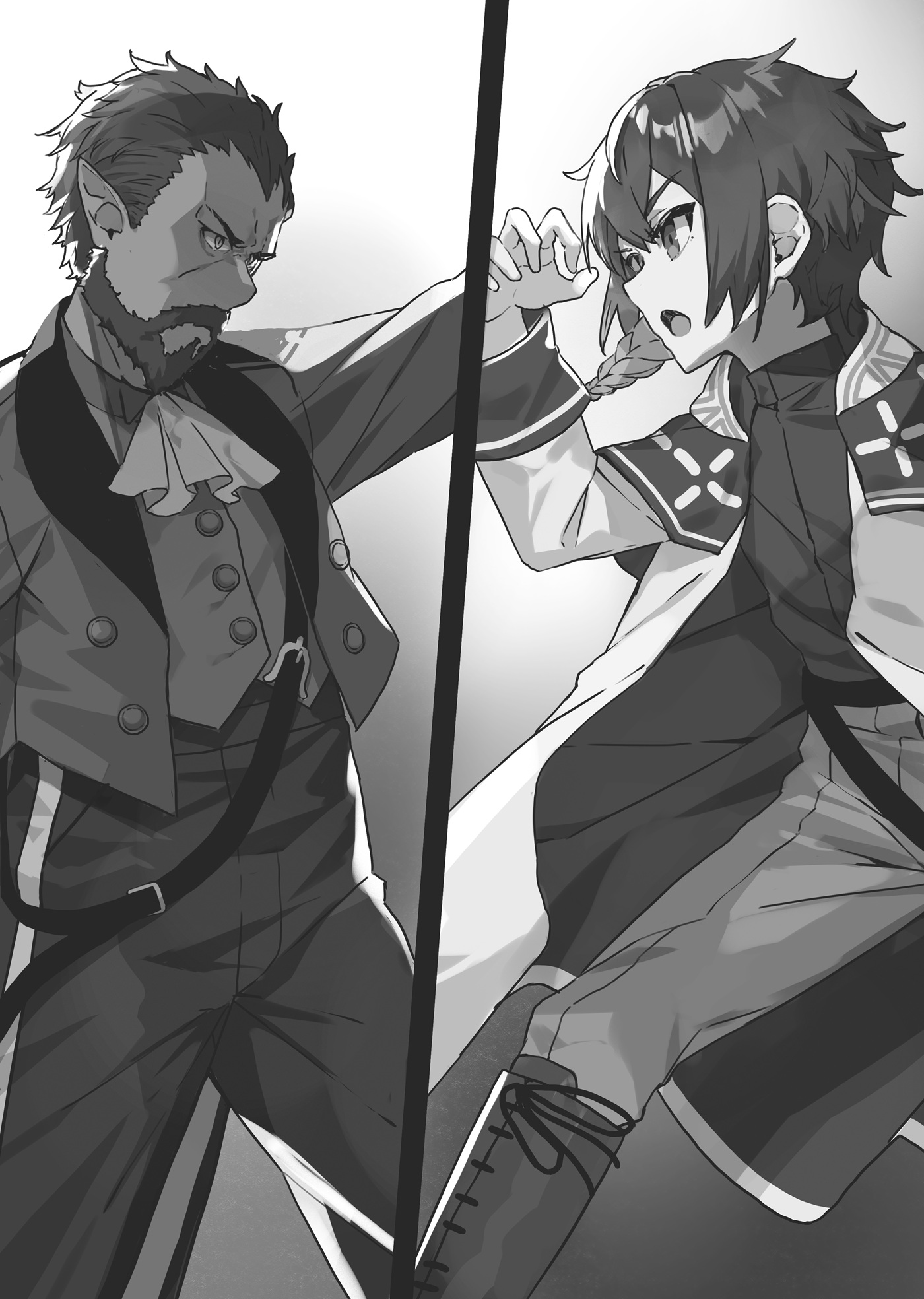
Chapter 17
Chapter 17
Mimi ran through the forest with Delarosa at her side, their pace steady behind Meira, who cut a clear path ahead. The air was thick with tension, every breath sharp with the weight of what they were leaving behind. Belamus hadn’t come with them—he was still out there, facing Lazalit alone. The thought gnawed at Mimi’s resolve, planting a deep, creeping unease in her chest. She trusted Delarosa’s strength, of course, she did. But the quiet certainty Belamus carried, that grounded, protective presence, was something only he could offer. And without it, her fear was harder to silence.
Just as that fear began to take root, Meira’s voice rang out. “Do you see that?” she called, pointing ahead through the trees.
Between the shifting trunks, a pale green shimmer began to take shape, a translucent wall of light, like liquid glass suspended in the air. They were almost there.
“That’s the boundary,” Meira explained, her tone sharp with urgency. “Beyond it, only the Blessed One and one person physically connected to them can pass. No exceptions.”
Mimi squinted at the wall. It looked impossibly thin, but the closer they came, the more imposing it felt. They were maybe fifty meters away now. With every step, a strange heaviness settled over her, an invisible pressure, thick with expectation. Her pulse quickened. Her hands trembled. She didn’t want to admit it aloud, but the truth sat plainly in her heart: she was terrified.
If only Belamus were here… But he wasn’t. He was holding the line so she could move forward. And that meant she had no choice. No one else could do this—not Meira, not Delarosa. The burden was hers alone.
Come on. You have to be brave. If you turn back now, those dwarves will die. All of them. Starved, abandoned… alone. You’re the only one who can change that.
They reached the edge of the barrier. Delarosa stepped forward first and pressed her palm against the glowing wall. It didn’t give way. She clicked her tongue softly and turned back to Mimi.
“Can’t get through alone,” she said in Goblin, voice calm but resolute. “All right. Let’s go, Mimi.”
Mimi nodded. There was no more room for hesitation. She reached out and took Delarosa’s hand. Their fingers locked together, warm, firm, and steady.
“Before you go, one last thing,” Meira said, her tone suddenly grave as she stepped closer. “Once you’re inside, stay close. If you stray too far from each other, Delarosa will be expelled from the inner sanctum.”
Mimi’s breath caught. So, splitting up wasn’t an option. That ruled out any plan to send Delarosa ahead to scout or guard the path while she followed behind. She quickly turned to Delarosa and relayed the warning in Goblin, making sure she understood.
Meira bowed deeply, her expression solemn. “May fortune be with you both.”
Without another word, Mimi and Delarosa stepped forward and passed through the wall.
There was no resistance, no jolt of magic or shimmer of energy. One moment, they were outside; the next, they had simply… crossed over. The barrier that had shimmered so ominously before offered no obstruction now.
“Woooow! We really got through! The wall’s just gone!” Delarosa exclaimed, spinning around to look behind her. “It was totally solid a minute ago!”
Her wide grin and lighthearted awe were oddly comforting. Mimi had been so tightly wound that even this small burst of joy, this reminder that someone beside her felt unafraid, helped ease the iron knot in her chest.
They pressed forward into the grove beyond, and then—
“Ah!” Mimi gasped aloud, stumbling to a halt.
Towering ahead of them was a tree. But not just any tree; this one was colossal. Its trunk alone was broader than a fortress wall, its branches rising like towers into the canopy. She hadn’t been able to see it at all from the other side of the barrier. It hadn’t simply been hidden; it had not even been there. The wall must have concealed more than just entry, distorting vision itself.
“That’s gotta be the Emperor Treant, right?” Delarosa asked, shielding her eyes as she looked up.
“I think so,” Mimi replied, still staring. “They said the cave is somewhere around the roots, so we head there first.”
“Got it!” Delarosa chirped, flashing a fang-toothed grin as she tightened her grip on Mimi’s hand, her voice brimming with confidence and zero trace of fear.
With their goal now unmistakably clear, they began walking toward the base of the ancient tree. The journey was surprisingly peaceful. The path was straightforward: no forks, no tricks, just a slow descent toward the massive trunk. More than that, the area was eerily quiet. There were no monsters, not even the distant howls or rustling of predators. The only living things they saw were small insects and birds, flitting through the branches or buzzing gently in the undergrowth.
It felt… protected.
Eventually, they reached the roots. From up close, the scale of the Emperor Treant was overwhelming. Its base alone could have housed a village. The bark was weathered and ancient, patterned like cracked stone, each groove deeper than a sword’s blade. But there was no sign of a cave—at least, not at first glance.
“There, maybe?” Delarosa pointed toward a wide, dark opening nestled between two massive roots.
Mimi stepped closer, eyes narrowing. “Yeah… I think that’s it.”
Together, they made their way toward the shadowed entrance.
The cave stretched out before them, winding into the earth like a stone throat. Yet it wasn’t completely dark. Strange particles of light drifted lazily through the air, soft, shimmering motes that hovered like fireflies. They cast a gentle, ambient glow that lit the way ahead, making it bright enough to walk without needing a spell.
“All right, let’s go!” Delarosa said brightly, tightening her grip on Mimi’s hand before bounding ahead, her energy undimmed by the shadows.
They stepped inside together, the soft crunch of boots on stone echoing faintly in the silence. For a while, the cave offered nothing but winding paths and the quiet flicker of floating lights. No traps, no monsters, just the rhythmic pace of their footsteps and the low hum of unseen magic in the air.
Several minutes in, Delarosa came to an abrupt stop.
“Wh-What are those…?” she muttered, voice laced with confusion.
Mimi stepped up beside her and froze.
Up ahead, emerging from the cave floor like rising mist, were pale figures. Humanoid in shape but utterly featureless, they stood about sixty centimeters tall. They had heads, arms, legs… but no eyes, no mouths, no faces at all. Ten of them in total, all made from a flawless, chalk-white material that shimmered like porcelain in the cave’s light.
Neither Mimi nor Delarosa could tell if they were hostile, but the tension in the air was unmistakable. And when the dolls began to rush toward them, Delarosa didn’t hesitate.
“Fireball!” she shouted, launching a burning sphere of flame at the closest one.
It soared cleanly, but missed. The white dolls were quick. Far quicker than expected. They scattered, skimming along the floor with uncanny speed, dodging blast after blast. Then they retaliated, and dozens of glimmering arrows of light formed in the air and shot forward in volleys.
They weren’t just fast; they were casting magic.
Mimi recognized the spell instantly. Light Arrows? Nearly identical to the ones Belamus often used, though less powerful. Still, they could hurt.
“Shield up!” she called, throwing a barrier between them.
The arrows struck, but her defense held; barely a scratch got through.
Delarosa didn’t give them a second chance. “Fast Fireball!”
This time, the magic shot forward with blistering speed, almost too fast to track. The white creatures didn’t react quickly enough. One after another, they were struck head-on. The moment the flames hit, their fragile bodies shattered into light and dust.
Their defenses crumbled at a touch. They vanished with a single hit.
Within seconds, it was over. All ten lay extinguished, the cave falling quiet once more.
Delarosa lowered her arms, a puff of steam rising from her fingertips. “Weird little things, huh?” she said, brushing her palms together and glancing around in case there were more.
“Y-Yeah,” Mimi replied softly, her voice strained. She couldn’t hide the slump in her shoulders, nor the way her gaze fell to the floor. Not once during the fight had she moved. Not one spell cast, not one step forward. She’d just… frozen.
So what if I learned magic, she thought bitterly. If I can’t even lift a finger when it counts, what’s the point?
When the battle had started, Mimi had just stood there, hands clenched, heart pounding, completely paralyzed as Delarosa fought alone. The spells she’d practiced, the confidence she thought she’d built… none of it had surfaced when it truly mattered. All she could do was watch, helpless and ashamed.
Next time… I won’t just stand there!
The thought burned in her chest, fierce and determined. One of Mimi’s rarest, most radiant qualities was how quickly she could pick herself back up. Even now, with her confidence shaken, she didn’t let the weight of failure crush her. She took a breath, steadied her nerves, and made a silent vow.
Next time, I’ll fight too. I’ll use my magic properly. I won’t freeze up again.
She straightened her posture, renewed purpose in her step, and followed Delarosa deeper into the cave. This time, she was ready for whatever came next.
Chapter 18
Chapter 18
The clash between Belamus and Lazalit had become a rhythmic, devastating dance of spells colliding midair, bursts of magic lighting up the battlefield with heat and force. Fire, wind, stone, light; every school of magic came to bear, neither combatant holding back. As the duel dragged on, both men began to sense it: their power was nearly equal. Every attack answered, every defense countered. They weren’t just testing each other; they were measuring legacies.
Amid the fierce exchanges, something far more unsettling stirred in Belamus’s mind. The way Lazalit fought… it wasn’t just powerful; it was familiar. The casting patterns, the magic power flow, the nuanced control of spell structure… It wasn’t merely competent. It was specific, and eerily reminiscent.
Yet Belamus knew of no dwarf in this era, or any other, who wielded magic in such a style. Lazalit’s techniques didn’t match anything taught in modern schools. In fact, the only time Belamus had seen anything like it… was in another life.
No. It can’t be. That time is long gone.
Centuries had passed since the age of his previous incarnation. Entire civilizations had risen and fallen in the span of his absence. And yet, here he stood, reincarnated through forbidden arts, his memories intact, proof that time itself could be breached. He had done the impossible. And others had tried as well. He remembered Hereldyne, the sorcerer who had refused death and reshaped himself into something beyond human to cling to life.
It wasn’t unthinkable. With enough power, enough desperation, someone like Lazalit might have done the same. If he truly is from that era, if he has carried his consciousness across time as I did, then who was he?
Belamus combed through his memories, peeling back the layers of his former life. Dozens of disciples had studied under him, but one stood out—Aled Lord. He had been ambitious, brilliant, and dangerously driven. Among the most talented of his students, Aled had craved strength above all and had always seemed willing to pay any price to achieve it. The resemblance now felt impossible to ignore.
His voice dropped, heavy with disbelief. “… Aled?”
For the first time, Lazalit’s expression wavered. His eyes sharpened not with hostility, but with recognition.
“Master Mercles,” he said quietly. “So, you, too, refused death.”
The truth settled over Belamus like a storm cloud. Lazalit—Aled—had survived. Somehow, he had found a way to cross the ages just as Belamus had, abandoning his name but not his ambition. It was no longer a battle between strangers. This was student versus master. Past versus present. And whatever came next, neither of them would walk away unchanged.
Belamus had once believed Aled would mellow with age, that by the time death came for him, he’d have shed that dangerous hunger for power and found peace. It seemed, in hindsight, to have been a comforting delusion.
“Are you really Aled?” Belamus asked quietly, though the answer had already rooted itself in his chest.
“Yes,” Lazalit replied without hesitation. “Though I admit, facing someone I once admired, and as an enemy no less, is… oddly bittersweet.” His tone remained flat, dispassionate, as if speaking about the weather. “Tell me, Master. How did youcross into this era?”
“Reincarnation,” Belamus answered. “A soul-binding ritual. I passed through time in a new body, memories intact.”
“Ah, reincarnation.” Lazalit nodded, almost thoughtfully. “So, you took the noble route. I chose something… more efficient.”
His eyes glinted faintly as he continued. “I’ve survived by possessing others. Over and over, I’ve transferred my consciousness, abandoning one shell for another. I’ve forgotten how many centuries it’s been… hundreds, easily. But I’ve remained myself through them all.”
Belamus stiffened. “You… possessed people?”
Lazalit offered no defense, no shame. “Yes.”
It was clear now. The truth of his survival wasn’t elegant or redemptive—it was brutal. Aled had preserved his soul by devouring the lives of others. Each step forward meant the erasure of another human being, their mind overwritten, their story ended. This was no natural longevity, no clean extension of life. It was parasitic. And it was forbidden.
The technique Aled had used was one of the vilest spells in the ancient tomes, outlawed not for its danger, but for its utter cruelty. Belamus had studied it once, long ago, only to bury it again. To use it would be to forfeit one’s soul, he had believed. And now here stood his former disciple, hollow-eyed proof of what that path became.
In that moment, the last remnants of hope, of the man Aled might have become, vanished.
“I was wrong about you,” Belamus muttered. “I thought, with time, you’d change. That you’d grow beyond your obsession.”
“Why did I use forbidden magic?” Lazalit echoed, as if answering a rhetorical question. “Because I had to. I wasn’t the strongest among your disciples. I tried. Gods, how I tried. But I hit a ceiling. And when I did, I chose not to stop there.”
His face remained utterly composed. Aled had never been one to wear his emotions openly, and that, too, had not changed. No shame. No guilt. Just logic.
“I continued using forbidden magic, again and again,” Lazalit said, his voice calm, disturbingly measured. “And yes, I did become stronger. But not enough. Not invincible. I needed more power. Something overwhelming. That was when I turned my attention to the dwarves.”
Belamus narrowed his eyes. “What are you talking about?”
“You already know, don’t you?” Lazareth continued, as if giving a lecture. “When dwarves die, their bodies crystallize into magic stones. And the higher the quality of the stone, the more magical power it holds. You taught us that yourself. But here’s what I’ve discovered: under the right conditions, those stones can be… refined. Enhanced. I experimented, and after several trials, I found two reliable methods to produce high-grade magic stones from dwarves.”
The words struck Belamus like a knife. “You experimented?” The implication was clear: This wasn’t theory. It meant dwarves had already died for it.
Rage began to coil in his chest.
“The first method is obvious: kill a powerful dwarf. The stronger they are, the purer the magic stone becomes. But this has limits. Truly powerful dwarves are rare. And I needed more. I needed a way to mass-produce high-grade stones.”
Belamus’s thoughts flashed to Kuusha, Mimi’s dwarven attendant. Her magic stone had been unusually potent. It had struck him as odd at the time, but now the pieces clicked into place. Lazalit—no, Aled—was telling the truth.
“So, I kept testing,” Lazareth continued. “And I discovered a second method. Far more effective. Suffering.”
His voice did not change. He didn’t flinch. He simply recited the atrocity as if it were nothing more than a scientific observation.
“The more pain a dwarf feels before death, the greater the quality of the stone. Especially starvation. Prolonged, hopeless starvation refines the soul into a perfect crystalline vessel. And so, the plan took shape: starve a large number of dwarves to death, extract their stones, and absorb the mana. With enough high-quality stones… I will become unstoppable.”
The words hung in the air like poison.
In that instant, everything made sense. Every unanswered question, every shadow cast over the recent chaos. Belamus saw the pattern. The movement to erase the Blessed One’s history in the Kingdom of Crystia… it hadn’t been political noise. It had been part of this plan. The story of a dwarf who had manipulated the king into erasing sacred records… it had to be Aled. And when that body failed, he had taken another. The man now known as Chancellor Lazalit had installed himself at the heart of the kingdom, holding its reins from the shadows.
It was a plan rooted in nothing but selfishness and cruelty. No grand ideal, no twisted logic, just pure, calculated evil in the pursuit of power. And Belamus realized, with a sharp and bitter ache, that he had made a terrible mistake.
I taught him magic. I gave this monster the tools he needed to do this.
Regret surged through him, not just as a teacher, but as the one who had once believed in Aled’s potential. That belief had festered into something monstrous. And now, no one else could stop it.
This is my burden. My responsibility.
“I can continue this cycle as many times as I need to,” Lazalit said calmly. “If I fail now, I’ll simply move on. I’ll find another body. Another name. Another plan. What was interrupted today can be resumed tomorrow. And next time, I’ll make sure no one gets in my way.”
He paused, then added with what almost sounded like sincerity, “Master… this has nothing to do with you. The dwarves are irrelevant to your legacy. If you walk away now, I won’t stop you. I don’t want to kill you.”
Belamus didn’t hesitate.
“It’s the master’s duty to stop a disciple who’s lost his way. Or have you forgotten that?” Belamus said, his voice steady. The words hit with quiet finality, sharp as any blade.
For the first time, Aled’s expression shifted. His face, usually so composed, flickered with something close to sorrow, just for a moment.
“That’s a shame,” he whispered.
With that, the time-worn bond between them was severed.
Across centuries, across lives, the master and his fallen student collided, magic against magic, conviction against corruption. There would be no turning back.
Chapter 19
Chapter 19
The battlefield erupted as Navasha and her allies clashed with the royal special forces. Six soldiers stood on the enemy side. It had been five at first, then one defected. With Rumalus’s departure, their numbers had dropped to four, but when the chancellor set out from the palace, two more had been pulled into the operation to reinforce them. So it was six against five.
On Navasha’s side were the primary fighters: herself, Medello, Liza, Gregald, and Rumalus. The rest of the Gagagamoor group—Rugen and the others—were present, but none had the strength or training to shift the tide in open combat.
Rumalus stepped forward, facing down the unit he had once called comrades.
“Are you out of your mind, Rumalus?” one of them barked. “What about your family? You’re just going to let the kingdom fall into chaos?”
“If we don’t act now,” Rumalus said, voice steady and firm, “then that chaos will find them eventually. You’re the ones who need to wake up. Stop following the chancellor before it’s too late.”
“Tch… Sounds like you’ve already been brainwashed,” Linden growled, clicking his tongue in frustration.
Navasha took a step forward, sword flashing in her hand with easy grace. Her stance was relaxed, fluid, but her eyes were sharp, focused, and utterly unshaken. She gave a dry grin. “So, he’s the big bad, huh? Well, I’d say we'd better knock you guys down fast and go help Belamus. Not that he needs it, probably.”
Her opponent was none other than Linden himself, captain of the special forces. In his left hand, he held a short sword; in his right, a sleek, high-performance firearm, much more advanced than the crude prototypes they’d seen in Rugen’s lab. He raised the gun in a flash and fired a single, pinpoint-precise bullet aimed dead at Navasha’s forehead.
The shot tore through the air at blinding speed, but Navasha was faster.
She twisted aside with barely a flick of her body, letting the bullet pass harmlessly by. Her movements were casual, but calculated. She had studied firearms before, so she knew what they could do, and more importantly, what they couldn’t. Long-range, high-speed… They were dangerous, but limited. She needed to close the distance.
She lunged. But just as she moved, a second soldier cut in from the right, blade swinging in a sharp arc. Before he could land the strike, Liza intercepted, stepping in smoothly with her own sword to parry the blow.
“Fireball!” Medello shouted, her voice cracking with urgency as she hurled the blazing spell forward, the heat reflecting the burst of courage surging through her.
The moment the enemy’s stance broke, Medello acted. A sphere of flame exploded from her hand and crashed into a soldier’s chest, sending him flying. When he hit the ground, he didn’t get back up.
One down. Five to go.
One of their own had already fallen, but Linden didn’t flinch. Without a word, he chambered his next round and fired again, the barrel snapping toward Navasha with deadly precision.
She dodged with ease, her body flowing like water around the bullet’s path. In the same movement, she closed the distance, blade flashing out in a sudden inward arc that forced Linden into a brutal melee. Steel clashed against steel, the sound sharp and heavy in the thickening air.
The other special forces soldiers moved to assist their commander, but Liza, Medello, and Gregald intercepted them immediately, blocking their path and locking them into separate duels. In the chaos, a one-on-one battle emerged between Navasha and Linden—uninterrupted and unavoidable.
Realizing he couldn’t maintain distance, Linden made a split-second decision. He tossed the gun aside, drawing a short dagger with his now-free hand. Twin blades glinted in the dim light. He dropped into a low, fluid stance, his entire body coiling into a weapon.
Their clash resumed with renewed violence.
With two blades now in play, Linden’s assault doubled in speed. His strikes came from every angle: feints, counters, tight arcs designed to overwhelm by volume. Navasha was fast, but even she began to lose ground. She gritted her teeth as she shifted into defense, her arms straining to parry the relentless onslaught.
This guy’s no joke, she thought, pushing back hard.
Linden was every bit the elite operative he was rumored to be. His dual-wielding technique was refined, surgical, and relentless. Navasha had faced countless opponents before, but this was one of the few who forced her onto the defensive. She couldn’t rely on brute force, momentum, or flashy counters; this was a fight of inches.
A sharp sting across her cheek snapped her into focus. One of Linden’s blades had grazed her face, drawing a thin line of blood. It wasn’t deep, but it reminded her just how narrow the margin for error had become.
She couldn’t stay on the defensive. So she shifted tactics.
With a sudden snap of movement, she kicked at her opponent’s legs, trying to throw him off balance. It was an unconventional strike, and it caught him by surprise, but not enough. Linden slipped back smoothly, avoiding the trip and resetting his stance with disciplined calm.
For a moment, the blades fell still. Both fighters stared each other down, breathing hard, reading every twitch and shift of weight.
He’s strong, no doubt about it… Navasha narrowed her eyes. But he’s not Belamus.
She had fought Belamus countless times, sparring matches that left her breathless, bruised, and always a little stronger. Compared to him, Linden’s form, while deadly, lacked something deeper. That ineffable pressure. That bottomless well of technique.
This fight was winnable.
Navasha exhaled, raising her sword not in her usual defensive posture, but high above her head, blade poised for a decisive strike. Her body stilled, every muscle tightening, focus narrowing to a single point.
Linden moved.
She watched him approach. Every step, every twitch of his shoulders, the way his blades shifted… She saw it all.
Then she struck. With all her strength, all her training, and all her belief, she brought the sword down in a single, perfect arc.
Linden couldn’t dodge in time.
Navasha’s blade came down like judgment, slicing into his shoulder with brutal precision. The force of the blow drove him to the ground, blood blooming rapidly beneath him. He gasped but didn’t cry out, his expression twisted in pain as he clutched at the wound. He wasn’t dead, not yet, but he would be soon enough if left unattended. The blood loss was already severe.
Navasha held her stance a moment longer, breaths shallow, watching for any hint of movement. When it became clear her opponent wouldn’t be rising, she stepped back, eyes scanning for the next threat.
If she’d hoped Linden’s defeat would rattle the others, she was quickly disappointed.
The remaining special forces soldiers didn’t falter. No hesitation. No panicked glances. They simply shifted their formations and prepared to continue the fight. They were professionals, well-trained and deeply disciplined. Losing their captain only made them more focused.
Navasha gave a sharp, feral grin. “Tch… Still got guts, huh? Fine by me. Let’s see if you can handle this, ’cause I’m taking all of you down.”
“Leave the support to me!” Medello called out, stepping up behind her with fire already gathering in her hands.
“Y-You’ve got me too! But man, battle’s still terrifying…” Gregald muttered as he took his position, voice trembling but feet steady.
Together, they surged forward into the next phase of the fight, blades flashing, magic flaring, the momentum now fully in their favor. The fall of Linden had shifted the rhythm of the battlefield, and Navasha, blade stained and stance solid, was already moving to break through the next line.
Chapter 20
Chapter 20
Mimi and Delarosa continued deeper into the cave, their path unusually smooth. No traps. No serious resistance. The enemies they encountered were minor at best, strange little creatures that Delarosa dispatched without breaking a sweat. Her fireballs cut through the darkness like streaks of sunlight, clearing the way effortlessly.
Despite the progress, Mimi’s expression had grown increasingly troubled.
“Hmm…” she mumbled, arms folded, brow furrowed.
“Don’t worry so much,” Delarosa said casually, tossing a glance over her shoulder. “I mean, I’m handling the enemies, right? So, what’s the problem?”
“It’s not that I don’t appreciate it,” Mimi replied quickly. “But I still haven’t managed to use magic properly. I freeze up every time something attacks. I just get too scared to even think.”
She had sworn to herself that next time would be different, that she wouldn’t stand motionless again. But even after that vow, even with her magic ready at her fingertips, her fear kept clamping down on her heart. And Delarosa’s flawless performance didn’t help. It only made her feel more useless.
“I get it,” Delarosa said with a shrug. “But hey, if I’m taking them out fast, that means we’re safe. That’s what matters, yeah?”
“I know that,” Mimi sighed. “But… I still hate this feeling. Like I’m just being protected, not contributing at all. It’s frustrating.”
Before Delarosa could answer, another enemy emerged from the shadows.
A strange, pure-white dog trotted into view. It was small, silent, and faceless, just like the doll-like humanoids they’d fought earlier. It had no eyes or mouth, yet it gave off an undeniable sense of intent. Something was unsettling beneath its cute, jerky movements. A moment later, it confirmed their suspicion, launching a glowing arrow of light, a Light Arrow spell, straight toward them.
This time, Mimi didn’t freeze.
Now!
She thrust her hand forward and focused with everything she had. The air around her trembled as she conjured her spell: Rock Blast, a direct earth-attribute projectile.
A jagged stone shot from her palm, streaking through the air and slamming into the white creature’s body. The impact shattered it instantly, its form dissolving into motes of light.
“I-I did it!” Mimi gasped. “I actually hit it!”
Her eyes widened with disbelief, then joy. She bounced in place, a delighted squeal escaping her lips. “It worked! It actually worked!”
Unfortunately, her celebration was short-lived. Two more of the faceless dogs darted forward out of the darkness. In her excitement, Mimi had let her guard down, and now both creatures lunged for her, claws extended.
“Watch out!” Delarosa shouted, her voice ringing out sharp and urgent. In a blur, she stepped in front of Mimi, fire already dancing across her fingertips. A searing blast erupted: Fireball, fast and hot. It collided with the attackers mid-leap, incinerating them before they could make contact.
Mimi dropped to the ground with a startled gasp, her legs giving out beneath her as the danger passed. Her heart still pounded from the suddenness of the attack and the narrow escape.
“You can’t let yourself get too cocky,” Delarosa said matter-of-factly, lowering her hand after casting the protective Fireball. “Stuff like that happens when you do.”
Mimi could only nod, her voice caught somewhere between embarrassment and relief. “Right… I know.”
Still, despite the scare, there was a quiet pride blooming in her chest. For the first time, she had cast a spell successfully and defeated an enemy. The feeling lingered like a faint warmth on her skin, even as the aftershock faded. Though she wasn’t physically strong, Mimi had always been sharp and thoughtful, the kind of girl who read everything and remembered it. But she’d long underestimated herself, her own value. That low self-esteem had kept her believing she was only ever going to be protected by others, never the one doing the protecting.
Now she had proof, real, tangible proof, that she could fight back.
As they continued deeper into the cave, the narrow, dim passage suddenly opened into a breathtaking chamber bathed in soft, otherworldly light. Dozens of flowers bloomed across the floor in vivid colors: blues, purples, reds, and glowing whites. The air shimmered with magic, and the petals swayed as if touched by wind, though the chamber was perfectly still.
“Whoa… it’s beautiful,” Mimi whispered, eyes wide.
“Incredible,” Delarosa murmured beside her. “Hard to believe this is inside a cave.”
“It shouldn’t be possible,” Mimi added. “Plants need sunlight to grow…”
Still, the evidence was right in front of them. This lush bloom, tucked beneath the earth, defied logic. Still, considering they were beneath the roots of the Emperor Treant, maybe ordinary rules no longer applied.
As they stepped carefully between the blossoms, they came upon something even stranger: a tree. Smaller than the massive one above, but still large, and somehow… familiar.
“A tree?” Mimi blinked. “But this cave is under a tree… Why would there be another one here?”
“Well, the big one is absurdly huge,” Delarosa replied. “Guess it’s not that weird if part of its root system sprouted something else.”
Mimi squinted up at the branches. “Hey, look, it’s bearing fruit. Dwarves don’t eat fruit much, but humans and goblins do, right?”
“Yup. I’ve seen stuff like that before, though not exactly that. Looks kinda tasty.”
Without hesitation, Delarosa climbed the trunk with practiced ease and plucked a fruit. It was about the size of her palm, smooth and radiant with a shimmering rainbow hue. It practically sparkled in the light.
“Pretty, huh?” she said, sniffing it carefully. A moment later, her face contorted. “Ugh, gross!”
She hurled it away instinctively. The stench had been sharp and revolting, completely at odds with its jewel-like appearance.
“Looks delicious,” she muttered, sticking out her tongue. “Smells like rotten eggs. Definitely not edible.”
“Really?” Mimi asked, picking up another and bringing it cautiously to her nose. But to her surprise… nothing.
“I don’t smell anything,” she said, puzzled. “Maybe it only stinks to certain species?”
“Could be. Dwarves don’t eat fruit, right? Maybe your nose just doesn’t pick it up,” Delarosa said with a shrug, still fanning the air in front of her nose as if trying to wave away the memory of the stench.
“I can’t smell anything… but it’s so pretty,” Mimi murmured, turning the rainbow-colored fruit over in her hands. “It feels like a waste to just leave it. Maybe I’ll take it with me.”
“What? No way! You should totally toss that thing!” Delarosa objected instantly, waving her arms in protest. “That stuff reeks like death!”
Mimi had already pocketed it with a little smile, unfazed by the warning. Whether it had value or not, something about it felt worth keeping.
They pressed on.
As they ventured deeper into the glowing, flower-filled cavern, the enemies grew stronger. And it wasn’t just a feeling; their size, speed, and resilience all increased, step by step. The once-small, doll-like enemies were now being replaced by larger forms, their movements sharper, their attacks faster.
“They’re definitely getting bigger,” Mimi said, eyes narrowing at the latest one on the path ahead. “You think we’re still okay?”
“They’ve gotten a bit tougher,” Delarosa replied casually, conjuring a flicker of flame in her palm without even breaking stride, “but it’s still nothing I can’t handle.”
There was no trace of worry in her voice, just calm confidence. Watching her, Mimi felt a deep swell of admiration. Ever since they’d entered the cave, she’d seen firsthand just how fast Delarosa could cast, how cleanly her magic struck, how precisely she controlled her power. At first, Mimi had harbored quiet doubts: Could Delarosa really handle this alone? Wasn’t she being overconfident? But now she knew better. And she felt guilty for ever having questioned it.
That trust would be tested again sooner than expected.
Delarosa suddenly slowed, eyes narrowing at a figure emerging ahead. “Hmph. This one’s new…”
Standing in the center of the path was a creature shaped like a horse: tall, sleek, and eerily still. Like every enemy they’d faced so far, it was pure white, faceless, and completely silent. Its body was the size of a real stallion, far larger than the humanoid and canine constructs they’d encountered earlier.
Mimi braced herself. If size really does equal strength in this place, then this thing’s a problem.
Still, it was alone. The others had attacked in groups, and that made a difference. A single strong foe was better than a swarm of weak ones.
“Fast Fireball!” Delarosa shouted, snapping her arm forward as the incantation left her lips. A burst of fire launched through the air and slammed directly into the creature’s head.
It didn’t fall.
The blast staggered it, singeing its sleek white surface, but not destroying it. Instead, it reared up on its hind legs, front hooves slicing through the air like giant hammers. If it had been a real horse, Mimi thought, it might have cried out in anger. But the beast had no mouth, no sound, just raw, silent fury.
In the end, though, the white horse was fast, but Delarosa was stronger.
No sooner had they caught their breath than the next threat emerged from the shadows: a towering white bear, just as faceless and silent as the rest of the cave’s inhabitants. It stood nearly twice their height, its massive frame shifting with unsettling stillness. It wasn’t some wild beast driven by instinct. No, this one understood magic.
Before either of them could react, a brilliant spear of light took form in the air: Shining Lance. The bear hurled it without hesitation, a blinding projectile tearing through the gloom, aimed straight at them.
Delarosa didn’t flinch. In that split second, she measured everything: the magical power density, trajectory, and destructive force. She knew her barrier wouldn’t hold, not this time. And dodging might save her, but Mimi stood too close. There was no time to warn her, no time to pull her away.
So, she didn’t defend.
She attacked.
“Dragon Flame!” she shouted, her voice sharp with power.
The air split open. A roaring blaze burst forth, coiling into the form of a great dragon made of flame. Its incandescent wings unfurled, its jaws opened wide, and with a thunderous rush, it engulfed the bear’s lance mid-flight. Light shattered into sparks as fire consumed magic, and the dragon didn’t stop there. It surged forward, smashing into the white beast and obliterating it in an instant.
Silence fell.
Mimi stood rooted to the spot, eyes wide with wonder. That had been no ordinary spell; it was devastating, majestic, alive. Her heart pounded in her chest. “Th-That was… incredible,” she whispered.
Delarosa let out a slow breath, shaking soot from her fingertips. “Heh. You okay?” she asked with a casual grin, as if she hadn’t just conjured a dragon from thin air.
Mimi nodded, still stunned. No dwarven weapon she’d ever seen, no matter how refined or intricate, could have done what Delarosa had just accomplished. Magic, real magic, was something else entirely.
“I used it without thinking…” Delarosa muttered under her breath. “That spell drains way too much magic power. I’ve been trying to avoid using it unless absolutely necessary.”
She regretted it immediately. If her magical power ran dry, she’d be out of the fight completely—that was the hard rule. No more spells, no backup. Which was exactly why she’d been conserving it. There was still a good chance they’d run into something really dangerous up ahead, and if she wasn’t ready for that, it could mean total defeat.
In the past, she wouldn’t have cared. She would have gone full throttle, blasting away without a second thought. But now… now she knew better. She’d grown just enough to think about things like risk and long-term survival. A little wisdom, perhaps.
“This cave just keeps going, huh?” she sighed. “How far in does it go, anyway?”
They’d been inside for hours already, but the passage stretched on ahead, dark and winding with no end in sight. Even with all her efforts to save energy, there was a real danger she’d run out of magical power before they reached the end.
Part of her wanted to call for a break. A short rest, just enough to recover. But outside, Belamus and the others were still locked in battle. Every second they spent in here was a second too long, and Delarosa knew it. The faster they cleared this place, the sooner they could go back and reinforce their allies.
“I wonder how much farther we’ve got…” Mimi’s voice wavered as she looked around the endless tunnel. “Everything’s starting to feel more dangerous. I really hope this ends soon…”
She wasn’t imagining it, either; the enemies were still getting stronger. If Delarosa hadn’t even been using her full power, maybe they would still be in control of the situation. But what if things escalated? What if something came after me? Could I really survive if I became the target?
I don’t want to be a burden, she thought. If someone like Delarosa had to protect me in a serious fight, I’d just slow her down…
The further they went, the heavier her dread became. She didn’t want to run into anything worse than what they’d already faced. Not now. Not ever.
Still, the two of them pressed on.
Eventually, the enemy presence began to thin. Fewer attacks, less resistance. Mimi began to relax, just a little. Maybe I was just being paranoid… The thought offered a fragile kind of comfort.
They stepped into a wide, open chamber. At the far end of the room, a staircase rose up to a wooden platform. Above it loomed a colossal wooden face, carved into the shape of an old man. The grain of the wood curled like wrinkles, and a thick beard flowed down from its chin. It looked almost… human.
Mimi’s eyes widened. “I-Is that… is that how the Emperor Treant talks? Through that face?”
Her nerves were showing again, but she forced herself to push forward. “So, this really is the last stop? Finally. We actually made it. All right… let’s just get this over with.”
She cupped her hands and called out to the towering visage, “Emperor Treant, sir!”
Silence.
No reply. Nothing stirred.
She tried calling out again, louder this time—but still, nothing.
“Maybe… maybe it can’t hear us?” Mimi tilted her head, squinting up at the towering face. “Do we have to go all the way up those stairs to reach it or something?”
Her voice faltered as she looked at the steps. “That staircase looks… absurdly long…”
At a glance, there had to be over a hundred steps. Maybe more. Mimi let out a deflated sigh. She’d already walked so far, and her stamina had been wearing thin for a while now. The thought of dragging herself up another endless climb made her legs ache just imagining it.
Still, there wasn’t much choice. Shoulders slumped, she took a reluctant step forward. But before she could even reach the base of the stairs, something massive dropped into her path.
Thud.
A hulking white figure landed between them and the staircase, just like the other enemies they’d encountered along the way, but this one was on an entirely different scale. Nearly three meters tall, its pale body resembled a humanoid doll, smooth and eerily featureless. In its right hand, it clutched a staff the same shade of ghostly white—an unmistakable signal of magical prowess.
“A white giant…” Delarosa murmured, narrowing her eyes. “Looks tough.”
Just like that, she gave it a name. A final enemy, perhaps.
“All right, Mimi. Stay back.” Delarosa said firmly, her voice calm but edged with the kind of seriousness that left no room for argument.
“O-Okay!” Mimi stumbled a few steps backward without protest. One look at that thing and she knew this wasn’t a fight she could jump into. If she tried, she’d just get in the way. Better to stay put and trust Delarosa to handle it.
The air shifted. Their final battle had begun.
It’s strong, sure. But so am I. I can take it.
Delarosa squared her stance, eyes locked on the giant. No hesitation. No fear. The confidence she carried wasn’t arrogance; it was the hardened calm of someone who knew her own power.
The white giant raised its staff high. A pulse of energy shimmered around its head, and then, in a blinding burst, several spears of light materialized above it. One by one, they launched toward her, brilliant and fast.
Delarosa reacted instantly, conjuring a glowing barrier just in time. The arrows slammed into her shield and fizzled into harmless sparks.
Her counterattack was immediate: a swift, precise Fireball. But the white giant raised its own barrier, mimicking her move with flawless timing.
Its magical skill was no joke. It was strong, dangerously strong. But even so, Delarosa could tell: It’s good. But I’m better.
It had only taken a few exchanged spells for her to gauge her opponent’s ability. It was powerful, yes, but not beyond her. The real problem was her condition. She’d been burning through her magical power while traversing the dungeon. And now, with her reserves partially drained, the edge she held might not be enough.
From that point on, it became a battle of spells.
Delarosa weaved through volleys of low-and mid-tier magic, sometimes blocking spells outright, sometimes slipping between them with agile precision. She returned fire with the same level of spells, all the while probing, calculating, and watching for an opening.
It wasn’t about raw power now. It was a chess match.
Hmph… this thing hardly moves. And it’s not using anything too strong either. No big openings, no wild attacks. Should I just hit it hard and force it down?
Even with her magical power partially depleted, she could still unleash Dragon Flame three more times. And the giant’s barrier didn’t seem capable of withstanding the full force of that spell, not entirely. If she fired off three blasts in a row, there was a good chance she could end the fight.
Still, it wasn’t the safest play. It was reckless, really. The better move was still to wait, create an opening, and strike when its guard was down. That was the surest path to victory.
She hesitated. And in that brief pause, the white giant moved again. Several arrows of light blinked into existence, then shot toward her all at once.
“Back to that trick again?” Delarosa narrowed her eyes, already summoning her barrier. “Fine. Bring it.”
She raised her hand and conjured a gleaming wall of force. But as the arrows flew closer, something felt… off.
Wait… those aren’t normal Light Arrows. Something’s different. Are they—
She didn’t finish the thought. The arrows passed straight through her barrier. And hit.
“What—?!” Her eyes went wide. “They phased through?! But, huh? I felt them hit, but… it didn’t hurt?!”
The surprise of the impact was nothing compared to what happened next: The arrows didn’t disappear. They stayed lodged in her body, glowing faintly, eerily, like ghostly needles of light. And then she noticed the threads. Thin, shimmering threads connecting each arrow back to the white giant, like strands of spun sunlight.
It didn’t hurt… yet. But something about it was deeply wrong. Grimacing, Delarosa grabbed one of the arrows and tried to pull it free.
Wait… something’s not right. I’m… losing strength. No… no, it can’t be—
Are these things draining my magic power?!
Panic surged through her. She yanked harder, ripping the arrow free. Then another. Then another.
There were more than ten. It took precious seconds to tear them all out, and in that time, she felt her magic bleeding away. Her limbs trembled. The warmth of power that usually flowed through her was fading, vanishing as water poured into sand.
Just moments ago, she’d had enough to fire off Dragon Flame three times. Now she was down to one.
The giant stood tall and silent, feeding on her stolen mana, swollen with magical energy.
Delarosa clenched her jaw. She didn’t need to say anything aloud; she knew.
The tide had turned. And not in her favor.
“Grrrgh… I’ll just have to land a direct hit, no matter what!” Delarosa clenched her teeth, her voice a growl of frustration and resolve as she glared at the looming giant.
Determined to break through and land her most powerful spell head-on, Delarosa steeled herself. She couldn’t afford hesitation, not when a single, well-timed strike could make or break the course of battle.
She held her breath and watched the enemy’s movements with razor-sharp focus. The white giant unleashed a barrage of spells—Light Arrow, Shining Lance, and more—but she danced between them, narrowly evading each one by a hair’s breadth. A magic barrier would have made it safer, smarter, even. But she chose to take the risk, conserving every ounce of magic power she had left.
Delarosa wasn’t just a spellcaster; she had trained her body, too. At Belamus’s insistence, she’d taken up physical training alongside her magical studies. “A mage who can move will always outlast one who can’t,” he’d told her. And he’d been right. While she could enhance her body with spells if needed, she’d worked hard to make sure she wouldn’t have to.
This time, conserving magical power took priority, so she didn’t use any body enhancement spells. She relied solely on her own speed and agility. Circling around swiftly, she slipped behind the white giant before it could react. In fact, it didn’t react at all. The creature didn’t move, didn’t turn, didn’t so much as twitch.
Seriously? That easy? I should’ve tried this from the start…
Kicking herself for not seeing the opportunity earlier, she gathered every last drop of her remaining magic power. This would be her final, desperate shot: her strongest spell, fired point-blank from behind.
“Dragon Flame!!!” Delarosa screamed, hurling the spell with every last shred of mana, her voice raw with desperation and defiance as the inferno erupted from her hands.
There was no way the giant could block an attack from behind—or so she thought.
Unfortunately, the blast struck something, an invisible wall. A rear barrier? The white giant had been maintaining a magic shield on its back the entire time. Delarosa’s Dragon Flame tore through it eventually and slammed into the giant’s body, but the shield had absorbed just enough of the impact to dull the spell’s force. It wasn’t enough to finish it off.
The giant turned at last, its gaze cold and towering as it loomed over her.
Delarosa didn’t need to check; she already knew. She had no magical power left.
Oh… oh, crap.
Her heart clenched. She was out of spells, out of options, and completely at her opponent’s mercy.
Chapter 21
Chapter 21
Belamus and Aled were locked in a fierce exchange of high-level magic, each spell clashing against the next in bursts of light and thunder.
“It’s been a while,” Aled remarked with a casual smile, as if they weren’t in the middle of a battle. “It’s rare these days to find someone who can match me spell for spell. Magic’s fallen quite far since… well, since that incident.”
Despite the ongoing duel, neither of them had gone all out yet. There was still a level of restraint in their movements, a quiet, measured assessment of strength.
That incident. Whatever had caused the decline of magic, Aled clearly knew more than he let on. Belamus felt a twinge of curiosity, a desire to ask, but now wasn’t the time. He pushed the thought aside.
Aled fought primarily with earth-based magic, just as he had in the era of their past lives. Whether it was a coincidence that Lazalit’s body, a vessel Aled had now possessed, also excelled at earth magic, or if the possessor’s affinity overrode the host’s, was still unclear.
“Let’s turn things up a bit, shall we?” Aled’s voice dropped into a more serious tone. “Black Golem.”
He summoned them with ease, towering magical constructs, self-moving earth elementals crafted from spell-forged stone. Black Golems were among the most powerful of their kind, requiring not only immense magical energy but intricate control and precision to create.
Each one stood nearly three meters tall, their bodies pitch-black, dense, and heavy, as if obsidian had come to life. Aled conjured three of them in a row and didn’t so much as break a sweat.
His magic power reserves are monstrous, Belamus thought grimly. In terms of raw magical power alone, he may even surpass me.
Fortunately, magic battles weren’t decided by magical power alone.
The destructive force of a spell came from how much magical power one could channel into it, yes, but spellcasting speed mattered just as much. The faster one could shape the image and speak the incantation, the faster the spell took form. And then there was knowledge.
To counter an opponent’s spell effectively, a mage needed to know exactly which one to cast in response. And the broader their arsenal, the more options they had in the heat of combat.
That was why Belamus had once been called the Great Sage. In his past life, it wasn’t just his vast magical repertoire that had earned him the title; it was the depth of his knowledge, the way he could adapt and outthink his foes in any situation. He’d faced others before who had greater magical power reserves or faster casting speeds. They had been formidable, no question, but Belamus had overcome them all, not through brute strength, but through mastery.
Black Golems are powerful, yes, but they’re not without their flaws. And once you know how they work, breaking them isn’t all that difficult.
Every golem had a core, a magical nucleus that served as its heart. Destroy that, and the entire construct would collapse. Simple in theory. In practice, not so much. The core was buried deep within layers of rock, and in the case of Black Golems, that rock was magically reinforced to the point of absurdity. Hardened to its absolute limit through multiple enchantments, it was nearly impossible to shatter by brute force.
If brute force won’t work… there’s always another way.
All three Black Golems lunged at Belamus in perfect unison, massive arms swinging down like hammers. He knew a magical barrier wouldn’t hold up, not against this level of concentrated force. Instead, he activated a spell to enhance his physical abilities and slipped through the hammers’ onslaught with fluid precision.
“Magic Search,” Belamus murmured, his voice low and focused.
His eyes lit up with a sudden, radiant glow. The spell allowed him to see the magical structure of the golems—every layer, every enchantment woven into their stony frames.
Four enchantments, all stacked together: one to resist physical damage; one to deflect magic; one to lighten the rock and make it faster; and one to grant regenerative healing when damaged.
“Release Dispel,” Belamus uttered the command with quiet authority. It was a simple incantation, but devastating in effect. Belamus began stripping the magic from the golems, unraveling their spells one by one. Most mages couldn’t dispel what they didn’t understand, but Belamus? He understood everything.
Even as the golems attacked, he moved with sharp precision, dodging effortlessly while dismantling their enchantments. First, the magical resistance fell, then the regeneration. With their protections stripped away, they were no longer formidable constructs, just animated slabs of enchanted rock.
Belamus raised his hand. “Shining Lance.”
A beam of searing light burst forth, piercing the exposed core of the closest golem with pinpoint accuracy. The spell wouldn’t have even registered against the original defenses, but now, with everything peeled away, it struck true.
The golem shuddered. Then collapsed, motionless. Its core shattered, its magic snuffed out.
One down.
The others fell in short order, disabled with the same ruthless efficiency.
From a safe distance, Aled watched the display with an unreadable smile.
“Well, well. That’s my master for you. I pour all that magical power into my Black Golems, and you dismantle them like it’s nothing. Truly, I wouldn’t want to be on the receiving end of your spells.”
His tone was light, amused. Not a trace of frustration or panic, despite the high-level magic he’d just seen destroyed. Even with the heavy magical power cost of summoning those golems, Aled still looked as calm and composed as ever.
Belamus had always known Aled wasn’t the type to show emotion easily, but even so, he’d expected at least a flicker of unease after losing the Black Golems. Aled’s steady calm unsettled him more than any spell could.
He should be rattled. At least a little. So why isn’t he?
Aled answered the question before Belamus could dwell on it.
“Perhaps it’s time I used my trump card,” he said smoothly, his voice almost amused. “You’re not the kind of opponent I can afford to hold back against.”
He reached into his cloak and pulled out five small stones, each one pulsing faintly with an eerie inner glow.
Magicite.
Even at a glance, Belamus could tell they were high-grade. Refined. Potent. And disturbingly familiar.
“I spent a long time experimenting,” Aled continued, almost wistful. “Trying to determine how a dwarf must die to produce the highest-quality magicite. These… are the results of that research.”
Belamus’s expression darkened.
“You bastard.” Belamus’s voice dropped to a growl, quiet but laced with venom, his gaze fixed on Aled with a cold, simmering hatred that burned brighter than any spell.
He didn’t know the details; he didn’t need to. The implication was clear enough: at least five dwarves had died in agony for those stones. The method didn’t matter; whatever Aled had done, it had been monstrous. The kind of cruelty only a mind such as his could conceive.
Aled pressed the gemstones to his chest one by one, fusing them into his body.
For a brief time, absorbing high-grade magic power stones would significantly boost a mage’s power. And these weren’t just high-grade; they were perfected. With five embedded, that power boost could last for three full days.
In magical combat, magic power alone didn’t determine the victor. Strategy, knowledge, and speed still mattered. But when the difference in raw magical energy became this overwhelming, even the most refined technique began to falter. There was a point at which brute force simply bulldozed everything else.
Without hesitation, Aled raised his hand. Once again, he cast the Black Golem spell—but this time, the result was drastically different.
It wasn’t three golems.
It was thirty.
The ground trembled as they emerged, one after another, towering obsidian shadows rising like a slow, unstoppable tide. The sheer number was staggering. It was an army of living stone.
Belamus cursed inwardly.
Even if I know how to take them down… thirty at once is another matter entirely.
The dispelling magic he relied on consumed more magical power than it appeared to, and if he pushed it too far, he risked exhausting himself. That would be fatal. On top of that, each Black Golem hit like a siege weapon. Just one blow could be deadly.
This isn’t just bad, it’s critical.
For the first time in this battle, Belamus felt something rare gnawing at the edges of his calm.
Chapter 22
Chapter 22
From the rear lines, Mimi watched in horror as Delarosa teetered on the edge of defeat. Panic gripped her like a vice.
I–I have to do something! If I don’t… Delarosa will… But if I rush in blindly, I’ll just get in the way… I’ll be completely useless.
Her thoughts spun in circles as she scrambled for a solution. Something—anything—that could help.
Wait… didn’t Meira say that if Delarosa and I got too far apart, she’d be automatically ejected from the battle zone…?
A fair distance already separated them, but not enough for the system to trigger. Apparently, the boundary hadn’t recognized Delarosa as too far gone just yet.
What if Mimi did move, fast and far? If she put enough distance between them, Delarosa would be forcibly transported out, away from danger. It would mean the conversation with the Emperor Treant would never happen, and Mimi herself would be left behind… possibly to die.
Still, if Delarosa were killed here, the outcome would be the same… or worse.
Delarosa got involved in all of this out of pure kindness… not because she had to. She doesn’t deserve to die for it.
Mimi clenched her fists, resolve hardening. She was just about to bolt away from Delarosa when—
A voice echoed faintly in her mind.
Use me.
She froze.
That voice… it was unmistakable.
Kuusha.
Her bodyguard, who had already died. She heard nothing more. Maybe it had been her imagination. A phantom born of desperation. But the voice had sparked a memory, a detail she’d completely forgotten in the chaos. Kuusha’s magical power crystal. She still had it. Tucked in her pocket, a keepsake she’d held onto ever since her death.
With trembling hands, Mimi pulled it out.
She didn’t know much about magical power crystals. She didn’t realize this one could enhance her magical power. But the moment she looked at it, she felt it deep in her chest: This will help me. This will give me strength.
Kuusha had been with her since childhood. A loyal servant, yes, but more than that, a protector. A constant. She’d scolded her when she slacked off, worried endlessly, hovered like an overbearing older sister… but Mimi had always known her heart was in the right place. And she loved her for it.
Part of her wanted to keep the crystal forever, to treasure it as a memento of someone irreplaceable. But now wasn’t the time for sentiment.
Please, Kuusha… lend me your strength!
Clutching the magicite tightly to her chest, Mimi drew in a sharp breath and felt it.
Power.
It surged through her like wildfire, hot and unfamiliar, but undeniably real. The magic power flowed into her body in waves, each one stronger than the last, flooding her limbs with heat and resolve.
Up ahead, the white giant raised its hand, arcane light gathering in its palm. It was about to finish Delarosa off.
No… I have to move. I have to do something. Now!
Mimi prepared to cast a spell. Her first instinct was Fireball—simple, familiar—but she knew it wouldn’t be enough, not against something like that.
I need something stronger… I need… Delarosa’s spell.
Dragon Flame.
She’d never cast it before. Not even once. But she’d seen Delarosa use it several times. She knew how it looked, how it sounded, and how it felt when it roared past.
And now, thanks to Kuusha’s crystal, she had the magical power to wield it.
I can do this… I have to do this!
Mimi closed her eyes and summoned the image with every ounce of focus she had: a colossal dragon, born of fire and fury, erupting from her soul and consuming the enemy in a blaze of unstoppable heat.
She opened her eyes.
“Dragon Flame!!!” Mimi screamed, her voice cracking with desperation and fierce determination as the blazing spell burst from her hands, the image of a flaming dragon surging forth just as she had imagined.
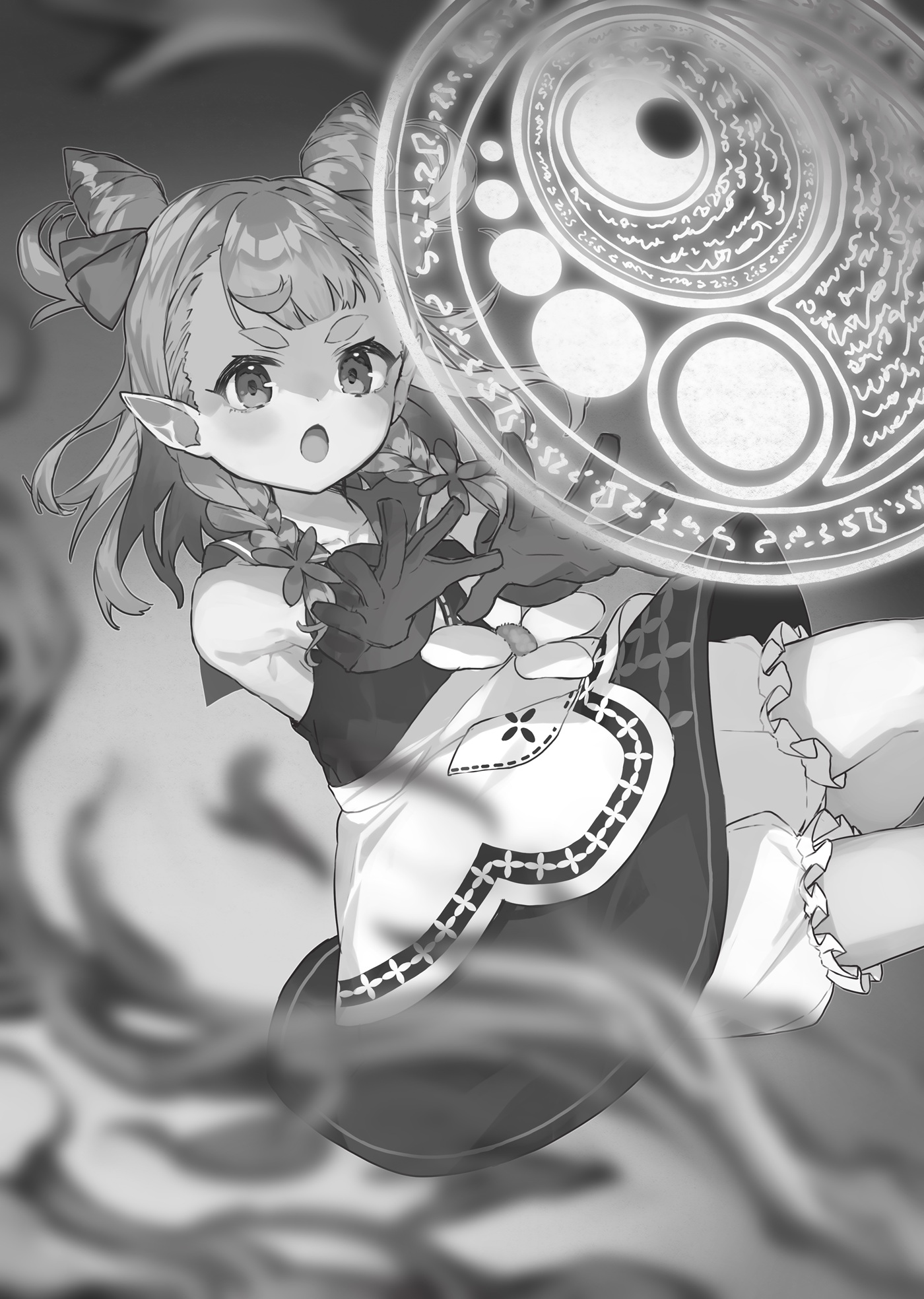
The spell had worked.
A dragon, forged from roaring flame and Mimi’s desperate will, surged across the battlefield and sank its burning jaws into the white giant. Still fixated on Delarosa, the creature had left its back completely exposed, and Mimi’s attack struck with unrelenting force. Though Delarosa’s earlier Dragon Flame had been blunted by the giant’s barrier, it had still left cracks in its magical armor. Now, Mimi’s direct hit tore through those openings, overwhelming what was left of its defenses. The creature let out no cry, no resistance; it simply dissolved into heat and ash, its form consumed by fire and undone by magic.
Mimi stared, frozen, as the last remnants of the white giant vanished. For a moment, her mind couldn’t catch up with what had just happened. Her arms trembled, and her heartbeat thundered in her ears. Then, as the silence settled over the battlefield, the realization sank in.
“I… I did it…” she whispered, eyes wide with disbelief. And then, softer, from a place deeper than breath, she murmured, “Thank you, Kuusha.”
It was more than gratitude. It was an offering from a girl who had been protected all her life to the knight who had guarded her until the very end. Kuusha had given everything for her… and even now, through the magical power crystal she left behind, she had saved her again.
Delarosa came rushing over, her expression an open mix of shock and joy. “Mimi, that was amazing! You actually pulled off Dragon Flame? That spell took me forever to get right!”
Mimi looked down, still breathless. “It was only because of Kuusha’s magicite,” she said, her voice quiet with humility. And while that was true—no ordinary beginner could cast a spell of that level—the fact remained: Mimi had done what most mages couldn’t. Even with amplified mana, the ability to replicate a complex spell from memory alone required extraordinary talent, clarity of image, and a deep, instinctive connection to magic.
Delarosa seemed to realize that, too. She didn’t say so outright, but the proud gleam in her eyes said enough.
“Well then!” she beamed, clapping her hands together. “Let’s go climb that ridiculous staircase.”
Mimi nodded, and together the two of them turned toward the steps ahead, an enormous spiral path that vanished into the forest canopy. The way to the Emperor Treant waited at the top, and though neither of them knew exactly what would come next, they moved forward with newfound courage.
After a few minutes of climbing in silence, Mimi glanced upward and hesitated. “Um… hey. You don’t think more enemies are going to show up on the stairs, right?”
Delarosa winced. “C-Can you not say creepy things like that right now?”
Both of them knew the truth: if another enemy appeared now, after everything they’d spent, they wouldn’t stand a chance. By the time they reached the stairway’s midpoint, both girls were utterly drained. Delarosa’s magic power had nearly run dry, and the magical boost Mimi had gained from Kuusha’s magical power crystal was all but spent. In their current state, even the appearance of a single low-level white homunculus would have been enough to overwhelm them.
“Please, no more enemies… no more enemies…” Mimi whispered the words like a prayer with each step, clutching her hands together as she climbed. It was the only thing she could do to keep her legs moving.
The staircase spiraled endlessly. Minute after minute passed, yet the summit, where the Emperor Treant’s face supposedly awaited, remained stubbornly out of sight.
“H-Haa… haa… seriously, how long is this staircase?” Mimi panted, swaying unsteadily as she dragged herself upward. “I-I can’t feel my legs anymore…”
In stark contrast to her wobbling exhaustion, Delarosa looked as energetic as ever—at least on the surface.
“J-Just a little more! You can do it!” she cheered, pumping a fist.
In truth, Delarosa was struggling just as much. Her magic reserves were nearly depleted, and her body was heavy with fatigue. But she pushed forward with sheer willpower, forcing herself to be Mimi’s support, even if her smile was starting to tremble.
Finally, after what felt like hours, the two girls reached the top.
“We… we made it!” Delarosa cried, arms raised in triumph, before she collapsed to the floor.
“Ghhh… I’m dead,” Mimi groaned, dropping beside her like a puppet with its strings cut.
They lay sprawled on the ground, panting, too exhausted to remember what had even brought them here in the first place. For a few blissful seconds, they just stared up at the treetop canopy above.
Then, Mimi blinked and sat up slowly. “Oh, right… We’re supposed to talk to the Emperor Treant.”
Shaking off the fog of fatigue, she looked around for his face. It didn’t take long to find: it loomed directly ahead, and up close, it was massive.
The Emperor Treant’s face was carved into the bark of the ancient tree like a living monument. It towered over them, easily as large as the royal palace back in the dwarven capital. The sheer scale of it left both girls speechless.
“W-Whoaaa…” Mimi breathed.
“Th-That’s huge…” Delarosa added, equally stunned.
It was so absurdly gigantic, their brains could only register it with awe-struck simplicity.
“A-Ahem… Emperor Treant, sir? Can you hear me?” Mimi called out hesitantly, raising her voice toward the enormous face.
No reply.
The silence hung in the air like a weight, and a pang of unease crept into Mimi’s chest.
Don’t tell me… after all that… we climbed all this way for nothing?
The thought chilled her more than any monster could. There was no way she could let this be the end, not after everything they’d gone through to reach the summit. Gathering the last of her strength, Mimi cupped her hands around her mouth and shouted with all the force she could muster.
“Emperor Treant!!! Can you hear me?!”
Mimi’s voice rang out into the towering silence, echoing off the wooden walls of the massive tree. A few seconds passed. Then, without warning, the Emperor Treant’s eyes snapped open.
“Wah!”
“Eep!”
Both girls recoiled, startled by the sudden movement. The great eyes, closed until now, were impossibly vast and unnervingly alive. And then, without the use of a mouth, a voice resonated through the air—no, not the air. It echoed directly into their minds.
“A dwarf… and a goblin. A rare pairing. So, you’re the one marked by blessing.”
It was a strange voice. Ancient, deep, and yet somehow gentle. The language it spoke wasn’t one either girl recognized, and yet they understood it perfectly. Some sort of magic was clearly at work, translating his words directly into their thoughts.
“Yes! Um… Emperor Treant, sir, could you please grow some ranma grass for us?” Mimi asked, trying her best to sound polite despite the tension still coiling in her chest.
“Too much trouble. I’d rather not.” The Emperor Treant’s voice drifted into their minds with serene detachment, as if the request had been no more significant than a passing breeze and not the desperate plea of two exhausted travelers.
“What?!” Mimi’s voice cracked in disbelief. That answer had been so blunt, so unexpectedly lazy, it knocked the breath right out of her.
“Y-You can’t be serious!” she cried, stepping forward in a rush, her voice rising with frantic urgency. “If you don’t, something terrible is going to happen! We fought so hard to make it this far!” The words tumbled out, half panic, half protest, raw, unfiltered desperation from someone who’d come too far to be turned away now.
“I’m joking,” the Emperor Treant replied smoothly. “No need to panic.”
“Joking?” Mimi blinked, her face frozen in blank confusion. The idea that this ancient, towering guardian could be the joking type hadn’t once occurred to her.
“I decided to increase the strength of the guardians this time. Did you enjoy the challenge?” The Emperor Treant’s voice rolled through their minds like the rustling of ancient leaves, unhurried and almost amused, like a god toying with his creations, curious to see how far they’d crawl before breaking.
“W-Wait, what? What do you mean… increased the strength?” Mimi’s voice wavered as she stared up in disbelief, her exhausted mind struggling to process the idea that their near-death ordeal had been… intentional.
“I raised the difficulty level. Things were getting too easy; it was becoming dull, wouldn’t you agree?” The voice was perfectly calm, conversational even, like a host discussing adjustments to a party game rather than life-threatening combat trials.
Mimi was speechless. “Y-You made it harder on purpose?!”
Now that she thought about it, it actually made a grim kind of sense. The dwarves didn’t use magic, and in terms of personal combat ability, they weren’t especially powerful. Even the strongest among them didn’t compare to Delarosa. And Delarosa had nearly died during the trial.
Which meant… if it had been anyone else…
They probably wouldn’t have made it this far at all.
“I… we almost died! That wasn’t fun at all!” Mimi burst out, her voice sharp with frustration and lingering adrenaline. The words slipped past her filter before she could stop them: raw, honest, and louder than intended. She knew she was supposed to be polite—this was a sacred ancient being, after all—but after everything they’d just endured, she couldn’t hold it in.
For a moment, there was silence. “Hmm. Is that so? Then, I owe you an apology.” The Emperor Treant’s voice, though still ponderous and deep, had softened with genuine regret. “The last dwarf who came through here said it was far too easy. He wanted more thrill, more challenge… I thought others might feel the same. But if it was too much, I’ll tone it down next time.”
So, it had been someone else’s fault, a reckless dwarf who'd convinced this ancient tree to raise the stakes. Mimi’s anger immediately deflated, guilt bubbling up in its place.
“I’m sorry,” she mumbled, bowing her head. “I didn’t mean to yell.”
“Now, about the ranma grass,” the Treant continued. “You needn’t worry. From the moment I awoke, it began to grow on its own. I don’t need to do anything further.”
“Wait, so it’s already sprouting?” Mimi asked, blinking in surprise.
“That is correct.” The Emperor Treant’s voice resonated gently in their minds, steady and composed, like the slow creak of branches in a timeless forest.
At that, relief washed over Mimi in a rush. The mission was complete. She’d done what she came to do. The weight she’d been carrying for what felt like days finally lifted, and she let out a long, shaky breath.
“Whew… looks like it all worked out,” she murmured.
“Thanks for growin’ the grass, Big Tree Guy!” Delarosa added cheerfully, waving toward the enormous face.
“What a crude nickname… but I’ll allow it,” the Treant rumbled, unoffended. It seemed his wisdom extended beyond magic; he had patience to match his size.
“All right! Let’s get back down and go help Belamus!” Delarosa said, already turning on her heel with renewed energy.
“Yeah. He’s probably still fighting,” Mimi said with a nod, her expression firming as determination returned to her eyes.
Just as they started to descend, the Treant’s voice halted them: “Wait.”
Both girls stopped in their tracks, Mimi tensing instinctively. Had something gone wrong?
“Judging by your condition, neither of you has any strength left,” he said matter-of-factly. “If you remain here a while longer, your stamina and magical power will recover faster in my presence. You should rest before you go.”
“What? But we don’t have time!” Delarosa protested, turning back.
“You spoke of providing support,” the Treant replied calmly. “But support is meaningless if you lack the strength to act. Go as you are now, and you will only get in the way.”
Delarosa hesitated. She didn’t want to admit it, but he was right.
“Ugh… I guess that does make sense…” Delarosa muttered, dragging a hand down her face, clearly annoyed but unable to argue with its logic.
As the two girls sat near the Emperor Treant, they could both feel it: an unmistakable sense of relief spreading through their bodies. The ache in their limbs began to ease, and the heavy fog of exhaustion started to lift. It wasn’t dramatic or sudden, but it was real. His words hadn’t been an exaggeration. Merely being near him truly accelerated their recovery.
“Hmm, what should we do?” Delarosa asked, stretching her arms overhead as she debated.
“I think we should stay and rest a bit,” Mimi replied, her voice calm but firm.
“Yeah, you’re right.” Delarosa exhaled and let her shoulders slump, conceding with a reluctant smile as the tension finally eased from her posture.
And so, just as the Treant had advised, they decided to pause their journey and recover their strength.
“Good,” the Emperor Treant rumbled, satisfaction in his tone. “Then remain here awhile. In the meantime, allow me to share a tale from the days when I still moved through the forest, as a Treant in full stride.”
“Huh?” Mimi blinked in surprise.
Is that why he wanted us to stay? she wondered. So he could tell us stories?
Apparently, so. Soon enough, the Emperor Treant launched into a tale from long ago.
Much to the girls’ surprise, it wasn’t some dry, meandering monologue. It was vivid. Dramatic. Genuinely entertaining. The kind of story that swept you up before you realized it, told in the slow, resonant cadence of someone who had watched centuries pass beneath his roots.
Chapter 23
Chapter 23
Belamus was running out of options.
Every Black Golem he destroyed drained more and more of his strength. It wasn’t just the Shining Lance required to pierce their cores; it was the constant layering of physical enhancement, defensive barriers, and, when he failed to dodge in time, healing magic to patch up his wounds. There were too many of them, and no matter how many he took down, the tide never stopped. With each clash, his magical power bled away. Worse, recovery spells demanded the highest energy cost of all, and now, his reserves were dwindling at an unsustainable rate.
At this pace, he wouldn’t last long enough to finish them off.
Even if he somehow managed to defeat all thirty of Aled’s golems, there was no guarantee it would mean anything. Aled’s magical power reserves felt bottomless; his magical presence coiled in the air like a storm that hadn’t even begun to break. How much power does he still have tucked away? The possibility that Aled was merely toying with him, that he hadn’t yet begun to fight seriously, gnawed at Belamus’s gut.
He couldn’t afford to keep playing this game.
No more. I have to go after him directly. That’s the only way this ends.
As long as Aled stood untouched, the golems would keep coming. Belamus could feel it in the air that the creatures weren’t autonomous. They moved with unnatural cohesion, like puppets dancing on invisible strings. Cut the puppeteer, and the performance would stop.
Reaching him was another matter entirely. Aled had positioned himself with care, standing at the rear of the battlefield, cloaked behind an impenetrable wall of golems. He offered no openings, no distractions to exploit. Every move was calculated. Every angle covered.
So, for now, Belamus stopped trying to bring them down.
He shifted his focus—dodging, deflecting, preserving what little magical power he had left. The moment for striking would come. It had to. He just needed time to find it. All the while, his thoughts raced, searching for some overlooked weakness, some hidden angle. But nothing came. No plan that wouldn’t cost him everything before it even had a chance to work.
Aled’s voice rang out across the battlefield, mocking and measured. “You’re just going to dodge forever? How dreadfully boring.”
The worst part was that he was right, and Belamus knew it. If this kept up, his magical power would drain dry, and he'd fall before he ever reached his enemy.
He couldn’t afford to stall any longer.
Then, through the swirl of movement and chaos, a flicker of hope caught the edge of his vision: Navasha and the others had arrived. Somehow, against all odds, they had pushed through whatever enemies had been thrown their way and now stood ready to assist.
Aled’s gaze never left Belamus. He stood motionless, calm and focused, paying his surroundings no mind. It was a mistake, or at least, it might have been. If someone could strike from behind, if even a single attack slipped through, there was a chance it could end this. And even if it didn’t bring Aled down, breaking his concentration might be enough. A moment of distraction. A fracture in the perfect rhythm of his Black Golem control. That would be all Belamus needed.
He didn’t care if the attack failed to wound. As long as it pulled Aled’s attention away, even for a heartbeat, it would be enough.
The real question was whether Navasha and the others would understand what needed to be done. He couldn’t call out. Not without blowing any element of surprise. All he could do was meet her eyes across the battlefield, silently pleading: Don’t come this way. Go for Aled. Now.
Did she understand? Her expression was unreadable. If it had been Delarosa, maybe, maybe she’d have picked up on the unspoken signal. Navasha, though… she was unpredictable.
Without hesitation, she broke into a run.
“No clue what you’re planning,” she called out, voice bold and reckless, “but I’m going straight for the big guy’s head!”
So much for stealth.
Still, for all the chaos of her approach, her instincts proved sharp. She charged toward Aled with reckless abandon and, whether intentional or not, achieved exactly what Belamus had hoped for.
Aled turned. Just slightly. Just enough.
The golems’ movements faltered for the briefest instant.
Belamus didn’t wait. He dashed forward, slipping between the lumbering giants, weaving through the gap that had opened in the moment of hesitation. In the same breath, he summoned power from deep within, channeling the highest-tier light-element spell he had: Saint Breaker.
At close range, the blast surged toward Aled in a blinding arc of divine energy.
Aled’s response was fast, but not without panic. He called forth his own ultimate magic—Sandstream, an elite earth spell—and unleashed it with desperate force. There was no time to erect a barrier. Against a caster of Belamus’s caliber, even a magical shield would have been torn apart anyway.
The spells collided in a blinding clash of light and earth. Raw, opposing energies roared across the battlefield before canceling one another out, exploding into a flash that left both casters unharmed but breathless.
Then Aled moved to regain control of the golems, but he wasn’t fast enough. Navasha had already closed the distance, surging into his guard with shocking agility. Her blade came down in a sharp arc, aimed squarely at his chest.
Forced to react, Aled dropped the Black Golem control and turned his full attention to her. With a sharp incantation, he conjured a Black Sword, a weapon of jet-colored stone, forged from the same enchanted material as his Black Golems. Its surface gleamed with unnatural hardness as he caught her strike, blade to blade.
Aled had power, terrifying, overwhelming power, but when it came to swordplay, he was a rank amateur. Even with his body enhanced by magic, his form was clumsy, his movements shallow. And against someone like Navasha, who thrived in the chaos of close-quarters combat, that gap in skill became impossible to ignore.
She pressed the attack relentlessly, forcing him into a defensive stance. Every strike drove him back, and when he finally leapt away to regain distance, Belamus was already waiting. He fired a Shining Lance; he couldn’t afford to unleash another Saint Breaker so soon, but the holy spear of light still tore through the air with deadly force.
Aled threw up a magical barrier just in time. The lance shattered against it, the light scattering harmlessly. It lacked the overwhelming might of the previous spell, but it kept Aled off balance.
Then the others arrived.
Medello, Liza, Gregald, and Rumalus joined the fray, and Medello unleashed a wave of magic powerful enough to force Aled to shield himself again right away. It wasn’t just raw force anymore; it was pressure from all sides.
While Aled fended off Medello’s spells, the others closed in. Liza, Gregald, Rumalus, and Navasha fell into an impromptu formation, attacking in fluid, instinctive coordination. They’d barely fought together before, but their talent and experience spoke for themselves. Each of them read the battlefield with deadly precision, adjusting their positions and strikes as if they’d trained as a unit for years.
Aled struggled to keep up. Navasha’s blade slipped through his guard and cut into his shoulder. A hiss of pain escaped his lips.
“Ghhh—!”
His eyes, so steady moments before, now flickered with panic. And that moment, just one moment, was all it took.
Belamus and the others weren’t the kind to let an opening slip by. They pushed harder, faster, hammering their opponent with attacks to make sure he’d never recover his footing. Blades and magic poured in from every angle, relentless and unceasing.
A cry tore from Aled’s throat as Belamus’s Shining Lance punched clean through his abdomen. The spell hit its mark before he could fully raise a barrier; he was a split-second too slow. It wasn’t fatal, not to someone like Aled, but it was enough to stagger him. He clutched his side and immediately began to cast healing magic, the wound closing before their eyes. But Belamus could feel that this was no longer a battle of dominance. It was a struggle to survive.
He allowed himself the briefest thought of victory, and then he saw it.
A thread, thin as a strand of silk, impossibly fast, shot from Aled’s fingers toward Navasha’s forehead. It wasn’t a spell Belamus recognized. It wasn’t Magic Thread. It was something else entirely. Something unfamiliar. Something hidden.
Navasha didn’t react. She didn’t see it.
Of course, she didn’t.
Belamus’s eyes narrowed. The thread was cloaked, camouflaged by magical distortion, invisible to ordinary sight. But his vision, honed by years of combat and the ability to pierce through illusion, caught the shimmer.
Belamus had been moments away from casting a magical barrier to block the oncoming thread when a sudden realization stopped him cold. His instincts screamed that this wasn’t an ordinary attack, and if he treated it like one, he’d lose. Abandoning the barrier mid-chant, he turned sharply and shouted, “Navasha! Down!”
She didn’t ask why. There was no time. And more importantly, she trusted him. Without hesitation, she dropped to the ground. A heartbeat later, a thin thread zipped past the space where her head had been, slicing the air with eerie precision. It missed her completely. Aled, calm as ever, wordlessly withdrew the thread.
Belamus’s mind raced. That thread… it wasn’t meant to wound. It was a vessel, a needle pulling a soul through invisible seams. A spell of possession. And one that no ordinary barrier could hope to stop. Unlike physical or elemental magic, this kind of sorcery bypassed the body to aim straight for the soul. Blocking it would take more than brute force.
Aled was too calculating to waste time on bluff or misdirection. If he’d chosen to act now, it meant he believed he could win without risk. Belamus remembered the stories, tales of Aled taking over the bodies of others, slipping inside them like a second skin. It wasn’t a common spell; it was in the domain of special-class magic, sorcery so rare and dangerous that most mages never encountered it in their lifetime.
Even worse, if Aled succeeded in possessing Navasha, Belamus’s own sense of morality would paralyze him. He wouldn’t strike unless he was certain he could kill Aled without harming her. Aled had likely banked on that hesitation.
The thread lashed out again. Same speed. Same angle. Again, it targeted Navasha’s forehead, the likely point of entry. It has to hit there for the possession to work, Belamus concluded, already barking another command to keep her low.
Just as the threat was averted a second time, another voice rang out. “Belamus! Behind you!”
He spun, a fraction of a second too slow. A Black Golem stood directly behind him, its massive stone fist already swinging downward in a crushing arc. Belamus threw himself backward, just managing to evade the blow. His focus on Aled’s spell had left him vulnerable; he’d let the summoned creature slip from his awareness.
There was no time to recover. Another wave of magic surged behind him. Aled had cast Big Hand, which conjured an enormous stone fist, this one barreling toward Belamus with devastating force. He snapped up a magical barrier, but even as it formed, another flared to life beside it: Medello, moving in sync, had cast her own shield to reinforce Belamus’s defense.
Aled’s assault had been overwhelming in power, with each blow heavy enough to crush lesser mages, but Belamus and Medello’s layered barriers held fast. Only one shattered under the force of the attack, leaving Belamus unharmed behind the second layer of defense. It was a narrow save, but a save nonetheless.
In that fleeting opening, Navasha moved like a shadow. She slipped around to Aled’s blind side, blade drawn and aimed straight for his neck. A clean kill, if it landed. Aled twisted at the last moment, steel meeting steel as he intercepted the strike with his sword. Their blades clashed with a flash of sparks, and in that breath of space between them, Aled raised his hand.
The thread spell again. This time, from point-blank range, aimed directly at her forehead. But Navasha had learned. After two close calls, she didn’t need Belamus to shout a warning. Her instincts flared with cold alarm, and before Aled could release the spell, she dropped low, evading it by a hair’s breadth.
“What?!” Aled snapped, his eyes wide with shock as his spell missed its mark.
Aled’s composure cracked. He hadn’t expected her to move—not this fast, not without prompting. His voice wavered with disbelief.
Now! Finish him!
Belamus didn’t hesitate. Aled couldn’t be left alive, not if they wanted this to end for good. If they failed to kill him outright, he would recover. That thread wasn’t just a tool; it was a strategy, a pattern. He’d keep coming until someone stopped him permanently.
Gathering power at his fingertips, Belamus unleashed Shining Lance, a radiant spear of light honed for lethal precision. The spell shot across the battlefield, gleaming like a fallen star, and struck Aled square in the head. There was no time for him to scream. No time to react. His body went rigid, then toppled forward without ceremony, collapsing like a puppet whose strings had been severed.
In an instant, Aled’s corpse shimmered and dissolved into a single, gleaming magic stone. Of all those Belamus had seen, this was the most flawless: pure, radiant, and ominously beautiful.
With their summoner gone, the Black Golems disintegrated one by one, crumbling into dust. The battlefield fell into silence.
The fight was over. Victory belonged to Belamus and his companions.
It’s over… We won.
Belamus stepped forward and picked up the magic stone. He stared at it, his expression unreadable, tight with the weight of memory, tinged with something that might’ve been regret. No one could deny what Aled had become: a villain, through and through. Ruthless. Corrupted. But there was also no denying the truth of their past. Aled had once been his student.
A brilliant student. A prodigy in magic.
Could things have been different? Could Belamus have corrected the twisted path Aled had taken? Could he have brought him back before it was too late?
These thoughts coiled through his mind like smoke, impossible to catch, impossible to dispel. And beneath them all, a single, gnawing truth remained.
There’s no point in dwelling on the past. Belamus drew a long breath, forcing his thoughts to settle. What matters now is that we’ve eliminated a major threat. That alone is worth acknowledging.
He shifted gears with practiced ease. A long life had taught him when to grieve and when to move forward.
“Yesss! We did it!” Navasha threw both fists into the air, skipping with childlike glee.
Belamus allowed himself a small smile. “If you hadn’t ducked when you did, things might have ended very differently. That was quick thinking.”
“Yeah, well… something felt seriously off,” she said, still catching her breath. “Like danger was crawling down the back of my neck. I figured, so that’s what Belamus kept yelling about. My instincts just kicked in, I guess.”
It hadn’t been logic or foresight. Just something primal, like a sixth sense flaring at the last possible moment.
“Oh, thank the stars…” Medello exhaled hard, pressing a trembling hand to her chest. “When I saw you surrounded by those giant rock monsters, Belamus, I honestly thought you were finished.”
“You saved me,” Belamus replied plainly. “If you hadn’t put up your barrier when you did, mine alone might not have held.”
Medello’s face flushed. “I-I was just acting on instinct, really…”
Belamus nodded once, letting the gratitude linger before moving on. “More importantly, what about the other assassins? Are they dealt with?”
“They’ve all been neutralized,” Medello reported, quickly regaining composure. “A few are still alive, but unable to fight. According to Rumalus, not all of them agreed with the order to kill Lady Mimi. Some resisted it.”
“I see…” Belamus folded his arms, considering this carefully. Aled, the one who had been most determined to see Mimi dead, was now gone. That alone could shift the tide.
If she’s still alive… if she returns from the cave… she might actually have a chance to reclaim her place in the palace.
Keeping some of the special forces alive could prove useful. Depending on how things unfolded, their testimony or their change of allegiance might serve Mimi well in the future.
If she returns… But Belamus trusted Delarosa. If anyone could bring Mimi back, it was her.
With that thought, he turned toward the edge of the battlefield. The remnants of the special forces were scattered there, battered and bloodied, but still breathing. He made his way over, determined to lend aid.
After binding the remaining soldiers with Magic Thread, Belamus moved quickly, casting healing spells to stabilize their wounds. They were still beaten down and weak, but no longer on the verge of death.
“I’ve taken care of your commander. Lazalit is dead,” he said plainly.
“What? You’re lying!” one of them shouted, eyes blazing with disbelief. “It’s gotta be a bluff!”
None of them believed him. Their faces tensed with denial, their bodies rigid despite the magical restraints.
Belamus had expected as much. The body had vanished, after all; Lazalit had been reduced to a flawless magic stone. It wasn’t definitive proof, not to them, but it was all he had. Without a word, he pulled it from his satchel and held it out.
“This is Lazalit’s magic stone,” he said calmly.
“W-Wait, how do we know that’s really his?” another soldier stammered, his defiance faltering.
“Think,” Belamus replied, his voice quiet but firm. “If Lazalit were still alive, do you think I’d be standing here right now, talking to you like this? Use your heads. This is his, there’s no mistake.”
The special forces soldiers fell silent. One by one, their expressions shifted from suspicion to confusion and finally to reluctant acceptance. Belamus’s logic was hard to refute. Slowly, realization began to take root. And then, unexpectedly, tears welled up in some of their eyes.
Was he more respected than I thought…? Belamus wondered at first, but the next words he heard made the truth clear.
“He’s gone,” one of the soldiers murmured, voice trembling with something between disbelief and fragile hope. “That demon is finally dead. Does this mean we’re free now?”
Another let out a ragged breath, as though a weight had finally lifted from his chest. “Maybe now we can do honest work again,” he said quietly, eyes glinting with cautious optimism. “Serve the kingdom instead of hiding in the shadows…”
They weren’t mourning. They were relieved.
As it turned out, many of them had been pressed into service by force. Some had been coerced, their family members held hostage to ensure their loyalty. The tears weren’t for Lazalit. They were for themselves. For their chance at freedom.
Belamus nodded to himself, then made his offer.
“Would you be willing to serve Mimi from now on?” Belamus asked, his voice calm and unwavering, eyes locking onto theirs with quiet conviction. “She needs help clearing her name and returning to the royal palace. If you’re willing, I’d ask you to assist her.”
“Lady Mimi?” one of them echoed, uncertain. “But, isn’t she cursed? We were told that was why she had to be sent away…”
“If it’s about helping her leave the country or break the curse, we can cooperate,” another said cautiously. “But…”
“There is no curse,” Belamus interrupted firmly.
Then he turned to Rumalus: once one of their own, now standing beside him. “You explain it,” he said. “They’ll listen to you more than they will to me.”
Rumalus nodded, stepping forward with quiet determination.
“S-Seriously?” one of the soldiers muttered, his voice shaky with disbelief.
“But why would Lazalit do such a thing?” another demanded, his brows furrowed in frustration. “What could he possibly gain by slaughtering dwarves?”
“Even I’m not entirely sure,” Rumalus admitted, trailing off.
At that point, Belamus stepped in and gave a full explanation of everything he had heard directly from Lazalit before his death. For most of those present, it was their first time hearing the truth. And once they did, the reaction was unanimous: outrage.
“That bastard!” Navasha growled, fists clenched and shoulders trembling. “I’ll never forgive him! I swear I’ll—wait… we already killed him, didn’t we?”
Belamus gave a slight nod.
“Right! Then hell yeah!” she shouted, thrusting a victorious fist into the air. “Justice served! One more scumbag down!”
“Used to be human… and he could possess other people’s bodies?” someone muttered in disbelief. “What kind of monster was he?”
“Dwarves died for such a twisted reason,” rumbled Rugen, his voice heavy with grief. “You’ve done us a great service, Belamus. You have my thanks.”
Next to him, Gregald stood pale and visibly shaken, arms folded tight across his chest. The truth had clearly disturbed him. But Belamus sensed it wasn’t just fear; there was something deeper, something personal.
“Used to be human, huh. Makes sense now,” murmured Linden, a member of the special forces. Belamus recognized him from earlier; he’d heard Rumalus call him captain. The others seemed to defer to him as well.
“If it’s true that Lady Mimi intends to return to the palace, I think it’s possible now,” Linden continued, more firmly this time. “Most of the royal court, including the king himself, was under Lazalit’s thumb. He was a master manipulator, blackmailing anyone who dared resist. But with him gone, that grip will loosen. If she presents her case clearly, they’ll believe her. Especially with the old man here claiming to have the original records to back it up.”
His words offered Belamus a rare moment of relief. Maybe, just maybe, Mimi really could go home. She’d saved the kingdom, after all. It would be cruel not to let her return to the place where she belonged.
Linden spoke again, his tone grim. “About serving Lady Mimi… I’d like to. I truly would. But I doubt she’ll ever forgive me.”
Belamus turned to him, puzzled. “Why not? We need all the allies we can get.”
Linden’s expression didn’t waver. “Because I’m the one who killed Kuusha, her attendant. I struck her down with my own hands. She’ll never accept me after that.”
Belamus fell silent. Until that moment, he hadn’t put the pieces together. But of course, Kuusha had been attacked during the assassination attempt. She hadn’t survived. And for Mimi, that loss had to be profound. Kuusha had been one of the few people she trusted without hesitation.
“I’ll tell her everything,” Linden said at last, his voice quiet but unwavering. “I’ll accept whatever punishment Lady Mimi deems fit. But let me make one thing clear: I killed Kuusha. The others didn’t lay a hand on her. They didn’t even injure anyone. If someone has to be punished, let it be me. I’ll ask her to spare the rest.”
It was a noble sentiment, but one with no guarantee of forgiveness.
Belamus remained silent, carefully weighing Linden’s words. The reality was complicated. Lazalit had been the one issuing orders, and the special forces had merely obeyed, many under duress. In truth, they were victims too.
There was the mission itself as well. With their skills, they could easily have killed both Kuusha and Mimi, completed the assignment cleanly, and returned to report their success. But they hadn’t. Kuusha had been fatally wounded, but Mimi had escaped. That failure didn’t seem accidental. It was hard to imagine these elite soldiers had simply let her slip through their fingers by mistake.
Which meant… they’d hesitated.
They hadn’t wanted to carry it through. Not all the way.
In any other scenario, Mimi likely would’ve died out there in the forest, lost to monsters or starvation. But she hadn’t. She’d survived. And part of that, Belamus knew, was thanks to the fact that the special forces hadn’t pursued her with full intent.
Belamus looked over at Linden and was silent for a long moment. Mimi’s a smart girl. She’ll see the bigger picture. She’ll weigh the cost, the circumstances… and the benefit of having a soldier like Linden on her side.
Still, he said nothing aloud. This wasn’t his judgment to make. The final choice belonged to Mimi. Until then, all they could do was wait. And so, they waited for Mimi, Delarosa, and Meira to return.
The longer the silence stretched, the more the tension grew. Every rustle of wind through the trees set nerves on edge. The minutes dragged on with no sign of them. Worry clung to the air like fog.
Then, finally—
“There they are! It’s Belamus and the others!”
The voice rang out clear and familiar, laced with relief and excitement. Mimi.
Belamus felt the weight in his chest lift slightly as he turned to see them. The three of them, Mimi, Delarosa, and Meira, were making their way toward the group, alive and whole.
“Did it work?” Belamus asked, his voice laced with hope.
Mimi nodded, smiling tiredly. “Yeah. Somehow, we managed. The Emperor Treant promised to help… said it would grow the ranma grass for us.”
Belamus let out a slow breath, the relief settling deep in his bones. “Good. That’s very good.”
Mimi’s expression grew more serious.
“What about Lazalit?” she asked quietly.
Belamus didn’t hesitate. He reached into his satchel and drew out the gem, a flawless, radiant magic stone that shimmered faintly in the light.
“I killed him,” he said simply.
“You… you killedhim?” Mimi asked, her voice barely above a whisper.
She looked up at Belamus with wide eyes, a faint tremor in her tone that was half fear, half disbelief.
“He wasn’t someone who could be taken alive,” Belamus replied quietly. “And more importantly… he wasn’t someone who should have been left alive.”
Then, calmly and without embellishment, he told her everything Lazalit had confessed before the end. As the truth settled over her, the color drained from Mimi’s face. But then, slowly, something changed. Her expression hardened, not in cruelty, but in resolve. As the third princess of the kingdom, it was only natural. There were some sins too great to forgive.
Her gaze shifted to the bound men nearby: Linden and the rest of the special forces.
“These men… they’re from the special forces, aren’t they?” Mimi asked quietly.
Belamus gave a slight nod. “They were forced to follow Lazalit’s orders. Threats, coercion, the usual tools of control. But none of them bear a personal grudge against you. They believed the truth about the so-called curse, but they understand now.”
“I see…” Mimi looked over at them again, this time with a softer expression. “Thank you.”
Linden winced, as though the words physically hurt.
“I’m not someone you should be thanking,” Linden said softly, his eyes cast downward, voice heavy with guilt. “I raised my blade against you. And more than that… I took the life of your attendant, Kuusha.”
Mimi’s smile faltered, and her breath caught. She hadn’t known, not until that moment.
“You?” Her voice was quiet, stunned. Pain flickered across her face. She looked away for a moment, struggling to compose herself. But when she looked back at Linden, her expression had changed again to be gentler, but still full of sorrow.
“The fault lies with Lazalit,” she said softly. “None of you is to blame.”
“No, Princess,” Linden said firmly, his voice catching. “I made a choice. I weighed my life, and the lives of my family, against yours and Kuusha’s. And I chose to protect my own. I drew that blade. That was me, not Lazalit.”
Mimi was silent for a long time. Then, quietly, she replied, “If I were in your position… I might have done the same. When it comes to protecting those we love, we all carry the weight of terrible choices.”
Tears began to spill from Linden’s eyes, falling without restraint. He bowed deeply, his voice breaking with emotion.
“I swear I’ll atone for it. Please, allow me… no, allow all of us here to serve you as your vassals. Let the special forces fight for you.”
“W-What?” Mimi blinked, completely caught off guard. “My vassals? But… you’re the strongest fighters in the palace! You serve my father, don’t you?”
Linden lifted his head, his voice steady now, resolute. “No. From this day forward, we wish to serve you, Princess Mimi.”
One by one, the remaining members of the special forces bowed their heads in unison, following Linden’s lead in solemn silence.
“I-I understand,” Mimi said at last, her voice hesitant as she looked at the men kneeling before her. “If you’re that sincere about it… I’ll accept you as my vassals.”
She looked overwhelmed. It was clear she’d never had this many people swear loyalty to her before, and certainly not soldiers of such renown. The weight of command was new to her, and it showed in the unsure way her eyes flicked between them.
Belamus stepped in to give some direction. “First, I’d like the special forces to return to the palace and spread word of two things: that Lazalit is dead, and that Mimi is not cursed. You’ll need to make that crystal clear. I’ll have Rugen show you to his archives; you can take the documentation as proof.”
“Understood,” Linden replied with a respectful nod.
“And one more thing,” Meira added, stepping forward. Her voice was calm, but beneath it lay years of exhaustion and quiet longing. “Tell them that Gagagamoor is not an evil organization. That’s a lie Lazalit spread to silence us. It’s time that lie ended.”
She’d spent years in hiding, years watching her people be branded as criminals. It was no wonder she wanted it to end here and now.
“She’s right,” Mimi said gently. “If it weren’t for Gagagamoor, we would never have uncovered the truth. Honestly, they deserve medals, not condemnation.”
Linden bowed again, accepting the charge. “Consider it done. Clearing Gagagamoor’s name should be easy enough, now that we know the slander came directly from Lazalit.”
At that, Meira couldn’t hold back the emotion any longer. Her eyes brimmed with tears as she murmured, “At last… our efforts will be recognized. You see, ancestors? Your struggle was not in vain!”
Belamus glanced at her, quietly moved. There was no question in his mind: if anyone deserved the title of true heroes in this battle, it was the dwarves of Gagagamoor. For generations, they had resisted Aled’s shadow in silence, keeping hope alive when no one else dared.
After that, they made a brief stop at Rugen’s laboratory to gather the necessary documents. While Linden and his men prepared to return to the palace to begin clearing names and setting records straight, the others remained behind waiting, for once, not in fear or uncertainty, but in quiet hope.
Chapter 24
Chapter 24
A few days later, Linden and the others returned, much sooner than expected. Belamus had assumed the process of clearing names and spreading truth throughout the royal court would take far longer. Their swift return left the group pleasantly surprised.
Even more unexpected was the news they brought.
Apparently, the information had been accepted rather easily. The court had believed them. Mimi’s supposed curse, the lies about Gagagamoor, the truth about Lazalit: it had all taken root far faster than anyone had dared hope.
An official summons had been issued. Mimi, the members of Gagagamoor, Rugen, and even Belamus and his companions were all requested to attend the royal palace. Not by decree, but by personal invitation. The king himself wished to meet those who had saved Princess Mimi and, by extension, the Kingdom of Crystia.
It was a surprising turn, but a welcome one.
For Belamus, there was an added bonus. Entry into the dwarven kingdom had always been restricted, but now, they were being welcomed as honored guests. With that, a long-standing barrier had quietly crumbled. Trade and cultural exchange might finally be possible. The idea thrilled him, and he found himself eagerly anticipating the journey ahead.
They crossed into the dwarven kingdom several days later.
“Whoa, this is amazing!” Delarosa burst out, eyes sparkling as she took in her surroundings. It was her first time seeing a dwarven city, and the novelty hit her all at once.
The place bustled with life. Dwarves filled the streets, working, selling, shouting across the market stalls. Everything felt compact and efficient, yet brimming with tools, gadgets, and crafts none in the group had ever seen before.
Belamus couldn’t help but feel a similar pull of curiosity. He would have loved to explore, to really take in the culture, but now wasn’t the time. The royal summons came first.
On the road to the palace, one particular sight made even Belamus pause. A large iron carriage rolled past them, rumbling steadily over the cobblestone path. It wasn’t pulled by horses or anything at all.
“What… is that?” he murmured.
It was called a car, apparently. A recent invention, still a luxury limited to nobles and the wealthy elite. The one they saw was moving slowly, but they were told it could go much faster. Still, there were safety concerns; excessive speed might lead to accidents. Pedestrians had already been hit in a few unfortunate incidents, so restrictions were tight.
The Kingdom of Crystia was preparing for the widespread use of cars. Roads would need restructuring. New laws would need to be written. Belamus was fascinated; modernization was coming to the dwarven lands faster than he’d ever imagined.
Eventually, one of those very vehicles carried them to the palace.
It wasn’t a towering marble fortress like human capitals tended to boast. Instead, it was compact, fortified, and built entirely of blackened steel, every line of it etched with craftsmanship and function. It was solid, powerful, and undeniably dwarven.
Inside, the group was ushered into a grand hall where the king stood and smiled, already waiting for them.
The king of Crystia stood tall, his presence as solid as the steel walls that surrounded his hall. A magnificent white beard framed his weathered face, giving him the stately gravitas one expected from dwarven royalty.
Ceremonial thanks were offered, and with them, gifts. Belamus had secretly hoped for something crafted by dwarven hands, some rare tool or mechanical marvel that bore their legendary craftsmanship. But instead, he received a gemstone.
It was exquisite, no doubt, brilliantly cut and shimmering with value. Still, he couldn’t hide a flicker of disappointment. It’s beautiful, he thought, but not exactly… interesting.
Mimi, too, was welcomed formally. The courtiers were gracious, the dwarves respectful, and the king offered his apologies, though veiled in the language of diplomacy.
Belamus noticed it right away, the stiffness in Mimi’s shoulders. The polite, practiced smile that didn’t quite reach her eyes.
After all, this was the same king who had once stood by as whispers of a “curse” spread, and who had nearly let her die because of it. Even if he’d been manipulated, even if it had all been Lazalit’s scheme… it wasn’t a wound that a single ceremony could erase.
Still, the tides were turning.
The members of Gagagamoor were finally recognized for their efforts, and for the first time in generations, they were free to move about Crystia without being hunted. Their joy was unmistakable. And so impressed was the king by their strength and loyalty that he offered them a place among his vassals. They accepted on one condition: they would serve under Princess Mimi, and her alone.
Mimi had clearly not expected that. Her eyes widened, and her smile turned uncertain as she nodded. “Y-Yes, of course,” she stammered, clearly flustered by the ever-growing number of retainers she was expected to lead. But how could she refuse? They had fought for her, suffered for her, and now wanted to serve her. She couldn't bring herself to turn them away.
Later that evening, a feast was held in their honor. But there was a problem: none of the food was made with humans or goblins in mind, and the dwarves, while master craftsmen, were evidently not master chefs for non-dwarven palates. In the end, Belamus and his group resorted to cooking their own meals over a borrowed hearth. It wasn’t elegant, but it was warm, familiar, and oddly satisfying.
The next morning, Belamus found a quiet moment alone with Mimi.
“This is a fascinating kingdom,” he remarked, gazing out over the city’s layered stonework and glimmering metal towers. “So many tools and inventions I’ve never seen before.”
Mimi smiled softly. “Is that so? I don’t really know what’s interesting and what’s not… I’ve only ever lived here. But if you’re enjoying it, then I’m glad.”
Her voice was light, but genuine pride lay behind her words. It meant something to her that someone she respected valued her home.
“I helped you,” Belamus said, folding his arms, “not only because I wanted to protect you, but because I wanted this.” He gestured around them. “Trade. Connection. If things continue as they are, we might actually make it happen.”
“I think so too,” Mimi said with a nod. “Word’s already spreading. You’re being called one of the heroes who saved the kingdom. No one’s going to oppose you making a trade agreement now.”
That was reassuring. But even so, Belamus couldn’t help but feel a little uneasy. Crystia had much to offer: cutting-edge technology, rare tools, enchanted artifacts, and most importantly, orichalcum, a precious metal used in the forging of legendary weapons.
What could Beresdral offer in return?
Not much, Belamus admitted silently. Not yet, anyway.
Originally, Belamus had planned to offer Merune fruit and other human-grown foodstuffs as trade goods if the opportunity ever arose to negotiate with another country. But now that he was in Crystia, it was clear such items would hold little value.
After all, dwarves didn’t eat conventional food; they consumed metal. That alone made most agricultural exports meaningless.
So, what do we offer in exchange?
At present, Belamus simply didn’t know enough about Crystian society to answer that. There was always a chance that human foods like Merune fruit might have some alternative value—alchemical, medicinal, or even industrial—but until he learned more, it would be reckless to assume.
He’d decided early on: Before negotiating anything, I need to understand Crystia better. Their needs. Their economy. Their gaps. That information would come with time and careful observation.
As he stood pondering trade strategy, Mimi stepped forward, her expression earnest and her voice steady.
“Belamus… If it weren’t for you, we never would’ve stopped the disaster in time.” Her words held the gravity of someone speaking not just for herself, but for her entire nation. “On behalf of the Kingdom of Crystia, I thank you.”
She bowed deeply, with grace and sincerity befitting a royal.
“And personally,” she continued, lifting her head, her tone softening, “I owe you my life. You’ve saved me more times than I can count. I’ve done nothing but rely on you, haven’t I? One day, I’ll repay this debt. I promise.”
Belamus shook his head slightly. “I didn’t help you to earn a debt,” he said. “I only hoped this would lead to something more lasting: peace and trust. If Crystia and Beresdral can build a strong relationship, that will be enough.”
Then, he extended a hand.
Mimi didn’t hesitate. She stepped forward and took it, her fingers curling tightly around his.
Chapter 25
Chapter 25
The trade agreement between Beresdral and the Kingdom of Crystia came together more smoothly than anyone had anticipated.
At the heart of the deal was a cultural and technological exchange: magic from Beresdral, and the dwarves’ masterful engineering. Skilled dwarven artisans were invited to Beresdral, where they began passing on their knowledge. In return, a handful of Beresdral’s mages traveled to Crystia to share their arcane expertise.
To further support this partnership, a massive new project was launched: the construction of a road through the vast Great Frazes Forest, connecting the two lands with a direct, permanent route.
The dwarves had no issue with venturing aboveground, but extended exposure to surface life reportedly caused physical strain over time. As a solution, they were housed underground. Conveniently, Medina had already hollowed out a sprawling nest beneath the forest. The dwarves took to it with enthusiasm, quickly adapting the space into livable quarters. It seemed to suit them quite well.
With the dwarves’ tools and Beresdral’s magic, the forest was cleared with incredible speed. Trees fell as if chopped down by invisible blades, and within days, a clear, structured road stretched between the two kingdoms. The journey, which had once taken weeks, now took less than ten days.
As for trade goods, an unexpected surprise came from the dwarves’ side—though it was something Mimi had casually mentioned at some point, now that Belamus thought of it.
Orichalcum, an ultra-rare metal treasured for its strength and magical conductivity, was apparently of no use to the dwarves. They had long since ceased using it, finding its properties unstable for their machinery. It had simply become excess material, cluttering their storage halls. And so, they gave it away freely.
Belamus could hardly believe it. He took full advantage, using the orichalcum to craft powerful enchanted weapons. Only a handful of people could manage the necessary magical refinement: Delarosa, Medello, and Belamus. For now, production was slow. But if more trained magic-smiths emerged, mass production could begin.
Another breakthrough came from Beresdral’s local monsters. Certain magical beasts in the surrounding region dropped rare materials that were nearly nonexistent around Crystia. These ingredients, though useless in Beresdral, proved immensely valuable to dwarven alchemists and crafters. Thus, a new stream of trade was born, with monster parts from Beresdral flowing into Crystia in exchange for machinery, components, and finished weapons.
While dwarven technicians continued to train their human counterparts, skill wasn’t something that could be transferred overnight. Beresdral still lacked the infrastructure to replicate dwarven craftsmanship outright. So, they did the next best thing: they imported finished products directly. Rifles, tools, reinforced alloys—anything the dwarves would part with, Beresdral happily acquired.
Months passed, and change came steadily.
Dwarven goods began to circulate throughout Beresdral. Streets buzzed with new machinery, new tools, and new possibilities. The outskirts of town were cleared again, making room for expansion.
New homes were built. New crops were grown. Food from Crystia was supplemented by local harvests. Travelers began to trickle in: wandering goblins, displaced orcs, refugees, and drifters who came seeking shelter. And Beresdral took them in.
The population grew. The town changed.
Chapter 26
Chapter 26
On the western edge of the vast Great Frazes Forest lay a massive cave system that was dark, ancient, and teeming with powerful monsters: Transta’s Stronghold. Deep within its labyrinthine depths, at the very heart of the stronghold, ruled a single being who commanded them all, a monster known only as Transta.
A subordinate knelt low before the creature’s resting place, delivering his report with caution.
“Lord Transta, I bring news. A town has been expanding rapidly near our territory. It is led by a human, but inhabited by goblins, orcs, and other monsters. It has grown enough to encroach dangerously close to your domain.”
“Huh? What’s that now?” Transta mumbled, barely lifting his head.
To any casual observer, he looked like nothing more than an ordinary white cat curled up on a plush cushion, tail flicking lazily as he lay sprawled across a stone dais.
This was how he always looked. Relaxed. Bored. Soft and entirely unthreatening.
Appearances, in his case, were beyond deceiving.
“Can’t you lot just go squash them yourselves?” he yawned. “Should be easy.”
“Whether it will be easy or not… we don’t yet have enough intelligence to say,” the subordinate replied cautiously. “But I believe it would be unwise to underestimate them.”
“You’re still the same worrywart as always, Robe,” Transta muttered, rolling onto his side without opening his eyes. “Do whatever you want. I’m staying right here. Don’t involve me unless things get really annoying.”
The one called Robe bowed deeply. Unlike most of Transta’s followers, Robe appeared human at a glance. He was cloaked in a black mantle, his expression unreadable, his voice cold as stone. Without another word, he turned and left the chamber.
Soon after, he gathered several key monsters in a side hall within the stronghold.
“As of now,” Robe announced, “Lord Transta has entrusted full authority to me regarding the expanding town. I’ll be taking command of all operations concerning this matter.”
“Perfect!” came a bright, eager voice. “I’ll go flatten it right now.”
Robe narrowed his eyes at the speaker. “No, Rook. That sort of reckless approach won’t be tolerated.”
The boy who spoke, barely more than a teenager, grinned beneath his unruly bangs. His feline ears twitched with amusement. Energetic, impulsive, and always spoiling for a fight, Rook was as dangerous as he was impatient.
Robe ignored the boy’s sulking and turned instead to a tall, thin figure standing motionless by the wall.
“You’ll go, Shamat,” he said. “Start with reconnaissance. I want every detail about this town: its leadership, defenses, and military potential. Move carefully.”
The lizardman, Shamat, stood perfectly still. Not a twitch. Not a nod.
“Hey, Shamat! Are you even listening?” Robe’s voice cracked through the chamber like a whip, sharp with irritation and already fraying at the edges of patience.
Shamat jolted as if physically struck. His shoulders tensed, and he spun around with a guilty grin. “Ah, sorry, boss. I totally zoned out for a sec,” he said, voice breezy, one clawed hand scratching awkwardly at his scaled neck.
“Don’t zone out!” Robe snapped, throwing up a hand in frustration.
Shamat only tilted his head, all innocence and lazy charm. “So… what were we talking about again?” he asked, still smiling as though they were chatting about the weather.
Robe stared at him for a long second. The fury drained from his face, replaced by something closer to resignation. With a deep sigh, he rubbed his temples. “I need you to scout the town. Can you handle that?”
“Uh, sure, I can… but like, which town are we talking about exactly?” Shamat asked, blinking as though the answer he sought would somehow be new information.
“You haven’t been listening at all, have you?” Robe asked flatly, his tone hollow.
“Nope. Not a word,” Shamat replied cheerfully, completely unfazed.
Robe groaned and buried his face in both hands. “Why do I even bother…”
Despite everything, he knew the truth: beneath Shamat’s airheaded attitude was a razor-sharp operative. Annoying? Yes. Exasperating? Absolutely. But reliable when it counted.
He straightened and looked Shamat dead in the eye. “Fine. I’ll explain it again. From the top.”
After a second detailed rundown of the situation, Robe finally paused. Shamat, at least pretending to be focused this time, gave a casual salute.
“Got it. I’ll go get the info on that town. Leave it to me,” he said with a wink, already shouldering his travel pack.
“I’m counting on you,” Robe said quietly, more to himself than anyone else.
Without another word, Shamat turned and strolled out of the stronghold with a spring in his step, vanishing into the gloom of the forest beyond.
The clash between the forces of Beresdral and the monsters lurking in Transta’s stronghold was about to begin.
Thank you all
Thank you for reaching the end of The Abandoned Reincarnation Sage (Light Novel), Vol. 3! We hope you've enjoyed Belamus adventures and his new life in the monster world. Your support means the world to us!
To help us bring you more fantastic stories, please share your thoughts on Amazon. Your reviews not only let us know what you liked (or didn't!) but also help us decide which light novels to bring to you next.
Click Here
Curious about what else we offer? Scan the QR code to discover our diverse range of light novels and many more to come!


Thank you for reading!
Stay tuned for upcoming releases and share your experience in our social media:
- Discord
Need a break from social media? We've got you covered! Sign up for our newsletter and we'll send you a recap with relevant news.
Sign Up