
Chapter 1: Liliana’s Lost Voice
Chapter 1: Liliana’s Lost Voice
What is going on? the girl wondered in a daze, fascinated by the scene unfolding before her.
◇ ◇ ◇
I stared blankly at the firewood being heaped at my feet. Though I was relieved my hands were no longer bound tightly behind my back, my new position was hardly any better: I was suspended above the ground on a thick wooden cross, my legs fastened to the upright post and my arms spread wide, secured to the crossbeam.
“Liliana Alexandra Clarke, you have been convicted of treason through the use of dark magic and condemned to burn.”
Those were my charges.
Executing a powerful mage who had turned to dark magic wasn’t as simple as beheading them; their body might still be put to malicious use. They had to be reduced to ash.
On a related note, how did things come to this?
The answer eluded me. It had all been fate—an unavoidable destiny. It must’ve been. Trying to fight it had only tightened the grip of the dark ivy coiled around me.
I saw familiar faces in the gathered mob. One belonged to my former fiancé, Riley Williams Slivegrad, crown prince of the Kingdom of Slivegrandia. Beside him, intimately close, stood the lovely Emilia Navy. Austin Ealdred, a knight of the royal guard, was right behind them.
Two soldiers approached me, torches in hand. I closed my eyes. The darkness I’d grown so accustomed to was nowhere to be found as heat began to rise from beneath my feet.
I’d never meant to do what I’d done. These past three years had felt like one long nightmare, my days fraught with overwhelming suffering. I was supposed to marry the crown prince and find happiness, yet my jealousy toward Emilia Navy had proven too much to bear. My actions had brought me scorn, the end of my engagement—and now, my execution.
I didn’t know why things had turned out this way, only that I would never again be able to protect this kingdom, its people, or even my loved ones.
Somehow, I couldn’t shake the feeling that this future wouldn’t come to pass.
◇ ◇ ◇
Dread roused Liliana from her slumber. Her head was burning up. She scanned her surroundings, hot air leaving her mouth with each exhale, as she tried to assess the situation. The canopy and lace curtains looked familiar.
“Are you awake, my lady?”
Liliana turned toward the voice, a wave of nostalgia washing over her. Amid the blur of her distorted vision, a face she recognized came into view. The woman’s simple black dress was issued to maids of the ducal House Clarke.
“Could you sit up a little, my lady? I shall give you some water.”
Liliana sat upright, though not by her own strength—the woman had to prop her up. Her head spun, though tolerably, and she managed a sip from the glass brought to her lips. It was no easy feat, but the water soothed the raw ache in her throat.
Evidently satisfied, the woman eased her charge back down onto the bed. Liliana stared vacantly up at her—at the face she knew she recognized. The woman met her gaze with a look of concern before quietly leaving the room to fetch the doctor.
Now alone, Liliana hovered on the edge of sleep. She was barely clinging to consciousness when the woman returned with the doctor, who began asking questions. Liliana opened her mouth to respond...but no sound came out.
After a contemplative pause, the doctor said, “I’ll see how your voice is faring once you’ve recovered,” and departed. Liliana heard the woman in black—her handmaiden, Marianne—leave as well.
As the room fell silent, Liliana closed her eyes, and fatigue pulled her down into the dark depths of unconsciousness.
The next time Liliana awoke, she found herself alone in her room. Her fever had broken, leaving her steadier than before, though her throat was still notably parched. She tried to call for Marianne, but no sound escaped her lips. All she could do was stare at the ceiling as fragments of the dream she had awoken from returned to her.
In her dream, Liliana had lived in “Japan,” a world with its own language and culture. She remembered having friends, though most of those connections had fallen away as she entered adulthood and work took over her life. Whatever free time she managed to carve out, she spent not with others but with her nose buried in a book. The subject hardly mattered, so long as it held her interest.
Then, one day, an otaku friend she had kept in close contact with recommended a certain otome game. Liliana wasn’t much of a gamer, but the story and art drew her in. The game even boasted a trove of supplementary content for fans, such as guides and setting notes. She went through them more thoroughly than the game itself.
The setting of the game had struck Liliana as peculiar. It resembled medieval Europe, yet it wove together elements of Asian, Arabic, and Northern European cultures. Combat was plentiful, with battles fought using swords and magic, which set it apart from ordinary romance simulation games. The protagonist was one Emilia Navy, from a baronial family, and chief among the romance options was Crown Prince Riley Williams Slivegrad. Liliana, too, had played a major role in the story—as the crown prince’s fiancée and the villainess who turned to dark magic.
Pushing thoughts of her dream aside, Liliana climbed out of bed. She still felt a little woozy, but nowhere near as much as before. She approached the full-length mirror by the wall and stared idly at her reflection—a slender girl with silver hair and pale green eyes. Her recent illness had made her already snow-white skin even paler.
I’m definitely Liliana Alexandra Clarke, she told herself, recalling the villainess from the game. The girl in her memories would no doubt have matched the one in the mirror if she were aged down.
Liliana sighed deeply. Her recent illness wasn’t the only thing weighing on her; she was also burdened by the knowledge that, at least in the game, her future was set in stone. Her fate was grim, no matter whom the main character chose to romance. Even in what were considered Emilia’s “bad endings,” the villainess never found happiness.
So far, almost none of the romanceable characters in the game had appeared in Liliana’s life. The crown prince, Riley, was the only exception; he had met with her regularly since she was two, as she was the primary candidate to become his fiancée.
Liliana tried to voice her dissatisfaction, but only a hoarse breath came out. She furrowed her brow. Further attempts produced the same frustrating result, and not just because her throat was so terribly dry.
So it didn’t heal, she concluded, as if completely detached from the situation. The doctor who had examined her when she first regained consciousness had noticed she couldn’t speak but had decided it would be best to check on her again once her fever subsided. I was told my high fever was to blame—the result of an epidemic. I can still understand what others say, so maybe the fact I can’t speak means some cells in the language center of my brain were destroyed.
Medicine hadn’t advanced very far in Liliana’s world, so her knowledge of the brain came from the dream of her past life. Even so, people here knew that a high fever could cause a loss of voice.
A less scientific explanation might be that I lost my voice as punishment. In Buddhism, throat ailments are said to result from speaking ill of someone. By this world’s value system, I suppose people would sooner see my impairment as a hex than recognize it as divine in nature.
Either way, being unable to speak was fatal. Liliana cast her eyes down in dejection, stepped away from the full-length mirror, and sank onto the nearby couch.
High-ranking nobles couldn’t get by without magic—and to use magic, one had to be able to utter incantations. But that wasn’t Liliana’s only concern. Without the ability to speak, she wouldn’t be able to perform the public duties of a crown princess, meaning it was only a matter of time before her status as a candidate for the crown prince’s hand in marriage was revoked.
On the bright side, this should steer things in a different direction from the game and keep me from saying anything imprudent. Maybe losing my voice is for the best.
In the game, a jealous Liliana had made snide remarks to the main character before turning to dark magic. Now that her voice was gone, she wasn’t capable of either. If her engagement to the crown prince fell through, perhaps she could actually break free of the fate the game had laid out for her.
That isn’t the only issue, though. If my father and grandfather decide I’ve outlived my usefulness and abandon me, or if criminals come after me, I have no way of defending myself right now.
House Clarke was one of the three largest ducal families, and Liliana’s father and grandfather were as cold and calculating as one would expect high-ranking nobles to be. They would abandon anyone who was no longer useful to them, even their own flesh and blood. With the memories of her past life newly restored, Liliana couldn’t help but suspect that her father, in particular, might be a psychopath.
House Clarke would endure as long as Clyde, Liliana’s older brother, remained to inherit it. If losing her voice cost Liliana her chance to marry the crown prince, she would have no choice but to face a life in a monastery or a marriage into a noble family seeking to benefit from a connection to her house.
After all, it would be a scandal if I were banished from the country or became someone’s mistress.
The only exception would be if she became Riley’s mistress—but even the king’s mistresses were usually married.
No matter how she looked at it, Liliana knew that simply avoiding the game’s endings wouldn’t be enough to escape a gloomy fate. For now, at least, she had the good fortune of servants to attend to her basic needs.
As if on cue, there was a gentle knock at the door, and Liliana’s handmaiden Marianne strode into the room. “My lady!” she exclaimed, concern etched on her face. “Please go back to bed. You can’t have fully recovered yet.”
Liliana knew better than to protest. She rose from the couch and lay down on the bed, pulling the sheet over herself.
“Just a moment, please,” Marianne said, hurrying out of the room. She returned shortly after with a tray holding a pitcher and a glass, accompanied by the doctor who had seen to Liliana at the height of her fever.
With Marianne’s help, Liliana sat up and took a gulp of water.
The doctor searched through a bag of medical instruments before starting the checkup with a perfunctory “Excuse me.” A serious expression accompanied the assessment: “Your voice still hasn’t returned, most likely because your fever lasted so long. I’ve seen this happen several times before.”
“Oh dear...” Marianne murmured, her features twisted in sorrow.
“It’s all right,” the doctor said with a reassuring smile. “Rarely are these cases permanent. There are outliers, of course, but let’s wait and see for now. Is the master here today? I’ll give him my evaluation.”
Marianne shook her head weakly. “Oh, no... He rarely stops by.”
In the world of high-ranking nobles, it was common for family members not to spend much time together, and House Clarke was no exception. Even by those standards, however, Liliana felt cast aside. Most noble parents might not say much to their children, but they would still see them occasionally, and siblings often spent time together due to the close proximity of their bedrooms. Liliana couldn’t even remember the last time she had seen her brother, Clyde.
It didn’t help learning that, unlike me, he actually gets to spend time with father and mother.
Liliana reflected on the days before her memories of a past life had returned. Her loneliness had cut deep, and she had begun taking it out on those around her. While her actions had remained within the bounds of what was acceptable for a girl born into nobility, they might have worsened with each passing year if her memories hadn’t brought her back to her senses.
Yet, with her in-game self’s lofty ideals, strong sense of duty, and awareness of social norms, she doubted she would ever have become truly insolent.
The doctor produced a pen and some paper, paying no mind to Marianne’s bewilderment, no doubt accustomed to such situations. “In that case, I’ll write him a list of symptoms. The young lady should take things as easy as she can for a while. I’ll come see her again in a fortnight or so.”
Marianne nodded.
After packing up, the doctor bade farewell to Liliana and departed. Marianne stepped outside as well, leaving the door ajar. Despite the handmaiden’s efforts to keep her voice down, Liliana still managed to overhear their conversation.
“Is there really no way to tell when my lady’s voice might return? She’s the strongest candidate for His Highness’s fiancée, standing out even among the others. Her future as crown princess was all but set in stone...”
“I’m afraid I’ve said all I can for the moment,” the doctor said, plainly.
Marianne clearly wanted to ask more, but the chamberlain waiting outside insisted she calm down. The handmaiden apologized, and Liliana soon heard the doctor and the chamberlain take their leave.
“She had such a lovely voice, sweet as birdsong...” Marianne lamented. “For this to happen just after her sixth birthday... The poor thing...”
Marianne wiped the tears from her eyes and took a minute to regain her composure before reentering the room. She hurried over to Liliana, fluffed her pillow, and gently laid her back down.
“I know you were prescribed rest, but that might prove difficult at the moment,” the handmaiden said. “Nonetheless, I will ask the master to excuse you from visiting the palace for a while when I deliver the doctor’s note.”
Marianne gently brushed aside the locks of hair that had fallen across her lady’s forehead. An ordinary handmaiden wouldn’t have been in a position to advise the head of the family; she would have had to deliver her message through a butler. Marianne, however, was the youngest daughter of Marquess Kenneth—and while common sense dictated that the daughter of a marquess should under no circumstances serve as a handmaiden to the daughter of an eminent duke, she had once explained with a smile that her family believed in letting its members choose the path best suited to their talents. Her status meant there was a chance the duke might hear her out personally, though the odds of him agreeing to her request were slim.
“I wish your education as crown princess hadn’t already begun,” Marianne continued—an impulsive remark that might have sounded like grumbling.
Crown princess candidates were educated partly at home and partly at the royal palace. How could Liliana manage the palace portion without her voice? If she were to encounter the king or the crown prince, she wouldn’t even be able to greet them. And yet, if her father ordered it, she would have to go regardless.
It’s best to avoid contact with both the royal family and my own. I need to gather knowledge and learn to use magic without anyone noticing. To escape a grim fate, I’ll need all the power I can muster.
Next on Liliana’s curriculum were magic lessons, though they would surely be postponed now that she lacked the ability to speak incantations. She would need to find a way to tackle the subject through self-study.
Liliana opened her eyes just enough to glance at Marianne, who was diligently tending to her at her bedside.
I never really cared about my servants before, but perhaps they could help me avoid my demise.
Nobles seldom paid much attention to their servants; in their eyes, such people faded into the background, like wallpaper or a perfectly forgettable vase. Yet even the servants who had never appeared in the game had thoughts and feelings of their own. If Liliana managed to gain their favor, it wasn’t unrealistic to expect their aid.
◇ ◇ ◇
Two weeks had passed since Liliana’s last checkup. After her follow-up with the doctor, she went straight to the library in her manor. Inside, bookshelves stretched endlessly, climbing toward the high ceiling. Accessing the top shelves required the ladders attached to the bookcases, which could be moved using the control panels tucked into the corner of each shelf. There was no need to switch on individual lights, as the same panels could brightly illuminate any area. The library made extensive use of magical devices found nowhere else in the manor.
They certainly didn’t call my uncle a bookworm for nothing. I had no idea there were so many books on magic here.
Books were expensive, yet the library’s shelves were packed with them. Most were written in the local language, but many were in foreign tongues as well, covering every subject Liliana could imagine. The collection had been assembled by her late uncle, who had once lived in the manor, with the overflow stored in a separate building in the backyard. It was an archive that could put even the royal library to shame.
My in-game self had an aptitude for magic, so that’s where I’ll start.
Magic was such a fundamental concept in the Kingdom of Slivegrandia that a corner of the library was devoted entirely to books on the subject. Hexes, by contrast, were far less well-known, which probably explained why only a handful of books in the entire collection addressed them—and even those offered only rough summaries. They didn’t pique Liliana’s interest, so she picked up a guide on magic and began thumbing through its pages. It explained that magic was composed of six elements—fire, wind, water, earth, light, and darkness—and that every person had an aptitude for one of them.
Even this book insists that incantations are mandatory. It also says that to wield magic of multiple elements, one must take extra care to avoid conflicts between them, and that the user must have sufficient mana as well as experience and talent in magic... But is that really true?
In the game, Liliana had been executed for using dark magic, yet her elemental aptitude was wind. It was extremely rare for someone to have an affinity for light or dark magic—in fact, the two were considered special. The guide offered no further explanation, so all Liliana knew was that most spells classified as dark magic were forbidden.
Historically, the men of House Clarke have had an aptitude for fire, and the women for wind. So how did my in-game self learn dark magic?
Liliana checked the section of the guide that covered wind magic. It listed only basic and beginner-level spells, and without much detail, so she returned the book to its shelf and started working through texts on basic-, beginner-, medium-, and expert-level spells, in that order.
Even in the most advanced books, Liliana found that only the spells and their incantations were listed. For dark magic in particular, the spells themselves were omitted until the expert-level texts—and even then, they focused mainly on dispelling illusion magic, which was often used during war or assassinations to mislead the enemy. That was likely why illusion magic itself wasn’t covered.
Learning true dark magic might mean having to get my hands on books stored in the Ministry of Magic...
The Ministry of Magic oversaw all things, well, magical. Learning dark magic from publicly available books was evidently out of the question—understandably, since most of its spells were banned—so Liliana decided to focus on magic of other elements, whose literature she could actually read.
To cast a spell, one simply amplifies mana to the required level and materializes it according to the appropriate mental image. Incantations merely vocalize the spell, and with magical devices, the spells are input directly into matter. So shouldn’t it be possible to cast them without incantations?
If Liliana’s hypothesis was correct, her lack of a voice might actually work to her advantage. People who believed incantations were necessary would assume she couldn’t use magic, at which point she could take them by surprise. Deception was a perfectly valid battle strategy.
Spells are devised according to this world’s common sense. With my memories from my past life, I should be able to use magic without worrying about the element. The important part here is probably imagination.
Liliana returned the expert-level spellbooks to their shelves and began searching for something even more advanced. High on one of the bookcases, she found research memorandums written by mages of the past. Leafing through them, she noticed that some explored the possibility of casting spells without incantations, yet all reached the same conclusion: It was only possible in theory. Perhaps she really was onto something.
I have an aptitude for magic—and now the knowledge from my past life as well.
Liliana’s memories from her previous life were mostly raw knowledge, completely devoid of emotion. That was why she felt she could put them to good use.
Magic is the art of materializing mana according to the mental image of a spell. In other words, I need to learn what it feels like to convert this mana into a spell.
Liliana squeezed her eyes shut and focused on the mana within her. At first, she couldn’t locate it, but gradually she became aware of a flow distinct from the blood coursing through her veins. Next came spellcasting practice.
Wind magic has a spell for moving things around. It might be easy to start with.
The explanations varied greatly between spellbooks, but the core principle was the same: using the air to both balance and move an object. Liliana combined that knowledge with what she remembered from her past life and unleashed her mana. It flowed from her, creating a breeze near her hand. She focused on the book she was holding, and it floated lightly into the air. The sight made her eyes widen—but even in her surprise, she maintained her concentration.
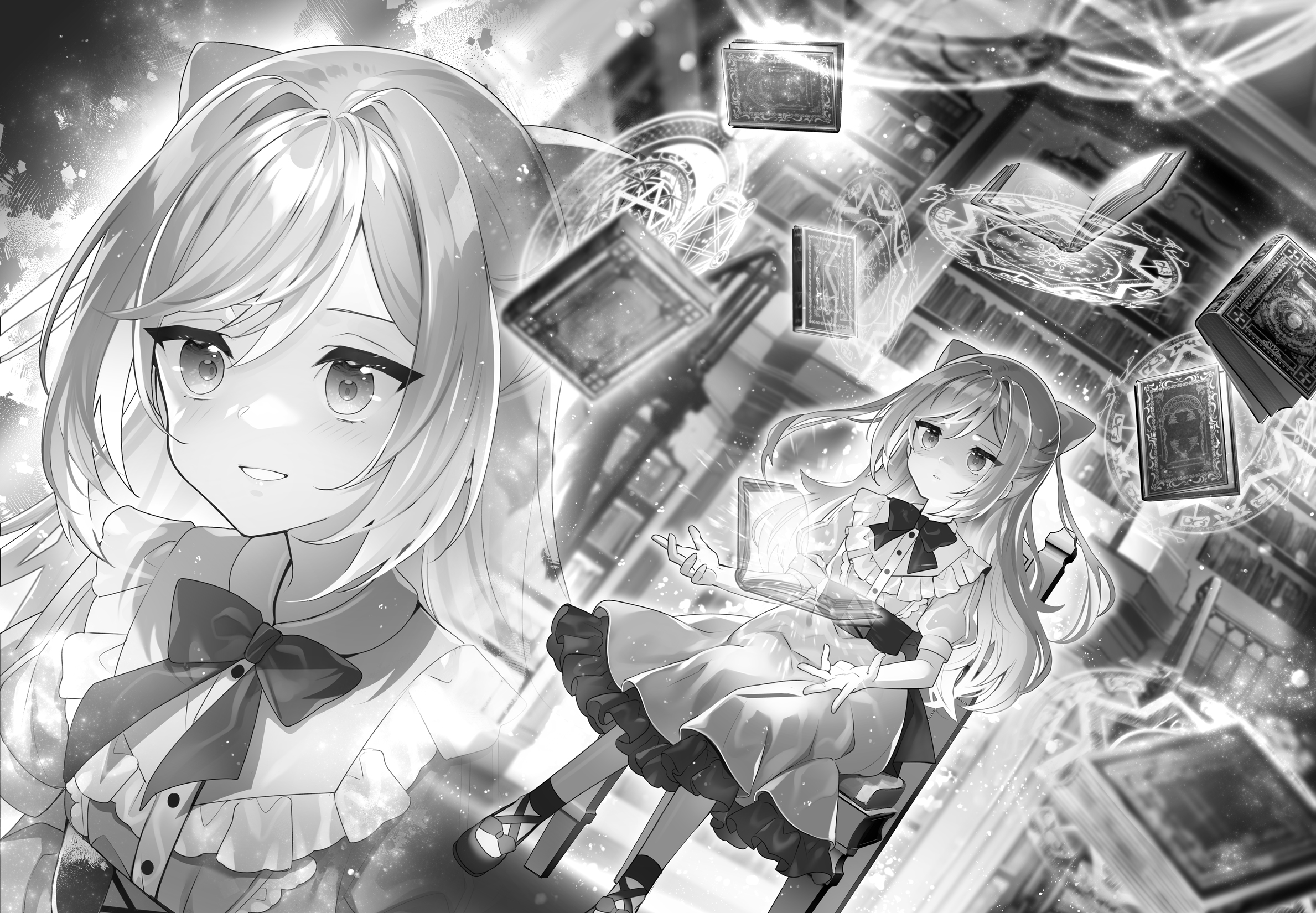
Oh, it worked.
Liliana’s eyes sparkled as the spellbook she had just been reading floated back to its shelf seemingly on its own. Magic was supposed to be impossible for humans without incantations, yet she made it look effortless. She stared at the bookcase for a moment before surveying her surroundings.
What about magic of the other elements?
Liliana blushed—an unusual occurrence for her—and began channeling her mana again. She wrapped a book on the table with its invisible flow, adjusted the refraction of light, and applied another of the spells she had just read about.
It works. I can’t see the book anymore.
The confirmation of her hypothesis brought a smile to Liliana’s face. Illusion spells were supposed to be exclusive to dark magic, yet she had produced one using nothing but her affinity for wind.
At that moment, a six-year-old girl shattered the common sense of her world.
◇ ◇ ◇
A week after she had started practicing magic in secret, Liliana received a letter. She read it in her room, with a pen and paper beside her so she could communicate with Marianne. As the handmaiden set some tea on the table, Liliana looked up and showed what she had written.
“Mikal from the stables is soon to become a father. Can you get him a guksi?”
A guksi was a wooden cup, a popular gift for commoner households with newborns. Simple yet thoughtful, it was meant for weaning foods—and later for tea or alcohol when the child came of age. It wasn’t popular among nobles and royals, however.
Marianne looked surprised at first, having been hired by House Clarke around the same time as Mikal, but then she smiled warmly. She was likely also in disbelief that Liliana would know a stableman was about to become a father.
Conscious of her handmaiden’s reaction, Liliana returned a weak smile and continued writing: “Mikal would refuse anything more expensive, wouldn’t he? I thought a guksi might strike the right balance.”
Marianne read the note, then nodded firmly. “Yes, he should certainly be pleased.”
Liliana beamed and began writing detailed instructions for the patterns to be engraved on the guksi. The handmaiden would only need to take them to an artisan; from there, the item would be delivered to Mikal as a gift from her lady.
“What about the letters of gratitude for the gifts I received for my birthday?” Liliana wrote. “Have they been prepared?”
“Yes, without issue,” Marianne replied. “The presents themselves are being stored in another room—except for the potted lily of the valley from the mistress, which the garden keeper is caring for. I have a list of the letters of gratitude that have been sent so far.”
Liliana had fallen ill the day after her sixth birthday, and while no celebratory banquet had been held, she had still received gifts and letters from the butler and housekeeper on behalf of her family. She had looked at them but hadn’t had time to send thank-you letters, which was why she had entrusted the task entirely to Marianne.
A quick scan of the list confirmed the handmaiden had arranged everything flawlessly. She was clearly talented, despite her young age. Calmly observing Marianne, who was several years her senior, Liliana concluded that her skill was most likely the result of the education she’d received from Marquess Kenneth.
Next, Liliana showed Marianne the letter she had just been reading. The handmaiden looked momentarily at a loss, then seemed even more puzzled when she saw the name of the sender.
“Am I truly allowed to read this?” she asked. The letter was from Duke Clarke, Liliana’s father.
“Yes, please do.”
The letter Liliana had received for her birthday hadn’t been in the duke’s handwriting, but this one was. Despite the long gap since she had last received correspondence from her father, it expressed no concern for her condition—only a brief, matter-of-fact message.
“‘If your voice doesn’t return in four years, your status as candidate for the crown prince’s fiancée will be revoked,’” Marianne read in shock. She clearly hadn’t intended to speak aloud; the words had simply slipped out.
Without her voice, it was only natural that Liliana would lose her candidacy—yet the letter also instructed her to continue her education as crown princess for the next four years. Most surprising of all was the final line: She was to have an audience with the crown prince the following day. How well could their conversations possibly go, given that she couldn’t even speak? Liliana couldn’t hide her astonishment, and neither could her handmaiden, who nodded with a sigh.
“Yes, my lady. I understand exactly what you wish to say.”
However appalled they might have been by the duke’s greed, they had no right to refuse him.
“My lady—per the master’s orders, you will need to depart early tomorrow morning. You might wish to decide now which dress you intend to wear.”
“Indeed. Could you start getting things ready? And please put these letters away for me, if you would be so kind.”
An audience with the crown prince required considerable preparation. Marianne gathered the letters scattered across the table and tucked them into a nearby drawer. Then she bowed and departed, no doubt heading to the dressing room to fetch outfits and accessories for her lady to choose from.
Liliana brought her tea to her lips, and its mild aroma made her smile.
In a way, this is a stroke of good fortune. Even if my voice returns, as long as I spend the next four years pretending it hasn’t, I’ll automatically forfeit my status as a candidate for the crown prince’s fiancée. Still, I wish I could study magic or explore the estate instead of going to see His Highness.
From what Liliana remembered of the otome game, her in-game self had been thirteen at the start and sixteen at the time of her execution. If things went well over the next four years—that is, until she turned ten—her relationship with Riley would be a thing of the past by the time the game began. The actual outcome would, of course, depend on how determined her father was to make her a crown princess, but for now, it was at least something of a relief.
Liliana’s plan was precisely why she would rather immerse herself in books than meet with Riley. She could even have spent the time reading more of her uncle’s memoirs, which she had found in the library, and searching for the hidden rooms and passages around the estate mentioned in them.
My relationship with His Highness is strictly formal. Though my in-game self was obsessed with him, she wasn’t actually close to him either.
In the game, Liliana had likely fixated on Riley only because of Duke Clarke’s influence. Having regained the memories of her past life, the current Liliana felt no such attachment to the crown prince.
“My apologies for the wait, my lady,” came Marianne’s voice. She had returned with another maid in tow, carrying clothes and accessories.
Liliana inspected the lineup. Her in-game self had favored alluring and extravagant garments, so she made a point of showing interest in simple, high-quality attire instead. She wanted to take every opportunity to carve a different path for herself and change her fate.
◇ ◇ ◇
Early the next morning, Liliana boarded a coach and departed the estate. Her handmaiden Marianne was staying behind, replaced by two escorts hired by Liliana’s father.
The estate, located on the outskirts of Hudore, the royal capital, had once been the residence of Liliana’s uncle, who had died young. It remained uninhabited for years after his passing, but when Liliana turned two and became a candidate for the crown prince’s fiancée, it was refurbished as her new home.
Liliana’s father, Duke Clarke, moved frequently between his mansion near the royal palace and his various domains. Her mother and brother lived in an estate in the Duchy of Fortier. Her uncle had owned many estates but had little taste for luxury, which was evident in their design. Liliana’s was the plainest of them all, though even it dwarfed the homes of barons and viscounts.
This is such a pain... Liliana lamented, gazing forlornly through the gaps in the curtains of the coach window. The sky was so clear that she could almost feel it mocking her. If she made even one wrong move, her escorts would surely report it to her father. He treated her like a tool, while her mother outright loathed her. How could she ever find comfort in such a family?
Despite her lack of appetite, Liliana nibbled on the sandwich Marianne had thoughtfully insisted she bring. It would see her through to the evening, even if no refreshments were served during her audience with the crown prince.
It was afternoon by the time the coach reached the palace. After crossing several moats, it passed through the gate and came to a halt at the restricted disembarking area. Liliana greeted the familiar palace guards, signaled her escorts to wait, and let one of the maids lead her to the parlor.
“Please wait a moment,” the maid said, bowing gracefully.
As the first maid left, another arrived with snacks and tea for two, setting them neatly on the table. Liliana couldn’t touch any of it until Riley arrived, so she waited, gazing at the beautiful courtyard outside. Flowers of every season bloomed across the grounds, and a fountain rose at the center. Every now and then, a bird took flight, breaking the stillness of the peaceful scene.
Though it couldn’t be seen from the parlor, the courtyard also housed a conservatory filled with medicinal herbs. Entry required advance permission, and even then, one had to be accompanied by its custodian. Liliana had visited it once before.
Hold on...
Liliana cocked her head. She hadn’t noticed it before she started practicing magic, but there was a barrier deployed in the courtyard. While its reinforcement around the conservatory came as no surprise, the area around the fountain was just as well protected.
One needed a certain amount of mana and sufficient magical knowledge to see barriers. The one in the palace was especially elusive, thanks to the advanced level of the spell used and its enhancement with an illusion. Only the top few percent of mages in the Kingdom of Slivegrandia—mostly those in the Ministry of Magic—would even have noticed its presence.
I wonder why the barrier is reinforced around the fountain as well as the conservatory.
It seemed suspicious, but Liliana had no time to investigate. She turned her gaze from the courtyard to the hall, and from around a corner appeared the people whose approach she had sensed not long ago: Riley and his chamberlain.
The crown prince was a handsome boy with blue eyes and golden hair, as if he had stepped straight out of a fairy tale. A smile spread wide across his features the moment he saw Liliana. His beauty surpassed his years so much that it was the talk of high society—yet it did nothing to make Liliana’s heart flutter. Nonetheless, she returned his smile and dipped into a refined, ladylike bow.
“At ease, Lady Liliana,” Riley said. “It’s been a while. How have you been? I was told the epidemic didn’t spare you.”
Liliana merely nodded in response, wondering whether the crown prince had yet to learn she had lost her voice.
Riley smiled in relief and invited his guest to take the seat across from him. While a maid poured their tea, Liliana drew a slip of paper from her hidden pocket and handed it to the prince. It explained her condition and apologized for her inability to converse.
Riley read the message at once, then met Liliana’s eyes again. “Think nothing of it. If anything, it is I who should apologize for summoning you in such a state.”
Liliana shook her head. There was no need for Riley to apologize—not when her father, Duke Clarke, had requested the audience in the first place. She produced a pen and a blank sheet of paper, then set both on the table in preparation to reply.
“You have such smooth penmanship,” the prince remarked as he watched her write. “Do you practice often? I recall you’ve sent me quite an abundance of letters.”
Perhaps he had assumed Liliana hadn’t written them herself—but she had, ever since she’d learned to write presentably. Explaining that by hand felt too laborious, though, so she only nodded, eliciting an awkward smile from Riley.
“I see. I’ve been practicing as well, but I can never quite balance certain characters.”
Liliana quickly wrote, “You have beautiful writing too, Your Highness,” and passed the paper to the prince.
Riley looked momentarily surprised, then beamed. It was the first time Liliana had seen a genuine emotion cross his face.
“I see you, too, are familiar with shorthand,” he said.
“I only started recently, so mine still needs work. Please forgive me if I make any clumsy mistakes.”
Riley shook his head, signaling she had nothing to worry about. He hadn’t yet learned to write in shorthand, so he seemed genuinely impressed that a girl younger than him had taken the first step.
“I admire how your writing flows even when using shorthand. It makes me want to work hard on it myself.”
“I hardly deserve such praise.”
“I mean it, though.”
Liliana’s humility left Riley at a loss. He acted more mature than most others his age, thanks to his education as crown prince, but he was still only a child. He couldn’t find the words to praise someone so modest.
Then he realized something. His eyes moved from the pen in Liliana’s hand to the snacks meant to accompany their tea. How could she eat if she had to keep writing responses? He chuckled and shook his head again.
“If all we do is talk, we won’t get to enjoy any of this food. Let’s help ourselves.”
Liliana nodded. She waited for Riley to pick up a fork, then followed suit, skewering a small morsel of what appeared to be a muffin and bringing it to her mouth. Its unexpected taste prompted a look of surprise, then a grin—there was dried fruit inside.
“It’s from my aunt, who married someone in the Empire of Yunatian,” the prince explained, bright-eyed as he watched Liliana savor the taste. “She said it’s a local specialty.”
Liliana had never met Riley’s aunt, though she knew her by name. She had married Duke Blomberg in the neighboring empire and sent snacks home whenever she could, evidently still doting on her nephew.
Their one-sided conversation passed peacefully, with Riley sharing snippets of his private life. It was the first quiet moment they’d shared since Liliana became a candidate for his fiancée.
As their teatime came to an end, Liliana felt someone watching her. She looked over Riley’s shoulder and saw two figures in the hallway across the courtyard. One was Malvina, daughter of Marquess Tanner. Her pretty face contorted with hatred as she met Liliana’s gaze. The other was a maid.
House Tanner ranked beneath House Clarke, but its members were loyal subjects who had served the royal family for generations. Malvina’s parents and grandparents were pleasant and dependable, to be sure, yet she and her older brother were rumored to be ambitious. Malvina probably sought to become Riley’s fiancée to strengthen House Tanner’s position in the kingdom and expand its influence, though she also seemed to harbor genuine feelings for him.
She flaunts her contempt for me at every opportunity. Even if I were no longer a fiancée candidate, I doubt that would change; she’d start looking down on me and making all manner of snide remarks.
Liliana stifled a snicker behind a perfect smile. When she turned back to Riley, she saw him enjoying his tea, evidently none the wiser. Liliana was glad, though she also feared he might not be perceptive enough for a future king.
He is just a child, I suppose. What matters is the effort he puts in from now on.
In the game, Riley was a boy with firm beliefs. He was also a philanthropist with few fixations, which had made him prone to giving up—at least before his encounters with the main character.
Come to think of it, Lady Malvina never appeared in the game. I wasn’t mute either. How could I have regained my voice? Did a mage treat me, or was it my own doing?
“Lady Liliana?” Riley asked, pulling her from her musings.
Liliana smiled reassuringly, and the prince’s ears turned red—if only briefly. She finished her snack, then casually glanced back at the hallway across the courtyard. Malvina must have gone home, for she was nowhere to be seen.
“Would you care to stroll through the courtyard with me?” the prince asked. “I’ve had some new flowers planted.”
Liliana nodded, finding no reason to refuse. As the crown prince escorted her to the courtyard, she stole a closer look at the fountain. There really was a potent barrier around it.
Riley stopped, drawing Liliana’s gaze from the fountain to the flower bed in front of them. “The new ones are just over there,” he said. “Do you like flowers, Lady Liliana?”
She nodded, earning a fond smile from the crown prince.
“Would you mind telling me your favorites?”
Liliana paused in thought. The prince’s question was one she had never considered before. She scanned the flower bed, filled with all manner of species, to see if any caught her eye. Soon, she pointed modestly to a gorgeous flower in full bloom, its dainty blue petals nestled closely together.
“That’s a pretty one,” Riley said. “Larkspur, was it? It reminds me of you.”
The compliment took Liliana by surprise, though she masked it with a thankful smile. No longer was she the small girl who took flattery at face value. She knew she would eventually lose her status as a fiancée candidate, so she didn’t want to develop feelings over such a trifle.
Judging by his look of relief, Riley had no idea what Liliana was thinking. The two resumed their leisurely stroll through the garden and soon entered an area where flowers bloomed more profusely than anywhere else, with golden poppies, clematises, and other blooms swaying in the breeze as their only company.
The prince stopped. Perhaps he had something else to show her, Liliana thought. Instead, he withdrew the arm he had used to escort her and turned to face her directly, openly nervous.
“Lady Liliana,” he began, “there’s something I wish to tell you.”
Liliana’s eyes lit up. It was finally time to discuss the important things, and she urged the prince on without a word.
“You’re a candidate to become my fiancée. Have you heard anything about that?”
Liliana nodded, recalling her father’s letter word for word.
Riley lowered his voice. “Father said that you might lose that status if your voice doesn’t return within the next four years—and that Duke Clarke knows this.”
Liliana responded with another confirming nod. The letter had said as much. It put her at ease to know her father had already discussed the matter with the king. As things stood, she would invariably be removed from the candidacy before the start of the game. What happened next would depend on Duke Clarke, but things would surely have changed enough for her to avoid the grim fate she had witnessed.
Not that she intended to share any of that with the prince.
Riley sighed. “But my father—His Majesty—wants me to marry you. Duke Clarke insisted on revoking your candidacy, so this four-year grace period was the compromise they reached.”
The prince’s confession caught Liliana completely off guard: if she took him at face value, her father was actively opposed to the engagement, whereas the king wanted it to happen whether her voice returned or not. Normally, it would be the other way around. The royal family would oppose the idea of a crown princess without a voice, while Liliana’s father would push for the engagement to expand the influence of House Clarke, already one of the three most prominent ducal houses.
What’s going on? Liliana wondered, her brow slightly furrowed.
Riley spoke matter-of-factly, stifling his emotions: “It goes without saying that my choice of partner isn’t entirely up to me. I understand that well enough. But even so, I...”
Hesitating, the prince hung his head and bit his lip. Then he looked up, his uncertainty giving way to resolve. The sudden intensity of his gaze took Liliana aback.
Riley may have been earnest, but he was also demure and unassertive—traits some nobles deemed too unreliable for a crown prince. In some ways, he resembled the Riley from the start of the game, amicable toward everyone despite the gloom within him. Yet the boy before Liliana now was unmistakably different.
Liliana strained her eyes, searching for subtle clues about the prince’s true feelings. Before losing her voice, she had never tried to infer someone’s true intentions from their expression or manner—their words had always sufficed. Now, she could tell what another person was thinking just by looking at them.
The strength drained from Riley’s shoulders almost immediately. “Sorry. I shouldn’t have told you all this,” he said, smiling awkwardly. “It’s just...I’m not sure about choosing my life partner solely for the advantages she might bring. That’s what troubles me.”
The prince’s last words came out hoarse. His voice was barely audible, yet Liliana understood—he was caught between his duty as royalty and his own feelings.
In truth, Liliana found the entire predicament absurd. She retrieved a pen and some paper from her secret pocket and quickly wrote a message, despite the difficulty of writing in their current location.
“We ought to act in accordance with pride and self-respect. That is more important than feelings or personal desires.”
Riley waited, unsure what Liliana was writing, then took the message she handed him. Surprise overtook his features, and he could only look up at her, dumbfounded.
“You—”
Liliana couldn’t understand the prince’s reaction; to her, she had only stated the obvious. She waited for his next words, but another voice cut him off.
“Are you here, Your Highness?”
Riley responded in the affirmative, and a refined-looking woman came into view. Liliana knew her well—she was Mrs. Finch, a home tutor from the marquesal House Finch.
“Forgive my interruption,” the woman said politely.
“Mrs. Finch. It’s not time yet, is it?” Liliana noted a hint of displeasure in Riley’s voice, though she couldn’t tell why.
The woman dipped into a bow and remained there. “With all due respect, I must inform you that Master Austin has arrived.”
“Austin?” Riley looked confused.
Liliana cocked her head in puzzlement, having stepped slightly away from the crown prince. Though she had never met Austin, she knew of him. He was the second son of the ducal House Ealdred and one of the game’s romance options. If all went as expected, he would become Riley’s personal guard and only right-hand man. But considering how young he must’ve been, he couldn’t yet be a knight of the royal guard.
Were we already acquainted at this point in time in the game? I’d rather not run into him.
Even in Austin’s route, Liliana hadn’t been spared an unfortunate fate. In the good ending, he had cut her down with his sword. In the bad one, her control of mana had been stripped away, and she had been exiled from the kingdom. She had almost certainly died in the aftermath.
Liliana looked at Riley, trying to think of an acceptable way to excuse herself, but he spoke up before one came to mind.
“While you’re here, Lady Liliana, why don’t you come meet him? He’s a childhood friend of mine, and as good-natured as they come. I’m sure he’ll help you out someday.”
Considering he kills me in the game, I very much doubt it.
Riley followed Mrs. Finch along another path between the flower beds. Liliana brought up the rear, straining to keep her face from twitching as she abandoned any hope of escape. It wasn’t long before they arrived at a cozy gazebo built for rest, where a red-haired boy stood waiting.
“Well, I shall take my leave,” Mrs. Finch announced, having apparently been tasked with fetching the crown prince. She bowed and departed, leaving only Liliana and the two boys.
Still escorting Liliana, Riley wasted no time in approaching his redheaded companion. “Hi, Austin. It’s been a while. I heard you’ve been in the duchy for some time.”
“It’s a pleasure to see you again, Your Highness. Yes, I’ve been busy helping my father.”
Austin’s politeness drew an awkward smile from the prince. “No need to be so formal. Speak as you normally would.”
No sooner had the words reached him than Austin broke into a chipper grin—his true self, no less. It was amazing how a simple change in expression made him look so much more his age.
House Ealdred, Austin’s family, stood alongside House Clarke as one of the three largest ducal families. Its domain lay in northwest Slivegrandia, far from Hudore, in the fertile region of Arcacia, the rest of which belonged to relatives of Duke Ealdred. By contrast, Duke Clarke’s duchies lay south of Hudore, among numerous domains held by the royal family.
“Austin, meet Lady Liliana, the daughter of Duke Clarke and a candidate for my fiancée,” Riley began, glad to see his friend behaving naturally. “Lady Liliana, this is Austin Ealdred, my longtime friend and future knight of the royal guard.”
Liliana bowed politely, while Austin looked flustered.
“Your Highness,” he said, his tone reproachful.
The prince grinned and shrugged casually. “Don’t worry about it. She won’t tell anyone.”
Liliana couldn’t tell whether Riley’s attempt to calm his friend was haughty or masterful. Evidently, Austin hadn’t wanted him to reveal things not yet certain, his future as a knight of the royal guard chief among them. The prince, on the other hand, seemed to either trust Liliana or simply not care. Of course, she wouldn’t tell anyone—and she met Austin’s stern gaze with a light nod in reassurance—but she couldn’t understand why Riley had entrusted her with the secret in the first place.
Austin looked conflicted for a moment, but he regained his composure and bowed to Liliana. It was the bow of an ordinary noble child, lacking the knightly flair he had in the game—understandable, since he wasn’t yet a knight.
“My name is Austin Ealdred. It’s a pleasure to meet you. Since we share a mutual friend in His Highness, I trust this won’t be our only meeting.”
It was a polite introduction, but Liliana had no voice to respond. She returned a ladylike bow, much to Austin’s confusion.
“Lady Liliana hurt her throat and can’t speak right now,” Riley explained.
“Oh. I’m sorry to hear that,” Austin said, rising from his bow.
Liliana shook her head, silently signaling that no concern was necessary.
“Call me Austin,” the aspiring knight insisted, his tone suddenly carefree. “Can I call you Lady Liliana?”
Liliana blinked a few times in surprise. Evidently, having finished his introduction, Austin felt comfortable dropping the courteous demeanor he’d maintained. She nodded at his question, finding no reason not to.
Riley shot his friend a sidelong look, displeasure flickering across his face. Austin merely grinned before inviting Liliana to sit. The crown prince settled down beside her.
“You’re so lovely, Lady Liliana,” Austin remarked. “It’s a shame. If you weren’t a candidate for His Highness’s fiancée, I might’ve sought your hand myself.”
“Austin...” Riley said, his tone sharp with warning.
“I mean it. You have such charming features, Lady Liliana, and eyes that sparkle with wisdom. I can hardly look away. If you ever lose your status as one of Riley’s fiancée candidates, let me know—I’ll make you my betrothed in a heartbeat.”
Faced with Austin’s sudden advances, Liliana tilted her head in mild confusion. Glancing at Riley, she saw him snap back to his senses, his sullen expression giving way to a half smile.
“That’s enough wooing my fiancée,” the crown prince said. “Sorry, Lady Liliana. He’s always like this.”
“What’s that supposed to mean?” Austin shot back. “I don’t talk like this to just any girl.”
“Sure, and I’m already king.”
“I mean it!”
Their relaxed banter spoke to how close they were, though Riley still seemed a little upset. He sighed and turned to Liliana.
“My apologies. I thought it would be nice for us all to spend time together, but I see now that I’m too narrow-minded.”
In other words, Austin’s frivolous remarks made him jealous enough that he wanted Liliana to leave. That suited her perfectly. She was grateful, even. Riley had already risen and offered to help her up, which she accepted with a nod, and the three of them left the gazebo, continuing through the courtyard.
Before long, Liliana spotted a maid waiting for her. It was her cue to part from the boys, so she bowed to them both before going on her way.
Well, that was strange.
There was still plenty of time before the events marking the start of the game. Liliana knew little of what had come before—just scraps of backstory and the characters’ personalities—so she couldn’t tell if anything had changed from how it was meant to be. Still, a gut feeling told her something was off.
Dwelling on it won’t help. I’ve got four years to shed my status as a fiancée candidate.
Nothing mattered more to her than escaping her gruesome future—the many roads to her untimely death. With her resolve renewed, she turned her mind to the spellbooks she was eager to read when she got home.
◇ ◇ ◇
After seeing off Liliana, Riley and Austin returned to the gazebo and sat on a bench. There was less risk of being overheard here than in the crown prince’s room at the palace, but they still activated a magical device to prevent eavesdropping.
“Sorry to ruin your private time with your fiancée,” Austin said.
“It’s fine. She’s still only a candidate. You’re in a hurry, aren’t you?”
Austin scratched his cheek. “Not exactly, though I do need to head to the barracks later.”
“The barracks? Oh, right—you’ve got that test early next year.”
“It’s the shortest path I can take.”
The entrance test for the royal knights’ order was held twice a year, and Austin had eagerly waited to be old enough to take it. Riley assumed his red-haired friend was putting his all into preparing—at least until Austin shot him a devilish smile.
“Thought I’d squeeze in as much fun as I can before then.”
Austin’s propensity for messing around drew a sour look from the crown prince. “Quit it already. We both know you’re not the type to actually fool around. You’re still young, so the rumors about you aren’t too bad—but that behavior won’t fly once you enter high society.”
“There’s more value in what those noblewomen say than you’d expect. And as the second son, I’m more adaptable than my older brother. If you heard some of their gossip, you’d think they were more useful than my family’s own information network.”
Austin spoke without remorse—but not from experience. Neither he nor Riley was old enough to have entered high society.
The crown prince cracked a smile. “I can guess whom you heard that from.”
“My uncle,” Austin replied calmly, not bothering to hide it.
Riley shrugged in resignation. “Duke Ealdred won’t be best pleased if you take too much after your uncle.”
Austin frowned. His father, Duke Ealdred, wasn’t one to scold. Instead, he explained earnestly and logically why this or that was wrong, looking disappointed all the while. It never failed to make Austin feel uncomfortable.
“Just endure the lecture with me,” Austin said peevishly.
Riley laughed. “Like that time I visited your estate, you mean?”
“You were the culprit then,” Austin said, raising an eyebrow in disbelief. “If anything, I tried to stop you.”
“Nice try. You were just as enthusiastic about it by the end.”
Austin threw his arms up in surrender, unable to think of a counterargument. He and Riley had known each other since childhood, and they had done all manner of reproachable things under the guise of what they called “adventures.” They would sneak around the palace and the Ealdred estate, hiding from adults and exploring unused rooms, secret passages, and routes meant for servants. Not even locks could stop them—Riley had learned to pick them, letting the pair cover more ground than ever.
The boys’ antics ended when Duke Ealdred caught them, and they were promptly subjected to an hours-long lecture. It covered all manner of topics: why they shouldn’t act like criminals, Riley’s duty to become a role model, and Austin’s role in admonishing such behavior as part of his responsibility to the crown prince. The two rascals hadn’t gone on any “adventures” since.
“That takes me back,” Riley said, reminiscing about Duke Ealdred, who seldom left his duchy. “The duke is second only to my grandfather in teaching me how to carry myself as king. I haven’t seen him in a while; it would be nice to change that.”
“He’s doing well. He and my uncle have been playing chess.”
“He’s still on a winning streak, I assume,” Riley mused. His relaxed expression then turned serious, and he quietly asked, “How’s the duchy?”
Austin, too, cast aside his high spirits. “It’s bad,” he groaned. “My father’s racking his brain for a solution. It’s hard even to tell friends from foes.”
“Today’s allies could be tomorrow’s enemies, I suppose.”
“You know it,” Austin replied, then leaned closer to the prince. “The situation’s too chaotic. And to complicate things further, some who publicly claim to be on our side are secretly in league with the Arcacians.”
Two generations past, the king’s brother had been granted a ducal title after losing the fight for the crown. Some might have expected the matter to end there, but a problem remained: the king was born of a Yunatian princess, while his brother came from a Slivegrandian duchess of royal lineage. The Arcacians argued that this gave the duke a purer claim to the throne than his brother, whose blood was imperial rather than royal.
In the present day, this sentiment had led the Arcacians to insist that Duke Ealdred was the rightful candidate for the throne, and the current king’s weak constitution had only swelled their forces. The loyalists remained steadfast nonetheless, standing by their king and placing their hopes in Riley as his successor.
“All this even though my father says he doesn’t want to become king...” Austin sighed. Duke Ealdred had no interest in the throne.
“I guess they don’t care what he wants,” Riley said, forcing a smile.
“Those drawn to power act the same in any era. Even my father can’t ignore Lord Plaisted.”
House Ealdred and its related families controlled Arcacia, in western Slivegrandia, with Duke Ealdred at the top of its hierarchy. His younger brother, Lord Plaisted, was second in influence, and everyone knew of his admiration for the duke.
The way Austin had woven Lord Plaisted into the conversation brought an ambiguous smile to Riley’s face, followed by a sigh he couldn’t suppress. “This stuff makes my head hurt. There wouldn’t be a problem if His Majesty were in good health.”
Austin frowned, unable to ignore what he’d just heard. “How’s he been recently? My father said there have been ups and downs...”
“He’s seemed a little better these past few days, but it looks like he’ll never fully recover.”
“I see...”
The two lapsed into an oppressive silence. For the past half year, the king had been in poor health—and now, nobles he had just barely kept in check were springing into action, represented by the Arcacians. There was nothing Riley or Austin could do, yet they were caught in the storms of political instability whether they liked it or not.
After hanging his head, his brow tightly knit, Austin looked up with resolve. “There’s something else—a rumor about His Majesty.”
“What rumor?”
“You know how the doctor diagnosed him with depression and heart disease?”
Riley nodded, unsure what his friend was getting at.
Austin leaned close to the prince’s ear and whispered, “Could it be a hex rather than a simple disease?”
Riley’s eyes widened, and he leaned in even closer. “What makes you think that?”
“Just a rumor,” Austin said, easing his friend back to his original position.
The crown prince took a deep breath to calm himself. “Okay. I’ll advise His Majesty on how to proceed, taking the possibility of a hex into account. If all goes well, we might get the Minister of Magic involved. But you’d better not tell anyone until His Majesty recovers.”
“I won’t. But don’t get too deeply involved.”
Riley didn’t respond. Austin frowned, then decided it was pointless to press further and steered the conversation elsewhere.
“So, what about Lady Liliana? Why was she here if she can’t speak? Did you summon her?”
Lost for words, Riley shook his head, offering no further explanation. He looked a little uncomfortable. “She’s healthy—she just lost her voice to the fever brought on by the epidemic. That’s why Duke Clarke said I don’t need to refrain from summoning her.”
“That’s terrible,” Austin said, showing concern—though Riley couldn’t tell whether it was for him or Liliana. “Will her voice come back?”
“I hope so.”
“Huh.”
There seemed to be a hidden meaning behind the prince’s words. Riley shot a sidelong look at his friend, whose reaction might have seemed like disinterest, but he couldn’t see any trace of emotion.
“If she can’t speak, that means she can’t call for help if she’s in danger,” Austin said at last.
“I know, but there’s nothing I can do about it publicly. She’s not my fiancée—just a candidate.”
“Yeah, your top candidate. That’s pretty much the same thing.”
“Keep those thoughts to yourself.”
Austin looked at his friend, incredulous. “Besides, her father’s the Cerulean Flame himself. Do you really think he doesn’t have a stake in this?”
Duke Clarke, as the premier of the Kingdom of Slivegrandia, had been nicknamed “the Cerulean Flame” by the public. He had been appointed to the role by the previous king, who took notice of his political acumen. The two had originally been on very bad terms—Riley knew his best friend had mixed feelings about the situation—but Austin insisted the animosity had come entirely from Duke Clarke.
Duke Clarke’s talents were part of why Liliana became the top candidate for Riley’s fiancée, though it also helped that few other powerful noble families had daughters of a suitable age.
After some hesitation, the crown prince spoke again. “I learned from my grandfather, the previous king, that the king is a symbol of altruism—and that he would slay even the Demon King if necessary to protect his kingdom and his people.”
Austin raised an eyebrow at the roundabout answer but prompted his friend to continue.
“Do you know what Lady Liliana told me a few minutes ago?”
Riley took a piece of paper from his pocket and handed it to Austin. It read, in Liliana’s handwriting: “We ought to act in accordance with pride and self-respect. That is more important than feelings or personal desires.”
“Isn’t she younger than us?” Austin asked.
“She is, but I admire her way of thinking,” Riley said, a flush rising to his cheeks. “She took the same stance as the previous king, and he was a wise ruler.”
Austin returned the message without a word, unsure what to think. He knew how much the prince respected his grandfather, having likely spent more time with him while his frail father was absorbed in art.
“Well, I can’t argue with that,” Austin conceded. “Even setting aside her age, she thinks far more like a member of royalty than the other fiancée candidates.”
Riley looked satisfied. Austin had wisely avoided saying anything unnecessary.
“In any case, don’t feel like you have to bottle things up,” the red-haired boy said, clapping the prince on the shoulder. “If anything happens, come talk to me.”
“Of course. What would I do without a friend like you?”
On that note, the two rose from their seats.
“Watch yourself out there, Riley. I don’t like where things are going. You better not be dead next time I see you.”
“Who do you think I am? I’ve been inuring myself to poison for as long as I can remember. You’re the one who should keep an eye out.”
“You don’t need to tell me twice,” Austin said, a bold smile curling his lips.
◇ ◇ ◇
Liliana sat in her coach, swaying as it carried her home, thoughts of Riley and Austin lingering at the back of her mind. The boys had seemed warmer than she remembered them. Was that because her reality differed from the game’s, or because she’d only ever seen them through someone else’s eyes?
They made a much better impression, in any case. Maybe I’m just misremembering them, though; I wasn’t all that engrossed in the game in my past life.
Liliana was struggling to gather her thoughts when the coach came to a halt. It was far too soon for them to have arrived. She frowned, wondering what was happening, when one of the escorts outside the coach called to her.
“Please wait a moment, my lady.”
Even without opening the door, Liliana felt the tension outside. Her hair stood on end.
Is this...malice?
A new sensation pricked at her skin. Someone wanted her dead. She raised the curtain just enough to peek outside without being seen and watched as, in one smooth motion, a mounted escort drew his sword and split an arrow mid-flight. Then, as if on cue, the air filled with the clash of swords.
After a moment, Liliana lowered the curtain and lightly shook her right hand. She could use magic whenever she wanted—but since she wasn’t yet accustomed to it, she found it easier to focus on the flow of mana when she had an actual reason.
Rekke, she said in her mind.
The spell was most commonly used to search for intruders in the palace and estates, usually by detecting nearby mana. Since it couldn’t find those without mana, Liliana had modified it to detect body heat as well, effectively creating a magical form of thermal imaging. A map that only she could see appeared before her eyes, showing the locations of everyone around her. By combining it with a spell that let her distinguish people’s mana, she could tell friend from foe.
There are four enemies fighting my escorts, eight waiting a short distance away, and one farther back. Maybe the last one isn’t part of the ambush—but even then, this feels like overkill for an attack on just one girl.
Why would anyone want Liliana dead to begin with? She suspected it had something to do with her father, but why her? At least there were no innocents around.
My two escorts are holding their own. As usual, father knows the right people for the job.
Even if he was the reason she was being targeted, Liliana was at least grateful to her father for assigning her such talented escorts. Their enemies must have realized their current force wasn’t enough, because the eight on standby soon joined the fray.
I should protect the coach, just in case.
Liliana’s two escorts were greatly outnumbered, and even one attacker breaking through would put her in grave danger. So, she would take matters into her own hands. Many of her new spells had been studied only in theory, and she welcomed the chance to put them into practice.
In truth, Liliana saw the battle ahead as trivial. She could take down a dozen bandits with ease. The only reason she’d spared them so far was that she didn’t want to take her escorts’ jobs from them or reveal her newfound magical expertise.
Liliana reinforced the coach and checked the escorts’ and attackers’ positions on her map. Her escorts were going all out, having already taken down four opponents, but something about their movements seemed off.
Do they not see this one? she wondered, furrowing her brow. One assailant was close enough to demand their attention, yet her escorts ignored him. Is he hiding with illusion magic?
The escorts could hardly be blamed—illusion magic was imperceptible to those without enough mana or knowledge of magic. Liliana’s scouting spell, however, had no such trouble. A small, graceful smile lifted the corners of her lips.
Now that I can finally test my spells, which one should I pick?
After memorizing the attackers’ positions, Liliana dismissed her map and focused on her targets. Ordinary barriers blocked magic, which was why she had only reinforced the coach. Now, nothing stood in the way of her spellcasting.
Dissipé.
No sooner had Liliana silently cast her spell than she once again peered through a gap in the curtains. She felt her magic working. The concealed assailant had moved from his last position, but any advantage that gave him vanished with his illusion—much to his wide-eyed surprise. Liliana knew her escorts were capable enough to deal with him, but they were busy fighting the rest of their attackers. They weren’t well placed to subdue the enemy behind them, nor even aware of his presence.
In that case, I’ll catch him for them.
Suppressing her excitement, Liliana unleashed another spell: captari. A clot of mana visible only to her seized the stray attacker in an instant.
“What the hell?!” the man cried, flustered, collapsing to the ground.
Regular immobilizing spells relied on plants or earth to physically restrain a target. Liliana suspected that taking the same approach would make her use of magic too obvious, so she had instead developed a spell that temporarily controlled and weakened the muscles in a person’s limbs. Focusing the spell was crucial, lest it also shut down the target’s heart and lungs. That was why she hadn’t cast lethàrge; its uncontrolled range of exhaustion would inevitably have proven lethal.
Liliana invoked rekke again. Her escorts had slain all their assailants except the one she’d captured. Thermal imaging alone wouldn’t have been enough to deduce that, since fresh corpses still retained some warmth, but the mana inside a person returned to nature the moment their heart stopped. If rekke showed a warm body without mana, it was either a brand-new corpse or someone—or something—who had never possessed mana in the first place.
My escorts didn’t spare a single one of them... Did it never occur to them to take someone alive, so that we might learn who’s behind this?
If the escorts saw no need to take prisoners, they were less useful than she’d assumed. Perhaps the thought had never crossed their minds—but knowing her father had hired them, Liliana had her doubts.
Let’s see how things go for now, she concluded with a small sigh.
Once the confusion over the spared man subsided, one of the escorts knocked on the coach’s window and reported to Liliana. “My apologies for the wait, my lady. We were attacked by bandits, and we’ve just finished dealing with them. What shall we do with this one? Should we leave him here?”
“Good work,” she wrote. “Bring him with us, so we can find out who hired him.”
“As you wish.”
The escort nodded and tied the bound man securely to the outside of the coach, which resumed its journey as if nothing had happened. The escorts remained on high alert, but the rest of the trip passed without incident.
I need to refine my spells. If I can target only the somatic motor nerves to inhibit their activity, I might be able to exhaust the skeletal muscles without affecting the smooth or cardiac ones. Neural circuits are mostly ionic, so in magical terms, I’d need to use wind and earth elements.
Settling into her chair on the coach, Liliana reflected on her magic arsenal.
◇ ◇ ◇
Perched atop a distant tree, a boy with deep blue hair that flowed in the wind calmly observed the attack on Liliana’s coach.
“Well, well... Her escorts know their stuff. But that spell on the coach could pose a problem...”
Flippant and easygoing, his tone betrayed both admiration and enjoyment. His pitch-black eyes currently harbored an enigmatic presence, reminiscent of a starry sky.
At a glance, the boy seemed to stare into empty space, but he was actually observing the attack on the coach from every angle using a far-sight spell. The eight who’d waited in the wings had just joined the fight, though one remained hidden from view. In the boy’s line of work, illusion magic was invaluable.
And yet, barely a moment later, the concealed man reappeared.
“What...?” the boy uttered, his eyes widening. “Seriously?”
Judging by his confusion, the man hadn’t miscast the spell. It must have been dispelled—but only a few people were capable of such a feat.
“Was it someone in the coach with her? Can’t see who’s inside... That’d certainly be a pain, though.”
Their target was still just a child. No matter how much mana she had, she was too young to use high-level spells. The only reasonable explanation was that she had a skilled mage with her.
“But they didn’t hire anyone like that, did they?” the boy mused aloud.
Before he could ponder any further, the man crumpled to the ground, his legs giving out beneath him. The boy grimaced at the sight, a quiet “Damn...” forcing its way past his lips. A physical attack was clearly not to blame, leaving magic as the next best explanation—but no common spell could produce such an effect. The only time he’d seen anything similar, the caster hadn’t been human.
“You’ve gotta be kidding me. What kinda monster do they have in that coach?” the boy muttered. But his surprise soon gave way to interest, and he stroked his chin, reenergized. “This is the kinda thing that makes this job worthwhile. It’s been a long time since a hit gave me a chance to show off.”
The attack ended with all the assailants dead except one. The boy terminated his far-sight spell, aware his turn hadn’t yet come, and his eyes returned to their usual pitch-black.
“You’d better watch your tongue, kid,” he warned, though he knew his words would never reach the captive.
The boy nimbly leaped down from the massive tree—more than three times his height—and landed without issue. He rubbed a ripe, juicy apple he’d grabbed during the descent against his shirt and took a generous bite.
“Good stuff.”
No sooner had the words left his mouth than a black crow landed on his shoulder.
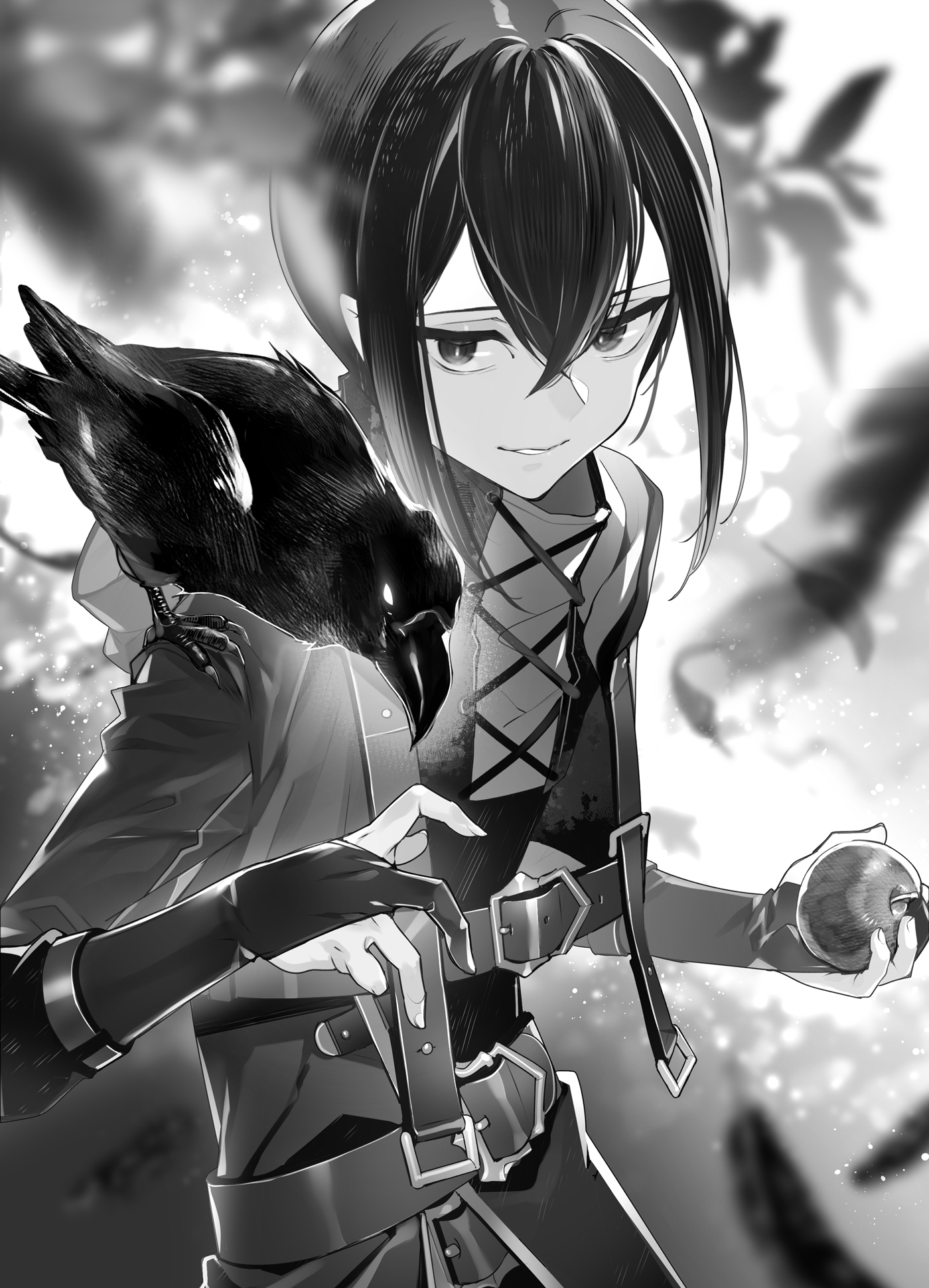
“Attaboy. Want this?”
The crow turned its head, refusing the fruit, and the boy chuckled. He finished it himself, savoring every mouthful.
“Any vultures about?”
The bird remained silent.
“Tell them to eat up before the humans come along. Eleven corpses should keep them fed for a while.”
As he licked the juice from his fingers, the crow cawed, and a dark flock descended on the scene of the attack—vultures. The boy watched with satisfaction as they tore into the corpses; he was on cleanup duty, and no one would bother identifying the remains.
Still grinning, he headed north, where Liliana’s coach had come from and where Hudore, the royal capital, lay.
◇ ◇ ◇
After the attack, Liliana’s journey home was otherwise uneventful. She safely reached her estate, ordered the escorts to interrogate the captured man to find out who had sent him, and then headed to her room.
Because she had returned to the estate later than expected, Liliana would need to wait until after dinner to read in the library. Still weary from the ambush, she couldn’t wait to change into something more comfortable and asked Marianne to assist her. Then she settled onto her couch with a cup of tea, finally able to unwind.
“It sounds like you’ve had a long day, my lady. Were you hurt in the attack?”
“My escorts dealt with it,” Liliana wrote on a nearby sheet of paper.
Marianne relaxed at the reply, relieved that her lady hadn’t gone through anything too awful. “That’s good to hear. How was the palace? You haven’t been there in some time.”
“His Highness was very considerate. I also met Austin Ealdred.”
“Oh my. The son of Duke Ealdred,” Marianne said. Being the daughter of Marquess Kenneth, she knew the nobility well.
“You know him?”
“Yes, I’ve heard rumors. He’s the duke’s second son, talented in both combat and study. People say he’s affable and popular with the ladies. He’s also known to have much in common with his uncle.”
Austin had proven himself quite the ladies’ man in the game. If girls were flocking to him now, it was frightening to imagine how adored he might become as he grew older.
“My lady, I fetched the books you were reading last night in the library. They’re on the writing table.”
Liliana turned to the table to find not just the spellbook she hadn’t finished, but a few related volumes as well. She was delighted—it meant she could study from the comfort of her room. Marianne had always had a knack for anticipating her lady’s wishes, but her talent had reached new heights since Liliana lost her voice.
“Thank you.”
She’s such an assiduous handmaiden, despite being due to enter noble society next year.
Marianne had never worked a job before serving Liliana, yet she had shown remarkable growth over the few years they had spent together. She was undoubtedly gifted, but her expertise had been honed through tireless effort.
I wouldn’t mind writing her a letter of introduction when she begins searching for a new position, if she wants one.
That was how deeply Liliana cared—though it didn’t change the fact that a girl of Marianne’s status should never have been working as the handmaiden of a duke’s daughter in the first place. Liliana couldn’t fathom why Marianne was still in her service, but the diligent young woman would surely marry into another family within a few years, as was customary for noble girls.
And if matters do not resolve themselves, I should at least help her find a good family to marry into, though she shows little interest in the idea.
Liliana’s gaze lingered on Marianne. The handmaiden seemed to take quiet delight in her duties as she assiduously set her lady’s belongings in order. Liliana had never asked if she had a man in her life—but even if she did, they could hardly have met with any frequency.
Setting her curiosity aside, Liliana drained the last of her tea, savoring its aroma. I shouldn’t get too deeply involved, she thought. Rather, I should let things take their natural course.
Marianne took the now empty cup from her lady and set it on a tray with the teapot. With no reason to go anywhere, Liliana settled in to read until dinner was ready.
Later, when she returned to her room, one of the escorts charged with interrogating the would-be assassin arrived to deliver his written report. Liliana accepted it and skimmed the contents, learning that her attackers had not been identified. The captured man had apparently taken poison in his cell, ending his own life and leaving nothing of consequence to be gleaned from the incident.
Did he really kill himself?
Marianne lit the bedroom’s fireplace, utterly unaware of her mistress’s thoughts. It may have been early summer, but the nights were still rather cold. Liliana tossed the report into the crackling fire, tilting her head to one side as she watched the flames consume it.
“Shall I prepare your bed?” the handmaiden asked.
Liliana shook her head and picked up the spellbook. It was a small gesture, but Marianne understood immediately, bowing before quietly leaving the room. Liliana waited a few moments, then locked the door behind her. The handmaiden would not return unless summoned.
The sun has set, and the body has surely not yet been disposed of.
It seemed almost certain that the man reputed to have taken his own life remained in his cell. The underground jail was vast, yet after some reflection, Liliana resolved to teleport there. Teleportation spells were taxing, but she didn’t have much trouble with them.
Rekke.
Again, Liliana employed her locating spell. Searching for mana would do her little good, as the man was already dead, but she could still focus on his body heat.
For the first ten hours after death, the body loses roughly one degree Celsius per hour. If our captive died soon after arriving, he must have lost only four or five degrees at most. I should still be able to detect him.
In truth, whether Liliana’s spell would locate the body was no more than a gamble. It was a chilly early summer night, and underground jails remained colder than the outside year-round. Thankfully, fortune favored her that day.
Found it.
The man had been taken to the deepest part of the jail, where the air reeked of blood, sweat, ammonia, and death. It was unbearable. Between the assault on her senses and the dismal atmosphere, Liliana wanted nothing more than to leave. But, steeling her resolve, she teleported past the iron bars into the man’s cell and crouched beside him to inspect his corpse.
The body was in dreadful condition. It was miraculous it still looked human. Evidently, the escorts had been thorough in their work.
It’s hard to make out with all the wounds, but there’s something drawn on his skin... A bird?
There was a small, barely visible tattoo at the base of the man’s neck. Liliana strained her eyes to see it, relying on the light of a spell. She had never seen the pattern before, but it looked like it could be a hex.
I could copy it down and look it up later. But if it really is a hex, who knows what drawing it might do?
Hexes hadn’t been studied nearly as thoroughly as magic, which meant they remained shrouded in mystery. Even just reproducing one could prove dangerous. Fortunately, the pattern was simple enough to memorize—and Liliana had a good memory to begin with.
Having decided against drawing the tattoo, Liliana turned her attention to other parts of the body. Though still an amateur in the field, she was able to estimate the time of death from the condition of the skin, the muscles, and the remaining warmth. The man had perished less than an hour after being locked up.
On inspection, none of the external wounds were lethal. It was reasonable to assume the man had taken his own life while the escorts were away, after they had tortured him. Yet there was no sign of any container that might have held the poison.
The report mentioned that too. Was it in his mouth all along?
If so, one had to wonder why he hadn’t taken it before the torture began.
Liliana still had questions, but the corpse had no more answers to give. So, she teleported out of the underground jail and back to her room, where she summoned Marianne and asked her to draw a bath. She feared the sickly odor of the cell still clung to her.
◇ ◇ ◇
As the crown prince’s fellow student, Austin paid regular visits to the royal palace. Today was no exception; he had come with his chamberlain. He sat through Mrs. Finch’s class, then accepted an invitation to Riley’s chambers. The boys relaxed over tea prepared by one of the maids, making use of a magical device that encased the entire room in a soundproof barrier.
“You’re almost at the end of your education as crown prince, right?” Austin asked, glancing out at the courtyard.
“Seems like it,” Riley answered, speaking as though it didn’t concern him.
Austin furrowed his brow, watching his friend out of the corner of his eye. “Is His Majesty not doing well?” he asked in a hushed voice, unable to think of another reason for the prince’s dejection.
Riley gave a slight nod. “Remember what you told me the other day? My father is hardly ever conscious at this point. During one of his brief moments of wakefulness, I sought his permission to discuss the matter with Mr. Bergson. I’ve asked the minister to investigate, but disease might be the only conceivable explanation.”
If, as Austin suspected, the king’s poor health was the result of a hex, they would need the help of a mage to remove it. But not just any mage. If the person attempting the dispelling lacked adequate training and knowledge, the hex would not only remain but could also have a harmful impact on everyone nearby. That was why Riley had sought the help of Nicholas Bergson, the Minister of Magic. He seemed the best candidate for the job, but that did little to ease the crown prince’s worries.
“As the next king,” Riley continued, “I’m expected to embody confidence no matter what—just as my grandfather did. I hate how terribly immature I feel.”
Austin bit his lip, lost for a response. Having occasionally mingled with commoners, he had friends and acquaintances among the lesser-ranked boys and girls his age. Compared to them, Riley seemed too mature, burdened with responsibility from the day he was born.
“State affairs have been stagnating ever since His Majesty became bedridden,” Riley explained. “Sure, the burden falls on the premier—but when the premier accumulates too much power, some nobles start to complain.”
The premier in question was Liliana’s father, Duke Clarke. He had already been one of the kingdom’s three most prominent dukes, but now he also served as the king’s representative, and many nobles took issue with the way he exercised his authority. Had they known about the countless notable policies he had enacted—or his political skill in general—since rising to prominence, they might not have complained; yet many voiced their disagreement nonetheless.
“I should do something, but I can’t risk adding to His Majesty’s burden,” Riley said. “He already has his condition to deal with.”
As much as it frustrated him, Riley was at an impasse, with no solution in sight. He may have received a crown prince’s education from a young age, but there was only so much he could do as a minor.
Though well aware of the shame gnawing at his friend, Austin could not pretend to understand how Riley felt. Their positions were already far enough apart. Still, the least he could do was stay by the prince’s side.
“You have a point,” Austin conceded with a nod. “No wonder you feel so low.”
“Indeed... It is what it is.”
Austin scratched his cheek. Being too considerate risked making him seem cold, but he wasn’t skilled enough to always maintain appearances. “Father said you’re one of the most talented crown princes this kingdom has ever seen—if not the most talented.”
“Really?” Riley asked, eyes wide with disbelief.
“Why would I lie?” Austin replied, forcing a sour look to hide his embarrassment. “I agree with that assessment, anyway.”
Riley’s cheeks flushed. He couldn’t hide his joy, no matter how hard he tried. Austin wanted to keep his friend in high spirits but lowered his voice to a whisper.
“Did you meet with Lady Liliana again today?”
“Yeah. She is the top candidate for my fiancée. Our meetings have felt a lot more frequent since she lost her voice.”
“Huh.” Austin paused, his expression serious. “And she’s still mute?”
“Indeed. Did you hear it from Mrs. Finch?” Liliana’s missing voice wasn’t public knowledge; Austin could only have learned about it from Riley or their teacher.
“You summoned her this time, didn’t you?” Austin asked, a glum look on his face as he dodged the question. “Why, if you know her voice hasn’t recovered yet?”
“I didn’t have much of a choice. It’s what His Majesty wants—to better guarantee her protection, he said. Not to mention...”
The remark about Liliana’s safety struck Austin as unusual, but he chose not to question it. “‘Not to mention’?” he repeated, encouraging his friend to continue.
“I feel there’s still much she can teach me.”
Austin groaned. He had known Riley long enough to tell that he was serious. The prince must have taken such a keen interest in Liliana because of the note she had written—the one echoing the teachings of Riley’s beloved grandfather. Even as Austin fought to suppress a sigh, his thoughts were plain to see; there were so many issues he wanted to raise that he didn’t know where to begin.
Riley only smiled awkwardly, showing no intention of backing down. “To be honest, I don’t understand His Majesty’s thinking either. If you assume I take him at face value, I can assure you I don’t—I just lack the power to question him. Not that I would abandon Liliana now that she’s lost her voice.”
There was an unmistakable fire in the prince’s eyes. He must have been torn between wanting to obey the king, who wasn’t the most politically astute, and searching for the actual best solution.
Austin gave up trying to be persuasive; he understood just how stubborn his friend could be. Nobles who didn’t know Riley well enough would insist he was unsuited to serve as crown prince, but in truth, he always strove to remain calm and impartial. That didn’t mean he was devoid of emotion—on the contrary, the fact he usually kept his feelings in check meant he was prone to the occasional outburst.
As he leaned back in his chair, Austin felt a twinge of frustration. Despite his best efforts, Liliana had beaten him to the punch in drawing out the prince’s true emotions.
Austin couldn’t see how following the king’s orders could possibly keep Liliana safe. If anything, Riley keeping her by his side and treating her as his de facto fiancée would only paint a target on her. Did the prince’s resolve stem from a sense of justice, or from his emotions?
“I saw Clyde yesterday,” Austin said.
Clyde was Duke Clarke’s heir and Liliana’s elder brother. Riley had spoken with him on occasion, as Clyde was to succeed one of the three major ducal families, but they weren’t particularly close. Hearing that Austin had met with him made the crown prince blink a few times.
“I told him Bergson might be able to do something about Lady Liliana’s voice.”
Riley was astonished. Was Austin seriously suggesting that Liliana might have lost her voice because of a hex?
“That can’t be...” the prince muttered. “If that were true, wouldn’t the duke have already sent for Bergson?”
“Maybe. But it’s better than saying nothing, don’t you think?” Austin asked sullenly.
Duke Ealdred was at odds with Duke Clarke, and Austin wasn’t thrilled about the latter’s daughter being chosen as the crown prince’s fiancée. But with the Arcacians’ growing influence, Riley’s position had grown precarious. Liliana was truly the only candidate of the right age and with sufficient backing—largely because, before Riley and Austin were born, every noble family involved in the failed coup against the previous king had been suppressed.
It was unfair to burden children with their parents’ grudges, and both boys knew it. Yet it was precisely because they understood each other so well that their arguments over Riley’s fiancée went nowhere.
“Anyway, how’s your training coming along?” the crown prince asked, trying to change the subject.
Austin saw straight through Riley’s intentions and forced a cheerful smile to dispel the gloom. “Rather well.” Back in his domain in Arcacia, he had received his father’s permission to join the royal knights’ order. Even since returning to Hudore, he hadn’t stopped preparing for his upcoming test.
“You’re pretty much guaranteed to get in, you know.”
Austin knew his friend was teasing him but frowned anyway, crossing his arms in an affected manner. “Yeah, well, I don’t want people thinking my father was the only reason I got in.”
The fact that Duke Ealdred’s second son was attempting to join the order was already a popular topic of conversation. If he succeeded, some unkind observers would insist it was only because of his father. Austin had, of course, trained more than enough to prove himself worthy of the role, but society would watch him more closely than any ordinary knight—for better or worse.
“You’ve got nothing to worry about,” Riley said. “You’re aiming for the Seventh, aren’t you?”
Of the nine corps that made up the royal knights’ order, Austin had set his sights on the Seventh. More than any other corps, it was famous for its merit system, where knights were judged strictly by their aptitude, not their pedigree.
Austin nodded, a bold grin spreading across his face. “That’s right. Distinguishing myself there would make it easy to become your personal guard. It’s not like I’m trying to join the First, who guard all and only royals.”
The aspiring knight’s words drew a delighted smile from the prince. Deep down, Austin felt relieved to see the tense expression his friend had worn during their earlier unpleasant exchange finally ease.
“How about a duel, Austin?” Riley asked, the thought just occurring to him. “It’s been a while.” Lately, his education as crown prince had focused almost entirely on studying, leaving him little time to brush up on his swordsmanship.
Austin chuckled. “Are you sure you want to challenge me?”
“I can’t ask the knight commander; he’s far too busy. And anyone else would hold back when they’re fighting me.”
Under normal circumstances, no one was allowed to duel the crown prince except his actual instructors. Exceptions could be granted with Riley’s permission, but even then, most would deliberately hold back—injuring the crown prince risked public outrage. As a result, Austin was his only true competition in sparring. They had won an equal number of times so far.
Ever since Riley had discovered the fun of no-holds-barred duels, he had openly referred to Austin as his best friend.
The pair made their way to the royals-only practice grounds, where they shed any cumbersome clothing and began with a light exchange of strikes. The longer the bout went on, the more heated it grew—and since Austin was seriously training to enter the order, the scales were tipped slightly in his favor.
“You sure have improved,” Riley said, his voice caught between glee and frustration.
Austin arched an eyebrow, effortlessly dodging the next sharp thrust. “We can’t have the future king outclassing his own escorts and knights, now can we?”
Riley only tutted in response, casting aside his usual princely composure.
“Should a crown prince really click his tongue?”
“It’s fine. You’re the only one in earshot.”
“That isn’t my concern.”
The clash of metal rang out once more as the boys traded blows without reserve, their expressions hardening as their senses sharpened. There was no better way to drive the unpleasant thoughts from their minds.
◇ ◇ ◇
Things were rarely so hectic at Liliana’s estate on the outskirts of Hudore. Liliana herself wasn’t busy, but Marianne, the other maids, and the guards were all rushing about, preparing for the trip to come.
To the south of Hudore lay Fortier, one of House Clarke’s duchies. Liliana’s brother, Clyde Benito Clarke, was hosting a banquet there to celebrate his eleventh birthday. She hadn’t kept in touch with him or their mother, but her father insisted she attend—for appearances’ sake.
I’d much rather stay here and read.
Learning magic brought Liliana far more joy than seeing her family. She enjoyed not just practicing the spells she found in spellbooks but also developing her own, and she looked forward to trying them all.
Clyde, a talented fighter and scholar, had the characteristic look of a glasses-wearing academic. He was trim and well-mannered, with a sharp, intelligent face. It was little wonder that he had been a romance option in the game—or that he had been a massive hit with its fans. He had forsaken Liliana in the end, which was one of the reasons she really didn’t want to run into him.
One means of escape would be to meet with His Highness, who has been summoning me more than usual of late. Not that I really want to see him either.
Every time she visited the palace, Liliana found herself the subject of gossip. The loss of her voice wasn’t widely known, but her presence alone spawned rumors. Malvina Tanner had already spread the word that Liliana was to blame for it—that she had tried to curse someone, only for the curse to backfire. Riley had been outraged when he found out, but since Liliana wanted to be rid of her candidacy as his fiancée, it had worked in her favor.
At our age, we normally don’t have much time for tea parties. Lady Malvina must have nothing better to do.
To strengthen her family’s connections, Malvina Tanner exchanged daily letters with her hangers-on, hosted tea parties in elaborate attire, and otherwise enjoyed a life of luxury. Her father was only a marquess, but it was hard to say how far she could push her extravagance before the money ran out.
I can’t even use hexes. Oh, but Liliana in the game could... Isn’t this practically cheating?
Once again, Liliana was amazed at what she could do. If she reached her full potential, she might even be able to use the kinds of spells deemed too complex for humans. Judging by the fact that Duke Clarke hadn’t sent a mage to see her, he must have been fine with her never regaining her voice. That, too, was good news for her.
In the game, Liliana had a voice, so maybe she met a mage through His Highness.
If the prince really did offer to introduce her, she would refuse. But what if she had done that in the game? The other Liliana must have suspected her lost voice was the result of a hex. And it wouldn’t be strange if, after recovering, she grew curious about hexes and taught herself to use them. Liliana knew that without her memories of her past life, she would have acted exactly the same way.
Liliana was drawn from her thoughts by a sudden knock on the door. She gave permission to enter, and Marianne stepped into the room.
“My lady, everything is ready for your departure.”
“Very well. Let’s go,” Liliana wrote, rising to her feet.
“I was told His Highness will also be in attendance, so I packed your prettiest dress,” Marianne said restlessly as she draped a cloak over her lady’s shoulders. “It’s wonderful how much he cares about you.”
Liliana gave an ambiguous smile. Not having a voice was convenient when she couldn’t think of a response. She wondered how other nobles would interpret the crown prince attending the banquet of an heir, even one from one of the three most prominent ducal families. It obviously had something to do with her father’s political designs.
Naturally, Duke Clarke would expect his daughter to behave in accordance with his intentions. She had yet to even depart, but the very thought of what might await her after a weeklong coach trip sapped the strength from her body.
I wish I could just teleport.
Liliana had never teleported with another person before, but she was confident she could at least bring Marianne. The problem was that teleporting would reveal she could use magic—and since she was studying in secret, she couldn’t afford to be so careless.
“As well as the usual two escorts,” Marianne continued, “a mage shall join you this time—at my request.”
Liliana cocked her head. For a trip like this, she would normally have only escorts and her handmaiden. House Clarke did employ mages, but not for her personal use.
Seeing her lady’s confusion, Marianne revealed a look of slight concern. “There seem to have been frequent monster sightings on highways and in nearby towns of late. This never used to be the case...”
Monsters almost never appeared on the highways branching out from Hudore. Their safety had always been their greatest appeal to merchants and travelers—but attacks were now on the rise. Against such ambushes, knights alone weren’t enough; to survive, one needed a mage capable of light magic.
Liliana reached for her paper and wrote, “Do you know which mage is accompanying us?”
“The Ministry of Magic shall send someone fit for the task.”
It would most likely be someone affiliated with the ministry. While not every mage worked there, nearly all the talented ones did—and they were practically the elite.
With monsters on the rise, the ministry will probably send a newcomer not tied up with internal work. Hopefully they’re nice.
Liliana’s mood lifted at the thought of having someone to ask about hexes. Her estate’s library wasn’t lacking, by any means, but there were barely any resources on the subject.
Knowing one’s enemy was the first step to victory. If her in-game self had mastered hexes, her current self would need to understand them too.
In the south of the royal capital, at the entrance to the highway to Fortier, Liliana prepared to meet the mage sent by the Ministry of Magic. Though mages were usually treated as escorts and traveled in separate carriages from their wards, arrangements had been made for this one to ride with Liliana and Marianne. If only Liliana’s coach were attacked, the mage needed to be close enough to intervene.
The coach came to a halt, and a knock sounded at the door. Marianne opened it to reveal a young woman in her early twenties, with violet eyes and wine-red hair that fell across her chest. Even her flowing robe—the mark of a mage—didn’t quite conceal the fullness of her figure.
“Hi there. Are you Liliana Alexandra Clarke?” the woman asked merrily. “The name’s Petra Myyrylainen. Call me Petra.”
As if it weren’t rude enough to speak to a duke’s daughter with such unabashed impoliteness, Petra hammered the introduction home with a wink. Marianne’s face went rigid, but Liliana grinned and produced the piece of paper she’d prepared in advance. It bore an apology for her inability to speak—and words of gratitude for the mage’s company.
Petra climbed into the coach, sat beside Marianne, and accepted the paper handed to her. “Huh...” She read the note with a smirk, then tucked it into her pocket and stared at Liliana’s mouth with obvious interest. “I knew you were a weird one.”
The mage’s tone was even less respectful. Vulgar, even. Marianne grew increasingly serious—not that Petra seemed to care—while Liliana forced a weak smile.
My in-game self would surely be furious by now.
Petra had never appeared in the game, but the in-game Liliana had practically radiated pride. At one point, she even lashed out at the main character—a girl of much lower rank—accusing her of breaching etiquette by making eyes at her fiancé, the crown prince.
Liliana understood noblesse oblige well enough and took the rules of a status-based society seriously, as befitted someone of her rank. Petra was a commoner, so it stood to reason that the in-game Liliana would have found her attitude just as offensive.
Still, even if I threw all my weight behind getting her convicted, I doubt she’d care.
Judging by her last name, Myyrylainen, Petra wasn’t from the Kingdom of Slivegrandia. Foreigners almost never made it into the Ministry of Magic, so if she had, she must have been skilled enough to silence the fussy government officials who usually blocked the way. Even more impressive, she had risen high in an institution steeped in male chauvinism. She was no random nobody; having her as an ally could only be an advantage.
One of the escorts shut the door, and the coach set off again. The highway was reasonably well maintained, though it still paled in comparison to the roads of Hudore. At least the ride was comfortable—the coaches used by ducal families were far sturdier than any stagecoach.
Inside the coach, however, the mood was far less pleasant. Marianne had no intention of speaking to Petra after the latter’s blatant lack of respect for Liliana, who continued to watch the mage with a calm, unbothered smile.
Even as she stared out the window, Petra’s interest in Liliana was unmistakable. She also seemed unusually cheerful. Perhaps that was to be expected—her job had been forced on her by the Ministry of Magic, whose senior officials couldn’t stand her. They would have claimed her bonus for themselves if they could, but the vice minister who had hired her ensured she received what she was due.
Petra had expected the duke’s daughter to be completely self-centered, but Liliana had pleasantly surprised her. The trip was already proving far more enjoyable than she anticipated.
◇ ◇ ◇
On its way to Fortier, Liliana’s coach would stop at several stage-station towns. Her first night was to be spent in one that doubled as a checkpoint, its inns and eateries clustered around a church. Broad moats and towering walls hinted at its past as a fortified city, while the streets swelled with travelers staying the night.
Liliana and her entourage had arranged to sleep in a first-class inn just beyond the checkpoint. Privacy there was paramount: Patrons rented not only a room but an entire floor, complete with quarters for maids, chamberlains, and escorts. Each level had its own entrance and staircase, ensuring that guests would never cross paths by accident.
After her evening meal in a private dining hall, Liliana retired to her bath.
“Will you be reading again tonight, my lady?” Marianne asked.
Liliana nodded; she had made a pleasant habit of reading before bed. Her handmaiden understood at once and, leaving the light on, withdrew to the adjoining room. Her own quarters lay next door, close enough to answer should her lady need her urgently.
Once alone, Liliana cast a sleep-enhancing spell on Marianne, then secured her own chamber with a soundproof barrier. She waited for the right moment—then teleported.
“You actually came,” said a merry voice.
Liliana took in her surroundings, then cast an unperturbed glance at the only other person in the room—Petra, who was settling into one of the spare chambers for maids.
“Well, well... I never expected to see someone your age use teleportation magic. And without a sigil, no less. I thought only I could do that.”
With a hearty chuckle, Petra opened one of several bottles of alcohol she’d bought in town and took a bite of a thick piece of meat.
Normally, teleportation required two sigils—one borne by the caster and another inscribed at the intended destination, serving as a landmark to ensure a safe arrival. But that didn’t mean anyone could teleport. The caster needed a wealth of mana, a high aptitude for the spell, and, above all, a way to guarantee the safety of their destination. As a result, very few people could actually use teleportation in practice.
Liliana’s mouth curled into a genuine smile. She had taught herself teleportation magic, and it felt good to have someone acknowledge her progress.
“Good evening. Thank you for accepting my request on such short notice.”
Petra’s eyes went wide as saucers. She had gone from mildly enjoying the situation to staring at the girl across from her in utter disbelief.
Ignoring the mage’s astonishment, Liliana continued, “I think it goes without saying what I’m doing right now.”
“Eh...”
Petra could hear Liliana’s voice, yet the girl’s lips hadn’t moved at all. They were frozen in a serene smile.
“Tele...pathy...?” Petra uttered, her voice hoarse as the cogs in her mind whirred back into motion.
Liliana nodded, her grin growing notably more charming.
Telepathy was a spell that directly affected the target’s mind to relay speech. Most assumed that it was impossible for humans—that only demons and spirits could wield it—yet here was Liliana, performing it with ease. Few things could render Petra speechless, and this was one of them.
At last, Petra laughed, shook her head, and gestured for Liliana to sit on the couch across from her. The girl had more than met her expectations.
“Are you even human?” the mage asked, dauntless, once Liliana had taken her seat.
“I most certainly am. But it would put me in danger if word got out that I could use telepathy. You’re the only one who knows.”
For safety’s sake, Liliana should have kept her telepathy a secret even from Petra. But that was a mere scruple compared to the reason she had teleported.
The mage heaved a sigh, finally recovering from her surprise. “It’s an honor, I’ve gotta say. I wondered about you when you handed me that note.” She took a swig of alcohol, then leaned forward with curiosity. “Tell me—what kind of spell are you using for your telepathy?”
“It’s nothing special. Spells are, at their core, just systems that allow anyone to use magic that connects phenomena with imagination.”
Liliana had reached this conclusion through her study of magic. One could say she had only recognized the importance of imagination thanks to her memories from her past life.
Magic required an appropriate amount of mana—but without something to embody the spell, like an incantation or magical device, it wasn’t possible to efficiently convert mana into magic and produce the desired effect. The magic would dissipate without ever manifesting. Conversely, entities with enormous mana—such as demons and spirits now relegated to history books—could easily wield magic without spells.
Petra fell silent for a moment, then burst into laughter. “Try saying that to those shmucks at the Ministry of Magic! I guarantee they’d lose it!”
“My sincerest apologies.”
Liliana’s words were anything but sincere. Two of the Ministry of Magic’s key functions were developing and systematizing spells. Claiming that spells were useless was essentially the same as saying the ministry had no purpose.
Petra laughed even harder, almost cackling. “Don’t worry—I’m a heretic in their eyes anyway. I agree with you. If we get too hung up on systematizing magic through spells, as is happening now, it’ll never progress.”
Liliana sighed inwardly in relief. She had come to ask Petra questions, and angering the mage would have hurt her chances of getting useful answers.
Across from the couch, Petra seemed beside herself with interest. “Damn. I still can’t believe you’re using telepathy. The spell is incomplete, and none that are theoretically correct actually work. Not to mention—it’s banned. A girl your age shouldn’t be able to use it so freely. So, how’d you manage it?” Beneath an air of displeasure, she was brimming with childlike curiosity.
“Picture dropping a stone into a large pond and watching the ripples spread. Hearing works much the same way: Air is the water, and sound is the ripples. Now, imagine we were at opposite ends. For my voice to reach you, those ripples would need to travel all the way across the pond. This spell skips them entirely.”
Of course, the transmission of sound was a bit more complex, involving the eardrum, middle ear bones, and auditory nerves—but medicine in this world wasn’t advanced enough for that to make sense. To complicate matters further, Liliana’s spell was essentially the theory of brain wave synchronization through quantum entanglement put into practice. An oversimplified explanation was therefore necessary.
Petra frowned, clearly not following at all. “Did you make a pact with a spirit or a demon?” she asked, scratching her head.
The mage spoke in jest, of course, but it was the only way she could make sense of the situation. Spirits and demons were generally believed to exist only in legends and stories, and even those who thought they were real agreed they had long severed contact with humans. Moreover, while spirits were said to aid humans, demons were invariably depicted as hostile. Even on the rare occasions they offered help, the powers they granted were limited and came at a heavy cost.
Petra mused for a while, her eyebrows nearly meeting above her nose, before finally conceding with a sigh and an awkward smile. “Well, you don’t seem to be lying. I guess you just tried it, and it worked, eh?”
“Pretty much.”
Liliana bowed her head slightly in a gesture of apology, but the mage refused it. Petra then picked up a sheet of paper from the table, holding it between her index finger and thumb—the note Liliana had given her on their first meeting.
“I was shocked when I first saw this. The last sentence is magical, right?”
“Yes. I wanted to speak with the mage assigned to accompany me, but I had no way of knowing your magical expertise without meeting you in person.”
On the surface, the last sentence of the note read, “May we have a pleasant journey together,” but it was actually enchanted with a spell that could alter its appearance. By focusing her magic on it, Liliana had rewritten it as “I shall come to your room tonight.” Undoing the spell reverted the change instantly.
During their first meeting, Liliana had watched closely to see where Petra’s eyes wandered. When she noticed the mage do a double take, clearly noticing the enchantment, she concluded that Petra could be trusted.
Having come clean about her intentions, Liliana got straight to the point, a broad grin spreading across her face. “There’s something I’d really like to ask a mage of your caliber.”
Petra returned the note to the table and smiled just as boldly. “I like people who don’t beat around the bush. Here—drink. I got this just for you.”
The mage took a bottle of lemonade from a box beside the table and offered it to her companion. Only then did Liliana realize that there were no glasses, and that Petra was drinking her alcohol straight from the bottle.
As a young noblewoman, Liliana had never drunk out of a bottle before. Perhaps she had in her past life, but no such memories came to mind. Bringing the lemonade to her lips, she took her first sip, her heart racing at the sense of doing something forbidden. The taste was cheap—but not at all unpleasant.
Liliana had already decided what to say to Petra. Not wanting to waste another second, she launched straight into explaining her predicament.
“I lost my voice after catching a fever during an epidemic.”
Petra nodded, urging the girl to continue. She already knew that Liliana had lost her voice.
“The doctor gave up on me, and my attempts at using healing magic on myself produced no discernible results.”
She quickly ruled out the possibility that she had simply miscast it. Her healing magic was strong enough to revive dying plants and restore wounded birds to flight.
Petra hung on Liliana’s every word. Even as her face flushed slightly from the alcohol, she didn’t interrupt.
“So I began to suspect I’d lost my voice to a hex, but I’m having trouble finding any literature on them...” For all the rare books her uncle had collected at her estate, there was hardly anything about hexes.
Petra nodded, unsurprised. “That’s because hexes are seldom studied in this country. They’re practically taboo, and new information about them is rarely made public. Learning hexes on your own is nearly impossible.”
The mage pursed her lips, eyes lowered in thought. Her usual manner made it easy to overlook her striking beauty, which surfaced only in moments of calm reflection—not that Petra seemed to notice. She cared only for magic and hexes; why else would she listen so intently to Liliana’s tale or regard her superhuman magical powers with curiosity rather than fear?
“It’s no surprise healing magic didn’t work—it’s suited to cuts and bruises, not colds or broken bones. It works by channeling the healer’s mana into the affected area, improving the flow of mana and boosting the body’s restorative ability.”
As if lacking access to modern medicine weren’t bad enough, the benefits of healing magic had their limits. They could never cure illnesses of unknown origin or heal injuries beyond one’s restorative ability. Even a known heart disease would require enormous amounts of mana for treatment—far more than any human could possess.
“Then again, I’m sure the healing magic you tried wasn’t exactly simple.”
Petra’s guess was spot-on. If Liliana had truly lost her voice from the fever, her speech-controlling cranial nerves would have been affected, and she had already tried using healing magic to restore them. Repairing the matter itself was far more mana-efficient than attempting to improve the flow of mana.
“Perhaps it was a bit different.”
“Figures. And if you couldn’t succeed, it’d probably be pointless for me to even try.”
Liliana could see the genuine admiration the mage had for her. “It’s an honor,” she said, keeping her happiness in check.
Petra squinted at her companion, crudely inspecting her mouth, then her throat, then her chest. Liliana remained silent, waiting for a response. Eventually, the mage’s violet eyes began to sparkle.
“Yeah—I sense a strange, lingering presence between your mouth and throat.”
At once, Liliana put a hand to her throat. She had felt something was amiss the moment Petra pointed it out.
The mage smiled reassuringly. “Don’t worry—it won’t kill you. It must be inconvenient, though.”
“Yes, it is.”
Liliana’s lost voice wasn’t much of an inconvenience for now, but she wanted perfect health to avoid a grim fate down the line. It was a perfectly natural wish.
Petra cracked an unreadable grin. “Well, I can’t imagine you, of all people, being stuck in a hopeless situation.”
The mage drew a ring etched with intricate engravings from her pochette, slid it onto her right middle finger, and murmured an incantation that barely made it past her lips. A haze Liliana took for mana formed over her eyes. Petra remained in her trance for a while, possibly unaware that Liliana was watching. Eventually, she returned the ring to her pochette, and the haze vanished.
“The most I can tell is that there’s a hex on you, and it’s probably why you can’t use your voice. I’d need to do a proper analysis to know more, but that comes with risks. Once this job is over, I’ll invite you to the Ministry of Magic.”
“The Ministry of Magic?” Liliana blinked repeatedly, taken aback by the suggestion.
“As much as I hate the guys there, it’s resistant to the effects of hexes and magic,” Petra continued casually. “It should be safe to analyze that hex of yours there, at least for anyone uninvolved.”
It was an attractive proposal—not just because Liliana wanted to analyze her hex, but also because it was a rare opportunity to enter the Ministry of Magic. To an ordinary person, merely setting foot inside was a pipe dream. Liliana couldn’t suppress a smile as her heart leaped for joy. A natural sight for a girl her age, it took Petra entirely by surprise, as Liliana had gone to such great lengths to hide her emotions until that moment.
Liliana leaned forward, oblivious to the mage’s surprise, and said, “I’d be most grateful.”
At first, Petra was speechless, but she soon erupted in throaty laughter. “You really are strange, you know that?”
Liliana tilted her head to one side, unsure what her companion meant. Petra rose from her seat in awfully high spirits and fetched a box from the corner of the room.
“What’s that?”
“A little something I picked up in town. Want some?”
“Oh my.”
Petra opened the box to reveal various fruits, all perfectly chilled. It must have functioned as a refrigerator.
“Don’t mind if I do.”
Liliana reached for a strawberry. Strawberries weren’t normally sweet in this world, but this one was. Indeed, all of Petra’s fruits were. The mage herself continued enjoying her meat and alcohol.
“So you share my interest in hexes, do you?”
“I find them most curious, but there’s only so much I can learn on my own. Even expressing an interest in hexes could get me labeled a heretic or treated like a problem child.”
“You’d be labeled a heretic for the magic you can use now,” Petra said wearily, then looked up and shook her head.
Liliana returned an awkward nod. The taboo nature of her magic was exactly why she had chosen to study it in secret. “That’s why only you know about it, Ms. Myyrylainen.”
Petra threw her arms around herself and shuddered. “As I said, call me Petra. I’m not big on formalities.” She seemed genuinely uncomfortable—at least until a broad smirk spread across her face. “How about this? I could teach you the basics of hexes over the course of our trip, if you have time.”
Liliana’s eyes lit up. Her main goal was to get help in regaining her voice—but if she could learn about hexes as well, so much the better.
“Oh my. Would that really be all right?”
“Of course,” Petra said, not bothered in the slightest. “I wouldn’t have offered otherwise.”
“I sincerely appreciate it. Please allow me to compensate you for analyzing the hex on my throat, and for teaching me about hexes in general.”
“What? Compensate me? Are you serious?”
Petra had already been surprised several times during their conversation, but now she looked at her wits’ end. Liliana couldn’t understand why. The mage sighed deeply, looking up at her through the gaps in her wine-red bangs.
“A noble girl—especially one your age—would never think to compensate a commoner like me.”
“Is that so?”
“You’re, what, six or seven? Noble kids your age think it’s only natural to have clothes, food, an education, and a place to sleep. The fact that regular people have to pay for them never even crosses their minds. Then again, I had a hunch you were an oddball from how few coaches you brought.”
Liliana met Petra’s observation with skepticism—but the more she considered it, the more it rang true. Before regaining the memories of her past life, she had been a typical noble child, treating her servants like inanimate objects. She had never realized they had thoughts and feelings of their own—that they worked at the estate to earn money to sustain themselves, and that they had families waiting for them at home.
Pushing those musings aside, Liliana offered a composed smile. “This is simply who I am. I cannot be anyone else. I’m ashamed to admit I don’t know the going rate for your services, so please tell me if this is too little.”
Liliana made her offer: a sum just shy of what Petra would earn for accompanying her on this trip. The mage gave a nod, her satisfaction tempered by disbelief.
“It’s enough. For this price, I’ll even teach you about hexes once we’re back in Hudore.”
“Why, thank you,” Liliana said warmly. “I’m pleased to hear it.”
Petra opened another bottle of alcohol. “So, when do you wanna start? I wouldn’t mind today, if you’re up for it.”
Liliana checked the clock. It was already late; their conversation had stretched on longer than expected.
“We have to leave early tomorrow, so could we postpone my first lesson until next time?”
“Of course. Far be it from me to keep a kid up past her bedtime,” Petra said with a smirk, as if getting back at her companion for all the surprises.
Liliana nodded, paying the jab no mind, and rose to her feet. “This conversation has been as valuable as it has been delightful. I entrust myself to your care for the remainder of our long trip.” She bowed gracefully—and then vanished into thin air, having teleported without an incantation.
Petra froze in place, bottle of alcohol in hand. She might have thought the whole exchange a dream if not for the empty bottle of lemonade. When she finally returned to her senses, she slumped back into her chair.
“Oh, right... She’s still mute. But a kid her age, with so little experience of the world, teleporting around without incantations? Yeah, I give up.”
With that, one of the Kingdom of Slivegrandia’s most prominent mages admitted defeat. Liliana didn’t just have more mana—she also had a greater aptitude for magic.
◇ ◇ ◇
Despite rumors of monster attacks, Liliana’s journey to Fortier proceeded without incident. She traveled by day and met with Petra at night for her secret lessons on hexes.
Inside the coach, solitude reigned supreme—at least until their third day on the road, when Marianne’s attitude toward Petra began to relax. By the fourth day, things actually seemed rather amicable between them. Perhaps the handmaiden was influenced by the calm between Liliana and Petra, or maybe she figured that adding to the tension could negatively affect her charge.
“My lady—we shall arrive at the estate in Fortier tomorrow,” Marianne joyfully said.
The handmaiden’s announcement was welcome news. They may have only been riding in a coach, but the journey had still proven mentally exhausting. Their last planned stop was an inn in a large merchant town closer to Duke Clarke’s duchy than any other. Situated in the heart of a seemingly endless forest, the town was said to be full of souvenir shops and eateries. It was no wonder Marianne was excited.
For the rest of the day’s journey, Marianne cast questioning looks at Liliana. It wasn’t until they reached the inn and finished unpacking that she finally voiced her concern.
“Are you sure you want to eat out with me, my lady?”
Marianne had expected her charge to spend the evening in their high-class inn, as she had at each of their previous stops. Instead, Liliana requested dinner at one of the town’s many eateries, since it was the final day of their journey.
“Yes,” she wrote, well aware of Marianne’s concerns.
Liliana had no need to experience the life of a commoner. If all went according to plan, she would progress from noble to crown princess to queen. However, if the events she had witnessed in the otome game came to pass, there was a real chance she could lose her status as a high-ranking noble entirely. For her own peace of mind, she wanted to familiarize herself with aspects of commoner life in preparation for that outcome.
But that wasn’t her only reason.
Ever since we set out, my meals have been laced with a nonlethal amount of poison.
It had never happened at the estate. Even on the road, her food was being tested for poison, but the dosage was so small that the taster hadn’t noticed. Liliana had discovered it only because of her recent obsession with testing a spell that analyzed the contents of whatever it was cast on. It was a troubling situation; if consumed often enough, even small doses of poison could leave her incapacitated. Her young body might not withstand the strain over the course of their long trip, leaving her so weak she could eventually die.
Liliana found that the poison was always confined to one part of her food, so all she had to do was avoid it. She wanted to learn the spell that neutralized poison, but as far as she could remember, it wasn’t listed in any of the spellbooks she had read.
My father has many political enemies, so I suspect one of them is to blame. Let’s see how they react to an unplanned outing. It’s a good opportunity to see what they’re capable of.
The potential culprits she could think of were the Arcacians, who supported Duke Ealdred; the loyalists, who feared Duke Clarke might grow too powerful; House Tanner, whose daughter was the second-best candidate for the crown prince’s fiancée; and the imperials, who sought to kowtow to the neighboring empire. There was too much chaos to know for sure who was behind the poisoning, but all risks had to be considered.
Marianne sighed, knowing her mistress wasn’t going to budge. Liliana got her way, and they headed into town with Petra and the two escorts. Rather than a fancy establishment catering to high-ranking nobles, they went to a simple, unpretentious eatery that looked popular with the masses. Its clientele was likely a mix of low-ranking nobles and well-off commoners with something to celebrate.
Though the handmaiden hadn’t managed to stop Liliana from eating out, she insisted that the owner at least give them a private room. She didn’t even feel comfortable letting her lady choose her own food, though Liliana didn’t mind. In the end, they ordered either what Petra wanted or what the owner recommended.
“Meat and drink are all I need, really,” Petra said bluntly—after placing a heap of orders.
“Would you kindly refrain from alcohol?” Marianne chided. “You are being paid to protect someone, if you recall.”
The two escorts looked nervous and out of place, having never dined with their mistress before. Still, they took bites of every meal and sips of every drink—partly out of gratitude and partly to test for poison. Liliana savored the meals, which were warmer than those served at the estate. They were free of poison, so whoever the culprit was clearly hadn’t anticipated their outing.
“This wild boar is to die for,” Petra gushed as the owner brought more food.
“Yes, this kind of boar only shows up in these parts,” the owner replied. It was apparently a famous local specialty.
“Really?” Marianne asked, clearly surprised.
At first, the owner merely nodded. Then, realizing he should probably be more affable, he launched into a hasty explanation.
“We’ve got the forest right on our doorstep, see. It’s not the safest place—deep ravines, steep cliffs, and all that—and the canopy’s so thick it blocks out the sun. They say there are monsters too, and anyone who gets lost in there never comes back. That’s why hunters stick to the edges. They’ve even marked some trees to help ’em keep their bearings and remind ’em when to turn back. So yeah, it’s dangerous all right—but its beasties make for some mighty fine cooking. That’s how our town got famous for delicacies you can’t get anywhere else.”
“Interesting. So they’re exclusive to these parts, huh?” Petra asked, her eyes alight. “Could you recommend any local brews?”
“Ms. Myyrylainen...” Marianne warned. “If you don’t behave, we’ll be asking for our money back.”
“I know, I know.” Petra pouted, looking on the verge of calling the handmaiden a stick-in-the-mud. “I was just asking.”
The owner beat a hasty retreat, and Petra said no more about alcohol. The escorts, evidently not ones for conversation, focused on their meals in silence. Once everyone finished eating, they began making their way back to the inn—but not before Petra purchased some dried meat, beans, and other items from the owner, most likely to go with her drinks.
She probably intends to buy some alcohol when no one’s looking.
Unbeknownst to Marianne, Liliana was meeting with Petra practically every night for lessons on hexes—and on each occasion, her teacher had drunk generously. The mage must have had an impressive tolerance for alcohol, as she always seemed perfectly sober by morning.
After the short journey back to the inn, Liliana asked her handmaiden to help prepare her for bed, as usual. Then, once Marianne had retired to her room, Liliana deployed a soundproof barrier and teleported. She arrived at her destination to find Petra clutching a bottle of alcohol—a predictable sight. The mage smirked the moment she saw her student.
“There you are.”
“Indeed. Thank you for having me.”
They had fallen into their roles quite naturally. Petra proved a surprisingly capable teacher, presenting ideas in ways that were easy to comprehend, while Liliana’s unique way of thinking consistently exceeded the mage’s expectations. Sometimes, their lessons even erupted into the kind of heated debates one might expect between two researchers.
“Are those drinks you bought here?”
“Yeah. Got them while you were getting ready for bed. You gave me plenty of time. We commoners can get ready in five seconds flat.”
Five seconds was surely an exaggeration. Liliana took the seat offered to her while Petra happily snacked on her dried meat.
“Gotta say, that maid of yours is a real sourpuss. She’d give those shmucks at the ministry a run for their money.”
Liliana chose not to press the matter. For better or worse, she had no acquaintances in the Ministry of Magic. Though she hadn’t known Petra long, she was certain the mage wouldn’t mind her silence—and Petra, in turn, knew Liliana wouldn’t take offense.
“My drinking never gets in the way of my duties. Here, I got you something.”
Petra gestured to a well-presented package on the table. Inside, Liliana found three bottles of juice.
“Supposedly, it tastes even better than lemonade. Take whatever you don’t finish with you.”
“Why, thank you.”
Liliana gratefully accepted the juice. Throughout their journey, Petra had bought her all sorts of local specialties and souvenirs, letting her try them under Marianne’s nose.
Petra grinned in satisfaction and took a swig of alcohol to wet her whistle. “Well then, shall we review what we’ve covered these past few days?”
The first thing Liliana had learned was the distinction between magic and hexes. Magic drew its power from mana, whereas hexes could produce the same effects with or without it. Magic could be categorized into the four basic elements of fire, wind, earth, and water and the two special elements of light and darkness, but these classifications were regional. In the east, magic was believed to consist of wood, fire, earth, metal, and water.
All the books on magic in Liliana’s estate sorted magic into six elements, with no mention of the alternatives. Evidently, Petra knew more than the people of Slivegrandia.
Liliana answered each of Petra’s questions concisely, earning a clap from her teacher. “Correct,” the mage declared. “You’ve got the essentials down. I knew you had it in you.”
Liliana shifted uncomfortably in her seat. She had never received a compliment before meeting Petra. The first few times, she had responded modestly, but she knew better now—the mage always protested, insisting that Liliana was promising and encouraging her to be more confident.
“Hexes don’t require mana, so even people without it can use them if they know how. At least, that’s the common assumption.”
“Is that not actually true?” Liliana asked, confused by her teacher’s roundabout phrasing.
“Nope,” Petra said, beaming. “Nobody knows why, but the more mana someone has, the better their hexes.”
It had apparently been proven through several studies, which Liliana found convincing enough. Perhaps unraveling the link between the amount of mana a person had and the potency of their hexes would shed light on the nature of mana itself—if such a thing were even possible.
“What is mana?” feels more philosophical than anything else. We’d probably have as much luck defining it as we would explaining why a cation carries a plus sign and not some other arbitrary symbol.
Indeed, definitions were a labyrinth without end. Liliana gazed absently into the air before snapping back to her senses.
“So, what happens to the target of a hex?”
“They’re affected whether they have mana or not—though the presence of mana changes both how the hex affects them and the means by which certain, more noticeable hexes are applied. Some hexes are lethal only to those with mana, while others are lethal only to those without. In that sense, they’re more varied than magic. You could use a hex to make an invisible monster—we call them spirits in the world of hexes—possess your victim. That’s not something magic can achieve. Then again, I doubt you’d find someone who wouldn’t burst in the process.”
Petra paused to take another swig of alcohol, her smirk betraying how much fun she was having. She must have been enjoying her drink as well, as she took several generous gulps in a row. Liliana had recently realized that her teacher favored hexes over magic, and as a result, her own knowledge of hexes had been growing exponentially.
“You can incorporate magic into hexes,” Petra continued, “though it doesn’t work with just any spell. Dark magic blends fairly easily—it has a high affinity with hexes, since both are curses. Light magic, on the other hand, resists it, mixing about as well as oil does with water.”
Liliana sipped her juice, savoring the crisp apple flavor. She then accepted a piece of dried meat from Petra and took a bite, though the taste was too strong for her.
“It’s the same wild boar we had for dinner,” Petra said, stuffing her cheeks. “It tastes so different because of the way it was cooked. I prefer it like this, personally.”
Liliana wasn’t at all used to tough food; she was barely halfway through her first piece when Petra reached for seconds. A fond smile tugged at the corners of the mage’s lips as she watched her student gnaw at the meat.
“Hexes are barely studied in this kingdom,” Petra noted, diving straight back into her lecture. “That’s why people assume all magic tied to hexes is dark magic. You can incorporate hexes into magic of other elements, though.”
Not just dark magic...?
Liliana was taken aback. From the various books she’d read, she had assumed dark magic was banned primarily because of its strong affinity with curses. Learning that hexes could be integrated with other kinds of magic changed everything.
“You can incorporate them into the four basic elements, though people in this country aren’t aware of that,” Petra added, noticing Liliana’s astonishment. “They even work with light magic, but that’s no easy feat—you’d need a good sense for it.” The mage took another bite of dried meat, then mused aloud, “Maybe I should get more of this. For gifts, I mean. It’s great, and the fact it keeps so long makes it even better. We’ll stop here on our way back, right?”
The meat’s long shelf life made it an excellent gift, Liliana thought, but that wasn’t why Petra wanted more. Clearly, the mage wanted more snacks for her evening drinking sessions in Fortier. Liliana had to suppress an awkward smile.
“When you think of it that way, hexes can be considered a kind of magic,” Petra continued, returning to the lesson’s focus. She always became livelier when speaking about hexes. “Of course, there’s a key difference between the two. With magic, the effects appear almost instantly after activation. Hexes can also produce immediate effects, but they don’t have to. What sets them apart is their potential for delayed attacks.”
“‘Delayed attacks’?”
“Yep. Take a hex that uses seeds, for example.”
Petra picked up one of the beans she’d bought to snack on, and an aura dark enough to inspire a shudder began emanating from her. Liliana’s eyes were glued to her teacher.
“Real or not, it doesn’t matter. The seed is just a metaphor, at the end of the day. So, what you do is plant this into the target.”
Petra held the bean between her thumb and index finger, showing it to her student. It was fried, but it sprouted anyway. Liliana couldn’t hide her surprise.
Pleased with the reaction, Petra tossed the bean into her mouth. “Beans use mana to grow inside the target’s body. When the right time comes, or some trigger occurs, they bloom, completing the hex and cursing the target. Any seed will work, though poisonous ones have a stronger effect. Of course, there are other ways to hex people as well.”
Petra laughed unreservedly, lifting the mood that had begun to turn heavy. Liliana released the breath she hadn’t realized she was holding as her teacher reached for more beans, perhaps having grown tired of the dried meat.
“There’s a lot to be said about hexes, but what’s both annoying and interesting is that they’re not as systematized as magic. Magic has spells, so even if your mana goes haywire or your spell fails, there are ways to deal with it. Hexes, however, don’t follow fixed models. If someone using one loses control, there’s nothing anyone can do. It won’t stop until it affects the target, bounces back on the caster, or produces some other consequence.”
“Hexes aren’t common in Slivegrandia or its neighboring countries, I suppose. Are there any countries where they’re more prevalent than magic?”
Even in the vast Empire of Yunatian east of Slivegrandia, magic was said to be more common than hexes.
Petra flung a handful of beans into her mouth, chewed for a while, then nodded and swallowed. “I’ve heard there’s a place far east of the empire where hexes are more common. I can’t speak for the present, but many years ago, they even considered words to be curses. From that perspective, curses are a hex thing. Magic has spells that can bring misfortune or disasters, but they’re all banned and aren’t technically curses. Besides, there aren’t as many types of spells as there are hexes, and their effects are weaker. In that sense, magic is for amateurs.”
Liliana found her teacher’s explanation remarkably easy to follow. Hexes had no fixed models, making them harder for amateurs to use—but the idea of wielding such unrestricted power was exhilarating.
Petra continued, seemingly fanning the flames of Liliana’s imagination. “What this means is that new hexes are being created all the time. Dispelling a hex is far harder than dispelling magic, mind you. With magic, you can examine the spell to figure out how to undo it, but hexes don’t have spells.”
That, Liliana realized, was precisely why Petra found hexes so alluring. After coming this far in the lesson, she finally understood what her teacher was getting at.
“So that’s why we need to analyze the hex on my throat.”
“Exactly. Only after analyzing it can we understand what effects it might have when dispelled and how best to deal with it.”
Sometimes, analyzing a hex could cause it to transform. Given the risk of adverse effects during the process, such an analysis couldn’t be undertaken lightly.
“It’s a real pain,” Petra grumbled. It was strange to hear her openly annoyed, but Liliana paid it no mind.
“We’re going to the Ministry of Magic to minimize the risks of analyzing the hex on me. Is that it?”
“Yes, exactly.”
Liliana now understood why Petra had invited her to the ministry, but the mystery only deepened. In the game, how had she learned hexes and cursed the crown prince and the heroine? She remembered being convicted of using dark magic, but judging by Petra’s explanation, her in-game self had probably relied on hexes rather than dark magic.
Maybe someone helped me.
The topic of hexes was far too complex for Liliana to have mastered alone. She must have had an accomplice. Yet no matter how hard she racked her memory, she found no answers. Information about the villainess Liliana was scarce to begin with, especially compared to the protagonist and the romanceable characters. The game unfolded from the heroine’s perspective, meaning all facts were presented as she understood them. Objective truths were almost never revealed.
Liliana stared at the woman before her. Petra had never appeared in the game. Her name hadn’t even come up in any related materials. The game’s events were still seven years away, and the mage wouldn’t be present for any of them. If she had been the one to teach Liliana hexes, her absence seemed strangely abrupt.
Unsure what to think, Liliana let out a quiet, inward sigh. I just don’t understand.
◇ ◇ ◇
In the end, Liliana’s group encountered not a single monster on their way to Fortier. Grateful for their good fortune, they continued toward one of Duke Clarke’s local estates.
The duke had various residences to choose from when visiting the duchy—manors he stayed at when carrying out inspections, and villas where he could escape the heat—but the upcoming banquet was to be set in the main estate: the one nearest Hudore, with easy access to the highways. By the time Liliana’s coach reached its gates, evening had already fallen.
Marianne draped a cloak around her lady’s shoulders—the temperature had begun to drop—and watched as Liliana accepted an escort’s hand to step down from the carriage. A butler named Philip and several maids came out to meet them; the housekeeper was nowhere in sight. Liliana couldn’t help but laugh at the less-than-cordial reception.
I can already guess how I’m going to be treated.
Philip wore a stiff expression. Since Liliana still couldn’t speak, Marianne took charge of the conversation, brisk and businesslike.
“My lady is tired from the journey and will take dinner in her chambers. These are her escorts. Please see them settled near her quarters, as per our agreement.”
“I understand,” the butler replied, his politeness superficial. “Follow me, if you will. The maids will attend to the others.”
Marianne raised an eyebrow at that—and she wasn’t the only one.
Since when do I need someone to guide me?
Liliana may not have been a frequent visitor to the estate, but she still had her own chambers in Fortier. They were meant to be kept ready so she could stay whenever she wished. Naturally, she and Marianne both knew the way; Philip’s escort was completely unnecessary.
“The lady’s chambers have been moved elsewhere,” the butler said calmly, as if oblivious to their confusion. Liliana didn’t know who had given such an order, but the fact it had been made without her consent made one thing clear: They had no intention of treating her fairly.
Perhaps to break the eerie silence, Philip elaborated: “My sincerest apologies, but since the lady so rarely visits, the decision was made to prepare more appropriate accommodation for her. You needn’t worry—it has been kept in pristine condition for the approaching banquet.”
The excuse was almost laughable, but arguing with the butler would have been a waste of time. Marianne seemed to realize that too; instead of demanding her lady’s old chambers back, she said nothing and glared daggers at him.
Indeed refusing to budge, Philip led the pair toward Liliana’s new chambers, unconcerned with appearances. As they walked down one of the estate’s long hallways, something struck her as odd. Though she couldn’t place it at first, it quickly became clear.
There isn’t a single magical device here.
Her manor near Hudore didn’t boast many, but at least the entrance hall, parlor, and library contained a few. If this estate’s devices were concentrated elsewhere, she couldn’t sense them.
The chambers Liliana and Marianne were shown to were scarcely better than the rooms outside the main building—the kind a butler or housekeeper might occupy. Liliana’s old chambers had offered a gorgeous view and abundant sunlight, whereas these looked out on the forest and cookhouse and were far less luminous.
Marianne glanced around beside Liliana, bristling like a cat ready to strike. Philip seemed eager to avoid any trouble.
“We’re preoccupied with preparations for the banquet, so I must ask that you fetch the lady’s dinner from the cookhouse yourself,” the butler told Marianne.
“Very well,” the handmaiden replied at length.
Philip left in haste, and Marianne nearly slammed the door behind him. Liliana sank onto the couch.
“It’s better than a servant’s room, but that isn’t saying much,” Marianne groused. “This is unacceptable.”
Liliana shrugged, lips curved in a humorless smile. Complaining would do nothing. She was lucky enough that the chambers were clean.
“You must be tired,” the handmaiden said. “Allow me to fetch your dinner.”
The moment Marianne finished unpacking her lady’s things, she left for the cookhouse. Liliana assumed the capable attendant would be gone for some time, but she returned far sooner than expected, placing Liliana’s food before her and explaining what she had learned from the maids.
“Only the mistress and the young master are at the estate right now. The master should arrive tomorrow, and the guests two days from now, on the night before the banquet. As for the senior master and mistress, we can expect them tomorrow. That no one thought to announce that you, one of the hosts, have arrived is preposterous.”
Marianne was still seething, but Liliana remained calm. She had never expected better treatment, so she simply ate in silence.
Once her lady finished, Marianne gathered the tableware and left to return it. Liliana took the opportunity to cast rekke, curious about Petra’s and the two escorts’ rooms. They were directly below her. Liliana suspected the arrangement was less about proximity for convenience and more about keeping the perceived nuisances in one place.
My brother sure has become honest with himself. I can tell he doesn’t want to spend time with me, whether mother had a say in it or not. He doesn’t even bother hiding it anymore.
Liliana wasn’t angry, but she was tense; they were deep in hostile territory, and its owners had picked a fight with her the moment she arrived. In the game, Clyde had eventually condemned her, and even in her own memories, he had kept his sister at a distance.
Pushing such thoughts aside, Liliana rose from the couch and peered outside. The sun had set, yet the servants were still hard at work.
There’s a surprisingly large number of them. Were some hired just for the banquet?
From what she could see, there were more servants than necessary to manage the estate, considering its size and the number of residents. Even if some guests stayed over, it wouldn’t justify such a drastic increase; every invitee was a noble with their own attendants to see to their needs.
Some might say I’m overthinking...
Liliana had originally planned to keep a low profile. She would play it safe, then leave as if everything were fine. It had seemed the best option before, but now she was increasingly unsure.
This is a good opportunity to investigate. Instead of turning a blind eye, I should work to get some aces up my sleeve.
She could ignore the provocation, but the risks were high enough that it was wiser to confront her opponents directly. She smiled absentmindedly; it wouldn’t hurt to learn her enemies’ weaknesses.
Now that Liliana had made up her mind, it was time for action. She asked Marianne to help her bathe, then insisted on going to bed early. She planned to teleport away and explore the manor in secret, using illusion magic to avoid being seen—but first, she had to erect a barrier so no one would notice her chambers were empty. She had incorporated a spell that would return her instantly if anyone approached.
For as long as she had been learning magic, Liliana had used herself as a test subject. Illusions were usually considered part of dark magic, but she had utilized wind magic, which she had an aptitude for, to minimize the mana cost.
In the innermost section of her chambers, Liliana focused on the mana within her. She was about to start casting each spell when her concentration was broken by a quiet knock at the door.
“My lady, are you still awake?”
Liliana was caught off guard. Marianne was supposed to have retired for the night; rarely did she return after Liliana announced she was going to bed.
For a moment, Liliana considered pretending to be asleep—but would the handmaiden truly believe she had passed out so quickly? Judging it far too suspicious, she sighed and rang the bell sitting by her pillow.
Marianne opened the door, her expression apologetic. “Forgive me for disturbing your rest. The young master is here to see you.”
At first, Liliana didn’t understand whom the handmaiden meant. Then realization struck.
Clyde Benito Clarke, her brother, was one of the game’s romanceable characters. He had been eighteen then, if her memories of her past life were accurate. So much time had passed since she last saw him that she barely remembered his features.
Liliana signaled her approval, seeing no reason to refuse. Marianne had entered ahead of Clyde, and she promptly set about placing a blouse over her lady’s pajamas. That her guest was her brother was irrelevant; she was a noble, and nobles did not receive guests in such intimate attire.
Once properly dressed, Liliana followed the handmaiden into the parlor, where she found the young Clyde looking nervous.
Brother...
Liliana stared at him. He was eleven years old, his still-growing body strangely disproportionate, and his face only faintly resembled his appearance in the game. There was sense in his ashen eyes, and his platinum blond hair evoked an angel.
He hasn’t started wearing his signature glasses yet, I suppose.
In the game, Clyde had been the intellectual type—talented from a young age and a strong candidate to become the next premier, all while hiding an ulterior motive. But the boy before Liliana now couldn’t even fully mask his emotions. He must have thought he appeared calm, yet he clearly didn’t know what to say to his sister, whom he hadn’t seen alone in years.
Liliana wanted to be on good terms with Clyde. And if that proved impossible, she was content with the second-best option—having nothing to do with him at all. In the game, if the protagonist chose his route, Liliana ended up either confined or dead from poison.
“It’s been a while, Lily. Sorry for the late-night visit.”
He had spoken barely above a whisper, but the nickname “Lily” carried a deep sense of nostalgia. Clyde had come in secret, as their mother was also in the manor. If she discovered that the son she adored had sought out the daughter she went to such great lengths to avoid, she would almost certainly throw a tantrum.
Liliana lowered herself onto the couch. Clyde glanced around, then shyly followed suit.
“Sorry that your chambers were moved without your permission, even though you came all this way,” he said, eyes cast down—whether from shame at his powerlessness or simple awkwardness. “There was nothing I could do.”
Oh? He really seems to mean it.
Liliana wondered if he was putting on an act to win her over, though perhaps she was making too many assumptions based on the Clyde from the game. She continued to watch him closely, a distant look in her eyes.
He must be speaking sincerely. An eleven-year-old could never be this convincing an actor.
Liliana didn’t know how, but in a few years, her sweet young brother would transform into a cunning schemer.
Clyde seemed momentarily confused, struggling to comprehend his sister’s silence. Then a look of understanding crossed his face. “Oh, right. Your voice hasn’t returned yet, has it? How are you feeling?”
Liliana smiled, nodded, and reached for the pen and paper on the table. Marianne, now waiting in another room out of consideration, had prepared everything her lady would need to communicate.
“It’s been a while. I’m pleased to see you, brother.”
Clyde was slightly taken aback by the elegance of his sister’s handwriting, but his surprise soon gave way to a smile. “I feel the same. I only recently learned about your fever and what happened to your voice. Father knew, but the news didn’t reach me right away.”
There was a note of self-deprecation in Clyde’s voice. He had purposefully avoided mentioning their mother, knowing she loved him more, though his guilt about being the favorite showed even when he spoke of their father. Liliana wasn’t sure how to interpret his true feelings.
“That’s quite all right. It’s nice that you care enough to worry.”
Clyde stared at her, nonplussed, before his sheepish smile returned.
Was he always like this?
Liliana racked her brain for the last time they had seen each other. It had been during dinner, and they hadn’t spoken in private. She had been too young to remember it fully, but she knew he had made a cold, uncaring impression.
Clyde spent most of his days at the estate, receiving an heir’s education. Liliana had heard from Marianne and other servants that he had recently begun staying at the family house in central Hudore, where their father personally instructed him and he had opportunities to meet boys from other ducal and marquesal families.
“You’ve met Austin Ealdred, right?” Clyde asked, a slight blush coloring his cheeks—perhaps from Liliana’s accepting attitude. “I was surprised when he told me about your voice. It was the first I’d heard of it.”
Riley and Austin were the same age, but Clyde was older than them both. Liliana hadn’t known her brother and Austin had spoken before, but once she got past her initial surprise, she concluded it would have been stranger if the heir of one of the three most prominent ducal families hadn’t made such a connection.
Clyde seemed unaware of what was running through his sister’s mind. He stirred anxiously in his seat, bashful about what he had just said, and added, “Well, this is fine too, of course. You’ll be here for ten days, right? You’re bound to encounter things that might make you uncomfortable. Feel free to rely on me when you do.”
“Thank you, brother.”
The uncomfortable encounters in question were clearly related to their parents. Clyde nodded in satisfaction upon seeing Liliana’s gratitude—he looked pleased that his sister was relying on him.
For a moment, Clyde’s ashen eyes wandered. Then he said, “It must be hard not having a voice. If you’d like, I can help with that too. There’s a talented mage coming to the banquet.” He surely meant well, but it wasn’t an offer that appealed to Liliana; she already assumed that either magic or a hex had taken her voice.
“A mage? But my doctor advised me to wait and see if my voice recovers naturally. Maybe I should just be patient.”
Liliana looked over her response and was relieved to see that her handwriting remained steady. She must have put up a good front. She brought her left hand to her forehead, wiping the sweat from her brow carefully so her brother wouldn’t notice.
Clyde read the note with a troubled expression. “But Lily, you’re a candidate for the crown prince’s fiancée. Isn’t it bad not to have your voice?”
“Yes, but I’m still only a candidate.”
Liliana was too flustered to come up with a convincing excuse. As she wondered whether to devise another, the emotion faded from her brother’s handsome face, leaving him particularly doll-like. Liliana braced for further attempts at persuasion.
“Fair enough. I’ll respect your wishes, then.” Clyde nodded warmly, though the light in his eyes betrayed a twinge of pain. He tried to suppress the emotion before his sister could notice. “We’ll see each other around. Let’s speak like this again if we find the time.”
It was too late for Clyde to stay. He rose from the couch, gave Liliana a reserved pat on the head, and began to leave. Liliana followed, leaving her pen and paper on the table. Marianne waited outside for them both.
Before stepping into the hallway, Clyde turned to his sister. “If you change your mind at any point, let me know. I can put in a good word with father. Good night.”
With a gentle smile, he took his leave. Marianne found the scene slightly odd but said nothing as she closed the door behind him.
“Are you going to bed now, my lady?”
Liliana nodded, returned the blouse to Marianne, and retired to the innermost section of her chambers. Once the handmaiden left and she was finally alone, she heaved a heavy sigh.
I see now. Father must have admonished him for something. I nearly fell for it.
Clyde’s parting look had almost perfectly matched the smile he’d so often given in the game. Young though he was, his beauty, calm words, and pleasant expressions were disarmingly effective. If Liliana treated the game as entirely separate from reality, she could find herself on a path of ruin from which there was no return.
He didn’t really seem to want to be father’s pawn, but I should remain wary nonetheless.
Exhausted from the unexpected visit, Liliana went into her closet and took one of the juice bottles Petra had given her from a bag she kept inside. She would cool it with magic in the hope it would invigorate her. In truth, she wanted to climb straight into bed, but she wouldn’t be able to explore the manor freely once her father and grandparents arrived.
I should save some of the juice.
Leaving half the bottle for later, she returned the juice to its bag in the closet and shut the door. Then, after casting the necessary spells on herself and the chambers, she teleported.
◇ ◇ ◇
Clyde walked through the hallways back to his chambers. The manor was quiet—dinner was over, and the servants had returned to their lodgings in a separate building. It had been quite some time since he had last seen Liliana in person. When her education as crown princess had fully begun at the tender age of four, she had moved far from Fortier to the outskirts of the capital.
“Clyde?”
A voice stopped him short of his chambers. Barely containing a sigh, he turned to see the source peeking at him from behind a half-opened door, a shawl draped over her shoulders.
“Mother,” he said.
Clyde and Liliana’s mother, Belinda, had apparently been famed for her beauty in high society. She had made few appearances since Liliana was born, however.
“Where have you been at this late hour?” she asked, concerned. “You’re not a child anymore.”
Clyde shrugged dismissively. “I couldn’t sleep, so I went for a stroll. I’m surprised you’re still awake, mother.”
“I was reading. Now be honest—you didn’t meet with her, did you?”
Belinda’s tone carried a sharp edge. She despised Liliana, despite being her mother. Clyde couldn’t possibly admit to having seen her, so he answered vaguely—or would have, if his mother had given him the chance.
“You can’t do that, Clyde. She’s the source of our misfortune,” Belinda spat, irritation seeping through every word. “You’re my only child, as far as I’m concerned. She should never have been born.”
Clyde averted his eyes in a way his mother wouldn’t notice. She had seemed so much happier before his sister’s birth. He remembered sitting with her as she lovingly held her slightly swollen belly with one hand and stroked his hair with the other, repeating the same sweet words:
“You’re about to be an older brother. Be nice, won’t you? The baby’s sure to be just as sweet as you.”
Something had changed in her when Liliana was born. Gloom seemed to overtake her, and she began to resent even the mention of her daughter’s name, lashing out at the slightest provocation.
“Just knowing she’s here turns my stomach. I can’t stand the sight of her hair, or the way she watches me with those light-green eyes. It’s terrifying.”
Belinda was working herself into a frenzy, her voice rising with each word. Liliana’s chambers weren’t close by any means, but Clyde was beside himself with worry.
“Mother, someone might hear you...” he said, doing his best to temper the rebuke.
Belinda reluctantly fell silent, seemingly understanding the reason for her son’s warning. Clyde approached, rested a hand on her shoulder, and gently urged her back into her chambers, not wanting to hear more of her scorn toward his sister. She turned to leave...then glanced at him over her shoulder.
“You’re a kind soul, Clyde...but you mustn’t sympathize with her.”
“I know, mother,” he said, forcing a smile. “Sleep well. You needn’t worry about me.”
“Good night, my beloved child,” she replied in a singsong, then went back into her chambers. Clyde made sure to close the door behind her before finally letting out a deep sigh. He then turned and continued toward his own chambers.
Clyde’s father was largely impartial, showing no interest, kindness, or affection toward either of his children. His mother, in contrast, was attached to him but abhorred Liliana, going so far as to actively keep them apart. On one occasion, when she had noticed Clyde attempting to send something thoughtful to his sister on her birthday, she had intervened and made the servants arrange everything instead.
Yet nowhere was Belinda’s hatred more apparent than in their manor. It had been at her order that Liliana’s chambers were moved so far away.
“She wants to take away every place Lily can call her own.”
The only home Liliana truly had left was her estate on the outskirts of Hudore—compared to Clyde, who had chambers in estates across Fortier and even in their house in the royal capital. Yet even in her current situation, she had to do everything possible to meet their father’s excessive expectations. She had seen servants who disappointed him vanish from her estate one by one, so merely being in his presence made her uncontrollably tense. She couldn’t relax around him for even a moment.
“I wish I could make her feel comfortable around me, if nowhere else...” Clyde muttered, voicing his true feelings only once he was back in the privacy of his chambers.
He was fortunate to have their mother’s love and the chance to study their father’s methods up close, but that didn’t mean everything was perfect. The fact that he had learned of Liliana’s lost voice from Austin rather than his father proved that he wasn’t yet considered an adult; otherwise, his father would surely have told him directly.
“Not even Philip sees me as an adult yet...” Clyde lamented before slipping into bed. He had asked the butler if they could introduce Liliana to a mage, only for Philip to respond indifferently that he would ask the boy’s father. Philip was loyal to the duke, but not to the duke’s son.
Faced with his lack of courage and authority, Clyde could only squeeze his eyes shut.
◇ ◇ ◇
No sooner had Liliana teleported out of her new chambers than she made her way toward her old ones. It was late enough that she didn’t encounter a single person along the way.
Rekke.
After using a spell to confirm the chambers were empty, she reached for the familiar door. It opened without resistance, revealing one of the manor’s brighter rooms—at least during the day. She didn’t remember much of her childhood spent here, but the interior had changed, and her belongings had clearly been relocated. No one else appeared to have moved in.
Mother sure was thorough. It’s as if I never lived here.
Liliana didn’t miss her confiscated garments or jewelry—she had taken her favorites to her estate on the outskirts of Hudore. Still, it amazed her how the transformation of a single room could make her feel so unwanted.
I thought she’d at least use it herself, since it gets so much sunlight... Liliana mused as she wandered about. She thought maybe her mother had turned it into a wardrobe room, but there were no signs of clothes. It doesn’t look like my grandparents are going to use it either.
If they truly were due to arrive tomorrow, as Marianne had said, there wouldn’t be enough time to prepare the chambers for them. The bed, chairs, table, and couch were all new, yet nothing suggested the space was meant for guests. Most likely, her mother simply wanted to put as much distance as possible between herself and the daughter she considered an eyesore.
If she hates me that much, why invite me to the banquet? I suppose father wouldn’t have tolerated my absence.
Although they seldom interacted, Liliana knew her father’s conceitedness all too well. If she—a candidate to become the crown princess—were missing from the heir’s banquet, rumors would spread, and the famously shrewd premier of Slivegrandia would never permit that. She may not have made her noble debut yet, but she still carried the weight of the Cerulean Flame.
Duke Clarke was flawless, seemingly immune even to pressure from the neighboring Empire of Yunatian. But his success left him with exceptionally high expectations for those around him. Anyone who fell short was met with his cold, merciless gaze. The memory alone made Liliana shudder.
I wonder what’s scarier—one of the game’s bad endings, or father. It’s hard to say.
Before long, Liliana finished searching her old chambers.
There’s nothing of interest here. Perhaps I should check father’s office and chambers next.
He had yet to arrive at the estate, making tonight the perfect opportunity. Slipping out of her old chambers, Liliana pressed deeper into the hallway. The duke’s office and chambers lay right next to each other.
Now that I think about it, I’ve rarely seen father and mother in the same room together.
For as long as she could remember, her parents had shown no affection toward one another. Her father resided in the family home in central Hudore, while her mother never left Fortier. Management of the duchy had long since been entrusted to Philip, and the office had become more his workroom than the duke’s.
Inside, Liliana found a substantial walnut-colored desk piled high with papers. Filed documents pertained to the administration of Fortier, and she took a few from the top of the stack.
Invoices. There’s even one for the presents I received for my birthday. Let’s see... A draft for the promotion of land policies, a proposal of regulations for managing industrial infrastructure, and...a draft of policies for the distribution of goods? There’s so much of everything here.
Philip was far too involved in running the duchy for a mere butler, having taken on many of the duke’s duties in addition to his own. Most nobles would assign the roles to separate people, but perhaps Liliana’s father cared more for efficiency than convention.
Oh, look—documents on the hiring of servants. And a report on income and expenditures. Mother has been quite the spendthrift.
From what Liliana could see, her mother had been purchasing jewelry in abundance, despite appearing so rarely in high society. The indulgence made little sense, though the expense was trifling compared to the income of a ducal family. The real problem lay with the servants. The documents confirmed what Liliana had suspected when she glimpsed the cookhouse from her chambers: They had been hired on a temporary basis for the banquet, yet in numbers far greater than reasonably necessary.
There are no individual contracts, and the servants are being made to work for meager wages—a textbook example of a duke exploiting his authority over his people. I haven’t the slightest idea why, though. It’s also strange that such large groups were hired from the same places.
The workers were from two villages so remote that Liliana didn’t recognize their names. Surely, somewhere in the estate, there would be correspondence to explain why those particular locations had been chosen.
There might be letters in father’s chambers.
Philip was the most likely to know something, since he managed the estate, but searching his chambers was out of the question. He was surely using them at this hour.
I’ll save that for another time. For now, I should focus on father’s and grandfather’s chambers.
After putting the documents back where she’d found them, Liliana passed through the door connecting the office to her father’s bedroom.
Duke Clarke’s bedroom was plain in design, but the furnishings were unmistakably high-class. A moose head was proudly mounted on the wall, and two spears crossed above the headboard. By the window, chairs flanked a small table bearing a marble-and-jade chessboard. Shelves were lined with books on business administration, history, and strategy. Liliana had seen similar volumes in her own estate—albeit considerably more advanced—and mostly remembered their contents.
For all its grandeur, the room didn’t feel very lived-in. Perhaps the duke kept most of his belongings at his house in Hudore.
How very like him, I suppose. Though I didn’t expect the books on strategy.
In truth, Liliana saw her father so rarely that she couldn’t be certain how accurate her impression of him truly was. As a premier, he was a civil official rather than a military officer. Whereas the previous king had heaped praise on those skilled in military arts, her father looked down on the military entirely—making his choice of books all the more jarring.
Oh...?
As Liliana studied the bookshelf, she noticed three volumes missing from a series that chronicled events from ancient times to the present. The books went into great detail on every era, covering not just historical facts but also legends and unconventional theories. Liliana read their titles.
The missing volumes cover the end of the Middle Ages—the three demonic centuries.
The dark era known as the “three demonic centuries” began with a grim civil war that plunged much of the country into endless conflict. Eventually, the strongest warlord emerged, conquering the others one by one. This warlord was the Demon King, the ruthless commander of a demon army feared for his treatment of those under his rule. Only when three heroes rose against him, overthrew his tyranny, and sealed him away was a new kingdom able to rise—Slivegrandia, the land Liliana now called home.
The royal family and two of the three main ducal families trace their lineage to those heroes. House Clarke is the exception, though it’s said to be second only to the heroes in distinction.
The story of the heroes who ended the three demonic centuries had become a legend known throughout the kingdom. Naturally, the royal family and the two ducal houses descended from the country’s saviors enjoyed tremendous support from both nobles and the masses. Their lineage also explained Slivegrandia’s high regard for skilled soldiers and capable officers—a tendency reinforced by the previous king, celebrated for his wise rule.
Liliana gazed through the glass door leading to the balcony, taking in the sweeping view of the courtyard. Beside it stood her father’s bed, and on the bedside table rested three items of interest.
There they are.
Though the rest of the room was perfectly organized, the books missing from the shelf sat in a messy stack, showing signs of heavier use than the others.
Does father enjoy tales of heroism, I wonder?
Liliana grew more puzzled as her impression of the duke continued to shift. She couldn’t be sure how he viewed the three heroes, yet it was clear that the volumes on the three demonic centuries were getting special treatment.
I don’t see any correspondence. I should check grandfather’s chambers next.
It was getting late. As she left her father’s bedroom, Liliana reminded herself how important it was to know when to give up.
Liliana’s final stop of the night were the chambers belonging to her grandfather, the previous duke. He and his wife spent most of their time at a secondary residence on Fortier’s southern edge and rarely ventured elsewhere. Liliana had seen them even less than she had seen her parents and brother, so she barely even remembered them. From snippets of conversation she’d overheard from the servants, she had inferred they were as strict as most nobles.
Yet when Liliana actually stepped into the chambers, what she saw left her speechless.
After all the talk of their strictness, I assumed they wouldn’t keep many belongings here. But there are far more than in father’s bedroom.
Liliana’s grandparents visited so rarely that it wouldn’t have been strange for them to keep their things elsewhere. Still, she could see now that they were nobles in the truest sense. The chambers, spacious enough to dance in, were filled with historical documents her grandfather seemed particularly fond of. They were also adorned with jewels that must have belonged to her grandmother—not wearable jewelry but cut and polished precious stones. The sight made Liliana’s head spin.
Since when did this manor turn into a museum?
She couldn’t begin to fathom the collection’s value. The stone that caught her eye most was a colorless, highly transparent sixty-carat diamond, flawless and free of inclusions—worthy of being a national treasure. Yet Liliana had little interest in jewels and quickly turned her attention to the historical documents, neatly organized by date, country, and region.
Nearly everything here is a valuable historical resource. There’s even a wealth of material on foreign magic.
A smile played on Liliana’s lips as she leafed through the papers. Among her grandfather’s vast collection, the most common subjects were the end of the Middle Ages—the three demonic centuries—and the three heroes who founded the Kingdom of Slivegrandia.
The apple doesn’t fall far from the tree.
◇ ◇ ◇
The next morning, Liliana took breakfast in her chambers—not by her own choice, but at the insistence of her handmaiden. Marianne wished to spare her lady the earful her mother would surely have given her in the dining hall. Liliana herself wouldn’t have cared, but she gratefully accepted the offer nonetheless.
Marianne’s been a little overprotective ever since I lost my voice, Liliana thought. Still, there was something strangely pleasant about it.
After eating at her leisure, Liliana decided to take a post-meal stroll in the courtyard. She changed into a simple yet refined dress that allowed for easy movement, then headed outside with Marianne.
As they made their way through the spacious courtyard, Liliana took in the scenery. Rows of tables and chairs were arranged in preparation for tomorrow’s banquet. Gorgeous flowers stood in full bloom, their pleasant fragrance mingling with the mouthwatering aroma of freshly made food. A wall blocked her view of the cookhouse, but she could still see the treetops of the deep forest rising behind it.
Liliana was musing on how different the courtyard and forest looked in the light of day compared to at night when she suddenly felt someone’s gaze on her. She turned toward the cookhouse just in time to see Petra approaching, clad in a robe. The mage seemed her usual self—save for the particularly sour look on her face.
“Good morning, young lady,” Petra greeted.
Liliana smiled and dipped into a slight bow. “Good morning,” she replied.
Petra smirked, the sole recipient of her student’s telepathy. “This place is insane. Luxurious as they come. They stuck me in a servant’s room, and it’s still fancier than my lodgings back home.”
She must mean the boardinghouse where the Ministry of Magic houses its mages.
Marianne, standing in her usual spot behind her lady, was visibly struggling to contain her anger at Petra’s casual, borderline rude demeanor. Liliana tilted her head with a troubled look, fully aware of her handmaiden’s frustration.
“If there’s anything you want to tell me, save it for the trip back. You never know who might be listening.”
Liliana could think of only one reason the mage had been waiting for her—there was something she wished to say. A flicker of surprise crossed Petra’s face, so brief that only Liliana would have noticed, before the mage masked it with an aloof expression and changed the subject.
“Must be nice working here,” she said, her lips curling into a cheerful grin. “Breakfast was great and all. Shame the ministry doesn’t allow side hustles.”
“Is that so,” Marianne replied, clearly eager to end the exchange. Had her lady been speaking to a noble, she would have had no choice but to hold her tongue. Anything less would have been a breach of etiquette. But Petra was a commoner.
With casual disregard, the mage reached for her student’s nape, paying the handmaiden no mind. Marianne’s frustration spiked, but Liliana motioned for her to stand down. A mysterious twinkle danced in Petra’s violet eyes.
The mage reached through the curtain of Liliana’s long silver hair, adjusted the collar of her dress, then withdrew. “Take this amulet, and don’t let anyone see it,” she murmured. Then, quieter still, “This place stinks—even more than the ministry.”
Liliana smiled. A pendant now hung from her neck, hidden beneath her clothes. For Petra to have called it an amulet, it had to be capable of warding off magic and hexes.
“Thank you. I’m touched you’d go to the trouble.”
“There we go.” Petra stepped back, ignoring the stern look on Marianne’s face. “Your collar was twisted. I was hired to deal with monsters on the road, so I can’t be of much help here at the estate, but let me know if you need me for anything.”
Marianne had dressed Liliana for their outing, so Petra’s remark was as good as a declaration of war. But before the handmaiden could argue, the mage waved and left. Only once she was fully out of sight did Marianne step out from her lady’s shadow.
“Good grief... She acts far too familiar with you, my lady.”
Evidently, Marianne was bothered not by Petra’s origins but by her attitude. It was rare to see her get so flustered.
They’re like-minded, in a way—not that Marianne would want to hear it.
Petra seemed to take delight in upsetting the handmaiden. And even when Marianne grew angry, her responses weren’t particularly harsh. Amused by the whole situation, Liliana had to suppress a smile as she resumed her stroll.
After a while—the courtyard was rather large—Liliana decided to return to her chambers. Passing the venue for the upcoming banquet, she peered inside...and immediately locked eyes with her mother, Belinda. The woman’s face twisted in disgust.
“Wretch.”
Liliana froze, rooted to the spot, unable to process the insult. Though it was just one word, it oozed resentment, worming its way through her ears and spreading like poison. She could feel Marianne stiffen behind her.
“Get out of my sight,” Belinda snapped, averting her gaze. “Or better yet, get eaten by a monster.”
Her maid stared at Liliana as if she were garbage, likely under her lady’s venomous influence. Then the two women left, abandoning the preparations entirely. Only once they were gone did time seem to resume for Liliana and Marianne.
“My lady,” Marianne uttered, struggling to get the words out.
Liliana turned to see her talented handmaiden white as a sheet, fighting to contain her rage. She offered a small smile in an attempt to soothe her.
Marianne’s face creased, her lips trembling as she wrestled with the urge to speak. Her fists were clenched so tightly it seemed she might draw blood. Liliana reached out and gently touched Marianne’s hands—and at once, the tension left her.
I know she feels sorry for me, but it pains me to see her like this.
Liliana had expected to be shocked by her mother’s open disparagement, yet she didn’t feel hurt in the slightest. Perhaps she had grown used to her mother’s spite long ago. She seemed to remember thinking it was normal even when she was very little.
Was there ever a time I wanted her approval—her praise? I’m really not sure...
Liliana resumed walking, pondering the question, with Marianne falling in step behind her. She was the same with her father, now that she thought about it. No matter how hard she had striven to meet his expectations, she had never felt sorrow or indignation. She was driven not by a need for approval but by her own survival instincts. Her only concern was avoiding the grim fate the game had set out for her.
If mother can’t even tolerate a short encounter with me, how will she survive the entire banquet?
The purpose of the banquet was threefold: to introduce Clyde to others, to shape outsiders’ impressions of House Clarke, and to flaunt the family’s prestige. It would be problematic if the guests discovered just how poorly some members of the family got along. Though Liliana planned to excuse herself early under the pretense of not feeling well, her mother would still need to endure her presence for the brief time she was there.
Well, that’s not my concern, Liliana concluded with a mental shrug as she entered the estate’s sunroom. She had come close enough to her quarters that she doubted she would run into her mother again, but before she could continue on her way—
“My lady, why don’t we rest here for a moment? I can fetch you some tea, if you like.”
Liliana was taken aback by the suggestion. Apart from her occasional strolls, she had fully intended to spend her stay at the estate holed up in her room.
Marianne smiled reassuringly. “I doubt the mistress will come here anytime soon. And look at this lovely weather!”
Liliana hesitated for a moment, then nodded. The sun streaming through the glass roof and the view of the courtyard made it the perfect spot for a rest. She gazed absentmindedly at the flowers outside as her delighted handmaiden went to fetch tea leaves.
Brother seems to get along with me, even if father has his ear. If I don’t hurt His Highness like I did in the game, I’m sure I can avoid ruination in Clyde’s route, where he becomes the next premier.
Liliana was sitting alone, lost in thought, when an unexpected sound drew her attention. Turning toward it, she saw an old woman and an elderly maid.
Grandmother...?
Though she remembered painfully little about her grandmother, Liliana knew her grandparents were due to arrive. The woman’s aura was sterner than almost anyone else’s. Despite her age, she kept her back straight and carried herself exactly as a virtuous noblewoman who strictly observed old customs should.
“Liliana, I presume?”
Liliana rose from her bench and executed a perfect bow. The woman may have been family, but politeness remained essential. At the sight of such a masterful display of decorum, Liliana’s grandmother, Barbara, seemed to relax slightly.
“I have something for you.”
In response to her lady’s announcement, the elderly maid stepped forward with a small parcel. Liliana accepted it without hesitation.
“Sweets from the cook,” Barbara explained. “I see no reason to dine with the sort of girl who would so frivolously abandon preparations for a banquet, though that letdown on legs seems to have gotten the wrong idea.”
The old woman referred to Belinda not as her daughter-in-law or even as a woman, but as a girl, punctuating her disdain with an insult. Liliana didn’t know precisely what Barbara had meant by Belinda having “the wrong idea,” but it was safe to assume she had witnessed what had transpired in the courtyard.
“Your grandfather is a strict man,” Barbara said. “The same goes for your father, Abram, who grew up striving to emulate him. Each found someone to give their heart to—and to those people, they devote their lives. Our role is to support them. Remember to carry yourself appropriately as a member of our house.”
With that, Barbara and her maid left the sunroom.
Liliana returned to her bench. Taken at face value, her grandmother’s words seemed the lamentations of someone burdened by duty. Liliana may not have fully related, but at least her grandmother appeared to genuinely care about her.
Maybe not everyone in my family is my enemy after all.
As awkward as the attempt had been, Barbara had seen her granddaughter spurned and tried to cheer her up. It was a kind gesture, but such consideration had its limits. Should Liliana ever come into conflict with her father or grandfather, Barbara would abandon her without a second thought.
Still, there was something in her grandmother’s words she couldn’t ignore.
She said my father and grandfather each live for a single person. Does it run in the family? And who are those people supposed to be?
In her grandfather’s case, perhaps it was his spouse—but Liliana could never imagine the same being true for her father, not after witnessing his relationship with her mother. It was curious, but not pressing, so she set it aside. A more immediate matter demanded her attention.
Liliana unwrapped the parcel from her grandmother, and the aroma of freshly baked cookies filled the sunroom. She had just taken her first bite when Marianne returned, carrying tea and cookies of her own.
“Oh? What’s this, my lady?”
With a broad smile, Liliana took out some notepaper and wrote that the cookies were from her grandmother. The handmaiden couldn’t hide her surprise; she must have been pleased that someone in the estate had shown kindness to her lady.
“What excellent timing,” she said with a smile of her own. “You can have them with your tea.”
Liliana nodded. In truth, the cookies from her grandmother weren’t particularly to her taste. She much preferred the plain ones from Marianne.
◇ ◇ ◇
The day of the banquet was graced with clear weather. Guests wandered from table to table, drinks in hand, engaging in pleasant conversation. The members of House Clarke did the same, staying together at first but dispersing the moment the duke concluded his speech.
Having yet to make her debut into high society, Liliana stayed in a quiet corner of the venue with Marianne, enjoying tea and sweets as she watched the guests mingle. Most attendees were already acquainted, so there was little need to size each other up, though people still tended to cluster with others of similar rank. They moved freely between the courtyard and the great hall, which featured a fully open balcony. Liliana’s grandparents and other high-ranking nobles stayed in the great hall, while her mother’s relatives lingered in the courtyard.
Marianne had gone to great lengths to ensure Liliana was impeccably dressed for the occasion, outfitting her in a simple yet high-end dress. It was both pretty and elegant, with sleeves shaded in a soft seafoam green gradient. Her jewelry—set with a light-green peridot and a dark-green tourmaline—perfectly complemented her youthful charm. The ensemble drew plenty of eyes, though Liliana was too absorbed in her thoughts to notice.
Petra must be relaxing in her room right about now. I’m a little jealous. I wish I were in my chambers, my nose buried in a good spellbook.
Alas, her father had instructed her to wait in the corner until she greeted the crown prince. It was all a farce—one Liliana was thoroughly fed up with—but Duke Clarke clearly knew what he was doing. Nobody who had heard his opening statement could possibly guess the truth of his relationship with his wife, or the other tensions simmering within their family. Belinda had worn a stiff expression the entire time, yet she still strained to play the role of the perfect mother her husband wanted to present to everyone.
Gratitude for his wife’s devotion, expectations and encouragement for his son due to inherit his title, consideration for his daughter—a candidate for the crown prince’s fiancée—and appreciation for the previous head of the family and his wife... To many nobles, father must seem flawless.
Liliana casually scanned those gathered in the courtyard.
Is that man speaking with my brother one of our distant relatives? If I recall correctly, the highways in his barony are notorious for monster attacks.
Clyde went around, affably greeting other relatives as well as nobles to whom he or the family owed obligations. Belinda, having lost both of her parents, had comparatively few conversation partners, limited to her remaining relatives and longtime friends. Though she was in the far corner of the courtyard, Liliana could still tell she was bragging about her jewelry—and that her companions were doing the same in return.
Some of those pieces must be worth a fortune. And a few of those pendants are unmistakably magical.
Liliana recalled the report she had read on her mother’s recent spending habits. Some of the jewelry Belinda wore must have been newly acquired, and several pieces might even have been enchanted.
There was northern blood on Belinda’s side of the family—and since the northern peoples were rumored to possess powers unlike anything seen in Slivegrandia, it was a point of pride among them. Apparently, many of Liliana’s maternal relatives were skilled in magic and hexes. For better or worse, however, Liliana knew almost none of them personally.
Among members of House Clarke, only my father and I should possess any “powers” of note, if the events of the game are anything to go by. Even then, it’s solely due to our vast reserves of mana.
Liliana was pondering the matter when she noticed something unusual. Her mother’s conversation with a friend must have struck a nerve—Belinda’s face flushed, and she trembled visibly. Even from across the courtyard, Liliana could tell she was furious.
I wonder what happened.
Acting even slightly inappropriately as a member of House Clarke was certain to earn a harsh lecture from the duke. Belinda should have known better, yet she failed to keep her emotions in check. Instead, she sprang up in an ill-mannered fashion and departed, leaving the women she had been speaking with exchanging looks and shrugs.
As much as Liliana wanted to know what had caused the scene, she couldn’t risk using a spell to eavesdrop. Her father and brother were present; in the worst-case scenario, they might discover she could use magic.
Those men talking with father... I don’t believe I’ve seen them before.
They were high-ranking nobles, from the look of their attire, yet they behaved too formally to be relatives. Liliana guessed they were her father’s colleagues from the palace. One figure stood out among them—a small, broad-shouldered, middle-aged man in a purple robe similar to Petra’s, though far finer, with a golden pendant hanging at his neck.
Is he the mage from the ministry my brother mentioned...? Liliana wondered. He seems quite close with father, though.
The man carried an air that clearly set him apart from Petra—but she was so unusual that perhaps it was to be expected. From her current distance, Liliana could judge him only by his clothing.
As she continued to watch, doing her best to remain unnoticed, Liliana saw her father exchange words with the robed man. He then spoke briefly with his other acquaintances, and the pair broke away from the group, heading straight for the corner of the courtyard where Liliana waited.
Do they want something from me?
Though Clyde had seemed intent on helping his sister regain her voice, Liliana knew better than to expect the same from their father. Abram seemed to want her out of the running for crown princess, which would explain his complete lack of effort to hasten her recovery—but whether that was truly his intent, she couldn’t say. The thought alone made her bristle.
“Liliana,” Abram said, wearing the mask of a gentle father.
She went rigid—her father only ever referred to her as “you,” never by name—but managed to maintain her composure. Since she couldn’t speak, the best she could do to greet the mage was rise from her seat, smile, and bow. Marianne, standing at her usual post beside her lady, quietly stepped back.
Abram turned to the robed man. “This is my daughter, Liliana. Liliana, this is Nicholas Bergson, the Minister of Magic.”
“A pleasure to meet you, lovely lady,” Bergson said, beaming. “His Grace’s wife is so charming, his son so gifted—and now I see his daughter is every bit as delightful. Your family must be the envy of many.”
There was something oily in his manner, as though he might start wringing his hands at any moment. With an exaggerated flourish, he took Liliana’s hand and planted a gentle kiss on the back. His warm breath gave her goose bumps, and she withdrew the moment he released her.
Ignoring his daughter’s lack of manners, Abram moved straight to the matter at hand, as sunny as ever. “Liliana lost her voice to a fever during the epidemic, and her doctor insists it might never return. I suspect that means a curse is behind it.”
Marianne held her breath. Liliana, meanwhile, could make even less sense of her father’s intentions. His unreadable gaze seemed to pierce right through her, yet he played the part of a kind father worried for his daughter.
“If a curse is to blame, a mage can help lift it,” the duke said, watching her closely. “Mr. Bergson is the highest-ranking mage in the kingdom. You wouldn’t want His Highness to give up on you, would you?”
The words drilled into Liliana since childhood echoed in her mind: “You’re my pawn. If you don’t want to be discarded, keep me satisfied and act like it.” It was one of the few things Abram had ever said to her directly.
The duke’s smile widened as he stared down at his little daughter. She had gone pale, though not for the reason he imagined. Liliana was simply confused.
What could this possibly mean? Isn’t it convenient for him that I don’t have my voice?
It also struck her as strange that he would speak so overbearingly in front of the Minister of Magic. He had always ruled through fear, but until now, he had at least kept up appearances in public.
“You’re right, from the look of things,” Bergson told the duke, studying Liliana closely. She was too lost in thought to really notice. “I can lift most curses, of course, but it takes precise control of mana—and my help won’t work if the target isn’t willing. So, young lady?”
Liliana lowered her eyes slightly. In a roundabout way, the minister was offering to dispel the hex then and there, with her father’s full approval. But she had no intention of regaining her voice. She didn’t want to be forced to find some other way to lose her status as a candidate for the crown prince’s fiancée, so she shook her head and feigned a tremble.
Bergson’s smile faded into surprise. “Don’t you want to be rid of your curse?”
It was a gamble. If her father commanded it, she would have no choice but to go through with removing the hex. Yet even then, Abram kept his intentions well concealed. He wore the same ambiguous expression, neither abandoning his frightened daughter nor showing relief.
As Bergson opened his mouth to speak, Liliana thought she heard a noise, high-pitched and metallic. She barely had time to locate its source before Philip approached at a half sprint.
“Master!”
Abram and Bergson turned to the butler, who made his announcement with a bow.
“His Highness has arrived.”
Liliana couldn’t keep from shooting Philip a cold glare. She was a candidate for the crown prince’s fiancée, yet the butler acted as if she didn’t exist. At least his arrival diverted Abram’s and Bergson’s attention from her refusal. Though she still didn’t understand her father’s plan, it was enough to avoid being pressured into dispelling the hex.
I suppose I should be grateful for Philip’s rudeness—as long as His Highness doesn’t offer to remove the hex too.
Abram and Bergson moved to the entrance hall to greet the crown prince, and Liliana followed. Her brother had arrived ahead of them, while her grandparents and mother appeared shortly after. Belinda was straining to keep her daughter out of sight.
Through the widely open doors, a six-horse coach came into view, emblazoned with the royal family’s lion-and-sword insignia. Knights serving as escorts opened the coach doors, and out stepped Riley himself, dressed in a frock coat.
Abram wasted no time approaching the crown prince, whose guards stood on either side of him. “Your Highness, I am most humbly honored by this visit,” he said tactfully.
“Duke Clarke.” Riley motioned with one hand. “There’s no need for ceremony. This is a joyous occasion for my fellow student and fiancée...candidate.”
“Your magnanimity knows no bounds, Your Highness,” Abram said, keeping his head lowered.
Riley nodded, then shifted his attention to Liliana’s grandparents. It was his first time meeting them, though he had heard of the previous head of the family from his grandfather.
“Sir, madam—it pleases me to see you both in good health,” the crown prince said.
“You are most kind, Your Highness,” replied Rodney, the former head of the family. He carefully avoided flowery language, as Riley had requested, while still showing the prince the respect he was due.
Once the formal greetings were over, Riley turned to Clyde and Liliana, grinning. “I’m glad to see you’re doing well, Clyde. And the same to you, Lady Liliana.”
Clyde grew bashful, while Liliana smiled and dipped into a ladylike bow. Riley advanced deeper into the estate and addressed the Minister of Magic.
“I see you’re here as well, Bergson. Thank you for your assistance on many fronts.”
“Please, it’s nothing worth mentioning. If anything, I am acutely aware of my own fecklessness.”
Riley handed his mantle to his chamberlain, revealing a tuxedo underneath, and followed the duke toward the courtyard, his entourage in tow. As the prince would be staying the night, Philip ordered that his belongings be brought inside.
“Fecklessness,” was it? Did His Highness ask something of the minister?
Neither Riley nor Bergson had elaborated, so Liliana put the matter on hold for the time being. She had greeted the prince, as her father had instructed; all that remained was to find an appropriate moment to excuse herself and retire to her chambers. She saw Riley at the palace often enough that she had no reason to linger.
Yet the prince approached her nonetheless.
“The color’s returned to your cheeks, I see,” he said, offering his arm. “Is it the water here in Fortier?”
Though taken aback for a moment, Liliana accepted the gesture with a small nod. She was in no position to refuse. Conversation would doubtless flow more smoothly if she used telepathy, but she was hesitant to reveal her power to anyone except Petra. Safety trumped convenience any day.
The corners of Riley’s lips curled as Liliana took his arm. “I really am glad to see you well. Your health comes first.”
As far as Liliana could tell, she was in the clear. The crown prince didn’t seem inclined to mention her voice in their current setting, and though her father and brother were watching, neither interrupted to bring up removing the hex.
The moment Riley entered the courtyard and his presence became known, everyone not already standing rose to their feet in respect. Even those mingling in the great hall came outside to see him. High-ranking nobles who had met the crown prince before remained calm, but Belinda’s relatives, far removed from royal circles, cooed in admiration—prompting a deep frown from Liliana’s grandmother.
First, the duke uttered words of acknowledgment for the prince. Then the guests took turns greeting him. Liliana was in no position to sneak away, so she put on her best refined smile as she watched the nobles come and go like an assembly line. Her father introduced each guest as they approached, though Liliana already knew them all. She supposed she could at least be grateful that, with so many people to get through, nobody hung around to chat.
It helps that only the men are approaching us. Custom forbids women from involving themselves, and the elderly enforce it with particular rigidity.
As it stood, things were going well enough—those who cared most about protocol were perfectly content with Liliana, who stayed a step behind the prince with an amicable expression. She had no reason to speak, which meant the guests had no reason to pry into her silence. Had the women greeted them as well, the process would have been twice as long and doubly exhausting.
Once the last guest had offered their greeting, Riley had a servant present Clyde with the congratulatory gift he had prepared. Several nobles followed with their own blessings and presents for the heir of House Clarke—gifts that had been delivered to the estate in advance. Clyde loudly expressed his gratitude to the crown prince and everyone else, and the gathering began to wind down.
“Your Highness, may I speak with you for a moment?” Abram asked. It was customary for the host and guest of honor to have a private word at some point, so no one would question their confidential conversation.
Liliana seized the opportunity to finally return to her chambers. Riley glanced at her as she turned away, but she pretended not to notice.
I wonder what they’re going to discuss.
Riley and Abram headed to one of the parlors, while Liliana’s grandparents, her mother, and Clyde continued to mingle with the guests. Liliana summoned her handmaiden, who had been waiting in a corner of the courtyard.
“Do you wish to retire to your chambers?” Marianne asked, ever quick to anticipate her lady’s needs.
Liliana nodded. She had yet to formally enter noble society, so no one would mind her leaving early. Her mother would actively welcome it.
Once back in her chambers, Liliana could finally relax. She thanked Marianne for making her tea and delved into the books she had borrowed from the library. She could read as much as she wished until dinner—her handmaiden would not interrupt her.
And yet, after reading for some time, Liliana’s mind kept returning to the private conversation between her father and the prince. She found it difficult to focus on anything else, so she set her book down on the table.
Let’s see if this works...
There were many spells Liliana wanted to try, but not all were easy to practice. Some could only be used when a particular opportunity arose. Teleporting to the place where her father and the prince were conversing was out of the question—the risk of Abram catching her was too high—so she had to take a different approach.
It worked the last time I tried it, but father might be blocking any external effects with his magic.
Liliana needed a spell that could bypass the duke’s interference without his noticing.
Magis rekke, sérch.
The familiar searching spell sprang into effect, with some modifications. There was no sign of it being blocked or neutralized, much to Liliana’s relief, and she located Riley and Abram on the map that appeared before her eyes. They were alone in the most elegant of the estate’s parlors.
Tapp.
Liliana cast her next spell, and in an instant, she could hear her father and the crown prince as if they were whispering directly into her ear.
“I see. So there are ups and downs. That worries me.”
“Thank you for your concern, Duke Clarke.”
Her lips curved upward. Everything had gone according to plan.
Though Liliana couldn’t see their faces, she could sense a peaceful mood between them. She had hardly ever spoken personally with her father, so hearing the way he addressed the prince piqued her curiosity. He had always been cold and heartless toward his family, which made his present normalcy all the more striking.
“It’s a great honor to have you here at our estate,” Duke Clarke said, “especially considering how far you traveled and the turbulent times we live in. My son is most certainly pleased you came.”
“I should thank you for the excellent company. Clyde and Lady Liliana are good to me as well—though I must admit, I am somewhat concerned about Lady Liliana’s condition.”
Riley spoke more comfortably in private than he had around the other guests. Yet as crown prince, he still afforded Duke Clarke the respect due to the premier.
“As am I, Your Highness,” Abram said gravely.
A brief silence followed before Riley spoke again, sounding hoarser this time. “Will her voice truly never return?”
“Though it pains me to say it, her doctor maintains there is little hope.”
Liliana couldn’t gauge the duke’s true feelings from his emotionless voice alone. Some might interpret his stoicism as restraint, believing he was doing his best to keep his sadness in check, while others might see only the words of a cold father indifferent to his daughter’s suffering.
“Was it truly illness that took Lady Liliana’s voice?” Riley asked nervously, as though he’d finally steeled his resolve.
“What do you mean?” Abram replied, his tone as measured as ever.
The difference in their ages really shows. And father has the advantage of experience—many more years than His Highness could hope to match.
Liliana cracked a smile. Riley was clever and mature for his age, but he still couldn’t hold a candle to the duke.
I wonder how he’ll proceed.
“Of course, I’m aware that some illnesses never fade,” Riley continued, “but I also think we should consider the possibility that her condition is the result of a hex.” Little did he know the very subject of his concern was listening in.
“Like His Majesty’s?” the duke asked. Liliana couldn’t see him, but she could easily imagine the faint, knowing smile that must have crossed his face.
I knew the king was in poor health, but could a hex truly be to blame?
Liliana gaped in astonishment. It wasn’t the kind of claim one made lightly, yet both Riley and Abram seemed to take it seriously.
“That’s right. In His Majesty’s case, we’re stuck without a solution, and his condition only grows worse.” Riley paused, fighting to keep his composure. “But Lady Liliana might recover. We’re fortunate to have Mr. Bergson with us today—he might be able to find a way.”
“I see...” Abram replied, his tone devoid of warmth. “I appreciate the thought, but it won’t work. My daughter’s condition isn’t the result of a hex.”
“It’s not...?”
“I asked the minister to examine her shortly after his arrival.”
Riley sounded surprised, but the duke’s composure didn’t waver. Liliana frowned involuntarily as silence settled over the room.
I thought father wanted to cure me...
When he had brought up the matter with Bergson, Duke Clarke had seemed perfectly willing to believe that Liliana was cursed. He had even insisted she have it removed, lest the crown prince reconsider their engagement. Yet here he was, trying to convince Riley that she would never speak again. Liliana couldn’t begin to read his intentions.
“That is most unfortunate,” Riley said, his voice tinged with genuine sorrow.
“Indeed. But I sincerely appreciate your consideration,” Duke Clarke replied, matter-of-factly as ever.
The prince must not have found anything suspicious in Abram’s answers; he moved on to matters of politics and the management of the duchy, as if eager to shift the tone of the conversation. Liliana leaned back against her couch, continuing to listen.
An hour later, the meeting drew to a close. It would have been a logical point for Liliana to stop eavesdropping, but she chose to keep tracking her father. Abram instructed his chamberlain to escort Riley to the guest room, then headed to his office. Liliana used rekke and saw that his butler was there with him.
“Welcome back, master.”
“Hey, Philip.”
“How was your meeting with His Highness?”
Abram sneered. “He asked if she lost her voice to a hex.”
“Oh my...” Philip muttered. He didn’t press for details, but Liliana could hear him stifling a chuckle.
“Any updates?”
Philip lowered his voice considerably. “You-know-who have begun to act.” He must have spoken vaguely in case anyone overheard—not that it would matter against Liliana’s spell.
There was a pause before Abram let out a deep groan. “The Bringers of Calamity...”
“Indeed.”
“Haven’t heard that name since the attempted coup sixteen years ago.”
Liliana knew exactly what he meant—she had learned about it early in her history education. Sixteen years ago, in what was considered the greatest crisis to ever befall Slivegrandia, usurpers had attempted to seize the throne. In response, the king at the time had personally taken up his sword, commanded the knights’ order, and rounded up the insurgents in one decisive move. He had been so daring and resolute in battle—and so merciless to the traitors—that he came to be known as the “Demon God,” as feared as he was revered. It was during that same coup that Abram had distinguished himself, earning his place as premier.
“Indeed, master. And with how suspiciously our neighboring countries have been acting, I’m sure some will grow overly eager in their pursuit of glory.”
The duke snorted. “This’ll be trouble. It was trouble back then as well. Those with power or connections to royalty kept being assassinated one after another, with no clue as to who was responsible. Identifying their leader was no easy task.”
“Yes, that was how the story went,” Philip replied.
At the time, credible rumors had circulated among nobles that people with various motives were hiring assassins. Many dismissed them as hearsay, and the rumors never reached the broader public. As a result, only a few high-ranking nobles were even aware of the so-called phantoms—the Bringers of Calamity.
There hadn’t been much hope for peace when those in power were dying in rapid succession. Many assumed Slivegrandia would go years—perhaps even generations—without a stable ruler. Yet the previous king quelled the rebellion and purged his political enemies. His efforts to rebuild the kingdom’s strength afterward earned him a reputation as both wise and formidable.
“Find out what they’re up to,” Abram commanded. “Report every single finding at top priority.”
“Understood.”
On the one hand, Liliana found it reasonable that the duke would be wary of the assassins from sixteen years ago. On the other, it struck her as odd. He was a realist—far too rational to believe in “phantoms.” Something felt off.
Why are they coming up here? Why now?
She had never heard of the “Bringers of Calamity” before—at least, not in the context of Slivegrandia.
They appeared not in the game, but in its sequel.
Liliana lowered her eyes as a strange uneasiness swept over her. The second game had been set in a different country, and the Kingdom of Slivegrandia hadn’t been mentioned once. As her thoughts whirled, her father and the butler moved on to other matters of the duchy.
◇ ◇ ◇
Come dinnertime, House Clarke and their attendees gathered in a specially prepared dining hall, where they gave the crown prince the warmest of welcomes. Though Liliana had taken her previous meals in her chambers, on this most important occasion she had no choice but to sit with their guest of honor. Riley was set to leave the next morning, so she would only have to share a table with her family once—which likely explained why, at least on the surface, things seemed relatively peaceful.
Yet you look as uncomfortable as ever, mother.
Still voiceless, Liliana ate in silence, her attention drifting to those around her. As expected, Riley’s sociable smile never wavered. Her father wore one as well, though faint cracks showed through the masks her brother and mother struggled to maintain. Her mother, especially, was painfully transparent; her attempts to keep Liliana out of sight made her behavior seem unnatural.
Every now and then, Clyde shot his sister a look of concern. Liliana appreciated the sentiment but wished he would leave her be.
As a future heir, he really needs to learn subtlety. He was a little tougher in the game—will something happen to change him over the next seven years?
She had kept her guard up around him the night before, but now she saw little reason to. Thinking about it calmly, she doubted he had any hidden motives. He wasn’t even trying to disguise his worry—not even in their mother’s presence. If anything, it was more apparent than before.
Surely something was going to harden Clyde into the young man Liliana remembered from the game, but she couldn’t recall what. Perhaps it had never been mentioned in any of the related materials to begin with.
Clyde had debuted in the game as a student, receiving the education required of the next head of the family. He had inherited the title during a time of great tension with one of Slivegrandia’s neighbors and faced many challenges as a young duke—but he had been accustomed to scheming even before then.
This doesn’t sound much like the setting of an otome game, does it?
The game hadn’t really taken place in a school, a dungeon, or a magnificent palace. There were palaces, of course—with balls and other grand events to match—but they existed more on the periphery. The setting and story had been created with remarkable attention to detail, and the developers eventually released guides and other supplementary materials to satisfy the fans’ curiosity. Hardcore fans had even read between the lines of interviews to speculate about the world of the game, writing all manner of articles and theories about it.
“Lady Liliana,” Riley said as the desserts were brought in. She looked up, their eyes meeting. “Would you care to show me around the courtyard after this?”
Liliana glanced at her father, who gave a solemn nod.
“Show His Highness around,” the duke said, his face betraying no emotion. “You will be perfectly safe within the estate’s bounds, but take a few escorts with you, just in case.”
“I appreciate your consideration, but my own escorts should suffice,” the crown prince interjected, politely declining.
Abram’s eyebrow twitched, though he showed no sign of offense—much to Liliana’s relief. “Very well. But should you need anything, do not hesitate to ask.”
Liliana smiled in acknowledgment. Now that her father had granted permission, she had no choice but to acquiesce. In the blink of an eye, her original goal of keeping distance from the game’s romanceable heroes felt even more unattainable.
◇ ◇ ◇
Liliana and Riley walked through the courtyard. They hadn’t ventured far from the manor before the night enveloped them, leaving only the moonlight to guide their steps. The prince used magic to illuminate the nearby lamps, instantly transforming the atmosphere into something dreamlike. His escorts kept their distance—close enough to intervene if necessary, yet far enough to allow the pair to speak without fear of being overheard.
“I’m glad I came to the banquet,” Riley said, his smile radiant. “It’s been so nice to see you again.” A passerby might have assumed he was merely being polite to Liliana, but she knew his words were sincere.
Liliana nodded; it was too dark to write a response.
“I only hope the feeling’s mutual.”
The most Liliana could manage was an ambiguous smile. Riley didn’t comment; he merely chuckled at the sight and continued escorting her around the courtyard, stopping only when the manor disappeared behind the trees.
“Lady Liliana... I asked the duke about your voice.”
At first, Liliana was confused. Then she realized what was on Riley’s mind—the supposed unlikelihood of her voice ever returning. Abram had given them very different accounts, to the point that, had she not eavesdropped on their conversation, she might never have understood the prince’s intentions. She looked up at him, blinking a few times to keep her true emotions hidden.
Wearing an uneasy smile, Riley reached into his pocket and produced a bracelet—a wonderful piece adorned with tiny jewels and small flowers. It looked as if it could complement nearly any outfit.
“I brought this for you. I didn’t want to draw attention away from Clyde’s debut, so I thought it best to give it in private, away from prying eyes.”
Riley held out the bracelet and, after a moment of hesitation, placed it in Liliana’s hand. It seemed fragile at first glance, but a closer inspection revealed its fine craftsmanship. The prince then retrieved the accessory and slid it onto Liliana’s left wrist.
“It’s magical,” he explained. “You can use it to speak to anyone with the receiver, in a manner similar to telepathy.”
Liliana stared at the bracelet in surprise, and Riley smiled at her evident interest.
The purpose of magical devices was to allow people to wield magic otherwise beyond their reach, even with an incantation. Generally, though, such devices only broadened one’s capacities by a small margin. And since humans were incapable of using telepathy—Liliana being the rare exception—the bracelet was nothing short of a national treasure.
“Speaking of which...” Riley drew another bracelet from his pocket, similar to the first but plain and unadorned. “This one’s the receiver. I won’t be able to hear you without it. It only receives, mind you—I’ll still need to respond out loud. As it stands, we’re the only ones who have these, so there’s no risk of anyone eavesdropping on you.”
Riley smiled mischievously, clearly eager to put the bracelets to the test.
This hardly seems necessary, though I can’t deny I’m curious. And it’s not as if I can refuse.
Despite the prince’s comparison, the bracelet seemed to function differently from Liliana’s own telepathy. She was conflicted: The chance to examine a new form of magic was undeniably tempting, yet growing closer to the prince could make it all the harder to relinquish her status as his potential fiancée. Perhaps she should decline the gift altogether—but wouldn’t that invite suspicion?
Having made up her mind, Liliana gave a small nod of approval. Riley sighed in relief and fastened the plainer of the two bracelets around his wrist.
“Go on. Say something.”
“Can you hear me, Your Highness?” Liliana asked, shaping the words in her mind as if attempting to speak them.
The crown prince’s face lit up. “Yes, I can. Great. It works, then.”
“This technology is incredible. I’m most grateful for your thoughtfulness. Magical items of this nature must be exceedingly rare.”
“Don’t worry about it. There’s someone in the Ministry of Magic who loves developing new tools. These bracelets weren’t the most reasonable request, but that certain someone was more than happy to make them.”
Liliana wondered to whom Riley was referring. From his phrasing, she could tell it wasn’t Nicholas Bergson, the Minister of Magic, and Petra had mentioned that development wasn’t her specialty.
“May I thank them in person someday?”
I really want to know who made these tools. It can’t have been the minister, right?
“All right,” the prince replied casually. “I’ll introduce you.”
Liliana sighed in relief. Evidently, the bracelet didn’t transmit all her thoughts to the wearer of the receiver—only those she deliberately chose to send. Its creator was merciful, if nothing else, sparing her the humiliation of having every idle thought laid bare.
Mind you, such a tool would be even more effective at extracting confessions than your average torture device. Or would removing its restraints cause it to stop working altogether?
Liliana shot a sidelong look at Riley, unconsciously touching her bracelet. Was he aware of the tools’ potential? He simply resumed escorting her, and they walked leisurely through the moonlit courtyard.
“These bracelets could prove extremely dangerous, depending on how they’re used,” the prince said in a low voice. “I made a magical contract with the mage who crafted them, forbidding any mention of their existence. Technically, I shouldn’t even have told you this much, so I’d appreciate it if you kept this between us.”
“As you wish.”
Liliana was relieved to hear he had considered the potential dangers before commissioning the bracelets. Evidently, he was taking his education as future monarch seriously.
“I do wonder, though—was it not possible to make communication work both ways?” she asked. It did seem rather impractical that Riley had to respond aloud.
“That was the original plan,” the prince said with a shrug. “Unfortunately, the spells clashed with each other.”
The artisan had tried several approaches but never managed to make the telepathy work in both directions. Liliana didn’t know much about magical devices, but she could imagine how difficult the task must have been.
As her curiosity about the bracelet’s spells showed, the prince joyfully revealed his true intent. “For all our conversations, it feels like I don’t really know you. Let’s change that, if you’re willing. Consider it preparation for what’s to come.”
Liliana paused, her expression unchanged. Her in-game self would no doubt have welcomed such an opportunity—she had been determined to become the crown prince’s fiancée. Her present self, however, was far less enthused.
“What do you want to know?” she asked, deliberately vague.
“Your hobbies. What you enjoy. You know, that sort of thing,” the prince answered without hesitation.
The prince’s answer caught Liliana off guard.
My only real interests are studying and practicing magic...
But did that even count? Liliana enjoyed things involving magic and hexes, but nowhere near as passionately as most people enjoyed their own hobbies. The only honest answer she could give was that she liked researching magic. Of course, she couldn’t admit to having learned it—not when, by all accepted accounts, one couldn’t use magic without a voice to utter incantations.
“I enjoy reading, I suppose,” Liliana ventured, offering the safest response she could think of. She hoped Riley would be satisfied and move on, but he pressed further.
“What kinds of books?”
Is all this talking really necessary? Even a long, awkward silence would be preferable.
Riley had excellent conversational skills—a desirable trait for a member of royalty—but Liliana remained unimpressed. Determined to maintain her distance, she wished to keep their exchanges strictly superficial.
“I don’t mind the subject matter. I enjoy reading about our country’s history as much as I do foreign cultures, for example.”
“Incredible. I shouldn’t have expected any less. What’s the most interesting book you’ve read lately?”
Enough was enough. Liliana decided to give the persistent prince no more openings, halting the conversation for good.
“Well, there was this one book on the religious rituals of Arshac Junmuryat that I found rather fascinating.”
The former country of Arshac Junmuryat never came up in standard education for nobles. It was largely unheard of even among adults, so the odds of Riley—or anyone else his age—knowing about it were practically nonexistent.
“Arshac Junmuryat? The republic ruled by numerous tribes that predates the Empire of Anatole by four thousand years?” Riley asked, eyes widening in surprise. “I don’t recall seeing much in the way of records—much less an entire book—but I’ll take your word for it. It can’t have been translated into Slivegrandian; I would remember it otherwise.”
Far to the east, beyond the neighboring Empire of Yunatian and several other countries, lay the Empire of Anatole. Most Slivegrandians didn’t even know its official name, referring to it simply as “the Far-Eastern Empire.” Its arts and crafts occasionally reached Slivegrandia, but the two nations seldom interacted otherwise. Royals and select high-ranking nobles learned brief details about the two-thousand-year-old empire, but almost nobody studied it in depth.
Liliana was stunned. She hadn’t expected Riley to know what she was talking about, let alone follow the conversation so easily. She barely managed to maintain her composure, though the shock lingered.
“My uncle had a copy in Orientam.”
Orientam was the official language of a small nation that had preceded the Empire of Anatole, buried as deeply in the annals of history as its homeland. In Slivegrandia, it was even more obscure than Arshac Junmuryat.
This time, Riley was rendered speechless. When he finally recovered, he cracked a smile and said, “I’m amazed that you even have access to such a thing. There are so few foreign books in circulation.”
“My uncle was a collector.”
Riley’s surprise was only natural, but he seemed satisfied with Liliana’s explanation. For one of the kingdom’s most prominent ducal families, acquiring rare foreign books was hardly impossible.
“So you can read Orientam? How did you learn it?”
“As I understand it, several languages are commonly used in the Empire of Anatole. One of them belongs to the same family as Orientam, so you can infer the general meaning by drawing analogies from the changes observed in the other languages. Mind you, almost all of these insights came from my uncle’s research.”
“I see. It still means you’re very talented.”
The prince’s tone carried genuine admiration, but it did little to ease Liliana’s discomfort. She was uneasy with the attention—and with the realization that she was more talented than she had ever imagined.
“So, the religious rituals you read about—were they very different from our own?”
Liliana nodded, half resigning herself to her fate. Her plan to quell Riley’s curiosity with a niche, complex topic had completely backfired. It was good that the prince was so interested, but she wished he would explore it without her.
“Arshac Junmuryat placed great importance on its rituals. The shamanistic ones were particularly prominent, and the shamans themselves held both high social status and widespread respect.”
“Shamanistic rituals, you say? Could you elaborate?”
“Primarily, shamanism is the practice of attuning one’s body to the spirits to convey their will to the living.”
Riley clapped, clearly impressed. “I see. So they believe in the cycle of transmigration.”
“Pretty much, yes.”
In Slivegrandia, belief in spirits was rare, and the cycle of transmigration wasn’t part of the common faith. A few small communities held such views, but they kept them private for fear of persecution.
Liliana’s attention shifted from her own predicament to the prince’s reaction. She was struck by his honesty and genuine thirst for knowledge. Many boys his age might have reacted with jealousy or rivalry when faced with a talented younger girl, yet Riley responded with admiration and praise. It left her with a twinge of guilt—her advantage came only from the memories of her past life.
A chill wind blew, making Liliana shiver.
“It’s gotten cold, hasn’t it? I suppose we’ve been out here long enough. Let’s head back inside.”
At the prince’s tactful suggestion, they made their way back to the manor, where Marianne was waiting. Riley entrusted Liliana to the maid’s care, and she thanked him with an elegant bow that made him blush.
“Thanks for today. I’m glad we got to spend this time together. I look forward to our next meeting at the palace.”
“The pleasure is mine.”
As the wearer of the receiving bracelet, Riley was the only one who heard Liliana’s reply. She watched him head toward his room, then returned to her own chambers with Marianne. A wave of exhaustion washed over her, and she sank into a deep slumber the moment her head touched the pillow.
Early the next morning, Liliana saw Riley off with a smile as he departed the estate.
Chapter 2: The Crumbling Town and the Cursed Seed
Chapter 2: The Crumbling Town and the Cursed Seed
Once the banquet ended and the guests had departed, Liliana made a hasty retreat from Fortier. Her father would return to the royal capital a day later, after reviewing the situation in the duchy. She suspected it would take some time for her grandparents to finish packing, and her mother and brother weren’t going anywhere. Belinda lived at the estate, and Clyde would remain with her for the time being.
Liliana had assumed that staying at the estate would be tolerable enough. Yet now, on her way home and finally able to relax, she realized she must have been tense from the moment they arrived.
I didn’t even learn anything important.
Only on her first day had she discovered anything of value. From the second day onward, her family and the servants had made it difficult to explore the manor in secret, so she had spent her time holed up in her chambers.
I suppose I can at least say my brother doesn’t seem to hate me all that much—a stark contrast to the game. Still, I don’t know whether his path has changed, or if fate will intervene to alter his feelings toward me.
Liliana couldn’t read while the coach was in motion, so she simply sat and reflected on her stay in Fortier. She looked at Petra Myyrylainen out of the corner of her eye. The mage hated nobles, so she had spent as little time in the estate as she could get away with.
Unconsciously, Liliana touched the necklace hidden beneath her clothes—the amulet Petra had given her. She didn’t know its purpose, but it had been in perfect condition when she received it. Since her conversation with the Minister of Magic, however, she had noticed a white crack running down the center of its sugilite inset.
Did this happen during the gathering, when I heard that metallic noise?
Though Liliana had devoted herself to studying magic, she didn’t yet know enough about magical items to draw any firm conclusions. She would need to consult someone with more experience.
“Petra, would it be all right for me to visit your room tonight?” she asked through telepathy.
The mage glanced at her, nodded, and then returned to staring out the window. It happened so quickly that Marianne didn’t even notice.
With Petra’s permission secured, Liliana slowly closed her eyes. Drowsiness crept up on her—and before she knew it, she was fast asleep.
◇ ◇ ◇
As night fell, the coach arrived at the only town where Liliana had ventured outside to eat—the one hemmed in by dense forest. She went out for a meal, returned to her lodgings to bathe, and then teleported with practiced precision to Petra’s room.
“There you are,” the mage said. “Take this. I tried it on the way to Fortier and thought it was good, so I picked up some more.”
Liliana gratefully accepted a bottle of apple juice before sinking onto the couch. Sitting without her teacher’s permission was hardly proper noble etiquette, but Petra didn’t care—she was too absorbed in her own drink. A bag lay on the floor nearby, and on closer inspection, Liliana saw it was filled with dried meat and other foods the mage had said she wanted to buy as gifts.
“You must’ve felt constrained at the manor,” Liliana said, then brought a hand to her chest. “And thank you for this magical pendant.”
Petra raised an eyebrow. “I only called it an amulet—never said it was magical. But I knew you’d notice anyway.” A pleased grin spread across her face, more satisfied than surprised. “I did feel constrained at the manor, yes. And I sensed something off about it. But I was barely there, as I’m sure your handmaiden told you. It’s all right; nothing happened to me. I’m sure you were fine too.”
The mage’s unease had been the reason she gave Liliana the pendant in the first place. Perhaps she had brought it for her own use; it would explain why she had largely avoided the estate after passing it to her student.
“It kept me safe, but there’s something that’s been bothering me.” Liliana set her juice on the table, then removed her necklace and held it out. “The mineral cracked.”
“It cracked...?” Petra muttered, her expression turning serious as she accepted the amulet. She held it up to the ceiling light, inspecting it closely. “Yes, so it did.”
“Does this mean it blocked some kind of attack?”
Petra didn’t reply immediately. She rose, retrieved a pen and paper from her bag in the corner, and returned to her seat. Quickly, she drew a sigil—a neat circle adorned with strange patterns and writing. Placing the necklace in the center, Petra channeled her mana into it.
“By my name, I command thee to reveal the true form of that which thou hast thwarted.”
Though it was different from the incantations Liliana had read about, Petra’s spell clearly bore some relation to the magic used in Slivegrandia. Liliana watched closely, captivated by the unfamiliar sight.
When the incantation ended, a black haze parted from the mineral, coalesced into strange letters, and then dissipated. Petra exhaled, sweat beading on her forehead. She retrieved the necklace and incinerated the paper bearing the sigil, reducing it swiftly to ash.
“I’ll dispose of the amulet safely,” she said.
“Um, what did you find out?” Liliana asked, still struggling to comprehend what she had just witnessed.
“I got the gist of it, but nothing more. The pendant blocked an attempt to meddle with your mind.”
Liliana blinked in surprise—mental interference magic was strictly forbidden.
“It was a high-level spell,” Petra continued, her displeasure evident. “And of course, no one would have noticed it. I don’t know what the intended effect was, but we can safely assume the caster had no concern for your well-being.”
“A person capable of using that kind of magic must be well-known.”
And wield enough status to know a banned spell in the first place.
“Right,” Petra said with a nod. Though her displeasure had eased, her brow remained tightly knit as she fiddled with the pendant. “Was there a mage at the banquet? I gave it a miss, remember.”
“Nicholas Bergson, the Minister of Magic.”
“That bald buffoon...” Petra hissed. “I don’t doubt he knows the spell, but he lacks the ability to cast it alone. His use of mental interference magic would be extremely limited.”
“Was he not made minister for his talents?” Liliana asked, head tilted in confusion. The mage’s low opinion of him seemed at odds with his position.
“Not for his talents, no. For his parents’ connections.” She paused, took a steadying breath, then continued in a more measured tone. “If there were no other mages around, that smooth-headed sneak must be to blame. I’d wager he was trying either to amplify an existing emotion or to remove a spell already cast on you—a hex, most likely.”
She was right on the mark.
“So he was trying to bring my voice back?”
“That seems the most plausible explanation,” Petra said, wrapping the necklace in a cloth designed to block magic and hexes before tossing it to the bottom of her bag. “I won’t know for certain without a proper analysis, though.”
“Do magical items make a sound when they’re damaged?”
“Yeah. The noise this one made was probably metallic—and too high-pitched for older people to hear.”
Everything matched perfectly with what Liliana remembered. Petra’s hypothesis was all but certain to be correct—not that Liliana had ever doubted anything she said about magic or hexes. The mage always drew a strict line between fact and opinion, never claiming more than she knew.
“You told me before that dispelling a hex is dangerous. Could it really have been done so easily?”
“Definitely not. You or the other party might’ve died, or the hex could’ve bounced back on that bald fool and left him mute. Though personally, I’d call that a blessing—spare the world his yammering for good.”
Perhaps Bergson simply hadn’t known the risks of dispelling a hex, and the pendant had saved them both. In that sense, Liliana had been doubly lucky: She had escaped death and managed to remain voiceless.
“I’m glad it didn’t work. Even if I got my voice back, I wouldn’t want anyone to know.”
“Oh...?” Petra blinked a few times in shock. Liliana had asked for help regaining her voice, but this was the first time she’d revealed her intention to remain mute regardless of the result.
“I’m a candidate for the crown prince’s fiancée, but I don’t want to be. As the daughter of one of the three most prominent dukes, though, I can’t simply withdraw from the running.”
“Makes sense...” Petra gave a throaty chuckle, caught off guard by Liliana’s response. “Still, I’m pretty sure most girls your age would want to marry a prince.”
“Some would, but the burden would be far too heavy for me.”
Liliana’s thoughts drifted to Malvina Tanner, hostile as she was. If not for her nature, the girl might have taken her education as a crown princess candidate more seriously.
Petra shook her head. “I think I speak for most commoners when I say we’d prefer those at the helm to get there reluctantly, not out of a hunger for power or the resolve to do anything to keep it. The reluctant ones would understand us better, if you ask me.”
“It doesn’t have to be me, though.”
Liliana retrieved her bottle of juice from the table and took a sip, having settled the matter of the cracked pendant and put Petra’s half-serious remark about her candidacy to rest. Only one thing remained that she wanted to know.
“Did the minister notice his spell was repelled?”
“He could probably tell from the fact you still don’t have your voice. But even then, I doubt he’d know for sure that it was repelled by a magical item.”
“That’s good.”
Petra’s phrasing wasn’t exactly reassuring, but Liliana figured the duke hadn’t heard the pendant break either. With that thought, the tension finally left her shoulders. She enjoyed some idle conversation with Petra before returning to her chambers earlier than usual.
Come morning, their journey back home would resume peacefully—or at least, that was the plan.
◇ ◇ ◇
It was a peaceful morning. Liliana and her entourage finished breakfast and readied themselves to continue the journey home. But the second they stepped outside the inn—
“RUN!!!”
A man’s sharp cry cut through the air, followed almost immediately by a presence that made Liliana’s hair stand on end. She braced herself as her two escorts reached for their swords. Petra clicked her tongue, eyes tense, while more screams and shouts echoed from the distance.
“It’s a swarm!”
“Run! Where are the guards?!”
Liliana’s escorts ran ahead to assess the situation, then promptly returned to her side. It took a lot to faze them, but concern was written plainly on their faces.
“There’s miasma!”
A black mist had already crept onto the inn’s grounds, drawing a low groan from Petra. Humans couldn’t withstand miasma: At best, it caused sickness; at worst, death. The poison could be countered only by light-element healing magic, and the only defenses against a monster swarm were the most advanced of light spells. Mages capable of purging miasma were rare—and without one, there was only one option.
Petra seized Liliana’s arm and ran. Liliana forced her legs to keep up, her pale-faced handmaiden close behind.
Having finally realized what was happening outside, the inn’s other guests began to run about in confusion. The mere mention of a swarm had sparked panic. Against a horde of monsters, it made no difference whether one was a noble or a commoner.
“Where are the guards?! What’s taking them so long?!”
In an instant, the peaceful town fell into chaos. The air shook with a cacophony of screams, cries for help, and desperate shouts to “make way.”
Outside the inn, Liliana sensed the direction where the miasma was thickest, and the blood drained from her face. An unnaturally dense black mist was seeping out of the forest—a threat so dire she might have feared for her life, had she not been so adept at magic. Many who had tried to flee before her had already lost the use of their legs and now trembled where they stood.
“My lady, the coach is—”
Marianne had clung to her composure just long enough to speak, but her face was ashen and her voice barely more than a whisper. Petra cut her short with a shake of her head.
“With all this miasma, the horses won’t get us far!” one of the escorts shouted, guarding the rear.
“Do you mean to have us escape on foot?!” Marianne cried.
Even in her confusion, the handmaiden kept moving. Some part of her knew that stopping would mean death. Monsters had greater speed and endurance than humans—and the miasma was faster still.
“If someone buys us time, I can teleport us out with a sigil,” Petra said, her voice low enough for only Liliana and Marianne to hear. Though she had slightly more experience than the handmaiden, it was her first time facing a swarm of this scale, and the pallor on her face betrayed concern. “I can’t bring everyone, but...I can at least manage the three of us.”
Petra was a talented mage, but it was folly to fight such a large swarm head-on. She couldn’t wield the top-level light magic needed to repel monsters and miasma, and with the grim reaper looming over them, their best chance of survival was to flee. In essence, the mage was insisting they abandon the escorts to their fate.
Liliana’s heart jarred in her chest. She had yet to abandon anyone in pursuit of her goals.
Can I save everyone if I use teleportation...?
Unlike Petra’s, Liliana’s teleportation didn’t rely on sigils—and though she’d never tested its limits, there was theoretically no restriction on how many people she could move at once. The problem was the monsters: They were an unpredictable element. She couldn’t see them now, but she could easily imagine their strength. Perhaps she could escape with Petra, Marianne, and the two escorts.
But what about the townsfolk? The local guard wouldn’t stand a chance against what was coming. Liliana could intervene, but only at the risk of revealing her ability to use magic. A wave of dread swept over her as another piercing scream rent the air.
“Noooooooooo!!!”
Without slowing her desperate retreat, Liliana glanced over her shoulder. A writhing mass of black and red made her breath catch in her throat. From the miasma emerged a throng of grotesque creatures—predators that fed on human flesh and blood and ruled the food chain through overwhelming violence. She had never seen the real thing before, and the horrific sight made her tremble.
◇ ◇ ◇
On a delivery to Hudore, a merchant and the mercenaries he had entrusted with his protection stopped in a town hemmed in by trees. Rumors of monster attacks on the highways were widespread, and he thought it best to err on the side of caution. They rented a room at an inn on the outskirts—on the opposite side of town from where Liliana and her entourage were staying—with plans to rest for the night and set out early the next morning.
Now the merchant lay buried under rubble, his innards torn out and his head ripped from his shoulders. Even in death, his face was frozen in the terror of his final moments.
The town hung thick with a sickening stench—iron mixed with brimstone—that seemed to suck the air from the lungs of anyone who breathed it in. Fire spread from the ruins of the collapsed kitchen, charring the dead. The monsters spared no one. Guest or guard, man or woman, young or old—all were ripe for the slaughter.
“Damn it!”
One of the merchant’s escorts cursed under his breath. He was putting up a good fight against the horde, using the remains of ruined stone buildings as cover. All of his fellow mercenaries were already dead, save for one.
What had once been a smooth, stone-paved road was now unrecognizable, littered with rubble and streaked with blood. Amid the choking dust and miasma, only the two mercenaries remained. Even those who had managed to flee must have been slaughtered.
“Hell of a job, this,” the first escort groused. “Should’ve asked for more money up front.”
“Really, Gildo?” asked a woman in men’s clothing, his only surviving companion. “Save your bellyaching for when we’re out of this mess.”
The two were in terrible shape—wounded all over, their clothes in tatters, stained with monster blood. The miasma had already seeped into their lungs, leaving a sharp, metallic taste on their tongues. Even the slightest movement made them dizzy, yet they remained formidable fighters all the same.
“Hey, Olga. How d’you reckon the survivor count’s looking? Wanna bet on it?”
“I don’t bet.”
“What a boring life you live.”
Gildo grinned, his front teeth sharp as fangs. Though drenched in sweat and pale as chalk, he was too proud to abandon his bravado. He clutched his side, but not even the sorry state of his insides would slow him. He steeled himself, spat out a glob of blood, and readied his sword.
“We’ve got another big one,” he muttered, honing his focus as a new presence emerged from among the monsters.
Olga narrowed her eyes, raising her sleeve to her brow to wipe away blood and sweat in one quick motion. “How many does that make now?”
“Beats me. Stopped counting ages ago.”
Between them, they had slain over a hundred monsters since the start of the swarm. The abominations weren’t increasing in number, but they certainly weren’t decreasing either.
“Oh well.” Olga’s dark-brown hair and equally dark eyes turned a luminous gold. “It’s little consolation, but we can’t ask for too much.”
“Huh. Not gonna use hallucinations this time?”
“Do you think we have time?”
“Nah.”
Changing the color of one’s hair, much less one’s eyes, was impossible—but not for Olga. Her golden tresses could put even the most vibrant blondes to shame. She would be a shocking sight if anyone saw her, which was why she normally employed a disguise, but she didn’t have the mana to spare. Thankfully, there was no one around to see her.
No one except Gildo, who remained entirely unperturbed.
After shutting down her companion’s banter, Olga began uttering an incantation in a hoarse voice, and a layer of ice formed over her sword.
◇ ◇ ◇
“Aaaghhh!!!”
The stench of blood and death was so acrid that Liliana’s nose had gone numb. She could barely smell anything at all. Swiftly, she deployed a magic barrier behind her group without even uttering an incantation in her head. She had never tried the spell before, but the threat of dying had pushed her ability to its extreme.
Marianne let out a short shriek. She had started to turn around, then thought better of it, fixing her gaze forward with newfound resolve. Her lips were pursed, and her face remained pale. She knew that if she dwelled on the dreadful sight behind her, terror would sink its claws in for good.
In mere moments, Liliana sensed two people vanish behind her. The escorts had slipped outside the barrier, and the monsters had snapped them up, moving even faster than the books claimed. Was the crunching sound the escorts’ jaws—or their skulls? Liliana forced the thought from her mind, unconsciously clutching her chest. At some point, fear had given way to frustration.
“Petra. Take care of Marianne.”
“What?!” the mage shouted, eyes peeled.
Marianne was none the wiser about Liliana’s telepathy—or her magical expertise in general. Taking advantage of that, Liliana used illusion magic to create a copy of herself while making her real self disappear. Illusion spells were usually considered dark magic, but she had repurposed hers as wind magic to keep the mana cost low.
“Escape with my look-alike. I’ll catch up with you later. Let’s regroup at the church.”
Every town had a church, each warded against monsters. If Petra and Marianne could reach it, they would likely hold out until the holy mages arrived from Hudore.
From her student’s words alone, Petra knew there was no point in arguing. She briefly nodded and ran ahead, the handmaiden following close behind.
Liliana came to a halt, still concealed. She looked around and glared fiercely at the monsters closing in. Her legs trembled—but from anticipation, not fear. She had never felt anything like it before. Yet even as her body shook, her thoughts remained crystal clear.
Monsters weren’t all that different from humans in composition. Their flesh was mostly protein, sugar, fat, and nucleic acid, and it smelled no better than a person’s when ignited by magic. What Liliana couldn’t grasp, however, was the theory behind the light spell capable of purging an entire group of monsters at once. Not even her knowledge from her past life offered an explanation.
Without understanding the spell, she couldn’t activate it without an incantation, full or shortened. She might attempt it, but failing could injure her—and in her current situation, she couldn’t take any chances.
“I call upon the powers of exorcism that holy light may shine upon the impure, purging them now and forevermore.”
In response to her incantation—taken from a spellbook on expert-level light magic—Liliana’s entire body surged with heat. She had never felt so much mana coursing through her. Her head spun violently, and it was all she could do to stay upright.
This is the highest-level light magic spell capable of exorcising monsters. It’s said that only a handful of holy mages serving Hudore can wield it, but it seems to be working for me anyway.
A sigil of pure white light appeared around Liliana. Dazzling radiance spread instantly, scattering luminous particles in every direction. Even monsters brushed by the light vanished, their bodies dissolving outward from the point of contact. The miasma around her was cleansed as well.
Three qualities were required of a holy mage: an enormous reserve of mana, resistance to light magic, and a mind capable of withstanding purification magic. Lacking any one of these traits made exorcism impossible. Even officially recognized holy mages had to be in perfect physical and mental health to wield it—and even then, they had to work together. The spell was so powerful that attempting to cast it alone was said to risk obliterating the caster’s mind.
Even knowing the stakes, Liliana hadn’t hesitated. Between dying from a miscast spell or being torn apart by monsters, the choice was obvious. She had never been good at judging right from wrong, but that was precisely why she had always chosen her words to match the image of an ideal noble. Abandoning the people and running away to save herself had never been an option.
By the time her surroundings were clear of monsters, Liliana was exhausted. Her breathing was ragged, and sweat trickled down her forehead. Yet she didn’t stop. In the sky above, black mist still stretched over the far end of the town and beyond. Running all the way there would waste time and energy she didn’t have, so she used teleportation magic instead.
Beneath the dark cloud, the roads were painted scarlet with blood, teeming with the corpses of people, dogs, and monsters alike. The first two were grim enough, but the monsters’ remains were actively dangerous; the miasma they produced rendered towns dysfunctional, which was why monsters had to be purified shortly after being slain.
Of course, the abominations lying dead in the streets were only a fraction of those in town. Many more still ran rampant, and the eerie absence of screams was anything but a good sign.
I should conserve my energy for exorcism magic. Purification magic wouldn’t demand as much mana, but using it now seems unwise; I need to get rid of the monsters first.
Monsters still thrived in the parts of town thickest with miasma. Liliana narrowed her eyes, intent on vanquishing them all. She had two more areas to clear.
◇ ◇ ◇
The two mercenaries had accepted their fate. The world around them was the very picture of hell. They had gone through hell countless times before, but none of those encounters compared to the carnage before them now.
“What’d I do...to deserve this...?” Olga wheezed, sputtering blood. “Can’t believe...your ugly mug’s...the last thing I’ll get to see.”
“Oh...shut it...you...” Gildo shot back, though his intrepid smile never wavered.
Before long, even stringing words together became too much. A frozen mountain of nearly two hundred monsters loomed next to them. Even in their pain, with blood gushing from their wounds, they would have fought on—but the miasma enveloping the town had severely worn them down, both physically and mentally.
Yet as the two gritted their teeth, determined to take down as many monsters as they could, a blinding flash seared the landscape.
“What?!”
Both mercenaries fell speechless. They had seen such radiance only once before, when three holy mages wielded the most powerful light magic to exterminate rampaging monsters. Dead monsters could be purified in various ways—through prayers from local churches, by ordinary mages, or, in the worst case, by outright incineration. Living monsters, however, were a far greater challenge. It took the best holy mages to eradicate them, and the odds of even one being in town were slim to none.
“Graaaaaaghhh!!!”
As the monsters burned in holy light, caught in their death throes, their screams sounded nothing like those of humans or animals. The horrid noise that would have shaken most people to the core contrasted sharply with the vivid, almost dreamlike particles of light dancing through the air.
Monsters that had barely escaped the light bellowed, baring their fangs at something unseen. Some drooled corrosive saliva that burned through everything it touched, while others emitted a lethal mist. In the nick of time, Olga raised a barrier of ice around herself and Gildo, deflecting a gout of dark-purple flame that reeked of brimstone.
The light weakened for a moment, and the monsters seized their chance. As one, they bounded toward the source of their ire, only to stumble as the already shattered ground rose beneath them. More monsters appeared, unlike any before, and crushed their staggered allies underfoot. Their chilling howls filled the air.
“They...called for backup!” Gildo shouted.
Miasma churned in a writhing tornado. A cavity had opened near the town’s center, and the monsters that had emerged from it were larger than those from the surface. The pulsing veins across their bodies glowed a sinister purple.
With the exorcism’s light gone, the new monsters almost grinned in triumph. Cold sweat ran in rivulets down Gildo’s and Olga’s cheeks. They had never faced foes so powerful, and the pressure bearing down on them was overwhelming.
The hole at the center of the miasma closed as quickly as it had opened. No new monsters would arrive, it seemed, but neither could they rely on another exorcism. The two mercenaries had faced desolation many times since the start of the swarm, yet never so keenly. They had glimpsed hope, only to be plunged deeper into despair than ever before.
Even as they accepted their demise, Gildo and Olga leveled the monsters with ferocious glares, determined to stare down their foes until the bitter end. But the ground shifted again, this time rising around the monsters in the shape of a jar. Its walls seized the flying creatures and pulled them into its depths along with the rest.
Olga gaped at the inconceivable sight. She had faced many battles, but never had she witnessed such an elaborate spell. Its intensity was rivaled only by its precision.
The ground soon leveled out, but the monsters couldn’t move—their legs were sealed in stone. They writhed, struggling to break free, only to topple over pitifully. Those accustomed to flight scrambled even more desperately.
Then the light reappeared, even more powerful than before. It enveloped the monsters, and the world turned white. Gildo and Olga tried to shield their eyes, but the radiance bled through their eyelids.
When the flash faded and they could finally see again, Olga looked around and gulped. “The monsters are...gone?” On the bloodstained streets and among the rubble, only human and animal corpses remained.
“Impossible...” Gildo muttered, staring in blank amazement. Not even the holy mages’ magic had been strong enough to erase the monsters’ corpses. Even if the caster had combined exorcism and purification spells, the result was too extraordinary to believe.
“What happened...?” Olga asked, slowly rising to her feet. Not only could she move, but the miasma had been cleansed from her body, leaving only exhaustion and the ache of her wounds.
Gildo prodded her arm. “Hey, check that out.”
Olga followed his finger, and what she saw took her completely by surprise. A girl lay collapsed under the rubble, dressed in plain but high-quality clothes. Her satiny silver hair rested in a pool of blood.
Immediately, Olga rushed to the girl and pulled her from the debris. Gildo leaned over his companion’s shoulder for a better look.
“She dead?” he asked. “Can’t see any serious wounds on her.”
“No, she has a pulse. I think she’s just unconscious. Her mana seems depleted.”
“For real? Where the hell did she even come from?”
Gildo straightened and scanned the area, but he found no clues. Olga carefully lifted the girl, who was fast asleep and showed no signs of waking anytime soon.
“Who knows?” the female mercenary replied. “At the very least, she wasn’t here before the exorcism’s light appeared.”
The pair exchanged a glance, silently weighing their options. They had worked together before, and though they didn’t always get along, they had come to trust each other.
“We can’t exactly leave her,” Olga added.
“Guess we should take her to the church, then. Her parents might be there.”
“Yes, that sounds like the best course of action.”
Olga’s mana had recovered enough for her to change her hair and eyes back to less conspicuous colors. She held out the girl to Gildo, who accepted her with a grimace. Though both were mercenaries, he had the greater physical strength.
And so, the pair set off down the blood-soaked, debris-strewn road toward the church at the center of town.
◇ ◇ ◇
Atop the tallest tree in the forest sat a boy, eating an apple with casual ease. His dark eyes twinkled like stars as he watched something far in the distance. Miasma swirled around him, yet he seemed entirely unfazed.
“Looks like they’re done for. My target is too, I guess, but what a boring way to go about it.”
He wasn’t allowed to get his hands dirty; his job was merely to observe.
“That damnable slave driver. How much easier would it have been to just kill her? I don’t get why the higher-ups chose something as roundabout as poison.”
The boy took his last bite of the apple and tossed the core aside. Bird-shaped monsters fought over it, but he paid the haunting sight no mind, eyes fixed on the faraway town.
Just a few hours earlier, the forest-wreathed settlement had been as peaceful as could be. Now it was completely at the mercy of a gigantic swarm. With no elite knights or holy mages who specialized in dealing with monsters nearby, it had been devastated in an instant.
Nothing could escape—not the horses, which spooked at the first trace of miasma, nor the humans, who were inferior to monsters in every way. The boy watched as they were slaughtered and disemboweled, reduced to lifeless heaps. Some could slip away using teleportation sigils, but few had access to such things in the first place.
“They’re a privilege of nobles and all,” the boy said scornfully, then sighed. “It shouldn’t be long now before the swarm kills my target. A measly sword can only do so much against monsters. It’s downright unsatisfying. Where’s the art in this?”
Nothing about his current objective excited him. There were aesthetic ways to kill, and not one of his recent assignments had met his standards. Meting out death was best enjoyed when it demanded wit and good fortune—though the boy knew he was in no position to make requests. He let out a cavernous yawn...
“What the...?”
...then froze, eyes wide, as a white flash swallowed the scenery before him.
When his vision finally returned, the miasma hanging over the forest had thinned, and the monsters he’d been watching were gone. Even the monstrous birds had vanished, no longer tussling over the apple core.
“Holy mages? Surely not. I’d have heard about them, for one, and they couldn’t have entered town without that lot noticing. How stupid would they have to be to screw up something that basic?”
The boy’s fellow assassins knew their craft well, having been raised and trained for it. Besides, he had been watching the town for a long time, and he could say with certainty that no suspicious figures had arrived. The light had to be the work of unexpected foreign elements.
Another flash erupted, this time on the opposite side of town. It spread farther and shone brighter than the first.
“You’ve got to be kidding me...”
The boy’s face went stiff—a rare occurrence—as he turned his attention to the new light. Just as expected, not a single monster remained, as if they had never existed to begin with. The only traces left behind were the bloodstains of the devoured humans.
No matter where the boy looked, there were no signs of surviving monsters. At most, he spied corpses in the places the light hadn’t reached.
“Who the hell could’ve done this?”
The boy had seen holy mages bring down swarms plenty of times before, but never in such quick succession—and never without their spells losing strength. For humans, it shouldn’t even have been possible.
He had been ordered to observe, and that task had never felt more crucial. His employer would brand him a failure unless he could identify exactly who had wiped out the monsters. When he shifted his view one last time, he saw three survivors: two bloodied mercenaries and an unconscious girl he recognized at once.
The boy’s lips curled in an unreadable smile.
◇ ◇ ◇
Petra, Marianne, and Liliana’s look-alike had taken refuge in the church. Others had gathered there too, and they huddled together in fear. Every church housed at least one mage capable of using light magic and one knight, making it safer inside than out. But against a swarm of such unprecedented scale, who knew how long that safety would last.
I can’t let people find out I’m from the ministry, Petra thought.
After a quick look around, the mage nonchalantly turned her robe inside out. As a member of the Ministry of Magic, she would be expected to fight if the church came under attack. It was one thing to risk her life for someone she cared about, but she certainly wouldn’t do it for strangers.
We should teleport away when Liliana returns.
It wouldn’t be easy. To bring Liliana and Marianne back to the estate on Hudore’s outskirts, Petra would need to teleport multiple times, draining her mana and leaving her physically spent. A few weeks earlier, she would already have escaped on her own—but she liked Liliana enough to go against her principles, just this once.
“Well, we should be safe here...” Marianne said, her voice steady despite her pale face.
The two found an empty corner of the transept and sat down. “Liliana” followed silently. Petra had noticed that the illusion sometimes flickered, and in those moments, she alone could sense what was happening outside.
I still can’t believe she cast light magic of the highest level—more than once, and all on her own. She’s like the Demon King at this point. It’s honestly terrifying.
Liliana’s wealth of mana, force of will, and resistance to light magic were on another level. The word “genius” no longer felt adequate.
Then again, the Demon King would never use light magic, so maybe she’s more like a saint. Didn’t she say her affinity was for wind magic, though?
Petra had queried the matter on their way to Fortier. She couldn’t fathom how the girl could wield such mastery over an element she wasn’t attuned to.
I don’t even want to imagine how strong her wind magic could get.
A shiver ran through her. Being anywhere near Liliana when she used wind magic without restraint would be a death sentence.
Suddenly, Petra felt something was off. She turned to her side and froze. Marianne turned as well and couldn’t suppress a gasp.
“My lady?!”
Liliana, who had been sitting between them, was gone. Marianne didn’t know it was only an illusion; as far as she was concerned, her beloved charge had simply vanished. Panic flickered across her pale face as she scanned the church, quivering. She started to rise but, realizing how much attention she was drawing, quickly sat back down. Even then, her eyes kept darting around.
A wise decision. She’s surprisingly rational. And here I thought she’d lose her head if something happened to her lady.
The people around them were already on edge. If Marianne had made a scene, who knew what might have followed.
This could be bad, though. I trust Liliana’s alive, but maybe she lost consciousness somewhere.
The miasma Petra had sensed earlier was gone. Since an illusion required its caster to stay conscious, she guessed her student had cleansed the town with exorcism magic, then passed out from mana depletion. If it had been anyone else, Petra would have assumed they were dead—but not Liliana.
The illusion vanished after the miasma, so she must be all right. I just need to find her. If I’d known it might come to this, I would’ve made her carry a tracker.
Petra resisted the urge to click her tongue. There was no use complaining. She could track Liliana through her belongings and a sigil, but she hated using magic in public. If anyone in the church realized she was a mage, they would beg her to find their missing family and partners. Petra had no interest in wasting precious mana searching for corpses, and she knew all too well how quickly survivors turned bitter when their last glimmer of hope faded.
They’d either refuse to see reason or blame me for everything. Screw them.
“My husband can’t be dead!” they would cry. “Please search again!” Or “My wife might’ve lived if you’d cast that spell sooner!”
Petra’s foreign blood made her the target of enough discrimination already. For a time, she had helped others despite knowing the criticism it would bring, but she had long since abandoned that kindness.
Liliana, though—she’s the only exception. I am getting a hefty sum for my troubles, though. I wanna go look for her, but I’m not quite sure I should leave Marianne alone...
The handmaiden was barely holding herself together, teetering on the edge of a breakdown. If left to her own devices, there was a good chance she would search for Liliana herself, and having to track down two missing people would be such a bother.
Moreover, Liliana had entrusted Marianne to Petra, and the mage was determined to see her duty through.
Man, this is such a pain in the ass...
Had she been alone, Petra wouldn’t have had to rack her brain over what to do. She hadn’t been herself since meeting Liliana—her recent actions and decisions had been a far cry from her usual behavior. But what puzzled her most was that she didn’t seem to mind.
◇ ◇ ◇
Gildo and Olga made their way to the church, carrying the unconscious girl. Her parents or escorts would surely be there, if they were still alive. If not, the mercenaries would need to stop by anyway to arrange transport out of town.
“I’d guess two-thirds of the town’s in ruins,” said Gildo. The monsters and miasma were gone, but the scars they left behind remained—a grim reminder of the carnage that had unfolded. As one of the main settlements along the highway, its restoration would be long and arduous.
“Yet it pales in comparison to the death toll,” Olga added. She and her companion both glanced at the girl in Gildo’s arms. “Do you really think she...?”
“Probably. But you’d think word would’ve spread by now.”
The girl who barely reached Gildo’s waist had slain the monsters with an exorcism spell said to be within the reach of only the most distinguished holy mages. It was the obvious conclusion, given the circumstances—but they couldn’t help wondering why word of a child wielding such powerful light magic had never reached them. Her clothing marked her as nobility, and though the mercenaries stood far lower on the social ladder, their contact should have heard of a miracle that extraordinary.
“Either it’s being kept secret, or nobody knows about it,” said Olga.
“Well, whatever it is, keep me out of it,” Gildo muttered.
Olga only shrugged, making no effort to calm him. “Either way, we’re only alive thanks to her. I’ve no idea who she is, but returning her to her parents is the least we can do.”
“With all that’s happened, who knows if we’ll even find them.”
If their assessment was correct, a lone noble girl had wiped out the swarm with an exorcism spell. Everything about it reeked of trouble. Gildo wore his displeasure openly, having had far too many bad experiences with nobles. Olga, by contrast, remained composed, concealing both the extent of her wounds and her feelings about the girl.
Eventually, the two mercenaries reached the church. Those inside must have sensed the danger had passed, for relief softened their exhausted faces. At last, they could begin searching for their loved ones—a realization that sent many surging outside, heedless of the strangers around them.
Gildo and Olga wove their way through the throng, eventually hunkering down in a quiet corner away from the commotion.
“So, how are we supposed to find them?” Gildo asked in a low voice.
“By wandering around, I guess,” Olga replied at the same volume.
“Yeah, right. This place is massive.”
Gildo shot his fellow mercenary a wry grin, which turned into a frown when he realized she wasn’t joking. He scanned the church and begrudgingly concluded she was right—wandering around really was their best bet for finding the girl’s parents.
“This is such a pain in the ass,” he groused.
“Quit complaining. What kind of mercenary abandons the girl who saved his life?”
“Since when do we have a code of chivalry?”
Despite his rebuttal, Gildo knew she had a point. They began walking slowly, keeping close to one of the church’s walls as they searched through the masses. It wasn’t clear whether the girl’s parents or guardians were present or even alive, but when they reached the transept, a quiet, hoarse voice reached Gildo’s ears.
“My lady...?”
He jabbed Olga with his elbow, and they both turned toward the source of the sound—two young women sitting in a corner. One of them, a maid who looked to be in her mid-teens, shot to her feet and ran to Gildo, nearly tripping over herself in her haste. Her bottom lip quivered as she reached trembling hands toward the unconscious girl, not sparing the mercenaries so much as a glance.
“My...lady...”
She threaded her fingers through the girl’s silver hair, now streaked and matted with blood. Tears blurred her vision as she feared for her lady’s life.
“She’s just unconscious,” Olga said, unable to watch any longer. “She has a pulse, and she doesn’t seem badly hurt.”
Without blinking, the maid moved her hand to the girl’s cheek. When she confirmed her lady was indeed breathing, she nearly collapsed in relief, managing to stay on her feet only because her companion, a woman with striking wine-red hair, propped her up in the nick of time.
“Careful,” she warned.
“Oh, sorry...” the maid murmured, straightening herself. “I’m just so glad she’s okay.”
The robed woman faced the mercenaries. “Thanks for saving her.”
“Just returning the favor,” Olga replied, keeping her words brief. She wasn’t sure if it was wise to reveal that the girl had used exorcism magic. The woman who had expressed her gratitude so casually seemed to be a mage, though her inside-out robe made it less obvious. She lifted the girl from Gildo’s arms with surprising ease, despite her slender frame, while the maid buried her face in her hands, sobbing tears of joy.
The mercenaries exchanged glances, reassured at having found someone connected to the girl. Gildo looked especially relieved that their duty was fulfilled. They would tend to their wounds, then decide whether to leave town or stay to help rebuild it.
But as they turned to leave, the robed woman called after them.
“Is something the matter?” Olga asked, confused.
The young woman smiled, her expression unreadable. “You’re mercenaries, right?”
“Ain’t it obvious?” Gildo replied, exasperated. If his demeanor wasn’t proof enough, his outfit left no room for doubt. “You got a problem with that?”
Far from intimidated, as most women and children were around Gildo, the robed woman exuded an air of indifference. “How’s your employer?” she asked. “Still alive, or...?”
Gildo squinted at her, his guard instantly raised. “What’re you tryna say?”
Olga, by contrast, stared in wide-eyed wonder. Then she smiled, looking as alluring as ever.
“Out of the picture, then, I take it,” the mage said. “We lost our escorts, so how about we hire you to guard us until the lady is back to her estate?”
“Excuse me...?” Gildo snarled. He resented nobles so deeply that he looked ready to pounce at any moment—yet the robed woman remained entirely unfazed. She turned to the maid, who had finally stopped crying.
“I’m not footing the bill, mind you. What do you say?”
The maid nodded, having followed their conversation even through her tears, and gazed up at the mercenaries with large, wavering eyes. “Yes, please. We would be most grateful, though I would need to ask my lady how much we can offer you, and payment would need to wait until we arrive at the estate.”
Since their travel expenses were being billed to House Clarke, they hadn’t brought much money with them. And in their rush to leave the inn, even that small sum was now gone.
Gildo clicked his tongue, then barely suppressed a sigh as he noticed a tremble run through the maid. As much as he wanted to refuse and be done with it, he couldn’t deny how convenient the timing was. The merchant they had been escorting had been slain by monsters, and with the other half of their payment dependent on his safe arrival, Gildo’s pockets were considerably lighter than he would have liked.
“Very well,” Olga said, taking the initiative. “I accept.”
“What...?” Her fellow mercenary’s eyes widened. “You can’t be serious.”
“I am. You don’t have to come, but good luck making ends meet on your own.”
The maid looked utterly grateful, while the robed woman appeared satisfied.
“Damn traitor...” Gildo muttered, folding his arms. Despite his sullenness, he wasn’t acting as hostile anymore, and he grudgingly added, “Fine, count me in.”
“Thank you so much!” the maid exclaimed. Now that she had stopped crying, she managed a bow that Olga thought seemed a little too refined for someone of her profession. “I think some introductions are in order. My name is Marianne, and my lady, whom you so kindly helped, is Liliana, daughter of Duke Clarke. This is Petra Myyrylainen, a mage hired to accompany us on our trip.”
“What...?” Gildo muttered despite himself, so astonished that his usual intimidating air vanished completely. Even Olga looked taken aback by the revelation. “Wait... Duke Clarke? One of the three most prominent dukes of the kingdom?”
“That’s right,” Marianne said.
“That’s his daughter?”
“Yes. Is everything okay?” Marianne seemed genuinely confused by the mercenary’s reaction.
“You’re kidding me...” Gildo said under his breath, clutching his head.
Olga was the first to recover. She smiled gracefully and dipped into a small bow. “Forgive our rudeness earlier; we didn’t recognize your lady. We shall accompany you to her estate, as promised. I assume you’ve lost your coach, so please wait here while we get everything ready for departure.”
“That would be tremendously helpful, thank you,” Marianne said sincerely. Procuring a new coach would have been a considerable hurdle, as the few that remained were sure to be sought after by surviving nobles and merchants. She had considered asking Petra to handle it, but the mage wasn’t one for negotiating. In a pinch, she simply relied on her magic.
Olga and Gildo asked the group to wait, then headed for the church’s courtyard where the wounded were gathered. They needed first aid before they could even think about searching for a coach.
“Hey, have you heard anything about House Clarke?” Gildo whispered as they walked, still in shock.
“The odd rumor,” Olga replied. “Probably no more than you have.”
Gildo drew his eyebrows into a deep frown. “Duke Clarke is the Cerulean Flame, and his daughter’s a crown princess candidate who wears a mask of ice.”
The pair were known for seldom showing emotion. Duke Clarke, in particular, was famous for treating his enemies without mercy, and it stood to reason that his daughter would resemble him. Among nobles, such things were whispered in secret, lest the duke find out and take offense—but commoners had no such scruples.
“That’s who we’re dealing with,” Gildo warned, his face betraying a mix of emotions. Olga immediately understood what he meant.
“We should assume they’re keeping the girl’s unusual powers a secret—not that I can fathom why.”
Exorcism magic was said to require the combined efforts of multiple holy mages, yet Liliana had wielded it entirely on her own, and more than once. If House Clarke made her talent known, it could secure more influence than any other faction in noble society.
Yet the girl’s aptitude for magic remained hidden. The only explanation the two mercenaries could think of was that the duke was waiting for the perfect opportunity to seize control—but even that seemed a stretch.
◇ ◇ ◇
Liliana was lost in a void, the game screen before her drifting from one scene to the next.
It’s like I’m being shown fragments of memories from my other life...
At first, she heard nothing. Then a muffled sound seeped through the silence—one she recognized immediately.
“Aaaaaghhh!!!”
The earsplitting scream had come from Liliana’s own throat. She was both inside the memory playing out before her and outside of it, observing as a third party. The sensation was strange, though not entirely surprising—it was just a dream, after all.
Carnage reflected in the panicked girl’s eyes: corpses and rivers of blood. Her escorts had been slain by the same monsters closing in on her, and the female mage who had agreed to escort her was nowhere to be found.
The girl’s fear, driven to the extreme by miasma poisoning, unleashed the enormous reserves of mana contained within her small frame. Mighty winds swirled around her, tearing through everything in their path. Yet the monsters continued to bare their fangs at her, even as the gales ripped them apart, spraying their sinister blood in every direction.
“My lady!!!”
A desperate, worried voice reached Liliana—but not the girl herself, too consumed by despair to notice.
“Please calm down, my lady! Listen to your handmaiden!”
Eventually, the wind ceased. The girl had expended the last of her mana, and she collapsed to the ground as her consciousness slipped away. Her surroundings were littered with bodies torn mercilessly to shreds—monsters and servants alike.
◇ ◇ ◇
“My lady?” came a relieved voice. “You’re awake at last.”
Liliana awoke in a daze, barely able to tell where she was. Looking up, she spied the teary face of the handmaiden she had just seen torn to shreds. She tried to speak, as she had in the dream, but no sound came out. Only then did the pieces come together.
Of course my mana would run out after all that.
She had cast exorcism magic again and again, vanquishing the swarm faster than even a group of holy mages at their peak could. It had been too much even for her, and she had collapsed mere moments after ensuring the last of the miasma was gone. In hindsight, she had gotten too caught up in the moment and acted recklessly—but at the same time, she realized her talent for magic was even greater than she had imagined.
Giving it my all let me see things I’d never seen before. It’s a good thing I discovered my exorcism spell needs work. I managed to make it more mana-efficient in the end than it was at the start.
As she slowly rose, Liliana found herself in a corner of the church, a borrowed blanket draped over her. Marianne hurried to prop her up.
“Don’t move too quickly, my lady. You lost consciousness. We’ve found transport to reach the estate, so we shouldn’t dally, but would you like me to fetch a washcloth?”
Liliana looked down at herself. Her clothes were still dirty, but the blood, sweat, and grime that had covered her when she collapsed were gone. Marianne must have done what she could to clean her while she was unconscious.
Refusing the handmaiden’s offer, Liliana burrowed under the blanket. Marianne handed her a pitcher of water, and only when Liliana took her first sip did she realize how parched she truly was. As she drank more, her thoughts drifted back to her dream.
I was too startled at the time to notice, but I remember now—in the world of the game, losing control of my mana was what sealed my fate and made me the crown prince’s fiancée.
The swarm had never come up in the game or any of its related materials; it must have been considered too minor to mention. Yet the more Liliana thought about it, the more certain she became that it held some significance.
When her mana had run rampant, the royal family learned of her immense power and arranged her engagement to the crown prince. The game had devoted only a single line to that explanation, but the topic of her future must have been fiercely disputed. Some had likely feared that marrying her off to a foreign nation would grant other countries access to her magic—or that she might become the figurehead of a rebellion if she didn’t marry into the royal family. Others opposed the idea out of concern that House Clarke would grow even more powerful, while still others argued she should be placed under near permanent house arrest.
For all the conflicting opinions, there had been one point on which everyone agreed: A girl with Liliana’s power required supervision. To ensure her absolute loyalty to the royal family, she had been made Riley’s fiancée.
Did father want my candidacy revoked in the game? The story took a turn against his intentions, if so.
Perhaps he, too, had wanted her confined. His true thoughts on the matter had never been revealed, but Liliana wouldn’t have been surprised if she were right.
But instead of getting cornered and losing control, I hid and used exorcism magic. Surely that’s a significant enough divergence from the game’s events.
If people discovered she had used high-level light magic, she might still end up following in her in-game counterpart’s footsteps. She didn’t know what had transpired while she was unconscious, but if she could fill in that blank, concealing her role in the swarm’s defeat would be easy enough. Even if someone claimed to have seen her, no one would believe that a six-year-old girl could wield exorcism magic.
“My lady.”
Liliana had just handed the pitcher back to Marianne when the handmaiden drew her attention to Petra, who had arrived with a man and woman. Liliana didn’t recognize them, but she could guess they were mercenaries. Petra must have noticed her student’s confusion, because she promptly introduced the pair.
“Meet Gildo and Olga. They found you unconscious and brought you here. Since they’re out of work, we’ve asked them to escort us back to the estate. They’re mercenaries, you see, and it feels too risky for the three of us to make the rest of the journey alone.”
Liliana nodded, grateful for Petra’s initiative. Her father would surely disapprove of her hiring mercenaries, but this was an emergency, and she welcomed the idea of escorts unconnected to him.
Gildo watched Liliana restlessly. Olga’s face was unreadable, yet her beauty still shone through. Seeing that neither harbored any hostility toward her, Liliana offered a gentle, amiable smile—her way of both greeting and thanking them. Gildo said nothing, merely forcing the corners of his mouth upward, while Olga gave a polite bow.
“We shall escort you to the estate,” said the female mercenary. “We should be ready to depart tomorrow morning.”
To Liliana’s surprise, Olga sounded nothing like a mercenary. Was she an illegitimate child of nobility? If so, she must have endured a lot to have ended up in her current line of work. Liliana was curious but merely maintained a polite smile, knowing it wouldn’t be wise to pry.
Liliana’s group left town early the next morning. The food had been tainted by miasma and was too toxic to eat, so their breakfast came from the church’s stores.
New arrivals ambled through the streets, blissfully unaware of the swarm that had struck the night before. Some, seeing the destruction, chose to pass through without staying the night, weaving around collapsed buildings and broken roads. Others made camp, mindful that their horses needed rest.
Meanwhile, those who had witnessed the horror were desperate to flee. The mix of newcomers and departing survivors turned the town and its outskirts into a swirl of noise and unease, people and horses moving in every direction.
“How do you feel, my lady?” Marianne asked inside the coach.
Liliana nodded to show she was fine. Since the monster attack, the handmaiden had been especially attentive to her lady’s condition—but with the mercenaries’ assistance, they could finally relax for the rest of their journey. Marianne still seemed worried, unable to shake the previous day’s shock, yet Liliana didn’t mind it in the slightest.
Their coach crept forward, hemmed in by slow-moving traffic, then slowed even more as it joined the line to leave town. It was plainer than Liliana’s previous carriage. Through one of its small windows, she watched the world outside.
What chaos.
She saw nobles shouting at merchants to be let through. The sorry state of their clothes was proof enough that they, too, had experienced the swarm. Having received a crown princess’s education, Liliana knew there was nothing more disgraceful for a noble than to put their emotions so garishly on display. It appalled her how easily some people cast aside their pride in times of danger.
A good example of how not to act.
She reminded herself to avoid such unbecoming behavior. As the coach began moving again, she suddenly felt cold eyes on her. One of the other coaches in the queue bore a familiar crest.
Why is he here...? Liliana wondered. Then she remembered she was running a day late, which had placed her on the same return schedule as her father. He was fortunate not to have encountered the swarm.
Suddenly, the duke’s face appeared in his coach window. Liliana might have imagined it, but it felt as though their eyes met for an instant. She even caught the movement of his lips, leaving no room for doubt about what he had said. The duke quickly drew the curtains and vanished from sight, but Liliana couldn’t contain her agitation.
“My lady?” Marianne asked, sensing her unease. But Liliana merely shook her head, silently insisting it was nothing.
Before long, their coach made it onto the highway. The rest of their journey would proceed smoothly from there, yet Liliana had to stifle a sigh. Though her emotions had settled, she hadn’t fully recovered from the shock, and the words her father had mouthed refused to leave her mind.
“What, you’re alive?”
◇ ◇ ◇
Half asleep, Liliana rubbed her eyes and peered through the gaps in the curtains. Olga had relayed a message from Gildo, who was driving the coach: They were approaching the next town. The vast forest was now far behind them, the scenery replaced by fields dotted with houses.
During their breaks, Liliana’s four companions often talked among themselves, yet not once had Olga or Gildo mentioned her use of illusion or exorcism magic. Had they truly not seen it, or were they deliberately avoiding the topic? Whatever the case, the fact she could use magic remained a secret, at least for now.
I want to know what father’s up to.
Still, the duke’s words preyed on her mind. The mystery was growing deeper. One look at the town should have made it clear there had been a monster attack that put his daughter’s life in danger—so why had he spoken as though he wished she had died? Granted, Liliana had never felt any love from him, but she had never sensed such transparent malice either. She would need to be even more cautious going forward.
I wonder who hired those bandits who tried to kill me...
Her thoughts turned to the attack on her carriage and the poison she so often found in her food while traveling. Half a year ago, on their way back from the palace, she and her two escorts had managed to fight off the bandits who had tried to murder her.
We managed to take one alive, but he took his own life in jail.
Her escorts had interrogated him—the same men who had perished in the recent monster attack. Liliana’s father had hired them, and she couldn’t rule out the possibility that they had deliberately allowed the bandit to take poison, or that they had silenced him personally under the guise of suicide.
I never imagined father would go so far as to try to kill me. Now I can’t help reading into everything.
Liliana had previously focused solely on the game’s romanceable characters. Now, the threat of dying before the story even began weighed on her. She bit her lip, feeling her temples start to throb.
In light of all this, I’m lucky to have met Olga and Gildo. I should persuade them to become my new escorts. They’re the perfect fit for the job, and it would put my mind at ease to have guards unrelated to my father.
The two mercenaries were tough enough to have survived the worst swarm in recorded history. Liliana couldn’t recall seeing any other mercenaries or warriors at the church who had taken on the monsters and lived; they must have perished defending those who couldn’t fight. In that sense, Olga and Gildo’s prowess was unquestionable. If anything, they were likely the strongest guards Liliana had ever had.
Few people managed affairs at her estate, so hiring the mercenaries would be easy enough if she simply explained they had saved her life. Her father probably wouldn’t find out as long as she kept the records clean.
I hear some mercenaries hate nobles, and Gildo seems to be one of them, but I’m sure he’ll come around if I sweeten the deal with a little extra coin. He also seems surprisingly amenable once Olga accepts something.
Liliana was planning her next moves when the coach slowed.
“We’ve reached our next stop, my lady,” Marianne announced, relief softening her tone.
No sooner had they chosen an inn and moved their belongings inside than Petra sprang to life. “We didn’t pass through here last time, so I can’t wait to see what drinks and snacks they’ve got.” She spoke with a casual air, as if none of the gruesome events in the previous town had even occurred.
“I can’t believe you...” Marianne said, incredulous. “Is your head full of nothing but food?” Petra’s frivolity seemed precisely what the handmaiden needed to distract her from the massacre—every time the mage spoke, Marianne looked a little less gloomy.
Gildo and Olga had chosen a different highway from the one Liliana had taken to Fortier. It wound through numerous towns, with few reports of monster attacks, making it relatively peaceful. Because the towns were so small, however, the residents weren’t used to accommodating nobles. Liliana couldn’t expect the luxurious treatment a woman of her status would normally receive, and sometimes she even had to go to restaurants herself. Marianne wasn’t pleased, but she swallowed her complaints; a minor inconvenience was far preferable to risking another encounter with a swarm.
“At least we managed to recover some money from the ruins of our last inn,” Petra said. “It’s not much, but it should keep starvation at bay.”
They could invoice House Clarke for their inn, but not all restaurants accepted that form of payment. Liliana’s four companions understood this, which was why they had gathered as much money as they could from the ravaged town before setting out.
“You might be satisfied, but my lady is of noble birth,” Marianne said. “She needs a place to eat that’s sufficiently respectable.”
Olga nodded in agreement, showing no hint of surprise at the situation, but Gildo crossed his arms. The handmaiden met his disgruntlement with a frown but didn’t protest; if she drove him out of Liliana’s service, there would be no one to take his place as a guard. Perhaps they could find someone in town, but there was no guarantee they would be fit for the role—and Marianne wasn’t permitted to manage personnel without Liliana’s approval.
Their current stopover was known for its relatively good public order. Visitors could walk the main streets freely without guards, so the two mercenaries were relieved of duty until dinnertime while Liliana, Petra, and Marianne explored. The handmaiden remained uneasy but had reluctantly agreed on the condition that they return to the inn before sundown. She likely hoped the walk would distract her lady from recent events.
“Everything I bought from the previous town got trashed,” Petra vented, having taken the opportunity to tag along. “Can’t eat anything tainted with miasma. I’ll miss that wild boar most of all—it’s not every day you find such a delicacy.”
The mage gave a sultry pout at odds with her usual demeanor, drawing looks from passing men. Liliana, too, received a few glances—her sweetness attracted attention from everyone, no matter their age or sex—but she remained none the wiser.
“My lady, do you really intend to buy gifts for the servants at the estate?” Marianne asked, moving the conversation along.
Liliana nodded. Few nobles would go to such lengths for their servants, but she needed every ally she could get. The game had revealed only so much of the events to come, and she wanted to be as prepared as she could. So, she started picking up souvenirs, choosing items that were neither too bulky nor too expensive. There weren’t many servants in total, even counting the kitchen staff and stablemen.
“Excuse me for a moment, my lady. Something has caught my eye.”
Marianne hurried to a store some distance away, where she began shopping for shawls, handkerchiefs, and other cloth goods that would likely appeal to young female servants. Petra watched her for a moment before looking down at Liliana in disbelief.
“You’re really doing this, huh...”
“Doing what?”
“Buying gifts for all your servants. I’ve never heard anyone do that before. If you have money to spare, you could use it on better food instead.”
Liliana smiled, noting the insinuation that her funds were limited. “I could, but this feels more appropriate. They take care of me on a regular basis, after all.”
“Thinking like that already makes you anything but a noble.”
Liliana didn’t mind the teasing. She wasn’t about to reveal the truth—that she was acting for her own sake.
If all my servants were like Philip, I’d never be able to win them over. Thankfully, that isn’t the case, so it shouldn’t be too hard to get them on my side.
If she could buy the servants’ loyalty, even temporarily, the expense would be more than worth it.
“By the way,” Petra began, her expression turning serious, “what’re you gonna do about your guards? Our current two should get us to the estate, but will you ask your pops for new ones?”
“No. I plan to hire Gildo and Olga permanently, if they agree.”
“Huh. The woman might, but I don’t know about the guy. What are the odds, do you think?”
“About fifty-fifty. I doubt he would have agreed to take us this far if he had other ways of making money. I’ll need to think of another way to convince him.”
Mute as she was, Liliana couldn’t speak with Gildo directly. Even if she found a way, she doubted he would want to converse with a noble girl. She sighed, troubled by the situation.
“Oh, that looks nice,” Petra chirped, eyeing smoked meat hanging from the eaves of a shop. She rushed toward it like a horse chasing a carrot on a stick.
Oh...?
Oddly, as Liliana stood alone on the roadside, away from the crowds, a sense of malice prickled her skin. It had been a while since she’d felt goose bumps rise on the nape of her neck—the last time was on her way back to the estate from the palace, moments before she had been targeted by bandits.
Though she scanned the crowds, she saw no one suspicious. Reasoning it was her imagination, she began searching for Marianne and Petra—but they were nowhere in sight. Anxiety rising, she took a few steps forward, only to collide with a slender man in a black robe.
“Sorry,” he said.
Liliana was about to fall when a well-built man caught her. The ease of his movements made it clear she weighed nothing to him.
“Where d’you think you’re goin’, bastard?!”
Looking up in astonishment, Liliana realized the man who had caught her was none other than Gildo. The glare he leveled at the robed man went beyond frustration into outright fury. Liliana wasn’t comfortable with the situation—she didn’t know Gildo well, and it would only cause trouble if he attacked someone over something so trivial.
“My apologies,” the robed man said, bowing low before Gildo could react. Perhaps he, too, wanted to avoid escalation, for he vanished into the crowds barely a moment later. Nobody seemed to have noticed the encounter.
Even after the slender man disappeared, Gildo continued to glare in his direction.
“My lady!” Marianne exclaimed, hurrying back with the items she had purchased. She seemed to have sensed from the mercenary’s attitude that something had occurred.
Gildo stared down at the handmaiden, his frown deepening. “What kinda servant abandons her mistress? Talk about useless. Who taught you? Does this family have any decent servants?”
Marianne blushed as the mercenary barked out a scornful chuckle. She was still young—it was unreasonable to expect her to serve perfectly or remain as vigilant as she had been during the swarm. Not to mention, she had likely assumed Petra would stay by her lady’s side instead of abandoning her for dried meat. Liliana wished she could defend her handmaiden, but she had no voice, and there was no way she would resort to telepathy.
“Well, in that case...”
Petra’s easy voice broke the silence. Arms full of goods, she shot a provocative smile at the man.
“What?” Gildo groaned, already starting to fold under the pressure. Either Petra was too much for him to handle, or he was simply wary of her. His rough demeanor would make most ordinary people tremble, yet the mage remained composed.
“Why don’t you train her?” she said. “I don’t know how long it’ll take, but let’s say a year. You’ll be working for a ducal family, so the pay will be good, and you can guard the young lady here while you’re at it. Doesn’t sound half bad, does it?”
“Excuse me...?” Gildo asked, his face twisting into a grimace.
Petra glanced at Liliana for approval and received a knowing smile. Liliana had thought it was too soon to try to win Gildo over, so she hadn’t even attempted—but the mage had created the perfect opportunity.
“Cut the cra—”
“She’s all alone in her estate, so there won’t be any other nobles to annoy you, and her only two guards died in the last town we stopped at,” Petra continued. “She’s pretty sympathetic for a noble, and you’ll get food and a place to sleep. It’s not every day an offer this good falls into your lap. Didn’t you lose almost everything in that monster attack?”
Gildo was completely overwhelmed. He cursed under his breath, unable to find anything else to say.
Marianne couldn’t hide her surprise at how much Petra seemed to know about her lady. Liliana had been equally taken aback at first, but then she remembered their conversations during their hex classes on the way to Fortier. She had assumed the mage hadn’t been listening—but evidently, she had been wrong.
Gildo opened his mouth to respond, but a quieter voice beat him to it. “That sounds good. Can I announce my candidacy?” The foulmouthed mercenary spun around to see Olga, who had just finished her shopping.
Petra smiled joyfully. “Of course.”
“Then I accept.”
“Huh?!” Gildo clenched his teeth. “So you’re just stabbin’ me in the back, is that it?!”
Olga remained unruffled. “We’re not partners or anything, you know. I do as I please. Why don’t you do the same?”
“You fuckin’...”
Gildo spoke as though he might start swinging at any moment, but Olga stayed calm and composed.
“Give it some thought,” Petra said, evidently satisfied. “We’ve got plenty of time before we reach the estate. I’m sure you’ll come around.” She gave the mercenary a playful wink, then turned on her heel and walked away, prompting Liliana and Marianne to follow.
Gildo gave Olga a reproachful glare. “What brought this on?” he asked quietly, careful that their three companions wouldn’t hear.
“It’s a nice job,” Olga replied nonchalantly.
“Sure, but...”
Despite his displeasure, a hint of concern flickered across Gildo’s face. Olga picked up on it and smiled.
“You noticed who that robed guy was, didn’t you?” the male mercenary asked.
“Yes, and that’s exactly why you should take it.”
Olga had seen the altercation and knew what her fellow mercenary wanted to say—but the conclusion she had reached was the polar opposite of his.
“Nothin’ good will come of getting involved,” Gildo said, indignant.
“Even so, I’ve decided to live without regrets,” Olga countered, her calm authority enough to forestall any further objections.
◇ ◇ ◇
As the boy in a black robe moved through the streets, keeping a low profile, he couldn’t suppress a grin.
“Well, what do you know... She’s completely oblivious to everything except malice.”
When he had worn his ill intent openly, she had sensed him from an impossible distance. But when he’d concealed it, she had been so blind to his presence that he had managed to walk right into her. The gap between her talent and experience was fascinating. Her guard had noticed him, but he was a seasoned mercenary.
Weaving through the crowds, the boy pulled an apple from his robe and took a bite. “This is getting fun. I wonder if she’s the one who dispelled that illusion.”
When he had watched his associates attack the girl’s coach, one of them had cloaked himself with illusion magic. But the spell had abruptly unraveled, exposing the man and leading to his capture.
Finishing his apple, the boy tossed the core onto the roadside and slipped into a back alley. Order was well-kept on the main streets, but the same couldn’t be said for the quieter ones, worn and deserted as they were. Bandits gathered there in droves, hostile to all but their own. To them, travelers were easy marks—and their eyes had already settled on the boy.
To their amusement, they didn’t even need to make the first move; their newest target was walking straight toward them. They stood, cracking their necks as their hands tightened around the worn grips of their swords. Scarred and twice the boy’s size, they were used to inspiring fear.
“What’s a kid doin’ out here, eh?” one of the men asked, his tone openly threatening.
The bandits circled their mark, cackling like predators toying with prey. Keeping his face shadowed under his hood, the boy stopped, silently fixing his gaze on the one whom he assumed was the leader.
“Show yer face, would ya?” the leader said, clicking his tongue. “Didn’t anyone ever teach ya manners?”
The boy didn’t reply or even move, no doubt too terrified to think. Up close, the men noticed the quality of his black robe. Even if he wasn’t carrying much, he would at least have enough to cover their drinks and company for the night.
“This is our turf,” the boss continued. “If ya wanna pass, ya gotta pay yer respects. Ain’t that right, fellas?”
The bandits chorused their agreement, tightening their grips on their weapons in a show of force. Most outsiders would have lost their nerve, surrendered their belongings, and fled with their tails between their legs. Some might even report the incident to the town guards—but their captain was the bandit leader’s drinking buddy. They shared the same taste in alcohol, if not in women.
Yet the boy subverted their expectations, responding with a shrug and a casual, uncaring “So?”
At first, the bandits struggled to believe their ears. There wasn’t a trace of worry in his tone; if anything, he seemed to regard the situation as outright absurd. As his audacity sank in, the men squared their shoulders, forcing themselves past the hesitation and unease that had begun to take root.
“You’ve got a lotta nerve, kid. Ain’t ya scared for yer life?”
The frail-looking boy should have collapsed at the first hint of danger—anything else was unthinkable. One of the men crept up behind him, club in hand, and swung with all his might.
Only the bandit leader saw what happened next.
The boy’s lips curved into a slight grin. At some point, a short black whip had appeared in his right hand. By the time the leader recognized it for what it was, it had already sliced through the air faster than his eyes could track, severing the heads of several of his men. Blood sprayed across the alley as their bodies crumpled to the ground with dull, heavy thuds.
At last, the boy lowered his hood, revealing a face utterly devoid of emotion. Pitch-black eyes glimmered beneath deep blue hair, scanning the corpses before settling on the bandit leader.
For the first time in his life, the man felt true fear. His legs barely obeyed him as the boy stepped forward—and when he tried to retreat, his back met a wall.
Once the boy was close enough to reach him, he smiled faintly. “You asked to see my face,” he said. “Satisfied?”
He was striking enough that, with makeup and the right attire, he could have passed for a girl. Yet the sharp gleam in his eyes spoke to a life forged in battle. Even his subtly alluring smile sent a chill down the bandit leader’s spine.
“To think you lived just long enough to see your wish come true.”
On that note, the boy shifted to one side—or at least, that was how it seemed to the bandit leader as his own head spun through the air, his face still twisted in fear. Before his body even hit the ground, the boy had already lost interest. He pulled up his hood and sauntered away.
The alley reeked of rust. It wouldn’t be long before someone stumbled upon the corpses, not that anyone would mourn a pack of lowly thugs.
“As convenient as these whips are to carry, it sucks I can’t use more than two at once.”
The whips were custom-made. Their grips looked ordinary enough, but the wires that extended from them were so thin they were invisible to the human eye. They could retract or extend as needed, making them equally suited for close and ranged combat. Because they were so difficult to wield, only the boy used them—and since their wires were too slender for even his allies to see, he was always forced to fight alone.
“Not that I mind,” he murmured. “I’m more than capable of managing on my own. It’s just... I had these made precisely so I wouldn’t have to.”
As the boy ventured deeper into the back alleys, the air thickened so quickly that anyone used to the main roads would have been struck speechless. But every town, big or small, had its underworld—and that was where he truly felt at home.
Walking at a steady pace, he soon stopped outside what looked like an old storehouse. A weathered sign claimed it was a bar, but no sane person would choose to drink there. The place seemed abandoned already, and the partially collapsed roof was just the finishing touch.
After checking that the coast was clear, the boy stepped inside without hesitation. The interior was dim and deserted, furnished only with a counter and some shoddy-looking tables and chairs. Dusty bottles of alcohol sat artlessly on the shelves along the walls.
Ignoring the mouse that darted across the edge of his vision, the boy turned his attention to the counter. Three cracked glasses rested atop it, clean enough to have been used recently.
“Hellooo?” he called out. “Customer over here.”
“A customer?” came a voice from the shadows. “But you’re a kid.”
From deeper inside the bar emerged an old man, short and unmistakably hunched. His hair was gray and unkempt, and his clothes looked overworn. He was far too filthy for a bar owner, but the boy didn’t seem to mind. He took a seat at the counter, smiling.
“Your point?”
The old man slid a glass toward him, ignoring the remark entirely. The boy took a sip and grimaced.
“Lemonade? Seriously?”
“The rest’s for grown-ups, kid.”
“If that’s how you’re gonna treat me, at least give me a decent job for once,” the boy said, pouting.
The old man raised a gray eyebrow. “Wasn’t your last one easy enough?”
“It’s boring being an observer.”
“You want in on the action that badly, huh?”
As the man shook his head in disbelief, his lone patron pulled a sealed letter from his robe. “The job sucked, but still—here’s my report.”
The old man took the letter. Without even a glance, he shoved it into his pocket hard enough to crease it. Then he grabbed a bottle of alcohol from behind the counter and took a swig.
“So, what kept you? You’re not usually this slow. The branch family’s already grumbling about the delay.”
“It’s not my fault, okay?” the boy protested, holding out his glass expectantly.
Clearly irritated, the old man set a large bottle of lemonade on the counter. Some of it sloshed over the rim, but he made no move to wipe it up. Evidently, the boy would have to pour his own refill.
“The job was a pain in the ass,” he went on. “If you cared about speed, you should’ve let me handle everything. The higher-ups’ methods are so roundabout, and there’s nothing aesthetic about them.”
“‘Aesthetic’? That’s what you call your techniques? Eccentric, maybe.”
“I can be subtle when it matters,” he said with a shrug. “But I’ll choose how I work.” Flashing a self-satisfied grin, he looked like any other boy his age. Yet the old man, who knew better, only frowned.
“Don’t stand out too much, or you’ll end up wearing a collar next time.”
“They’d have to get one on me first,” the boy replied, his tone making it unclear whether he was joking. “But if they managed that, sure—I’d play along.”
The old man snorted. Few alive could even dream of putting a leash on the boy, and the boy knew it. That awareness made him all the more intolerable. He could be as disrespectful as he pleased, never worrying that anyone might try to stop him. Many his age overestimated themselves, but he never misjudged his own strength.
With a sigh, the old man produced a sealed envelope and slid it across the counter. “Your next job.”
The boy channeled mana into the letter to open it, then grimaced as he read its contents. “From the main family? What a pain.”
“Aren’t you popular?”
“With some wrinkled nags? Who cares.” He incinerated the letter with magic as the old man took another swig from his bottle.
“So, learn anything?”
“From the poison or the swarm?”
“The swarm.”
The boy shrugged. “Greed’s fine, but know your limits. Pick fights with everyone in your path, and it won’t end well.”
There was no reply. The old man was just a go-between—it was pointless to lecture him—but the boy didn’t care.
“No, I didn’t learn anything. The swarm vanished, and there weren’t even holy mages in town. Did someone botch the setup?”
The old man met his mocking tone with a sour look but said nothing.
“I told you—it’s too roundabout, and the aesthetics are all wrong,” the boy concluded. He drained the last of his lemonade, thanked the old man, then left the bar as swiftly as he had entered.
Left alone, the old man sighed. He moved to the window, opened it, and released a bird into the sky. The boy, now heading back toward the forest at the edge of town, watched it until it was nothing more than a speck against the horizon.
He let out a joyful chuckle. “At long last, I’ve found an interesting target. Don’t deny me my fun, now.”
Such fine toys were hard to come by, which was why he refused to let his newest one be taken. To keep her to himself, he hadn’t even mentioned the girl capable of using light magic of the highest level—not to the old man, and not in his report to the branch family.
◇ ◇ ◇
Liliana’s coach edged closer to Hudore. A major landmark of the royal capital, which surrounded the royal palace, was a tall watchtower built at Slivegrandia’s founding. It was said to have withstood artillery and lightning strikes, and its history fascinated first-time visitors to the city.
To the mercenary Gildo, however, the watchtower was nothing more than a symbol of royalty and nobility. He despised the sight of it, letting out a sigh as it appeared through the gaps in the trees. He glanced at Olga, seated beside him with her eyes closed.
“I know you’re awake,” he said.
“Just when I was about to fall asleep...” Olga opened one eye slightly. “What is it?”
A frown creased Gildo’s brow. He had known many mercenaries, and Olga had never struck him as a natural fit for the profession. In both character and fighting style—the latter an impressive blend of magic and swordplay—she was better suited to being a mage knight.
Though the two mercenaries had clashing personalities, their approaches to combat were highly compatible. Partnerships where each side compensated for the other’s shortcomings were common among mercenaries, but on a global scale, they were almost nonexistent.
“I wish we didn’t have to go through the city...” Gildo muttered.
“Worried they’ll arrest you?”
The man grimaced, though he knew Olga wasn’t mocking him. She also didn’t flinch at his menacing expression.
“Oh, shut it,” Gildo snapped. “Name me one mercenary who’s never done something shady.”
“Me.”
“You’re an exception, dumbass.”
Olga giggled at his response. Opening both eyes, she gave up on napping, folded her arms, and surveyed their surroundings. “So you won’t keep protecting the girl after this?” she asked, blunt as ever.
The man said nothing. Olga knew how deeply Gildo hated nobles, so she would normally have avoided pressing the matter—but this time was different. Even faintly, she sensed he was still torn.
“She has a lot of backbone, hiring mercenaries like us right after her previous coachman and escorts died,” Olga remarked. “The pay’s good, she isn’t fazed by your threatening looks, and she even eats with us like it’s nothing. After all the times you’ve told me you’ll take any job for coin and drink, I can’t imagine you’d pass up one this good.”
Olga was right. Most mercenaries had to claw out a living, scraping from one day to the next. Whether merchant or noble, most clients treated them like slaves, and it wasn’t uncommon for a job to turn out nothing like what had been promised.
Liliana, however, treated the mercenaries like anyone else. Even her handmaiden, Marianne—who was closer to the sort of noblewoman Gildo was used to—was still a far cry from most of her peers. She didn’t fear him; if he ever disrespected her lady, she would boldly object, no matter how menacing he looked. Petra didn’t mistreat him either, simply laughing whenever he acted up.
The girls were so strange that Gildo couldn’t help calling them all monsters—earning himself another scolding from Marianne, of course. At least he had no reason to complain about the work environment.
He groaned, his voice low and wolfish. “You wanna work with me that badly, do ya?”
An ordinary mercenary might have flared in response, but Olga ignored the feeble provocation. There was nothing more Gildo could say, so he clicked his tongue and turned his attention back to the road.
As tempting as the job seemed, his sixth sense warned him it wouldn’t end well. That black-robed man who had bumped into Liliana was clearly involved in something shady. He had directed malice at the girl from within the crowd, then masked his presence and closed in with alarming speed. Clearly, he was a professional.
Gildo considered himself stronger than the average fighter, but there were dangerous people in the world for whom even he was no match. That robed man was one of them. If he ever decided to take Liliana’s life, Gildo doubted there would be anything he or Olga could do to stop him. Failing his duty would lower his value as a mercenary—and if he failed to protect a noble, he might even have to pay with his life.
With a sigh, Gildo roughly scratched his head. He had always been bad at jobs that required thinking, which was why he left that side of things to Olga. As he made a long face, unused to using his brain, the coach window opened and Petra poked her head out.
“Pull up at the next intersection,” the mage said. “I need to get out.”
They were still some distance from the estate. Gildo took the reins from under his feet and urged the horses to slow down. Only then did he remember Petra wasn’t a permanent hire.
No sooner had the coach stopped at the next intersection than Petra opened the door and nimbly disembarked. She grinned at Gildo in the coachman’s seat, and he responded with a grimace, whipping the horses into motion before she could say anything. The coach’s wheels rattled as it rolled back onto the road.
They weren’t far from Liliana’s estate. Gildo’s job was nearly done.
“I already know you’re going to take the offer,” Olga said as if stating the obvious. “Here’s to another year of working together.”
“For crying out loud... I didn’t even say anything.” Gildo bounced his leg in irritation. The job stank, but the positives clearly outweighed the negatives. Pretending not to notice Olga’s smile, he muttered, “I don’t like this. It’s pissing me off.”
He shook his head, as if even thinking about it was unbearable without a strong drink. He’d normally drown his sorrows in spirits or poitín—easy enough to find in a pub on the edge of town—but what were the odds of securing either at a ducal estate?
Gildo’s shoulders drooped. Despite his complaints, he really had already resolved to sign the contract and continue protecting the girl.
“This is gonna be one dull job,” he griped.
He had always claimed he was fine with any work as long as there were booze and women. But to him, Liliana and Marianne were still children. Petra had some appeal, but not the kind he really cared about.
“Leaving only drink to look forward to...” he muttered under his breath. Yet, to his own surprise, it didn’t seem all that bad.
◇ ◇ ◇
A few weeks had passed since Liliana’s return to her estate, and she was in an unusually good mood.
“You’re in particularly high spirits,” Marianne observed as she worked on her lady’s hair. “Are you that eager to see His Highness? You have an especially long visit to the palace today, don’t you?”
“That’s right,” Liliana wrote. She punctuated the message with a small nod, trying not to interfere with her handmaiden’s work.
Now that her education as crown princess was almost complete, Liliana visited the palace only for tea with Riley. She would be away from the estate nearly the entire day, though only her morning would be spent with the crown prince. She had somewhere else to be as well—but that remained hidden from Marianne. Only her escorts, Gildo and Olga, were aware. With the risk of her father discovering her activities through unexpected channels, Liliana had to stay constantly on her guard.
“Travel safely.”
Parting ways with her handmaiden, Liliana set out for the palace with her new escorts. Olga looked so refined she could pass for a knight of the royal guard, while Gildo still carried the unmistakable air of a mercenary, even in formal attire. He couldn’t stand the palace—or the city as a whole.
Liliana had created a false identity for Gildo, though his skill at staying unnoticed might have made it unnecessary. Nobles rarely deigned to glance at a guest’s guards, and in situations where standing out was inevitable, he would simply hang back, leaving the work to Olga.
At the palace, Liliana parted with her escorts and followed a maid to the usual parlor—a spacious room off a peripheral hallway. Normally, the daughter of a noble family would require a chaperone to accompany her, but Liliana was such a frequent visitor to the royal palace that she sometimes arrived alone, without even Marianne.
Liliana soon reached the parlor, though Riley was taking his time. She had expected as much; he rarely arrived before her. She sank onto a couch by the window and reached into her bag. Her usual spellbooks were far too bulky to carry around, so she had brought a collection of romantic poems instead. Though they were all the rage with noblewomen, they weren’t exactly her cup of tea, making them particularly laborious to read.
“Your heart gleams with the beauty of Vollmond, goddess of the moon. It stirs the fire of my love, yet cools, rather than thaws, this frozen land.” I mean...what even is this?
Both the language and the structure were simple compared to her spellbooks, yet she found deciphering the intended meaning far more difficult. It was all so vague. That women around the world longed to hear such sweet nothings made Liliana sympathize with men.
“Your eyes are the sun, your words the warm glow of a hearth, your touch fierce as hellfire. They lead me astray, ignite me, and tempt me to sin.” If that’s true, then go ahead—burn in all that fire, why don’t you?
So obtuse were the metaphors that the author’s intent was completely lost, rendering the collection of poems almost worthless. Liliana could infer the general meaning at best—and even then, she struggled to relate. The thought of having to commit such tripe to memory for her debut into high society was painful.
Suddenly, Liliana felt eyes boring into her—eyes that did not belong to Riley. She looked up, having barely focused on the poems anyway, and locked eyes with Malvina Tanner.
What is she doing?
The girl stared at Liliana, masking her hostility with a pleasant smile. In roundabout ways, she had spread the rumor about Liliana’s missing voice throughout noble society. It had done her little good, however, as she seemed not to have fared well in her education as crown princess, and Riley had met only with Liliana of late. The newest wave of gossip insisted that Malvina was fated to lose her candidacy.
Even in this situation, the girl took great pride in being the daughter of a marquesal family and went to considerable lengths to dress impeccably. She always chased the latest trends, Liliana had heard, frequently indulging in expensive clothes and accessories. Even today, she wore a dress with a pattern rarely seen in Slivegrandia—most likely imported from the neighboring Empire of Yunatian.
Setting fashion trends is expected of the queen and crown princess, but it doesn’t make up for her other shortcomings.
Liliana heaved an internal sigh. Part of a crown princess’s education was learning to distinguish good trends from bad—something she excelled at naturally. Malvina had a keen eye for jewelry and works of art, but even there, she paled in comparison to her perceived rival.
Malvina made her way through the peripheral hallway into the parlor. There was plenty of room, and she was still a crown princess candidate, so the chamberlain could do nothing to stop her. She approached Liliana, spread her fan, and ostentatiously covered her mouth with it.
“Good morning. I thought it prudent to come by, what with all the rumors that your voice still hasn’t returned. How are you? Might I ask why, in a place like this, you’ve got your nose buried in a book? Is it not inspiring enough to be here, serving so close to royalty? I shouldn’t have expected anything less from a daughter of House Clarke.”
Malvina was trying her best to speak formally, but her phrasing betrayed her youth. She was taunting Liliana about her missing voice and the fact that she had arrived without attendants. Malvina was alone as well, though Liliana suspected her maid waited just out of sight. Had the failing crown princess candidate stopped by solely to fling a few catty remarks?
Liliana smiled, raising her fan to her mouth and elegantly tilting her head. Her eyes indicated the table, and the color promptly drained from Malvina’s face. Though tea and snacks had yet to be served, the place settings were laid out for two.
I guess even she can take a hint when it’s this obvious.
Liliana calmly studied Malvina’s reaction. One of them was a guest with an official invitation from the crown prince; the other had simply wandered in. She regarded the girl with pity, knowing how long it must have been since Riley had invited her to tea.
She should know that members of royalty use this parlor in a personal capacity.
Color surged to Malvina’s cheeks, and she opened her mouth to retort—but a new arrival spoke first.
“My, what an unusual pairing.”
Liliana and Malvina both turned to see Austin standing at the parlor’s entrance. Malvina’s cheeks burned even brighter, this time from embarrassment rather than anger. Liliana glanced at her in disbelief; it was inexcusable for one of the crown prince’s fiancée candidates to allow another man to move her so openly.
Then again, Austin was Riley’s childhood friend, the second son of a ducal family, and particularly easy on the eyes. Perhaps it was only natural that Malvina was smitten.
“Oh, I simply saw Lady Liliana sitting alone and thought I would check on her,” Malvina replied nervously.
Austin’s calm demeanor never wavered. He and Liliana had met often enough that he no longer felt the need to maintain formal airs around her. That he still spoke politely told Liliana it was best to sit back and let the exchange unfold.
The aspiring knight stepped into the parlor and addressed Liliana. “His Highness will be here shortly. Would you mind waiting a moment? Lady Malvina and I shall take our leave.”
Austin and Liliana both outranked Malvina, but Liliana was the top candidate for the crown prince’s fiancée. Austin requested permission as if it were only natural, and Liliana acknowledged him with a calm nod.
“Come, Lady Malvina,” Austin said. “Let us depart together.”
He held out his arm, and she accepted it with glee. She shot Liliana a self-satisfied grin as they left, but Liliana merely narrowed her eyes, glad to be rid of her.
Once alone, Liliana reopened the collection of poems—but no matter how hard she tried, she couldn’t focus. Concentrating on something so utterly uninteresting felt nearly impossible. She was on the verge of giving up when a familiar presence approached.
“Sorry to keep you waiting,” Riley said as he entered the parlor.
Liliana returned the book to her bag and shook her head. “It’s all right, Your Highness.”
Riley’s eyes drifted to Liliana’s left wrist—to the bracelet he had given her—and his lips curved into a smile. They had seen each other a few times since Clyde’s banquet, but on none of those occasions had the crown prince looked so weary.
“Are you busy with work?”
“No... Well, maybe.”
Liliana let him escort her from the couch to the table, where he sat across from her, smiling awkwardly. A maid quickly entered and poured their tea before leaving them to their conversation.
“It’s not that I’m busy, exactly... Have you heard anything from your father?”
Liliana regarded him curiously. Riley glanced around to ensure they were alone, then lowered his voice to a whisper.
“It’s an open secret at this point. His Majesty’s condition has been fluctuating for some time, but he’s recently taken a turn for the worse. Doctors and mages are attending him constantly, but with little success. He hasn’t even been able to get up these past few days.”
Liliana wore a mask of concern, nodding ambiguously. She could not reveal that she already knew, having eavesdropped on her father in Fortier. Riley took her expression as proof that she was genuinely unaware.
“More and more people are beginning to suspect human involvement.”
Though the prince could not be certain—there was no evidence to warrant it—a dark glint remained in his intelligent eyes.
“I sincerely hope His Majesty recovers soon.”
“Thanks.”
Riley furrowed his brow. Liliana smiled and, in an attempt to console him, placed her hand over his on the table. He stiffened at first, then relaxed into a warm smile.
“Our tea will get cold,” Liliana said, slowly withdrawing her hand. She brought her teacup to her lips and lowered her gaze.
Why is he telling me this now?
Had the weight of his situation worn him down, or did he have an ulterior motive? Liliana lacked the information to know. As she pondered how to learn more, a knock sounded at the door, and the chamberlain announced a new visitor: Austin, standing in the doorway with a cunning smile.
“Mind if I interrupt?” he asked.
“Would it matter if I said yes?” the prince glumly replied. It was hardly the first time his friend had inserted himself into one of their private meetings.
“If Lady Liliana doesn’t want me here, I’ll leave.” Austin grinned at Liliana and, when she offered a small smile in response, turned back to the prince with a flourish. “See? She’s fine with it.”
“She’s just being polite.”
Despite his evident frustration, Riley rang the bell on the table, summoning a maid to bring tea and snacks for their guest. Austin waited until she had left before taking a sip of his drink and leaning in to whisper.
“I saw off the fox’s sister.”
“The fox’s...? Oh, her.”
It took Riley a moment to realize whom Austin meant. Once it dawned on him, he produced a small magical device from his pocket and deployed a soundproof barrier.
Even then, Liliana had no idea who “the fox” was. Over the course of their tea parties, she had grown less reliant on written communication, as the boys learned to read her intentions from the subtlest gestures. Writing had become more of a chore than anything, especially since her bracelet offered a function akin to telepathy.
Riley smiled kindly at her, as he often did when explaining things. “Austin calls the future heir of House Tanner a fox. You probably haven’t met him yet. He’s tall and slim, with sharp features and narrow eyes.”
“He really does look like one,” Austin added, unashamed.
“Come on,” Riley said, frowning. “That’s just rude.”
“It’s fine—I know when it’s safe to speak and when it isn’t.” Austin chuckled, set his cup down, and leaned across the table. “The issue lies elsewhere. I hear a prosperous merchant is visiting the Tanners’ marquessate.”
“Really?”
“Yeah, with rarities you won’t find anywhere else in the kingdom.”
Apparently, neither boy knew the merchant’s identity. Liliana resorted to writing her thoughts down, since she couldn’t use her bracelet with Austin; its magical properties were a secret shared only between her, the crown prince, and the mage who had made it.
“I cannot be certain, but could the merchant be from the Empire of Yunatian?”
The boys exchanged glances. Yunatian lay across Slivegrandia’s eastern border.
“The empire?”
“Why there?”
“Lady Malvina’s dress had a pattern not used in Slivegrandia. It looked like something from Yunatian.”
“Huh... I wouldn’t have thought to check her dress,” the prince mused, while Austin sighed, apparently regretting that he hadn’t paid closer attention.
Liliana smiled faintly. From the start of their tea parties, she had noticed that Austin was more than just a womanizer—he was respectful and went out of his way to make her comfortable. He seemed guided by his own principles, though he had never shared them, and she saw no reason to press one of the game’s romanceable characters for his private thoughts.
“It might be worth looking into, for safety’s sake,” Austin said, his expression serious. “The fox lives near the border. If this merchant is licensed, fair enough, but if not... Well, it could spell trouble.”
“I agree. But whom could we ask to investigate?” the prince wondered, folding his arms with equal gravity. There was only so much he could do at his age, before entering high society.
Austin scratched his head. “We can’t act on a gut feeling. It would stir up too much trouble if we involved Lord Plaisted, not to mention the premier. And the ‘shield’ of the three ducal families is out of the question.”
“Obviously. We’re not trying to start a war,” Riley said, drawing his eyebrows together. “Besides, we’d never convince the ‘shield’ to intervene anyway.”
The head of House Locard—the so-called shield family—remained firmly out of the public eye. Rumor had it that he paid regular visits to the king, but with no proof, it was little more than hearsay. Most people only knew that the house’s duchy lay in eastern Slivegrandia, near the border with the Empire of Yunatian. Its strategic location ranked second only to the two marquessates.
Liliana sipped her tea calmly, listening to the boys’ conversation.
“Things would be so much easier if I could go,” Austin said. “Consider it one of the perks of being a second son.”
“You’ve got the knights’ order entrance exam coming up. That’s more important.”
“Obviously.” Austin’s expression twisted into a smug grin. He had prepared thoroughly for the exam, and it was all but certain he would become a knight.
“Well, I’ll think about it,” Riley said with a sigh. “Just don’t go making any moves on your own.”
“I won’t.”
There was no point in discussing the matter further. The boys may have been older than Liliana, but they were still only eight; there was only so much they could do. Granted, they were more or less prodigies for their age, but rash actions could endanger the kingdom. Their awareness of that fact was precisely why they limited themselves to gathering information.
A reasonable decision—though perhaps it’s about time they had their own spies, being sons of the king and a duke, respectively. Or does only the eldest son of a duke get that privilege? Now that I think about it, His Highness might still need His Majesty’s permission...
Liliana watched Austin from the corner of her eye. Riley likely already had spies, but she had no idea if the same was true for his best friend. At their age, boys normally began learning to give orders, and even Clyde had already been entrusted with tasks requiring the use of informants. As a girl, Liliana had not been afforded the same opportunities; if she wanted spies of her own, she would have to find them herself.
I wish it were easier. It would save me so much trouble gathering information.
No ordinary girl would concern herself with such matters, and Liliana made no effort to flaunt her interest. She wondered how she might even go about hiring spies—it was nothing like recruiting new servants.
“Whatever the fox intends to use his sister for, he can’t make a move just yet,” Austin went on, unaware of what was running through Liliana’s mind. “Acting now would only complicate things further.”
“What do you mean?” the prince asked. Liliana couldn’t tell what Austin was getting at either, so she put her thoughts on hold to listen.
“My father’s worried that Lady Liliana might lose her candidacy as your fiancée—which means he wants her to become crown princess. And since Lord Plaisted is so devoted to my father, the Arcacians should stop backing the other candidates once he’s on board.”
Riley’s breath caught in his throat, then left him in a pleased sigh. Liliana couldn’t believe her ears.
“That’s good to hear,” the crown prince said.
“I figured you’d say that,” Austin replied, crossing his arms and grinning for some reason.
Riley shot him a sharp look. Liliana wondered why, but she had more pressing matters to consider.
Quite the curious situation we have on our hands...
Abram Clarke wanted her candidacy revoked, while his political rival—Austin’s father, Duke Ealdred—believed she was fit to be the crown prince’s fiancée. By all rights, it should have been the other way around.
Though the two boys seemed relieved, Austin’s revelation brought Liliana no peace of mind. Historically, House Ealdred had been founded when the brother of the king two generations past lost the contest for the throne and was granted a duchy instead. The Arcacians wanted Duke Ealdred to take the throne, and even if Lord Plaisted, their leader, chose to respect the duke’s wishes, it would only silence their public opposition. There were still countless schemes they could use to strip Liliana of her candidacy behind the scenes—or erase her entirely, should they hire the Bringers of Calamity.
I’m not about to die so easily, but I’d rather not go through the trouble of planning countermeasures.
Liliana’s gloom had just begun to take hold when a maid entered the parlor.
“Oh, look at the time,” Riley said, rising to his feet. “We’ll have to end our tea party here. Liliana, may I escort you at least part of the way to your coach?”
The crown prince offered his arm while Austin remained seated, waving cheerfully. Liliana rose, dipped into a polite bow, and then left with Riley. They had walked only a short distance when he suddenly stopped and turned to her, looking apologetic.
“Sorry about that. We can’t talk properly when he’s around.”
“I enjoy listening to your conversations. I seldom get to leave my estate, after all.”
“Even so, it would have been nice to hear about the books you’ve read.”
The prince smiled and stepped a little closer—an act that would have made most girls blush. Liliana merely returned his smile.
“You were reading another book today, weren’t you? What was it?”
“A collection of poems.”
“Really? That’s unusual,” Riley said, his mental image of her clearly at odds with the answer.
“Indeed,” Liliana replied, composed as ever. “I heard it was popular and wanted to see what the fuss was about.”
“Ah, that makes sense. How was it?”
Liliana paused to think. As much as she wanted to admit she hadn’t understood a word of it—and to dismiss the poems as a complete waste of time—she knew such bluntness would hardly be ladylike. In the end, she settled on something as vague as the poems themselves.
“They were like lullabies from a world far removed from our own.”
In other words, utterly unintelligible and sleep-inducing. Liliana wanted Riley to give up on her already, but instead he laughed, eyes bright with amusement.
“I’m glad to hear that, because I’m not good with them either. Austin, on the other hand...”
“Oh.”
It wasn’t the response she had expected, but at least Riley hadn’t tried to sweet-talk her.
“Guess we’re like-minded, then,” the prince said cheerfully, long since accustomed to Liliana’s unchanging expression. He stepped even closer, and though she wanted to edge away, there was little she could do while he was escorting her. “To think we’re already at your coach...”
At his signal, a maid went to confirm its arrival. Fortunately for Liliana, it was already waiting. She slipped her arm free and bowed, ready to take her leave.
“I’ll write to you again,” the prince said. “One of my letters should include the date of our next tea party.”
“Very well.”
Without a hint of regret, Liliana departed. Riley lingered at the doorway, eyes following her coach until it vanished down the road.
◇ ◇ ◇
As her coach departed the palace, Liliana wrote a message and knocked on the wall separating her from the driver. Olga noticed at once, rose to take the paper, then sat back down to read it.
“Gildo, didn’t you say you’d been to the Tanners’ marquessate for one of your past jobs?”
“Huh? I was there, but not for long. Why?”
“The girl wants to know about a merchant who recently visited the domain.”
Gildo raised an eyebrow at Olga, spotted the paper she was waving, then glanced over his shoulder into the coach. Leaning close to his companion, he muttered, “What’s she plottin’ now?”
“How should I know?” Olga shot back, matching his raised eyebrow.
With an irritated click of his tongue, Gildo shoved the whip and reins into her hands. Then he hopped to his feet, leaned around the side of the moving coach, and addressed Liliana through the window. Even she was taken aback by his acrobatics.
“I was there for work about a year ago, but I never heard anything about a merchant. One of my contacts from back then should be able to look into it, though. Want me to ask him?”
Regaining her composure, Liliana pulled out another sheet of paper and wrote, “Do it. Compensation is negotiable.” Gildo accepted the note without complaint and returned to the driver’s seat to read it.
“She’s even gonna pay? That’s hella generous...” he muttered to himself. He had no reason to refuse his employer’s instructions, so he called back in a louder voice, “You got it.”
Liliana smiled.
I really did luck out with my companions. I have to watch out not only for Arcacians, but for my father as well, all while dodging the game’s events. There’s too much to think about.
Petra, Olga, and Gildo were more than mere guards to her, and she was grateful to have escorts who weren’t simply her father’s pawns. But since none of the three had appeared in the game, she could only gamble on how much those foreign elements might alter her fate.
◇ ◇ ◇
Liliana’s coach arrived at an old brown brick building on the outer edge of Hudore: the Ministry of Magic, workplace of Slivegrandia’s finest mages. Though the sky was clear, the air felt unusually heavy. A tall, cylindrical belfry rose at the center of the grounds, just beyond a majestic gate adorned with the mages’ crest. No one passed through without permission.
The coach rolled to a stop before the gate, where Petra waited in her mage robes. Olga opened the door, and Liliana stepped down.
“It’s been a while,” Petra said, offering a meaningful grin. “I’m glad to see you’re doing all right.”
“Thank you,” Liliana replied with a smile. “Looks like you’re doing well too.”
In truth, Petra seemed more tense than when Liliana had last seen her, and she appeared to have lost some weight—though her mood was pleasant enough.
“We won’t stray far,” Olga said, shutting the coach door. “Meet us back here at the appointed time.”
Liliana nodded.
Petra held her hand to the gargoyle statue beside the gate, and the gate opened on its own—a spectacle rarely seen in this world. Liliana stared at the statue, eyes sparkling.
“It reacts to mana,” the mage explained. “Specifically, it compares the mana you give it to the mana imprinted into it. If there’s a match, the gate opens. Statues like this are so rare you won’t find them anywhere outside the ministry.”
Liliana’s estate had a fair number of magical devices, but not much in the way of variety. The thought of how many the ministry might hold made her uncharacteristically excited.
Noticing her student’s enthusiasm, Petra gave a warm smile and stepped through the gate. Liliana followed a beat later, reluctant to tear her eyes from the gargoyle. The main building lay a fair walk ahead.
“Do they use the gargoyle to prevent impersonation? I suppose that even if someone copied your appearance, they couldn’t replicate your mana.”
Mana was deeply individual to its owner. In theory, one could try to modify their mana to mimic someone else’s, but no one had ever managed to pull it off.
“That’s right. It’s for security,” Petra said, her tone noticeably more serious than when they had traveled to Fortier. Liliana knew her mentor couldn’t stand the ministry’s mages, but something told her there was more to it.
They exchanged no further words as they moved inside. A lone, wrinkled old woman sat at the reception desk—Liliana couldn’t begin to guess her age, or even if she was awake—but they walked past her into a veritable maze of branching corridors. Any first-time visitor would surely get lost, so Liliana watched their surroundings carefully, memorizing the path in case she somehow got separated from Petra.
The mage kept a brisk pace—then abruptly slowed, clicking her tongue. Liliana nearly collided with her but caught herself just in time. Up ahead, a door swung open, and mages spilled out of what looked to be an auditorium.
“Turn invisible,” Petra whispered, stopping beside the wall.
Liliana didn’t know why, but she used an illusion spell to hide herself, even subtly altering the air around her to mask her mana signature.
“Good,” her teacher said without glancing her way.
The mages exiting the auditorium averted their eyes the moment they noticed Petra. A few even snorted or grimaced in open disdain, and it wasn’t hard to guess why.
Mages were overwhelmingly nobles, to the point that commoners were almost nonexistent among their ranks. Men with magical talent who weren’t destined to inherit titles often joined the ministry—and they openly looked down on anyone outside it, dismissing them as magically incompetent. As a commoner with foreign blood, Petra was treated worse than most.
“Well, well...” drawled one of the three elderly men who were last to leave, actually bothering to look at the object of his scorn. “It’s rare to see you here. Finally come to hand in your resignation letter, have you?”
Petra answered with a cold glare. The trio, however, looked perfectly at ease, no doubt emboldened by their numbers. One was tall and scrawny, another short with a massive beer belly. The third—the shortest of them—had a decent build but couldn’t stop leering at her.
“I had high hopes for you. That’s why I was so strict. Yet you’ve done nothing with yourself. We can’t stick up for you forever, you know. Do you understand what that means?”
“You’re being too roundabout for this barbarian—well, woman—to understand.”
“Now, now, that’s plain rude. I’m sure she’s doing her best. Effort only gets you so far without talent to back it up, though.”
“Only the most gifted can join the ministry in the first place, after all.”
The men weren’t being subtle; their contempt was plain to see. The ministry was supposed to be a meritocracy, and Petra must have passed the entrance exam to get in—though the trio spoke as though they had forgotten that entirely. Then again, the ministry was full of nobles, and they prized connections above almost everything else.
Even Liliana, with her limited understanding of the world, could sense Petra’s skill. For a commoner to earn a place in the ministry, she would have had to outclass her noble peers. The men, however, seemed to believe their own slander.
Empty vessels make the most noise, Liliana thought.
She assumed Petra would ignore them and rise above their mockery. But after letting them prattle on, the mage finally let out a sneer, her eyes flashing with scorn.
“Insult me all you like, but I can’t do research without funding. Could any of you produce results without equipment or a budget? Perhaps with spells that create something out of nothing. They’re forbidden, of course, but what should that matter to you? You can just give yourselves permission. Go on, then—help yourselves to the coffers while you’re at it.”
“Excuse me...?”
“What did you just say?”
The men’s faces soured, and they shot Petra stern glares. Clearly, they had never imagined she would mock them back.
Petra’s sneer only deepened. “What, going deaf now? Maybe if you spent less time brownnosing the higher-ups, you’d have the sense to fill that empty space in your skulls where your brains ought to be. Who knows—you might even secure some legitimate funding. Maybe a bonus too.”
The men trembled with outrage, their faces turning beet red. They were so taken aback they couldn’t even muster a retort.
Liliana looked furtively at Petra. The mage surpassed these men in raw magical ability, but they were nobles. They held absolute authority over her, and they were undoubtedly crafty. Had she considered that before provoking them?
“W-We’ve been so courteous with you, and this is how you treat us?!” one of them sputtered. “Preposterous!”
For a moment, Liliana thought she had misheard. They had been nothing but rude, yet they seemed blissfully unaware of it. Her irritation grew, and she wanted nothing more than to pluck out the last few hairs clinging to the man’s scalp.
But before she could so much as entertain the thought, a young man’s voice cut cleanly through the argument.
“If you have time to run your mouths, perhaps I should give you more work to do.”
Petra had stood firm until now, but relief flickered across her expression as she turned toward the speaker. Liliana turned as well—and tensed. Normally, she would have sensed his mana immediately, yet she hadn’t noticed his approach at all. Her detection spell was no match for him.
The young man was tall, with short, unkempt hair and a worn dark robe. His clean-cut features stood out, though stubble partly obscured them, and his poor complexion hinted at an unhealthy lifestyle. Even so, his imposing presence commanded attention with ease.
“Th-The vice minister...!”
The mages’ faces went stiff. Liliana had spoken with Minister Bergson in Fortier, and the man before her now was his second-in-command. He looked straight at Petra, giving the men not so much as a glance.
“Myyrylainen—what you said a moment ago was rather interesting.”
“I said a few things. You’ll have to be more specific.”
Unlike the three men, who seemed to have lost their nerve, Petra held her composure. Her detractors glared daggers at her, but she and the vice minister acted as though they didn’t exist.
“Something about research funding and forbidden spells.”
“Oh, that.”
Liliana suddenly noticed the calm, almost friendly look on Petra’s face. Though the mage couldn’t stand the people of the ministry, it seemed the vice minister was an exception.
“I’ve uncovered some suspicious financial activity, and not only in the research funding,” the young man said, shifting his attention from Petra to the silent trio. His tone was restrained, but a thread of irritation seeped through. “I’m looking into the matter and will submit my report soon. As for forbidden magic, if someone were using it, I would know. And that person would, of course, be summoned to a hearing. Until a conviction is made, I advise you not to make unfounded accusations.”
He appeared to be admonishing Petra, but the warning was clearly aimed at the men. Practitioners of forbidden magic never knew they’d been discovered until it was too late, so they could never relax. Even those who believed they had slipped by unnoticed were never truly safe.
“If you’re summoned to a hearing, it means the evidence is solid—and there’s no escaping the death penalty for using forbidden magic,” the young man went on. “Even children know that much. There are also severe consequences for wasting my research time, though I imagine you’re smart enough to remember that.”
“Oh, um... Yes... O-Of course...”
The men blanched, sweat beading on their foreheads. Liliana could only roll her eyes at how quickly their bravado evaporated. They mumbled excuses and scurried away with their tails between their legs. Only once they were out of sight did the vice minister sigh and turn back to Petra.
“Myyrylainen, could you not pick fights with everyone you come across? It eats into my research time.”
His tone was far softer than it had been moments earlier. Liliana suspected this was the real him.
“They started it,” Petra said with a shrug. “Do you really think I’d want to look at those jerks’ faces any longer than necessary?”
“You have a point,” the vice minister conceded. “Oh well. Come.”
Liliana had expected him to reprimand Petra, not agree with her, but she barely had a second to process it before he lost interest entirely and began walking. Petra followed, motioning for her student to do the same.
Not wanting to be left behind, Liliana hurried after them, still invisible. They wound through twisting corridors and went up and down several sets of stairs before finally reaching the vice minister’s office deep within the ministry. The outer corridor was quiet and empty—in marked contrast to the clamor near the auditorium. Through a nearby window, Liliana glimpsed a sprawling field of medicinal herbs.
The vice minister let Petra inside and locked the door behind her—though Liliana slipped in just before it closed. He moved to his desk, buried under paperwork and magical devices, and slumped into the chair behind it.
Then he looked straight at Liliana without a moment’s hesitation.
“You there. Show yourself.”
“Go on, young lady,” Petra added.
Liliana froze, stunned to have been noticed at all. After a brief pause to consider her options, she obeyed and dispelled her illusion.
The vice minister squinted at her. His expression barely changed, yet Liliana caught a glint in his eyes, like a predator sizing up new prey. He promptly leaned over his desk.
“Interesting. You’re mute, yet you can still use magic. I assume you don’t need incantations—or is thinking them enough? And your invisibility uses wind magic? I’ve never seen anything like it. You’ve reduced the mana cost to a fifth of what it’d be with dark magic. Mind if I borrow your technique? I won’t tell anyone—and even if I did, I doubt anyone would believe it. Oh, and you hid your mana, didn’t you? Not very well, so how about we tweak your spell? Maybe I could measure your mana while we’re at it. You’ve got more than anyone I’ve ever met, and the quality is—”
It quickly became apparent that the vice minister didn’t know when to stop. Liliana had never met anyone so talkative. Petra must have noticed how overwhelmed she was, because she cut in at once.
“That’s quite enough,” the mage said, looking equal parts amazed and exasperated.
The young man looked ready to protest but bit his tongue and settled back into his chair when he caught Liliana’s reaction. “Right, I suppose I should introduce myself first. I’ve heard much about you from Myyrylainen, Lady Liliana. Seems I was right to send her your way—though I didn’t expect you two to get along well enough for her to bring you here.”
So the vice minister had been the one to task Petra with escorting her to Fortier. He’d apparently anticipated Liliana’s visit to the ministry as well. She had plenty of questions but kept them to herself; whether he knew she could use telepathy was still unclear.
Unfazed by her silence, the young man went on. “To be honest, I’m just a mage in court service. I don’t have a title, but my family’s fairly well-known, and I ended up the vice minister out of obligation. A shame, really—I want to spend my time on research, but instead I’m stuck cleaning up after idiots. Investigating suspicious transactions, training new recruits, securing budgets, laying the groundwork for projects... I’d delegate the work, but the higher-ups insist we can’t afford to hire anyone. It’s awful.”
In a matter of seconds, his introduction had devolved into a full-blown complaint. Liliana would have expected Petra to find him unbearable, but she didn’t look irritated in the slightest. If anything, she seemed impressed by the display.
“Knock it off,” she said. “You only have one ‘higher-up.’ What if he heard you?”
“Oh wow. How considerate of you. Should I take that to mean your current research is actually going to produce results?”
“And quit the nice-guy act. It’s disgusting.” Petra grimaced, but mostly for show. She turned to Liliana and switched to a more explanatory tone. “This guy here is Ben Draco, the vice minister of the Ministry of Magic. He’s the youngest person ever to hold the position, and a complete magic fanatic—or research fanatic, more accurately. People call him a genius, but there’s a thin line between genius and idiocy, and there’s no questioning which side he’s on.”
“Now, now—there’s no need for that. I could just as easily call you a hex fanatic.”
Despite his pout, the young man seemed to be enjoying every moment of their ridiculous argument. Petra did too. Liliana, meanwhile, fought to keep her expression from locking up as she remained frozen in a bow.
Ben Draco? He’s the elder brother of one of the game’s romanceable characters.
House Draco had no hereditary title, but it was renowned for producing one remarkable mage after another. Its lineage was said to trace back to the three demonic centuries, to a mage who had helped establish Slivegrandia itself. The family had long served royalty, and though they had been offered titles and decorations countless times, they had declined each and every one.
The kings who offered the honors hadn’t been offended by the refusals; if anything, they were moved by the family’s modesty and integrity. As a result, House Draco became the only noble family without a title, with authority that rivaled that of ducal houses. Credible rumors claimed its standing stemmed from secret spells passed down through the family for generations.
The house’s youngest son, Berasta, was one of the game’s romanceable heroes. His brother Ben, by contrast, received only a passing mention in Berasta’s route, having died sometime before the game’s events. He didn’t even appear in the supplementary materials.
“Anyway, about what I asked you for...” Petra began.
“It’s ready in the basement. And if anyone asks, I’ll say you’re assisting me.”
“Okay.”
Evidently, the two had some kind of prior arrangement. Petra signaled Liliana to follow, while Ben Draco used magic to pull a sheet of paper from a precariously balanced stack of documents and began reading it.
Petra and Liliana descended a spiraling stone staircase into the basement. Candles mounted along the walls flared to life as they approached, cutting through the pitch darkness, then went out again once they had passed. Liliana had similar magical devices in her manor’s library, but those required mana to activate. She had never heard of lights that reacted to a person’s presence—at least, not outside her previous life.
“It must be convenient to have candles that light and extinguish themselves.”
“They’re imbued with a spell that makes them do that,” Petra said. “They’re expensive, though, and they only react to people with mana. Not very useful to the general public.”
“I see.”
There weren’t many people with enough mana to activate magical devices. For the candles to reach the masses, they would need to be altered to react to those without mana as well as those with it.
“Why don’t nobles have them, then?”
Plenty of nobles had mana. Whether they were reluctant to reduce their servants’ workload and give up the prestige of maintaining a large household was hard to say, but purely in terms of convenience, Liliana found it surprising that such candles weren’t more widespread.
Petra shook her head. “Only the royal family and the three ducal houses could afford them. And think about it—the palace doesn’t even use the kind that needs to be imbued with mana, much less the ones that activate automatically.”
She had a point. The palace’s lights had to be lit by hand. It made Liliana wonder why her own estate had so many magical devices. Perhaps her uncle had simply taken a liking to them, since they were only installed in a few specific places, but she had never once heard that he collected such things.
“And you can’t mass-produce them, since the spell has to be imbued into the candle itself,” Petra continued, unaware that Liliana’s thoughts had wandered. “You know how candles get shorter as they burn? You have to inscribe the spell into as small an area as possible—but even then, you end up replacing them sooner than an ordinary one.”
“What about enchanting the candlestick instead? Would that work?”
“People have tried, with little success. The spell needs to be added to the candle. That’s why you only see them in places with barely any foot traffic, like a spiral staircase leading to a rarely used basement.”
As they reached the bottom, a faint scent of medicinal herbs drifted into Liliana’s nose. The basement walls were fitted with the same magical lights her estate used; they lit up the moment Petra channeled mana into them.
“Take a seat. That bonehead prepared a few things, but there’s still work to do before we begin.”
Liliana settled onto a wooden chair in the corner while Petra gathered herbs from a wall shelf and set them to boil in a large pot. A new, equally peculiar aroma spread through the room. The mage added a red powder, simmered the mixture into a purple paste, then poured it into a bottle and brushed it onto the tip of a twisted staff.
At once, she began drawing strange geometric patterns around a large crystal on the floor—intricate lines adorned with elegant, vine-like flourishes.
“Are you close with the vice minister?” Liliana asked.
She had wondered why Petra worked at the ministry at all, given how frequently she complained about it. Yet around Ben Draco, the mage behaved differently—almost as if she genuinely trusted him. Petra paused, her staff hovering mid-stroke, before resuming her drawing as though nothing had happened.
“Yeah. He’s the one who brought me to the ministry in the first place,” she said. Liliana hadn’t expected her to answer so readily.
“As in, he became your guardian?”
“Technically, his parents took me in, but he’s the one who actually looked after me. I was a war orphan.”
Petra said it so casually that Liliana found herself staring, though the mage was too focused on drawing to notice.
“You know how the kingdom was at war sixteen years ago? My parents immigrated here, and I didn’t have anywhere to go. That was when Ben took me in.”
She must have meant the attempted coup. The rebellion had been put down, but the kingdom hadn’t escaped unscathed. Considering the former king’s reputation as a demon god, his ferocity was easy to imagine. No matter the era, the weakest always suffered most.
“When he learned about my interest in hexes and my aptitude for using them, he arranged everything I needed to study for the ministry’s entrance exam and take it. And now that I’m here, he makes sure I get paid and keeps an eye out so the nobles don’t mock me. I don’t need his concern, but he insists on it because he put me on this path to begin with.”
The Ministry of Magic had accountants, but most were nobles. Given how harshly Petra was treated, it wasn’t hard to imagine her pay not reaching her in full. Only Ben Draco’s vigilance ensured she received what she was owed.
“I wouldn’t be here if not for him,” she added quietly. “There’s no real need for me to stay, but...”
Petra’s expression went blank; then she eased back into her usual calm.
“He has an unhealthy obsession with magic, and his life’s a mess—but he’s cool.”
Liliana stayed silent, unsure how to respond. Petra’s hand stilled, and a faint blush colored her cheeks.
“Keep all that between us, of course. Not that you’re the type to gossip without a good reason.”
Liliana shifted in her chair. Petra really did trust her.
“All right. We’re good to go.” The mage rose and set the staff and the bottle on the table. “Now, let’s analyze that hex on your throat. You’re too strong for this to work unless you accept the process.”
“Very well.”
Following Petra’s instructions, Liliana stepped into the patterned circle the mage had drawn on the floor.
“Close your eyes, relax, and imagine power flowing into you.”
Liliana squeezed her eyes shut as a strange warmth washed over her entire body. She almost tensed at the unfamiliar sensation but forced herself to stay relaxed. Even when her throat felt as though it were sizzling, she endured. Her senses dulled, as if she’d plunged underwater, but she tried not to resist it.
“Slowly open your eyes.”
Petra’s voice sounded normal, yet it echoed sharply in Liliana’s ears. She pried open her heavy eyelids and realized her vision was tinted gold.
“It worked,” Petra said, evidently satisfied.
The mage stood beyond a thin golden veil which, on closer inspection, mirrored the patterns drawn on the floor. The characters woven through it were different, however, and the misty lines shifted constantly. It was mesmerizing.
“What is this...?”
“I created a visible manifestation of the hex on your throat. It won’t tell us more than its type, medium, and purpose, but at least it works. Good thing it was a hex in common use.”
Petra’s explanation was as concise as ever. Liliana recalled what she’d been taught, and a single question rose to mind.
“Is that related to how you once said hexes don’t have spells?”
“Precisely. You’re such a good student,” Petra said with a grin. She traced a sigil in the air with her finger, enlarging the manifested hex bit by bit. With each expansion, the golden patterns changed shape. “Analyzing a hex is difficult and time-consuming. First, you have to determine which form it belongs to—eastern, western, or undefined. Yours is western, which is why I could manifest it so easily. And if I can expand it, I can certainly dispel it.”
“Would it have been harder if it were eastern?” Liliana asked. Since it was labeled and not undefined, it had to be organized as a system—meaning it could at least theoretically be undone.
“Quite a bit harder, yes. The western form comes from the neighboring Empire of Yunatian, so its hexes share fundamental similarities with our magic and can be categorized under the spells we know. That means we can trace and dispel them. The eastern form, however, comes from lands farther east of the empire. Its history and underlying principles are completely different from ours. Most hexes of that type can’t be dispelled even if you manage to manifest them.”
Slivegrandia and its neighboring countries relied far more on magic than on hexes. Eastern hexes had a long history—and it was said that almost none of them were truly understood.
“We know their most basic principles, at least,” Petra said. “Broadly speaking, the western form tries to approach reality by classifying and systematizing phenomena. The eastern form, on the other hand, defines the principles of the world first and then classifies everything according to them. We’re standing in completely different places, looking at completely different things.”
“Isn’t the eastern form banned?” Liliana wondered. After all, the purpose of eastern hexes was to create something from nothing.
“Exactly. Hexes that can’t be cast with the western form sometimes work when aligned with eastern theory.”
Liliana nodded, finally understanding why the eastern form wasn’t widely used. Petra continued, lowering her voice as if confirming her student was following her reasoning.
“It’s no wonder the ministry tries so hard to control eastern-form hexes, with only a select few people permitted to work with them. One reason is simply that most people can’t understand them in the first place, though.”
“Are you involved with them too?”
“Yep. Outside of the management, I’m the only one who is.”
In other words, Petra was one of the ministry’s most capable mages—and likely unmatched when it came to hexes.
“I’m just about done,” the mage said. “You’ll get exhausted if you stay like this too long, so let’s stop here.”
“Did you find anything out?”
“I did. Take a seat for now. You must be tired, so let’s talk through my findings over tea.”
Liliana returned to her chair while Petra prepared tea in a small corner kitchen. The mage brought over two glasses, set one before her student, and took the seat opposite her. The drink was uniquely refreshing; its flavor reminded Liliana of Chinese tea from her past life.
“These leaves were imported from the east,” Petra explained.
“This is my first time trying them.”
Petra took a delighted sip of tea, then let out a soft sigh. “Think back to when you lost your voice. Was there anything poisonous around you at the time?”
“Poisonous?” Taken aback by the sudden question, Liliana searched her memory for anything that might help. “Maybe my father hid something in my estate.”
“What’s the deal with him, anyway?”
Whether or not Liliana was on the right track, the fact that she suspected her father at all said enough about their relationship. Her lips twisted into an uncomfortable smile.
“I can’t be certain he’s involved.”
“Then think more realistically. What if the cause was even closer to you—something in your room, perhaps?”
“In my room...?”
“Yeah. Did anything new appear within a week of you becoming mute?”
Liliana sifted through her memories, staring absently at the glass in her hand.
I lost my voice after catching a fever during an epidemic, on the day after my sixth birthday.
“A fever put me to sleep for a week,” she said, “and when I woke up, I couldn’t speak anymore. If anything showed up in my room, I wouldn’t have been awake to notice.”
“What about the week before your fever?”
“Well, I caught it the day after my birthday, after getting presents from my family.”
The gifts resurfaced in her mind: a fountain pen from her father, an embroidered shawl from her brother, and—her breath hitched—a potted lily of the valley from her mother.
Lilies of the valley are poisonous.
Their leaves and stems contained convallatoxin and convallosid, and even touching them could cause skin inflammation. Ingesting them was far more dangerous, resulting in dizziness, vomiting, and in the worst cases, death from heart failure. They were said to be fifteen times more poisonous than potassium cyanide, with even their pollen carrying small amounts of toxin. There had even been cases of poisoning from drinking the water from a vase that once held the flowers. Liliana didn’t know whether people in this world understood the plant’s danger, but it was certainly possible.
“I received a potted lily of the valley from my mother.”
“A lily of the valley?”
“Yes.”
Petra blinked a few times in surprise, while her student held her gaze.
“It’s poisonous,” Liliana added, an involuntary smile tugging at her lips.
Whoever meant to harm me—I’m onto you.
“Then the plant must’ve been the medium. Can you bring it to me sometime, along with the pot? If we can get our hands on the tool used to cast the hex, dispelling it should be trivial.”
“All right. When do you want it?”
Petra paused to think. “We should keep your visits here a secret. How about the next time you see the prince at the palace?”
“Very well.”
It was exactly the arrangement Liliana had hoped for. The potted lily of the valley may have come from her mother, but Philip had been the one to send it. Had the butler acted on his own? Or on her father’s orders? She couldn’t yet tell, which was precisely why she needed to keep her movements hidden. If whoever was responsible realized what she was doing, Petra might be the one they tried to silence next.
“All right, now that that’s settled...” Petra said, breaking into a mischievous grin. “Have some sweets before you go.”
The mage cheerfully bounded over to the shelf beside the small kitchen and returned with her hands full of treats. As it turned out, the basement was stocked with her favorite confectioneries.
◇ ◇ ◇
Riley stood outside his father’s bedroom. He had visited every day since the king’s condition worsened, but today felt different—his father had regained consciousness and asked to see him that afternoon. Leaving his chamberlain in charge, the prince bowed silently to the guards and slipped inside.
“Father?” he said softly, announcing himself. The king lay with his eyes closed.
The lavish bedroom, rich in shades of red, was sectioned off with curtains that cast a dark, melancholic air over the space. An unusual incense hung thick in the room—whether for treatment or prayer, Riley couldn’t tell—and its scent made him furrow his brow. Simply standing there felt enough to make one ill.
After a quiet sigh, the prince stepped toward the bed. The king—Horatio Geoff Slivegrad—was terribly emaciated despite his youth. No trace remained of the handsome young man whose looks had once captivated high society. Unlike the previous king, who had earned the title of “Demon God,” Horatio was a frail man with delicate features said to have come from Riley’s grandmother. True to his appearance, he had always favored art over the military sciences.
“Are you awake, father?”
The king’s eyes slowly opened, his clouded gaze surveying the room. When they settled on the prince, he breathed a hoarse “Riley.”
“How do you feel?”
“Adeline... She came to me in my dream,” the king murmured with a faint smile, leaving the question unanswered.
Adeline—Riley’s mother—had died giving birth to him. In a world where marriages were almost always political, hers with Horatio had been a rare exception. They had loved each other completely. The previous king had kept many mistresses, yet Horatio had never taken even one. His retainers had urged him to remarry after Adeline’s death, but he had refused; and before he could even consider opening his heart again, illness had bound him to his sickbed. His devotion had become a favorite subject among the kingdom’s minstrels, though each retelling seemed a little more embellished than the last.
“How wonderful,” the prince said, taking care to speak gently.
Riley had no memories of his late mother, but her marriage to his father was said to have been perfectly harmonious. Her death had driven Horatio into a depression so deep that even simple tasks became too much for him. He did his best to appear normal in public, but the small cracks in his facade had earned him the previous king’s ire.
The prince felt closer to his grandfather than to his father, having spent more of his formative years with the former. As the future king, he had received guidance on many important matters from the so-called Demon God.
“She told me not to give in,” Horatio continued, forcing a smile that Riley couldn’t bring himself to return. Did his father truly not realize it was far too late for such resolve?
Riley said nothing, merely awaiting the king’s next words.
“How are things going with the daughter of House Clarke?”
“Well,” the prince replied, caught off guard by the question.
Horatio nodded. “Good. Keep her safe.”
The king had long insisted on keeping Liliana as a fiancée candidate for her own protection, but the remark came so abruptly that Riley wasn’t sure how to respond. As he searched for the meaning behind it, a rare seriousness overtook Horatio’s expression.
“As you can surely tell, I am not long for this world.”
Riley remained silent. Denying the obvious would do nothing for a man already convinced of his fate.
“I still think you’re too young for what I’m about to tell you, but the situation leaves me no choice.”
“Do you mean the king’s duties?” Riley asked, unable to make sense of the vague preamble.
“Hah... The Council of Advisers understands those better than I do.”
The previous king had ruled for so long that Horatio had spent only two years on the throne. Even as his health declined, the Demon God had clung stubbornly to power, issuing orders from his sickbed. Only after his death could Horatio truly assume control—but he was so new to leadership that the old retainers surpassed him in experience. He was not dim, by any means, but he could not hope to compete with the legend who came before him.
Even before Riley was born, the former king had been hailed as a hero of the kingdom. The experiences he recounted near the end of his life were somehow even more compelling than the embellished tales spread by traveling storytellers. Riley had enjoyed them more than the sagas of the three heroes who had founded Slivegrandia.
“To protect your kingdom and your people, you must be ready to make sacrifices,” his grandfather had told him, his voice fierce even as his body failed him. “As kings, we attend to the needs of the many, not the few.”
The words had moved Riley so deeply that he remembered them verbatim. In the eyes of the people—and in his own—the previous king had risen beyond mortality into godhood.
A shift in the king’s expression pulled Riley back from his memories. Though his face was pale and emaciated, a strange light flickered in his eyes as he gazed at his son.
“Rather, there is something I must tell you about the pernicious legacy of the previous king.” Horatio’s lips curved in a faint, self-mocking smile. “Have you ever heard it?”
Riley shook his head. He knew better than to take his father’s words about the former king at face value, well aware of the strain that had existed between them, but it did nothing to lessen his curiosity. He harbored no illusions that his grandfather, renowned as both a wise ruler and a demon god, had gone his entire reign without error, yet he had never heard anything of a “pernicious legacy.”
“Put up a barrier,” the king said weakly.
Riley obeyed, using a magical device to raise a soundproof barrier. For good measure, he wove an illusion spell to keep anyone from reading their lips.
“You have talent I could only hope for,” Horatio continued, sounding satisfied.
“You undersell yourself, father. You are a magnificent king.”
“Please. I would rather you speak honestly. I know full well how much you looked up to my predecessor.”
Unsure how to respond, the prince steered the conversation back on course. “What did you mean by ‘pernicious legacy’?”
“Your grandfather’s rule was brutal—though you already know that much.”
“Yes. I was told he promoted those with talent while casting aside those he deemed incompetent.”
“Precisely. He was the Demon God not only on the battlefield, but here in the palace as well.”
Horatio went on to explain that the previous king had placed far too much importance on talent and affinity for different kinds of work—and that this tendency had only worsened after the attempted coup sixteen years prior.
“He purged the traitors, of course, but he had no way to guarantee support. So instead, he promoted talented people who could serve as his pawns, even though they might only have been feigning loyalty.” The king’s expression twisted bitterly. “He could have prevented that coup, but he chose not to. He wanted to smoke out his enemies efficiently and solidify his power.”
Rather than crushing the coup in its infancy, the former king had allowed the rebels to prepare in full. Then he struck a decisive blow, rounding them up all at once. Some nobles swore loyalty to him for it, while others merely feigned respect to protect their families. The former king hadn’t cared; he rewarded them strictly according to their performance, having accounted for the possibility of betrayal from the very beginning.
“He clung to authority till the bitter end,” the king said. “I inherited the throne only because the law required it.”
Riley knew that to be true. His grandfather had never named a successor.
Horatio’s eyes, vacant as they were, settled on the prince. “Son. Could you wield a sword without a hilt?”
Riley started, racking his brain for an answer to such a roundabout question. “Do you mean if I had to hold it by the blade?”
“I do.”
“Perhaps if my hands were wrapped in tough enough leather, but it would demand a great deal of technique. And I’ve never heard of leather that couldn’t be cut through.”
Horatio nodded, evidently satisfied with the response, and said in a rasping voice, “My father wielded such a sword by choice.” He turned away from Riley. “He would rear rabid dogs, knowing they might one day turn on him, if they had the potential to be useful. He would let them roam freely but never out of his sight. Sometimes he ordered them to do his bidding—other times he manipulated them into it without their even realizing.”
Riley unconsciously held his breath, studying his emaciated father’s profile. There were many such “rabid dogs” in the Kingdom of Slivegrandia—remnants from the former king’s rule. Every one of them was formidable, concealing their true intentions behind false loyalty, simply waiting for the day they could bare their fangs.
“Perhaps he believed a king ought to manage such people,” Horatio went on. “But it was too much for me.”
The current king was gentler and more compassionate than his predecessor. He could not stomach the world he had inherited—being handed a poisoned drink by someone with whom he had just shared a thoughtful conversation, exchanging kind words with those who wished him harm, or feeling compelled to purge people he had once called friends. The very idea of abandoning his wife or child for the kingdom’s sake had been unbearable.
“When I took the throne, I felt like the entire world was against me.”
Horatio had been at his weakest when he inherited the crown, forced to endure without his beloved wife and without a single trusted subordinate. The weight of it had eaten away at him. To the “rabid dogs” left by his father, he was a nobody. At times, he had wished he were blind to the truth of it all—that he had never noticed the scorn and disgust in the eyes of those who swore loyalty to him.
“Your grandfather never deemed anyone worthy to succeed him,” the king said. “He cast me aside with the rest.”
Horatio attempted a self-effacing smile, but the pain beneath it was unmistakable. Riley could tell the king’s relationship with his father and predecessor remained a tender wound.
“Because of that, when he was on his deathbed—when he was supposed to tell me what I mean to tell you now—he said nothing at all.”
Riley was lost for words. Royals and high-ranking nobles carried deep secrets meant to be passed from one heir to the next—knowledge of the utmost importance. Yet the previous king had taken those secrets to his grave.
Catching his son’s reaction out of the corner of his eye, Horatio understood immediately. His heavy sigh disturbed the silence of the room. “So he didn’t tell you anything either. I suspected as much.”
Some of their family’s most crucial secrets had died with the former king. Riley knew the information shared with all members of royalty, such as the palace’s secret passages, but nothing of what should have been entrusted to the crown prince alone.
“I...thought he was a wise ruler,” Riley sputtered, his face pale and his fists clenched tight. Even at his age, he understood the severity of what he was hearing.
“To the people, he certainly was.”
The former king had been sagacious, but that had been the limit of his wisdom. He had not deserved the admiration lavished upon him.
“All your grandfather wanted was the freedom to wield power as he pleased,” Horatio said. Obsessed with what he might accomplish, the previous king had viewed his retainers—and all his subjects—as mere pawns for his ambitions. “He wanted to become a hero.”
And in that regard, he had succeeded. Even as Riley and Horatio faded into obscurity, the legend of the Demon God would live on.
The king’s eyes drifted shut as exhaustion overtook him. It was the first time since his illness began that he had spoken at such length.
“Father...”
Horatio did not respond. He had lost consciousness.
Riley dispelled the barrier, then briskly left the king’s bedroom. Normally, he would have paused to thank the guards and his chamberlain for their service, but not this time—he was nearly sprinting by the time he rounded the corner, as though desperate to escape their curious stares. Such behavior would surely have earned him a lecture from his home tutor, but he was far too distracted to care.
As soon as he reached his chambers, the prince ordered everyone inside to leave. He needed to be alone, fearing that the strange emotion surging through him would drive him to disgrace himself. The instant they were gone, he locked the door and, without even turning around, slumped to the floor.
“Grandfather...wasn’t such a good king after all...?”
Riley grabbed his hair in messy fistfuls. The sting confirmed he wasn’t dreaming.
If what his father had said was true, the previous king had been so fixated on his own ambitions that he’d neglected everything else. Even the attempted coup that had cemented his legacy had been little more than a ploy—one he had knowingly let people die for.
Riley had personally visited the monasteries that housed children orphaned by the tragedy. He had seen little ones cry for mothers they would never see again. He had seen a boy declare that he would become a strong leader like his late father. He had seen a girl clutch a memento of the brother who had rushed to save her when her legs no longer worked. He had even stood in a beautiful field of sunflowers, beneath which lay countless people whose names he didn’t know.
“They said he kept the damages to a minimum.”
Riley had believed the stories his home tutor and grandfather had told him. Everyone praised the late king’s achievements. Even near the end of his life, the man had carried the reputation of a hero.
“He was meant to teach me to be a king...”
Outside the palace, not a single person questioned the former king’s renown as the hero who had saved Slivegrandia from an attempted coup. Riley had believed it too, even leaning on it for strength.
“But it was all bullshit!” he shouted, the curse tearing past his usual restraint.
A portrait of his grandfather in military dress rested on his bedside table. Riley lurched to his feet and hurled it across the room. It landed on the rug with barely a sound. The gesture felt so futile that tears welled in his eyes.
It was his admiration for the previous king that had driven him to work so hard, even as people ridiculed his efforts because of his age. The calluses on his right hand spoke to how tirelessly he had practiced swordplay, determined to follow in his grandfather’s footsteps. He had even pleaded with the premier and other officials to let him take part in government affairs.
Securing a place in government had been an uphill battle—and even when the premier finally relented, Riley had been given only the most trivial tasks. His opinions were dismissed out of hand, yet he persisted, masking his frustration with a smile as he worked to earn the officials’ trust. He had refused to believe their claims that his father was a puppet king, choosing instead to form his own judgment. He had even imitated his grandfather’s way of speaking, hoping it would make people take him more seriously.
Riley’s entire identity had been shaped by his admiration for his grandfather. The man had been as vital to him as the rising sun—an object of fascination, and the ideal he believed every king should aspire to.
The prince bit his lip until it bled, a storm raging in his heart. If his father’s words were true, then the former king had, in no uncertain terms, betrayed his kingdom. It was a harrowing thought...yet deep down, he knew it was true.
In mere moments, Riley’s every aspiration had crumbled to dust. As it finally sank in that he had spent his life clinging to an illusion, tears streamed down his cheeks unbidden.
“I...believed him.”
He had visited his grandfather nearly every day, content just to listen to his stories. Even then, he had known of the rift between his father and the former king, yet the pieces had never fallen into place.
Time and again, the man revered as the Demon God had told him that loved ones were a crutch—that they would weaken a king’s resolve when weighed against the greater good of the kingdom. Riley had never thought to doubt it, convinced a king must never show weakness. But now, after hearing his father’s account, he finally understood what those words had really meant.
The previous king had trusted no one.
Riley sluggishly lifted his head, his bleary gaze settling on the sword mounted on the wall—his grandfather’s favorite. It had been gifted to him, yet now it only fed the flames of his outrage. With uneven steps, he approached it and pulled it from its sheath in one quick motion, his hand trembling as he fought the urge to break it.
“Damn it all!”
Even after everything his father had said, the former king had been Riley’s hero for as long as he could remember. How could he bring himself to break the sword that had given him strength when he feared he could endure no more?
His breathing grew shallow, his heart racked with pain. Part of him wished he had never learned the truth about his grandfather, but another part insisted that he would have discovered it eventually. He sank deeper and deeper into despair...until a knock sounded at the door.
“What?” he asked at length.
“Master Austin of House Ealdred is here.”
Though Riley had demanded solitude, his chamberlain could not simply turn away the son of one of the kingdom’s three largest ducal families. Riley forced a smile—one that didn’t reach his eyes, which had never felt so dark and lifeless.
He hesitated. He had always confided in Austin, but he couldn’t possibly share what his father had just revealed. And he had no reasonable excuse to refuse the visit. He would need to pretend everything was fine—though he doubted he could mask his turmoil well enough for Austin not to notice.
“Your Highness?” the chamberlain asked, concerned by the lack of response.
“Take him to the office,” Riley said. “I’ll meet him there.”
They would normally have met in the prince’s chambers, but the very thought was overwhelming. When Austin had declared his intention to serve as Riley’s personal guard, rather than as a royal guard in general, the prince had sworn never to betray him. He didn’t want to snap at his friend because of a transient, uncontrollable emotion.
Leaving the room in disarray, Riley took a moment to fix his appearance before heading to the office. Austin was already there, dressed in the standard uniform of the knights’ order.
“Hey there,” he said with his usual grin.
Riley dismissed the guards and his chamberlain from the room. Though displeasure briefly crossed their faces, they bowed and stepped outside.
Once the two of them were alone, the prince gestured for Austin to sit on the couch before taking a seat himself. “It’s been a while. I’m glad you made it into the order without issue.” He looked everywhere but at his friend, afraid Austin would read him too easily if their eyes met.
“I’m in training for now,” Austin replied, clearly satisfied with the state of things. Then he narrowed his eyes, studying Riley more closely.
“Well, I’m sure it won’t be long before they let you join in full,” the prince said, pretending not to notice.
“I was hoping you’d oversee my investiture.”
It was the king’s duty to invest knights, but Horatio’s poor health meant the task would inevitably fall to Riley. He tried to smile, but it didn’t come through, and an uncomfortable silence settled over them. His first instinct had been to say he would become a great king like his grandfather, but that was out of the question now. With his role model revealed as a sham, he felt trapped in a maze with no exit.
Riley cast his eyes down and tried to steady his breathing. When he looked up again, Austin was watching him with an unusually serious expression for someone normally so playful.
“Is that the will of the Arcacians?” the prince asked.
“It’s my own. The Arcacians don’t have a collective will yet.”
Austin had once told him that his father, Duke Ealdred, supported Liliana as Riley’s fiancée. The duke also supported Riley’s eventual ascension to the throne—though among the Arcacians, many believed the duke himself was the natural choice. Riley had to wonder if they wanted him and Liliana, the daughter of their political rival, together so they could eliminate them both at once.
Sweat dampened his palms, and his composure wavered. He was on good terms with Duke Ealdred, with Austin, and with Austin’s brother...yet here he was, searching his best friend’s demeanor for any trace of betrayal. Wasn’t that, in itself, a betrayal of them? He thought of how deeply Austin would be hurt by his doubts, and only then did he realize how painfully dry his throat had become.
“What does Lord Plaisted have to say about it?” Riley asked, doing his best to keep his tone measured.
“Not a word.”
“So he’s biding his time.”
“Honestly, I haven’t seen him in a while,” Austin said bitterly. “Or my father or my brother, for that matter.”
Lord Plaisted was one of the key Arcacian leaders backing House Ealdred, and his loyalty to the duke made it hard to imagine him acting against the man’s wishes. The rest of the faction would almost certainly fall in line as well—but with Austin unable to reach him, nothing could be said for sure.
“I don’t like where this is going,” Riley said, worry coloring his voice.
“Me neither. We can’t afford a civil war right now.”
“There was a report of a swarm the other day—near a highway that had never experienced one before.”
“Another one?”
Swarms were becoming more common in rural areas, and their scale was steadily increasing. Captures of illegal immigrants at the kingdom’s borders were also on the rise. The further things progressed, the less able the royal family seemed to unite those around them.
“In times of national crisis, we would normally rely on Houses Ealdred and Clarke,” Riley said. “But with the Arcacians in their current state, I suspect we can depend only on the latter.”
“I doubt the other nobles will appreciate that, to put it mildly.”
“It’s going to make Duke Clarke even more powerful.”
Faced with a situation that made their heads ache, Riley and Austin couldn’t hide their sour expressions.
As premier, Duke Clarke presided over the Council of Advisers. Its meetings were attended by the kingdom’s most influential nobles, but Duke Ealdred rarely set foot in Hudore, and the two most prominent marquesses had recently been absent as well, tied up with guarding the border. Any one of the three was formidable enough to challenge the lone-wolf premier alone.
But in their absence, Duke Clarke’s power grew by the day—especially as swarms became more frequent. Naturally, his self-righteous conduct stirred discontent among the lesser nobles and sowed rebellious inclinations among those of higher rank.
“There’s been no movement from the shield yet, right?” Austin asked.
“Apparently, House Locard refused to tell the council its intentions,” Riley said. The council had recently allowed him to sit in on their discussions—only as a listener, but it was still a significant step.
Austin sighed and folded his arms. “It’s a tough one. My father said you and Liliana should get engaged, but looking at the situation, it might be better to remove her from the candidacy.”
“The king wants me to stick with it.”
“What about Duke Clarke?”
Riley thought for a moment, then said, “He probably wants the opposite.” The duke still claimed to support his daughter’s candidacy, but something in his demeanor suggested otherwise.
“Has Lady Liliana said anything about it?”
“Nothing. I doubt she knows what the duke intends.”
Even if he asked her directly, Riley doubted he would receive a straight answer. And even if he did, he felt so fragile he would probably assume she was lying to him. He let out a sigh without even realizing it.
“So, what’s got you so down in the dumps?” Austin asked, breaking the silence.
“Do I not seem my usual self?”
“Nope. The sky couldn’t be clearer—except for those dark clouds hanging over you.”
Outside the window, the sky was indeed a brilliant blue. Just as Riley had feared, he hadn’t managed to hide his thoughts from his longtime friend. He took a moment to consider his response, then reached for an escape so flimsy he almost winced at himself.
“It’s nothing important.”
“It obviously is, or you wouldn’t be this depressed.”
Riley had no answer to that. His expression must have given him away, because Austin soon shrugged and apologized.
“It’s okay,” the prince said automatically, his stubbornness relaxing as he realized his friend wasn’t going to press him.
There was hurt in Austin’s eyes, but Riley was averting his gaze too much to notice. The knight in training studied him quietly as their conversation fizzled out once more. Was there truly nothing he could do to ease the weight crushing the future king?
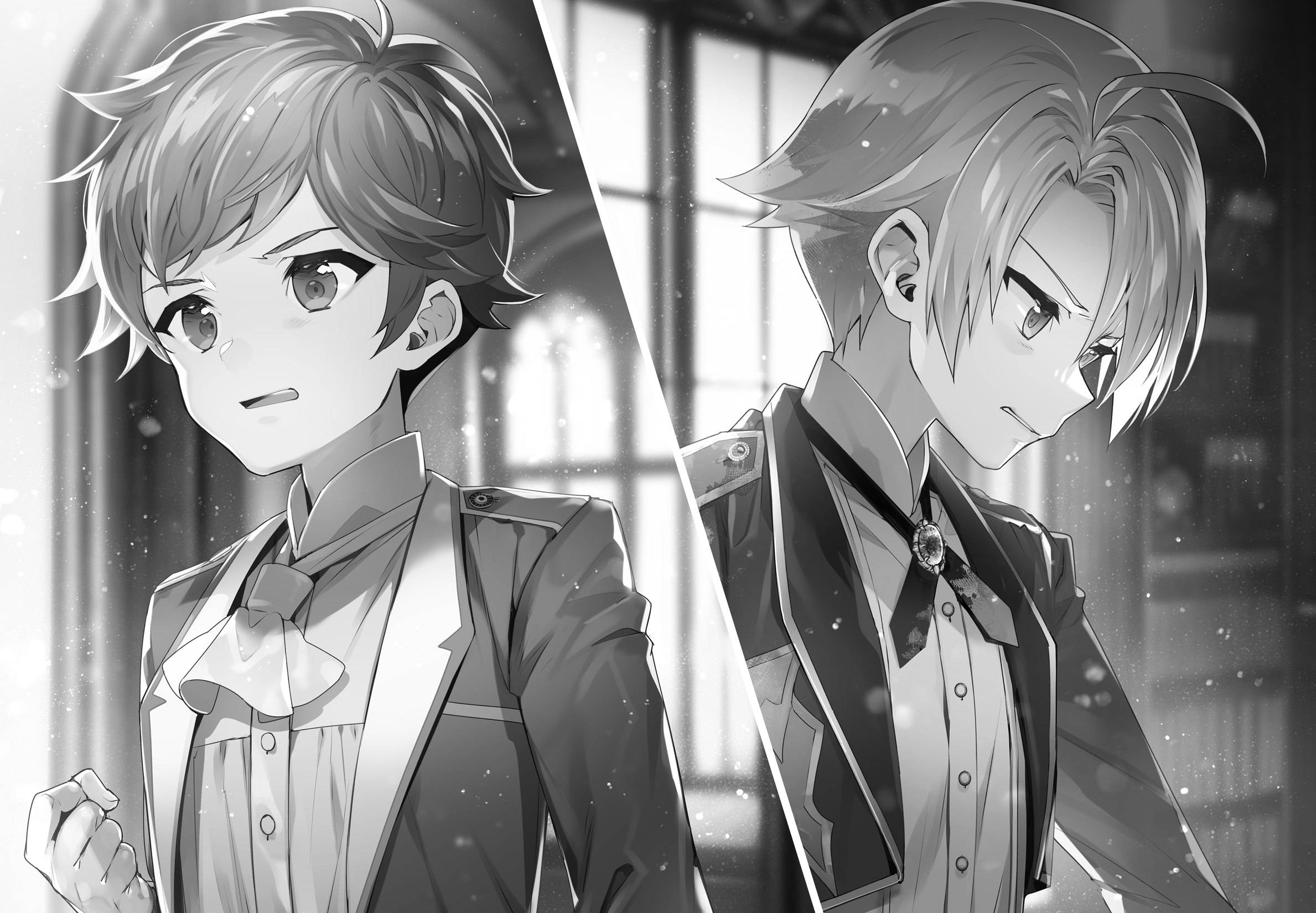
Things had never felt this unbearable for Austin. He spoke faster than usual, trying to smother the emotion creeping into his voice.
“I don’t know what you’re going through, but you should at least share some of that burden with someone you trust.”
“What...?” The unexpected words made Riley’s eyes widen, his head snapping up to look at his friend.
Austin pushed on, resolve shining in his eyes. “I didn’t come up with that myself. It’s what my father told me when I passed the test to join the order.”
“He said that?”
Austin nodded. “We’re surrounded by talented people who still remember what things were like under the previous king. That’s why everything they do seems amazing, and why we feel so small. Take me, for example. I thought I was somebody before I joined the order, and then I realized I’m still just a kid.”
He had been skilled with a sword among his peers, but within the order, he wasn’t even allowed to take part in practice matches. Whenever discouragement hit him, he recalled his father’s words and pulled himself back together.
“We have a lot of growing up to do,” Austin continued. “The people around us have far more experience than we do; we can’t expect to keep up with them right away. You have me—and you’ve been getting along with House Clarke’s son lately. You’re not lacking for options, so find someone you trust and share your problems with them. A burden shared is a burden halved, as they say.”
Riley was taken aback. He and Austin had been together since birth, and he had always assumed they stood on equal footing. But somewhere along the way, his best friend had pulled ahead.
The realization gave him a sharp twinge of envy. Until now, he had lived by his grandfather’s teachings. The former king’s insistence that a ruler must never rely on anyone had shaped Riley’s entire worldview, leaving even his bond with his own father shallow at best. For a fleeting moment, he wondered whether life would have been different if Duke Ealdred had been his father—though he knew the thought was pointless.
Austin shifted under Riley’s gaze, seeming faintly embarrassed. A subtle flush colored his cheeks.
“Yeah...you’re right,” Riley managed at last.
Would telling Austin the truth about his grandfather ease the weight on his shoulders? He considered it—then abandoned the idea entirely. Lightening his own burden shouldn’t mean forcing it onto someone else.
A crown prince’s troubles were never ordinary. Sharing them wasn’t the same as confiding in a friend; one careless word could force him to silence the listener for good. No matter how shocking Horatio’s revelation had been, it was only the beginning. He would face heavier secrets in the years ahead, and he would have to bear them alone.
“Here’s a suggestion,” Austin said, changing his tone as he leaned forward. “Why don’t you rally the people in our generation you can trust?”
“As in...form a faction?”
“It doesn’t need to be that formal. Think of it more like the soirees kids hold before they enter high society.”
Riley couldn’t host soirees yet, but daytime gatherings were an option. Austin was essentially suggesting he create a space for light, relaxed exchanges of ideas. Riley did already have a small study circle, but it consisted entirely of boys from the highest ranks of nobility.
“Try bringing in girls and lower-ranking nobles too—and as many talented kids as you can,” Austin went on. “What do you think? You never know who you’ll get along with until you talk to them.”
A smile tugged at Riley’s lips. “You come up with some crazy ideas.”
“You would’ve proposed it yourself if not for whatever’s on your mind,” Austin said, raising an eyebrow in mock reproach. “You’re not as sharp as usual today.”
“Maybe you’re right,” Riley admitted. He hadn’t known mental strain could cloud his thinking so much. “I should arrange to meet some boys from the lower ranks.”
“I can introduce you to some,” Austin added confidently. His connections in the knights’ order made it easy for him to meet lower-ranking nobles.
A genuine smile spread across Riley’s face. “Then I’m counting on you.”
“You won’t be disappointed,” Austin said, full of conviction. He glanced at the clock—and jolted upright. “Damn, I’ve gotta run. I sneaked out on my break.”
“All right. I’m glad we got to talk. It’s been a rare thing lately.”
“Same here,” Austin replied with a bright grin before hurrying out of the office.
The moment Riley’s chamberlain closed the door behind him, the prince slumped back into the couch with a weary sigh. With the room quiet again, the air seemed to grow heavier by the second. He covered his eyes and groaned. Talking with Austin had made the future feel bright for a moment—but the instant his friend was gone, the unease crept right back in.
“What am I supposed to do from now on...?”
Austin’s suggestion to build a network of trustworthy people made sense, but could he truly keep himself from doubting them? He had wanted to become a worthy king like his grandfather—yet now that he knew the truth, even the man revered as the Demon God hadn’t been especially wise. So what kind of king was Riley meant to be?
Moving lethargically, he rose from the couch and returned to his room, where he remained for the rest of the day. Even that evening, when his chamberlain offered to bring dinner, Riley dismissed him and stayed shut inside.
No good ideas came to him as the hours crawled by, and he didn’t sleep at all that night.
◇ ◇ ◇
It would be some time before Liliana saw Petra again. She had intended to visit her the next time she met Riley for tea, but the prince’s increased workload meant he hadn’t been interacting much with his fiancée candidates. Instead, he had pivoted to hosting social gatherings with lower-ranking nobles—events Liliana attended only occasionally.
Eventually, another tea party invitation arrived.
Liliana brought the potted lily of the valley with her in the coach. Its flowers had wilted with winter approaching, but the bulb remained healthy, no doubt thanks to her talented gardener. It would have bloomed again next year had it not been used for a hex.
Really, it’s a good thing it’s withered. It’s easier to carry like this.
She had conducted as much research as she could and concluded that the hex had transferred from the plant to her simply because of her proximity to it. Considering the duke’s attempt to dispel the curse in Fortier, it likely hadn’t been meant as a permanent measure.
Still, I don’t know what father intends to do if he succeeds in removing my fiancée candidacy...
Liliana suspected he was scheming, but she had no way to know for certain. For now, her best course of action was to regain her voice in secret. A small smile crept onto her face. Strangely enough, she had no doubt they would succeed in dispelling the hex.
I guess that says a lot about how much faith I have in Petra.
Of course, she had no intention of relying on the mage for everything. She already felt embarrassed about depending on her this much. If she had one concern regarding Petra, it was her connection to Ben Draco, the brother of one of the game’s romanceable characters. Liliana didn’t know enough about the vice minister to judge what precautions she should take.
He never appeared in the game, so maybe I’m overthinking it.
Upon arriving at the palace, Liliana followed her usual route to the familiar parlor. Riley didn’t keep her waiting long—though he looked thoroughly exhausted when he entered. There was barely a spark of life in him.
“Are you tired?”
Riley’s eyes widened before his face softened into a wry, curious smile. “Do I look it?”
“You do. Is work wearing you down?”
“You could say that. Not that I’m entrusted with anything important.”
There was something bitter in Riley’s tone, though Liliana chose not to press him. Instead, she turned her attention to the maid setting out their tea and snacks. Palace servants often struck her as tense—understandably, given that they served royalty—but this woman seemed unusually calm.
A sudden chill crawled down Liliana’s spine. She didn’t recognize the maid. And as she studied the table more closely, she realized the cutlery was gold, not the usual silver. Riley would have noticed under normal circumstances, but he was far too preoccupied in his current state.
I meant to overlook a few things to help push myself out of his list of fiancée candidates, but given the circumstances...
Should she warn the prince or pretend she hadn’t noticed the attempt on his life? Her thoughts spiraled as she weighed each possibility.
As one of the romanceable heroes from the game, Riley couldn’t meet his end this early. Then again, the swarm Liliana had encountered on her way home from Fortier had deviated from the original storyline, and she couldn’t ignore the chance that this situation might too. No matter how unlikely disaster seemed, blindly trusting the game’s plot could be fatal.
Plus, I really don’t want to be suspected of poisoning anyone.
Her mind made up, Liliana spoke just as Riley reached for his teacup.
“Wait, Your Highness. It seems to be poisoned.”
“Lady Liliana...?”
The prince stared at her, stunned, as if he couldn’t process the words. Then he snapped back to his senses.
“You there. Stop where you are. And you...”
Riley ordered the maid who had brought the tea and sweets to remain still, then gestured for one of the royal guards. The servant went pale, and the chamberlain stiffened at the abrupt change in atmosphere.
“Could you bring us silver teaspoons?” Riley asked softly. “And some sugar cubes.”
“A-As you wish,” the guard replied, a grave look in his eyes. He clearly understood why he’d been given what would normally be a maid’s task.
Watching the scene unfold, Liliana adjusted her opinion of the prince. Rather than accept her claim outright, he intended to confirm the poison for himself.
From what I can tell, my cup is poisoned too.
Riley must have built up some resistance to poison, though Liliana had no idea how much had been slipped into their tea. Was the culprit simply trying to weaken him enough to jeopardize his position as crown prince, or was the goal to eliminate both him and his most likely fiancée? Since Liliana’s drink was poisoned as well, it couldn’t have been an attempt to frame her and put pressure on Duke Clarke.
If only I’d mastered that poison-neutralizing spell. Treating it as an impurity with water and earth magic didn’t lead anywhere.
If she could identify the type of poison, she might be able to separate its compounds by their molecular structure, but her knowledge in that area was patchy at best. Her personal solution had always been simple: Don’t eat or drink anything contaminated.
The royal guard returned quickly with the silver spoons and sugar cubes, then resumed his place by the wall with the others. All of them kept wary eyes on the maid as Riley slowly dipped one of the spoons into his tea. Nothing happened at first—then the metal began to darken, an ominous black creeping up toward the handle.
Liliana tested her own cup, careful to move slowly. Her spoon blackened as well. She turned to Riley, and their eyes met. He wore a heavy expression, tinged with anxiety.
“I suppose my tea isn’t fit for drinking either,” she said with a smile.
“How unfortunate.”
The maid trembled at Riley’s calm pronouncement. Without hesitation, the guards seized her and forced her to her knees.
“Y-Your Highness...!” the woman cried, the picture of despair.
Riley coolly crossed his legs, gaze fixed on her. “Was this your doing?”
“N-No, I... I would never...!”
“Hmm?” The prince’s smile was dazzling, but his eyes were terrifyingly cold.
He’s starting to resemble the crown prince from the game.
Liliana paused as the memory rose unbidden. The start of the game was still seven years away, yet the steel that would define his adolescence was already beginning to show.
Riley waited for the maid to explain herself, but she could barely string two words together. She looked moments away from fainting. With a sigh, the prince abandoned the interrogation and ordered her arrest. Only when the royal guards handed her off to be taken away did he finally turn back to Liliana.
“Sorry,” he said, genuine concern seeping through. “Our tea party has been ruined.”
The tainted snacks were whisked away and replaced with fresh ones. Tea was hard to enjoy after almost being poisoned, though.
“I don’t mind.”
“Thank you.” Riley let the tension ease from his shoulders. After a moment of thought, he asked, “Lady Liliana...if you don’t mind, may I call you simply Liliana from now on?”
The request caught her off guard. Clearly, the prince wanted to close some of the distance between them. She wanted the opposite—but as one of his fiancée candidates, she had no good reason to refuse.
“If you wish.”
Riley’s face brightened with wholehearted joy. “Again, Liliana, thank you. You may call me just Riley from now on.”
“I appreciate the consideration, Your Highness.”
“Come on, you can do better than that.”
Liliana’s head spun. Why was he suddenly being so insistent?
“Very well—Lord Riley.”
It was the best compromise she could manage. Addressing him without a title felt like a step too far.
“I suppose that will do for now.”
Liliana said nothing, pretending she hadn’t heard him.
“So...would you like to come to my office?”
“Your office, Your—um, Lord Riley?”
Their meetings at the palace were almost always held in parlors—either the one they used for tea parties or another for gatherings with other nobles. Liliana knew the prince had an office, but he seldom received guests there. He had extended that privilege to Austin and lately to her brother Clyde, but never to his fiancée candidates. If she accepted, she would be the first to set foot inside.
Seeing Liliana at a loss for words, Riley added, “No pressure. It’s okay if you’d rather not.”
She hesitated. The attempted poisoning had brought their tea party to an abrupt end, and it wasn’t yet time for her meeting with Petra. It might also be wise to gain a better sense of the palace’s layout; the game’s supplementary materials hadn’t included a map. For a story centered on romance rather than rebellion or escape, it hadn’t been necessary.
“It would be my pleasure.”
Riley greeted her answer with a smile.
◇ ◇ ◇
Riley’s office was in a separate building from the parlor, situated between the royals’ private quarters and the government officials’ offices. The hallways were busier than she was used to, and the decor differed from that of the main palace. Several officials they passed looked surprised to see Liliana, fanning the flames of her unease.
What if I run into my father?
As premier, he spent much of his time at the palace, and his position guaranteed his office would be nearby. With the king indisposed, things were worse still; Duke Clarke now met regularly with the crown prince. It was far too late for Liliana to reconsider, so she swallowed her tension and continued after Riley.
Fortunately, they reached his office without encountering the duke. Liliana let out a quiet sigh of relief.
“Here we are,” Riley said. “Oh, I almost forgot to mention—your father isn’t here at the moment, so you don’t need to worry about running into him. He’s out on a regional inspection.”
“I see.”
Liliana forced a smile. Had her thoughts shown on her face? She didn’t think so, but she pulled herself together nonetheless, suspecting that the prince might have noticed something.
Inside the office, Riley insisted she take a seat on the couch, then prepared tea and sat across from her. He left the door ajar but raised a soundproof barrier around the room for privacy. He was likely always on guard for potential threats.
The prince straightened. “I thought this might be a good time to discuss your position as one of my fiancée candidates.”
Liliana wasn’t sure where he intended to take the conversation. It would have been wonderful if he were asking her to step down from the contest, but only her father had the authority to approve such a change. Instead, Riley steered things in a different, more reasonable direction.
“Has the duke said anything about it?” he asked, gentle but serious.
“No, I can’t say he has.”
She wasn’t lying. Her father had told her not to lose her candidacy, but he’d done so in such a roundabout way that his real intentions were hard to interpret. Without her memories from her previous life, it would have been a major source of stress and confusion.
It was bad enough that the duke kept doing and saying things designed to stir fear and anxiety in his daughter. Her mother’s treatment would have been another source of strain, if not for the fact that Liliana had been emotionless even before regaining her memories.
At that realization, several pieces seemed to fall into place.
In the game, the swarm made me panic. That’s why I lost control of my mana. Did father anticipate that happening?
It was an absurd thought, but not one she could dismiss so easily. Perhaps the duke had toyed with her on purpose, knowing mental instability would cause her mana to rampage.
But for that to be true, he would have had to know the swarm was coming.
Swarms were impossible to predict—yet his words when they’d crossed paths in the aftermath lent credence to her theory.
“Liliana?” the prince asked, concerned by her silence. “Is something the matter?”
She forced a faint smile and shook her head.
“Really? You’re not putting on a brave face, are you?”
“Perish the thought. I appreciate your concern.”
The graceful reply left Riley conflicted. He didn’t believe her, but he had no way to prove she was lying. And as far as Liliana was concerned, she had no reason to confide in him; all she wanted was to lose her position as a fiancée candidate.
“If there’s anything you need, let me know. I’ll do what I can to help.”
“Thank you.”
It was a generous offer, especially from the crown prince. Liliana wished she could accept his kindness, but she knew the opportunity would never truly come.
◇ ◇ ◇
After her meeting with Riley, Liliana made her way to the Ministry of Magic. She had left the matter of the attempted poisoning to the prince, since she hadn’t come to harm, but she doubted interrogating the maid would reveal the true culprit.
She met Petra at the gate, just as she had during her first visit, and together they headed toward the vice minister’s office. He was out—probably for work—but they arrived without any of the mages harassing them.
“Ben gave me the key,” Petra said with a wink, unlocking the door with practiced ease. “Don’t tell anyone.”
They stepped inside, and the mage locked the door behind them. Then they descended the stairs to the place where preparations for lifting the hex had already been laid out.
“Did you bring it?” Petra asked.
“Yes, it’s right here,” Liliana replied. She set the potted plant on the table and undid the invisibility spell concealing it.
“No flowers, huh?”
“They wilted, but the bulb is still alive. It should bloom again when the season turns.”
“Interesting...”
Petra examined the lily of the valley with intense curiosity. For someone in her profession, she knew surprisingly little about flowers; mages were supposed to be well-versed in medicinal botany.
“I know I’m supposed to know this stuff, but I have a bad affinity with this kingdom’s flowers,” she said defensively.
“Oh, that’s unfortunate,” Liliana replied. She had never heard anyone lament their “affinity with flowers” before.
“Ben’s a master with them, though. It’s honestly sickening how well he knows them.”
Petra’s tongue was naturally sharp—especially around other mages—but when she spoke of Ben, there was a trace of kindness beneath the spite. Even Liliana could see it, emotionless as she was.
She doesn’t seem aware of it, though...for whatever reason.
Unaware of her student’s thoughts, Petra set about gathering what they needed to lift the hex. There was such a bounce in her step that Liliana half expected her to start whistling. The mage chalked a sigil on a stone pedestal Liliana didn’t recall from her previous visit, then placed a white, human-shaped piece of paper at its center.
“What’s that?” Liliana asked. She recognized the paper from her past life, but she had never seen anything like it in this world.
“It’s a katashiro. They’ve been used in eastern hexes for ages. They’re pretty handy—think of them as stand-ins for people.”
So the usage was the same as in her past life. Could eastern hexes follow the same principles as Onmyodo and Shinto? If so, perhaps she really could become proficient with them.
If I remember correctly, everything in nature is categorized into yin and yang, and all things are created and destroyed through those two cosmic forces.
Eastern hexes and magic were built on five basic elements—wood, fire, earth, metal, and water—each aligned with yin or yang. Western magic, by contrast—the kind used in Slivegrandia and the western half of the Empire of Yunatian—held that the world was composed of the four classical elements: fire, wind, earth, and water.
No wonder the mages here struggle with eastern magic. Most of them can’t think outside the box.
Liliana didn’t know any mages besides Petra, but if the others were anything like the oafs she’d encountered on her previous visit, she doubted they were particularly competent. Most in the ministry were probably hired for their connections rather than their skill.
“Mages other than Ben are too soft in the head to appreciate things imbued with eastern hexes or magic, so I only use them when I’m working alone,” Petra said. “People like them are the reason research into magic and hexes barely progresses in this kingdom.”
Making her usual scathing remarks about her colleagues, Petra set the lily of the valley beside the katashiro. She murmured an incantation and channeled mana into the sigil, and the pot was wrapped in a golden glow—the same light that had enveloped Liliana when Petra first analyzed the hex. It was mystical and strangely mesmerizing.
Before long, a shifting pattern appeared across the sigil, constantly rearranging itself.
“This hex is simplistic,” Petra said. “I can’t tell who placed it on you, but it was either someone close to you or someone who had access to something connected to you.”
“By ‘someone close,’ do you mean a blood relative?”
“Yeah. The mana’s similar to yours.”
In that case, it had to be her mother or father. Most people would reel at the thought of a parent hexing them, but Liliana remained perfectly calm.
Petra smirked. “You look relieved more than anything.”
“Yes, I am. Honestly, I expected this, so I’m glad to have been proven right.”
“You really don’t act your age, do you?”
Petra gave a wry smile and a shrug, clearly aware her student wasn’t bluffing. If anything, Liliana was glad she wouldn’t need to start suspecting anyone new.
“Well, let’s dispel that hex. Just to confirm—you don’t want the person behind it to know it’s been lifted, right?”
“No, thank you.”
“Got it. Stand over there, please.”
Liliana stepped beside the stone pedestal and the lily of the valley resting atop it. Petra drew a new sigil around her, then placed four white crystals along its perimeter. She murmured another incantation, and the same golden light from before mingled with silver before enveloping Liliana.
“Lay thy shadow upon the katashiro.”
Liliana barely caught the words, but the white paper rose at once, drifting and turning like a leaf caught in a breeze. Each time Petra spoke an incantation, the katashiro swayed in response. It looked as though she were unraveling threads one by one, untangling the hex until, at last, it tore free of Liliana and entered the katashiro in its complete form, staining the paper with wine-red script.
The golden-and-silver light faded, and the katashiro fluttered to the floor. Petra incinerated it with a burst of magic to purify it. She regarded the ashes with cold eyes, then looked up at Liliana.
“We’re done,” the mage said. “How’s your voice?” She sounded almost unsure, as if afraid it might not have returned.
Liliana hesitantly opened her mouth. After half a year without speaking, she could barely remember the sound of her own voice.
“Ah...”
The rasp that escaped her made her shut her mouth at once. Her eyes darted to Petra, who was grinning from ear to ear. After a stunned pause, Liliana tried again.
“I...can...speak.”
“Great!” Petra exclaimed. “It worked!”
Liliana’s voice was still too quiet to hear clearly, but the mere act of speaking felt strangely nostalgic. As the seconds passed and the reality of it settled in, her forced enthusiasm softened into something real.
Petra lunged forward and swept Liliana into an elated hug. Liliana froze at first, unaccustomed to physical contact, then slowly, hesitantly returned the embrace.
Pulling back, Petra looked her straight in the eye. “I’m so glad it worked,” she said warmly.
No one in Liliana’s life had ever touched her out of genuine feeling. Marianne only touched her while she was tending to her; Riley only when he was escorting her. Her family didn’t touch her at all. She knew such distance was normal among nobles, yet the combination of physical contact and sincere emotion shook her to her core. Never before had anyone been so openly happy for her.
She forced a smile, unable to name the emotion stirring inside her, and murmured, “Thank you.”
“Don’t mention it—especially after how much you paid me. Honestly, I would’ve lifted that hex for free.”
When Petra stepped away, Liliana felt both unease and relief. Once the initial shock had passed, warmth spread through her chest, and a faint, natural smile tugged at her lips.
Is this...joy?
She had to comb through everything she knew to identify the feeling coursing through her—an emotion she had never experienced before. Comparing it to Petra’s words, she finally arrived at a theory.
I must be happy that she’s happy.
Liliana’s lost voice had never been Petra’s burden. So why had the mage been so pleased to help her? Why had she acted without expecting anything in return? Perhaps she was simply proud of successfully lifting the hex, but the term didn’t feel right. “Happy” fit far better.
Either way, Liliana appreciated the woman’s sincerity.
As she savored the warmth blossoming in her chest, a sharp pain suddenly lanced through her head, far worse than any headache. A chill swept through her, forcing her to cover her mouth as her brief happiness ebbed away. Petra didn’t notice; she was busy tidying up. Thankfully, the pain faded as quickly as it had come.
I must just be tired from the new experience.
Having convinced herself of that, she joined Petra in cleaning up. The process was quick; the procedure hadn’t required much at all.
“That’s our first objective out of the way,” the mage said, evidently in high spirits. “You’re not planning to tell anyone about it, right? Not even your handmaiden?”
“That’s right. Some other concerns remain.”
To escape the wretched fate the game had in store for her, Liliana needed to avoid becoming crown princess—and to do that, she needed everyone to continue believing she was mute. The most she’d told Petra was that she was in danger for political reasons. That much was true: Her father was a powerful noble, and there were plenty among the Arcacians and neighboring nations who wanted her dead. The mage hadn’t seemed entirely convinced, but at least she hadn’t insisted on bringing Marianne into the loop.
“So, should we get back to our lessons on hexes and magic?” Petra asked.
“I suppose so. I would appreciate your tutelage.” Liliana had said she wanted to improve her hexes and magic for self-defense, so it made sense for them to continue.
“Sure thing.” Petra grinned. “You’ve got a great attitude. It’s rare to meet someone who actually appreciates hexes. Here in the kingdom, magic is all anyone cares about.”
“It’s true our countrymen tend to view hexes with disgust, but I’d imagine a few people must take interest in them.”
“Hex users are seen as the dregs of society. Nobody with sense wants to enter the profession.”
In the kingdom, hexes invariably conjured associations with dark magic. Petra spoke matter-of-factly, though frustration seeped through her tone.
“Is that why you call yourself a mage?” Liliana asked.
“Yeah. It’s not untrue—I can use magic—but hexes are my specialty.”
Liliana thought back to the three mages and their mocking behavior. Their cruelty seemed too intense to be explained solely by Petra’s foreign blood or commoner origins. Perhaps her affinity for hexes played a part in how poorly she was treated at the ministry.
“There seems to be a great deal of depth to hexes,” Liliana said. “Learning about them is sure to lead me to many new discoveries.”
“You’re spot-on. I’ll ask Ben if I can bring you to his manor sometime. The hex books and tools there are way better than anything in the ministry. I’ve visited plenty of times before.”
With that surprising revelation, Petra put the kettle on, looking thoroughly pleased.
Chapter 3: Looming Shadows
Chapter 3: Looming Shadows
Liliana’s daily life changed slightly with the return of her voice. She still kept her social interactions to a minimum, studying and practicing magic at her estate when she wasn’t meeting Riley at the palace, but now she also visited Petra at the Ministry of Magic to learn about hexes. The mage had recently secured permission for her to visit Ben Draco’s manor, and the day had come for them to travel there together.
Liliana swayed with the coach as it rolled toward the vice minister’s estate, her eyes vacant. Petra sat in front of her, drifting in and out of sleep after staying up all night. Olga rode alone up front; Gildo would have joined them, but he had the day off.
Ben Draco is the brother of one of the game’s romanceable characters. And yet...here I am.
Ben’s younger brother was the fourth romanceable hero, after Crown Prince Riley, the aspiring royal guard Austin, and her own brother, Clyde. Seeing the vice minister at the ministry was one thing, but visiting his estate dramatically increased the risk of running into the love interest in question. Liliana took some comfort in knowing they weren’t headed to the family’s principal residence but to Ben’s private manor—a place he had purchased for work.
I won’t run into him there, right...?
Ben knew her voice had returned. He was also extremely curious about her aptitude for hexes and magic and about the “abnormally high” amount of mana she apparently possessed. Taken together, those facts made it nearly impossible for her to refuse his invitation.
Sure, his lectures on magic are interesting, but he’s too passionate. How am I supposed to explain casting without incantations, or how my spells function at all?
They used entirely different systems of magic. Liliana crafted her spells using knowledge from her previous life, while Ben was confined to the logic of the world around them. From his perspective, it surely looked as though she had refined the magic he knew—her spells cost less mana and activated faster, and her incantations were shorter—but learning her methods required scientific knowledge from a world he’d never known. Explaining centuries of development from memory was an impossible task.
The coach passed through central Hudore, approaching the district where the wealthier merchants lived. Ben’s manor would be close now.
Should I have refused to come? No, I want to see the books and implements I can’t find anywhere else.
In the end, she had prioritized curiosity over minimizing risk. She told herself she needed the knowledge to protect herself, but the truth was that she was just as obsessed with hexes and magic as Ben.
“We’re almost there,” Petra said, having woken up at some point.
Liliana simply nodded.
Soon, the coach stopped before the main gate. Petra opened the door, stepped out first, and helped Liliana disembark. The estate was smaller than those owned by nobles in Hudore yet still far larger than the homes of wealthy merchants. Its design was simple, and the courtyard was neatly kept. Considering the state of the vice minister’s office, it wasn’t hard to imagine the servants here worked tirelessly to maintain some semblance of order.
“Ben doesn’t care about keeping things tidy, so it’s all on Paul,” Petra said, noticing Liliana’s curious look.
“Paul?”
“The steward here—and Ben’s foster brother.”
Liliana blinked. It was unusual for a commoner household to have a steward at all.
“As the eldest son, Ben’s supposed to oversee things at home, but you’ve seen how obsessed he is with research. Without Paul, nothing around here would get done.”
Ben fulfilled his duties as vice minister well enough, though he constantly complained that administrative work kept him from his research. From the sound of it, Paul acted more like a secretary than a traditional steward.
Petra opened the gate with casual ease and stepped through. The courtyard was lined with pretty flowers—nothing at all like the image Liliana had of Ben Draco. Petra must have caught her expression, because she started chuckling.
“Paul’s tastes stand out even more than last time.”
“Does he like cute things?”
“He loves embroidery and romantic operas. Just the other day, Ben came to work looking sick to his stomach. When I asked what happened, he said Paul had made a five-layer cake and insisted he eat it.”
Evidently, Paul had rather girlish tastes despite his talents as a steward. Liliana and Petra took in the courtyard so clearly shaped by his personality as they made their way to the entrance. When they arrived, Petra walked in without bothering to use the knocker.
The lobby was just as pretty: a large vase overflowing with flowers here, a frame of pressed blossoms there. Liliana found herself captivated by the delicate decorations. Petra, meanwhile, seemed long accustomed to the sight and headed straight for the staircase—only to stop short with an abrupt “Oh.”
The front door opened, and a tall young man strode in—a muscular figure dressed in a well-tailored uniform. “Ms. Myyrylainen, how many times have I asked you to tell me when you arrive?” he said, wearing a sullen expression.
“What does it matter? If you’ve got guests, don’t worry. We’ll keep quiet in another room.”
“That’s not the problem.” He turned to Liliana and bowed with practiced grace. “A pleasure to meet you. I’m Paul Purcell, the steward of this estate.”
Liliana stared at him, caught off guard. Based on the courtyard and the lobby, she had expected someone far more feminine. She kept the thought to herself and offered him a polite smile in return.
So this mountain of a man arranged that lovely courtyard and made a five-layer cake. I suppose one shouldn’t judge by appearances.
She glanced at Petra, who caught the cue and took over the introduction.
“This is Lady Liliana of House Clarke. She can’t speak, so be mindful of that. She’ll probably be coming here rather often.”
“As you wish,” Paul replied.
Petra’s claim made Liliana blink. She had never intended to frequent Ben’s estate. She shot Petra a smile edged with quiet reproach, only to receive a smug, unrepentant look in return. Paul seemed blissfully unaware of their silent exchange.
The mage turned toward the stairs as though the matter were settled, but the steward stopped her.
“Please wait. It isn’t a guest, but...perhaps you should wait for him to leave.”
“There’s someone here?”
“Yes, well... A tempest.”
Paul’s tone was cautiously evasive, but Petra understood at once. “Oh... Should we come back later?”
“Oh, no. He arrived a couple of hours ago, so he’ll most likely leave soon.”
“Okay. Guess we’ll wait, then.”
Paul gestured for them to head toward the door he’d come from—but before they could take more than a step, a loud crash echoed through the estate, and a door on the second floor burst open.
“You’re my brother, not my father!” a young boy shrieked in a high, furious voice. “Stop acting like you know anything other than research!”
Liliana snapped her head toward the commotion. Out of the corner of her eye, she saw Paul drag a hand down his face and slump forward. So this was the “tempest” he’d mentioned.
The boy stormed down the stairs. When Liliana finally saw his face, she froze.
Well, this is quite the turn of events...
He was younger than she remembered, but the resemblance was unmistakable. And given that this was Ben Draco’s private residence, it was safe to assume the boy was indeed one of the game’s romanceable characters.
“Young master,” Paul called.
The boy flushed the moment he saw Liliana. Then his gaze slid to Petra, and his expression soured. He turned without a word and tried to march toward the lobby, but Paul closed the distance in a quick stride and caught him by the collar.
“Forgot your manners, little brat? Need me to remind you?”
Paul kept his voice low—probably for Liliana’s sake—but she heard every word. Beneath that gentlemanly veneer, it seemed, was someone who grew rather foulmouthed when annoyed. The boy squirmed, but he was so much smaller than his captor that the scene resembled a kitten being held up by the scruff.
Ignoring his struggling, Paul turned to Liliana and bowed with exaggerated courtesy. “Please accept my apologies for his behavior. This is Berasta, House Draco’s youngest son. Young master, this is Lady Liliana of House Clarke. Now—what do you say?”
The last line was steeped in menace. Berasta must have felt it; as soon as Paul released him, he bowed his head, rubbing the back of his neck.
“I’m Berasta Draco. A pleasure to meet you.”
Liliana’s suspicions were confirmed. In the game, Berasta possessed extraordinary magical talent and would become the youngest Minister of Magic in history. Yet even in his route, Liliana had been doomed, either killed by him or assassinated for other reasons. It was hardly an encouraging future.
The boy’s sulking only made the vein on Paul’s temple throb harder. “I’m truly sorry,” the steward said. “I’ll teach him proper manners after this.”
His hellish tone made Berasta go pale.
Liliana was genuinely surprised that Paul was responsible for the boy’s upbringing. Berasta clearly hated it, but learning proper etiquette at his age was for his own good. Even in the game, he’d felt inferior to his gifted elder brother and carried a quiet resentment he only managed to overcome through talks with the protagonist. He had also struggled with nobles after becoming minister.
Oblivious to Liliana’s thoughts, Berasta stood frozen under her graceful smile, his eyes darting awkwardly.
Paul shot him a sidelong glance and made a quiet, cautioning sound through his nose. Then he instructed the boy to wait in another room, straightened his own collar, and turned back to Liliana.
“Allow me to escort you to the master’s room.”
“It’s fine,” Petra said, having watched the exchange with folded arms. “I know where it is.”
Paul didn’t budge. “It is my duty. I cannot allow guests to wander on their own.”
The mage shrugged, indifferent either way.
Paul led them upstairs, and after a brief walk down the corridor, they stopped outside a heavy door. The steward raised an eyebrow and glared at the lower panel. It was badly dented, no doubt from Berasta’s kick. From the irritated twist of his features, Liliana could practically hear him muttering, “That stupid brat even put magic behind it.”
He seemed to remember her presence a beat later, clearing his throat twice before opening the door as if nothing were amiss.
“You have guests, Master.”
“Myyrylainen and Lady Liliana, right?” the vice minister called. “Let them in.”
“Understood.”
With Paul holding the door, Liliana and Petra stepped inside. The room was cluttered, though not nearly as bad as Ben’s office at the ministry. Liliana suspected that was thanks to Paul. Even with the little she’d seen, she could easily imagine the steward scolding Ben while tidying around him.
Ben Draco rose from his chair to greet them, still wearing a robe despite being in his own manor.
“Please, take a seat on the couch,” Paul said. “I’ll fetch you all some tea.”
For some reason, the steward took the initiative, not the head of the household. It must have been routine, for Ben showed no sign of objecting. He sat across from Liliana and Petra, a broad, joyful smile spreading across his face as he watched the steward efficiently prepare the tea.
“There’s only Paul in this manor,” Ben said. “He’s my butler, my chamberlain, my secretary, and my coachman. Sometimes he’s also a gardener, a pâtissier, and even a guard.”
That was far more responsibility than Lilianna would have expected of any steward. Yet everyone in the room behaved as though the arrangement were perfectly ordinary.
“I keep telling you there’s only so much one man can do,” Paul said. “You ought to learn to take care of yourself.”
“I want more of those sweets,” the vice minister replied, ignoring the protest entirely. “What were they called again? Baba?”
“I can make more, but only if we buy rum or kirsch,” the steward answered curtly.
Liliana hadn’t tasted the sweets herself, but the liquors immediately brought savarin to mind. In her previous life, it had sometimes been called “baba” as well. Brioche was soaked in tea-flavored syrup, cooled, and then covered with rum and kirsch—one distilled from sugarcane, the other from cherries.
Does Ben like alcohol...?
The game had revealed almost nothing about him, but few people who disliked alcohol enjoyed savarin. Either way, it seemed perfectly normal in this household to make desserts rarely seen in Slivegrandia.
Paul set out the snacks for tea, bowed, and left the room. Petra waited until his footsteps faded down the hall before speaking.
“That door has a dent in it.”
“Oh, that. Berasta’s doing. I told him to stop getting physical when he’s upset, and it only made him angrier.”
“You do enjoy provoking him, don’t you?”
“Younger brothers are adorable when they’re that much smaller than you. He’s definitely in his rebellious phase, though.” Then, without a shred of shame, Ben added, “Oh, and younger sisters are cute too.”
Liliana tilted her head at the mention of younger sisters. Petra caught the gesture.
“Berasta has an elder twin sister—Tania,” she explained.
“We all dote on them,” Ben said. “They’re the youngest in the family.”
“They sound lovely,” Liliana replied.
“That they are,” Ben said, beaming. He was clearly delighted she agreed.
Liliana smiled as though she found the moment heartwarming, but something else preyed on her thoughts.
Tania Draco—I’d almost forgotten that name.
In Berasta’s route, Tania had appeared as the protagonist’s rival. Unlike Liliana, though, she wasn’t a villainess; to reach Berasta’s ending, the main character had to raise her affection as well. You could even grow close enough to unlock her friendship ending.
“So, about what we agreed on for today...” the mage prompted.
“Don’t worry. I have everything ready,” Ben replied.
“Good, good.”
All Liliana knew was that they would be practicing hexes here at the estate. Ben apparently collected books on hexes that would have to be burned if the public ever learned they existed. This was the only place he could freely pursue research forbidden at the ministry. Liliana also had to consider her father’s ties with the minister; visiting the ministry too often risked drawing the wrong kind of attention.
“All right, let’s get to it,” the vice minister said.
Ben and Petra rose and passed through a heavy door into an adjoining room. Liliana followed close behind.
◇ ◇ ◇
While the others began their lesson on hexes, Paul remained on the first floor with Berasta, arms crossed as he stared at the boy sitting stiffly in his chair. For all his professionalism around guests, he had failed to keep his true irritation under wraps.
“What was that attitude earlier?” Paul asked. Though he made sure to maintain the proper master-servant dynamic, he was still a brother to both Ben and Berasta. “That was no way to behave—especially in front of the daughter of a duke.”
“Well, they’re not here for me, are they?”
“You still have to greet them.”
Paul sighed, while Berasta, who had only recently turned six, pursed his lips and hung his head. The boy clearly had mixed feelings toward his elder brother, and the adults of the Draco family were equally frustrated with his unusually early rebellious phase. A household of researchers seemed poorly equipped to understand the delicate emotions of a child so young.
He’s the polar opposite of Tania, Paul thought.
Tania was stouthearted—nothing like sensitive Berasta—and her manner of speaking was proper enough to rival most adults. To Paul, she was as brassy as they came, but the family’s elders adored her.
Though they were twins, Tania and Berasta couldn’t have been more different. Berasta struggled to express his thoughts and feelings, and being surrounded by headstrong women only pushed him further into his shell.
Paul stared vacantly.
To think he’d fall in love at first sight—and with the crown prince’s fiancée candidate, of all people. Not that he seems to realize it.
The steward had witnessed the exact moment his inexperienced younger brother became captivated by the prim and proper girl. He had no intention of enlightening Berasta, though; he wasn’t about to burden the boy with feelings he wasn’t ready to understand.
“And didn’t I tell you to stop breaking doors?” Paul said.
“It’s the doors’ fault for being there.”
“Don’t kick them, and don’t reinforce your leg with magic. What about your daily practice to better control your mana? You can’t keep applying it to everything.”
“My teacher said I’m improving...” Berasta mumbled, his voice barely a whisper, lowering his head and puffing out his cheeks. Having a relative as talented as Ben must have frustrated him to no end. He was an angel in his mother’s eyes, but apparently he couldn’t stand that either.
“If your emotions make you lose control, then you still need more practice.”
Berasta knew Paul was right, which only made him sulk harder. The steward massaged his own temples as though trying to soothe a headache.
“So, what brought you here?” Paul asked. “These days, you don’t visit Ben unless you have business with him.”
“Well, it’s nothing important...” the boy began. He looked up, saw the steward patiently waiting for more, and continued in a quiet voice, “I heard Tania plans to start properly studying magic.”
Paul wasn’t surprised. Tania had gained control of her mana unusually early; taking her studies seriously was the natural next step. For the impressionable Berasta, however, the news must have made him feel more inferior than ever.
In House Draco, education was based on ability rather than age, especially when it came to magic and hexes. Children received tutors as soon as they learned to control their mana. Ben, being the genius he was, had gotten one at five years old—five years before most people managed basic control.
“Did you request a tutor too?” Paul asked.
“He refused...” the boy muttered at last, frustrated.
Again, Paul wasn’t surprised. Ben was more obsessed with research than anyone else in House Draco and paid painfully little attention to other people. He treasured his family—especially his younger brother and sister—but the steward often wondered whether they noticed. For all his chattiness, Ben struggled to get to the point, and his brilliance made him poor at reading ordinary emotions. Even Paul occasionally misunderstood him or took offense, though it had become less common over the years.
Berasta gritted his teeth, clearly still stewing over the rejection.
Paul stifled a sigh, not wanting to deflate the boy’s already shaky confidence. “I’m not proficient with magic, but I’ve heard there are three reasons someone might struggle to control their mana.”
The boy looked up in surprise, meeting the steward’s gaze directly for the first time. Tears welled in his eyes as he resisted the urge to cry.
Paul had never studied magic formally, and what little he knew he’d picked up from Ben over drinks. In House Draco, the basics were considered such common knowledge that no one bothered to explain them. Tania would learn them soon enough from her tutor.
“The first is a lack of aptitude,” the steward went on. “The second is proficiency with offensive magic. And the third is having a tremendous amount of mana.”
Berasta’s eyes widened. Paul silently chastised the elder of his foster brothers for not explaining all this sooner.
“I can’t say which applies to you,” he continued, “but most people only learn to control their mana around the age of ten. Why not take things at your own pace?”
Berasta gave a slight nod. He seemed only a little encouraged, but the rest of his worries were his own to work through; Paul had no more comforting words left. Deep down, he sympathized with the boy—it couldn’t be easy growing up in such a talented family.
“Right,” he said, moving the conversation along, “have some cookies while you wait for your coach.”
“You made cookies again?” Berasta asked, rising from his chair in surprise.
“Too many, in fact.”
“Were you stress baking again?”
“Oh, be quiet.”
Hearing the bitterness in Paul’s voice, it was Berasta’s turn to sympathize.
The more Ben Draco lost himself in research, the more work fell on the steward. And it wasn’t just chores—Ben frequently sent him to procure herbs, minerals, and books from far-flung countries. The lack of sleep took a noticeable toll on Paul’s mental health, and baking sweets in abundance was one of his usual ways to cope.
“I just hope he comes back to his senses before it’s anything worse...” Berasta muttered.
“I’ll call you as soon as my next five-layer cake is ready.”
“Please don’t.” Berasta grimaced. “I can’t stand the thought of more cream.”
Seeing him finally make a face appropriate for his age, Paul reached out and tousled the boy’s hair. Berasta wriggled away and made for the kitchen.
◇ ◇ ◇
Liliana stepped into a room far more spacious than the corridor—or even the manor’s exterior—had led her to expect. Shelves ran up to the ceiling, packed not only with books but with various magic- and hex-imbued items. Some objects sat directly on the floor, their purpose inscrutable. Even so, there was still enough space to move comfortably.
Ben closed the door behind them and moved to stand before a wide table. “This room is magically expanded. To enter, you need mana and my permission. You can’t even see the door otherwise.” Judging by his proud grin, he had poured a great deal of effort into creating the space.
“It’s rather surprising,” Liliana said.
Satisfied with her reaction, Ben uttered an incantation, and two maps materialized on the table. The smaller depicted Hudore and its environs; the larger covered all of Slivegrandia. Scattered across them were a dozen small arrows and four large ones.
“The small arrows mark places where monsters have appeared unexpectedly over the past year,” Ben explained as Liliana studied the maps in silence. “The large ones show where swarms appeared.”
Liliana’s eyes widened. One of the large arrows pointed directly at the town where she had encountered a swarm roughly half a year earlier. The others marked different towns and stretches of highway, with no obvious pattern. The only trend was their proximity to deep forests—but countless other towns fit that description and had never seen a swarm.
Petra remained expressionless, while Ben used magic to pull several tomes on magic and hexes from the shelves. Not only were they terribly old, but some weren’t even written in the local language.
“This is the focus of today’s class,” Ben said. “But honestly, it’s more of a research project.”
“In what sense...?” Liliana asked, unable to see how swarms related to a lesson on hexes.
“You’re a wellspring of interesting ideas,” Petra interjected. “You experienced a swarm firsthand, so we might discover something new with your help.”
A chill ran down Liliana’s spine. It almost sounded like Petra knew she’d used high-level light magic to repel the swarm. Liliana pretended not to notice, grateful the mage wasn’t pushing the matter.
“The monsters’ numbers have been abnormal over the past year,” Ben continued. “They’re appearing in places they never have before, and their size and the damage they cause is the worst in Slivegrandian history.”
Abnormal incidents always had a cause. The Ministry of Magic had tried to uncover the truth behind the attacks, but their progress was minimal.
“Yet they’re being written off as a natural phenomenon,” Ben said. To Liliana’s surprise, a clear look of contempt flashed across his normally aloof face.
“You mean they plan to simply deal with the swarms as they come?” she asked.
“That’s right. Those fools are a disgrace to mages everywhere.”
The vice minister spoke with a smile that didn’t reach his eyes. Clearly, there had been conflict within the ministry. Some high-ranking mages insisted the swarms had a natural cause, while Ben and other younger members pushed for a proper investigation.
“Until we understand why the attacks have become so frequent, the damage will only keep escalating,” he continued. “I’ve tried explaining that we need a solution other than top-tier light magic, but do that stubborn lot listen? Not at all. I’m sure politics are involved, but is power really that important? At least when the younger mages give up, it’s because they want to do research on their own initiative, not for political reasons.”
As things stood, advanced light magic was the only reliable method of exterminating monsters. But few people could use it, to say nothing of its other limitations. Ben’s frustration made perfect sense; ideally, they needed a method that even the manaless could employ.
Seeing that both Liliana and Petra agreed with him, Ben seemed to relax, and his tone returned to normal. “So, I’ve been doing my own research with Myyrylainen’s help. We’ve hit a wall, though, so I figured I might as well rope you in. We could use a fresh perspective.”
“Very well,” Liliana replied. “We need to identify the cause as soon as possible.”
“Glad to have you on board.”
Swarms were a plague upon the ordinary people living in affected areas. And they were growing more and more frequent. There was no time to dwell on the Ministry of Magic’s internal power struggle.
“We’ve outlined two possible explanations,” Ben said. “First, that this is a sign of the Demon King’s impending return. Second, that it’s man-made. Regarding the first—did you know the Demon King is sealed away in Hudore?”
“Um...” Liliana’s face went stiff for an instant before she arranged it into confusion. “I thought that was a fairy tale.”
Well, this is quite the major revelation.
To the public, the Demon King being sealed in Hudore was little more than a story. Some believed it held a kernel of truth, like the legend of the three heroes who ended the three demonic centuries and founded Slivegrandia, but refused to accept it wholesale.
Liliana, however, knew it was real. The Demon King’s awakening played an important role in the game. In fact, after completing all the traditional endings, players could even unlock him as a romanceable character.
It’s much too early for that, though.
Not until the start of the game—still another six years away—would the Demon King’s seal come undone. Liliana resolved to buy time until then, lest things spiral out of control.
“That’s the natural assumption, but it really is true,” Ben said, unaware of Liliana’s restlessness. “Oh, but don’t tell anyone. It’s a state secret.”
“O-Of course.”
Liliana put up a convincing front, feigning the shock expected of a girl suddenly entrusted with such a revelation. When she glanced at Petra in feigned confusion, she caught the mage giving Ben an awkward smile. Petra had clearly already known about the Demon King’s seal.
“The rise in monster swarms could mean the seal is weakening,” Ben went on. “As it deteriorates, a demonic presence seeps into the world. In high concentrations, it becomes what we call miasma, which eventually spawns monsters. The thing is, I went to inspect the seal myself, and it doesn’t seem to be the cause. It’s aged, sure, but nowhere near enough for monsters to appear this frequently. Which leads us to our second explanation.”
“Can people truly spawn monsters?” Liliana asked. She had never heard of such a thing. Miasma was only supposed to leak from cracks in the Demon King’s seal.
“I knew we were right about you,” Ben said, satisfied. “That’s exactly the right question. By all accounts, miasma can’t be created. It’s theoretically possible, but not realistically.”
“But it is possible, in theory?”
“Do you know what else miasma can come from?”
Liliana went quiet. None of her books had mentioned such a thing, but she could infer the answer from his tone.
“Monsters?”
“In a sense.” Ben’s mood sobered. “Hatred, sorrow, despair—when people’s negative emotions overflow, they can form a source of miasma.”
“Negative emotions...” In the east, there were countless stories of grudges and rage attracting malice in the air, turning people into demons. Liliana assumed he meant something similar.
“People are frail, though,” Ben continued. “A normal human would succumb to madness long before reaching a concentration high enough to produce miasma. Someone with a lot of mana might survive, but even then, considering the upper limit, it wouldn’t explain what’s happening now. In an extremely—no, unfathomably—unlikely case, maybe a slime could form. At most. So yeah, not exactly promising.”
Though they were technically monsters, slimes posed very little threat to humans.
“So we have to assume someone is creating miasma through magic or hexes,” Petra added, her expression as grave as the vice minister’s. If she and Ben were right, and negative emotions really could produce monsters, it would explain why the ministry had so unnaturally abandoned its investigation, forcing the two of them to look into the matter in secret.
Liliana tensed. “Do you have any leads on what sort of magic or hexes could be responsible?”
“None at all,” Petra said flatly.
Liliana turned to Ben for confirmation, and he shrugged. “We think the monsters are coming from forests, but we haven’t found a single trace of magic or hexes in any of the sites we’ve checked. Either the evidence was cleaned up, or it never existed in the first place.”
After a moment’s thought, Liliana picked up the nearest book—an eastern volume on hexes. Hexcraft was common in the eastern territories of the Empire of Yunatian and beyond, so it was no wonder that even the opening pages described concepts unfamiliar to her.
“Research into hexes is painfully stunted in this kingdom, so we have to look abroad for anything useful,” Petra said with an awkward smile. “The problem is, there’s so much material that just getting a grasp on the theoretical foundation took forever.”
Liliana checked the index, then the table of contents, searching for anything relevant. Then she nodded. Ben and Petra’s theory seemed to hold water.
“Could the cause be a combination of magic and hexes?” she suggested.
“Got an example?” Ben asked, folding his arms with an amused grin. He appeared to have memorized every relevant book. Petra clearly hadn’t reached that point, for she was currently leafing through one.
Liliana set her book down and tapped a finger lightly against her chin. “Perhaps something that induces fear in people and amplifies the bad air those emotions create.”
“With the hex inducing fear and the magic amplifying it?”
“Yes. Or the reverse.”
Ben nodded, as though he harbored the same suspicion. “Then we’ve got three questions to answer: How do they collect negative emotions? How do they amplify them? And how do they create monsters afterward?” Though it was all but certain that monsters were born of miasma, the process behind it remained a mystery.
The three exchanged glances. Their information came almost entirely from books; without concrete proof or fieldwork, uncovering the truth would be nearly impossible. Liliana arrived at the only natural conclusion.
“The next time a swarm occurs, we should go there immediately to investigate—before the ministry or the knights’ order.”
“Agreed,” Petra said. If either organization realized they were looking into the unnatural surge in monster attacks, they might interfere. The risk of evidence being destroyed was far too high.
The vice minister smiled, clearly satisfied. “I figured you’d say that.” He pulled two stones from his pocket and handed one each to Liliana and Petra. “Here. We should each carry one.”
“What are they?” Liliana asked, accepting her stone and inspecting it closely. It was a precious gem, but clearly not just an ornament.
“Witchstones,” Ben said. “Well, ordinary stones I enchanted with a spell. We can use them to communicate over long distances. They react only to our mana, so no one else can use them, but keep them safe anyway. They’re a pain to make.”
Liliana hesitated as she felt the spell woven into the stone. Even without searching her memories, she recognized it as the same kind used in the telepathic bracelet she wore. Ben must have created the bracelet first, then developed these witchstones after finally achieving two-way communication.
“Very well,” she said, choosing not to question him.
Liliana sneaked a glance at Petra, who wore her frustration openly. The mage clearly wasn’t thrilled about her boss now being able to reach her outside of work.
“With these, even if the ministry hinders your research, I can act on your behalf,” Liliana said. “I wonder how they’re involved with the swarms.”
“I’m not letting a duke’s daughter do anything reckless,” Ben countered. “The ministry won’t know anything until the matter’s already settled. And they have neither the manpower nor the mana to keep constant watch over the whole kingdom.”
“Does that mean the knights’ order might find out first?”
“You could say that.”
Even if they did, it would still only be after the fact. Both the ministry and the order were severely limited in how quickly they could respond to swarms. It was disastrous for the kingdom, but it guaranteed Liliana’s group a head start. And since she and Petra could teleport, transport wouldn’t be an issue.
The mage and the vice minister let out long, weary sighs, fully aware of how dire things had become.
“Without a mage who can use the strongest light magic and a mage knight to hold the monsters back, no town under attack stands a chance,” Petra said bitterly. “Swarms are at least being contained to the towns they appear in, but there’s no telling how long that’ll last.”
“We can analyze the miasma to predict where new swarms will appear and how large they’ll be, but that still gives us only half an hour at best,” Ben added. “It really limits how effectively we can respond.”
Listening quietly, Liliana suddenly had an idea.
If I analyze the miasma the way I’d analyze air, I might figure out its composition.
If she could determine which elements set it apart from normal air, she could pinpoint which component—or combination thereof—made it so poisonous. After that, she would only need to find the concentration at which monsters formed.
I should try it myself the next time a swarm appears.
From there, she could devise a neutralizing spell for Ben and Petra to spread to the masses. Perhaps she was thinking too far ahead, but she was already looking forward to presenting it to them once it was ready.
◇ ◇ ◇
In his office, Riley looked over a report from the Ministry of Magic, one hand pressed to his aching head. With the king’s declining health, the crown prince was being sent more documents than ever—though, given his age, they still required the premier’s approval. The document before him was different, however; he had personally asked an official to bring it.
“Huh. ‘The swarms are of natural origin and will no longer be investigated.’”
One could gauge a document’s importance by its signatures, and this one bore both the premier’s and the Minister of Magic’s. It was also uncomfortably precise. In the past, Riley might have taken that as typical of senior mages—but after hearing about the former king’s “pernicious legacy,” he found himself reading more deeply into it.
“Are they serious?” he muttered. “Won’t the swarms just keep getting bigger, causing more and more damage?”
Nothing meaningful was being done to curb their growing frequency or scale. The only proposed “solution” had been to increase the number of guards and knights along major highways, an idea Riley found painfully insufficient.
“The order doesn’t have enough knights who specialize in slaying monsters, so they can’t spare any for highway patrols. And the feudal lords would never lend out their own. Not to mention that most of their knights are peasants.”
Knights serving under feudal lords weren’t trained to fight monsters. Apart from mages capable of using the strongest light magic, only the mage knights of the royal order had any hope of defeating such beasts.
“Did the premier truly approve of this?”
Riley couldn’t shake the feeling that something was off. He wanted to believe there were other countermeasures being discussed behind the scenes, simply omitted from the report, but he doubted it. With a sigh, he decided he would ask the premier directly the next time they met.
The prince set the report aside and rose to his feet, craving a change of pace. He took his favorite sword from its mount on the wall and left the office for some fencing practice. Austin had been so busy since joining the knights’ order that they rarely trained together anymore. His friend felt more distant than usual, but Riley assured himself it was a natural part of growing up. The secrets he kept weighed heavily on him, but he still looked forward to the day Austin would serve as his personal guard.
As he stepped into the hallway, Riley slowed. Approaching him was the king’s half brother, just shy of twenty-nine. The prince grimaced inwardly but presented his usual calm, courteous smile.
“Uncle Franklin. What a surprise. It’s been a while since you last came to the palace, hasn’t it?”
“Yes, I’m here to visit an old friend. But when I heard my brother was sick, I thought I should see him.”
Archduke Franklin was an illegitimate son of the former king. Tall and slender, with a sweet face adored by the fairer sex, he had long been infamous for his scandalous love affairs. A philanderer through and through, he had earned so much of his father’s contempt that the late king had refused to deal with him at all.
Franklin had once served in the royal order’s First Corps—but only to boost his popularity with women. His shameless motives had earned him extreme disfavor in the Seventh, where merit meant everything. He remained unmarried and lived comfortably in a royally owned domain far from Hudore.
Riley sighed, working to suppress the irritation rising in his chest. The “old friend” Franklin had mentioned was obviously one of his lovers—and judging by his tone, he was far more interested in her than in visiting his ailing half brother.
“Are you heading back to your lands?” the prince asked.
“Would that be more convenient for you?” Franklin shot back with a nasty grin.
Though Riley was the crown prince, Franklin had a legitimate claim to the throne as well. Riley’s bloodline was superior, but Franklin was a more appropriate age for the role, hence his subtly antagonistic demeanor. It wasn’t enough to rattle the prince, who forced a polite smile and shrugged.
“Of course not. I was just curious. Normally, you return home right away, without even stopping by the palace.”
Franklin’s bravado vanished at once. Everyone knew he had abandoned his royal duties to fool around. Even the archduke himself seemed aware of it, judging by how he wilted.
“With my father gone and my brother as he is now, I’ve never had much reason to stay,” he said. “I just thought my being here might help, with everything you’re dealing with. If you want me gone, I’ll go, but is there truly nothing you’d like to talk about?”
“I appreciate your concern, but I’m fine. My retainers are very capable.”
“What, those sly old foxes my father left behind?” Franklin exhaled through his nose, hands linked behind his back. “The ones who hold the kingdom’s reins?”
Riley’s eyebrows twitched in an almost imperceptible frown.
“They don’t understand the value of royalty,” Franklin went on, contempt curling his lips. “They make light of us, convinced they can run the country alone. What hubris. They have no respect for the family whose ancestors founded this kingdom. Just minutes ago, when I offered to handle approvals, that fool of a man told me I ‘wasn’t needed.’”
“Which man?”
“Some old sleazebag. The Cerulean something. Completely full of himself.”
Riley barely managed to stifle a sigh. Franklin calling Duke Clarke “old” was laughable, considering they were of the same generation. The duke had also done far more for the royal family—and the kingdom—than the amorist archduke, to say nothing of the vast gulf in political acumen. Franklin could flaunt his royal status all he pleased; it meant nothing to the head of House Clarke. Riley himself had only been able to take part in governance by navigating the duke with extreme caution.
“I see. Perhaps you could take on work that only you can do?” Riley said, playing to his uncle’s pride.
“Work that only I can do...?”
“Gathering information from around town, for example. But be sure to bring guards—you know these are troubled times.”
“Yes, I suppose you’re right.”
Franklin brightened immediately. The delight on his face was impossible to hide. Riley, meanwhile, felt relieved that his uncle would be steering clear of politics.
In truth, there wasn’t much Franklin could do. His “information gathering” amounted to whatever gossip he heard at brothels, where he spent most of his time boasting. And as he barely managed his own lands, let alone played any meaningful role in the kingdom’s central politics, there was nothing he could say that foreign spies would ever care to hear. Naturally, he was the only one unaware of that fact.
“I may not look it, but I’m busy,” the archduke said. “I’m heading out, but let me know if you need anything.”
With a cheerful wave, Franklin departed. Only once he disappeared from view did Riley let the strength drain from his shoulders. He could easily imagine the two sour-faced guards behind him were just as irritated with his uncle.
“It’ll be a while before Liliana’s next visit, I guess...”
The words slipped out before he could stop them, and his ears turned red. He had always been comfortable around Austin—they were childhood friends—but somewhere along the way, taking tea with Liliana and speaking with her as an equal had become just as important to him, if not more.
◇ ◇ ◇
Save for those of the First Corps, the knights at the palace barracks were busy with their usual training. Austin, now an apprentice, had finished his drills for the day and was occupied with chores. As the second son of a duke, he could have asked for better treatment, but that privilege applied only to the First. In any other corps, he would be expected to do the same grunt work as commoners and low-ranking nobles—and since he aspired to join the meritocratic Seventh, he took to it with gusto.
“All right, done cleaning up. All that’s left is tidying the toolroom. I wonder if Mick’s finished yet.”
Mick had joined the order at the same time he had. Austin’s relaxed nature and strong communication skills made him popular among his seniors, and he’d forged good relationships with the other newcomers. A few whispered that he was relying on his family’s status, but they were a tiny minority.
Pleasantly tired from the day’s work, Austin headed toward the toolroom. His mind drifted, and a sigh escaped him.
“I thought he saw me as his best friend...” he muttered, thinking of the crown prince, whom he’d barely seen lately.
Austin had met Riley when he was still so little he couldn’t even sit up. The king’s youngest brother had married Austin’s aunt, so their families had always been close. Being the same age, the two boys had grown up side by side. As they got older, there were more and more things they couldn’t share with their families, yet they had always confided in each other.
That unshakable trust was why it had cut so deeply when Riley hid something from him for the first time the other day. The prince maintained a perfect facade around everyone else, but in front of Austin, he’d looked utterly dismayed. Haggard, even. Austin could tell his friend hadn’t wanted to speak about whatever troubled him, no matter how desperately he himself wanted to know. So he’d forced himself to be mature and offer advice instead of prying.
Yet the unease kept festering.
If he saw Riley now, he feared he might snap at him. So he’d claimed he was too busy with his new duties and stopped training with him, even though it had always been one of his favorite parts of the day. Still, the gloom lingered.
“Hey, Austin!” someone called from under a nearby tree. Two knights were there, chatting. “Done with your work?”
The speaker was slim but clearly muscular—a knight at first glance. His brown hair and eyes were plain enough, but his features were handsome, and his easy smile made him popular with the palace maids.
“Yes, Captain Calvert,” Austin said. “I was just on my way to help Mick. He’s tidying the toolroom.”
“He just said he’s done,” the other knight chimed in. This one was shorter than the captain but far more imposing, with black hair, a stern face, and sharp eyes that suited his no-nonsense attitude.
Austin faltered, suddenly left without a task.
Dunhill Calvert gave him a surprised look. “You sure work hard, huh? I was nothing like you in my apprentice years. You’re not going overboard, are you?”
“You slacked off too much,” the black-haired knight—Brendon—said in his deep rumble of a voice. “Yet somehow, you still got your captain to like you.”
“Oh, shut it. Don’t embarrass me in front of a newbie.”
“Then get serious about your work for once.” Brendon showed no mercy. Then he turned to Austin, his expression firm as the young apprentice stood at attention. “Dunhill’s right, though. There’s nothing wrong with giving it your all, but you’re overdoing it.”
“I am...?” Austin replied.
He’d always thought of himself as someone who could go with the flow, unlike the stubbornly earnest Riley. He thought he was cutting corners where it made sense, but to these two seasoned knights, he apparently looked frantic.
As he stood there, caught between confusion and embarrassment, Dunhill folded his arms and nodded. These two were said to be among the strongest knights in the entire order; Austin wasn’t about to argue.
Dunhill Calvert was captain of the Second Corps, a unit of mage knights, while Brendon Carey commanded the merit-driven Seventh. Dunhill was the second son of Marquess Calvert; Brendon, a commoner. They were total opposites in birth and temperament, yet they got along better than anyone else in the order.
“Hard work’s admirable, but reckless effort does more harm than good,” Dunhill said. “If it’s a short sprint, fine—go all out. But life’s a long race. There are moments when recklessness pays off, but this isn’t one of them. Keep this up and you’ll burn yourself out.”
Skilled as they were, the two captains were also known for looking after their juniors, which only made the knights respect them more. They regarded Austin with kind, considerate eyes. Dunhill’s words hit home, but the apprentice couldn’t bring himself to respond. The captain of the Second studied him for a moment, then softened.
“If something’s weighing on you, kid, we’ll listen anytime. But if it’s something you can’t talk about... Well, why not come out with us instead?”
“Yes, sir,” Austin said stiffly, still unsure what he was being roped into.
“Good. You’re off tomorrow, right?” Dunhill got to his feet. “Let’s grab some food together. Go get changed and meet us at the gate.”
“Understood. Thank you.”
The offer felt oddly anticlimactic, but Austin wasn’t about to keep them waiting. He hurried back to the barracks and changed at record speed. When he reached the gate, Brendon was already there.
“I’m sorry I kept you waiting, sir.”
“Don’t worry about it. This was Dunhill’s idea, and he’s not even here yet.”
The third knight arrived soon after.
“You’re late,” Brendon said.
“You’re just early,” Dunhill shot back. “Taking your time is part of being considerate of your juniors.”
Brendon paused, then turned to Austin. “Don’t mind him.” His flat tone made the young apprentice quickly shake his head, insisting he wasn’t bothered.
With that, Dunhill set off down the road. Brendon followed him through the gate without another word.
“Um, is nobody else joining us?” Austin asked, flustered as he trailed a step behind them.
“Nope. Everyone else is on duty tomorrow,” Dunhill said with a grin.
Austin hadn’t expected to be invited to dinner with two captains he admired, and the realization left him a little overwhelmed.
“So, where are we going, Dunhill?”
“I’m craving herring stew. You’ve been there once before, right?”
“Oh—that place.”
Apparently, those few words were all Brendon needed to hear. He didn’t eat out much, but Dunhill had visited cafés and restaurants all over Hudore.
Once the crowd thinned, the captain of the Second adopted a gossiping tone. “By the way, did you hear the archduke’s back?”
Austin’s eyebrow twitched. “Which one?” he asked quietly.
“The philanderer.”
That could only mean Franklin Slivegrad. He’d served in the order once, and every story that surfaced about him was unflattering. Austin managed not to click his tongue, but he couldn’t hide the bitter twist of his expression.
“Why...?” he asked.
“Says he came to see an old friend and figured he’d visit His Majesty while he’s at it.”
Austin stared at Dunhill with a blend of admiration and disbelief—the man always seemed to catch rumors as soon as they began to circulate.
“Shouldn’t it be the other way around?” the young apprentice asked.
“That it should,” Dunhill replied with a wry smile.
Brendon stayed quiet, though he seemed no less repulsed than his fellow captain.
A shiver ran through Austin like a cold wave. “I wonder who this ‘old friend’ is.”
“I wonder which one.”
“Dunhill,” Brendon cut in before the conversation could stray into indecent territory. He probably hoped to spare their young recruit, but Franklin’s reputation was so notoriously sordid that Austin already knew the gist.
The archduke had once turned up to every social event with a different woman on his arm, seducing anyone who caught his eye—even if she was married or engaged. He would pursue his latest fancy relentlessly until she gave in, only to cast her aside the moment he’d succeeded. Eventually, the former king had grown sick of the scandals and banished him to a royal domain far from Hudore. One could only shudder at how much havoc he might have wreaked if he’d been allowed to stay.
“Depending on who this ‘old friend’ is, the city might have a storm on the horizon,” Dunhill said.
The kingdom’s political climate had been unstable ever since the previous king’s death. Franklin had no talent for politics, but pedigree was its own kind of power. With the right schemer pulling the strings, he could become quite the pawn—assuming they found a way to sidestep his illegitimacy.
Just then, a warm, savory smell drifted toward them, cutting their grim speculation short. They had arrived at their destination: a cheap restaurant popular with commoners. Austin had slipped into this part of town before, but even he had never eaten here.
“Eat as much as you like,” Dunhill said cheerfully, easing Austin’s tension. “Herring stew isn’t the only good thing on the menu.”
Perhaps the two captains had brought him here because they’d noticed how downcast he’d been lately. The thought alone made his lips curve into a small, involuntary smile.
◇ ◇ ◇
An elegant moon hung in the sky, and starlight picked out the watchtower in the distance. In the dark, Gildo tossed his bottle of spirits to the floor and rose with a click of his tongue. He took the sword beside his bed and left the room.
“There’s no end to them, is there? Was it this bad before we came?”
He wished they’d take a day off for once—though he doubted they were working for the same people as the last lot. He moved through the estate, closing in on the newest wave of assassins: amateurs who couldn’t hide nearly as well as he could. He may not have had mana, but he was built like a fortress and skilled even by mercenary standards. Though he preferred fighting head-on, he was just as good at taking out the sneaky sort.
Both below average, with only a slight difference between them. Better than what we got the other day, but still not much of a threat.
A few days earlier, he’d fought an assassin who was truly bottom-of-the-barrel. The one before that had been better, but still below average. Gildo had to wonder if there were any half-decent assassins left.
He closed in on the more capable of his two targets, unheard and unseen. By the time the man reached for his weapon, it was already too late—a brawny arm cinched around his neck, snatching his consciousness away.
Gildo pivoted toward the second assassin, but this one caught his approach. The mercenary sprang into the air as three daggers flew at him from the bushes. The intruder must have realized he couldn’t stay put; he burst from cover, a fourth dagger clenched in a reverse grip.
Poisoned, huh? How thorough.
Gildo could tell from the blade’s shape. Whether it was lethal or paralytic didn’t matter—it would never so much as graze him.
“Whatever.”
He smirked, drawing his sword like a wolf baring its fangs. The flicker of hesitation in his target’s eyes was all he needed. He surged forward, and the assassin swung on reflex—exactly as expected. Gildo dropped low and aimed a sideways kick at the man’s legs. The assassin dodged but lost his balance, leaving himself wide open. Gildo slipped behind him, seized his dagger-wielding right arm, and wrenched it up behind his back.
“Agh!”
The assassin’s shoulder popped from its socket. Gildo held him still with one hand, took the dagger with the other, and sniffed its tip.
“Paralytic, eh? So with one little prick, you’d go all numb on me?”
“Let...go...!”
“I’m half tempted to test it out.”
The assassin gritted his teeth in pain, glaring over his shoulder. Gildo tossed the dagger aside.
“Don’t be too rough with him,” said a voice too high to be male. “We need him to talk, remember.”
“Well, quit standin’ there and help me,” Gildo snapped, turning to Olga. She had been watching from the shadows.
“You were better suited to dealing with him. Where’s the other one?”
“In the forest. Won’t wake up for hours,” Gildo said, his mood improving a notch when he saw the ropes in her hands. He used one to bind the assassin quickly. “You realize they’re probably not gonna talk, right?”
“We have to try, for the sake of our reports. You have been writing yours, haven’t you?”
Gildo averted his eyes. “I’ll just lump ’em all together.”
Olga heaved a long sigh. She had no intention of doing his paperwork for him. He’d caught the assassins, so he would need to write about them. Gildo knew it too, so he didn’t even bother protesting as he retrieved the other attacker and locked them both up. Before returning to his room, he swung by the kitchen for another bottle of spirits.
“Other nobles don’t have this many assassins after them,” Gildo muttered with a frown as he rummaged through the drawers. He didn’t have much experience guarding noble estates, but he knew mercenaries who did, and none of them spoke of danger like this.
The slow tread of footsteps broke the silence. Gildo looked up, instantly alert—then relaxed when he saw who it was.
“Oh, it’s you,” Mikal the stableman said as he stepped into the kitchen. He had a plain face and the build of someone used to physical labor. “What’re you doing here this late?”
Gildo cocked an eyebrow at the shovel in the man’s hand. Surely that was stranger than looking for a drink. He raised the bottle he’d just found and announced, “Wanted a new one.”
Mikal chuckled. “You drink too much for a guard.”
Gildo had met Mikal on his first day working at the estate. The stableman had struck him as odd at first, but Mikal wore a knowing smile, and they quickly realized—without even having to say much—that they had plenty in common. They had been on good terms ever since.
“It barely has an effect on me,” Gildo said. “Want some?”
“Nah. I’m not a musclehead.”
Gildo didn’t mind not sharing. He bit down on the cork, yanked it free in one smooth motion, and took a hefty swig.
“Just had to give some unwanted guests a warm welcome,” he said. “How come you get so many assassins here? Even for one of the three big houses, this is too much.”
Mikal shrugged, adjusting his grip on the shovel. “That was why Old Man Kenneth sent me with Marianne—to guard the girls. Marianne never seems to get targeted, mind you, and the last guards did a good enough job protecting the young lady that I almost never had to act. Which was good, because protecting people isn’t my specialty. You’re right, though—I’ve got more and more work these days.”
“I don’t like where this is going...” Gildo muttered. “You know who’s behind it?”
Mikal shook his head, then said so quietly that even Gildo had to lean in to catch it, “The duke has a lot of enemies.”
“Figures.”
Assassins were mere subcontractors—they rarely knew the full scope of an assignment. Still, if he didn’t resolve the matter quickly, it could cut further into his sleeping and drinking.
Mikal gave the mercenary a knowing smile. “If you want answers, you won’t get far without a contact in the underworld.”
Gildo snapped his head up in realization. “Oh, right. I’ll keep that in mind when I follow up on this.” He pulled a sheet of paper from his pocket, so creased it was nearly unreadable, though he remembered its contents well enough. Grinning, he added, “Thanks, buddy.”
“I’m not sure what for, but I’m glad I could help.”
After a parting wave from the stableman, Gildo returned to his room with his bottle of spirits. His thoughts drifted back to the note: Liliana’s request that he investigate the merchant frequenting the Tanners’ marquessate.
◇ ◇ ◇
A few days later, Gildo took some time off. As the sun began to set, he made his way to a particular venue, scowling the entire time. Tucked into a backstreet, its entrance was small enough that most passersby never even noticed it. Very few had any business there.
“Hey,” Gildo said as he stepped inside.
“There you are.”
“That all the welcome I get?” the mercenary scoffed. “Glum as ever, Tenrec?”
The man gave him an amused look. Despite his nickname, better suited to a rat than a man, Tenrec was in his prime, with an unremarkable build and ashen hair that let him blend into nearly any crowd. He looked frail enough to pass for a commoner, but there was nothing weak about him. He was dangerous—a major figure in the underworld whose real name no one knew.
“So the wolverine finally found himself a master,” Tenrec said with a smirk. “That’s what I keep hearing.”
“It’s not like that,” Gildo replied flatly. “I got caught up in a swarm and needed the coin, that’s all.”
“Sure. Let’s go with that.”
Gildo grimaced. Tenrec clearly knew everything. And worse, he’d dredged up that old nickname: wolverine. Though it had once inspired awe, Gildo had abandoned it long ago. Tenrec sometimes brought it up regardless.
Complaining was pointless. The man knew too much, and the nature of Gildo’s request only made things more awkward. It was obvious why the mercenary, who hated nobles so intensely, would ask for such information.
“First things first,” Tenrec said, offering a sheet of paper. “Here’s what you asked for.”
Gildo snatched it from him, skimmed it, and raised an eyebrow. “He had a permit?” Foreign merchants needed one to trade in Slivegrandia. The paper was an elaborate reproduction of their target’s, created with magic.
“Yeah,” Tenrec replied. “Your employer was onto something, though.”
“Go on.”
Gildo had only commissioned the man to investigate the merchant frequenting the Tanners’ marquessate. Liliana merely wanted confirmation of a permit, but Tenrec had gone the extra mile for old times’ sake.
Taking a swig from his bottle, Tenrec continued evenly, his expression unreadable. “Your merchant deals in clothing from Yunatian. He’s extremely selective with his clients, though. It’s strange—selling to nobles usually means expanding your market through connections, so being this picky isn’t natural.”
“Picky how?”
“He avoids loyalists and Arcacians entirely, selling only to families whose heads—or heirs—are neutral.”
Gildo bared his teeth at the unexpected revelation. “What a pain...”
“I’d steer clear if I were you,” Tenrec advised. “Though I doubt your employer will.”
The loyalists and the Arcacians were the kingdom’s two dominant factions: one backed Riley and the current king, while the other wanted Duke Ealdred to take the throne. Truly neutral nobles were rare, which made the merchant’s behavior even more suspicious.
Gildo clicked his tongue, scratching his head as if annoyed by the need to think. “Whatever. My job’s just to report back.”
“You’ve taken to her well, I see.”
“Get your eyes checked.”
Tenrec smirked, crossing one leg over the other. “When a little bird told me you’d taken a yearlong guard job in Hudore, I could hardly believe it.”
“I never planned on coming back here.”
“Makes sense. Still, sounds like you found yourself an interesting employer.”
“Oh, shove off.”
Tenrec seemed to enjoy Gildo’s irritation far too much. He continued to smirk, even as the mercenary’s mood got worse and worse.
“Is that all?” Gildo asked.
“Nope. They’ve started moving. Be careful out there.”
“They have? Where?”
“Everywhere,” Tenrec said, shrugging theatrically.
Gildo’s eyes narrowed into a glare. “Which one?”
“Both,” the man said, his voice tight.
Gildo tutted. “Like seventeen years ago?”
“Probably worse.”
“What...?”
The mercenary’s eyes narrowed even more. Tenrec gave him a knowing look, then said in his lowest voice yet, “I hear there was a leadership change two years back. Now the main and branch families are at odds with each other.”
“So it’s gonna be chaos.”
“I’d tell you to leave Hudore while you can, but the borders won’t be any safer.”
Silence fell, and Gildo’s ferocity seemed to chill the room. The group Tenrec referred to rarely acted openly, preferring to exert its influence from the shadows. Rumor even claimed it had helped secure the former king’s victory during the failed coup seventeen years earlier.
“Is this something you heard, or just a hunch?” Gildo asked.
“Just a hunch. For now.”
The strength drained from the mercenary’s shoulders. Though his face remained bitterly twisted, he no longer looked quite as fierce. As much as he disliked where things were heading, he didn’t say he would leave Hudore—even though his younger self would have packed up and gone without hesitation.
“There’re bound to be a lotta people coming after that employer of yours,” Tenrec added. After all, she was the leading candidate to become the crown prince’s fiancée.
“If she asks for more protection, how many people can you get me?”
Tenrec was so taken aback by the question that, unusually for him, he was momentarily speechless. He shook his head in utter disbelief before realizing Gildo was serious.
“Everyone’s shorthanded right now,” he said at last. “Most of the talent’s busy fighting monsters. At best, I could get you one or two people for any length of time.”
“That’s not enough.”
Tenrec shrugged; he’d expected as much.
“What about people who could train the girl to protect herself?” Gildo pressed.
Again, Tenrec fell silent. “You’re serious?” No matter how hard he stared at Gildo, the mercenary refused to budge.
“Feels like the easiest option.”
Hiring more amateurs barely able to hold a sword would do little to improve Liliana’s chances. Teaching her how to protect herself—or at least how to act around her guards—would be far more effective. It was an unreasonable expectation for most noble girls, but after watching Liliana since the swarm, Gildo suspected she might actually rise to it.
Tenrec, on the other hand, remained unconvinced. He didn’t know Liliana personally and had nothing to judge her by. Gildo waited in silence until, finally, the man rubbed his forehead and sighed.
“I’d ask if you hit your head, but...”
“I told you—I’m serious.”
“That just makes it worse,” Tenrec muttered. He thought for a moment. “What about Mantis? He’s expensive, but you won’t find anyone better.”
“Mantis, huh... Yeah. He’d do.”
“That settles it, then.”
“I’ll check with the girl first. Don’t contact him before then.”
“I won’t.”
Gildo pulled a pouch of coins from his pocket and tossed it across the table. Tenrec caught it effortlessly in his left hand, spread the contents out, inspected them, and grinned.
“Pleasure doing business with you,” he said.
Without another word, Gildo left. As he neared the door, all expression drained from Tenrec’s face, and his presence faded to almost nothing.
“Hey,” he said quietly.
A small figure emerged from the shadows.
“Find Mantis,” Tenrec said, not even turning his head. “Death Worm too.”
“He...should be tied up helping the branch family,” the figure replied—but Tenrec ignored the comment.
“Tell him he’s being headhunted.”
“Understood.”
Once the figure slipped away, Tenrec lit a cigar. A dark smile crept across his lips—one he would never have shown Gildo. Alone in the hush of the room, he spoke softly.
“Time to make some money.”
◇ ◇ ◇
The sun was at its zenith when a small man known as Mantis arrived at Liliana’s estate. He was slender, his deeply wrinkled face seemingly frozen in a permanent smile, but his eyes gleamed with a sharp light.
Despite his shady reputation, Mantis held a court rank in the Empire of Yunatian and carried a letter of introduction. The gate guards couldn’t verify his credentials, but they dared not turn away a potential noble. Per his agreement with Liliana, he went with Gildo straight to a detached room, keeping the visit secret.
Liliana soon appeared in a modest dress, Olga at her side. Mantis rose and bowed with impeccable form, still wearing his dubious smile.
“A pleasure to meet you, young lady. I go by Mantis.”
“She cannot speak, so she will communicate in writing,” Olga explained, her professional manner leaving no openings to exploit. “Be aware: It is only out of her consideration for your status that this meeting is being held with so few people present.”
“Well, ain’t that kind of ’er.”
Olga’s tone had sharpened, but Mantis barely reacted—aside from a dramatic pout. Liliana ignored it and returned his bow with a polite, graceful smile.
The man stroked his chin and glanced at Gildo. “Your man here says you want me to teach you how to deal with assassins?”
Liliana nodded.
Mantis’s eyebrows rose slightly. Though he had come at Gildo’s request, he had likely expected to dismiss the matter outright, assuming it a joke or an inappropriate demand from a child. His casual demeanor suggested confidence that he could make a clean escape should the meeting turn hostile.
“Assassination comes in many forms,” he continued. “It can be made to look like an accident, an illness, a suicide... Why not hire more guards instead of learning to handle this yourself?”
As the daughter of a duke, Liliana could afford it—and it would have been the more conventional choice. But she had anticipated this objection.
“‘If you know the enemy and know yourself, you need not fear the result of a hundred battles.’ I wish to learn every method of assassination you know and the countermeasures for each—where they exist.”
Liliana knew there was no point in training to fight head-on. In the game, her only real strength had been magic. Instead, she was pursuing an approach akin to the broken windows theory she’d encountered while studying environmental criminology in her previous life. Just as improving an area could deter crime, she intended to deter assassins by understanding their methods and eliminating opportunities to strike altogether.
The ambiguous smile faded from Mantis’s face. He narrowed his eyes, silently probing Liliana, who didn’t so much as flinch. In the end, he was the first to look away.
“All right, then. Keep in mind, though, that some assassins use magic and hexes, and you can’t deal with either without some magic of your own. Your lost voice might be an issue there.”
“I know a mage I can ask for help.”
Liliana had no intention of relying on anyone else—but since Mantis was a man of the underworld, she wasn’t about to show her hand.
“Oookay... Must be a rich-person thing.”
Whether he was impressed or unsettled was hard to tell, but he didn’t seem inclined to mock her.
“There are two kinds of assassins,” he continued. “The first strike at night or under cover of darkness. Even if they’re caught, it doesn’t matter, so long as no one traces the job back to the client. You can leave those to your guards.”
Assassins of that sort weren’t particularly adept at hiding themselves, he added, and any competent guard should be able to deal with them.
“The second kind aim to obscure the very fact that an assassination took place. Most operate in broad daylight, and some wait years for the right opportunity. They blend in as ordinary people and favor more elaborate methods. Some even use magic or hexes. They’re rarer than the first kind, though.”
Mantis explained that magic always left traces of the user’s mana—traces assassins feared could expose them. Hexes were an alternative, but they required time and preparation. That left direct, hands-on methods, which were simpler, cheaper, and harder to trace. The ease with which he spoke made it clear he knew the subject well. He must once have been an exceptional assassin himself. Perhaps he had even mentored a few, much as merchants and artisans took on apprentices.
Though retired, Mantis remained a wellspring of knowledge. Liliana suspected he was holding back certain details, careful not to compromise others in his line of work, but that was fine. She was likely the only noble learning about assassination from an actual assassin.
“Your two guards, Gildo and Olga, should be more than capable against all but the finest hitmen.”
Gildo grimaced at the assessment. Olga’s expression didn’t change.
“How many of those talented contractors are there in Slivegrandia and the neighboring countries?”
“‘Talented contractors,’ huh? That’s a pleasant way to put it. I really can’t with you nobles...” Mantis gave a wry smile and sighed. “Not many. Three or four, I’d wager.” His eyes roamed the room. “One of them stands out, though—the nastiest of the lot.”
“In what way?”
“He can’t be controlled. Assassins are simply meant to eliminate their targets, but he toys with them. It’s unacceptable.”
Liliana sensed a hint of exhaustion in his voice. Evidently, even assassins had trouble with their peers.
There’s a code of conduct, I gather. It reminds me of the stories I heard in my previous life—about serial killers and the rules they set for themselves. Not that rules make it any better.
Taking a breath to collect herself, Liliana guided the conversation back on track. “Besides poison, what physical methods of assassination are there?”
Mantis blinked, not having expected the question. He gave it some thought, then reached into his pocket and withdrew a small tool of some sort.
“Poison’s the simplest, but it requires contact. You can prick the neck with a tainted pin as you pass—or you can use this.” He opened his hand to reveal what looked like an ordinary sewing needle. “It takes skill, but here’s what an expert can do.”
He raised his hand casually, as if greeting an acquaintance, and the needle vanished. Gildo and Olga tensed behind Liliana...then relaxed.
“See it?” Mantis asked.
Liliana followed his finger to a stone ornament far across the room. Something metallic glinted faintly from its surface. Gildo approached and, with considerable effort, yanked the missing needle free. Mantis smirked at Liliana’s surprise.
“As I said, it takes experience—but it lets you kill from farther away than most people expect.” He produced various other tools. “Beyond that, it depends on what you can physically manage. If things ever get too dangerous, run and hold out until help arrives. With arms as slender as yours, a sword won’t do you much good.”
Mantis regarded Liliana’s physique with faint pity. Training for fiancée candidates didn’t include swordsmanship or martial arts, and there was nothing remarkable about her build. Still, melee combat wasn’t entirely out of the question, thanks to spells that enhanced the body. Perhaps catching her enemies by surprise could bridge the gap.
“I’d like to try, even if I can’t master it. Would you teach me?”
Mantis nodded, a slight grin forming on his face. He had grasped her temperament well enough in the short time they had known each other. “I’ll give you something you can use to protect yourself. No need for payment—consider it a parting gift.”
“Thank you.”
For a moment, Liliana’s genuine smile caught him off guard. Then his gaze shifted to the two guards behind her, and again, pity flickered across his face. Protecting such a tomboy couldn’t be easy. He wrestled his features back into a nonchalant expression before speaking again.
“I’ll also teach you how to weaponize everyday objects.”
Liliana readily accepted. She couldn’t rely on always having weapons at hand. While she intended to use magic to deal with assassins, she needed options for when that wasn’t feasible.
Thus began three months of lessons, during which Liliana cheerfully bombarded her new teacher with questions. Mantis had intended to keep things simple, but he gradually found himself more invested than he’d planned. The sessions were infrequent and focused mostly on theory, with demonstrations to back it up. Liliana proved a gifted student, and by the end, Mantis had grown oddly accustomed to her presence.
“I’ll admit,” he said as Liliana saw him off one last time, her smile awkward but sincere, “I didn’t expect a noble girl to have this much talent.” The sharp glint she had noticed in his eyes at their first meeting was gone; now, he looked almost relaxed.
“Thank you for teaching me. I learned a great deal in your care.”
It was an unusual response for a noblewoman, but Mantis had come to expect it from her. He shrugged to mask his discomfort—he wasn’t used to gratitude—then gave a brief bow and departed without another word. Liliana doubted they would ever meet again. She was the daughter of a major ducal house; he was a man of the underworld.
◇ ◇ ◇
Liliana was in rather good spirits. The long stretch of rain had finally ended the day before, and the sky was at last beginning to clear. Rocking to and fro in her coach, she gazed absentmindedly out the window at the passing evening scenery. Gildo was driving her home after her lessons at the palace and tea with Riley.
The king, the crown prince, and Duke Ealdred had all publicly voiced their support for her candidacy. Her father, however, had yet to retract his demand that she step down unless she recovered her voice before turning ten. Liliana had considered the possibility that he might force the issue sooner, but even a man of his talents couldn’t easily disregard the wishes of the other three. Their backing had bought her enough time that her crown princess education was nearly complete. If she became Riley’s fiancée proper, she would likely gain access to the secrets of the royal family.
Normally, it would be the other way around...
Liliana sighed. It would have been far simpler if her father supported her candidacy and Duke Ealdred opposed it—yet the inverse was true. She could gauge neither man’s intentions. Riley and Austin accepted the duke’s advocacy at face value, but Liliana remained unconvinced.
The coach slowed to a halt.
“My lady, there appears to have been an accident ahead,” Olga said from her seat beside Gildo. “May we take a backstreet instead?”
Liliana tapped once on the partition in assent, and the coach started down another path. Hudore’s backstreets weren’t especially dangerous, but she drew the curtains nonetheless. Even if trouble arose, Olga and Gildo were more than capable of handling it. Liliana trusted them far more than the escorts her father had assigned her. Those guards hadn’t been weak, by any means, but they were no match for her current companions.
As the coach rolled along the backstreet, the rocking grew more pronounced. The main roads, frequented by nobles, were well paved; these lesser routes, used mostly by servants and the like, were not.
Oh...?
A black coach stood parked at the roadside. Though it bore no crest, it clearly belonged to a high-ranking noble traveling incognito. Liliana drew the curtains closer together, watching through the narrow gap that remained. A tall man in a fine hooded robe emerged from the rear entrance of the nearby manor, moving as though he didn’t wish to be seen. In the doorway behind him waited a woman, her eyes pleading as she watched him go.
Mrs. Finch...? This must be where she lives.
Mrs. Finch was a collateral relative of Duke Ealdred. Renowned as a teacher, she was Riley’s home tutor despite being married to an Arcacian. Her hair was usually neatly bound, but now it hung in disarray, and the secrecy of the scene left little doubt of an affair. Liliana found herself wondering who the man was; she couldn’t see the face beneath his hood.
After a brief hesitation, she turned to magic. The more she knew, the fewer uncertainties she had to fear.
Flutt.
Liliana created a gust of wind just strong enough to lower the man’s hood. He had clean-cut features and looked somewhat younger than Mrs. Finch. Startled, he pulled the hood back up and looked around—but the coach had already passed. As it rattled onward, Liliana could only sit speechless.
Archduke Franklin Slivegrad!
Though she had never met the man, she recognized him instantly from portraits. Even she knew the rumors of his many affairs and of his banishment by the former king to a distant royal domain. She hadn’t known he had returned to Hudore, let alone that he was involved with Mrs. Finch. Her husband, Marquess Finch, was the second most influential figure among the Arcacians, surpassed only by Lord Plaisted.
If this is more than just a love affair... If she leaks sensitive information to him...
It could deal a serious blow to Duke Ealdred. The archduke himself was a notorious hedonist who seldom thought too hard about things, but that made him all the more useful as a pawn for those seeking access to his knowledge.
Should I tell His Highness? At his young age, I doubt there’s much he could do.
Not to mention, Riley was in frequent contact with Duke Clarke—far more so than Liliana. What if he let something slip? Petra and Ben Draco were the only others she trusted, but both were far too absorbed in researching magic and hexes to care about a power struggle. And even if they did, what could they accomplish against royalty?
Avoiding the grim fate laid out for her by the game wasn’t the only reason for Liliana’s interest in the kingdom’s balance of power. She also needed to protect herself from forces that might seek to bring her down.
Liliana was still weighing her options when she arrived at her estate. She disembarked, headed to her room, and changed into a simpler, more comfortable dress. Only once she was alone did she notice that the witchstone the vice minister had given her was glowing. She deployed a soundproof barrier, then held up her hand to activate the stone with her mana.
“Liliana, are you free?” Petra’s voice asked.
“I am. Is something the matter?”
“There haven’t been any swarms yet, but I need your help with something. Can you teleport to me? I’m in Profen Forest.”
“Of course. I’ll be there shortly.” It was unusual for Petra to make such a request, but Liliana felt too indebted to refuse.
“Thanks.”
As the call ended, the witchstone dimmed, once more resembling an ordinary pebble. Liliana lowered the barrier and rang a bell for Marianne. The capable handmaiden arrived promptly.
“I had a lot of snacks at the palace, so I won’t need dinner tonight.”
“Oh my! As you wish, my lady.” Marianne smiled, assuming her lady had spent much of her time speaking with Riley.
“I’d also like to rest now. It’s been a long day.”
“Understood. I’ll prepare your bed.”
Marianne moved at once. Liliana had no intention of sleeping—she meant to meet with Petra—but she changed into her pajamas and climbed into bed to sell the ruse to her perceptive handmaiden. Once the lights were out and Marianne had left, Liliana waited a little longer for her to get far enough away, then slipped back into a simple dress.
Profen Forest, was it? I hope no one’s interfering with my ability to detect her mana.
She turned invisible and teleported to Petra, using the mage’s mana for accuracy. Liliana had already improved her teleportation spell to avoid obstacles at her destination—an enhancement unknown to normal mages, which was why they relied on teleportation sigils.
When she arrived, her first thought was that she had miscast the spell. Her hair stood on end, and she instinctively erected a barrier around herself. Petra stood nearby, a green-haired girl cowering behind her, while countless red eyes burned in the darkness of the miasma surrounding them.
The mage must have sensed the vibration in the air, because she said, apparently to no one, “Thanks. I don’t think even I can handle this alone.” Sweat beaded on her forehead.
“Is Ben busy?” Liliana asked telepathically. Still invisible, she studied the girl beside Petra.
“I couldn’t reach him. He’s probably at the ministry.”
The green-haired girl finally moved, peering up at Petra with wide, light-blue eyes like a frightened kitten. She might have seemed spirited under other circumstances, but her tiny frame was trembling.
“Miss Petra? Who are you talking to?”
“Don’t worry, Tania.” Petra gave her a reassuring pat on the head. “She’s our friend.”
Liliana stared intently. Never in her wildest dreams would she have expected to run into her here. Her surprise was so intense that, for a moment, she forgot about the monsters hemming them in. The girl bore an unmistakable resemblance to Tania Draco from Berasta’s route in the game, where she had served as the protagonist’s rival. Her popularity had even led to a friendship ending being added for her.
Unable to see Liliana—and therefore to notice her shock—Petra continued, “I put up a barrier so the monsters can’t get closer. It should hold for now, but I can’t guarantee it if the miasma thickens. And we can’t risk teleporting with monsters this near. Honestly, they seem smarter than they did during that last swarm.”
Liliana scanned the shadows. The monsters were watching them, waiting to see what they might do next. They were nothing like the ones from before that had thrown themselves at everything that moved.
I never knew monsters had intellect...
Barriers interfered with teleportation to the point that even Liliana had needed to arrive outside Petra’s. To escape, they would have to drop their primary means of protection—which seemed to be precisely what the monsters were waiting for.
“Then we have to get rid of the monsters first.”
“Exactly.”
Petra specialized in hexes, however, and her strengths leaned toward defense. She might have managed alone, but not while protecting Tania against so many enemies.
This may not be a swarm, but we can’t risk these smarter monsters attacking human settlements. Guess I’ll need to help out.
Liliana took stock of the terrain. The trees’ growth suggested there were no towns nearby. The smell of the earth, the air, and the humidity told her the area was likely shaded throughout the day, with a body of water close by. She couldn’t hear anything running, so she doubted there was a waterfall—perhaps a lake or slow river. Miasma gathered easily in dark, damp places like this, and less so under strong sunlight or near fast-moving water.
The air thickened as the monsters tightened their encirclement, preparing to attack.
Liliana had used the highest-level light magic to deal with a swarm. Since then, she had researched the matter and concluded that, as far as solutions went, it was wildly inefficient. A massive swarm might have warranted it, but not a couple dozen monsters.
It was like killing a fly with a cannonball.
This was the perfect chance to test a theory she’d formed during a conversation with Ben and Petra. It must have been one of the reasons Petra had summoned her.
“If the monsters leave corpses, will that tell us they appeared naturally?”
Petra didn’t answer aloud, but her nod was unmistakable. Liliana smiled, a surge of excitement rising in her chest. As a noble, she almost never had the chance to experience combat, and this was a rare opportunity to test her skills. She gathered her mana and dispelled the barrier around her.
Assesso and inscrébe.
In the moments before the monsters lunged, she analyzed the miasma’s composition and recorded the results. One creature sprang at her ahead of the others, but she dodged it effortlessly and concentrated her mana. She was calmer now than during her encounter with the swarm. As mana swelled within her, she drew the monsters toward her and cast a spell without an incantation, her green eyes bright and silver hair lifting in the wind.
Mistral.
Claws of wind tore ruthlessly through the monsters’ thick hides, leaving them no time to flee. The savage gale ended them with a single touch.
“Wow, that’s brutal...” Petra breathed, staring from behind Liliana. There was no hesitation in the wind magic. Stories spoke of warriors carving through a swathe of monsters with a single strike—but this had covered the entire area.
Normally, magic couldn’t be used to attack enemies you couldn’t see or sense, and the miasma enveloping the monsters made it exceptionally difficult to track their individual movements and positions. Liliana had targeted them as a whole, simultaneously neutralizing the miasma’s effects. She could perceive in every direction at once and wield dozens of weapons on reflex—a feat that would have been impossible without her extraordinary mental discipline, vast mana reserves, and lightning-fast reactions.
Petra had been astonished when Liliana used the highest level of light magic to repel the swarm, but this was even more impressive. Faced with such superhuman power, she was left speechless.
“How have you not lost your mind...?” the mage finally asked, her voice hoarse even to her own ears as she unconsciously wiped sweat from her forehead.
Monsters roared and drooled. Some already lay in pools of blood, slain before they could even process what was happening. Still, the tougher ones lurched toward their doom-bringer. Even without seeing her, they seemed able to pinpoint the source of her mana.
But when they reached it, Liliana was already gone.
Whirl.
The six monsters that had charged toward her concentrated mana were yanked into the air and torn to shreds. Liliana dispelled the localized whirlwind immediately after. Within minutes, roughly thirty monsters had been neutralized.
Purge.
All that remained was to purify the miasma with light magic. Unlike the expert-level spell she had used before, this one didn’t erase the corpses. The quick performance left Tania stunned; though she’d gone pale, it was impressive that a six-year-old hadn’t fainted at the sight.
“Wow... Guess I shouldn’t have expected anything less,” Petra said, caught between shock and awe. After checking that the area was clear, she dispelled her barrier.
“How did you end up here at this time of day?”
“I was investigating a report that monsters appeared here yesterday.”
Petra glanced at the girl clinging to her hip, at a loss for what to do. Tania, meanwhile, could only stare in confusion at what she perceived to be a one-sided conversation.
“So, what brought you here?” Petra asked the green-haired girl after a moment of thought.
“Um... I started studying magic,” Tania replied, her eyes proud and willful.
“I know that much,” Petra said. Being in a forest at dusk was another matter. “There has to be more to it.”
Tania puffed out her cheeks. “Don’t you get it? During today’s class, my teacher said you can increase your mana with safflowers, junipers, and burdock.” She clearly expected that to be explanation enough; when Petra only frowned harder, her irritation flared, as though she were on the verge of a tantrum. “So I came here to get them!”
“In the dark?” Petra asked.
“Well...”
Tania looked ready to cry.
Her teacher had probably mentioned the plants without much thought. Tania’s body and mind were still developing, so it wasn’t advisable for her to increase her mana. Textbooks also warned that the plants used for the procedure mustn’t be consumed in large quantities.
If I remember correctly, safflowers promote blood circulation, while junipers and burdock act as diuretics and purify the blood.
They were chosen to smooth the flow of mana through the body. But juniper, in particular, affected the kidneys, even risking death if the strain placed on them was great enough. Trace amounts in herbal teas or perfumes weren’t dangerous, but who knew what damage might be done if the effects were amplified with magic?
Petra looked horrified, doubtless having reached the same conclusion as Liliana. “You’re gonna kill yourself doing things like that.”
“B-But...!”
“No buts. I’ll tell Ben you’re too young to have a magic tutor.”
“Why?! Y-You’re not my sister, you know!”
Even as Tania finally snapped, she didn’t pull away from Petra. The fear from their run-in with the monsters had yet to fade. The mage tilted her head toward the sky, visibly fed up, and clicked her tongue too softly for the girl to notice.
Having observed the exchange, Liliana offered a solution.
“How about teleporting this young lady home, if you have the time?”
“‘Young lady’? Should you really...” Petra began, then wisely cut herself off. She seemed to think Liliana’s phrasing was strange, considering that the two girls were the same age. “Okay. I’ll take her home. What will you do?”
“I’ll investigate here, then return to my estate. Will you come back once she’s safely home?”
“Yeah. That’s the plan.”
“Then I shall wait for you.”
Petra took a sigil from her pocket, and she and Tania vanished.
Liliana undid her illusion spell and set about studying the area. It still wasn’t clear where miasma came from. The most promising theory was that its particles already existed in the air, and what people called “miasma” was simply their gathering into a dense concentration.
That does leave a question, though...
Did the miasma itself give form to monsters, or did the animals it poisoned turn into them?
“Today’s monsters seemed particularly intelligent,” Liliana murmured. “If the animal theory is correct, then smarter creatures must have fallen to the miasma this time.”
Of course, that depended on how intelligence was defined. If measured by the capacity for abstract thought, one possible indicator was a high brain-to-body-mass ratio. Humans, elephants, dolphins, gorillas, crows, wolves, and bats were prime examples—with humans, crows, wolves, and bats being the most likely candidates in Slivegrandia. The corpses before her, however, suggested nonhuman origins.
“Magis rekke.”
After uttering an incantation to reduce the burden on her mana, Liliana checked the area for lingering traces of magic or hexes. The spell’s usual purpose was to detect mana and magic, but she had modified it to react to hexes cast using mana as well.
Doesn’t seem like there’s anything relevant around. I should have known it wouldn’t be that easy.
With a short sigh, Liliana spoke the incantation for a spell that would gather the scattered corpses in one place. She raised a barrier around them to be safe.
“Struct.”
She envisioned the spell as an AI algorithm. First, she grouped proteins sharing the same genetic arrangement, then subdivided them based on mana. From the structure of cells and tissue—and even the attached microorganisms—she drew what inferences she could, then set about recreating the monsters.
The spell demanded not only an inhuman amount of mana but also exceptional expertise in spell design. If anyone had seen her now, they might have fainted in terror, convinced she was the Demon King in disguise.
Liliana, however, was oblivious to the impression she made. She wasn’t pursuing a taboo like immortality; to her, what she was doing was closer to recreating dinosaurs from fossils. With the remains of nearly thirty monsters before her, sorting through and rebuilding them all was madness—yet she had always been fond of precise work.
“Some parts remain unclear, but this will have to do. I’ll re-create them from what I understand,” Liliana said. There were still gaps in her knowledge. During the fight, the miasma had made it impossible to see the monsters clearly.
The reconstruction took only minutes. The results were lifeless copies, much to her relief; the last thing she wanted was another outbreak of miasma.
“A lot of these are shaped like wolves. Others resemble crows, hawks, and rabbits.”
Liliana was checking them one by one when she felt the air vibrate. She tensed—then relaxed as she recognized the familiar mana.
“That was quick,” she said.
Petra had returned. She stared from Liliana to the reconstructed monsters, needing a moment to process what she was seeing. It took all of the talented mage’s brainpower to comprehend it.
“Are you even human anymore?” she finally asked, looking worn down.
Liliana’s smile widened without her realizing it. “I don’t recall abandoning my humanity.”
“My mistake was expecting you to act human in the first place...” Petra muttered. Evidently, she was getting used to Liliana’s flagrant disregard for common sense. “Was there a particular reason you re-created these monsters?”
“When they were alive, there was too much miasma to see their shape.”
With that, Petra understood. The goal was to determine what monsters truly were. She approached the barrier and examined the reconstructions closely.
“I see. They look like ordinary animals. No idea what’s up with this spell, though.” Having caught only fragments of Liliana’s magic, she gave up on trying to make sense of it.
“They look like animals to me too,” Liliana said, neatly sidestepping the matter of her spell. “I wonder how they end up with such abnormal physical ability and mana.”
“Hmm... No idea. We don’t have enough samples, and even reconstructions like these don’t prove anything.”
Liliana brought a finger to her chin. The monsters really were close to animals. Their bone structures and musculature, as well as their proteins, hormones, and organ proportions, were largely the same.
I don’t see much change in their body composition or blood circulation. Too bad. If there were clearer differences, they might point us somewhere.
Her shoulders sagged. Even with her memories from her past life—knowledge that let her infer far more than Petra could—her only conclusion was that she still knew almost nothing.
“We might have to take one alive next time,” Liliana said.
“Huh...?”
“It would be much easier to understand them with a live specimen. Don’t you agree?”
Petra turned to stare at her, thinking she must have misheard. Instead, she met Liliana’s blank gaze, far too adorable for what she had just proposed.
“How would we even capture one?” the mage asked. “They use mana, so we’d need a mana-suppressing cage. But then we couldn’t study it with magic.”
“We’d be hard-pressed to analyze a conscious one, then...” Liliana said matter-of-factly.
Petra’s eyes widened. “You mean we’d have to knock it unconscious? Are you serious?”
It was generally believed that monsters never lost consciousness—that they sowed destruction until the moment they died. They wouldn’t relent as long as they retained their form.
“I think it’s possible,” Liliana said, as casually as if she were discussing breakfast. Her plain expression spoke to her complete lack of regard for common sense.
Petra’s eyes narrowed. She studied Liliana closely, trying to judge just how serious she was.
“I would need to test the spell first, of course,” Liliana added, “so please wait until it’s ready.”
“I don’t know whether I should hope that chance comes or not.”
Liliana would only be able to test her spell when more monsters appeared. Petra was curious about it, but she didn’t want her student putting herself in danger.
“Evanesse.”
After lowering her barrier, Liliana whispered a single word as though it were a prayer. The monsters’ remains crumbled into dust, drifting upward before fading away. White specks glittered like the Milky Way as they caught the moonlight filtering through the trees.
◇ ◇ ◇
Deep in the forest, miasma swelled to a worrying degree.
A girl walked alone, excited for her first adventure—though the pout on her face didn’t show it. She moved carefully, illuminating her path with a magic light she had just recently learned to cast.
Is this Profen Forest?
Liliana didn’t understand what she was seeing. She had parted ways with Petra, returned to her estate, and gone to bed.
Oh, this must be a dream.
The girl was Tania Draco, whom Liliana had met only hours earlier. A small light fought against what would otherwise have been pitch darkness.
“Everyone treats me like a kid. I got to study magic early, though—earlier than Berasta—so I’m practically an adult. Safflower, juniper, burdock... Hee hee. I remember it all.”
Tania was proud to have begun studying magic at six years old. She was equally proud of her excellent memory.
“Ben said he got his tutor when he was five. I’m a year late, but I should still be good enough to help him.”
Ben Draco, her elder brother, had risen to vice minister at a younger age than anyone else in the Ministry of Magic’s history. He came from a talented family, yet he still managed to distinguish himself. Tania adored him, which was precisely why Berasta’s recent rebellious streak struck her as utterly foolish. Why would anyone defy the most amazing person in the world? As a result, she barely spoke to her twin brother anymore.
Even so, despite all his complaining, Berasta had apparently become more serious about learning to control his mana. Tania feared he might catch up to her—but only a little. She was already far ahead of him. Her dream was to become a powerful mage and, with any luck, Ben’s right hand.
“For that, I need to increase my mana. My teacher said it’s too early for me, but what if that’s wrong? What if I do nothing, and suddenly it’s too late instead? I’m not your ordinary girl, after all.”
She kept talking, unaware she was trying to distract herself. If she thought too hard about what she was doing—wandering alone through a dark forest—fear would overwhelm her. And with the thick canopy overhead, the forest darkened far earlier than the city.
Tania was equally unaware of the creatures gathering nearby. Even when she sensed that something felt off, she dismissed it as her imagination and continued on. Only when thick, nauseating mist closed around her did she finally stop.
“What...?!”
Monsters burst from behind the trees as if drawn to her fear. She tried to raise a barrier, but her magic was too weak and unpracticed. Worse still, she had only just turned six; she couldn’t hope to keep her composure in her first encounter with even a single monster, let alone dozens.
Their dark, frenzied eyes fixed on her as they roared, their foul breath washing over her. Tania’s face drained of color as despair set in. Her barrier came apart, and the nearest monster swung its sharp claws. Her legs gave out, and she collapsed, curling into a quivering ball. Overwhelmed by fear, she couldn’t scream or even try to defend herself.
But before the claws could reach her—before her small head could be torn from her shoulders—a bestial shriek split the night. Tania timidly looked up, confused by the absence of pain. A woman in a robe stood before her, eyes blazing as she glared down the monsters.
“Sheesh. Berasta was right to fuss about your vanishing. What’re you doing all the way out here?”
“Ah, P-Pet—”
Tania’s lips trembled too much for her to speak her savior’s name. Petra Myyrylainen was the only woman her beloved elder brother trusted outside their family. Their conversations were always too complicated for Tania to follow, which frustrated her deeply. She felt left behind, like she would never catch up to Petra.
As the girl watched, stunned, Petra fought the attacking monsters with her magic, defeating them one by one. Tania finally collected herself, resolving to help—but she stepped in front of Petra at the worst possible moment.
“You’re in the way!”
“Hey!” Tania snapped. “Watch how you speak to—”
She was too late to notice the fangs lunging for her.
Petra scorched a monster on her other side, then realized she couldn’t reach the one attacking Tania in time. Instead, she yanked the girl to her chest and turned, taking the bite herself. Heat flared across her side as the poison spread, followed quickly by a chill that almost made her lose consciousness. Miasma would inevitably seep in through the wound and taint her further.
“Miss Petra...?”
Tania looked up at the mage still shielding her. Summoning what little of her strength remained, Petra drew the dagger hidden beneath her robe and drove it into the beast, weakening it enough for her to pull away and cauterize her wound with magic. It stopped the bleeding, but it did nothing for the poison. For that, she needed healing magic—something she couldn’t self-apply—and the monsters were still closing in.
Petra collapsed, her breathing ragged. Only then did Tania notice the blood soaking the mage’s side, and the last bit of color drained from her face.
“Miss Petra—”
“We’re leaving.”
With the last of her power, Petra teleported them both to a familiar room.
“Myyrylainen?!”
As her consciousness faded, she heard the voice of a familiar man. She could feel him desperately trying to heal her with magic, and when she opened her eyes, she saw that he was ghastly pale.
“Please...please don’t die, Petra.”
His voice was gentle and grief-stricken. He had never called her by name before.
Wimp... Why’d you wait this long? Petra thought in her daze, regarding the man fondly.
“Don’t you die on me, Petra.”
Even as she lay motionless, he kept pleading with her. And as she later learned from his half brother, Paul, he had looked after her constantly while she was indisposed.
Ben Draco had taken Petra into his care after the loss of her mother left her a war orphan. Since she had only a first name, he had given her a surname—Myyrylainen. He told her to work at the Ministry of Magic and follow in her mother’s footsteps, as she too had been a hexer.
When Petra finally awoke, the vice minister was gone. A scar remained on her side, but she managed to return to something like her usual life. Yet something between her and Ben had changed. When she did see him, he was curt, and she could never seem to start a conversation with him. For years, their relationship stayed that way. Tania often looked at her as though she wanted to say something, but Petra ignored it. Paul claimed Ben felt guilty that Petra had needed to protect his sister, but the mage only sneered at the idea. How was she to sympathize with a man who avoided her?
“That coward...”
Yet Petra had to wonder—was he really the coward, or was she? She refused to speak her true feelings; the fear of rejection was simply too strong. As much as she sneered about Ben not speaking to her, she never tried to approach him either.
Petra knew well that nothing lasted forever. But she had never expected to feel it so sharply, nor to regret so deeply her refusal to act when she had the chance.
◇ ◇ ◇
Liliana stared absently at the familiar ceiling of her estate.
“A dream...?”
It felt far too real to have been one.
She let out a long, listless sigh, her face drained of color. When she had returned home the previous night, after slaying the monsters in the forest, she had compared her record of miasma with ordinary air. Exhausted as she was, she had forced herself to investigate the matter, convinced it was urgent. As expected, she found a clear difference in composition: Miasma contained toxic substances such as sulfur dioxide and hydrogen cyanide. They drifted separately, without reacting with each other.
Only then had Liliana collapsed into sleep. Maybe the dream had simply been a nightmare born from pushing herself too hard. She shifted slightly. Her head swam, her hands trembled, and sweat drenched her body.
“What was that about? It wasn’t real...was it?”
It felt real, but she wasn’t certain. She had experienced lucid dreams before, but they had always followed the events of the game. This was the first to diverge from both the game and reality.
“Was it something that’s going to happen?” she murmured, sitting up. “No, that can’t be right either...”
Tania had already encountered monsters in Profen Forest once; why would she recklessly return there alone? Yes, she was a child—and often behaved like one—but she wasn’t foolish.
Liliana’s heart pounded with a growing sense of dread. She pressed her shaking right hand to her chest, but it did nothing to calm her. Cold sweat trickled down her back.
Chapter 4: The Abducted Northerners
Chapter 4: The Abducted Northerners
Riley sat in his office chair, rubbing his temples in a futile attempt to soothe his aching head. “So, why did you bring this to me?”
“The premier is busy,” Dunhill replied.
Across from the prince were Austin, Riley’s childhood friend; Dunhill Calvert, captain of the Second Corps; and Brendon Carey, captain of the Seventh. All carried themselves with humility—though Dunhill alone seemed almost cheerful.
“I suppose that’s true,” Riley said. “He has been busier than usual lately.”
“They say the papers in his office are stacked even higher than yours. It would be a serious problem for our marquessate if our report got lost among them.”
“I don’t believe the premier would neglect Marquess Calvert.”
“Of course not,” Dunhill continued. “My father has received many kind words from both His Majesty and his predecessor. But everyone makes mistakes. And since my father hasn’t left our domain in years, his influence in the central government has started to wane.”
Riley couldn’t make sense of the knight’s elusive manner. One thing, however, was certain: None of the three men before him intended to drop the issue.
He inspected the report again. It concerned a recent increase in disappearances in the Calvert marquessate. Judging by the names listed, almost all the missing individuals were men. Human trafficking commonly targeted women and children, who fetched higher prices, which made this pattern all the stranger.
“Can you not deal with it yourselves?” Riley asked. A noble being kidnapped might warrant bringing a report to the palace, but the troubles of commoners were rarely elevated this high.
“I heard the Kenneth marquessate is having the same problem,” Brendon added.
Riley frowned. He barely interacted with Dunhill or Brendon, yet he could tell the captain of the Seventh was the stubborn sort. What he didn’t know was that the three had originally planned to bring the matter to the premier alone—until Austin persuaded them otherwise.
“Were all the people who went missing immigrants?” the prince asked as he reached a certain section of the report.
“Yes,” Dunhill replied. “And from what I’ve heard, it’s the same for the Kenneth marquessate. Immigrants aren’t familiar with the area, and their disappearances usually go unreported. Even when they are reported, it’s typically long after the fact.”
“That would explain the mismatch between the dates they were last seen and when the searches began. It also explains why only the two biggest marquessates are reporting these incidents.”
Dunhill and Brendon exchanged quick looks of surprise. Rumors had painted Riley as mediocre, yet he was clearly far more perceptive than imagined.
The Calvert and Kenneth marquessates were cornerstones of the kingdom’s defenses, and both saw heavy traffic. As a result, they had administrative systems capable of tracking their populations—a rarity for territories of such scale. Their tax ledgers, in particular, were reviewed regularly and thoroughly. Other domains either kept no such records or failed to maintain them systematically.
“I can’t say I’ve heard of anything similar happening in the Clarkes’ duchy,” Riley mused. “Austin, what about yours?”
“Apparently, we haven’t had any reports either. My brother’s going to check with father just in case.”
Outside of the two foremost marquessates, only the three largest duchies kept tax ledgers. Even then, the records were maintained carelessly enough that disappearances might simply have gone unnoticed. Reaching that conclusion, Riley gave his visitors a pointed look. Dunhill and Brendon stirred uncomfortably under his scrutiny.
“I’ve heard immigrant numbers have increased lately,” the prince said. “Is the same true for your marquessates?”
“It is, yes,” Dunhill replied.
Brendon and Austin remained silent, evidently unsure. They saw immigrants but hadn’t registered whether the influx had changed significantly.
“Very well. I’ll consult Marquess Kenneth and see this matter resolved, so keep it between us,” Riley said. “Austin, could you stay behind for a moment? There’s something I want to ask you, if you have the time.”
Austin glanced at Dunhill, who signaled approval with a look. With the supreme commander absent, Dunhill’s noble status made him the highest-ranking officer present, and Austin deferred to him.
“As you wish,” he finally responded, bowing to the prince in a knightly manner.
Once the two captains had departed, Riley motioned his childhood friend closer. In a low voice, he said, “Be honest. Do those two—or rather, Marquesses Calvert and Kenneth—not trust the premier?”
Austin hesitated, then responded just as quietly: “They wanted to take the matter to him but decided it wouldn’t accomplish anything. So no, I don’t think they trust him much. I suggested we bring it to you instead.”
Riley gave an ambiguous nod. High-ranking knights would rarely trouble a crown prince shy of adulthood with such concerns, even if encouraged by a trusted subordinate. He was well aware of the rumors circulating about him in noble society and among the knights’ order.
Austin squirmed slightly under the prince’s steady gaze. “What?”
Suspicion pricked at Riley’s thoughts. Perhaps this was a test of his suitability as future king—and of Austin’s suitability as his trusted retainer.
“Come to think of it,” Riley murmured, almost to himself, “Brendon Carey is a distant relative of Marquess Kenneth.”
“Now that you mention it—yeah,” Austin said.
Brendon was the eldest son of the marquess’s elder sister, a connection that naturally tied him to the Kenneth family. The two great marquessates wielded enough strength and influence to rival the three largest duchies, yet they were aligned with neither of the kingdom’s main factions. They would pledge allegiance only when a successor worth supporting emerged.
Austin smirked. “I can guess what you’re thinking, and you’re only half right. I don’t know all the details, but Duke Clarke was favored by the previous king.”
“I see. That tracks, given his talent.”
Nobody knew what the two crafty marquesses were plotting. The same was likely true of Brendon and Dunhill—and even if they did know, they wouldn’t reveal it easily. It wasn’t hard to imagine them being wary of Duke Clarke; the previous king had made him premier, and contending with him was notoriously difficult.
Riley sighed. “I doubt even Clyde or Liliana knows.”
“I wouldn’t be so sure,” Austin said. “Clyde’s helping manage the duke’s territories now. He might be able to help.”
As the future heir, perhaps he could. Satisfied that they had reached the same conclusion, Riley began planning his next move.
“I’ll ask Clyde soon,” he said. “I want you there too.”
“Sure thing.”
With that, their discussion concluded. Riley still had official duties to attend to, while Austin had more training with the order. They quickly arranged their next meeting and parted ways. At some point, the awkwardness that had lingered between them had vanished without a trace.
◇ ◇ ◇
While Riley examined the report on the two largest marquessates’ missing immigrants, Liliana was taking afternoon tea. Her usually cheerful handmaiden seemed unusually subdued—and when Liliana asked what troubled her, she received a strained reply.
“My younger brother is visiting Hudore. He came with a friend, but they’ve apparently lost contact.”
“As in, his friend has gone missing?” Liliana asked. That was rather troubling news.
“Indeed. His friend was staying with him in our town house. Two days ago, he went out to see the sights and never returned. At first, my brother wasn’t worried, and neither was the boy’s family. He’s a commoner, so they assumed he was simply wandering around. But when he didn’t return last night either, that sentiment quickly changed.”
“Is your family that close with commoners?” Liliana asked, not quite able to follow. Marianne was the daughter of Marquess Kenneth, after all.
The handmaiden gave an awkward smile. Few nobles ever grew close to commoners. Some weren’t overly conscious of the difference in rank, but genuine friendship between the two classes was unthinkable in most circles. A noble and a commoner sightseeing together would raise eyebrows no matter how charitably one viewed it.
“My family is special in that sense,” Marianne said. “The barrier between nobles and commoners is far less severe than in other domains. Our knights’ order, in particular, values individual merit above all—whether you’re a noble or a commoner doesn’t matter. My brother works there as a knight in training, and that’s where he met his friend.”
Marianne had previously explained that her father’s unconventional views were the reason she, a marquess’s daughter, served as Liliana’s handmaiden. If that hadn’t been surprising enough, it seemed the Kenneth marquessate was even more liberal than Liliana had imagined.
“I see. Did you submit a request to search for him?”
“We did, but...” A bitter expression crossed Marianne’s face.
“They won’t search for him because he’s a commoner?”
“That’s right,” the handmaiden said, irritation creeping into her voice. “And an immigrant on top of that. They didn’t refuse our request, but that doesn’t help at all.”
The only reason the request hadn’t been dismissed outright was because it came from House Kenneth. Any other noble would have been rejected immediately. If they hoped to find the missing boy, they would have to rely on the marquessate itself—but no one would mobilize an entire domain for a single child. Marianne wanted to help her brother, now pale and sleepless with worry, but she couldn’t think of a way to be useful.
“Do I have anything scheduled in the next two days?” Liliana asked, making up her mind on the spot.
“No, nothing in particular...” Marianne answered, startled by the abrupt question.
Liliana smiled brightly. “In that case, Marianne...can you introduce me to your brother?”
“My lady...?”
The handmaiden tilted her head in confusion, trying to parse her charge’s intentions. Her puzzlement turned to astonishment when she saw what Liliana wrote next.
“I’ll try to help. Let’s look for your brother’s friend together.”
Marianne reread the message again and again in disbelief. Her eyes really weren’t deceiving her. Before she could object, Liliana had already rung the special bell to summon Gildo and Olga.
◇ ◇ ◇
The Kenneths’ town house was one of the largest in Hudore, its size a subtle display of the family’s power. Yet in keeping with their famed fortitude and modesty, the building was traditional and unadorned. Liliana arrived outside with Gildo, Olga, and her handmaiden.
I shouldn’t have expected any less from the Kenneths.
They made their way to the living room, where they were greeted by Marianne’s father and brother, who had been informed of their visit beforehand. Liliana was startled to see the marquess himself present. Collecting herself, she smiled and offered a ladylike bow.
Marianne’s father was a stout man in his fifties. His stern features likely made him unpopular with the ladies, but they also lent him an air of reliability. Despite his imposing appearance, he seemed good-natured and spoke gently, unconcerned with Liliana’s muteness.
“Nice to meet you,” he said. “Thank you for looking after Marianne, and for coming to speak with us about my son’s problem.”
Liliana quickly wrote her response—“Thank you for welcoming us so warmly, despite the sudden nature of our visit”—and passed the paper to Marianne to deliver. Even in her father’s presence, the handmaiden stayed focused on her duties. He treated her as a maid in turn, though his eyes softened when they fell on her.
Marquess Kenneth read Liliana’s elegant handwriting and raised an eyebrow. A knowing smile touched his lips, and his posture relaxed noticeably as he looked up from the note. Once his maid had served tea and withdrawn to the corner of the room, the marquess gestured toward the boy beside him.
“This is my son, Billy Kenneth. Go on, Billy.”
“Billy Kenneth, at your service. Thank you for so generously taking the time to see us today, Miss Clarke.”
He was about seven years older than Liliana. His introduction was brisk, and a faint, nervous flush colored his cheeks. He seemed cheerful by nature, but his exhaustion was plain to see. Marianne had been right—he hadn’t been sleeping well.
Liliana smiled and went straight to the matter at hand. To save time, she had written her questions for the Kenneths in advance. She glanced at Marianne, who retrieved the paper from her bag.
“Here is a list of questions my lady has for you. Please take a look.”
“Well, well...” said the marquess, his eyes widening as he read. He shot Liliana a pointed, appraising look, his earlier warmth replaced by the palpable presence of a veteran warrior.
Liliana met his gaze head-on, her calm smile unwavering.
Still watching her keenly, the marquess said, “Billy, do as she asks. Bring something of your friend’s. Marianne, go with him. I’m sure you have things to discuss.”
“Very well,” the handmaiden replied.
He was clearly asking for a moment alone with Liliana, but only she and Marianne understood. Billy simply nodded and followed his sister out. As soon as they were gone, the marquess glanced at Gildo and Olga, who stood protectively behind Liliana. She gestured for them to leave, though they looked reluctant.
The marquess smiled like a ferocious beast of prey—yet the guards’ reactions seemed to please him. “You’ve got some loyal dogs. Fine. Leave the door slightly ajar.”
Being mere commoners, Gildo and Olga had no choice but to comply. Gildo shot Marquess Kenneth a threatening stare before stepping outside. The marquess’s maid left soon after.
Once he was alone with Liliana, Marianne’s father lowered his voice. “Are you planning to use a hex to look for my son’s friend?” Evidently, he had pieced together her intent from the strangely assorted questions she had prepared. Slivegrandian warriors tended to look down on mages and rarely understood magic well, but Marquess Kenneth was clearly an exception.
Liliana gave him a sweet smile. She intended to use hexes in combination with magic, but she saw no reason to reveal that.
“Marianne said you lost your voice,” the marquess continued matter-of-factly. “That means you shouldn’t be able to use magic. But judging by this list, you need to activate your mana for the hex you’re planning.”
After a moment of hesitation, Liliana made up her mind to speak. Marquess Kenneth had been irrelevant in the game; surely telling him a few things wouldn’t cause any major issues. Besides, her instincts warned her that negotiations would quickly break down unless she gave him a decent explanation.
Whether the marquess noticed her tension or not, he betrayed nothing.
Liliana deployed a soundproof barrier around the room. “Actually, I already got my voice back.”
The marquess showed no surprise. Still seated calmly on the couch, he gave her a piercing look. “May I ask why you pretend to be mute?” He must have wondered why she hadn’t told her guards—or even Marianne.
“Can you keep a secret?”
“Of course.”
Liliana smiled, satisfied. “My father has many enemies, which puts me in danger. That’s why I act mute.” Nothing she said was untrue; assassins frequently slipped into her estate, and more than one of her meals had been poisoned.
“I see,” the marquess murmured, studying her. “Who else knows you can speak?”
“Only the person who helped me regain my voice.”
“‘Helped you,’ hmm...?” He gave a thin, unreadable smile. “And who knows about your visit here?”
“Only those who came with me. I don’t intend to tell anyone else.”
“Your escorts are mercenaries, aren’t they?”
“Yes. I hired them personally.”
The marquess seemed to grasp the implication—that the guards were hers, not Duke Clarke’s. He also appeared to accept that the duke didn’t know she could speak. His expression eased.
Liliana technically had no right to involve herself in the search for the missing immigrants, given her age and status. Marianne had said the Kenneths couldn’t afford to send anyone to look for Billy’s friend, but the marquess’s presence in Hudore suggested otherwise. He must already have been taking action. Liliana’s help was hardly necessary, but she had wanted to ease Marianne’s distress—to say nothing of her other motives.
“I understand you’ve already sent people out to search,” Liliana said. “How is it going?” She didn’t want to expose more of her circumstances, and Billy and Marianne would return shortly, so she got straight to the point.
The marquess raised an amused eyebrow. “Did Marianne tell you that?”
“No. She believes your family can’t afford to send anyone.”
The marquess’s smile deepened. He rested an elbow on the arm of his couch and stroked his chin. “Then what makes you think there is a search?”
“Why else would you be in Hudore outside the social season?” Liliana asked. Marquess Kenneth rarely appeared in the royal capital even when he had reason to.
The man let out a throaty laugh. “You make it sound like I expected my son’s friend to go missing.”
“Even with the fastest horses, it would take you a week to get here from your marquessate,” Liliana said, implicitly affirming the marquess’s statement. She didn’t look away, even as the tension thickened. Her instincts whispered that they had reached a decisive juncture.
“Are you suggesting I’m involved in his disappearance?”
“I would never. But I do suspect you might have been able to predict it.”
“Is that so? You say some interesting things, young lady.”
The marquess laughed sardonically. Liliana didn’t flinch. He was old enough to be her grandfather, yet the two of them were measuring each other like seasoned opponents. It felt like a duel between titans.
Liliana had reached a conviction. The Kenneth marquessate might be liberal enough that a noble and a commoner could visit Hudore as friends, but one of them was the marquess’s youngest son. There was no chance he would travel without guards. Billy didn’t seem aware of it, but his friend had almost certainly been used as a decoy in the investigation of the recent disappearances.
The two stared each other down for a long moment. Then the marquess laughed again, clearly entertained. “You’re His Highness’s fiancée candidate, aren’t you? Your competition doesn’t stand a chance.”
“You are too kind,” Liliana replied.
A chill ran down her spine. That was the last compliment she wanted while actively trying to lose her candidacy. Still, regardless of the marquess’s thoughts, she could extricate herself from becoming crown princess if she pushed the right events into motion.
Marquess Kenneth gave a ferocious smirk. “I must say, this is the first time I’ve been challenged so directly by a seven-year-old.”
Liliana felt a flicker of anxiety. Had she gone too far? She spent most of her days surrounded by adults, and the only children she interacted with were the crown prince and the sons of the three largest ducal families, all of whom had been raised under stricter education than most. She no longer remembered how to behave like a seven-year-old, so she doubled down and met his gaze with defiance.
“No one else thinks so highly of me,” she replied.
“What about your family?”
“I doubt they know anything,” Liliana said—again speaking the truth.
The marquess nodded solemnly, then changed his tone. “It’s an honor. But why are you so determined to take part in this matter, even to the point of revealing your secret to me?”
“Because it weighs on Marianne.”
However worthy he seemed to find her, Liliana sensed his reluctance to involve her too deeply. She couldn’t tell whether he had accepted her explanation; instead, an amused light glimmered in his eyes.
“It’s a relief to see you finally act your age,” he said. “I can’t deny that my agents are having trouble. I’ll accept your aid—on the condition that this stays between us.”
Liliana hesitated. She hadn’t expected things to proceed so smoothly.
“Surprised?” the marquess asked with a smile.
“I must admit that I am. At the very least, I expected you to doubt my skill with hexes.”
“Well, I certainly could...” He chuckled, enlivened by the shift in her demeanor. “Young lady, allow me to offer an old man’s advice. When someone accepts your help or places their trust in you, be glad. The arrogant take such things for granted—but you’re not one of them. You negotiate with confidence, yet you understand that talent alone doesn’t inspire trust without proof. That awareness sets you apart from other noble girls.”
He had seen through her completely. Liliana herself often inferred others’ abilities and motives from their behavior. Still, this served as a reminder to stay sharp.
“If you can keep this to yourself,” the marquess continued, watching her intently, “I’ll tell you what’s happening.”
Liliana nodded. She had no reason to refuse.
“The kidnapped boy’s name is Georg. He should be fourteen or fifteen by now. He’s a northerner, and he’s been training in my domain’s knights’ order since last year.”
“Northerner” was a blanket term for those from the lands north of Slivegrandia. In recent years, their numbers had steadily increased throughout the kingdom. Slivegrandia maintained no formal ties with their homelands—an immense mountain range separated the kingdom from the north—so they arrived either overland through the Empire of Yunatian or by sea.
“Over the past few months, more and more northerners have gone missing from my domain,” Marquess Kenneth explained. “We’re investigating the possibility of organized human trafficking.”
Liliana pressed her lips together. “Why target northerners specifically, I wonder?”
“Indeed. Once they’ve completed the required paperwork, they’re as much our people as anyone else. It’s our duty to protect them.”
He truly cared for his domain. Liliana had studied the kingdom’s various territories as part of her crown princess education, and it seemed clear that the Kenneth marquessate’s prosperity stemmed partly from its lord’s consideration.
“If they’re being targeted not only in the marquessates but in Hudore as well, then the operation must be large-scale,” Liliana said. “Do you have any suspects?”
“All we know is that there’s a sizable organization involved. I came to Hudore to pursue them, but they’re always one step ahead.”
Not even the decoy had flushed them out. That, Liliana realized, was likely why the marquess had agreed to her involvement. The two continued to probe one another carefully.
Liliana was about to ask more when she abruptly dispelled the soundproof barrier. She had sensed Marianne and Billy approaching.
“Come in, everyone,” the marquess said.
Marianne, Billy, Gildo, and Olga entered. Gildo looked visibly relieved to see Liliana unharmed. Marianne noticed the lingering tension around her lady and shot her father a reproachful glance. Billy returned to the chair he’d occupied earlier, looking noticeably brighter; his conversation with the handmaiden must have lifted his spirits.
“I brought Georg’s leather belt,” he said. “The guards in Hudore watch anyone carrying a sword closely, so he left it here. Back home, he always wore it.”
Liliana accepted the belt and examined it closely. Mana tended to cling to items that saw frequent use or were kept for a long time, and she intended to use that residue to find its owner. The piece was simple but well-made. An invested knight would usually pair it with a baldric, but Georg seemed not to have used one; instead, his belt was fitted with a sheath sling woven from thick wool in a cable stitch. His sword might have carried traces of others’ mana, but this should bear only his own.
Residual mana isn’t quite mana at all. It’s more of a presence, one could say.
Though distinct from mana proper, it could still be used in a hex to locate its owner.
Liliana spread out a sheet of paper inscribed with a large hexagram and placed the belt at its center. She cast a cognitive impairment spell on both herself and the paper to keep others from noticing her mana use, then set a witchstone at each corner of the hexagram. Each stone was engraved with a single word in ancient script: “fire,” “water,” “wind,” “earth,” “light,” and “darkness.”
As soon as she placed the last witchstone, she channeled mana into the hexagram, and it suddenly flared to life.
A collective gasp rose around the room. The concealment spell made it seem as though the witchstones had activated the magic, when in truth they were only for show. Light surged upward, brushed the ceiling, then dispersed into a thin white mist above the hexagram. Within it, golden letters flickered into being.
“‘Blue roof, weather vane, harbor, water wheel’?” Marianne read aloud, dazed.
“Must be a code,” the marquess said.
“Is Georg somewhere connected to those words?”
All eyes turned to Liliana, and she nodded. The phrases pointed toward the target’s location—yet no one could think of a place that tied them all together.
“It’s been a day and a half since he went missing,” the marquess said gravely. “We’ll need to conduct an exhaustive search, assuming he might no longer be in Hudore. Bring a map of the city and its environs.”
A maid hurried off to carry out the order. When she returned, Liliana moved her hexagram aside, making room for Marquess Kenneth to spread the newly fetched map across the table. She herself only traveled between her estate and the palace, and the marquess seldom explored Hudore even when he visited. That left the task of cracking the code to Billy, who had toured the capital recently, and to Gildo and Olga, who walked its streets regularly.
“‘Weather vane’ is a tough one,” Marianne said. “A church would fit, but I can’t think of any with blue roofs. It has to be something else...”
“Blue roofs are distinctive enough,” Olga murmured. “But a blue roof with a weather vane... Nothing comes to mind.”
They rubbed their temples, no closer to an answer. Gildo remained silent, deep in thought, unnoticed by the others as they pored over the map.
“Speakin’ of weather vanes,” he finally said, “you know they were originally used to ward off evil, right?”
“That they were,” Olga replied. “Do you have an idea?”
Everyone turned toward him, and he nodded slightly. “What about places where churches used to be?”
Surprise rippled through the room.
“I know one,” Gildo continued, a sharp glint in his eye. “It has a weather vane, but not on the roof. I’ve only been there once—it’s a warehouse now, used for harbor goods and grain storage.”
“Entrepôt!” Marquess Kenneth exclaimed.
Entrepôt was a district in western Hudore where goods from the nearby harbor were stored temporarily. One of its warehouses had a blue roof, making it a promising candidate. The only clue that didn’t quite fit was “water wheel.” The others assumed it referred to the grain stored there, since mills were water-powered, but Liliana wasn’t convinced.
That connection feels optimistic at best.
Gildo’s idea had momentum, but it wasn’t wholly satisfying. Still, seeing the quiet certainty in his expression—and lacking a better alternative—Liliana chose to let it stand. The marquess appeared to reach the same conclusion, letting out a low groan as he shifted in his seat.
“I can’t think of anywhere else it might be,” he admitted. “I’ll send my subordinates to Entrepôt for now.”
That left Liliana and the others with nothing else to do. She smiled, then wrote, “Thank you for your magnanimity, despite the sudden nature of my visit and the impertinence of my request.”
“On the contrary,” the marquess replied. “You’ve given us hope. I won’t let word of your involvement spread, but I do hope we can remain on good terms.”
“Your kindness humbles me. By all means, let’s be warmer with one another from now on.”
They exchanged cordial farewells, and Liliana departed the estate. Once inside her coach, she took several small, bird-shaped slips of paper from her pocket.
Spoor.
The papers transformed into invisible birds and took flight. All but one returned to the Kenneths’ town house, shadowing the marquess’s agents as they set out in search of Georg.
◇ ◇ ◇
After returning to her estate and eating dinner, Liliana read alone in her room. It was late at night, after the servants had gone to bed, when she suddenly looked up in realization.
“Oh.”
She set her book on the table and quickly changed out of her pajamas, slipping instead into the simple dress she wore when traveling. Then, using magic, she created a map only she could see. It showed the position of a man moving under cover of darkness.
“Looks like Gildo made his move.”
Her prediction had come true—much to her own satisfaction. After watching how the mercenary carried himself at the Kenneths’ manor, she had suspected he was plotting something, so she had dispatched one of her invisible birds to shadow him. She doubted he would give her an honest answer if she asked directly, which was why she intended to meet him at his destination. She felt an uncharacteristic rush of excitement and, upon pressing her hands to her cheeks, noticed a smile creeping across her face.
I should be able to help him, at the very least. Especially since the marquess’s people are headed elsewhere.
Though Gildo had mentioned Entrepôt, it had been little more than a bluff. He meant to search elsewhere, and Liliana doubted he could face their current enemy alone. Not to mention, even rescuing Georg wouldn’t stop the abductions.
She waited for Gildo to slow down, ready to teleport. About half an hour later, the light marking his position on the map stopped moving. Liliana switched to watching through her invisible bird just in time to see him dismount his horse and tie its reins to a nearby tree.
Are those the slums of eastern Hudore?
Liliana had never been there—they weren’t even within walking distance of her estate—but she had learned about them as part of her crown princess education. They were the worst in the city, and anyone foolish enough to bring a coach or horse there was all but guaranteed to have it stolen. Even ordinary commoners avoided the area, and it was safe to say Marianne and Billy had never set foot near it either.
In truth, Liliana wondered if the slums really were the right place to look. It made a certain kind of sense—they were a hotspot for kidnappers and other criminals—but she doubted they would find any buildings there that matched the hex’s clues.
Gildo had no such reservations. He moved with purpose until he reached the back of a dilapidated church. A weather vane jutted from its tower, but the roof wasn’t blue.
Now’s the time.
Liliana turned invisible and teleported to him. The stench of rot and ammonia hit her at once, so sickening that she immediately cast a purification spell over her surroundings. She revealed herself just outside Gildo’s reach.
Sensing the new presence, the mercenary reached for the sword at his hip—then froze in wide-eyed astonishment. “What?!” he blurted, as if unable to say anything else. He recovered quickly, strode toward her, and hissed, “The hell are you doin’ out here?!”
Liliana didn’t scold his language; she only watched him with a smile. Gildo looked around, searching for escorts.
“Wait... Don’t tell me you came alone.”
“I’m not alone,” Liliana said sweetly. “You’re here, aren’t you?”
She spoke without hesitation, having decided to reveal that she could talk. He would be more likely to trust her if he believed she had merely pretended to be mute than if he knew she could use magic without incantations. Besides, silent spellcasting was her trump card.
Gildo stared at her. He was clearly conflicted, but one emotion rose above the rest: disbelief that she could speak at all. Eventually, he let out a deep sigh and scratched his head, irritation plain on his face. He shot Liliana a reproachful glare, yet she didn’t even flinch.
“So you were lyin’ about losin’ your voice?”
“Not exactly. I really was mute a year ago.”
“Then you could speak durin’ that swarm.”
So he had noticed that she had repelled the swarm with the highest level of light magic. Liliana didn’t answer immediately, but she knew she owed him an explanation.
“It’s true that I got my voice back, but I’m telling only certain people. For my protection.”
“For your protection. Really?”
“Really.”
Gildo frowned. Liliana remained elusive.
“Please keep it to yourself,” she added. “The only other people who know are Petra and her boss.”
“Petra? Oh, that mage.” Gildo was uninterested in other people, but even he seemed to remember her—much to Liliana’s surprise.
“Anyway, about why you’re here,” she began.
“This ain’t somewhere you ought to be,” Gildo cut in, unimpressed. He clearly didn’t want her involved.
“Is that so? Because it seems to me you might need a helping hand.”
She meant it, but Gildo bared his teeth. “Why would I?” he growled.
“Say you find yourself in need of magic...”
The mercenary looked away bitterly. Olga was good at magic, but Gildo couldn’t use it at all—something Liliana had learned after hiring him. He was all muscle. With his unmatched skill in melee combat, he might hold his own against an average mage, but not against one truly accomplished. He seemed to know it too, for he clicked his tongue sharply. The sound might have intimidated most people, but Liliana remained calm.
“Do you know why I’m here?” he asked.
“To rescue Georg, right? I’m sure you have other concerns, though.”
“You knew that and still came? Jeez... What even are you?”
“Just the daughter of a duke.”
“Yeah, right,” Gildo muttered through gritted teeth. He was clearly fighting the urge to shout.
“Anyway,” Liliana said with an amused smile, “what brings you here?”
“Exactly what you think. Rescuing Georg—and the others, while I’m at it.”
He sounded convinced that he would find other victims too. It was plausible, but Liliana couldn’t tell what his certainty was based on. She doubted he would explain even if she asked, so she chose a different question instead.
“Do you know Georg?”
“Nope.”
Liliana could hardly believe it. Gildo was braving the slums for a boy he wasn’t even acquainted with. It was unusual for a mercenary who normally steered clear of trouble. She had heard that northerners looked out for one another—perhaps that explained it.
Not that I can relate.
A sudden ache of longing rose in her chest, but she forced it down.
“I’ll follow under a cognitive impairment spell,” Liliana said. “You won’t need to protect me. Enemies won’t even realize I’m here.”
“All right,” Gildo replied as he started forward. Then he looked at her over his shoulder. “Wait—won’t that mean I won’t be able to see you either?”
“I suppose so.”
“Then stay visible. I don’t wanna accidentally hit you.”
“And here I thought a fighter of your caliber could find me from my presence alone.”
“I normally would,” he said. “But with your cognitive impairment magic? I wouldn’t bet on it.”
“Very well,” Liliana said. She wasn’t convinced, but she saw no reason to argue. “Is there anything else you’d like to say?”
“Don’t mind me when you start throwin’ offensive magic. I’m built well enough to withstand the average spell.”
Gildo sounded remarkably confident for someone who had just admitted he might not even be able to perceive her. He didn’t elaborate, and the two of them lapsed naturally into silence.
The mercenary resumed the lead, and they entered the church together. Liliana watched for traps made with magic or hexes, while Gildo stayed alert for weapon-based attacks. The building was vast, with two floors aboveground and some below.
After confirming there were no traps between them, Liliana hurried up to Gildo. “This can’t be the place my hex told us about.”
“Well, it was exactly the place that came to mind,” Gildo said with a smirk, like a child pleased with a prank he’d just pulled.
Liliana said nothing, prompting him to continue. She already knew he had deliberately misdirected the search at the marquess’s manor—she just hadn’t understood where he meant to go.
“The blue roof, harbor, and water wheel are all part of a mosaic,” he said. “The only one in this church.”
Gildo pointed. Though the church’s stone walls were all a dull gray, one bore a vivid mosaic of a blue water mill in a port city. Liliana’s eyes widened at the sight.
“How did you even know this was here?” she asked.
“This church is famous around these parts. They used to hand out food here.”
Liliana paused. The last time that had happened was under the former king, in the aftermath of the attempted coup.
Did Gildo live in these slums back then?
She didn’t know his age, but he must have been young at the time. Perhaps he had sheltered in the church, whether briefly or for longer. Neither of them lingered on the thought, instead pressing on into the underground levels. Unusually for a church, there were three.
Together they descended a stone spiral staircase into the dark. With the mercenary’s permission, Liliana conjured a light with magic.
The lowest level opened into a relatively wide space. Gildo moved confidently through the winding corridors, with Liliana close behind. After some time, he motioned with his left arm for her to stop. Liliana dimmed her light until they could barely see.
“They’re here,” he murmured.
Tensions rose. Liliana deployed a protective barrier, prompting Gildo to glance at her.
“Did you put up a barrier or somethin’?”
“I did.”
A conflicted look crossed his face. “Doesn’t that mean we can’t attack?”
Barriers repelled attacks from both sides. Most blocked only magic, but some also guarded against physical attacks. They were effective defensively, yet the inability to strike through them made using one akin to retreating into a fortress. People typically relied on them only when reinforcements were expected—and soon. Gildo’s concern was natural.
“Don’t worry,” Liliana said. “I’ve tweaked it so it’s one-sided.”
“Damn...”
Gildo went a shade paler. As valuable an ally as she was, perhaps he was imagining what it would mean to face her as an enemy.
Suddenly, Liliana’s barrier flashed, and several knives clattered to the floor in front of it. Gildo stepped out from behind the shield and instantly sent their startled attacker crashing into the wall.
“Goodness,” Liliana remarked, smiling. “I never realized you were this strong.”
She hadn’t seen him fight up close before. Then again, he had stood his ground during the swarm and stopped every assassin who had come for her since. He was awful at submitting reports—he found paperwork too much of a bother—but she could forgive that. She had hired him to guard her, and she couldn’t have asked for better.
After bringing down three men in a heartbeat, Gildo said, “Let’s go,” and walked on, already seeming to have lost interest in the attackers he’d defeated. Liliana followed, leaving them behind; they still hadn’t reached their destination. Enemies struck in bursts as they noticed them, but Gildo dealt with each without trouble. There was no coordination to speak of.
The mercenary exhaled through his nose, looking bored. “Just a bunch of random thugs.”
“I didn’t expect to have so little to do,” Liliana admitted.
“Told you I could’ve handled this myself.”
Liliana answered with an ambiguous smile. She hadn’t expected to need her magic for combat in the first place.
Deep within the church, they found a prison cell with seven kidnapped children inside. There were no signs of enemies nearby, but Gildo kept his guard up as he approached.
“Wait,” Liliana called out. Something didn’t feel right.
“What?”
She gestured for him to come back, glaring at the space around the cell. Gildo looked unconvinced, but he obeyed.
“What’s this all abou—”
Before he could finish, Liliana began gathering her mana.
“Dissipé.”
The cell vanished in an instant, and the “children” inside twisted into mages. Gildo’s eyes widened, but Liliana remained unfazed.
“Damn it! They found us!” one of the mages cried.
They launched into weaving spells, rapidly uttering incantations. One raised his staff and hurled flames, but Liliana erected a barrier to block them. The difference between her mana reserves and theirs was clear as day. Gildo surged toward the mages before they could attack again.
“Mistral.”
Gildo brought down three, while Liliana incapacitated the remaining four with wind magic. She had dialed the spell back from what she’d used against the monsters, but it was still strong enough to tear the staves from her enemies’ hands.
“Magis null.”
She wove a spell that prevented the mages from casting again, then used another spell—trammel—to slice their robes into strips and bind them with the torn cloth. Gildo watched, slack-jawed.
“Do you even need guards...?” he muttered.
“These kinds of people can’t use offensive magic without staves, so they’re no threat,” Liliana replied calmly, tilting her head. To anyone who didn’t know her, it might even have looked cute. “Questioning them can wait. Let’s find the children first.”
Gildo sighed and shrugged, as though giving up on trying to make sense of her, then rubbed his chin. “If they’re not here, they’re probably on the other side. There’s another cell there.”
“Why does a church have prison cells in its basement, anyway?”
“These are catacombs, to be precise.”
There were different kinds of catacombs. Some held skeletons and other remains. These, however, were simply meant to store coffins.
Gildo led the way down a corridor toward the transept on the opposite side of the floor. Liliana stayed alert, but the lack of resistance suggested they’d already taken care of every threat in the building.
They soon reached the second cell. Three coffins sat inside, with several children crouched behind them. The iron bars were unfittingly robust for catacombs, as though they’d been installed later to turn the space into a prison. To Liliana’s surprise, neither magic nor raw strength seemed to work on them. She frowned, studying them carefully.
I could probably break through if I stopped holding back, but there must be a smarter solution. Perhaps I should stabilize the pillars and foundation with earth magic so the church won’t collapse, then destroy the stone above and below the bars.
The children trembled at the burly mercenary’s approach. They barely spared a glance for frail Liliana.
With a sour look, Gildo asked in a low voice, “Got the ash key?”
Most of the children looked baffled, but two reacted differently. They watched him warily as the older of them slowly answered, “The horse of the god who forged the green key has already withered.”
“Thy names?”
“Georg.”
Liliana stopped planning how to break the bars and focused on the exchange. It had to be a code, and the boy who responded was the person they were looking for.
The other child who had reacted—a girl—spoke in a hoarse voice. “My name is Ingeborg. And thine, my brother?”
“Gildo,” the mercenary replied in the same grandiose tone. Then he added something too quietly for Liliana to catch, and the air around him changed.
“Gildo?” she asked, confused.
His muscles bulged, and his presence swelled severalfold, leaving even Liliana at a loss. Georg and Ingeborg didn’t seem fazed, but the other children recoiled in terror.
Gildo closed one hand around an iron bar. He didn’t look to be exerting himself, yet the metal bent, and part of the stone ceiling crumbled with it. Once he’d opened a gap wide enough for the children to squeeze through, he stepped back.
Georg and Ingeborg hurried out first. The others, who had just moments before been paralyzed with fear, scrambled after them.
Gildo looked at the two children he had spoken with. “You goin’ back to the marquess?”
“Yes,” Georg said. “He’s been taking care of me.”
The mercenary gave a small nod, then turned to the girl. “And you?”
She swallowed, then answered without any further hesitation. “I’ll go with him. I have nowhere else to go.”
“All right.” Gildo didn’t so much as glance at the other children.
Just as I expected, Liliana thought. I never imagined I’d see them before the start of the game, though.
Keeping that to herself, she looked at Gildo, silently asking him what he wanted to do next. He met her gaze and shrugged.
“All I cared about was freeing these two. The rest is up to you.”
“Are you sure?” Liliana asked, giggling. Then she turned to the children—though most of them were older than she was. “It’s a long trek to the marquess, so I’ll take you from here. If anyone asks, this is what happened: You escaped on your own and went to the manor of Georg’s friend. Remember that.”
A bright light enveloped the children. By the time it faded, only Gildo and Liliana remained.
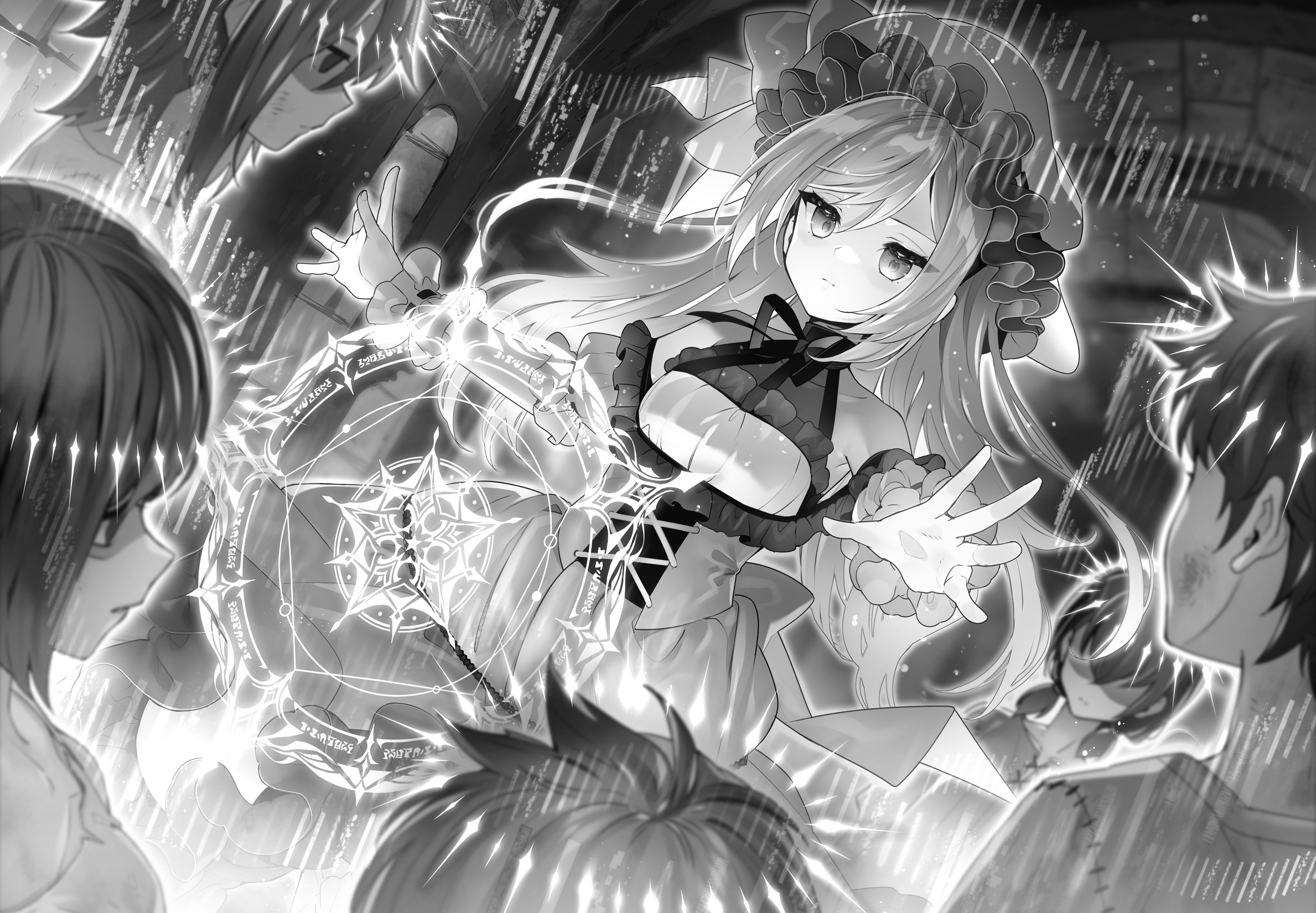
The mercenary blinked. “You teleported them?”
“I did. I also altered their memories of the past few minutes.”
Liliana’s frank admission of mental interference drew an exasperated look from Gildo. Even with his limited understanding of magic, he knew it was not only forbidden but also beyond what humans were meant to be capable of.
“You really aren’t human, are ya?” he asked. “Teleporting seven at once while tweakin’ the memories of five of ’em? The hell even are you? No wonder you put down that swarm all by yourself.”
“Who said I did?” Liliana replied, subtly warning him not to tell anyone. Not that she expected he would.
Gildo only chuckled.
“Wait,” Liliana said, a new thought striking her. “You said I tweaked the memories of five of them. Were the other two immune?”
The mercenary looked as though he’d already said too much. Still, he replied, “Georg and Ingeborg are immune to magic.”
“The same as you?”
He hesitated—but only for a moment. “That’s right. It comes with conditions and exceptions, but we children of Alvaldi are immune to magic.” Since Liliana already seemed convinced, he saw little point in hiding it.
In her past life, Alvaldi had been the name of a titan from Norse mythology. It had never appeared in the game, however. Northerners had always been just that—northerners—though there had been passing mentions that some were different. And now that she thought about it, they hadn’t even entered the story until the third game. When the marquess had spoken of northern immigrants, Liliana had assumed he meant northerners, but it was still strange for them to be appearing so early.
“‘Children of Alvaldi’?” she repeated.
“Yeah. Nomads from the far north. People in these parts don’t even know we exist.” A hint of disgust entered his voice. “To the locals—and the people in Yunatian too—we’re all just ‘northerners.’”
Slivegrandia was cut off from the northern lands by a steep mountain range, and its ties with them were almost nonexistent because of it. The Empire of Yunatian maintained some diplomatic contact with the northern countries, but it, too, was largely insulated from them. The result was widespread ignorance. Most people couldn’t even distinguish between the northern peoples and their ethnic groups.
“What about everyone we left lying around the church?” Gildo asked. Obviously, kidnappers ought to be handed over to the authorities, but Liliana wanted to question them before leaving them to the marquess’s people or the knights’ order.
“I want to learn what I can about their employer,” she said. “Those children weren’t the only ones taken.”
“All right. Then let’s go back, I guess.”
Gildo started walking, and Liliana fell into step beside him. His muscles were still swollen, his frame enlarged enough that just looking up at him made her neck ache.
“There are many northern countries,” she said. “How did you know those two were your kin?”
“The patterns.”
“What patterns?”
Gildo explained that he had noticed the decorative woolen fabric on Georg’s belt, where a strap would normally sit. “Those patterns are special to us children of Alvaldi. Weather’s rough up in the mountains, but if one of us dies, the others can identify the body by those designs.”
That made sense. In Liliana’s past life, fishermen on the Aran Islands had worn knitting patterns for much the same reason. Apparently, the patterns differed by family and made it possible to identify a fisherman who washed ashore after a tragic accident at sea.
“We’ve got no country of our own,” Gildo continued. “Most of us live in communities, but not all. There’re misfits like me scattered around too. If we ever cross paths, we’re expected to drop everything to help each other. Betrayin’ our kin costs us our powers. That’s the rule.”
Their solidarity was intense. It had never come up in the game.
“Do you wear a pattern too?” Liliana asked.
Gildo looked away. After a long pause, he awkwardly said, “No.”
Liliana decided not to press him. Silence reigned for a while before Gildo spoke again, as if forcing the words out.
“I ran away from my parents when I was a kid, so I don’t have one.”
“Oh.”
Liliana didn’t say anything else. Gildo’s past didn’t seem easy to discuss.
Before long, they reached the site of their last fight. The men were still there, bound and sprawled across the floor. It had been some time since Liliana and Gildo left them that way, yet no one had come to help them. Liliana frowned.
“What is it?” Gildo asked.
“I was wondering why they’re still here.”
“Would you have rather they escaped?”
“No, but...”
If no one had come for the mages, then they had most likely been abandoned. It was hard to believe their employers had entrusted them with running this place simply because they assumed it would never be discovered.
I can’t imagine the sort of people even the marquess couldn’t track down would leave such an easy trail. We should be grateful we rescued the children, but I doubt interrogating anyone here will give us answers.
Oblivious to her thoughts, Gildo hauled one of the nearby men to his feet. The mercenary’s eyes burned with anger.
“I’m sure you won’t be able to make them talk,” he said, “so look away. Unless you wanna puke.”
Liliana thanked him for the warning—then chose to watch anyway.
Even in their daze, the men squirmed on the floor, trying to put as much distance between themselves and the pair as they could. The mercenary clearly terrified them, but so did the little girl who had acted so calmly on the battlefield.
“No running, now,” Liliana said, mercilessly restraining them with her magic.
Gildo slapped one mage lightly on the cheek to wake him, looking used to the process. He yanked him upright by the hair—hard enough that strands tore free—then slowly traced the tip of his sword along the man’s body.
“Talk if you ever wanna walk again,” he said. “Or would you rather lose your eyes? I don’t care either way. They say you can still hear even after your ears are messed up, so should we start there?”
“I... I don’t know anything...”
The man looked unused to violence. He grew paler by the second, trembling as he insisted he was a short-term hire—a mediocre mage, barely more than a con artist.
One day, while he was drinking at a bar, a well-dressed man he’d never seen before had offered him a lucrative job: keep watch over children in the basement of a church for a few days. He was to fend off intruders and hand the children over when the boss arrived. That was all.
“Y-You’ve gotta be kidding me! I never agreed to this kinda treatment!”
“When were you supposed to hand them over?” Gildo pressed.
“T-Tomorrow night! Look, man, I’ve told you everything! Now let me go!” the man pleaded, still being held by his hair.
Gildo glanced at Liliana. She gave a small shake of her head. They wouldn’t get anything more useful from their current line of questioning.
The mercenary rounded on the mage again. “Describe the man who hired you.”
“He looked like some stuck-up noble in a robe. Couldn’t see his face ’cause of the hood. Oh, and I think he had a wound between his thumb and index finger on his left hand. He probably wore a ring on his left middle finger, but it wasn’t there when he met us.”
“How observant of you.”
“It’s part of the job.”
Perhaps he hadn’t been lying about being a scammer. He must have made a fair sum of money in his trade.
Gildo released the mage, who hit the floor hard. Then, ignoring the man’s cries, he walked back to Liliana.
“So, what’s the plan?”
“Let’s leave them. The marquess’s men should arrive soon.”
“Fine by me. Less trouble that way.” He paused, then added as though it were obvious, “You’re gonna wipe their memories too, yeah?”
Liliana nodded. They couldn’t risk the marquess learning they had freed the children and captured the men. “Take care, everyone,” she said with a smile, then erased the mages’ memories of her and Gildo.
All that remained was to bind them with magic so they couldn’t flee before the marquess’s men arrived, then return home. As they headed for the exit, Liliana rewrote the memories of the men collapsed elsewhere as well.
When they reached Gildo’s horse, still tied to a tree, Liliana turned to him.
“Are you returning to my estate?”
“Yeah. I’ll never be able to repay you for tonight.”
“Repay me...?” Liliana asked, genuinely surprised.
“Yeah.” Gildo’s usual half-joking tone was gone, and his gaze sharpened. “I never would’ve found them if you hadn’t used a hex. And before that, you saved my life. No exaggeration.”
Indeed, this was the second time Liliana had helped him. The first had been during the swarm.
“Can I take that as an offer to extend your contract?” she asked with a smile.
“What...?”
Gildo looked completely caught off guard. His and Olga’s contracts would expire soon. Olga had asked to renew hers the other day, but Gildo hadn’t said a word—he seemed to have forgotten about the matter entirely. When realization finally struck him, his mouth twisted into a sour curve.
“I’m not against it.”
“Then let us continue as before.”
“I can’t with you nobles...”
Yet for all his grumbling, he never said no.
◇ ◇ ◇
Marquess Kenneth watched fondly as his youngest son rejoiced at being reunited with Georg. Even after withdrawing to his office and settling behind his desk, he had to fight to keep a smile from his face.
It hadn’t been long after his men reported that there was nothing suspicious in Entrepôt when word arrived of Georg’s return to the manor. Several other children had come with him, none of whom the marquess had seen before. He had dispatched a trusted team to inspect the place where the captives had been held, and they had found the kidnappers already tied up on the floor.
The interrogation yielded little. Each culprit insisted they had been restrained before they even realized what was happening. They also claimed they were to hand the children over to their employer the following night, but that employer surely wouldn’t appear now.
“Didn’t see that one coming...”
Marquess Kenneth’s butler twitched as he watched from nearby. His master sounded almost impressed as he stared into empty space.
After a long moment, the marquess turned to his attendant. “Tell Brendon to meet me in the usual place the night after next.”
“Understood.”
After the butler bowed and left, the marquess lit a cigar. “Liliana Alexandra Clarke, huh...” It had been his first time meeting her. At a glance, she had seemed graceful, sweet, and even frail. She was also the strongest candidate to become the crown prince’s fiancée with a reputation as a talented student.
But there was more to her than that.
“I suppose she really is the daughter of the Cerulean Flame...”
As the night wore on, Marquess Kenneth gazed out the window, losing himself in thought.
◇ ◇ ◇
Come evening, Brendon Carey requested a leave of absence, changed out of his uniform, and made his way into the city for the first time in a while.
Hudore was vast and carved into countless districts. Beyond the noble quarter surrounding the palace lay streets bustling with commoners. The city itself had grown remarkably from what was once a small settlement clustered around the knights’ order.
Raised a sincere, frugal man, Brendon rarely wandered the city for personal reasons. The order provided everything he needed, so his days were spent between the barracks and the training grounds. He went farther afield only for patrols or the occasional dinner invitation from a colleague. Or when that man sent a summons.
Brendon passed through the crowded streets and slipped into a back alley. It was lined with reputable stores and restaurants, so he wasn’t surprised to see a few connoisseurs sauntering about. Before long, he turned onto a night street—one where doors opened only after dark. Despite being known as one of the most straitlaced knights in the order, he entered a building without hesitation, paying no mind to the fact that it had yet to open.
At the reception desk, a man was busy counting coins. He glanced up at Brendon and said simply, “Second floor.”
“All right,” Brendon replied.
He went upstairs to the door at the end of the corridor, knocked twice, and entered.
The room was clean but unremarkable: a table, some chairs, and a couch. Most of the other rooms were cramped, offering little more than beds and dressing tables, but this one was reserved for special guests.
Brendon looked around with practiced caution. He had to be sure there were no hidden passages or magical eyes or ears—anything that might threaten their privacy. Only once he was satisfied did he close the curtains. Then, leaving the lamps unlit, he watched the street below through a narrow gap and waited.
Brendon had been waiting for some time when his shoulders twitched. The door had opened without warning, admitting a man dressed entirely in black, from his overcoat and gloves to his fedora. His high status was obvious at a glance. The cane in his hand was plain but finely made, and Brendon knew it was more than an accessory; it would become a deadly sword the instant an enemy appeared.
“It certainly has been a while, uncle.”
“How have you been, Brendon?”
“Well, thank you.”
The man removed his overcoat and fedora, then sat in a nearby chair. He shot Brendon a sharp look, inviting him to sit as well.
Brendon gave a small nod and took the seat across the table from the new arrival: Marquess Kenneth, his mother’s younger brother, and the very man he had been waiting for.
“How is Billy?” the knight asked.
Marquess Kenneth’s expression softened at the mention of his youngest son. “Still as cheeky as ever. He wanted to see you.”
“He wrote that he became an apprentice in the Kenneth knights’ order.”
“Yes—and he’s still as green as they come. I’m sure he’ll ask you for a practice match one of these days.”
Though the captain of the Seventh seldom let his emotions show, Marquess Kenneth’s words brought a rare smile to his face.
Brendon had developed a good relationship with Billy Kenneth while living at his own family home in the Kenneth marquessate. He was a commoner by birth; his mother had married a commoner and lost her noble status, something possible only because the marquessate maintained an unusually narrow divide between nobles and commoners. In principle, he would never have been allowed to mix with his noble cousins—but his mother remained on good terms with Marquess Kenneth, so Brendon had played with them regularly as a child.
Like Billy, Brendon had originally planned to join the local knights’ order, but he had accepted the marquess’s recommendation to join the royal order instead. Even so, his new status as a knight had done nothing to change his relationship with his cousins.
Brendon wiped the smile from his face; he hadn’t come to reminisce.
“His Highness is investigating the matter in secret,” he said. “How successful he will be, I cannot tell.”
“I see. Is he acting alone?”
“No; the second son of the western tiger is helping him.”
The marquess looked up at the ceiling and stroked his chin. “I thought the second son took more after his mother.”
“It isn’t clear yet, but he seems focused on military arts.”
“I see.” The marquess’s eyes darkened. “If he carried more of his father’s blood, his admiration for the crown prince could easily have swayed many nobles to support him as well.”
Brendon remained silent. He understood exactly what his uncle was thinking.
Duke Ealdred—the “western tiger” in question—had been hailed as a child prodigy in his youth. Most such children grew into ordinary adults, but the duke had proven genuinely exceptional. People still spoke of when, in his twenties, he took on five opponents at chess simultaneously, even wearing a blindfold “as a handicap.” Each challenger had been confident in their skill, yet he moved his pieces without hesitation and ultimately won every match.
Austin, his son, was Riley’s close aide. If he possessed even a measure of his father’s talent, nobles would rally under the crown prince’s banner. Unfortunately, the duke’s blood couldn’t be felt in him at present.
Brendon struggled to find the right words even on his best days, and this was no exception. He racked his brain, then finally ventured, “This is just my opinion...”
The marquess turned back to him, prompting him to continue.
“But I think His Highness is trying to gather allies among the promising sons of influential nobles. Those around his own age, specifically.”
“Oh?” The marquess’s eyes brightened. Brendon’s words had clearly caught his attention.
“His Highness is pursuing a relationship with just one of his fiancée candidates. Meanwhile, the son of the western tiger seeks out the premier’s son at every opportunity.”
“You mean they’re trying to secure both Clarke children as allies.”
“In all likelihood.”
Recently, nobles had begun whispering about the remarkable talent of both of Duke Clarke’s children. If Riley and his future aide had set their sights on them, perhaps they had a keen eye after all. Brendon kept that revised assessment to himself, however; admitting he had once thought poorly of the crown prince could be construed as disrespect toward royalty. For now, he could only watch how matters unfolded.
“Anything else?” Marquess Kenneth asked.
Brendon shook his head.
The marquess hadn’t seemed to expect more anyway. “I suppose you can’t move around so freely either,” he concluded.
“Do you think His Highness should involve House Locard as well?” Brendon asked, cautiously but clearly.
Marquess Kenneth studied him with an unreadable expression. Though faintly intimidated, Brendon waited patiently for his response.
House Locard was known as “the shield” among the three largest ducal families. Its influence was said to rival House Ealdred and House Clarke, yet most nobles knew little about it. Brendon, a commoner, knew even less. He had hoped the marquess might enlighten him, but the man merely smiled and shook his head.
“They can’t possibly reach them.”
“So even His Highness stands no chance...”
“It’s precisely because he’s the crown prince that I say so.”
Their verbal tug-of-war made Brendon furrow his brow. Clearly, Marquess Kenneth had no intention of giving a straight answer. The knight was almost ready to give up when his uncle continued.
“Do you know the origin of our kingdom’s royalty and its relationship with the nobility?”
“Yes, sir,” Brendon answered, caught off guard. As the marquess’s relative, he had received a far better education than any ordinary commoner could hope for. “Their relationship was contractual.”
“It was, but not anymore. Officially, the king is absolute, and the feudal lords obey him. It’s a far cry from how things started.”
During the three demonic centuries, when the kingdom had been fractured by civil war, each region had been ruled by a powerful family. Then a man emerged who could unite them, and the people called him king. He provided and protected the feudal lords’ domains, and in exchange, they mobilized their armies at his request. Thus began the relationship between royalty and nobility—though it had changed entirely since then.
“House Locard is different,” the marquess continued. “It still upholds the contract made with royalty when Slivegrandia was founded. Others have altered the terms over the years, but not the Locards. From the start, the contract they made with royalty stood apart from the other houses’.”
Brendon frowned. Was this not a state secret? Should he really be hearing it? Marquess Kenneth must have sensed the knight’s unease, for his expression softened.
“Don’t worry,” he said. “Anyone with ducal-level power knows at least this much.”
If so, the marquess barely met the threshold. Brendon wasn’t his direct descendant, so he couldn’t help wondering whether he was permitted to hear something so sensitive. Not that he could complain; he’d raised the subject to begin with.
Marquess Kenneth continued matter-of-factly, brushing off his nephew’s hesitation. “Naturally, the only ones who know the terms of that contract are the king and the current head of House Locard.”
Brendon paused in thought. “You mean nobody else knows the conditions that would compel House Locard to act?”
“Precisely,” the marquess said with a smile. “Still, it’s wise of His Highness to seek allies among the three ducal families. He won’t have any luck with House Locard—but since no one can win them over, I wouldn’t call that a cause for concern.”
Brendon wasn’t entirely convinced, but he refrained from pressing further. The marquess gave a satisfied nod, then changed his tone, adopting a more sober expression.
“How is the boy from House Calvert doing?” he asked.
“He’s as healthy as ever.”
“Good, good.” Though the corners of the marquess’s lips curved upward, his eyes remained sharp. “Get in touch with his family as well. Our targets are too good at covering their tracks.”
“Did using Georg as a decoy not bear fruit?”
“We only caught some hired goons,” the marquess replied, his displeasure plain. “But we know the premier’s daughter was involved.”
“What...?” For once, Brendon had to doubt his ears.
“She isn’t our enemy, but I wouldn’t call her an ally yet either,” the marquess said, unbothered by the knight’s wavering composure.
“What do you mean?”
Marquess Kenneth didn’t answer; he merely sank into thought. A seven-year-old girl had negotiated better than the average adult, and she had used a hex to locate Georg with startling efficiency.
They hadn’t found anything at the location the hex indicated. Georg—and the other kidnapped children—had apparently escaped and reached the manor on their own. The place they claimed to have been held was in the opposite direction from where the hex had pointed, and the kidnappers were already tied up when they were found. None of them could remember who had restrained them.
It seemed unlikely that Liliana had done everything herself, but there was no doubt she was entangled in the affair.
The entire situation was too absurd to put into words. What could a seven-year-old possibly do? Marquess Kenneth didn’t expect anyone to believe such a story; they would assume he’d lost his mind.
Still, he trusted his intuition.
“Listen carefully, Brendon—don’t take your eyes off that girl. Do what you can to bring her to our side.”
“Understood.”
At some point during their conversation, the moon had risen. It hung bright against the night sky.
Extra: The Girl and the Foreign Circus
Extra: The Girl and the Foreign Circus
“My lady, some traveling entertainers from the empire have arrived in Hudore’s square,” Marianne announced one sunny day.
Liliana, who had been enjoying the handmaiden’s tea snacks, looked surprised by the news. Marianne smiled, pleased to have caught her young mistress’s interest. She must have been worried—Liliana had done little but travel between her estate and the palace since returning from Fortier.
“They say it’s a rather large troupe,” Marianne continued. “They even have magicians and all kinds of animals.”
Normally, only traveling minstrels performed in Hudore. Permission to use the square was notoriously difficult to obtain from the city’s guards, yet somehow that hurdle had been cleared.
Liliana gave the matter some thought. She had little interest in anything beyond magic and hexes, but she couldn’t deny that her curiosity had been piqued. If there were animals, it was probably a circus, yet she had never heard of such a thing in this world.
“Would you like to go see them tomorrow?” Marianne asked.
As the daughter of a duke, Liliana would first need to ask Olga and Gildo to accompany her as protection. Even so, she could already feel her excitement growing.
The next day, Liliana visited the city square with Marianne, a reluctant-looking Gildo, and Olga, whose thoughts were as unreadable as usual. Gildo disliked the idea of his charge making herself so vulnerable; he had stopped too many assassins at her estate to take her safety lightly. Nobles and commoners were separated by designated areas and visiting hours, but the square was still an ideal environment for foul play.
“Bah...” he muttered. “I know it’s our job to guard you, but there’s only so much we can do when you’re deliberately putting yourself in danger.”
Olga gave him a consoling pat on the shoulder, leaving him to sulk in silence. Marianne, tense but determined, was scanning the square for performances her lady might enjoy. As if on cue, cheers rose from somewhere ahead, drawing their attention. Liliana, however, was too short to see over the crowd.
Oh well. I don’t care enough to use magic here.
Yet just as she decided not to bother, her feet left the ground. She froze at the unexpected turn of events.
“Gildo!” Marianne exclaimed. “What are you doing to my lady?!”
“What? She’s obviously curious,” he replied. “This is the easiest way.”
In an instant, Liliana found herself sitting on Gildo’s shoulders, her feet dangling in the air. She didn’t know how to react, but Marianne was openly furious.
“My lady is the daughter of a duke, not some commoner!”
“Oh, shut it. Olga, keep an eye out for projectiles.”
“All right,” Olga replied.
Marianne must have been counting on at least Olga to side with her, for the female mercenary’s response finally rendered her speechless. Commoners often picked up their children and even hoisted them onto their shoulders, but it wasn’t something young nobles—especially high-ranking ones—would typically experience.
“Hold on to my head,” Gildo said sourly.
Liliana obeyed, albeit hesitantly. It was enough to help her stay balanced. As she finally relaxed, she turned toward the source of the cheering.
A man was performing tricks with birds. When he removed his hat, pigeons burst out one after another and perched on his fingers. Then, with a light flick of his arm, they vanished. Some spectators whispered that it must be real magic, but the magic-nullifying cage around him suggested otherwise.
“Impressive,” Olga remarked.
The act was so splendid that even Marianne forgot her anger. “Is it really not magic...?” she muttered.
“Can’t be,” Gildo said. “See the nullifying cage around him?”
“I never would have believed such things were possible without magic. It doesn’t look humanly feasible.”
Liliana agreed that the performance was interesting, but she kept scanning the square. From her new vantage point, she could see far more than she ever could from the ground: a human-shaped figure throwing knife after knife at an unmoving performer, narrowly missing each time; a juggler keeping several balls in the air while balancing in a handstand; and more besides.
“Did you find something you want to see, my lady?” Marianne asked, noticing Liliana staring fixedly in one direction.
From her higher vantage point, Liliana could see over the crowd. She nodded without taking her eyes off her target.
“Where?” Gildo asked. He craned his neck to follow her gaze, then started in that direction—toward a man with a whip, a lion, and a flaming hoop. Several royal knights stood nearby, keeping watch over the dangerous animal.
Once enough spectators had gathered, the performer spread his arms and cried, “Ladies and gentlemen, feast your eyes on this fearsome beast! Though it killed countless in its hunger for flesh and blood, its sharp teeth and claws were no match for humankind. I brought it down in combat and bent it to my command. Now, watch closely!”
He snapped the whip against the ground. The lion, which had been sitting obediently, slowly rose and began to pace before the ring of fire.
At the man’s shout, the beast let out a low growl. Then, after a short run-up, it leaped through the flaming hoop. The crowd erupted in cheers. Animals were normally afraid of fire, and the spectators gaped at the performer who had made the lion act against its primal instincts.
“Again!” he called, and it jumped back through from the other side.
After repeating the stunt several times, the performer ordered the lion to stand down and turned back to his audience.
Liliana had been holding her breath; she had never seen a circus animal before. Only then did she realize she was clutching Gildo’s hair, and she hastily loosened her grip. It must have hurt, but he didn’t utter a word of complaint. He was grinning, if anything.
“You actually like this stuff?” he asked. “Guess you’re finally actin’ your age.”
Liliana blinked at the mercenary. She couldn’t quite parse what he meant, but Marianne and Olga seemed to understand at once. Neither replied; their silence made it clear they agreed.
“I’m glad we found something you enjoyed, my lady,” Marianne said. The genuine warmth in her voice made Liliana feel awkward, and she turned away to hide a faint blush.
Gildo, too, seemed to have shed his earlier reluctance, growing oddly enthusiastic as he searched for more acts. Different corners of the square featured different performances, though the ones involving animals were clustered together.
“A bear ridin’ in circles?” Gildo said. “Never seen anything like it.”
Liliana turned. Not far from the ring of fire, a bear rode a unicycle as though it were human. Unicycles had existed in Liliana’s past life, but she had never heard of them in this one. The bear’s didn’t even have a seat—just two pedals fixed to a single wheel. If the two worlds were meant to follow similar historical paths, unicycles shouldn’t have appeared until far into the future. Perhaps progress here would unfold differently.
“Think you could ride that thing, Olga?” Gildo asked.
“Maybe with practice. It would take time, though.”
“Yeah...”
He seemed genuinely impressed. Then a mischievous grin tugged at his mouth, and he added, “Don’t even think about tryin’ it, little one. You’ll hurt yourself, and you-know-who’ll faint.”
Having been raised as a duke’s daughter, Liliana had never been teased with such casual familiarity. She stayed quiet, uncertain how to respond—while Marianne’s eyebrows shot up.
“That’s quite enough, Gildo! My lady would never do such a thing.”
“You never know. It’s the quiet ones who do the wildest things,” Gildo said, as if speaking from experience. He glanced at Marianne as if to say, “Aren’t you the same?”
“I would never!” the handmaiden protested, her face flushing beet red.
“I don’t know about that...”
Gildo seemed to relish needling her. Marianne may have had more experience with people than Liliana, yet she didn’t seem to realize that her outrage was exactly what he wanted. Olga watched with quiet sympathy—which the handmaiden didn’t notice either.
“Are there any other performances you wish to see, my lady?” Marianne asked, trying to steer the conversation back on track. “I heard there’s a rest area at the edge of the square. We can go there if you’re tired.”
There were no rest spots in the areas open to commoners, but one had been prepared for nobles. Apparently, it even offered tea and snacks. Liliana shook her head, though; her time in Fortier had taught her that such things tasted best at home, made by her handmaiden and other servants. The risk of poison here was surely low, yet the caution and ceremony required to avoid it would be tiresome.
“How about over there?” Olga suggested, pointing. “It looks like they’ve got tightrope walking and trampoline acts.”
Liliana nodded, and Gildo set off again with her still perched on his shoulders. It was no longer strictly necessary, but it felt strangely comforting—and less tiring, given how little she usually walked.
At first, Liliana had only wanted a quick look at what the square offered, but she and the others ended up staying until evening. When the sun finally sank, a fire was lit, casting the square in a more mystical glow. By then, Liliana was thoroughly exhausted.
Gildo carried her back to the coach, and she slept so soundly that she remembered nothing of the ride home—or of being carried to her room. For that reason, she never learned that Marianne had gently patted her forehead as she slept.
Afterword
Afterword
Hello. My name is Kei Yose. Thank you for reading this book.
The main story and episodes remain unchanged from the web novel, but I added a lot while adapting it into a light novel—for example, new scenes and setting details that were previously unclear. I hope these additions made the book even more enjoyable.
When I first began writing, I was taking it easy. I never imagined the story would grow this long, much less be adapted into a light novel. It has reached this point only because of the readers who supported the web novel, and for that, I am truly grateful.
I would also like to thank Ruria Miyuki for the many wonderful illustrations. They added great depth to the world and characters, and as I wrote, it often felt as though the cast began to move of their own accord.
Last, I would like to express my heartfelt gratitude to my chief editor and everyone in the editorial department, as well as to the proofreaders, designer, and everyone else involved in producing this book.
I hope we meet again in my future works.
Color Illustrations
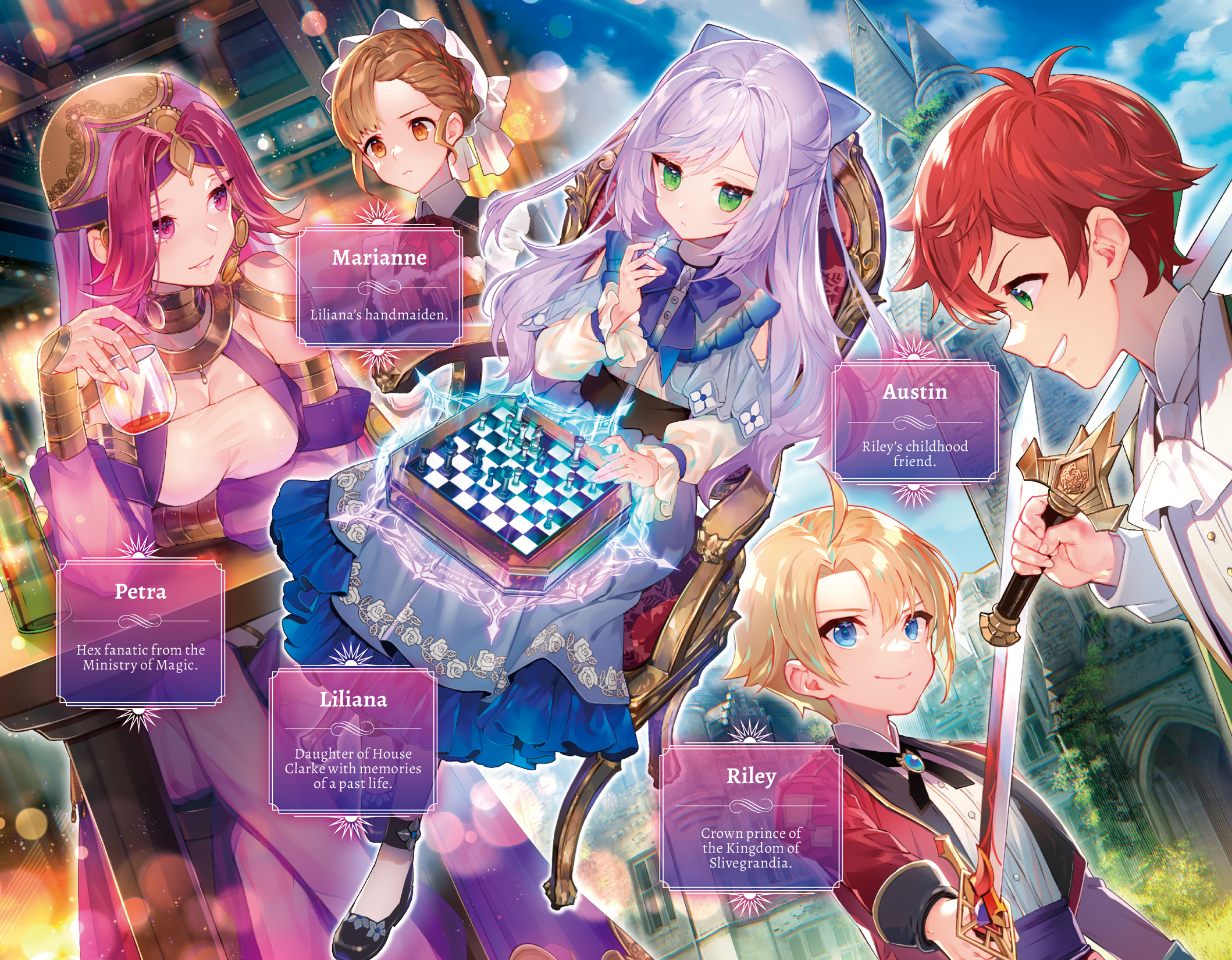
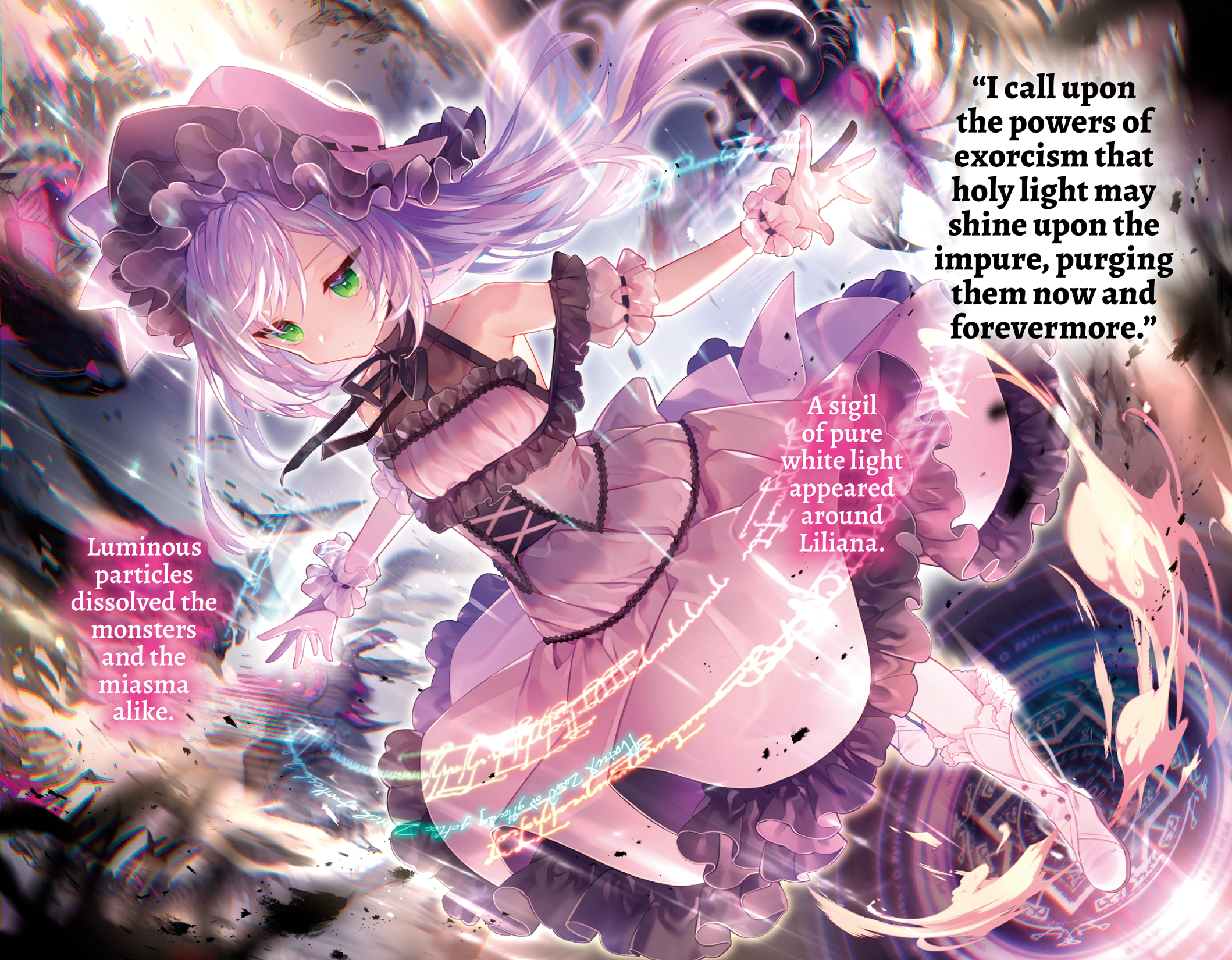
Characters and Geopolitics
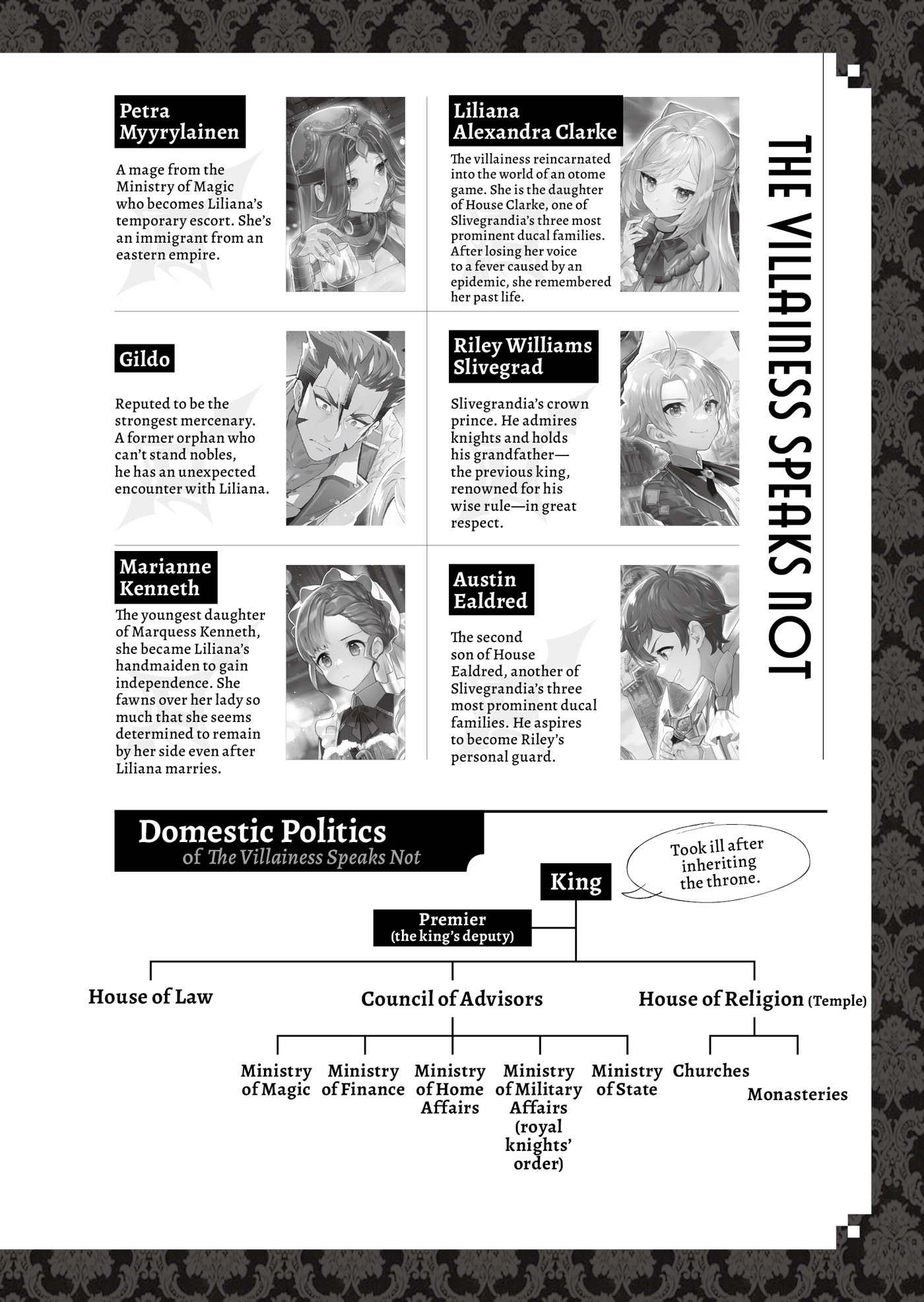
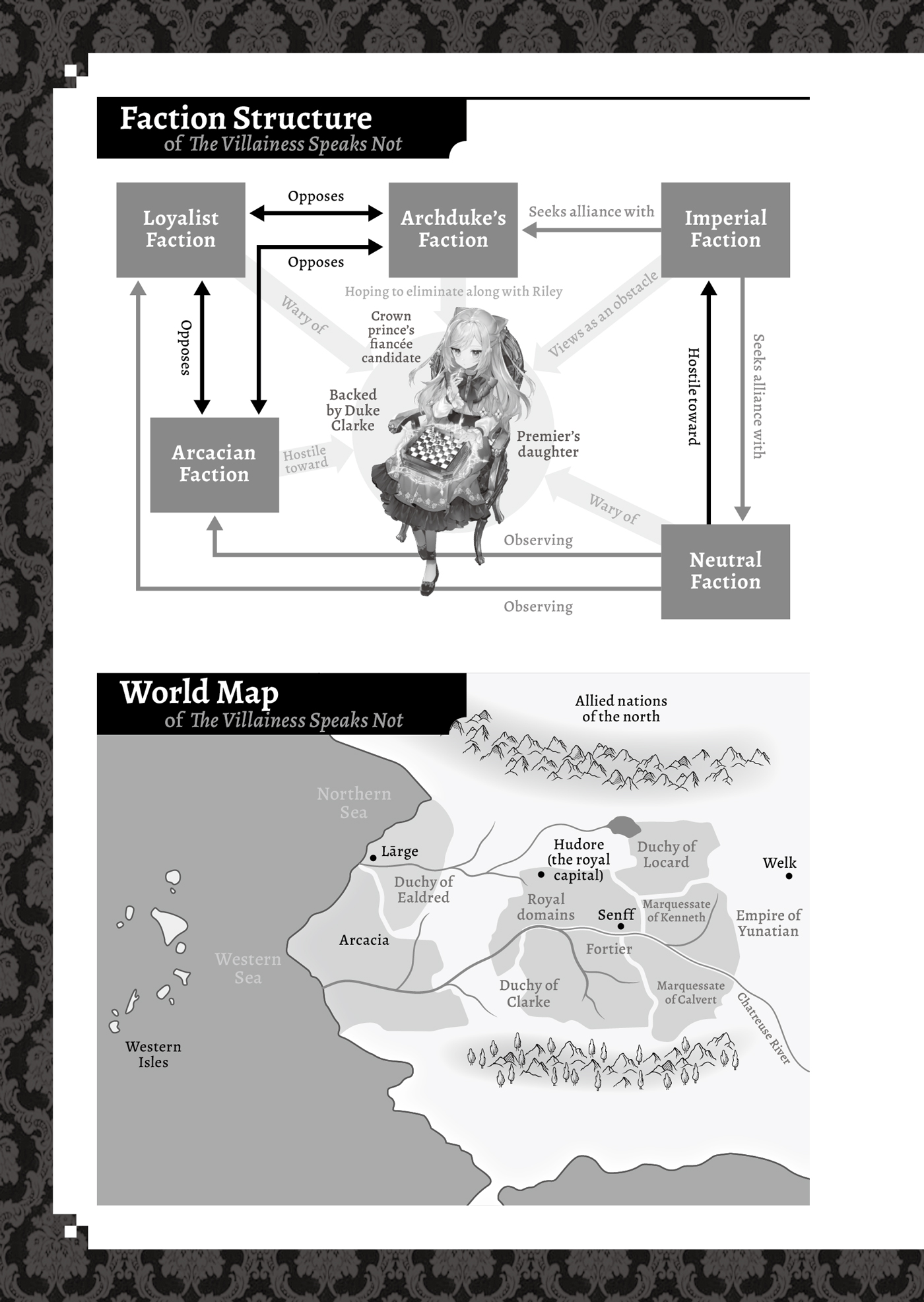
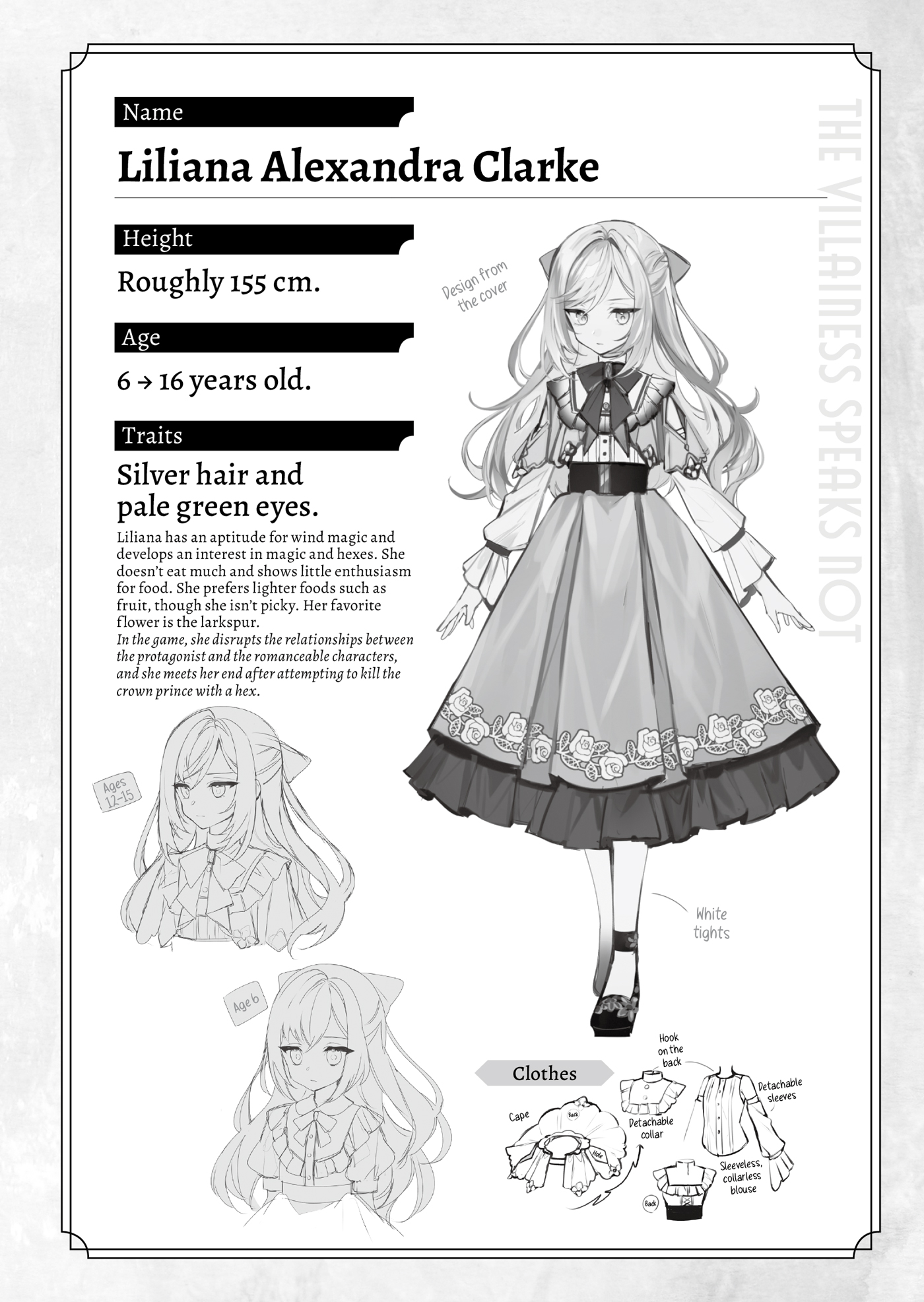
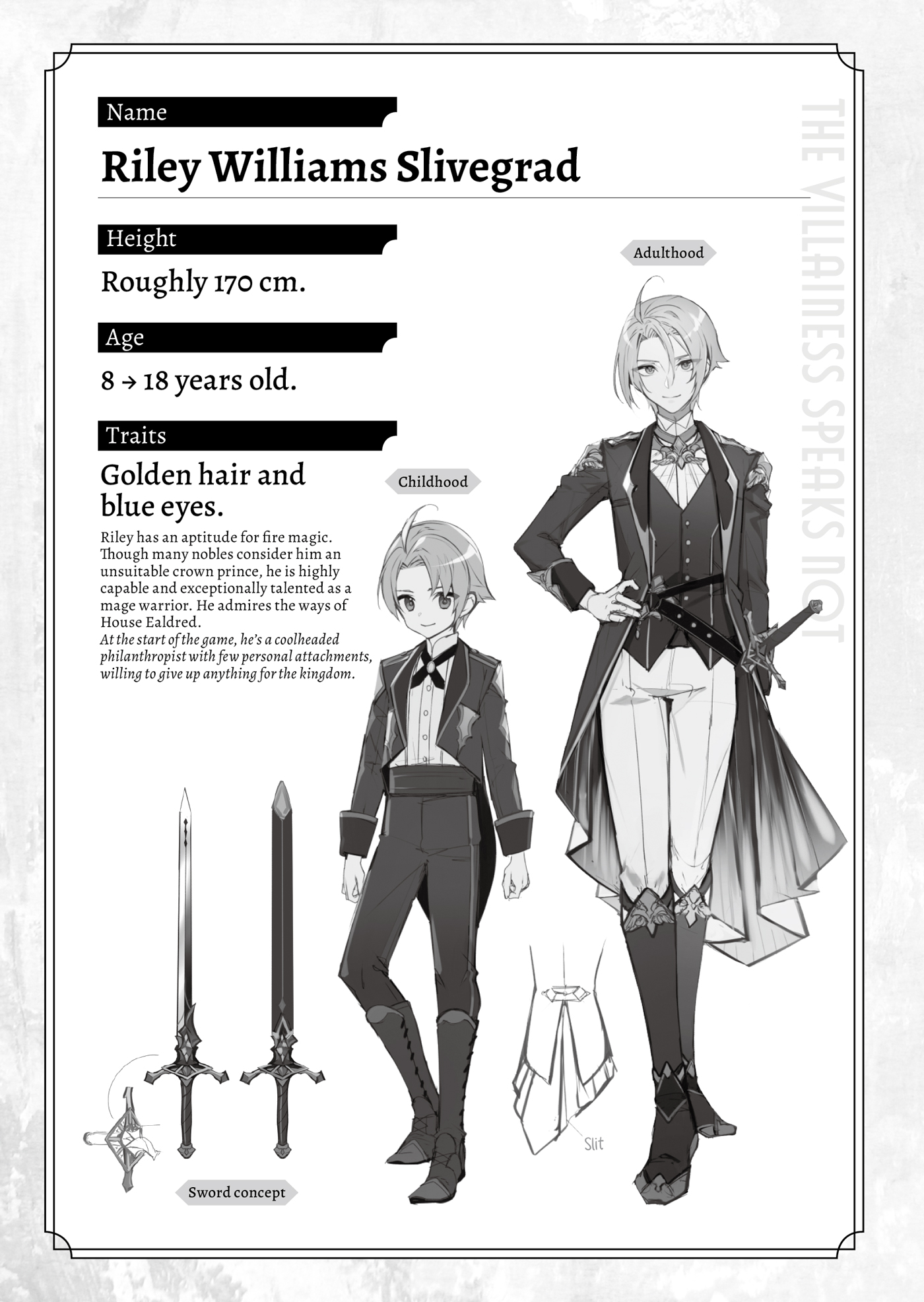
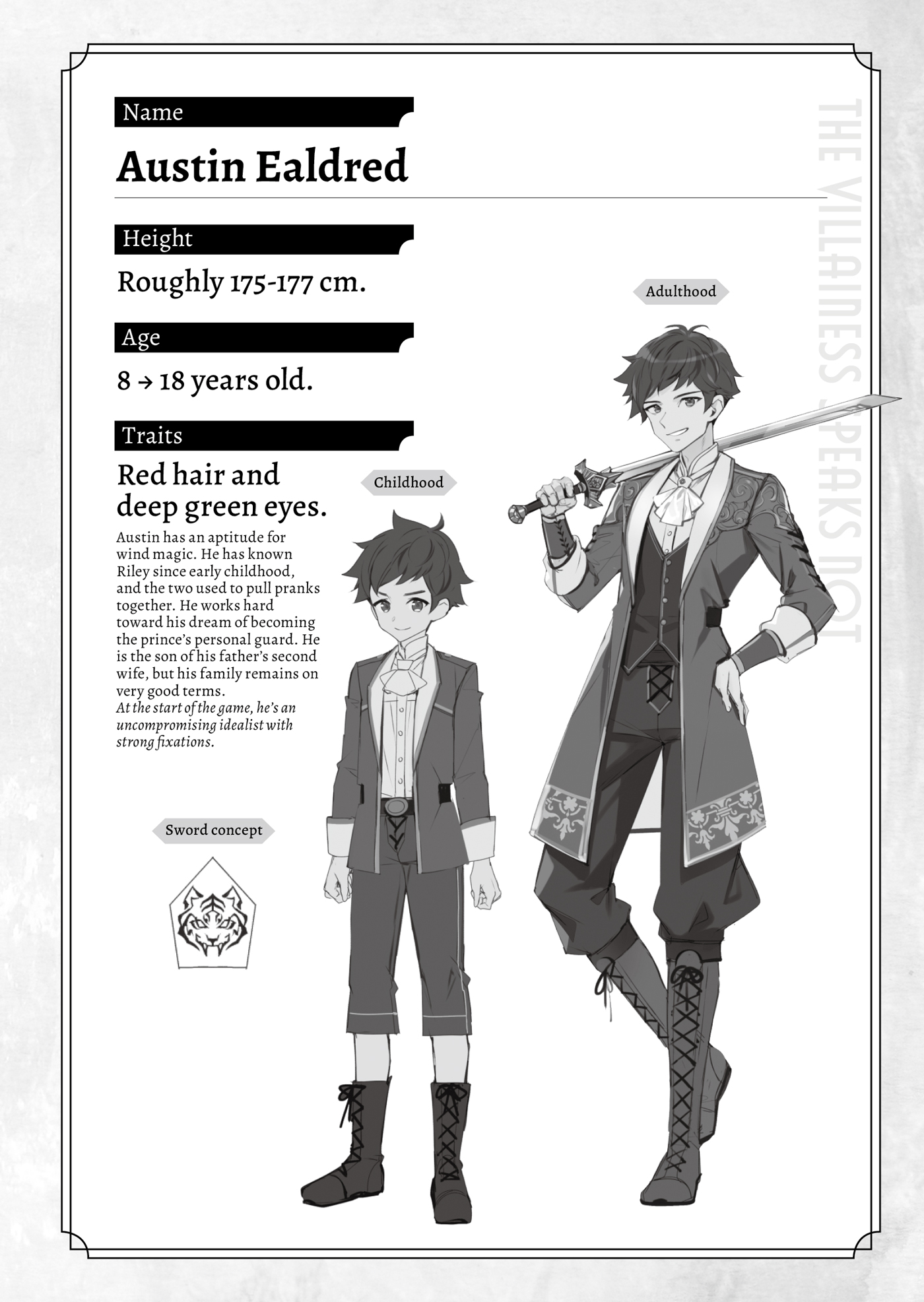
Bonus Textless Illustrations