TIMELINE
1943 | During World War II, the head of a European nation in an unfavorable position conducts a demonic summoning ritual, sacrificing both his own and enemy soldiers. The ritual successfully summons the first demon. |
The demon bestows a part of itself to the humans who survived the sacrifice, turning them into beings known as “demonkin.” With them come strange creatures called “monsters,” which serve under the command of demons and demonkin. | |
With its army of demonkin and monsters, the demon massacres huge swaths of humans to summon more demons. They kill the leader of the nation who summoned the first demon, releasing it from its contractual bonds. The chaos caused by this series of events leads to a ceasefire in human conflicts, and World War II ends without a victor. | |
1944 | Following the end of the war, the Japanese military withdraws from the mainland. |
1945 | Manchuria, the Joseon dynasty of Korea, and a few smaller factions merge, with the support of the Republic of China and Soviet Russia. They declare independence from Japan and form the Republic of Korea, claiming the Korean Peninsula and parts of Northeast Asia as their territory. |
Meanwhile, in Europe, the violence escalates as demons summon more of their kind through mass slaughter, creating a vicious cycle. Ultimately, over forty demons are summoned. Roughly half cross into the Americas, initiating wars between humans and demons there as well. | |
1946 | European nations that have been hit hard by demon attacks form a military alliance with Middle Eastern and African nations facing sporadic raids. |
195X | Having been defeated in an internal power struggle, a demon named |
The first combat mech, named Camael, is completed in Europe. Children imbued with a special element under the Savior Project begin piloting these machines into battle. | |
195X | As fighting on the European front reaches a stalemate, the Republic of China develops combat mechs designed for conventional warfare. China sparks a new war as it attempts to conquer neighboring countries. |
195X | In Japan, a mech designed to combat other mechs, named Kunitsuna, is developed and exported to nations invaded by China. |
196X | Countries everywhere fight back against the Republic of China, which also suffers internal uprisings, leading to its collapse. It reorganizes as a federal parliamentary republic, the United People’s Federation of China, made up of six provinces: Yong, Yi, Jing, Ji, Yang, and You. |
196X | Several demons from Europe invade the United People’s Federation of China. The northwest Yong, southwest Yi, and central south Jing provinces are overrun. |
197X | Demons invade Southeast Asia. With the exception of island nations such as Indonesia, the Philippines, Timor, Taiwan, Brunei, and Japan, nearly the entire region becomes a battlefield. |
197X | Demons begin appearing in island nations such as Indonesia and the Philippines. |
198X | Demons are confirmed to have spread to Taiwan and Japan. |
199X | Demons are discovered in Australia and New Zealand. The entire world has now become a literal hellscape where humans and demons are in a perpetual state of war. |
199X | In Japan, the Symbiosis Faction attempts to implement their Anti-Savior Plan but are thwarted by the brave efforts of the National Defense Forces. A young boy who was almost sacrificed in the process offers to cooperate with the military, prompting the launch of the Second Savior Project. |
200X | On the mainland, the United People’s Federation of China suffers a major defeat, losing northern and northeastern China. |
201X | Japan successfully develops the first artificial magicite crystal. |
202X | The first mech compatible with artificial magicite, named Murakumo, is developed. |
202X | The First Counteroffensive is launched. Japanese forces, including Murakumo units and Second Savior Project candidates, deploy to the Korean Peninsula. Despite a major victory, conflicts between Japan, whose goals are to hold the front line and gather intel, and local factions who wish to reclaim territory lead to Japan’s withdrawal. |
202X | The Republic of Korea falls to demonic forces. |
203X | Fighting intensifies in Tsushima, Kyushu, and Okinawa, but each time, the National Defense Forces manage to repel the invaders. |
203X | To support the Second Counteroffensive, Japan exports Murakumo units and their upgraded version, Kusanagi, to Southeast Asia. However, due to a lack of compatible pilots, their deployment is limited. Although the front lines hold, their strategic objectives are unmet, resulting in a failed operation. |
203X | In light of this failure, the Third Savior Project is proposed and approved, with the goal of increasing the number of individuals whose bodies are compatible with artificial magicite. |
203X | The global human population falls below five hundred million. Due to the overwhelming death toll and food shortages, the large-scale war becomes difficult to maintain. (Demonkin survive on human food, while demons rely on humans and demonkin for sustenance, meaning if both humans and demonkin die out, so too will the demons.) |
204X | Having gathered their strength after a decade-long period of inactivity, a coalition of Southeast Asian countries launches the Third Counteroffensive, successfully liberating much of Taiwan and the Philippines. |
204X | Victories in Thailand, Vietnam, and Myanmar expand humanity’s habitable regions. |
2053 | Emboldened by continued victories, General Muroguchi of the National Defense Forces pushes to extend the front lines farther into enemy territory. Under his command, the Third Division suffers a historic defeat at Imphal. |
2054 | The demons and demonkin that triumphed at Imphal launch a counteroffensive, turning Thailand and Myanmar into battlefields once again. |
2054 | In response to intensified combat in Southeast Asia and new invasions from the Korean Peninsula, Japan decides to dramatically increase military personnel. |
DEC. 2055 | Present day. |

Legend of the Far East’s Savior
“Special Ensign, the time is now 0900. You may commence the operation.”
“…Roger that.”
The flat, mechanical voice echoed inside the cockpit.
Whether it came off as lifeless or atmospheric probably depended on the person listening.
Me? I was in the “atmospheric” camp.
Rumor had it that in some divisions, you got your own personal navigator capable of reporting on the situation in real time. In our trial unit, however, nobody had anything like that.
Honestly, I’d never trained with a real-time operator feeding me orders or practiced coordinating with other units. Even if someone was assigned to me, something told me I wouldn’t be able to keep up. In any event, I preferred the cold precision of a machine’s voice over a human one, so I had no plans to get a personal navigator anytime soon.
Besides, I was still a barely trained student. Sudden chatter could throw off my concentration, which was why our comms were set up so I couldn’t even talk to other units.
The only exceptions were HQ and an engineer stationed in the hangar named Mogami, who monitored me and the mech. If anything went wrong, I would hear from one of them.
But right now, I had no messages from HQ. Nothing from Mogami, either.
In other words, the operation had officially begun.
“All right. Let’s do it.”
This was my second time in actual combat. No—actually, if last time was just considered a trial run, then this was my first real battle. I’d be lying if I said I wasn’t nervous. But at the same time, I could feel a strange excitement bubbling up inside me.
It’s not like I enjoy risking my life in combat… But hey, if you end up getting reborn into a world with giant robots, you’d be a fool not to pilot one, right?
Craving peace but grinning on the battlefield… Yeah, I didn’t quite get myself, either. I’d have to leave the psychoanalysis for later, though.
Right now, I had a job to do.
“This is Special Ensign Kawakami of Task Unit 2099. Commencing operation on schedule.”
The monitor showed a stretch of beach. Normally quiet and peaceful, it was currently swarming with all kinds of monsters making landfall.
There were…well, a lot of them.
Even though we had our own forces deployed, if those things managed to organize themselves, we’d be in serious trouble. They’d probably even be able to wipe us all out despite our superior numbers.
That was how dangerous monsters were.
But this wasn’t some sports match. It was war—kill or be killed.
So there was no reason to wait around for the enemy to get ready.
“Target confirmed.”
There was no such thing as cowardice or dishonor here. Preemptive strikes were fair game. My sights were set on the big ones. They’d just swum across the Sea of Japan and were likely exhausted.
Sorry to spring this on you when you’re tired, but I’ve got a job to do!
“Moving to eliminate!”
I jumped into the air and fired a round straight at the biggest guy in front of me—a proper hello.
“Bweh!”
“…?!”
The huge beast exploded with a pitiful death cry. The others watched its remains collapse before finally realizing they were under attack, then all at once unleashed a barrage in the direction the shell had come from—my location just a moment ago.
The distance between us was about seven kilometers. My shells flew at roughly Mach 2, so they took about ten seconds to hit. The monsters’ return fire, however, came in at around Mach 1, so it would take close to twenty seconds for their attacks to reach their target.
Twice as long, sure, but it was still just twenty seconds. That was more than fast enough to kill not only Yoichi-type mechs but also Kusanagi-type ones.
“Which is why your tactics made sense. But that’s all about to change!”
A Yoichi-type mech, which focused on firepower, wouldn’t have been able to dodge the monsters’ return fire.
A Yatsufusa type, which prioritized mobility, might have dodged it, but it lacked the power to take down a large monster in a single shot.
A Kusanagi type, which had average firepower and mobility, would have been blown away without being able to either attack or evade.
If evasion wasn’t an option, then what about defense? Long story short, it was impossible.
Fending off an attack from a single monster might have been doable, but when you had volleys coming in from multiple monsters? There wasn’t a suit of armor or defensive system out there that could handle that.
So you couldn’t dodge, and you couldn’t defend against it. That left only one outcome: The brave sniper who had managed to take out one of the larger monsters—which were the backbone of the enemy forces—would end up vaporized by the counterattack.
Everyone knew that. That was the rule of engagement. Until now.
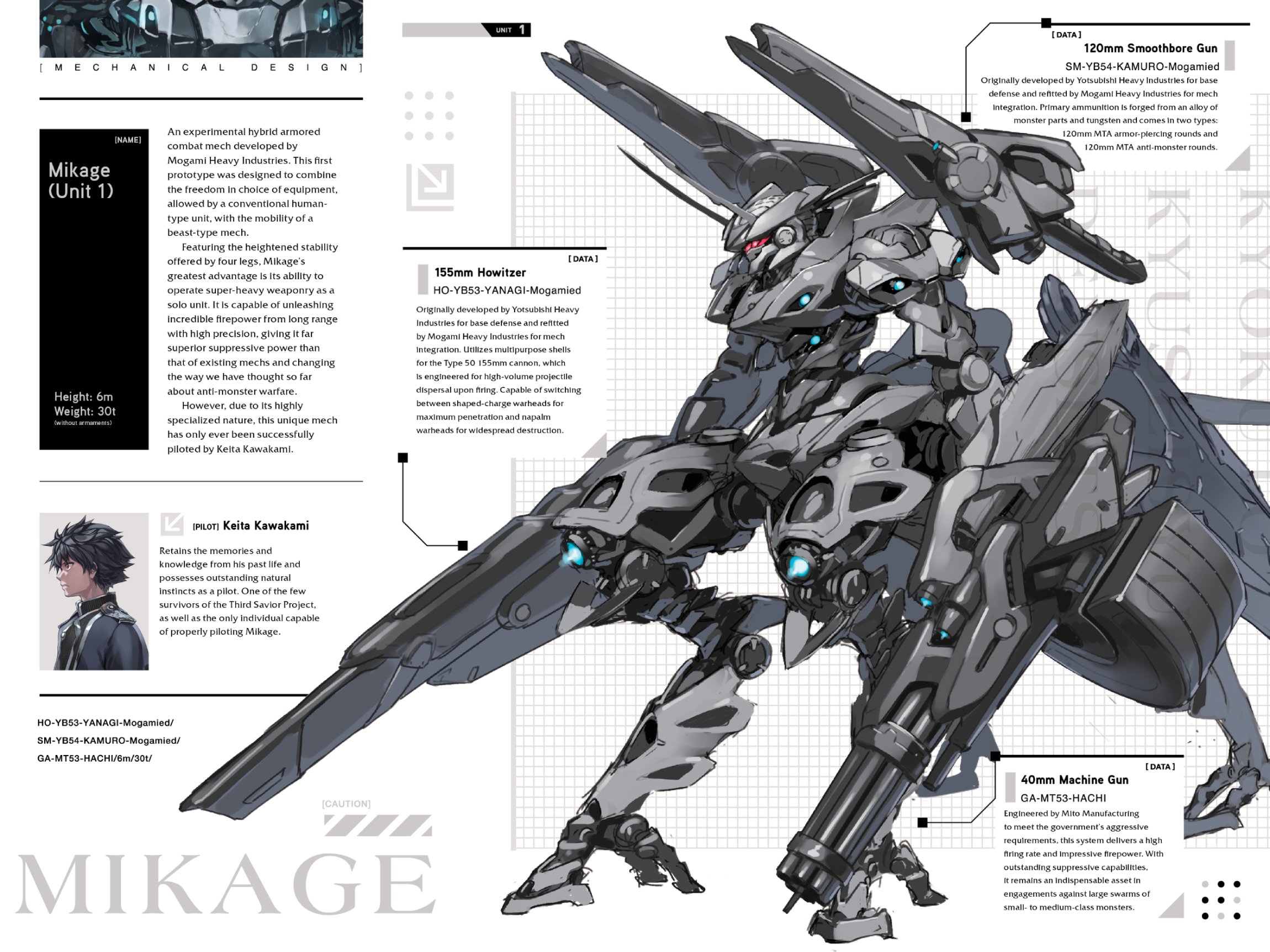
Today, that rule had been shattered by a certain lunatic who’d built a mech that combined Yatsufusa’s agility with Yoichi’s firepower, surpassing them both.
“Sorry, but I’m not over there anymore.”
Dodging wasn’t even necessary; I simply wasn’t where the monsters had targeted.
“Raaah!”
“Roooar!”
They were screaming and firing at empty air.
And they’d left themselves wide-open.
“Talk about spoiled for choice.”
“Brp!”
Second shot. Just as planned, I took out the second-largest one.
“That’s it for the thirty-meter class. Next up, the twenty-fives and twenties.”
Bigger meant stronger. So far, I’d been able to move and fire simultaneously, keeping my enemies from retaliating, but I couldn’t count on that lasting forever. They might adapt.
That was why I had prioritized eliminating the biggest potential threats, just in case.
Not that the twenty-five- or twenty-meter ones were pushovers. One hit from them would still kill me. I couldn’t afford to get complacent.
If I wanted to survive, I had to take them down while I still could.
“Don’t worry, I’ll make it quick!”
“Bwam!”
“Doo-doo-doo!”
“Wraaah!”
Maybe they hadn’t caught up with my movements yet; their return fire was still wildly off target. I just kept attacking.
“No way this latest model’s going to lose! Let’s gooooo!”
“Kadoom!”
“Come and get some!”
“Dwooh!”
Jump, shoot, strafe, get another round off mid-fall. Touch the ground for a split second, then jump again and shoot. Scatter my shots all around. And repeat.
Honestly, even I could tell I was getting a little manic. If I watched the footage or listened to my voice later, I’d probably roll around on my bed in pure embarrassment.
But I couldn’t stop moving. The moment I stopped, I’d be dead.
I used to be a normal student… How the hell did I end up like this…?
That day, that moment, that place—I’d chosen to join the military to survive. Had it been the right decision or a terrible mistake?
Well…I’m still alive, at least. So for now, I’ll call it the right one.
I stayed sharp, dodging the monsters’ increasingly accurate shots, and fired back.
“Your aim’s off!”
“Kabrah!”
Land. Jump again—no issues with the legs. No damage from the recoil. A bit of lag when reloading shells, but not enough to be a problem. Honestly, that’s on me. I need more practice. So basically…
“No issues overall.”
They say that when you start thinking about how you can keep going, you’re already in danger. But I’ll be fine. I’ve got backup.
I wasn’t trapped in an enclosed space, and I wasn’t fighting alone.
In fact, the allies around me weren’t rookie pilots. They were seasoned veterans with way more experience than me.
Right… I’ve only been at this for a few months.
Even as I dodged and weaved through the battlefield, my thoughts drifted back to that day not so long ago.
The day that had changed everything for me, Keita Kawakami.
The day my fate was sealed.
Guidance

First, let me give you a general overview of the Second Savior Project.
It all started a few decades ago, when a child was born to a group known as the Symbiosis Faction.
One day, the child’s parents decided to perform a ritual that had unfortunately become common practice among members of the Symbiosis Faction. It involved offering a sacrifice to summon a demon, with the goal of turning a human into an intelligent monster known as a demonkin.
The child was chosen as the sacrifice, and a piece of magicite—a magic crystal left behind by monsters when they die—was implanted into them.
If a demon responded to the summoning, or if the child absorbed the magicite and became a demonkin, the ritual would have been considered a success.
However, before the ritual could be completed, a group from an opposing organization stormed in. The child, desperately resisting the magicite’s influence, was left behind as their parents and other Symbiosis Faction members were killed.
The child, writhing in pain from the ritual, was rescued by the group.
Thanks to their naturally strong vitality, the child—who should have lost both their mind and body to the magicite and turned into a mindless monster—did the unthinkable instead. They absorbed the crystal.
This shocked those in charge of the child’s rescuers—the upper echelons of the National Defense Forces.
The child gained unique powers from the magicite. And so, for the sake of the nation—or rather, for the future of humanity—they willingly cooperated with the military and participated in a series of experiments.
Over the next decade, the military was able to repurpose the data gathered from the child’s voluntary experiments. Eventually, we succeeded in developing a relatively safe form of artificial magicite.
That was the greatest achievement of the Second Savior Project.
Today, those compatible with this artificial magicite serve as the core of our national defense.
No magicite-compatible individual can ignore the contributions of the original child, who made it all possible.
Moving on, the artificial magicite developed by the National Defense Forces serves two main functions.
The first is that it acts as a kind of pseudo–item box.
The mechanism behind how it functions isn’t fully understood, but the magicite can retrieve items linked to the user’s mech.
Mechs are equipped with a container, and any food and water stored in there can be easily accessed, making it much simpler to resupply. You can try this out for yourself. It’s especially useful to fill your item box with mana-infused water, as this can even serve as fuel.
However, be aware—once an item is absorbed by the magicite, it becomes infused with the crystal’s mana. This means supplies can only be consumed by whoever put them there, and fuel will be rejected if it’s used in another mech. Simply put, it only boosts your own survival capabilities, so make sure you remember that.
There’s one more important thing to point out. The pseudo–item box doesn’t have a hard limit on size or weight, but the user still bears a portion of its weight.
Specifically, one-thousandth of the total weight stored is added to your own load. If you store ten tonnes, for example, you’ll end up carrying an extraten kilograms. So be smart about what you put away, as overloading yourself will only wear you down faster.
The magicite’s second function is that it serves as the key to your mech.
Essentially, mechs designed for fighting larger monsters are made from the biological components of a variety of different monsters—meaning that no matter how advanced the mechs are, at the end of the day, they’re just stitched-together corpses. To make them move, they need a pilot carrying a magicite crystal.
Technically, mechs can move without a pilot if they have a magicite crystal; however, they just go berserk until they’re destroyed. You’re basically giving fuel to a corpse without a brain, so this is a natural consequence.
Keep in mind, though, that this can actually be a very effective form of sabotage. This is why you should never let anyone but yourself or designated maintenance personnel near your mech.
That concludes the basic explanation of magicite and the mechs that use them.
For more in-depth information, speak to the commanding officer of your assigned unit.
Now that you have successfully adapted to the magicite and become one of humanity’s saviors, we sincerely hope you all find yourselves in a battle worth fighting.
Chapter 1: The Night Before Enrollment
1
“…So basically, a kid was forcibly implanted with a magicite crystal by their lunatic parents and, by some freak chance, managed to absorb it, only to end up being yanked around by the military as a guinea pig?”
That was what I found myself muttering under my breath right after finishing the mandatory orientation video that all students had to watch as part of the enlistment process. I bet everyone who saw it had the same thought.
Still, I had to admit I owed that kid. They were the reason I was able to fight now, too. I was grateful for that, at least.
I offered a silent prayer to the child, now remembered as “the Original,” and took a moment to reflect on my current situation.
My name is Keita Kawakami. I’m fifteen years old and about a hundred and seventy centimeters tall, with black hair, black eyes. Nothing really stood out about me. I was an average teenage boy, someone you could find just about anywhere.
If there was one thing that set me apart from others, it was that I still faintly remembered my past life.
Those memories had people calling me a genius for a while when I was younger, but not anymore. You know the saying—a prodigy at ten, a talent at fifteen, and just another adult after twenty. That said, I was still considered one of the brighter kids even now that I’d turned fifteen, so it wasn’t all bad.
What really made a difference, I think, was that I understood the meaning and value of the words hard work before I even started elementary school.
Thanks to that, I was still alive today. No doubt about it.
As for my parents…they were gone.
Last year, they’d gotten caught up in a battle with demonkin while on a business trip somewhere in Thailand or Vietnam. They died, leaving behind me and my sister, who was three years younger than me.
After it happened, the government and the company that Mom and Dad had worked for gave us a small compensation payout. That was it.
Then again, given the state of the world, we were lucky to get that much.
What was inexcusable, though, was how our so-called relatives had suddenly decided they were our guardians, sold off our house and land, and even tried to steal the compensation money.
I’d kept quiet about the house and land, since maybe they had paid into it somehow. But no one was touching that compensation. That was for my sister’s tuition.
These days, getting into high school was one thing, but university cost a lot. On the plus side, though, anyone could get in so long as they had the money.
In Japan, people who received higher education were officially recognized as national assets. That meant if my sister got into university, she wouldn’t have to be sent to the battlefield.
You could say it was just a trick the rich used to keep their kids out of combat, but right now, I was grateful for it.
The problem was, the compensation money alone wouldn’t cover tuition. So instead of going to school, I’d decided to get a job.
Of course, being a middle school graduate with no connections, no external support, and no special qualifications meant I had zero chance of getting into a proper company.
I’d been left with only one option: to join the National Defense Forces, which was notoriously always short on personnel.
But that wasn’t the only reason I picked the military. During a regular medical checkup, I’d found out that I had a natural affinity with magicite crystals—and a pretty high compatibility rating, at that. I figured it probably had something to do with those memories from my past life, but I didn’t know for sure, and I certainly wasn’t about to go around telling anyone about them.
As of 2055, there were a decent number of people with an affinity for magicite, but their compatibility ratings varied wildly. Someone like me, whose level was relatively high, was apparently considered a valuable military asset.
And if I was valuable, I figured they’d treat me accordingly. Sure, there was always a chance I’d be thrown onto the front lines right after training, but at least I wouldn’t be tossed out there with nothing but a rifle.
If I made it as a mech pilot, my odds of survival would skyrocket. And as long as I stayed alive and kept fighting, I could keep those good-for-nothing relatives away and protect my sister.
That was why I chose the military.
The military’s main concerns were both external enemies and internal spies. As such, anyone with the potential to become a spy wasn’t allowed to enlist, and once someone did enlist, their family was also closely monitored to keep sketchy people away.
Also, if you moved into military housing, there were always soldiers guarding the place for free.
Some people might have found that kind of environment suffocating, but personally, I saw it as a win. It meant dangerous people wouldn’t be able to come near us.
On top of that, military personnel actually had decent social standing. My sister would be treated far better as a soldier’s relative than as just a random orphan, and she’d be less likely to face discrimination when applying to schools.
Unlike the past, danger was now visible and close. No one in their right mind would bad-mouth the people who protected everyone else or their families.
Well, some people did, but most of them were either enemy agents sent by demons or else brainwashed by them.
Seriously, anyone clamoring to cut military spending in times like this was downright insane.
Their arguments? Stuff like “We can communicate with demons, so we should try to understand each other,” or “We might not be able to negotiate with demons, but we should try to come to an agreement with demonkin before resorting to weapons.”
Let me be clear—that just wasn’t going to happen.
Demonkin, by their very nature, hated humans, not to mention we were currently in the middle of a cutthroat race for survival. Negotiations served no purpose other than to sow discord within our ranks. Nothing productive would ever come from it.
Promises to spare our lives? What was that, some kind of joke?
There was one exception: a demon that had lost a battle against another demon and cozied up to humans afterward. They hadn’t done that because they wanted peace, but for self-preservation. So no, you couldn’t negotiate with demons. Anyone who thought otherwise was out of their mind.
Demons essentially saw humans as food. The only kind of “negotiating” you could do with them was to offer unconditional surrender and agree to live as a slave for the rest of your life.
…Whether you could even call that a negotiation was up for debate, though I guess technically it counted.
In fact, the Symbiosis Faction seemed to operate on that very premise. And look, I didn’t entirely blame people who were tired of the war and wanted to live out their lives somewhere peaceful, even as slaves. But they were underestimating what becoming a slave to a demon actually meant.
Sure, under a demon’s protection, you might be kept alive. But only because once you were dead, you were no use to them anymore.
A decent living environment, though? Forget about it.
Becoming a demon’s slave meant being exploited like the villagers from Higanjima—stripped of everything, physically and mentally.
That said, some demons were clever. They lured humans in with videos showing people living carefree, comfortable lives—and all they had to do was surrender.
Yes, some people did live like that. But they were a tiny minority.
By treating a select few slaves well, demons funneled the hatred of the vast majority toward them, feeding on that negative energy. That was how they worked.
Worse yet, the special treatment only lasted for a limited amount of time. Once it was over, the so-called lucky ones were dumped into the same slave pits as the rest.
Basically, it went like this: Someone defected and sent messages to their family and friends saying, “This place is paradise!” that convinced more people to defect. Then once the demons had lured in enough humans, that first person conveniently disappeared into slavery.
By then, there was no one left to complain that they’d gone missing.
“It’s awful, but effective. Really awful, though.”
I didn’t believe everything the military said, but when they showed me some of the videos sent to families to “enlighten them,” it was obvious the backgrounds were reused.
The military knew exactly what happened to the missing people. They had seen what was left of them when they reclaimed cities.
And they weren’t hiding it. They were broadcasting it everywhere.
Because of that, most people nowadays refused to entertain the idea of negotiating with demons. And they saw the Symbiosis Faction as nothing less than traitors to humanity.
The people who joined the Symbiosis Faction did so for all sorts of reasons. Some were deeply tired of war. Others had loved ones who were being held hostage.
But the most active members were people related to that tiny, pampered group living under the demons’ favor.
They had made a deal: So long as they kept delivering humans to the demons, they would be treated well. So when they said it was possible to negotiate with demons, they weren’t exactly lying. Their recruitment pitches had real conviction behind them.
And sadly, there were always people who fell for it.
The thing about humans is that they tell themselves that it will never happen to them. By the time they realize the truth, it would be too late, and all they can do is resign themselves to their fates. The truly unfortunate ones were the family and friends who got dragged down with them, but I didn’t have the luxury to care about strangers anymore.
Anyway, I had no plans to join the Symbiosis Faction, and I wasn’t about to let my sister anywhere near it, either. So if the military wanted to have soldiers patrol our neighborhood, I had no complaints.
“So, Officer. Any chance we could move into military housing?” I asked.
“Nope.”
“Why not?”
“Because too many people think the same way you do.”
“Gah!”
“…That said, you did show a high magicite affinity. We can bend the rules a little for someone like you.”
“Huh?”
My aptitude test had revealed I was compatible, but if that was enough to receive special treatment, they should have said so from the start.
Getting shot down only to be offered a sweet deal right afterward seemed like a pretty big red flag.
There’s always a catch, right?
Still, it wasn’t like I could afford to walk away.
I was a total nobody, just some random kid. No connections, no clout. If I pissed off the officer in charge of my future, I was screwed.
“…What do you mean, exactly?”
I figured I might as well hear him out. If it sounded too sketchy, I could always say no.
“Good. Keep that cautious mindset. Even after you’re officially assigned, don’t blindly trust anyone. Except your superior officer, of course.”
I know sarcasm when I hear it.
“…Yes, sir. Sorry, sir.”
“I wasn’t being sarcastic. I meant it as a compliment. But fine.”
I’d asked the question with the courage of someone walking to their own execution, but the officer seemed to see right through me. He gave a dry chuckle before continuing:
“It’s simple. You know you need proper training to pilot a mech, right?”
“Well, yeah.”
Of course you did. Even getting a driver’s license took at least a month (though that was partly to benefit the driving schools). Operating a mech was considerably more complicated, so obviously, it would take longer.
“Generally, the military prefers to conduct training at a facility. It’s better for unit coordination. But for younger recruits like you, there’s another option: the military academy. We send you there to build your basic knowledge and skills before deployment.”
“…Because it’s better to deploy someone after they’ve learned the basics, rather than throwing an untrained kid into a unit and trying to whip them into shape?”
That made sense. Teaching the basics could be a real hassle, and more than that, no one wanted to deal with some brat who thought he was hot shit just because he had a natural affinity for magicite.
“To put it bluntly. Plus, the academy helps us assess your suitability for different assignments.”
“Can’t argue with that.”
An academic record—or in this case, an internal assessment—would make it easier for higher-ups to scout talent later on and plan further training.
“The usual program is three years. You’ll get a small salary, too. And while things like birth or background aren’t entirely irrelevant, the most important factor is compatibility with your mech. Also, your time at the academy counts as officer training, so once you graduate, you’ll be commissioned as a junior officer.”
“Seriously?!”
So I’d get paid and have a path to promotion even without any connections? That was huge!
“I wouldn’t lie about something like this. Also, if you go to the academy, you’ll live in the designated dorms. But lately, we’ve had more cadets like you who want to stay with their family, so we also have two-bedroom and three-bedroom units available. There’s an elementary school and a junior high school nearby, so you won’t have to worry about your sister’s education.”
“Wow! I see!”
Yes, this was basically the military trying to secure talent, but I was totally on board. No issues here!
“How about it? If you’re interested, I can begin the process to sign you up now.”
The military academy, huh? Sounds perfect to me!
“Please do!”
“Good, good. I’ll get started on it, then. Do your best.”
“Absolutely! And thank you for the advice!”
No way was I going to let a golden opportunity like this slip through my fingers. I was all in.
…At the time, I’d taken the officer’s words at face value and was so giddy that I didn’t notice a thing—certainly not the smirk that crept across his face when I told him I was willing to sign my future away.
I didn’t stop to think about how strange it was to get paid simply for going to school.
I’d just been telling myself that if something sounded too good to be true, there had to be a catch. And yet I hadn’t had the slightest suspicion about the tempting deal the officer had dangled in front of me.
No. Back then, I really hadn’t seen any of it.
2
After that, the officer told me he’d handle the paperwork, so all I had to do was sign a document saying I intended to enroll in the military academy, and then I headed home.
Of course, I knew the whole thing sounded too good to be true. I made sure to read through the documents carefully, in case I was unknowingly signing my life away. But no matter how many times I checked, the papers said, more or less, that I agreed to attend school at the military academy. That was it. Nothing shady. I could breathe easy.
For peace of mind, I also asked why we’d be getting paid just for being enrolled.
The answer? Students who entered as pilot candidates also served as test pilots. So basically, while we were getting used to the mechs, we would also be helping to work out the kinks and do some debugging.
That was real work. Of course they’d need to pay us.
There was a chance the academy I’d be going to would be more of a testing ground disguised as a school, but even so, I doubted that a real, uniformed military officer would lie to a kid just to lure him into going there.
And if he had… Well, I wasn’t just some kid. If push came to shove, I wasn’t about to go down quietly.
With that determination burning quietly inside me, I returned to our run-down apartment (thirty years old, two rooms and a kitchen, forty thousand yen a month, and no guarantor needed). We’d been living here ever since our so-called relatives had sold our family home out from under us.
“I’m back!”
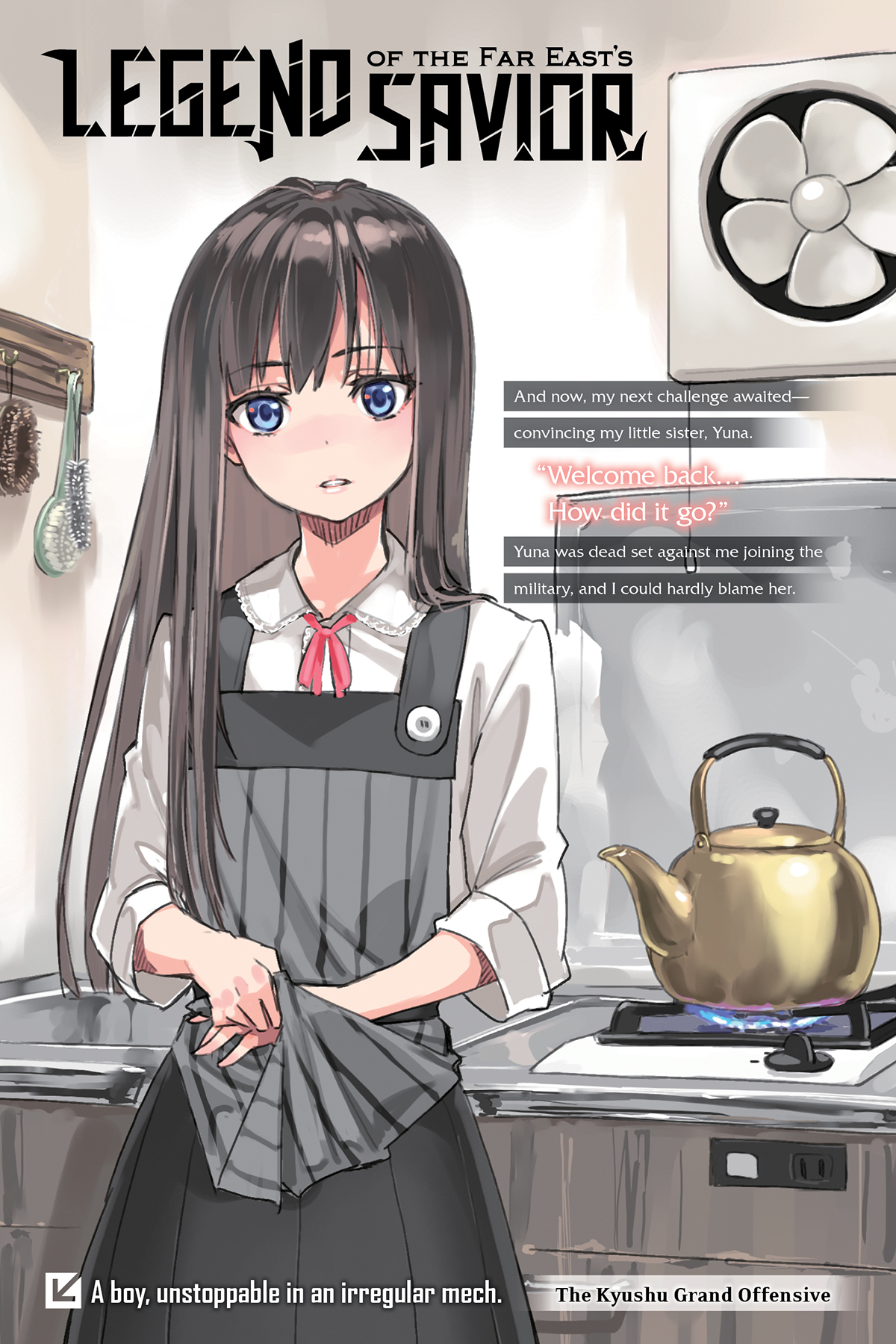
And now, my next challenge awaited—convincing my little sister, Yuna.
“Welcome back… How did it go?”
Yuna was dead set against me joining the military, and I could hardly blame her. From her perspective, I was throwing my own future away just to make sure she could keep studying and live a normal life.
If the roles were reversed, I would object, too.
However, the truth was, my decision to enlist wasn’t entirely for her. It was because I’d judged that if I didn’t join the military now, we wouldn’t be able to live a halfway decent life in the future. It was for both of us.
That was what I’d planned to say to convince her, but I had a better card to play this time. Something I hadn’t even expected!
“I passed the exam. I’ll be joining the military starting next year.”
“…I see.”
Did her eyes just go dark? Hold on, there’s no need to panic yet.
“B-but listen!”
The last thing I wanted was to see her upset, so I hurried to explain the good news.
“I’m listening…”
My cheerfulness must have told her something was off. Yuna seemed curious now, and her eyes lit up again, prompting me to continue.
“I’m not going in as a regular soldier. I’m enrolling in the military academy first!”
“The military academy…?”
Apparently, she didn’t know much about it. That made sense, though. I hadn’t, either.
“Basically, it’s a school for training future officers. Graduates aren’t grunts—they’re treated as officer candidates. They even get a high school diploma. And that’s not all! Since the test piloting counts as military service, I’ll get paid just for attending!”
“…You’d be an officer candidate? That means you won’t be sent to die on the front lines?”
“Y-yeah.”
Wow, she had really been bracing for the worst. Though I guess if your sole surviving family member said he was off to join the military, even a kid like Yuna would do a little research.
And that research had probably told her that a fresh recruit with no high school education and no backing would quickly end up as cannon fodder.
Normally, she would’ve been right. In fact, I’d already prepared myself for that outcome. It hadn’t come to that, though, because apparently, I had an affinity with magicite—and an unusually high one.
“Huh?” Yuna’s eyes widened when I mentioned it. Yep, I knew the feeling.
I had never told her the results of my physical exams before. I mean, who would, unless something was wrong? I’d never seen her results, either. At most, our parents would just say, “Everything looks fine.”
Anyway, it turned out that even with advances in artificial magicite research, only one in a thousand people could actually pilot a mech. That was how rare it was.
Even Yuna never would’ve imagined that her ordinary big brother was among those one-in-a-thousand talents. Not that I’d known, either. When the officer first told me, I’d been more shocked than she was now.
But putting that aside—
“Mechs are incredibly valuable, but the pilots who can actually control them are even more so. That’s why if a kid with aptitude wants to enlist, they usually send them to the academy first, to make sure they get the knowledge and survival skills they need.”
“H-huh…”
Still stunned, Yuna was obviously trying to process the fact that her boring, run-of-the-mill brother was actually a rare gem. It felt a little sneaky to keep talking while she was dazed, but I figured there was no reason to stop while I was on a roll.
“Also, since I’ll be attending the academy, I’ll have to live in the dorms they manage. I’ll be moving in there at the start of the new school year. And of course, you’ll come with me.”
“What? We’re moving?”
“Yeah. For security reasons and all that. It won’t affect your elementary school, since you’re graduating soon, but it will mean you’ll end up going to a different middle school than we originally planned.”
“So I’ll go to a school near the new place?”
“Yeah. I’m sorry you’ll have to leave your friends behind, though…”
At that age, friends were everything. And the new school, being run by the military, would mean starting over from scratch socially. Unlike her, most of her classmates would probably be from military families or have some other sort of connection.
Yuna was smart, charming, athletic, and had top-notch grades. But because she was so perfect, she might stand out—in the wrong way. I didn’t want to imagine her being isolated.
What would I do if that happened? I could endure anything, except the thought of her suffering through that. Still, we couldn’t survive if I didn’t enlist, so staying here wasn’t an option. But what if that choice made her miserable?
“Well, I’m fine with it.”
Just as I was spiraling into a pit of anxious hypotheticals, Yuna casually cut through it all with a single sentence.
“…You are?”
“Yeah. Well, because…”
“Because what?”
“I already figured we’d have to move when…you know, Mom and Dad died.”
“…Ah. Right. Yeah.”
Normally, kids like us would have been handed off to distant relatives. If that had happened, Yuna would’ve had no choice but to transfer schools, so she’d probably made peace with that the moment our home was taken from us.
The truth was, I was the weird one. I’d seen through our greedy relatives, suspecting them of just wanting the money our parents left behind, and during the funeral, I’d made a beeline for a company executive who’d come to apologize on behalf of our parents’ employers. I’d practically begged him to find someone we could pay to act as our legal guardian—just on paper—until we were in the clear. After that, I’d rented an apartment close to home that didn’t need a guarantor and gotten us the hell out of sight before those relatives could pull anything.
They’d eventually figured out where we were living, but by then, we had a guardian on record, and our relatives no longer had any legal angle to interfere. That didn’t mean I could drop my guard completely, but…yeah. Anyway, enough about that.
The important thing was that I was going to the military academy, and Yuna was coming with me. She understood the risks, knew she might end up isolated, and was still willing to go to a different middle school. That was all that mattered.
…And if she really did end up lonely or unhappy, I’d do something about it. As her older brother, that was my job. But for now, that was just a hypothetical. For all I knew at this stage, she might even end up super popular. In fact, that seemed the more likely outcome!
Yeah. Let’s go with that. Worry but don’t overdo it.
After all, ancient texts—or maybe just common sense—say you shouldn’t smother a growing girl.
“All right! Then I’m counting on you to help with the move. I’m thinking we should do it right after your elementary school graduation.”
In other words, before our good-for-nothing relatives tried to butt in again.
“Oh, right. Your middle school graduation is before mine. Got it. I’ll start packing.”
“Thanks!”
Yes! Mission accomplished—Yuna was on board!
Feeling like a huge weight had been lifted off my shoulders, I decided to treat her to a rare dinner out, just the two of us.
After dinner, we ordered dessert, and it was then that Yuna gave me a pointed little reminder: “I’m happy we got to eat out together, but from now on, let’s make sure we stick to a budget, okay?”
Fair enough. But I hoped she’d let me off the hook this once.
Interlude: Yuna’s Perspective I

I know this is random, but I have a brother three years older than me.
This is also kind of random, but I think he’s a genius. He can do pretty much anything, and he’s really smart.
I don’t just mean book-smart, either. He has a wise, grown-up way of thinking. “Social intelligence” or whatever you want to call it.
In fact, last year, when Mom and Dad died—or the people we used to call Mom and Dad died—he didn’t trust those researchers claiming to be relatives of ours. Even though he had to get a little forceful, he still managed to keep them at arm’s length.
I’m not sure if he knows this, but I’m actually pretty smart myself. Mostly with data and information systems. And I also know something else: Those people we used to call Mom and Dad weren’t our real parents.
Actually, he probably doesn’t know this, either, but we’re not even biologically related. I took a peek at the research data our “parents” left behind, so I’m sure of it.
Both of us were born from the woman we called Mom. That much is true.
But the genes they’d used to create us had come from completely different sources.
We were artificially engineered as part of the Third Savior Project, then monitored as “successful test subjects raised in a normal household.”
As for our parents, who died last year? It turned out they’d tried to sell off our research data to a foreign country, as one of the Third Savior Project’s rare success stories. Officially, they were killed by monsters while traveling, but in reality, they’d most likely been executed by a military agency. Those self-proclaimed “relatives” who’d shown up around the time of the funeral were other researchers trying to pick up where the two of them had left off.
They even sold our house without permission, probably to leave us without a place to stay and force us into their custody. But no underhanded trick like that would ever work on my genius brother.
Believe it or not, he approached one of the military personnel who had come to the funeral under the pretense of paying respects, and he asked them for protection.
I don’t know if the person he talked to was directly involved in the Savior Project, but the military definitely hadn’t expected one of their engineered subjects—someone raised as a normal civilian—to come to them on his own.
Normally, they would have rejected him outright. The experiment was still ongoing, so technically, we should have remained under the researchers’ control.
Instead, though, the military agreed. Probably because they saw the benefits in not just securing a successful test subject so quickly but also gaining one who actually wanted to cooperate.
It’s obvious when you stop to think about it. For any experiment, it’s much easier and more efficient if the subjects volunteer instead of being forced.
Even if the military had plans to bring us in eventually, they must have decided it was worth upsetting the researchers if it meant earning our loyalty early on. That was probably why they agreed to his terms without hesitation.
I don’t know exactly what kind of deal he struck with them, but judging from the fact that our living conditions didn’t change much other than moving into this new apartment, he must have only asked for a little money and for the researchers to be kept away from me until I reached adulthood.
I looked into how other test subjects were treated after being taken away by the researchers, and what I found wasn’t pretty. My brother must have made that deal so I wouldn’t have to go through anything like that.
In return for their protection, he offered himself to the military. He probably framed it as voluntary enlistment into their division for appearances’ sake.
Normally, one person enlisting wouldn’t mean much—but my brother was different. He was one of the few successful test subjects from the Third Savior Project, and a genius no less.
The military was already short on pilots. Then came news that the Third Division had been wiped out. They were desperate.
And just like that, my brother showed up. As a Third Savior Project test subject, his magicite compatibility was off the charts. Plus, having him nearby also meant early access to data that the researchers usually kept to themselves.
By putting him through training and actual deployment ahead of the other test subjects, the military could gauge the project’s effectiveness and create a benchmark for future recruits.
In other words, they got to move their expected timeline up by a few years.
There’s a saying—Time is money—and in today’s world, with constant invasions by demons and monsters, just about everyone understands how precious a few years can be.
My brother was worth far more than he asked for. Now, just this once, they could get him with minimal investment. Why would they say no?
“I’m back!”
…And just like that, my big brother walked through the door.
The genius. The test subject for the Third Savior Project. The one who’d just gone off to take the military entrance exam.
He had the smarts to leave any researcher in the dust if he was by himself. But because I held him back, he’d had no choice but to cut a deal with the military.
“Welcome back… How did it go?”
Honestly, I didn’t want him joining the military. Especially not now, when they were scrambling to cover for all the damage caused by the Third Division’s rampage. It was the worst possible timing. If he waited a little longer, at least until he finished high school, there would be more data on other test subjects. On top of that, a high school graduate might receive drastically different treatment from a middle school graduate.
I had hoped they would reject him because of his age, but deep down, I already knew what their answer would be.
“I passed the exam. I’ll be joining the military starting next year.”
Of course. They weren’t going to let someone like him slip through their grasp.
“…I see.”
Thinking about his future made my chest feel heavy. The knowledge that it was all my fault only made it worse.
“B-but listen!”
“I’m listening…”
Trying to make me feel better, he made his voice a little too cheerful.
I wanted to tell him that he didn’t have to fake it, but with everything that had happened, I couldn’t find the words.
“I’m not going in as a regular soldier. I’m enrolling in the military academy first!”
…Wait, what?
“The military academy…?”
Had I heard that right? Had he really said military and then academy right after?
He’d enlisted in the army, right? So why was he talking about going to school?
“Basically, it’s a school for training future officers. Graduates aren’t grunts—they’re treated as officer candidates. They even get a high school diploma. And that’s not all! Since the test piloting counts as military service, I’ll get paid just for attending!”
He explained everything with a proud, gentle smile, like he expected me to be confused.
To him, the “getting paid” part was probably the most important. From my standpoint, however, that didn’t matter one bit.
Yes, we needed money to survive, but between the two of us—a genius and someone who could keep up with one—we could make all the money we’d ever need. That wasn’t the issue.
The real benefit was that Keita would be going to school. And not just any school, but one for future officers rather than foot soldiers.
“…You’d be an officer candidate? That means you won’t be sent to die on the front lines?”
“Y-yeah.”
I had to double-check, just in case I’d misheard. Although it came out a little awkwardly, he said yes.
“Huh?”
As he told me more about it, I made a surprising discovery.
Keita had known he could resonate with magicite crystals, but it seemed like he hadn’t been aware of how unusually high his compatibility rating was compared with other people’s.
Actually, I doubt he knew even now.
He must have taken the same health checkups—tests, really—that I did…
Then it hit me. Those two people we called our parents had never told us any details. The only reason I knew was because I’d secretly read the reports. Without that, I wouldn’t have known about my own unique qualities, either.
Which meant Keita had managed to negotiate with the military without even understanding his full potential. Yep, that was my big brother for you. He wasn’t called a genius for nothing.
“Mechs are incredibly valuable, but the pilots who can actually control them are even more so. That’s why if a kid with aptitude wants to enlist, they usually send them to the academy first, to make sure they get the knowledge and survival skills they need.”
“H-huh…”
From what he said, it didn’t sound like he’d be a full-blown officer like a major or a general, but he wouldn’t be treated like a grunt, either.
Thank goodness. I couldn’t bear to watch him get chewed up and spat out on the battlefield.
I was finally starting to relax when he hit me with another piece of news.
“Also, since I’ll be attending the academy, I’ll have to live in the dorms they manage. I’ll be moving in there at the start of the new school year. And of course, you’ll come with me.”
“What? We’re moving?”
Even though we’d gotten this apartment through his negotiations with the military?
“Yeah. For security reasons and all that. It won’t affect your elementary school, since you’re graduating soon, but it will mean you’ll end up going to a different middle school than we originally planned.”
Security…? Maybe confidentiality was part of it. Or maybe they were just trying to avoid any more fights with the researchers. And middle school? Where would I end up?
“So I’ll go to a school near the new place?”
That was what usually happened, right? You moved house, and you ended up in a different school zone. Nothing strange about that. Unless the school had some weird rule?
But my genius brother—kind and thoughtful as he was—was worried about something completely different.
“Yeah. I’m sorry you’ll have to leave your friends behind, though…”
Friends?
“Well, I’m fine with it,” I answered without thinking.
What friends?
It wasn’t like I had any. Just boys who kept messing with me for no reason, and girls who got snippy and told me I was full of myself. Lately, I’d been dealing with boys trying to act all nice because my parents had died and girls trying to one-up me over it. To be honest, moving away from them sounded like heaven.
“…You are?”
But of course, I couldn’t tell my big brother any of that.
“Yeah. Well, because…”
“Because what?”
“I already figured we’d have to move when…you know, Mom and Dad died.”
“…Ah. Right. Yeah,” he said with a grimace.
I wasn’t sure what thoughts that had brought up, but seeing Keita’s expression left me flustered.
I wanted to comfort him, but at the same time, part of me was thinking how rare it was to get to see this side of my big brother. Before I could stop myself, I found myself staring at him, trying to hold on to the moment.
“All right! Then I’m counting on you to help with the move. I’m thinking we should do it right after your elementary school graduation.”
“Oh, right. Your middle school graduation is before mine. Got it. I’ll start packing.”
Having made up his mind, Keita had started planning the schedule. I couldn’t let him catch me gazing at him, though, so I’d hidden my face and pretended to think for a moment before answering.
“Thanks!”
Yes! He didn’t notice!
If he’d caught me smiling at his distress, it would have been game over. Thank goodness I’d covered it in time.
Since he was in such a good mood after that, we went out for dinner together.
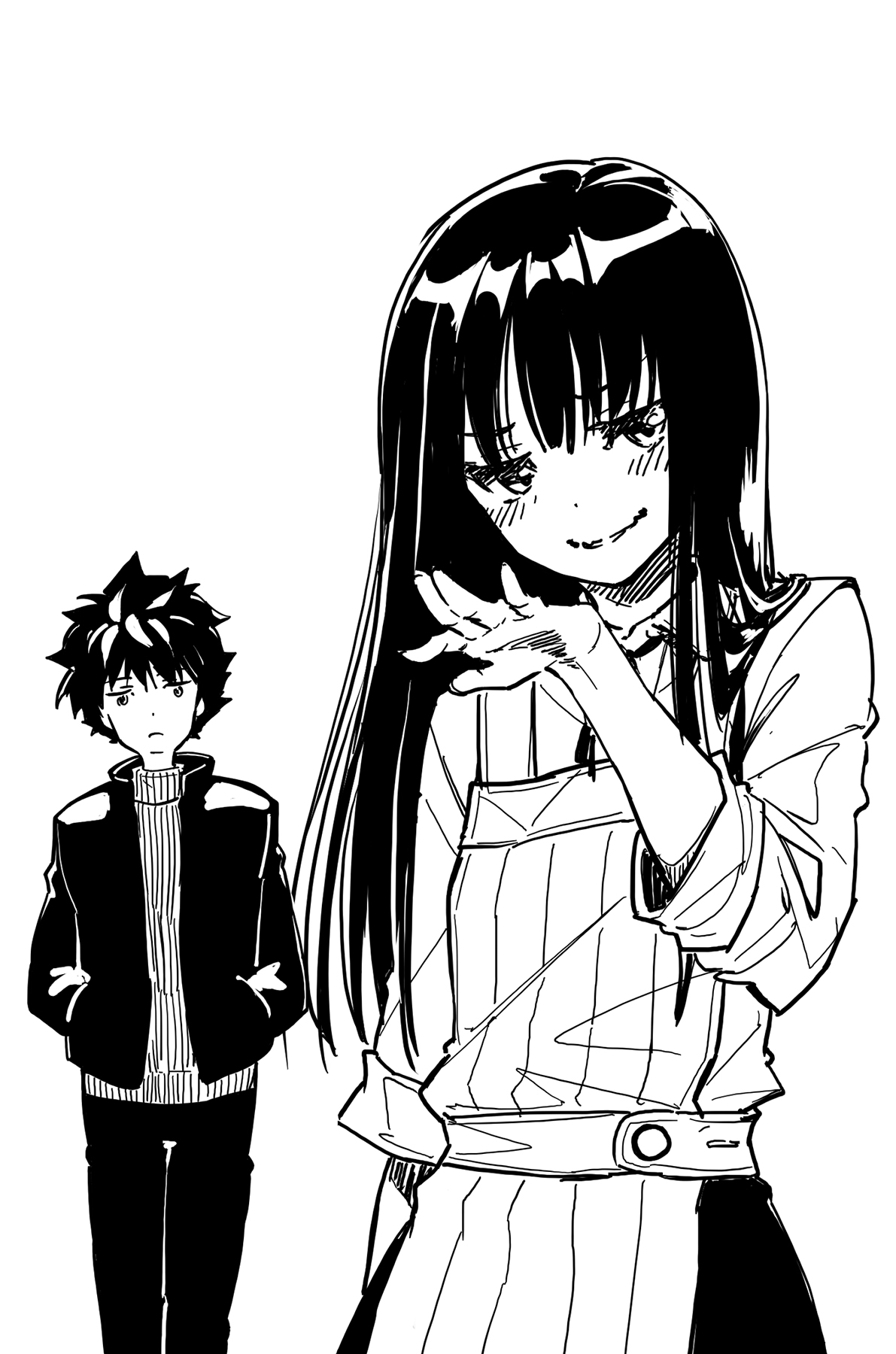
Watching Keita enjoy dessert, which he hardly ever ate, was certainly heartwarming. Still, I couldn’t help but think we’d spent far too much. It wouldn’t be too difficult for us to make money if we worked together, but that was a future thing, not something for us to consider right now.
Besides, if Keita was going to the military academy, he wouldn’t have time for a side job. We would have to live off what we had, which meant being careful with our spending.
When I told my brother that, he visibly deflated.
Yeah… I like seeing him happy, but there’s something about when he’s all dejected, too.
I would never have told anyone this, but seeing his downcast expression gave me a secret little thrill.
Chapter 2: Admission

1
“…No matter how many times I see it, this place is huge,” I murmured under my breath as I stood in front of the academy gates.
Though to be fair, this was only my second time here.
It was April now. After receiving instructions from the military officer I’d enrolled with, I’d taken the entrance exam and been accepted into the military academy without a hitch.
The main campus was in Ichigaya, where the Ministry of Defense was located. However, since we mech pilots-in-training had to do maintenance and operational testing on our units, and because we used the air base in Iruma, the campus we were to attend was out in Ome, removed from the heart of Tokyo.
Each grade had one hundred students. It was a three-year program, so that made three hundred students in total.
The top ten students were placed in Class A, the next twenty were in Class B, the thirty after that in Class C, and the bottom forty were put in Class D.
Only a hundred students a year with the war ramping up across the world? I’m sure it sounds dicey. But this department selected students based on their magicite compatibility. Only those with high compatibility ratings got in, and it seemed the small enrollment numbers hadn’t been a problem yet. Though, obviously, they would’ve loved to have more high-compatibility candidates if they could find them.
Among the students, only those in Classes A and B were said to have the kind of compatibility rating that let them bring out the full capabilities of mechs. Students from Classes C and D could technically use them, but with a noticeable drop in performance. That said, the academy did have a system in place where students could get promoted to higher classes during their time here if they showed growth. So even if you started in Class C or D, there was no reason to let it get you down.
Of course, that was much easier said than done for the poor kids actually stuck in the bottom classes.
Once registered to a student, a mech became their exclusive unit unless it was reset. After all, they were far too valuable to waste on kids who couldn’t use them properly. Even though this was a training school for mech pilots, there weren’t enough units for every student, so it made sense both logistically and financially.
That was why the academy only provided ten units a year—just enough for Class A.
Among the students in Class A, though, some had families with military connections. In fact, most of them did. And in those cases, their families sometimes secured private mechs for them.
…Must be nice to be rich.
When that happened, the academy’s spare units got passed down to the top-performing students in Class B. Of course, some kids in Class B also had their own family-supplied mechs, so all told, there were about fifty available school-wide.
So what did students without mechs do? They trained in simulators and learned to maintain real units, essentially studying and developing hands-on experience to build their understanding of both magicite cores and the machines themselves.
There was a big difference between “can’t use one to its full capabilities” and “can’t use one at all.”
Those students might not be skilled enough to have gotten a proper mech, but they were certainly good enough to fight with a training unit. That kind of base-level education could really come in handy if push came to shove, so it certainly wasn’t pointless.
Now, the most important question: Which class had I gotten into?
…Class A, naturally!
Heh. Those memories from my past life weren’t for nothing.
To be honest, accounting for both this life and my past one, I probably had double the usual compatibility rating. On top of that, I still had all my knowledge from my previous life, so the written exam had been a breeze. The real problem would’ve been if I hadn’t made it into Class A.
I placed third in the entrance exam rankings, by the way!
…Wait, third? Even with those memories from my past life and cramming like crazy, I’d only ranked third? I might’ve been swamped with the move and all, but still… Yuna had even prepped me with a full-on study guide and practice sets. And after everything—third? If I’d come in second, I could have shrugged it off with the thought that there really were bona fide geniuses out there… But third?
Frankly, knowing there were two people ahead of me was a blow to my ego.
“…Guess I better head in.”
I might have been feeling a little down, but third place was nothing to complain about. Sulking over it would have been an insult to everyone else, so instead, I tried my best to hide it. I slapped on a confident look and puffed out my chest as if to say, “I’m Kawakami, who got third in the entrance exam!” then marched proudly through the academy gates.
So that’s him.
Black hair, black eyes, average height and build. At first glance, he could have passed for an ordinary young man. But on closer inspection, the impression he gave off changed completely. Those sharp eyes were constantly scanning his surroundings, and he was surrounded by a certain aura.
Keita Kawakami, huh? Not from a military or corporate family, but unbelievably, our intelligence agents only described him as “somewhat clever” in their reports. What were they even looking at? Unless…he knew he was being watched and hid his ability?
A normal teenager from a civilian background getting recommended to the academy was already suspicious. And the one who’d recommended him wasn’t a naive political puppet, but an officer in the Second Division—someone who worked day in and day out with the best of the best.
Considering everything, maybe the “pretending to be useless” theory wasn’t so crazy. Maybe he’d acted like a nobody so he wouldn’t attract attention before enrollment.
Well, what’s done is done. I’ll bring up the declining performance of our intelligence operations later. The real question is, what now?
His sense of presence, compatibility rating, and written exam scores were head and shoulders above everyone else. There was no way he was some fluke.
So the only reason he was placed below me and the top scorer was thanks to the influence of our families? Trying to save face for the military elites is exactly the kind of thinking that got the Third Division wiped out.
The academy may have been a school, but it was still part of the military. Political games and power plays were par for the course. Regardless, it stung to see the establishment care more about appearances than actual results.
Not that I can complain. I lost to him. People would probably just tell me to shut up and be grateful.
That’s right. The only reason the academy needed to manipulate the rankings to protect the reputations of a select few was because those few had actually lost to a civilian.
Both he and the girl who’d placed first came from powerful military families and had been groomed for their current roles since early childhood. It had long been decided they would enter the academy, and they’d been given the best education imaginable to get there.
Yet they’d still lost. Not to some longtime rival or a prodigy from another school, but to a random newcomer who’d only taken the entrance exam at the last minute because he happened to catch the attention of a Second Division officer during military enlistment.
It was no wonder the higher-ups had scrambled to prop them up.
If you’ve got complaints, you have to earn the right to voice them. That’s the only way.
Yes, it stung. But it was their own fault for not being good enough. That was the bitter truth.
So once they had come to accept that fact…what was the best way to deal with the real top student?
Do I treat him as a friendly rival? Try to bring him down a peg? Or just keep my distance?
Definitely not the last option. With someone like that, you either kept them close, or you took them out. Leaving them alone was the worst possible move.
In a perfect world, they could have been friendly rivals, pushing each other to grow. But this boy, Kawakami, had been recommended by someone from the Second Division, meaning he was probably under their protection now.
If I’d made contact before enrollment, maybe I could’ve recruited him. I wouldn’t stand a chance now.
The Seventh Division—which his family was a part of—didn’t have a bad relationship with the Second Division, but they weren’t exactly cozy with them, either. More like politically neutral. If he made a move on his own, it would only cause friction.
Wait… Could he be part of the Savior Project? If so…I’d need to talkto the family first. They might want me to befriend him or order me to eliminate him. Until then, I’d better play it safe and keep my distance.
Grades should have had nothing to do with family. Yet here he was, still thinking about what was best for them.
With that twinge of self-loathing, the second-placed student from the entrance exams, Kazunari Fujita, stepped through the gates of the military academy.
2
I’d just left the gymnasium after the entrance ceremony and was on my way to Class A’s building when it happened.
“Hey.”
The ceremony itself had gone off without a hitch—but of course, things like that didn’t just end once they were over.
“Hey, I’m talking to you.”
There had been speeches from the principal, the student council president, and the first-year representative. I knew there were, but I couldn’t remember a single thing any of them had said.
“Hellooo?”
No doubt they’d practiced their speeches for hours ahead of time, nervous but determined as they addressed us all. But when there weren’t any major screwups, no one really registered what was said. I knew that from my middle school days.
“Hey, are you listening? I know you can hear me!”
I was the only one who didn’t seem to care, though. Everyone else had been starry-eyed, especially when the student council president and the first-year representative—both girls—gave their speeches. At least, it seemed that way to me, but maybe I was wrong. Not that it really mattered either way.
“Wait. Are you seriously ignoring me right now?”
Still, it seemed like not everyone was okay with being ignored.
“Hey! Don’t just stand there! Answer me!”
Case in point, the girl making a fuss in front of me. She was probably one of the not-okay-with-it types.
Red hair, cut short. Around a hundred and fifty centimeters tall, give or take. I hadn’t gotten a good look at her, not wanting to be rude, but from what I could see, she was decently well equipped in the chest department. Her voice was on the high side, and most striking of all, she had a permanently angry look in her eyes.
It probably didn’t help that she was looking up at me from below, which made it feel like she was glaring. But even without that angle, her eyes were sharp.
“Enough already! You— Eek!”
As I was observing all this, the girl suddenly looked like she was about to take a swing at me. I noticed that her guard was wide-open, so I swept her legs out from underneath her. She went down easily.
They do say the moment of attack is when you’re at your most vulnerable.
“Wh-what just…?”
She sat there, stunned, not realizing what had happened. I couldn’t blame her.
Thanks to my memories from my past life, I had always understood the importance of training the body and had spent years doing just that.
On top of that, we had tons of books on mechs and piloting back home thanks to my parents’ work. Everything drilled home the same point: To pilot a mech, it’s important to picture what you want to do in your mind. If you can’t imagine doing it with your own body, you’ll never pull it off in the cockpit. This is why aspiring pilots should study martial arts and marksmanship. My parents’ library even had training manuals for the recommended disciplines. I hadn’t been aiming to become a pilot back then, but I had still been interested in mechs, so I’d done my best to master those skills.
Even in Gundam and fighter-jet video games, balance and g-force resistance were a huge deal.
In fact, I had desperately tried to recreate Z Fighter moves, Holy Warrior finishers, and Soul Reaper techniques during my training—a secret only my sister knew.
I trained so hard because I believed that if I didn’t awaken some kind of hidden power, I’d die in the cross fire when the real heroes showed up.
But anyway.
Thanks to that effort combined with my naturally high physical aptitude, I had some decent skills. I couldn’t exactly crush rocks down to atoms or anything, but I could look after myself in a fight.
That’s why if I went all out and used everything I had, tripping up a yelling girl who was too distracted to watch her footing was easier than dozing off on a spring afternoon.
“Wh-what just happened?”
She continued to sit there on the ground, flustered and confused. I was just about to hit her with a cool assassin-style one-liner—“Child’s play”—when I noticed something.
White.
An undeniably bright white. A flower blooming bold and unashamed.
“Hmm.”
Thanks to the angle and her position, there it was. Completely unintentional and totally unavoidable.
…Now, your average teenage boy might have reacted to something like this, but not me.
Appearances aside, I was a proper gentleman at heart. Plus, I lived with my little sister, and I did all our laundry. I’d seen enough girls’ underwear to last a lifetime.
What was the big deal if I caught a glimpse of one more pair?
Well, maybe I was a little curious. But when I thought about it—standing there, frozen to the spot, staring at the blossom that had suddenly bloomed right in front of me—it became obvious what I should do.
“…”
Keita Kawakami exits, smooth as hell.
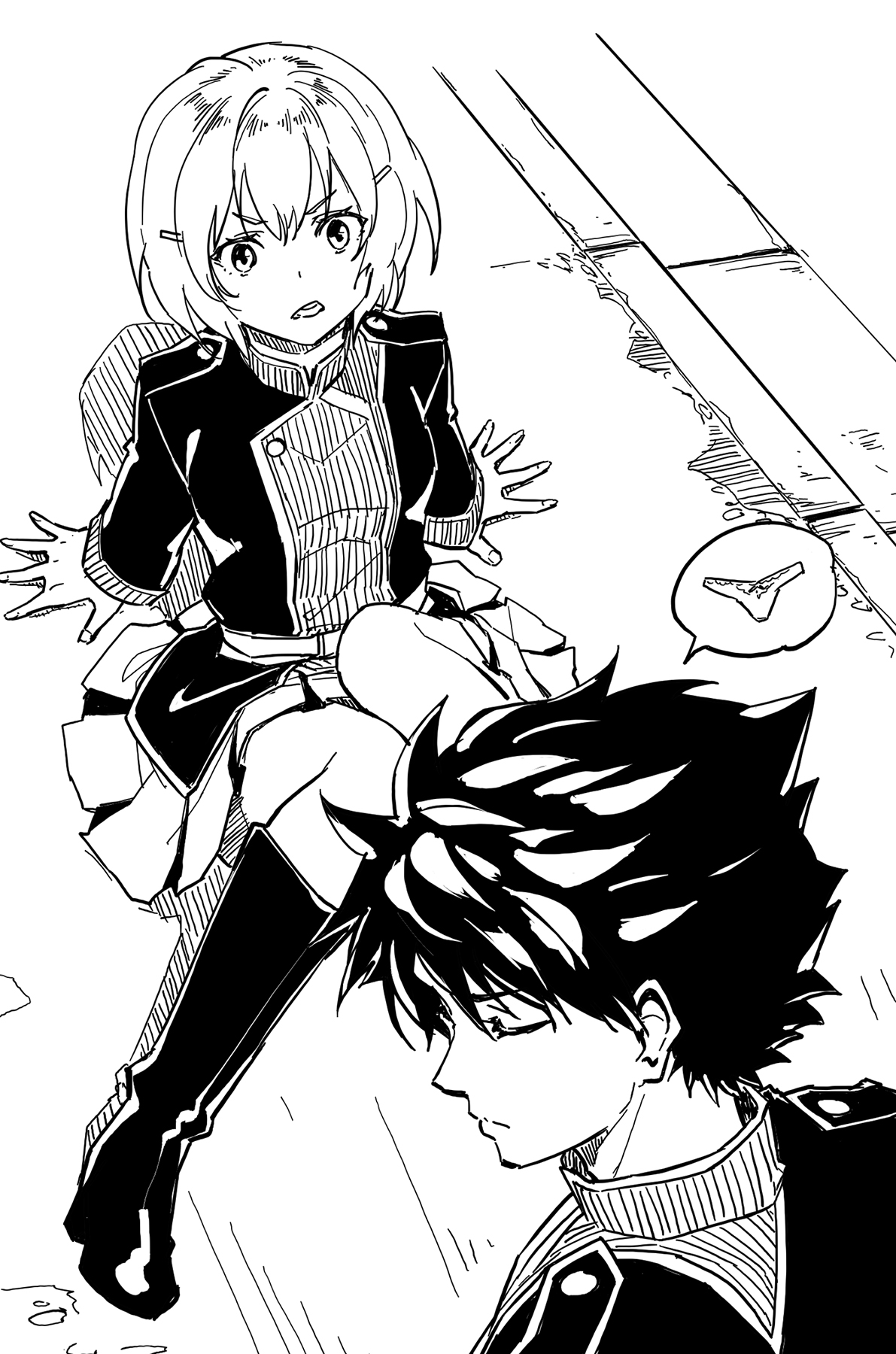
“Hey! Get back here!” she shouted after me.
But I strolled off, not listening.
“…Did you see what happened, Junji?”
“No, I didn’t catch it. What about you, Kazunari?”
“Me neither. But I doubt she just fell over on her own.”
“I agree. It didn’t look like he tripped her or anything. Maybe he used a breathing technique or something to upset her balance?”
“You think he’s a martial arts master?”
“I’m not ruling it out.”
“Fair enough…”
Kazunari had noticed Keita Kawakami getting mixed up in something right after the entrance ceremony. Thinking he might be able to step in if anything happened and get in Kawakami’s good books, Kazunari had decided to observe from a distance alongside his classmate and fellow Seventh Division member, Junji Fukuhara.
From where they were standing, it didn’t look like Kawakami had done anything—but they knew he must have.
“Ugh! What the hell was that?!” a girl shouted after Kawakami, who’d briskly walked away.
The young lady—Shoko Isotani—remained on the ground, visibly upset. She was brilliant, top of her class at middle school, and had been admitted this year with the fourth-highest score. If Keita hadn’t been there, she would have been third.
To her, Keita Kawakami was a clear rival. A threat.
What’s more, her family belonged to the Sixth Division, responsible for protecting the Kinki region. Of course they would be interested in the movements of the Second Division, which was handling defense operations in Kyushu and the Chugoku region.
Considering that, she’d probably decided to try to get some dirt on Keita, thinking he was linked to the Second Division.
But what had just happened was a problem.
Shoko Isotani was supposed to be the pride of the Sixth Division. Her ranking alone showed she wasn’t some average student. Yet Kawakami had brushed her off like she was nothing.
Who was he?
“I think it’s best we avoid direct contact for now.”
“Yeah. I don’t know what he did, but we definitely need to stay alert. Especially you, Kazunari. You’ve got the whole Seventh Division riding on your back. It’d be a real problem if you got hurt.”
“That goes for you, too.”
“It’s a matter of priorities.”
“…You’re a pain, you know that?”
“Take it up with the Third Division.”
“Already have. Plenty of times.”
As Junji had said, expectations were high for Kazunari, who’d missed out on the top spot but managed to come in second. Normally, that wouldn’t have been such a big deal, but this year was different.
All because the Third Division had been wiped out at Imphal.
What did that have to do with Kazunari and the Seventh Division? Over the next few years, the number of officers each faction managed to produce would directly affect its standing in the power struggle among the separate divisions.
The National Defense Forces were divided into nine major divisions, each with its own jurisdiction.
The First Division covered the Kanto region. Their main job was to protect the capital.
The Second Division handled Kyushu and the Chugoku region. They were the front line against demonic forces invading from mainland Asia, so they received the lion’s share of the budget.
The Third Division was normally responsible for the Chubu region and served as backup for both the capital and the Kinki region. However, they had been deployed as an expeditionary force and effectively wiped out. Right now, their top priority was rebuilding.
The Fourth Division used to cover the Chugoku region, but their jurisdiction had been handed off to the Second Division so they could join the expeditionary force. They were currently fighting somewhere around Vietnam.
The Fifth Division was formerly in charge of Hokkaido but had been reassigned to the expeditionary force. They were engaged in battle somewhere around Thailand.
The Sixth Division covered the Kinki region. They mostly played a support role for the Second Division and dealt with stray monsters from the Chugoku area.
The Seventh Division now handled the Tohoku and Hokkaido regions, mainly fending off monsters trying to invade through Russia.
The Eighth Division covered Shikoku while also serving as rear support for the Second Division, like the Sixth.
The Ninth Division handled the Chubu and Hokuriku regions. They provided backup for both the capital and Kinki, and dealt with monsters trying to come in through alternate routes, like the Seventh did with Russia. So far, however, they hadn’t seen much action.
That was a general rundown on the current state of each division.
The ones that had some breathing room at present were the First, Sixth, Seventh, Eighth, and Ninth Divisions. The First Division was treated differently, being responsible for the capital, but the other four were all looking to boost their influence at the expense of the fallen Third Division.
Despite losing a large number of officers at Imphal, the Third Division had left behind families and relatives. It wouldn’t be too difficult to use them to rebuild. The downside to this was that filling the void with only their own people might create a division that was desperate to restore its reputation as quickly as possible.
No military organization worth its salt would appoint someone known to be thirsty for glory as a senior officer. The National Defense Forces had a history of playing favorites with prestigious families, but after this disaster, nobody wanted to take the fall for coddling someone and risk another screwup. This meant they needed a cadre of levelheaded officers they could fall back on. However, with every division stretched thin, nobody had spare personnel to loan out.
That was where the military academy graduates came in.
Each division understood that if they could send in some of their own people as entry-level officers, they could start exerting influence within the Third Division.
If graduates deployed to the front lines ended up being mostly from outside the Third Division, its factional status could very well collapse. On the other hand, if the Third Division was able to train their own people to serve as officers on the battlefield, they might be able to keep their faction alive.
That was why people like Kazunari and Junji from the Seventh Division, and Shoko Isotani from the Sixth, cared a lot more about their school rankings than Keita realized.
It was also why they were watching Keita, the unofficial top of the class, so carefully.
Though, really, the ones panicking the most are the people from the Third Division.
Three kids in this year’s Class A were affiliated with the Third Division—namely, the top-ranked, fifth-ranked, and ninth-ranked students.
After General Muroguchi and countless other officers were killed at Imphal, the Third Division had become desperate to produce new officers. It was currently their highest priority.
However, being under tight surveillance by the military, they had almost no chance to earn military honors. In fact, it was practically impossible.
There was one path open to them still, though—becoming mech pilots and making their name on the battlefield.
Normally, officers commanded from behind the lines, thinking it unbecoming to actively fight on the front lines. Yet the old saying still held true: No one followed a commander who didn’t fight alongside their troops.
As such, the current Third Division policy was to get its young men and women commissioned as junior officers and send them to the battlefield to distinguish themselves. At the same time, they would be trained for higher positions.
In fact, even noble-born daughters who were originally supposed to attend fancy, elite schools had ended up here at the military academy—which was how Saori Muto, this year’s top student and the incumbent class representative, had found herself here.
No matter how refined she tries to act, in the end, she still belongs to a military faction. One slipup, and it all comes crashing down. Knock on wood.
“Kazunari?”
“…Sorry. Just lost in thought.”
He didn’t not feel bad for Saori Muto, but Kazunari didn’t have time to worry about anyone else—not when he hadn’t been able to take the top spot for himself. He hadn’t even scored second on his own merit, but only with some outside help.
Keita Kawakami brushed off Shoko Isotani like she was nothing, and Saori Muto is being pushed into battlefield duty for the sake of her family. Should I just sit back and enjoy the show, or do I take this as a warning? Whatever happens, this place is going to shape my whole future.
Naturally, Kazunari chose the latter option. After all, he’d given everything he had in the entrance exams and still come up short. His second-place rank—boosted by the influence of his faction—wasn’t something he could be proud of.
“Honestly. This is throwing me off…”
His gaze fell on Shoko Isotani, who’d finally risen to her feet, though she still looked far from satisfied.
Either fortunately or unfortunately, neither Kazunari nor Junji had witnessed the white flower Keita had seen.
3
Even after I’d unexpectedly gotten a close-up look at a beautiful, fresh (hopefully…) flower in full bloom, I managed to maintain my gentlemanly composure and find my classroom. Now I was trying to calm myself before homeroom started.
This was our very first homeroom since starting at the academy. It was no exaggeration to say that depending on how well our self-introductions went, the next three years could either be filled with friendly banter and camaraderie or total isolation.
We would all be shipped off to our respective posts as soldiers after graduation, so you could argue that training should take precedence over making friends. Still, having comrades I’d been in the academy with carried a certain weight, in my opinion.
Not that I would know, mind you. I’d never been a soldier.
At the same time, though, there could be rivalries or struggles for promotion depending on faction politics, so getting too friendly could end up backfiring.
To top it off, my past memories meant that I was basically an old man on the inside, so keeping some emotional distance from everyone probably wasn’t such a bad idea.
What would happen if someone found out I have memories from my past life? Normally, people would just write it off as me being delusional, but if you factor in my reputation as a genius and unusually high magicite compatibility, there’s a chance they could launch a full-blown investigation. Heck, my Second Savior Project connection makes that pretty much certain. It’s a scary thought.
“Good. Looks like everyone’s here.”
Just as I was vowing to never let anyone find out, a woman who seemed to be our homeroom teacher walked into the room.
If I had to guess, she was probably in her late twenties or early thirties and around a hundred and sixty centimeters tall. She was slim, yet still seemed to maintain a firm center of gravity, and her posture and stance showed zero openings, so she was clearly well trained. She had short blond hair, and something about her face made me feel like I’d met her before. After a second, it hit me; she looked like a character from a certain gritty, mech-themed video game.
I didn’t know if she had a sense of humor, but she was clearly the sort of person you didn’t wanted to cross.
It’s a given that you’re not supposed to disobey your superior officers, but this woman struck me as someone you needed to be extra cautious of.
Her nickname was now officially “the Boss.” No objections allowed.
“Let’s begin homeroom. We’ll start with self-introductions. Just your name will do for now. I’m your homeroom teacher, Shizuka Kuga. My rank is major.”
The Boss wasted no time laying it out. Straightforward self-introductions only—no hobbies, no greetings, no fluff.
She was really something. Anyone who could make major at that age was seriously talented.
These brief introductions cut down on time, but she probably favored this method out of consideration for students who weren’t good at public speaking. I’d heard of first-rate teachers doing this in elite schools.
Ultimately, the important thing was whether she knew us, not whether we knew one another. Surface-level information at this point wouldn’t help anyone. At the same time, not knowing your classmates’ names would be a problem, so it made sense to keep it short and sweet. Her approach might have been blunt, but it was reasonable.
Or maybe this was just standard practice in military schools. I wouldn’t know.
“The class order is based on your entrance exam rankings, starting from the top. Let’s begin. Muto?”
“…Yes, ma’am.”
The first person called was the girl who’d given the speech at the entrance ceremony. She might have glanced at me before standing up, but maybe I was imagining things.
“Saori Muto.”
Ah. So she was top of the class.
Muto was about the same height as the teacher and had long, straight black hair down to her waist. It felt rude to stare, so I couldn’t say too much about her physical features, but she didn’t seem particularly curvy. Her perfect posture suggested she’d had martial arts training, but other than that, she seemed more like a refined young lady than a future soldier.
“Next!”
“Kazunari Fujita.”
So he was second place. Got it. Fujita was taller than me, probably around a hundred and seventy-five centimeters. Good posture, solid core—he clearly worked out. His short black hair was cut just above the ears.
These two had outperformed me fair and square despite my advantages. They were the real deal. I had no way of knowing if we would become friends, but I should at least avoid making enemies of them.
“Next! Wait—actually, skip to fourth place.”
“Huh?”
Just when I’d psyched myself up to go, I was skipped? Seriously?
Was this bullying? Teacher-initiated hazing?
“Got a problem with that?”
“No, ma’am!”
I had literally just decided not to defy the Boss. And if this really was bullying, I could retaliate later. No, this wasn’t the time to lose my cool.
“All right, next.”
“Shoko Isotani.”
Wait—fourth place was Ms. White Blossom herself. She fixed me with a sharp glare, but maybe that was just because I’d beaten her in the rankings.
“Next!”
“Tatsumi Kasahara.”
Fifth place—male, slightly shorter than me, with a two-block haircut. He was glaring at me harder than Isotani was, and we hadn’t even met. If it was about grades, he only had himself to blame. He should’ve studied harder.
“Next!”
“Nana Taguchi.”
Number six was a girl, petite yet definitely well equipped in the chest region. She had brown, fluffy-looking hair and seemed easygoing—but getting into this school, and Class A no less, meant she would be no pushover.
Also, she wasn’t glaring at me. That made an instant favorable impression.
“Next!”
“Natsuki Hashimoto.”
Seventh, another girl. She was about my height and had silver hair tied in a ponytail. Her slim frame indicated she probably had some Eastern European blood in her.
In this world, World War II hadn’t gone the way I remembered it. The Soviet Union had never broken its nonaggression pact with Japan, and that along with other diplomatic differences meant we still had decent ties with various Eastern European countries.
Politics aside, her appearance was striking, so she wasn’t someone I’d soon forget.
“Next!”
“Junji Fukuhara.”
Number eight. Male. Huge. No further explanation needed.
Seriously, he had to be around a hundred and ninety centimeters tall and was built like a tank. With his blond buzz cut, this guy was basically a walking advertisement for Systema martial arts.
Fukuhara’s physique and atmosphere clearly set him apart from the rest. Yet the Boss seemed to completely ignore his massive presence… Was I the only person worried about that?
Everyone else’s utter lack of reaction left me feeling like the weird one.
“Next!”
“Kenjiro Obata.”
Ninth place was another big guy. Not as big as Fukuhara, but probably around a hundred and eighty centimeters tall. Honestly, I was a little jealous. He had short black hair in a crew cut and looked like a textbook Japanese soldier.
He was also the one glaring at me most. Had I done something to offend him?
“Next!”
“Matsuri Ayase.”
Number ten was a girl. Slightly shorter than me and with her blond hair in a side ponytail, she gave off strong-willed, rich-girl vibes. She was also reasonably well equipped. If I had to rank them in that regard, the order would go sixth, fourth, tenth, then first and seventh were about the same. Height-wise, seventh was the tallest, then tenth, first, sixth, and fourth.
Come to think of it, half the class are girls?
This wasn’t just a military school, but a place to train pilots, who would definitely see the front lines. I’d figured it would be all guys. The fact that it wasn’t came as quite a surprise.
Looking around me, I couldn’t help but think that maybe we didn’t need gender-based equal opportunity laws. But perhaps Class A was special.
“Next. Last one, third place.”
“Oh, uh. Keita Kawakami.”
“…And?”
“Huh?”
I’d given my name like everyone else, but the Boss was looking at me like I was an idiot.
“…Fine, I’ll do it for you.”
Did she just sigh at me?
“This guy clearly doesn’t understand the point of what we’re doing here, so I’ll introduce him myself.”
“Wait, what?”
There was a point to all this? Nobody had told me that. Had everyone else known about it except me?
“This is Keita Kawakami. Aged fifteen. Lives with his younger sister. Their parents were researching magicite technology, but they were killed last year during a demonkin counteroffensive while on assignment in Thailand. The main reason he’s joining the military is to support himself and his sister financially. Have I gotten anything wrong so far?”
“…No.”
Whoa, whoa, whoa! She wasn’t wrong, so how did she know all that? I mean, sure, of course they’d done background checks on us, but was there a reason why she was announcing it to the whole class?
I promised myself I wouldn’t go against the Boss, but this is… Huh? What’s going on?
Right as I was about to speak up, I noticed something had shifted in the room.
Looking around, I realized the students who had been glaring daggers at me a minute ago had all suddenly lowered their gazes.
“Some of you might have already put two and two together, but I’ll spell it out for you anyway. Kawakami’s parents were direct victims of the Third Division’s rampage and subsequent destruction. Actually, it’s probably more accurate to say he’s a victim himself. Don’t forget—military blunders like that don’t just harm other soldiers. Civilians suffer equally as much, if not more.”
The class went silent.
Ah. I see.
It was only then that I finally understood what was going on—both the Boss’s angle and the looks I’d been getting.
First off, those glares had probably come from classmates affiliated with various factions. They all seemed to know one another and have some kind of shared background. To them, I was a complete unknown.
Their families or superiors had probably given them an earful when I’d beaten them in the entrance exams. Sure, it was nothing more than misdirected resentment, but they were still just kids. Of course they would be upset having someone rain on their hard-won acceptance into this program.
Hence, the stink eye.
The Boss had probably revealed my background to make a point: “People like Kawakami are what happen when you lose. Instead of wasting time resenting the victims, get stronger so it doesn’t happen again.”
That would put a stop to any grudge they might hold against me. And if they did keep hanging on to it and tried anything, the Boss would probably hand down some kind of punishment…
It was a warning to me as well: “You’re being targeted, so stay alert.” And really, it wasn’t like she’d given out my home address or PIN. It was just details about my background, stuff anyone could dig up if they wanted.
The Boss hadn’t had any intention of humiliating me; she’d been cautioning a bunch of misguided kids who didn’t realize how childish they were being, and warning me that I was in their crosshairs.
Phew. At least I know now this isn’t the kind of place where teachers would leak a student’s personal info and get them bullied.
If that had been the case, I was ready to take serious action. Which, ironically, would have been my version of holding a grudge.
My bad. Sorry, Boss.
“Good. As long as you all understand. Anything more than that would violate privacy laws, so if you’re curious, get to know one another first and ask for yourselves. Now that we’re done with the introductions, let’s move on to what we’ll be doing this year.”
I didn’t know if she realized I was internally bowing in reverence, but I did notice the classmates who’d been glaring at me earlier were now acting a lot less hostile. Seemingly satisfied, the Boss shifted the topic to a rundown of the curriculum.
Wait, hold on. I still didn’t know anything about the other students. Were we not going to cover that…?
No? I had to find out for myself by talking to them? Yeah, all right.
It was kind of jarring, though. My life story had just been broadcast to the whole class, and now we were continuing like it had never happened. Still, I couldn’t exactly ask the teacher to gossip about everyone else for my sake.
“That’s all from me. You’re to head to the hangar immediately to receive your mechs.”
“Yes, ma’am!”
Hmm. I guess socializing can wait… First, I get my very own mech!
Just like that, with a head full of mixed emotions stifled by the thrill of finally receiving my own personal unit, I wrapped up my first homeroom session.
4
“What the heck?”
I’d been led here and told, “This is where you’ll find your assigned mech,” but as soon as I stepped foot inside the hangar, all pumped up with excitement, I couldn’t help but let out a cry of surprise.
By the way, we generally called them “mechs,” but the official term was “Monster-Armored Combat Unit.” I preferred mech, though, because it called to mind old-school anime series like Super Robot Wars and Cybuster. But that was just me. Most people avoided the official term for a different reason: They didn’t like being reminded that these vehicles were made from the corpses of slain monsters.
I couldn’t blame them. I wouldn’t want to go around shouting, “Check it out! I’m piloting the reanimated, armor-wearing corpse of a monster!” either.
So yeah. Mech was by far the better term.
To be fair, the first designs used to be made entirely from monster corpses, but now only the core components came from them. The rest was reinforced with artificial muscle fibers and mechanical parts, all covered in armor made from synthetic materials. Supposedly, there wasn’t much of the actual corpse left in the final product.
Still, that stigma remained. The image of it being a monster corpse was hard to shake, so for PR purposes, the military just stuck to calling them mechs.
As a bit of extra background information, in military terms, a “monster” was described as any mutated animal twisted by some sort of demonic influence. That was how you ended up with weird creatures like bull-headed humanoids called Gozuki and creatures with the head of a bull and body of a spider called Gyuki.
How those creatures made sense biologically, I had no idea. Honestly, you would probably have to ask demons or demonkin themselves to get any answers. Though whether they would actually tell you the truth was another story.
But enough about how they were made.
When I first learned about monsters, my initial reaction was “This is super confusing.”
Take the bull-human hybrid Gozuki, for example. They stood around five or six meters tall—what we called “mid-sized.” The arachnid Gyuki, on the other hand, were over twenty meters long. Naturally, they were considerably more difficult to take down.
I’d heard a story about how, not too long ago, a fully equipped battalion had been sent out to take down a Gyuki. However, when they got to the site, all they’d found was a single Gozuki, leaving them baffled.
Apparently, it was because the recon team from Ise-Shima had mixed up the two bull-headed monsters. So upon receiving their report, Command had assumed they were dealing with the twenty-meter nightmare, not the six-meter grunt. A whole battalion had been geared up for a major battle only to find a much smaller monster waiting for them.
Understandably, Command was incensed by this colossal waste of time and effort. Now, though, it was mostly a joke passed around the military.
Of course, if it had been the other way around—expecting a Gozuki and getting a full-size Gyuki—it would have been a total bloodbath. So now, even if you messed up the size or threat level in your report, getting the name wrong was absolutely not tolerated.
Maybe that was why several of the entrance exam questions had a bunch of monster pictures, asking you to give their names.
Not to brag, but I’d done pretty well on that test. I had made sure to study up on the most famous bits of background knowledge, and Yuna had even helped me prep with a bunch of past exams.
So with all that in mind, let me just say again:
“What the heck?”
Most mechs were based on specific monsters, so if you knew what to look for, you could usually tell what kind of creature a unit was built from by examining the frame before it was equipped with armor.
At least, that was the theory.
But even with all the knowledge I had crammed into my head, I couldn’t make heads or tails of the thing standing in front of me now.
Well, that wasn’t quite true. I could take a guess at what it was; I just didn’t want to know.
After all, the mech I had been assigned had four legs and a humanoid torso. It was hard to believe that freaky thing was meant to be my unit.
A Scylla…? From Greek mythology? But I’ve never heard of anything like that being spotted, let alone killed and turned into a unit. Yet here it is…
“This is the mech you’ll be piloting,” came a voice from the side as I stood there, trying to make sense of it. “It’s a new hybrid model. We just started rolling them out this year, so it’s no wonder you’ve never seen it before.”
I turned to face the man talking to me. He seemed to be—or rather, was—a member of the maintenance crew staff.
“Oh—uh, sorry! I’m Keita Kawakami, Class 1-A. Looking forward to working with you!”
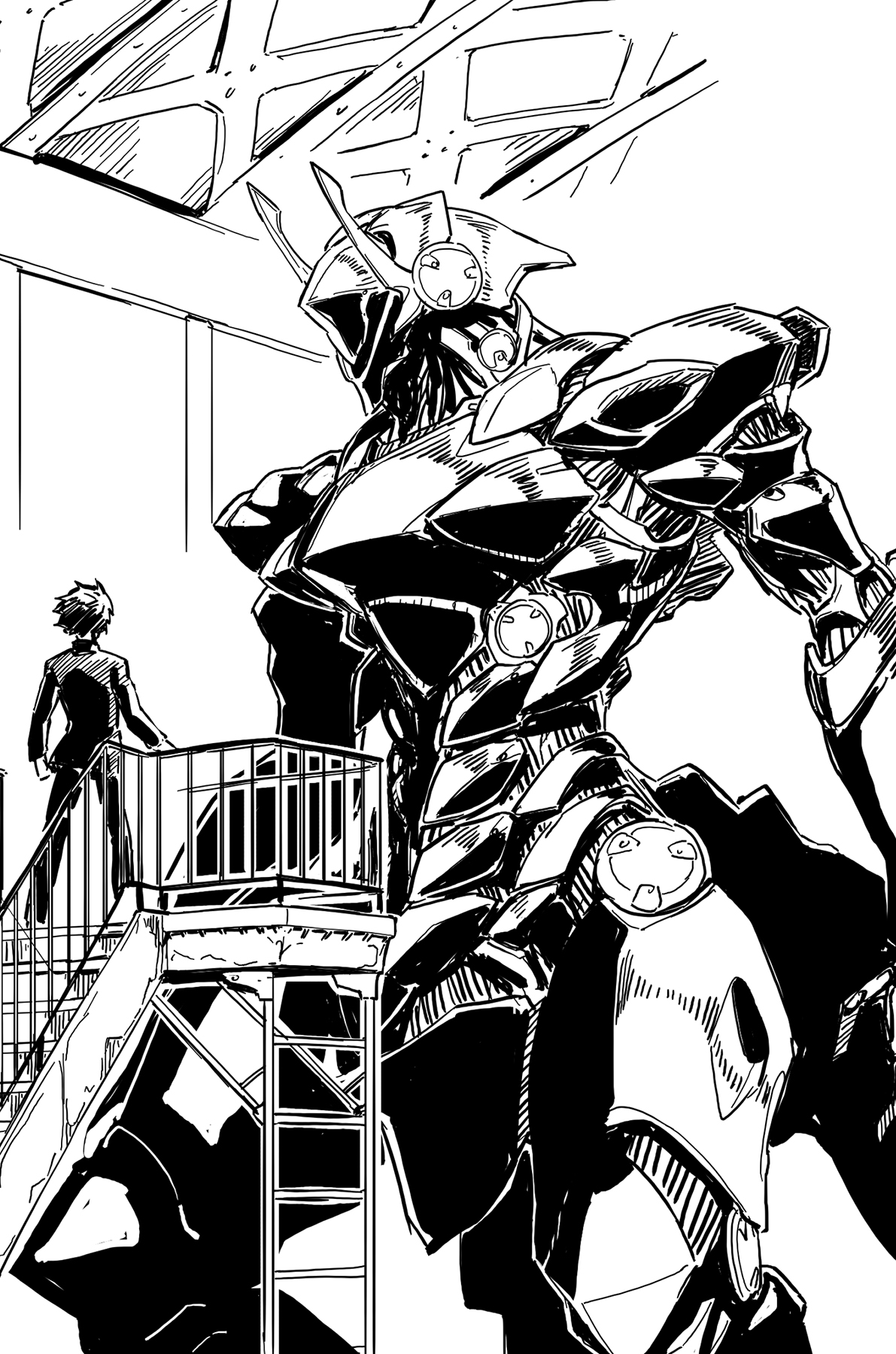
First impressions mattered—even the ancient texts said so—and this guy was a mechanic, the person responsible for keeping my mech in one piece. If I got on his bad side, the consequences could be fatal.
Regardless of whether the thing I was being given was grotesque, or whether it was a brand-new, untested prototype—making me a glorified guinea pig—he was going to be holding my life in his hands.
If bowing my head was what it took to establish a good relationship with him, then I would bow.
That said, what happened next would depend entirely on how he explained the abomination in front of me.
“Oh—uh, sorry! I’m Keita Kawakami, Class 1-A. Looking forward to working with you!”
“…Likewise.”
Huh. Kid’s got manners. Didn’t expect that from someone his age, thought Takafumi Mogami, head engineer and president of Mogami Heavy Industries, as he watched the young Kawakami bow respectfully to him.
These days, with demand soaring, most recruits aiming to become pilots came from long-standing military families. Meaning they also tended to hold their noses pretty high in the air.
The polite term was prideful, but that was essentially code for calling them spoiled brats. Not that anyone could say so out loud.
Takafumi understood where they were coming from, at least on paper.
Those military families were all split into factions, and there was as much infighting within them as there was between them. When you were constantly surrounded by rivals, showing weakness wasn’t an option. He could understand why they were always on guard, always posturing.
Still doesn’t mean I want to deal with their attitudes all the time.
Understanding their situation was one thing. Tolerating their behavior was another.
On top of that, Mogami Heavy Industries had only recently branched out into manufacturing mechs. Up until now, they had only been in the weapons game. To the military, they were still a no-name start-up when it came to producing full-fledged units, which meant they had faced an uphill battle just to get a spot in this year’s field-testing program.
Takafumi hadn’t known what he’d do if the student pilot they were assigned turned out to be some cocky brat. But instead, this kid—Keita Kawakami—had shown up, bowing properly and greeting him with respect.
All right. I can’t say I like that initial reaction of his, but it is a brand-new model. You can’t expect a first-year trainee to know what he’s looking at.
He’d been prepared for the worst, but Keita had turned out to be a pleasant surprise. True, that first remark about the unit stung a little, but so long as the kid didn’t make a major mess of things, Takafumi decided he was willing to meet him halfway and tweak the mech to fit his needs.
5
Yep. No matter how many times I look at it, it still seems wrong.
Spurred on by the mechanic’s warm encouragement to look up so he could explain the mech, I lifted my head.
There it was—my own personal mech, its huge hybrid form standing front and center. It hadn’t moved, of course; that wasn’t the issue. The problem was the thing itself. It was wrong.
But before I get into why it was wrong, let me give you a quick rundown of how these things are usually categorized.
I’ve already covered their official name and the materials they’re made from, so I’ll go straight to the types.
There were two main categories of mech.
The first was the standard humanoid model. In Japan, these were called Kusanagi-type units. Here in Japan, they were generally built using the corpses of monsters like ox-headed Gozuki and horse-headed Mezuki, while in the West, they used giants like Minotaurs and Gigantes.
What set this type apart was their ability to mimic human movements.
They could dual-wield swords, carry shields, and even mount heavy weaponry. Naturally, the more skilled the pilot, the more effective they were in combat. Folks who had trained in martial arts from a young age or had experience with firearms tended to prefer these.
The second were beast-like mechs, also known as Yatsufusa types here.
As the name implied, these units took the shapes of animals. They were usually quadrupedal, which meant they were lower to the ground compared with the standard humanoid types.
Beast-like mechs were built from the remains of monsters that had mutated from large creatures like tigers, bears, or wolves.
Their main advantages were their excellent stability and traversal capability thanks to their lower center of gravity and four-legged form. They weren’t as flexible when it came to gear, but they often had built-in fangs and claws, and you could mount cannons on their backs or shoulders. This made them ideal for sniper positions that standard models couldn’t reach, giving them an edge in terms of firepower.
Plus, since they were lower to the ground and built from more agile monsters, they were better at evading enemies. They weren’t as strong defensively, sure, but they more than made up for it in terms of maneuverability.
That said, beast-like mechs were bulkier, and their cannons got in the way, so running several of them in a close formation was tough. It wasn’t impossible to coordinate them like a real wolf pack, but it took a lot of training. Still, it was easier than learning martial arts from scratch, so pilots without much skill in hand-to-hand fighting often preferred them.
To sum it all up, standard human-type mechs were versatile and durable, and with the right training, they could be operated in groups. They were used in the main forces or advance deployments and could also handle tasks like construction or camp setup. Beast types, on the other hand, shone in solo missions—reconnaissance, harrying enemy forces, sniping, and the like. They were also handy in situations where signal interference might become a problem, since they could relay orders independently, so they were mostly found in scouting and vanguard units.
That was it as far as basic knowledge went. Anything further got into specialized knowledge that only mattered once you were assigned a personal unit, so I hadn’t bothered studying that far.
Once you understood the differences between the two types, one question would naturally come to mind looking at the mech in front of me: What on earth was the idea behind this thing?
The upper half was a standard humanoid torso, so it could no doubt wield weapons and armor like a person. That much was clear. But anyone with even a shred of martial arts experience knew that it was the lower body that was most important in a fight—and the lower body was straight out of a beast type, all muscle and graceful quadrupedal motion.
There’s no way I can use any of the techniques I’ve learned in that.
Any attempt to apply my martial arts know-how in that thing would only slow me down.
After all, I was human.
Let’s say I tried to figure out how to use the legs. Beast-like mechs were known for their fluid, agile motion, but the humanoid torso would get in the way of that. Like I said earlier, beast types relied on being low to the ground—around two to three meters—to make those movements work.
The unit in front of me, however, had a three-meter-tall beast-type lower body combined with a three-meter-tall humanoid upper body. That put its height in the same range as a standard type.
Worse, while standard types could crawl or crouch if needed, this thing wouldn’t even be able to bend its torso. It had been fixed to the legs, giving the mech limited flexibility.
Essentially, it seemed like they’d thrown out nearly every advantage offered by beast-like mechs. This hybrid unit was like someone had taken the worst parts of both types and mashed them together.
At least, that was how it looked to the untrained eye.
I, on the other hand, could see the potential.
“This thing’s built to combine quadrupedal mobility with the weapon loadout of a standard type, right?” I asked the mechanic.
“Oh? You picked up on that?”
“Yeah. I’m guessing it’s even heavier than a standard type? The legs would have to be reinforced to handle the extra weight.”
“Heh. Nailed it.”
“Nailed it”? Why are you acting like that’s normal?
“So the idea is to use this to snipe from long range with heavy artillery, which is too much for either a standard or beast type to handle?”
“That’s right.”
I knew it. Honestly, that was the only thing that made sense.
Standard types couldn’t handle big guns because their legs were already busy supporting all that upper-body weight, and they would be left vulnerable by the recoil. Beast types were even worse. They were lighter, so if you strapped a cannon on one, the recoil would completely throw your aim off.
This hybrid must have been designed to solve that problem—to take down monsters that neither of the other types could handle and use heavy weapons with extreme precision.
On top of that, unlike tanks or battleships that had fixed weapon systems, its magicite core let you swap out armaments mid-battle. That gave it real versatility that wasn’t just limited to sniping or cannon fire.
I could grasp the general concept. It would be difficult to pilot, no doubt about it, but it filled a niche. If you could operate it properly, it could serve a real purpose.
“If”…
That was the crux of the matter.
“How much does it weigh?” I asked.
“…Thirty tonnes. Thirty-five with a full loadout.”
I knew it! This was why it was better to call out these engineering types directly instead of dancing around an issue. If you didn’t, they’d go off on a tangent about something completely irrelevant. Having come to this decision, I dropped the polite act and addressed the mechanic bluntly.
“Are you stupid?”
“Excuse me?”
Oh, please.
“Standard types usually weigh fifteen tons. Beast types weigh ten. Why is this thing heavier than the two combined?”
It weighed about as much as a medium-sized tank.
“Y-you need that kind of mass to withstand the recoil of a cannon strong enough to take down large monsters!”
“I guess that makes sense.”
I understood the logic. To match a tank’s firepower, you also needed to match its weight to absorb the recoil. But understanding it and accepting it were two different things.
“You realize that when I store this in a magicite crystal, it’ll weigh thirty-five kilos, right? You’re saying I’ll have to lug that weight around twenty-four seven?”
“…Soldiers often march with forty kilos of gear, you know.”
Did he really expect that would convince me? He might not have been wrong, but his eyes were darting all over the place.
“Soldiers get to put their gear down when they rest. Can I do that? Am I allowed to just summon and unsummon my unit mid-mission?”
“…”
Exactly.
Mech pilots were trained to keep their units inside their magicite core when resting. Leaving a six-meter-tall mech out in the open would make you a sitting duck. Plus, the core helped with auto-repair and absorbed energy from fallen monsters for upgrades.
In that respect, the core functioned like an inn from an RPG—rest, and you recover, maybe even level up. It also strengthened the bond between unit and pilot.
For those reasons, it was generally recommended to keep the mech stored inside the magicite core as much as possible. The magicite’s item-box function came with a very clear downside, however: The bearer still had to carry one-thousandth of the stored item’s weight.
Would you expect a teenager constantly carrying thirty-five kilograms on his back to be able to get any real rest?
Of course not. Whether you were walking, riding in a car, going to the bathroom, or trying to sleep, it would be too much. You would collapse from exhaustion before even reaching the battlefield.
And needless to say, it would be far too impractical to transport it in a specialized trailer. At that point, it was quicker to use a regular mech.
“O-once your compatibility with it improves and it levels up, that weight should drop down to around half!” the mechanic stammered.
Oh yeah? Great.
Sure, half might have been manageable.
Except for the fact that it’d be impossible to get to that point.
“Assuming I’m still alive by then…”
“Uh…!”
Seriously?
Saying it got stronger when it leveled up was just another way of saying it was weak until it did.
This wasn’t a game but real-world combat, where every fight was life or death. How was a rookie pilot, worn out from dragging thirty-five kilos around all the time, supposed to gain the experience needed to level up? Forget surviving a fight—I’d have a hard time even getting there.
“Also, the top half is humanoid, and the bottom half is a quadruped. Can you really imagine yourself driving this thing?”
“W-well, I guess it might be a little difficult at first…”
“Might be? No. It will be difficult.”
If it were a standard bipedal unit, I could rely on my own skills and experiences, and if it were a full beast form, I could probably wing it on instinct and stubbornness. But this hybrid thing? No chance.
Was I supposed to control it with brain waves like one of those Gundam Universal Century mechs? We still had a long way to go before we reached that level of technology.
“…”
Finally speechless, huh?
Well, I couldn’t blame him. No matter how great the specs might look on paper, if you couldn’t actually operate the thing, it was worthless.
Just think about how many weapons had been scrapped during the testing phase.
Sure, the British had approved the Panjandrum during World War II, but that was only because they were high on tea or something. It would be wrong to assume that was normal.
Still…I might have come out with a lot of negative comments about it, but honestly, I did think this unit had potential.
I mean, the whole idea was to snipe from long range, right? I’d get to keep a reasonable distance from the front lines, which sounded good to me.
Thirty-five kilograms was a lot, but I was fit and healthy, and I could store the weight in the hangar when I wasn’t deployed.
Yuna weighed about that much. If I imagined I was carrying her around, it probably wouldn’t feel heavy at all.
If I died, she’d end up all alone. When I thought about the weight as that burden of responsibility, it actually felt kind of right.
And if it still felt too heavy, I’d just have to use my three years at the academy to train up. Even if the unit itself didn’t grow, I could at least improve my compatibility with it and reduce the load. I was being paid to train in a safe environment for three full years, so there was no point complaining.
“…Anyway, whining about it won’t help until we’ve actually tried it out,” I said. “Let’s fire up the simulator.”
“Y-you’re sure?”
“It’s not about whether it’s practical or not. It’s too late to swap it now, so let’s make the best of it. Can you get the simulator ready? And show me the manual, if there is one.”
“R-right!”
Let’s not forget, my role at this school was to be a test pilot.
There was no such thing as good or bad when it came to a prototype unit. As the pilot assigned to this mech, my job was to run it through the wringer and write up a thorough report.
I doubted the military was expecting miracles from a prototype anyway, but if I was going to reject it, I’d better give a convincing reason.
It may look like a freak experiment made by some strange company, but that just means it has the potential to surprise everyone.
With that thought, I started working out ideas for how to handle the unit while the mechanic handed me the manual. He glanced at me, looking half apologetic and half excited, as I started reading everything I could about the mech.
Chapter 3: From Simulation to Combat
1
Center on the target, fire.
Confirmed hit.
Jump to the side, center, fire.
Confirmed hit.
Center on the target while landing, fire.
Confirmed hit.
Again. Jump to the side, center, fire.
Confirmed hit.
Center on target before landing, fire. Center again while landing, fire.
Confirmed hit. Aaand…confirmed hit!
Hmm. As expected, storing preloaded weapons in the magicite core let me shoot without having to reload each time. Swapping weapons in and out of the core took a bit of getting used to, but it was something I literally had to get used to.
The one drawback was the strain on my legs from all the jumping and landing, but that was where the beast-type frame with its high flexibility really shone. So far, there were no issues.
Still, I had to admit: The mech must have looked pretty creepy from the outside.
If I was in a standard bipedal model, it wouldn’t have been out of the ordinary to jump or roll sideways—assuming, of course, that you’d trained for it.
But on a quadruped? That was a whole different story. Just think about it: If a wild animal suddenly jumped sideways with no warning, you’d be terrified, right? Now imagine that same animal having a human upper body. Nightmare fuel.
Taking it one step further, imagine that same abomination jumping sideways while shooting. The manual said that you could move immediately after firing, but I seriously doubted even the designers had imagined this kind of movement.
At this point, I might as well have been rewriting the rulebook for snipers.
It was said that the most important trait in terms of piloting mechs was your ability to visualize your actions.
The pilot wasn’t connected to the mech through their nerves or anything; instead, everything was done through the magicite core.
The basic theory was that a mech couldn’t do anything its pilot was unable to imagine. So when someone with martial arts training started using a mech, the first thing they were taught was to visualize their entire nervous system connecting to the machine.
Basically, your weapon became an extension of your body.
The clearer the mental image, the more precisely the mech could mirror your own movements.
For beast types, the image you were supposed to focus on was crawling on all fours.
Yes. Like a baby.
Apparently, most training involved getting down on the ground and crawling on your stomach. If you didn’t want to do that, you were supposed to pretend you were playing horsey or something. But in the end, it all came back to crawling.
While it might look silly, crawling is hardwired into our biological instincts. And since it’s instinctive, it’s apparently easier for the mech to replicate than martial arts, which requires conscious control.
So with all that in mind, how did my mech fare?
Well, I couldn’t exactly envision myself as a quadruped; I simply wasn’t that imaginative. And there was no way I could send neural signals to just the top half and cut off the bottom.
In fact, when I tried to imagine crawling, my upper body simply got in the way.
Pulling off something like a sideways jump with only the lower half while sniping with the upper half wasn’t something a normal person should be capable of doing.
So why could I do it, despite not being particularly gifted?
Because I had a secret weapon: the leftover memories from my past life.
They were only fragments, really. Most of them were faded. But one thing that had stuck with me was robot anime series and video games.
Think about it—how could I possibly forget all that after being reincarnated into a world with actual monsters and robot suits?
That said, I didn’t know any technical details or maintenance knowledge. All I had was a vague, general idea of how to do it. What helped was my knowledge of a certain obscure, by-fans, for-fans robot action game I’d waited more than five years for a sequel to come out for, only to die before it happened. Its name: Armored Core.
Unfortunately (or maybe fortunately), in this world, they hadn’t discovered those special particles, so there was no hovering. But what they did have was powerful springs in the mechs’ legs, so it was pretty much the same idea.
In other words, I’d decided to pilot this thing the way you would control a mech in a video game.
Instead of imagining nerves and muscles, I imagined using a controller (and claw style, at that).
The results spoke for themselves. Even if my brain had forgotten, my body—or my soul, perhaps—remembered.
It’d taken a little time to get back into the groove, and obviously, it wasn’t exactly like the game, so there were some hiccups. But overall, it was working out pretty well.
I could probably even tackle some late-game missions now. Not that I’d be able to clear them necessarily, but it would be worth a try.
That said, I’d be in trouble if an enemy got up close. I could manage, most likely, but in melee combat, where every millimeter counted, there was a chance I might fall behind.
That was fine, though. This mech was designed for long-ranged sniping with high-powered weapons. It wasn’t intended for close combat.
Why not? That was like asking a prototype Guntank to hold up in a melee battle.
Of course, I couldn’t ignore the problem. It was still something that needed to be addressed at some stage down the road.
—Mission Complete—
“Huh? That’s it?”
The simulation had ended while I was still going over all sorts of things in my head. That must have been the last objective.
The final tally was eight large-class and six medium-class monsters eliminated, with twenty-two small-class targets caught up in the incendiary blast radius.
It was just a simulation, so I wasn’t sure how much this would affect my evaluation, but it wasn’t a bad showing. Actually, it was pretty good. More than good.
How could I be so sure? Because I’d been able to take down several large-class enemies. Solo.
Monsters were artificial life-forms created by demons and demonkin, built from raw materials like humans or animals found in demon-infested areas. No one quite knew exactly how they did it, but apparently, it involved implanting the subjects with magicite cores or demonic elements.
The military categorized them into four sizes.
First was the small-class monsters, at under three meters—goblins, wild animals, things like that. These were the most common.
Next were medium-class ones, at three to ten meters. The humanoid variants included things like the bull-headed Gozuki, while beast types were mutated bears, tigers, and the like. Most of the corpses used to build our mechs came from these.
Then there was the large class, at ten to thirty meters. These were the fantasy monsters—yokai-looking creatures like the Gyuki, giant insects, massive beasts. It was also where you started seeing super-strong giants and dragons capable of shooting laser-like beams.
And finally, extra-large—thirty meters and up. Monsters could be a hundred or five hundred meters long, and they would still count as extra large. A few such creatures had been spotted in Europe. Some were manifestations of mythological creatures like Fenrir or Midgardsormr, while others served as carriers for smaller monsters.
Once monsters hit medium class or larger, they started generating something called a “mana field.”
These fields had the power to significantly reduce the effectiveness of attacks that didn’t contain the equivalent amount of force or mana. As such, taking down medium- or large-class monsters with regular weapons that couldn’t channel mana was a considerable hassle. It wasn’t impossible, but it definitely required a lot of effort.
Think of it like a weaker version of an AT Field.
That was why we needed mechs that could channel mana through their attacks via magicite cores.
The bigger the monster, the more of that “demonic element” it possessed and the stronger its mana field was. Their attacks also went from physical to magic, like those laser beams.
Given the circumstances, taking down a large-class monster usually required multiple mechs or specially designed defense units (basically giant cannons on legs that could barely move or defend themselves). They were high-risk, high-reward, and often didn’t come back.
Well, that about covered monsters and mechs.
Basically, whether you were talking about multiple units or specialized defensive weapons, the National Defense Forces expected some level of damage when going up against large-class monsters. So the fact that I’d taken down multiple of them entirely on my own—and come out without a scratch, no less—meant I had no doubt provided them with valuable data.
Then again, that was just my take, and I’d only done a little bit of reading before I enrolled. Maybe soloing big monsters was standard now? Still, even if that was the case…I wanted to think my results weren’t half bad.
Setting aside those wishful thoughts, if I had to point out one area of concern from a test pilot’s perspective, it was that those incendiary rounds were great for cleaning up small fry, but you really had to watch out for the splash zone. The last thing anyone wanted was to pull the trigger and accidentally take out a teammate.
As a suggestion, maybe we should get some armor-piercing rounds for single-target sniping, or we could just slap a tank turret on this thing.
The real problem, though, was what happened if the enemy closed the distance. Even if I put aside thinking about larger monsters for later, I still needed a plan for medium and small ones.
Ideally, the situation would allow for a clean retreat. But if I had no allies around and couldn’t get out on my own, I would effectively be boxed in.
The only solution was close-range combat gear—some kind of melee weapon or mounted gun.
Of course, that would add extra weight on top of what was already a hefty setup. Plus, switching from long-range sniping to close-quarters fighting was far from a speedy transition. If we were talking about mass-producing these units, that complexity might be a hard sell.
Honestly, if you were going to use them for sniping alone, you might as well use modified heavy tanks with specialized cannons. That would be faster and easier.
Regardless, my job here was just to report.
The rest would be for the higher-ups. And for future me.
“Let’s leave it there for now,” I told the mechanic. “This was my first test run, so I’m sure I overlooked a few things. Do you think you could help me tweak it a little?”
“Y-yeah. Of course.”
Huh?
The man looked rattled. Sure, there were some issues, but that was to be expected with a prototype. It wasn’t like I was in live combat, where one mistake could kill me. He should have been pleased; that was why we’d identified the flaws in a safe, controlled simulator.
What’s wrong? Cheer up a little.
What the hell?!
Even though it was just a simulation, seeing Keita zipping around the battlefield like it was nothing, sniping monsters mid-leap while casually narrating his report like he was reading off a grocery list—it was so far removed from his expectations that Takafumi couldn’t help but let out a mental scream.
What Keita was doing matched the movements described in the hybrid unit’s manual—the one he had helped write—but that document was little more than a wish list of theoretically possible maneuvers scribbled down by a team of overambitious engineers. It was an ideal. A fantasy.
In reality, the mech stopped moving when it fired, and the recoil threw off its center of gravity. Yes, you could leap sideways, but landing was a huge strain on the legs. There was no way anyone should have been able to land and shoot at the same time, then jump again before confirming the shot had reached its target. Even if the frame survived that kind of abuse, the poor pilot inside wouldn’t.
And yet Keita’s hybrid-type mech had moved exactly how Takafumi and the rest of his team had dreamed it would. Perfectly.
“Let’s leave it there for now. This was my first test run, so I’m sure I overlooked a few things. Do you think you could help me tweak it a little?”
Takafumi had been watching in stunned silence when Keita’s voice snapped him back to reality.
“Leave it there”?! What does that even mean?!
Keita’s report had covered everything in the test scenario, from the entirety of the simulation outlined in the curriculum to detailed points of improvement and even specific numerical tweaks to adjust. As a mechanic, Takafumi couldn’t argue with any of it. Every suggestion the boy had made was perfectly reasonable.
Keita had brushed it off, claiming this was just his first test run, but most people would have needed five runs minimum to collect even close to that amount of data.
He had absolutely no complaints about Keita’s performance in this first test run, so all Takafumi could do was give another little scream internally while stammering the only response he could muster.
“Y-yeah. Of course.”
However, Takafumi wasn’t just any mechanic. As the president of Mogami Heavy Industries (in other words, a bunch of mad engineers), he could clearly see that Keita’s performance and the issues he had uncovered were all essential pieces in completing the hybrid model they’d staked their company’s future on.
This is going to work. We can do this!
The National Defense Forces didn’t want high-performance, high-maintenance, ultra-specialized machines that only gifted pilots could handle. What they wanted was something that performed well enough, was easy to use, easy to maintain, and cheap to mass-produce. In other words, they wanted efficiency.
Takafumi was well aware of that. A good company didn’t build what it wanted to, but what the customer was looking for. That said, engineers, being engineers, always wanted to build the best machine they possibly could, regardless of the consequences.
Up until now, he’d had to make compromises, telling himself that it was necessary. After all, the company needed to stay afloat to look after its employees.
But not anymore!
Now, for the first time, they had a capable pilot. They could finally take readings for things they’d only guessed at before. Better yet, they had the perfect excuse to pour resources into development, what with this being a potential new military prototype.
Of course, Takafumi planned to push every value to its limit to see how the unit performed at its threshold, then use that data to go even further. If they meticulously recorded Keita’s performance and converted it into something usable, then maybe mass-produced units would be able to replicate his movements, even if they never reached his insane level of maneuverability.
If we can do that, the military will definitely want more hybrid units!
That meant Mogami Heavy Industries, which was currently overlooked and even mocked by its competitors, could become a manufacturer that the military went to first.
We’d best ride this wave all the way!
At last, Takafumi’s passion project—the joint project of all the eccentric engineers at the company—finally aligned with cold, hard business sense.
“Heh-heh-heh.”
Imagining their long-ridiculed hybrid units lined up on the battlefield, tearing through monsters with ease, he couldn’t help but chuckle.
“There’s no time to waste! But… Heh-heh-heh.”
Grinning like a man possessed, he dived into his paperwork.
To anyone watching, Takafumi must have looked unhinged. He was unaware that, for normal people, the image of those hybrid mechs storming the battlefield was nothing short of a nightmare.
2
“Hey. I heard you got stuck with a freak-show mech.”
“Don’t call it a freak show.”
…Even if that description was kind of true.
The one who’d tossed out that half-sympathetic, half-sarcastic remark the moment class ended was the same girl who’d gotten so riled up about losing to me in the entrance exams, Ms. White Blossom…or rather, Isotani. She’d said she wanted to apologize after the Boss revealed I was a victim of the war. It turned out that, despite her piercing gaze, she was a pretty straightforward girl underneath.
The rest of the students were still unsure how to deal with me—and frankly, I wasn’t sure how to approach them, either. Isotani was the only one who’d reached out without hesitation.
Apparently, her family was affiliated with the Sixth Division, who were responsible for the Kinki region and frequently coordinated with the Second Division, where I was supposedly going to end up. For that reason, she must have decided it was practical to begin a working relationship with me now.
Sure, it was a calculated move, but relationships were often built more on convenience than sincerity. As long as it was just a chat every now and then, I didn’t really mind, so I’d gone along with it. That was how we’d ended up as casual acquaintances.
As for why I would no doubt be working with the Second Division, one of their officers had taken care of my enrollment. I could only assume the higher-ups would decide my post after graduation, so I wasn’t about to complain. But if I did get a say, I would prefer a position on the back lines. Just putting that out there.
Anyway.
According to Isotani, all the other students were already tied to various factions, which meant they couldn’t chat freely without risking political fallout. I, on the other hand, didn’t belong to any of those camps. I was a genuine civilian, even if I was in the care of the Second Division. That made me neutral ground—and apparently, a hot topic for gossip. Isotani’s superiors wanted to know more about me, so it was practically a strategic maneuver on her part to chat me up. She said her parents had even praised her for it.
I couldn’t tell what kind of intel she was getting out of our conversations or what she might be leaking, but the way she was so open about it somehow made it seem less suspicious.
Considering their statuses, all of my classmates were probably rivals with one another.
I’d also heard their families were strict with their teaching.
It had to be exhausting always being on guard.
I couldn’t help but wish Isotani would hold back a bit on extracting information, but it was hard to pour cold water on someone who was positively beaming about finally earning some praise from her father.
I just had to put up with it a little. Yes, I’d chosen to overlook the fact that she was leaking my information. It would be a problem if she shared something really personal or damaging, but we’d only been talking about everyday sorts of things. If she could get any useful intel out of that, I’d simply have to accept it as proof of her investigative skills.
And no, accidentally glimpsing her flower in full bloom when we’d first met had nothing to do with it. Nothing at all.
Once I started treating her like a normal friend, she turned out to be surprisingly easy to talk to.
For one thing, she rarely lied.
She probably realized she wasn’t any good at it.
If we touched on a topic she couldn’t talk about, she would just keep quiet or change the subject. That was it.
Apparently, that first confrontation had also been her way of trying to get information about me, a guy who’d come completely out of left field. She’d wanted to figure out what kind of person I was and how best to interact with me. But once the Boss outed my background in homeroom, Isotani had accepted that I was an unaffiliated civilian and decided I should be treated as someone to protect instead.
Of course, that description had only applied to me before enrollment. Now that I was officially in the academy, I was a soldier. In other words, her colleague.
To be honest, I appreciated her treating me like this. It was the right sense of distance for an outsider like me.
“So it’s got a standard upper half and a beast-type lower half? That’s pretty much the textbook definition of a freak show.”
She was also the sort of person to speak her mind. Like she had just now.
“…I don’t think it should be too bad if I can master it.”
“Can you master it?”
I replied exactly the same way I had to the old guy—er, Mogami—back in the hangar.
“I did okay in the simulator, at least.”
That said, I didn’t know how hard it was supposed to be. My tests were still just computer simulations as well, so I couldn’t afford to put too much weight on that.
“Oh? So you didn’t get shot down before it could take off? You could dodge and shoot and all that?”
“Pretty much.”
I wouldn’t have said I’d done okay if I hadn’t been able to do that…
“Don’t look so surprised. Most people can’t even start up a freak show like that. But you did. And you’re telling me it didn’t only move—it responded to you? You were able to dodge attacks? That’s definitely good intel. My dad’s gonna be so proud!”
“Right. Yeah.”
She’s sharp, I’ll give her that. Or maybe I’m just dense.
It didn’t take a genius to realize that test data on a brand-new prototype was highly valuable, regardless of whether the mech would prove usable in the long run.
Still, it was a bit disheartening to know she was excited solely because she could earn her dad’s praise.
Nonetheless, I couldn’t let my guard down too much. I might be a student, but I was in the military now.
“I better go. I’ve got training.”
“Yeah, me too.”
If it’s about me personally, fine. But letting her leak info about the unit itself can’t be good…
Having decided that, I wrapped up the conversation and made my way to the hangar, where my so-called freak show and its obsessive creator were waiting.
Two days after that conversation, we found ourselves in the middle of what the outside world called Golden Week, a string of holidays in late April.
Unlike the general public, who were needed to keep the economy going, soldiers who’d been fighting demons for over a hundred years since World War II didn’t get to take long breaks. Golden Week, May Day—none of that mattered to us. We stuck to a strict five-day workweek, no exceptions.
To be fair, things had used to be a nonstop grind of Monday-Monday-Tuesday-Wednesday-Thursday-Friday-Friday, but it turned out people actually needed rest to function properly. Also, without time off, they wouldn’t spend any money, so the economy would stall. That was why we had weekends off now.
So what did everyone get up to?
Well, I—Keita Kawakami—was way down south, on the north coast of Kyushu, hundreds of kilometers from Tokyo.
Yeah, I know. Believe me, I was just as confused as you are.
I’ll give you the short version. The previous day, the Boss had suddenly said, “You’re going to Iruma Air Base tomorrow.” When I got there, a group of mechanics was already waiting for me, and in the blink of an eye, I was getting off a plane in Kyushu.
“Wait, what gives?!”
It made no sense. Sure, we were military cadets. Unlike civilians, we didn’t get holidays. Even if the rest of the country was taking time off, the same didn’t go for us. We were headed to the battlefield after graduation, and there would be no time for R & R there.
Even if, by some miracle, we did get time off, we would no doubt spend the whole “vacation” training. After all, if you weren’t used to your mech by the time you got deployed, you were dead. Literally.
It wouldn’t just be us, either. We were officer cadets, so once we graduated, we’d become full officers—squad leaders or their aides. If someone like us died, the chances were good that the whole unit would probably get wiped out, too.
Dying alone was one thing, but we would also be responsible for our subordinates. If anyone could enjoy a holiday knowing that, you didn’t say they had “strong mental fortitude.” You called them a damn sociopath.
At least, that was how the military saw it. And they had zero time and patience for training sociopaths to become officers. Anyone trying to slack off during holidays got unceremoniously kicked out. I mean, we were literally getting paid to attend school. Skipping class was unthinkable.
That said, some students did try to skip nonmilitary classes, which included everything other than PE, military history, combat techniques, battlefield strategy, and mech maintenance. This was quietly tolerated so long as they didn’t fail their exams. In that sense, you could probably say the academy was fairly laid-back.
The general attitude could basically be summed up as “Training takes priority over class!”
That wasn’t unique to military schools, though. I’d heard stories of sports-focused private schools working the same way, where if you got in on an athletic scholarship, your life became all about training and competition.
You didn’t necessarily have to show your face on campus on weekdays, but your exam scores affected your rank, and your attitude in class affected your record, so most students still went to class. Most.
With all that said, there was one circumstance where you could skip class without hurting your record.
At those sports schools, for instance, if you missed class because of a tournament or practice game, it counted as an officially approved absence. Totally excused.
So here’s a quiz question for you:
Q: In a military school training future soldiers, what is the equivalent of a tournament or practice game?
A: Going to an actual battlefield.
Yep. That’s right.
“There’s nothing right about that! What the hell—this is insane!”
“What’s with the shouting?” Mogami asked.
He gave me a puzzled look, probably wondering about my sudden outburst.
But seriously, I was well within my rights to be confused here!
“Come on. I just enrolled, like, a month ago. Why am I being sent to the front lines already?!”
The curriculum did include on-site battlefield training, but that was for third-years. And not just any third-years—only Class A students, or Class B students with mechs assigned to them. In other words, elite students with over two years of training under their belts.
Not someone like me, who was barely a month in and saddled with some irregular hybrid mech that was taking forever to calibrate.
What in the world was the school thinking?!
I voiced my complaint, trying to sound calm and rational.
Mogami grinned and gave me a thumbs-up. “I may have pulled a few strings.”
“You’re the one behind this?!”
After my first day in the simulator, I’d gone home and asked Yuna to dig up whatever she could find on my mech. That was when I discovered something astonishing.
Mogami wasn’t just any old mechanic—he was the president of Mogami Heavy Industries.
I hadn’t heard of his company before, despite having done a decent amount of research into the industry, but I soon realized why. They hadn’t been making full mech units, only parts—tank treads, heavy artillery, weapons systems, and so forth. Now, for some reason, they’d decided to get into manufacturing whole mechs. No wonder I hadn’t heard of them.
Normally, this field was locked down by the big players. The standard models came from Yotsubishi and Mito, while the beast-type models were monopolized by giants like Kaizaki and Kida. It wasn’t exactly a welcoming market for newcomers.
But global instability had changed the game. The counteroffensives in Asia and the fall of the Korean Peninsula had created such a surge in demand that supply couldn’t keep up.
As such, the military had started asking capable companies to help fill the gap. Mogami Heavy Industries, eager to move beyond parts and build full units, had been one of the first to raise their hand.
A few years later, Mogami’s prototype was ready. Normally, no one would assign an untested prototype to a student, no matter how much money had been thrown at it—especially a cadet, one of the military’s “golden eggs.”
However, two years ago, when the Third Division had been annihilated, the top brass had panicked.
Worried about both national defense and overseas deployment, they’d decided to try out the Mogami prototype in live conditions just in case it proved useful.
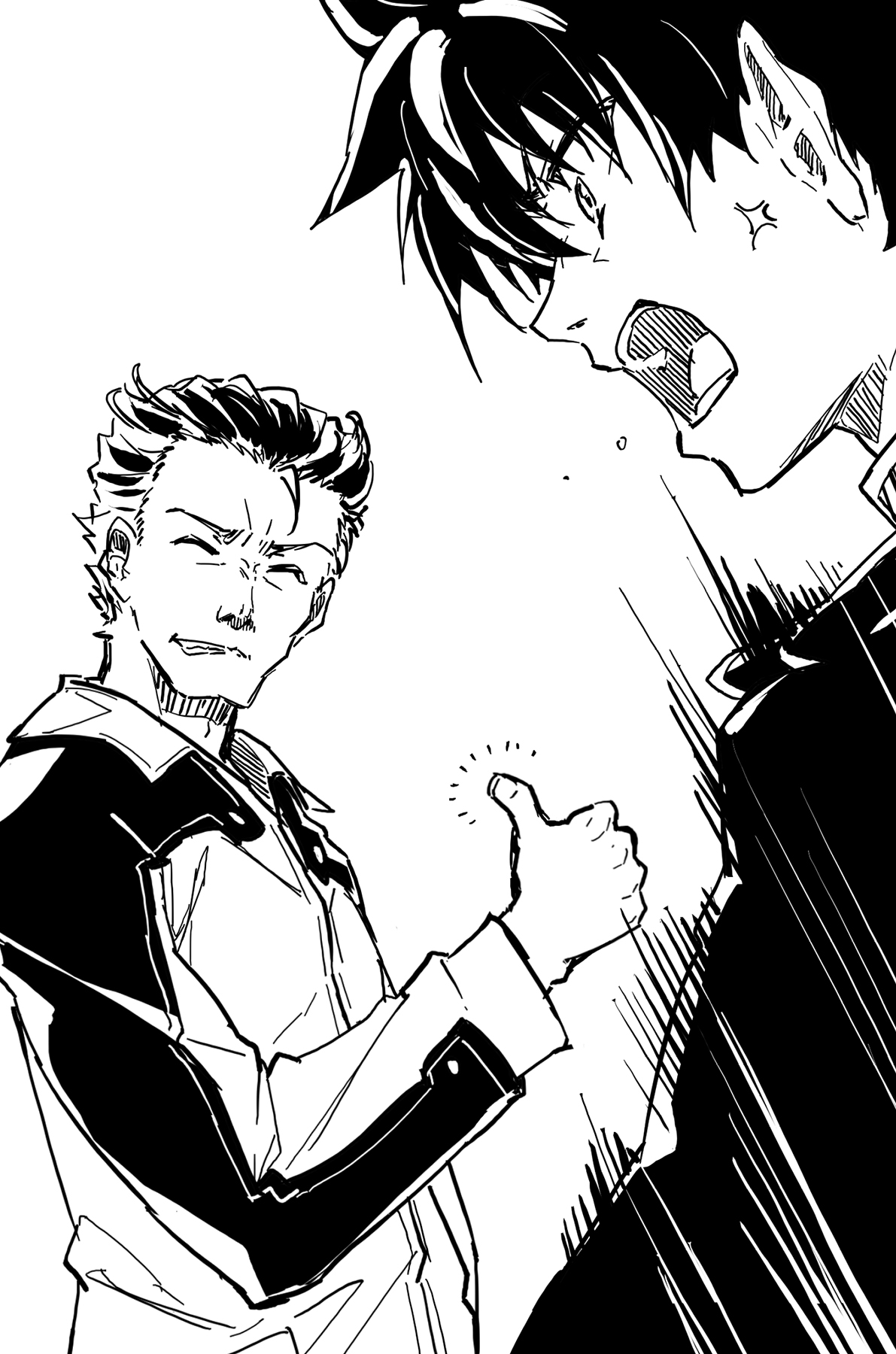
That was how I’d gotten stuck with it.
Why me? Because I wasn’t tied to any faction.
Most cadets were connected to one military clique or another, which meant giving a questionable prototype to them was a nonstarter. I, however, was a nobody. There was no powerful family to complain if I got handed a death trap, no one to raise hell if I died using it. Naturally, I’d been given the guinea pig assignment.
The way Mogami saw it, the sooner they tested the hybrid unit in actual combat, the better. If it performed well, the military might officially adopt it. It made sense that they were in a hurry.
From a business standpoint, I could understand where they were coming from.
What I didn’t get was why I had to be the one dragged into it.
I hadn’t signed up to become a war hero. All I wanted was a quiet post away from the front lines, a safe job that wouldn’t get me demoted or punished.
Ideally, I would get assigned to the Sixth Division in the Kinki region or the Eighth down in Shikoku. That would be a dream come true.
Yet here I was in Kyushu, working with the frontline, elite Second Division. Isotani had mentioned this would no doubt be my fate, but still!
Why were they sending students to the front?! Why couldn’t they use their own damn pilots?!
I was sure the Second Division didn’t want some newbie student playing around with a new model during actual combat, either!
I’d made all those points time and time again, but unfortunately, I hadn’t understood just how terrifying adults could be when they were serious.
“Relax,” Mogami said. “I don’t intend to bring a student onto the battlefield.”
“…Huh?”
Uh… I’m literally standing on a battlefield right now.
“You’re not a student. At least, not while you’re here.”
“Huh?”
What the hell was he talking about?
“You look confused. Check your student ID. That should clear things up.”
“My student ID?”
Student IDs—one of the standard forms of identification for students since forever.
That said, as of the year 2056, they didn’t come in the form of a physical card like they used to. These days, they existed purely as data, accessed via military-issued smartphone.
I didn’t have the faintest idea what Mogami was getting at, but if he said I would understand once I checked, then fine—that’s what I’d do.
“What am I looking for…? Wait, what?”
Half expecting nothing, I pulled it up anyway. First came my photo, my name, and my date of birth, followed by my unit and rank.
The first three were all correct, as expected. The problem was the final two.
“…Second Division, Special Ensign?”
“Congrats, Ensign.”
“Huh?”
Forget waiting till graduation, I’d been promoted a month into enrollment.
Well, maybe promotion wasn’t quite the right word.
I wasn’t just an ensign—but a special ensign.
A “special” status meant that under normal circumstances, I would be treated according to my base rank. For a student like me, that was equivalent to being a warrant officer. But when I was assigned to special operations, I would receive all the privileges of an ensign.
In essence, I was an ensign with strings attached. And of course, those strings were…
“You haven’t completed officer training yet, so you can’t be officially commissioned. But if you prove yourself as a test pilot here, once you graduate from the academy, you’ll be commissioned as a full ensign—or maybe even as a lieutenant. So allow me to congratulate you again. Well done, Kawakami.”
Ah yes, a classic fait accompli. Ugh!
Dammit. I’d underestimated this old geezer and Mogami Heavy Industries.
Of course a company powerful enough to muscle into the defense industry would have money and connections. And with those, it would be child’s play to promote a no-name student to special ensign and toss him onto the battlefield.
Even if I was classed as “special,” I was still officially an ensign. In the military, ranks were absolute.
Simply put, insisting I was just a student wouldn’t cut it anymore.
“…So what exactly am I supposed to be testing out here?”
“Good. That ability to adapt quickly is what I like about you. We’ll start with mobility and deployment training. Head to the hangar, retrieve your unit, and move to the designated location.”
“…Understood.”
That was how I learned just how terrifying an obsessive with money and power could be. And how I ended up training on an actual battlefield, even if it was in the back lines.
3
The test site for the new prototype was a stretch of coastline near Itoshima, Fukuoka.
Center on the target, fire.
“Splorch!”
Center on another target, fire.
“Splat!”
And again. Center, fire.
“Skreee!”
Switch weapon type, fire.
“Chvah!”
No friendlies in the blast zone. Good. Fire an incendiary round into the group of swarming small-class monsters.
“Gyaaaah!”
Keep shooting and shooting and shooting at the monsters making landfall from the Sea of Japan.
If they shoot back, dodge. Or better yet, dodge before they shoot at all.
They might have been monsters, but that didn’t mean they were going to just sit there and take fire from a distance. They hurled rocks and shot beams of light like lasers.
Naturally, they aimed for wherever the fire was coming from. Which meant me.
“Rooooar!”
“Oopsy-daisy!”
But I wasn’t there anymore. I was hardly going to be sleeping on the job here.
Shoot and run. Basic sniper doctrine.
Though to be fair, jumping was easier than running.
The trick was to learn how to land without jarring the actuators.
Would installing some kind of wire-anchor system help control my airtime? I’d have to ask about that later.
Things like that, you could only learn from active combat. I’d make sure to include it in my report.
But back to business.
“Take that.”
As soon as you spot an opening, blast away. And don’t let up.
“Hrooo!”
I nailed one monster with a counter just as it was about to attack. Even at a distance, there was no missing something that big. A mid-class, it was six meters tall, give or take.
This was all playing out just like the simulations predicted. Still…
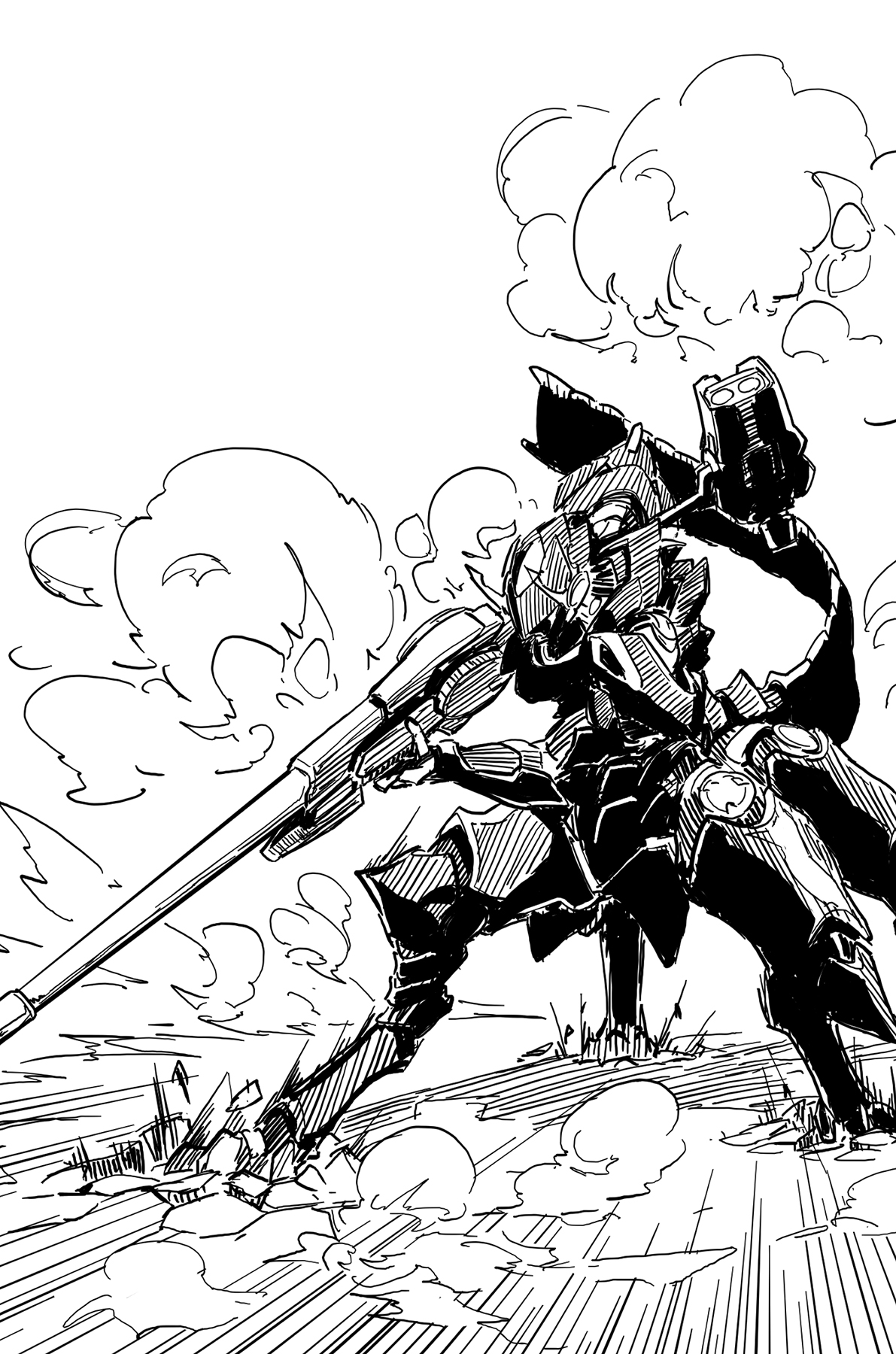
…wasn’t this already way outside the bounds of field training?
This was actual combat. I was basically participating in a coastal defense operation.
Wasn’t my training supposed to be away from the front?
Technically, I was keeping my distance, so maybe this still counted as the back lines.
But I mean, usually back meant behind our own forces, not behind the enemy.
Ah. Target locked.
“Haaah!”
“Ugeh!”
I couldn’t say everything I was doing out loud, but I took notes in my head.
Was it my imagination, or were the Second Division people watching behind me starting to feel put off by my performance?
“They’re going to reach you if you keep fighting on your own like that. Let’s leave it to the Second Division from here. Launch an incendiary spread and fall back… Can you fire with both hands?”
“Yes, sir.”
Seriously, what did they expect would happen? You send a long-range combat mech into battle solo, and of course it would be overwhelmed.
I was grateful they were pulling me back before things got too dangerous, but still…
Could we honestly call this training?
In any event, things would get ugly fast if I let enemies get too close, so I wasn’t holding back.
“Take this!”
No precision this time, just scatter shots everywhere. Talk about exciting!
“Graaaah!”
Good. They were burning.
“Confirmed hit. Falling back.”
Technically, I’d started retreating before all my attacks had made impact. I had my orders, though, so it was fine.
Full-speed retreat, straight to the rear!
…Running on all fours sure is rough.
When I broke into an all-out sprint, I essentially had to give up on controlling the upper body.
Yeah. That was going in the report as well.
“Confirmed hit. Falling back.”
The moment that message came through the comms, the hybrid unit holstered the cannons it had been holding in both hands and began to retreat, arms crossed like the Supreme Ruler of the Century’s End charging ahead on his black stallion, Kokuoh (though, to be clear, only the upper body looked composed—the lower half flailed about with a wildly unsettling gait).
From the beginning of the engagement to retreat, it had taken roughly thirty minutes. The people from the Second Division had been watching the entire time, and they were already deep in discussion about the new model’s performance and combat style.
“…It took out four large, six medium, and over twenty small targets in that short a time? And then inflicted massive damage on dozens more with that last incendiary blast?”
“Unbelievable. What in the world is that thing?”
“More importantly, what was that movement?”
“A four-legged side jump? How are the joints not shredded?”
“Swapping weapons is one thing, but shooting while jumping? How is it managing to hit anything?”
“Right after it took out that large monster with the 120mm smoothbore cannon and thermite penetrating rounds, it whips out two 80mm howitzers, one in each hand, and rains down incendiary shells? What the hell was that thing designed to fight?”
Mwa-ha-ha-ha! That’s right, be amazed! It’s unbelievable! That, my friends, is our latest model—Mikage!
Amid the collective shock of the Second Division officers, Takafumi Mogami, the man responsible for designing and building the new mech, reveled in triumph.
Just moments ago, these same people had been calling his creation a monstrosity. Now they were tripping over themselves to heap praise on it. It was the kind of turnaround every engineer dreamed of.
Granted, it’s probably never going to reach this level of performance again.
Even as he basked in the glory of having his machine finally earn the appreciation it deserved, Takafumi knew better than anyone that this was an exceptional case.
Keita’s remarkable showing had only been possible because this was a trial run, which had let them take a few shortcuts they usually wouldn’t have been able to.
First off, transport. Normally, the unit would have been carried inside a magicite crystal by its user, Keita, but this time, they’d flown it in. As a result, Keita only had to carry it a few kilometers from the air base to the front line. That dramatically reduced the physical and mental strain on him.
Then there was the weaponry. Every gun had already been preloaded, had the safety off, and been stashed away, ready to use. All Keita had to do was draw and fire. Naturally, there were no spare rounds, so reloading was impossible.
And even if it was possible, Keita had no experience reloading mid-combat. It would have taken him ages.
If we’d let them see that, our evaluation would’ve tanked. Though I’m sure some of them watching figured it out… Still, if the initial setup can yield this kind of result, they can’t really complain.
After all, combat was unpredictable. No mech was ever going to be deployed in perfect conditions. That was why the most important thing as far as the military was concerned was adaptability—how well a unit could handle the unexpected.
Which was to say that a test conducted under ideal conditions like this didn’t make for useful reference material.
…Or at least, it normally wouldn’t.
“The pilot has no experience reloading or resupplying in the field. The maintenance crew has never repaired the unit after real damage. The commander has no actual operational experience. There are lots of unknowns that we’ll have to start working through. But if a student who’s had the unit for less than a month can pull this off…”
Yes! This is it!
Takafumi’s biggest miscalculation—as well as his greatest stroke of luck—was crossing paths with someone like Keita, whose whole way of thinking was slightly off.
Using weapons with the upper body while moving the quadrupedal lower half might have sounded simple in theory, but when the top half was humanoid and the bottom half beast-like, the difficulty skyrocketed. Anyone who knew anything about the structure of the mech would have sworn it couldn’t move, let alone fight.
Of course, Takafumi himself had asked Keita how he was able to operate it, considering this fundamental design flaw.
To that, Keita had replied, “I can sort of get it to work by treating it like a third-person shooter. It’s probably a little different, actually—like I tweak the visual inputs a bit. Anyway, it’s sort of like that. There’s some lag, and melee combat gets tricky, but I figure I’ll get the hang of it eventually.”
I had no idea what he meant back then, but I think I get it now. He’s got that rare spatial awareness you hear about in elite snipers. The ability to visualize yourself from above.
It was a skill that was referred to as having a “hawk’s eye.”
In other words, he’s combining the live feed from the camera with his own innate ability to track his position from a third-person perspective. That’s probably how he builds a 3D mental map of the battlefield and predicts enemy movements.
That was why he could see when attacks were coming.
If he could see attacks, he could dodge them.
If he dodged them, he could keep his cool.
And if he kept his cool, he could aim properly.
Once he was locked on a target, pulling the trigger was easy.
The recoil from landing and jumping caused the mech to shake, but the unit had been built heavy to absorb that. So long as the sights were precalibrated, that shouldn’t pose any major issues. Plus, it was no doubt a huge source of reassurance having the elite Second Division right behind him as backup—another factor not to be overlooked.
This performance was a result of those ingredients coming together.
Of course, Keita didn’t actually have any fancy third-person perspective skills. All he did was zoom out on his eye-cam feed and try to replicate the feeling of a certain video game as much as possible.
Nonetheless, the fact that he could accomplish this with that single trick proved one thing: Keita was hopelessly infected with FromSoft-brain.
No one in this world knew what FromSoftware was, of course, so they couldn’t possibly have realized that his very soul was corrupted by some otherworldly element.
But putting aside Keita’s incomprehensible condition…
Right now, we’re relying entirely on his unique skills, but if the Second Division backs us with funding and actual battlefield trials, we’ll be able to gather more data. Then even if future models perform slightly worse than the prototype, we can mass-produce units that are more than satisfactory!
Thus, Plan V—which, so far, had only ever existed in a madman’s mind—began to take shape in the real world.
If Keita had been around to hear this, he would have immediately pointed out how ridiculous it was and started coming up with a proper plan. But sadly, not one person present had enough classic mech anime knowledge to keep up.
There was no one to rein things in, and Takafumi, who did know the machine’s flaws, had no intention of revealing them here. So what would happen next?
“Tell me, Mogami. There’s only one of that unit so far, correct?”
The conversation moved on—right in the direction the madman wanted.
Here it is!
“Yes, it’s just that one for now. If we reallocate some spare parts, we could probably put another one together soon. However, as you saw, the machine is riddled with issues even at this stage. It’s also extremely picky about the pilot. If we rush into building a second unit before resolving those problems, it might cause more harm than good…”
“It is a prototype, so some issues are to be expected. That said, let me be clear: While it’s impressive that it has the firepower to bring down a large-class monster solo, what really caught our attention was its evasive capabilities. This kind of unit will be the envy of the corps, especially for pilots stuck in cannon coffins. We’ll submit a formal request as well, but please proceed with the second unit. Of course, we’ll assist with pilot testing and field evaluations. Feel free to reach out to us at any time.”
“I’d be honored to!”
Their once-ignored prototype was now in the spotlight.
For Takafumi, this was more than personal vindication—it was a professional breakthrough. The Second Division, which was always in need of weapons and munitions, had just become a valuable business connection.
Yes! Now I can keep my employees fed!
Sure, building a passion project like this was a romantic idea, but if no one bought into that romance, it was just an expensive piece of trash.
We still need more trials, and I don’t know how the second unit will go, but the Second Division has essentially already bought Unit 1 along with all its weapons and ammo! That’s more than enough for now.
With the demonstration a clear success, the prototype’s value had skyrocketed. Now they could pitch their other products as well. And it was all thanks to Keita.
You did great, kid. I’ll make it up to you, I promise. Just rack up a few more wins and outrank the rest of your class!
“Now then, let’s talk about dates and locations for the next round of tests…”
Takafumi had recently been on the receiving end of frosty looks from his wife, his daughter, and even the finance department. Yet now he was eagerly coordinating the next test schedule with the Second Division, hoping to finally bring some profit to the company and repay Keita for his help. He was unaware, of course, that Keita’s real dream wasn’t to find glory on the battlefield and rise through the ranks, but to quietly serve as a test pilot and eventually secure a nice, safe desk job.
Thus ended the debut mission of the hero who would one day be known by allies as the Harbinger of Death and “weirdo,” and by his enemies as the Black Deviant.
Interlude: Reactions

1—Kazunari Fujita
“Junji. Did you hear?”
“Yeah, of course.”
“Who’d have thought he’d be on the battlefield barely a month after enrolling? And as a special ensign, no less.”
“They say he took out multiple medium-class monsters and even a large.”
“A large one…? They’ll make him an ensign for real on graduation, then. Maybe even a lieutenant.”
“Could be. He’ll make ensign, at the very least.”
“He’s gotten the jump on us by more than a year.”
“Yeah.”
Normally, graduates of the military academy were commissioned as warrant officers, expected to spend a year in the field before being promoted to ensign.
However, Keita’s performance had already earned him a promotion, effectively skipping that one-year requirement altogether.
It might only be a year, but it meant he would be dealing with drastically different kinds of missions.
While the majority of the class got their hands dirty as warrant officers, Keita would already be commanding troops on the battlefield as an ensign. There was no contest in terms of who would get ahead faster.
True, cadets bound for the military university took a slightly different route, but either way, the starting line wasn’t the same.
When Kazunari first heard about Keita’s promotion, even he had brushed it off as rumor. It had been officially recognized by the Second Division, though, meaning it wasn’t a lie or an exaggeration.
“I guess we’re not supposed to feel jealous, huh?”
“Yeah.”
Fighting on the battlefield just a month after enrollment, putting up incredible results, and getting promoted… Who wouldn’t be jealous?
How had he gotten deployed so fast? What kind of shady trick had he pulled?
It wasn’t just students from Class B who were giving him envious glances and suspicious looks, but upperclassmen as well. If Kazunari hadn’t heard about Keita’s circumstances, he might well have felt the same way.
But he knew better.
Keita wasn’t like the rest of Class A, who’d been raised and trained for the battlefield since the moment they were born.
They knew Keita was a victim of war.
They knew he had no family connections or backing.
They knew he’d joined the military to protect his little sister.
They knew the mech assigned to him was an experimental hybrid-type unit that no one had ever piloted before.
They knew it had been developed by a new, nonconglomerate company, and because it wasn’t a big-name product, it was considered expendable.
They knew the top brass didn’t care if he died, which was exactly why they had allowed a student to be deployed to the battlefield for field tests in the first place.
In other words, Keita had only been sent out there because it was convenient for the higher-ups. He’d fought like hell just to survive and come out on top by sheer force of will.
Is that really something to be jealous of? No way.
You didn’t look at someone like that with envy.
“I’ve made up my mind, Junji.”
“About what?”
“I’ll admit, I didn’t know how to act around him, so I’ve been keeping my distance.”
“…Same goes for me.”
Guys like them never usually crossed paths with war victims, so it was little wonder they weren’t sure how to approach Keita.
Or so they’d thought. But that had been naive.
Now that Kazunari realized that, he had to change. He had to.
“From now on, I’m done seeing him as just a victim.”
“You mean…?”
“I’m not saying I’ll forget what he’s been through. I’ll keep that in mind as a lesson to myself. But that’s separate.”
“How so?”
“Maybe the idea won’t sit well with the purists, but it would be wrong to ignore his achievements simply because he doesn’t come from a military family. He’s not just a victim. He’s a comrade who’s proven he belongs on the battlefield with the rest of us.”
“…I see.”
That said, Keita did technically outrank them now.
The rest of them would catch up soon enough.
“First things first, we need to take a look at that mech of his. Of course, we won’t just extract intel; we’ll also share what we know. I can count on you to help, right?”
“No problem.”
And so, these two young men, representatives of the Seventh Division at the academy, acknowledged Keita as a comrade and decided to finally try to get to know him.
2—Saori Muto
Around the same time the two members of the Seventh Division were reevaluating their relationship with Keita, the students from the Third Division, led by the top-ranking Saori Muto, were also discussing him.
“The only reason he got to fight against the monsters is because he has no backing! The Second Division just used him to keep the rest of us off the battlefield!”
Is that really how it happened…?
“Tatsumi’s right,” agreed Kenjiro. “Once they put him out there, the Second Division can just say, ‘Sorry, we’ve already accepted a student, so we can’t take on any others.’”
I suppose he’s got a point there…
Tatsumi Kasahara, who’d entered as the fifth-ranked student, was practically shouting. Meanwhile, Kenjiro Obata, ranked ninth, nodded along smugly, clearly pleased that someone agreed with him. His sense of superiority despite being ranked lower than Tatsumi came from the difference in their family backgrounds.
The Kasahara family was one of the most distinguished lines in the Third Division, known for producing staff officers and brigade commanders. However, the Obatas were related to the even more prestigious Muroguchi family, which had produced the previous division commander, Renjiro Muroguchi. The Obata family had adopted Renjiro’s second son, and Kenjiro was his second son.
In other words, Kenjiro was the grandson of the Third Division’s late leader.
Right now, however, the Muroguchi family was without a formal heir. Renjiro; his eldest son, Nobumasa; and Yuji, the second son adopted into the Obata family, had all died during the disastrous Imphal operation.
There was Takanobu, Nobumasa’s son, but he was only a year older than Kenjiro, who was still a student, and lacking any military accomplishments of his own.
Plus, the Muroguchi name had taken a serious hit in the public eye, and it was unlikely that Takanobu would be deployed to a real battlefield anytime soon, let alone come back with honors.
All of which meant that expectations for Kenjiro were sky-high.
Kenjiro understood that perfectly. He was determined to rack up sufficient achievements ahead of Takanobu and reclaim the family legacy.
His grand ambition, therefore, was to spend a year or two at the academy, then go off to the front to complete his practical training and achieve military success. After that, he would take over as the next head of the Muroguchi family.
As such, the Kasahara family had ordered Tatsumi to support Kenjiro behind the scenes. The two were effectively master and retainer.
As for Saori Muto, her family had also produced major figures in the Third Division—including her father, the former chief of staff. Even the Muroguchi family had to take them seriously.
That said, after having lost many key members during recent campaigns, the Muto family had its hands full and were disinterested in the power struggle between Kenjiro and Takanobu. Saori’s first priority was to restore her own family’s martial reputation.
In fact, rather than support Kenjiro, Saori had been explicitly instructed to remain at a distance. Having been raised as a true high-society lady, she naturally wanted to keep people like Tatsumi and Kenjiro at arm’s length anyway, so the order was a godsend.
Though for some reason, Tatsumi and Kenjiro both seem to think I’m on their side…
Saori wanted to let out a sigh, but she decided there was no point in stirring the pot. It was better just to keep her head down and listen in on their conversations.
But that was enough about Saori and the Muto family’s motives for now.
Kenjiro, who saw himself as the rightful heir to the Third Division, understandably had mixed feelings about being outperformed on the entrance exam by both Tatsumi Kasahara and Saori Muto. He’d rationalized it away, however, telling himself, “I’m going to be their commander. Of course I wouldn’t score as well on an exam that prioritizes magicite compatibility above anything else.”
Then came the final insult—some no-name kid, not even from a military family, had scored higher than all of them. On top of that, the brat had the gall to act like some tragic victim, going on about how he’d lost his parents because of the Third Division’s defeat, and he hadn’t even bothered to introduce himself to Kenjiro. And then he’d been assigned some bizarre, experimental mech built by a company no one had ever heard of. Kenjiro had to laugh, or else he’d be overcome with rage.
But then came the news that Kawakami had been sent out onto the battlefield ahead of all of them and racked up several major achievements while he was at it.
At first, Kenjiro hadn’t believed it, but when he found out it was true, his displeasure became obvious. Rather, he completely lost it.
This meeting had actually been arranged by Tatsumi, who’d seen the writing on the wall. He’d gathered them all to calm Kenjiro down and talk strategy—specifically, what they should do to help Kenjiro earn some accolades of his own.
Which brings us back to the present.
Saori, who was from a prestigious family and enrolled as the top student, hadn’t contradicted anything they said. So when the head of their faction, Kenjiro, seemed to accept Tatsumi’s opinion, Tatsumi had gotten a little too confident and started acting even more smug.
“Exactly. Without a doubt, the biggest reason he got deployed was factional politics. Though the official excuse they used was something else entirely.”
“…The trial for the new prototype, you mean?”
“Right. Without that, even if the Second Division pushed for it, there’s no way a random civilian kid would’ve been sent out before us!”
“True. If it’s a field test for the only prototype in the academy—heck, in all of Japan—then they might have approved it as an exception. Especially if the test pilot’s expendable.”
“Yeah! That’s right! And just look at the results—clearly, that mech was meant for us!”
“Hmm. So what you’re saying is that since it hadn’t gone through a test run, there was no way they’d risk handing something potentially unstable to one of us. That’s why he got it first. That’s all it is?”
“Correct! The only reason he got those results is because of that mech. Anyone could’ve done it!”
The conversation wasn’t grounded in fact, which Kazunari or Junji would have made sure of first. No, this was just the two of them venting. Even if they believed they were having a serious discussion.
That’s not how I see it.
Saori, quietly listening, was skeptical about everything they were saying.
Though a skilled pilot herself, Saori wasn’t confident she could operate the hybrid mech Keita had been assigned. The way she saw it, merely being able to move that thing proved how capable—or maybe how uniquely compatible with it—he was.
Her feelings about Keita weren’t that different from how Kazunari, head of the students’ Seventh Division faction, regarded him.
In fact, she thought Keita was far more competent than she herself was. Her having been named top student was mostly just for show, a product of her family connections. Though she was undoubtedly more talented than a certain pampered heir who got all the same favoritism and had still barely managed to rank ninth.
The Third Division is in bad shape right now. Shouldn’t we be making allies, not enemies?
That was Saori’s personal opinion, but it also made sense strategically. Rebuilding the Third Division would be impossible without support from other factions, so antagonizing the rest of them was most certainly a bad move.
Especially Keita, who had no political backing. True, the Second Division seemed to be taking an interest in him now, but that could easily change. Perhaps they could bring him into the fold through a political marriage or something of the sort?
They could marry off someone from their family to him, or vice versa. His sister, maybe. The point was, someone who had earned military merit should be recruited, not treated as an enemy.
If we’re supposed to be biding our time, can’t they at least hold it together for a year or two? Or is this some sort of male pride thing? I really don’t get it.
“They’re saying the Second Division has requested a second unit.”
“Then let’s seize it for ourselves. Taking something from an unknown company like Mogami Heavy Industries shouldn’t be too difficult. There are plenty of people who won’t want the Second Division hogging all the new tech.”
“Brilliant idea!”
Is it, though? If you do that, you’ll be making enemies out of both Mogami Heavy Industries and the Second Division. Honestly, this conversation just proves I need to keep my distance from these two. For now, maybe I should get in touch with Kawakami. Fujita has probably already started making moves of his own, too. That makes at least two people on that side… I’ll need to start gathering allies quickly. If only these two were even remotely competent… No, I can’t say that… Ugh, what a hassle.
Watching Tatsumi and Kenjiro plot among themselves, Saori let out a quiet sigh.
Raised as a proper young lady, she had been trained to trust her instincts. And right now, those instincts were focused on the subtle, looming power struggle that was beginning to unfold.
“I suppose I should start by getting to know him.”
Saori Muto had made up her mind to try to get closer to Keita Kawakami. To do that, she’d decided she would need an ally who could help her bridge that gap, and had settled on Shoko Isotani, ranked fourth in their year.
Saori had several reasons for picking her.
First, Shoko’s family belonged to the Sixth Division.
The Sixth Division oversaw the Kinki region, and while their relationship with Saori’s own faction—the Third Division, which backed both the Kanto and Kinki regions during times of emergency—wasn’t precisely friendly, it wasn’t hostile, either. At the very least, Saori judged that there was little risk of their families clashing behind the scenes.
Second was Shoko’s personality. She knew she was talented, but she wasn’t smug about it. On the contrary, she was the kind of person who pushed herself to improve even further.
Of course, it probably helped that there were three students who’d outperformed her on the entrance exams, so she couldn’t afford to let herself get carried away. Then again, the world was full of people who could barely scrape into ninth place, even with all kinds of advantages propping them up, and still managed to delude themselves into thinking they were the best.
Compared with that, wanting to befriend someone who saw her as a rival and kept striving to improve didn’t seem like such a bad idea.
Even someone like Saori, whose proper upbringing had included the art of socialization, would prefer to choose who she dealt with if she had the option. Especially if the alternative was someone who was mentally exhausting just to be around.
The last reason was Shoko’s attitude toward Keita.
While everyone else, Saori included, was unsure how to deal with this anomaly named Keita Kawakami, Shoko had approached him head-on. Some might have said she’d picked a fight with him, but Keita himself seemed to have taken it in stride, which suggested they got along reasonably well.
“Just going up and saying ‘Let’s be friends’ would only make him suspicious.”
It wasn’t like Saori had possessed no interest in him before. Still, Keita would likely just see her as someone who only wanted to get closer to him now that he’d been promoted.
Which is fair…but it’s also not the whole story.
Saori had her pride—both as a proper young lady and as a member of a military family. She could endure a little discomfort. However, she wasn’t nearly mature enough to tolerate being seen as shallow by a boy her own age.
Of course, Shoko wasn’t stupid. She would definitely be suspicious if someone she had never really interacted with suddenly approached her, and she would figure out pretty quickly that Saori was looking for a connection to Keita.
“Which is the whole point, really. She needs to notice.”
If Shoko realized Saori’s true intentions, how would she respond?
Try to gain favor from the Muto family, a major force in the Third Division? Or keep it to herself?
Most people would pick the former. After all, Saori and Keita were classmates anyway.
Things might be a bit awkward at first, but they would be spending three years in the same class, so the idea of them eventually becoming friends didn’t seem like such a long shot.
In that case, whether Shoko helped or not, the end result would be the same. So why not get in early, offer a helping hand, and earn herself a favor from the Mutos? That would be the smart move.
No matter how laid-back she might have seemed, Shoko was still here as a representative of the younger generation of her faction. There was no way she would forget about her family’s interests.
“Maybe the head of the Isotani family will tell Shoko to keep Keita to herself for a while. If that happens, I’ll deal with it then. For now, I should try to approach her. I have the perfect excuse, after all.”
To outsiders, Saori, with her refined looks and pedigree, might have seemed like a pure, sheltered noble girl with no idea of the dirty workings of the world. Even within her own faction, people like Tatsumi Kasahara and Kenjiro Obata treated her that way.
However, the truth couldn’t have been more different. Trained by her father, who used to be chief of staff, Saori was a cunning strategist who was fully aware of her own charms—and not above using herself as a pawn if it served her ends.
“Heh-heh. Not knowing how the game is going to unfold makes it all the more fun.”
Smiling sweetly, the gears began to turn in her sharp mind as she figured out how to deepen her friendship with Shoko Isotani—and, once that was done, how best to approach Keita.
3—Shoko Isotani
While everyone else was agonizing over how to deal with Keita, Shoko Isotani was in a fantastic mood.
“Heh-heh. Mm-hmm. Hmm-hmm…”
She was in such a good mood, in fact, that she’d started humming to herself without even realizing it.
“You seem happy, Shoko.”
“You can tell? How?”
“How could I not?”
Shoko’s childhood friend and assistant, Emi Sakazaki, had just missed out on getting into Class A and was stuck in Class B. While she was glad Shoko wasn’t sulking, she had to admit this was a little annoying.
But who could blame her? After all, Keita had gone out on a real mission, racked up some considerable achievements, and gotten promoted faster than anyone else, even their upperclassmen. And Shoko had been the only one to keep an eye on him (at least in her mind anyway).
Sure, Shoko was jealous it hadn’t been her. But she was the kind of girl who could be genuinely happy for a friend’s success.
And that wasn’t all.
Because most of their classmates had kept their distance from Keita, they barely knew anything about him.
Shoko, however, was different.
She was the only one in Class A who’d actually gotten close to him. Meaning she was also the only one who’d managed to gather intel on Keita Kawakami, the Second Division’s secret weapon and user of a prototype mech built by Mogami Heavy Industries.
Even her normally stern parents had praised her for it. That was how impressive a feat it was.
Now that Keita had proven himself, the other students would definitely start trying to get closer and dig up more info on him. But Keita, while a little careless at times, wasn’t stupid.
He would be wary of anyone who suddenly tried to cozy up to him after his promotion. Sure, maybe he would eventually let his guard down and treat them like friends—after all, they were classmates—but only if they didn’t give him a reason to doubt them.
How long will that take, though? A month? Three? Six? A year, even?
Keita was cautious like that. And Shoko had made sure to tell him—casually, of course—that all their classmates belonged to some faction or another. That included herself, a member of the Sixth Division.
By now, Keita would be operating under the assumption that everyone trying to get close to him was doing so on behalf of their faction.
In other words, anyone else who wanted to become his friend would have to clear a significant hurdle.
But Shoko? All she had to do was keep acting the same as before, and Keita would naturally compare her to the others, who’d only started acting friendly after his promotion.
And when he made that comparison…well, it wasn’t even a contest.
The more attention he gets, the more people will want information on him. But the more people approach him, the more guarded he’ll become. It’s an infinite loop. And when the time comes, I’ll reach out with a lifeline. Whether that lifeline goes to Keita or to someone from another faction…I suppose that depends on Dad’s orders and how the others act.
Since it involved dealings with other factions, her father, the head of the Isotani family, would decide on the general strategy they would take. He couldn’t micromanage everything happening at the academy, though, which meant Shoko had been granted a little decision-making power of her own.
And given that her decisions had led to this prize—having a monopoly on information about Keita—it was unlikely that the Isotani family would second-guess her unless she did something incredibly stupid.
“In other words, I’m the one with all the power right now…! Not that top-ranked Saori Muto! Not second-place Kazunari Fujita! And not Keita in third. But me—Shoko Isotani!”
Wow. Now that’s a look, thought Emi. Please don’t make that face at school, okay? You’ll freak Kawakami out for real.
Shoko was honest and straightforward, as Keita himself would have agreed. Yet she was also a teenage girl with her fair share of ambition and a desire to be recognized. Shoko basked in her sense of triumph, imagining how her classmates would scramble to befriend her, while her aide Emi cringed at her self-satisfied expression.
…Meanwhile, unaware to Shoko, the head of the Isotani family was quietly struggling with the fact that his daughter—who’d never shown so much as the slightest interest in boys before—had been chatting animatedly about a male classmate ever since having entered the military academy.
Chapter 4: Moving Forward

1
For the next two days after my successful retreat under the cover of incendiary shellfire, I was involved in a variety of follow-ups: giving my opinion on how useful it would be to have some sort of wire anchor, talking about how the equipment performed in the field, checking for stress on the joints from all the jumping around, and inspecting the connections between the upper and lower halves of the suit.
Despite everything, the mission wrapped up without a hitch.
If there was anything you might have called a problem, it was probably that the next test was scheduled for before I even got back.
When I heard that, I couldn’t help blurting out, “Wait, what?”
Since I was officially a commissioned officer now, my personal schedule didn’t really matter anymore. But what about the mech upgrades and the new gear we needed to develop? Not to mention, I hadn’t even mastered the current equipment, especially everything to do with reloading!
Who knew how long that was going to take? You couldn’t just slap a date on the calendar like that! After I pushed back hard enough, the old man in charge, Mogami, reluctantly backed down.
Though of course, before that, he threw out the line, “You sure? Getting deployed helps you get promoted.”
Seriously, did he have me pegged as some rebellious kid trying to rise through the ranks and get close to the people in power so I could avenge my parents or something?
Yes, I had a little sister who was bound to grow up into a great woman someday, but that was about the only thing that fit with that mental picture. I hadn’t been particularly close with my parents, and I definitely wasn’t destined for something incredible. I was just your average high school student.
After I got home, Yuna asked me about the mech. When I got to the part about carrying around thirty-five kilograms all the time, she started fretting.
“Don’t worry. It weighs less than you do,” I told her—only for her to throw a knife at me. Then she almost dumped the piping hot sauce she was making all over me.
Let this be a warning: Thick, boiling sauce and burdock root should never be used as weapons. They’re far too dangerous.
“All right. Time to start the day… Huh?”
After that heartwarming family moment, I headed to school, only to find that people were looking at me differently.
What was going on? Had something happened while I’d been away these past few days? Had they picked work experience groups or something? Or decided who was going to be the class representative?
If they tried to rope me into serving on some committee, I would be nipping that in the bud immediately.
As long as it didn’t involve me, I didn’t care what was going on.
“Oh! Look who finally showed up. You sure seem relaxed, Ensign.”
Just when I was getting confused by all the stares, my one and only friend right now, Ms. White—Isotani—called out to me.
“‘Finally’? It’s still ten minutes before homeroom…”
…Ah. I get it now.
She’d called me “Ensign” right off the bat, and everything had clicked into place. I could see why people were staring now. Isotani was good at giving me a nudge in the right direction like that without making a big deal out of it.
The looks I was getting weren’t out of hostility. It was because people didn’t know how to react to my sudden promotion, and that was mixed with a healthy dose of curiosity about how it had happened.
The way I saw it, it was just the latest in a long line of annoyances. In the past few days, I’d been called in by the Boss without warning, taken to an air base, dragged out onto the battlefield, and involved in real-life combat for the sake of gathering data. But for people who wanted to be on the battlefield, who wanted to stand out and move up in the ranks, it must have looked very different.
I’d swap places with them in a heartbeat if I could.
Still, I could understand where they were coming from.
And now that I knew what was going on, the solution was simple: I just needed to play along with Isotani. That was all there was to it. At the very least, she didn’t seem the sort of person to throw me under the bus.
You won’t, right? I’m counting on you here…
“Oh? I thought you’d be here early, bragging to everyone,” she joked.
By “bragging,” it seemed like she was saying she wanted information. Message received.
“You say that, but there isn’t much to brag about. It wasn’t like I did anything on my own. Getting promoted to ensign was just the product of a series of crazy flukes. It’s not worth boasting about.”
The fact was that, even if I was only a “special” Ensign, I’d been commissioned before achieving any battlefield results. And the only reason I’d managed those results was because of the mech’s performance and because Mogami had the weapons and logistics all squared away. It wasn’t like I’d done anything worth being proud of.
“Really? Well, either way, I’d love to hear more about it.”
Even if the rank was “special,” a promotion was still a promotion. For my classmates, who were all aiming to earn their way up through the ranks by proving themselves on the battlefield, someone who’d gotten there as a student was a valuable resource.
So yeah, I could see why they wanted to know more. I really did.
But the question remained: What was in it for me?
“That kind of intel doesn’t come cheap.”
I was trying to make it clear I wasn’t planning to divulge any more details. Isotani must have heard something else entirely, though—that I would give her the intel if she paid up.
“How much?”
The words had come out so quickly, she’d almost cut me off.
I hadn’t had a price in mind, but now that I’d said that, I couldn’t take it back. That would make me look like a jerk. And I didn’t want to risk losing the one friend I had at the academy over something like this.
Now what?
Like some sort of divine revelation, a gentlemanly voice whispered a brilliant idea into my mind: Think about it the other way around. Why not sell the information? Just name a price that’s so high, a student couldn’t possibly afford it.
It was genius.
Prices were set through back-and-forth negotiations between the buyer and the seller. There was no “correct” fixed price right from the start.
So if I said, “This intel’s worth a million yen,” and she responded with “That’s too expensive,” I could say, “Then I’m not selling.” And that would be that.
I wouldn’t be saying I was refusing to sell it—she would just be unable to buy it. I wouldn’t have to lie, so there was no reason for her to be upset. And of course, as a soldier, it made perfect sense for me to keep certain information classified.
It was brilliant, really.
The only problem was that I had no idea what the price should be. Ask for too much, and I’d come off as greedy—ask for too little, and she might actually buy it. I needed a number high enough to scare her off but not so high that it fractured our friendship.
The tough part was that, as a soldier and a student, I had to do both.
Was she ready for this? I knew I was.
“…Five hundred thousand yen, I guess.”
It was a little pun on her name, Isotani being written with the characters for fifty and valley. It was a pretty good number for something worked up on the fly, if I did say so myself.
Or so I thought.
“Sold.”
“…That was fast.”
I had just asked for half a million yen. A reasonable amount for an officer, maybe, but surely not for a student. I’d even planned to scoff if she’d said it was too much and reply, “Well, that’s pretty reasonable based on what an ensign makes.” But Isotani hadn’t hesitated for a second.
Seriously? It was that easy?
“It doesn’t matter how fast it was; I bought it. So you can tell me during the next training period. Oh, and don’t sell it to anyone else before then, okay? I know you’re not the type to blab secrets all over the place, but just to make sure.”
I was locked in now. And after she heard the intel, I’d be free to sell it again, though probably only if I upped the price.
“…Understood.”
And so, with the painful realization that I had underestimated both the value of my information and Isotani’s buying power, I braced myself for a long day of filtering what I could and couldn’t say—as well as trying to come up with a way to negotiate so I could refund some of that money.
“…You heard me. If you want the info, you’ll have to wait until after I get it, okay?”
“Well, as long as I do get it eventually, I have no issue with that.”
“Besides, once Isotani talks to him, his walls will probably come down a bit.”
“Good point.”
“I would prefer just a proper introduction, you know?”
“Hmm? Can’t you do that yourself? It would feel kind of weird introducing classmates at this point. Still, if you hang around with me, you should have plenty of chances to get to know him.”
“True.”
“…Women sure are scary.”
“You’re just figuring that out now?”
2
In the end, I was careful to only provide Isotani with intel that was either already public knowledge or soon would be, and on topics that Mogami had explicitly told me were okay to talk about.
“Sure, you can tell people,” he’d said when I asked. “In fact, tell anyone you can.”
That meant I told Isotani that I had ended up on the battlefield because the military wanted data from the new model I was piloting, and that Mogami wanted to market his company’s technology to them. Their interests happened to align, and I was the only test pilot available, so I’d been dragged along.
As for me being made a special ensign, that was purely because they couldn’t legally send a student into combat. For that reason alone, they had to slap a title on me to make it official.
I’d managed to pull off such astonishing results simply because the machine was overpowered and the preparations had been flawless. That said, the military’s current assessment of the mech was that it didn’t have the endurance required for longer engagements, so they were running tests to improve its staying power.
All this was to say that my classmates, equipped with standard or beast-type models, probably weren’t going to be deployed anytime soon.
Lastly, I handed over data on the 120mm smoothbore cannon’s firepower, the effect of the incendiary rounds, and the monsters I’d taken down.
Whether or not all that was worth the five hundred thousand yen Isotani had paid was up for debate, but according to her, records of battles with large-class enemies were rare in the Sixth Division. Getting the latest data from the Second Division always took ages, so even just the monster intel was more than worth the price tag, or so she’d said.
From a certain perspective, this might have looked like I was leaking classified information, but apparently, that wasn’t the case.
It turned out that the Second Division wanted to release this data, but they were required to compile it into official reports before circulating it to other divisions. And from what I’d heard, they were too swamped with work to actually get around to doing that.
As long as the people on the receiving end didn’t mind getting the raw data, my superiors were more than happy to pass it along. In fact, they wanted it distributed as soon as possible and actively encouraged me to share it.
Charging money for it still felt kind of sketchy, but if the Second Division’s goal was to share intelligence across faction lines—and if Mogami was eager to show off his company’s fancy new machine and Isotani was happy with the data she got—then who was I to complain?
So when all was said and done, it turned into an unexpected payday for me. Honestly, if I could make a little extra cash through combat deployments, maybe being on the battlefield wasn’t all that bad. I was more than happy to keep this up.
With my wallet nice and plump from the small token of love I’d received from Isotani, classes finally ended for the day.
Ever since leaving Kyushu, I had been storing the mech inside my magicite crystal—while at home, in the bath, eating with Yuna, sleeping, in class, and handing information to Isotani. Now, at last, it was time to bring it out.
“Hey! You made it.”
“I’m here. Thanks again, as always.”
“Good. Now hurry up and take it out.”
“Roger that.”
Once the mech was parked inside the hangar, Mogami and his team, who had all clearly been waiting for me, jumped into action.
These were the people Mogami trusted most, here to handle the maintenance and upgrades of my mech after its evolution inside the magicite crystal.
Everyone was raring to get to work, so I figured I might as well follow their instructions without further delay.
“Sleeping with that thing and lugging it around during drills was tough…but I suppose it had to be done.”
As I retrieved the mech from the crystal, I immediately felt the crushing weight that had been dragging me down for days vanish.
“Whew! That feels good.”
I felt like an athlete who’d taken off their weighted gear after resistance training.
“…”
“All right. Time to give some feedback on the updates, then hit the simulator… Hmm? Something wrong?”
The moment I pulled the unit out, the hangar went dead silent. Honestly, I’d expected a bigger reaction—after all, their very own experimental unit was back from a real battle with solid results. Had something happened?
Curious, I followed their gazes. Unsurprisingly, everyone was staring at the mech. Except…something felt off.
It was like asking Santa for a Gundam model kit for Christmas, only to wake up and find an L-Gaim kit by your pillow instead. That kind of off.
Huh. What’s going on?
I felt an itchy feeling creep up my back.
“It’s different!” three voices yelled at once.
It was Mogami and the others, who’d finally rebooted from their shock.
Wait—different?
“Oh! You’re right!”
It was only then that I realized what was bothering me.
Originally, the hybrid model had looked like a human riding a beast that was all covered with armor to make it appear seamless. But now it was closer to the kind of mech from the video games I used to play.
The legs were longer and more mechanical, almost like a spider’s if you were comparing it to an animal. In addition, the upper body now looked less like a demon’s and more like a robot’s.
It should have been obvious at a glance, so why hadn’t I noticed?
Simple. From the beginning, I’d been picturing a mech just like this—the kind I knew from video games.
I had trained on a simulator, not the actual machine, and since the engineers were constantly working on upgrades to the unit, I’d hardly ever gotten the chance to get a good look at it.
The only time I’d actually seen it was when we arrived in Kyushu and I had to store it in the magicite crystal. In combat, all I saw were enemies, or maybe the forelegs and weapon arms.
After the mission, it had been put into a special hangar for inspection and maintenance, then I’d immediately stored it away again.
In other words, I had never actually had a chance to examine the finished unit.
That was why, when I’d pulled it out and it looked more mechanical and stylized, it hadn’t immediately struck me as strange. If someone had said I didn’t know my own machine, I wouldn’t have been able to argue back, but it is what it is.
“Maybe we shouldn’t focus so much on how it used to be, but how it is now.”
“It’ll be a problem if it’s too different from before.”
“…Point taken.”
I’d tried to play it off as not being a big deal, but it hadn’t worked.
Of course it hadn’t.
This hybrid model was Mogami’s flagship project, on which he’d staked his company’s future, and now it had changed into something completely unplanned. Obviously, he would be ticked off.
I was about to apologize for being so flippant—until I noticed something strange.
“Is that…?”
“Could it be…?”
“I see. In that case…”
“This unit must be…”
“But that would mean…”
Mogami and his team, silent until a second ago, were staring at the mech as they each muttered to themselves.
“Uh, Mogami…?” I interrupted.
“Hmm? Oh, right. Sorry. I’ve got a theory. Listen up, and I’ll explain.”
“Ah, okay.”
The way he ordered me to “listen up” with that gleam in his eye told me he wasn’t looking for an apology, so I shut up and let him talk.
You never interrupted a tech geek when they were on a roll. That was just common sense.
“First off, the changes to the unit are definitely an update.”
“An update? But it was only in the magicite crystal for a few days.”
I knew storing a unit in a magicite crystal triggered optimization processes and growth, but how could it have evolved this much in only a few days?
“I understand your skepticism. But when you think about it, it makes perfect sense.”
“How so?”
Maybe this was one of those things only industry insiders could grasp?
“Do you remember how many monsters you took down the other day?”
Huh? My kill count? I’d told Isotani not long ago, so of course I remembered.
“Four large, six medium, thirty-one small. Plus, three medium and twenty-five small partially damaged. Right?”
I’d only taken out the large- and medium-class monsters directly, but the incendiary bombs I’d thrown at the end had cleared out a huge swath of smaller ones.
“Exactly. Now, do you know what score qualifies someone to be called an ace?”
Where had that come from? Well, based on where this was going…
“Let’s see… Maybe five of the large class?”
In the world wars of long ago, fighter pilots had originally needed ten kills to be considered an ace, but that had changed to five once the capabilities of their enemies caught up. Taking into account the strength of mechs and monsters, five mids didn’t feel quite right, so I’d gone with five large.
“Wrong. It’s five mids.”
“What?”
That seemed kind of low, didn’t it?
“Don’t give me that look. As you know, most monster fights begin with tanks and naval bombardment, but you won’t be considered an ace for finishing off five monsters that are already half dead. You only qualify if you take out five mids solo. No backup.”
“Oh, right.”
So in most cases, the initial shelling disqualified you from the start.
If you took down five mid-class enemies completely on your own, it could only be because of a surprise attack or if you were sent into combat without artillery support. Essentially, desperate last-stand stuff. If you could survive and eliminate five enemies in such extreme conditions, then you had definitely earned ace status.
“Anyway, back to my point. It’s said that when a mech takes down five monsters in a single battle, it experiences rapid growth. After all, the demonic energy that would normally be split among a hundred troops is all going into one unit. If that doesn’t make it evolve, what would?”
“That makes sense.”
If you hogged all the experience points, of course you were going to level up fast.
“When a unit evolves inside a magicite crystal, it undergoes a wide variety of optimizations. Standard models, for example, get better at syncing with their pilot. You’ve heard of that, right?”
“Of course.”
They’d taught us that at school. Everything about it growing lighter as time went on was also part of that optimization process. When I stopped to think about it, I had been able to sleep fine carrying the presumably thirty-five-kilogram weight on my back, so it had probably started evolving the moment I got home.
“Now look at you. Usually, a full squad would soften up the monsters first, but you handled everything, start to finish, entirely on your own. Four larges. Six mids. Tons of smalls. Think about how much experience that machine absorbed. It’s not surprising it’s leveled up like crazy.”
“…Hmm.”
It had clearly grown more than I’d expected it to. Its new form was probably optimized for the kind of movements I’d had in mind while using it. That was fine, though. The unit was made from materials like monster corpses and magicite cores, so there was no point overthinking it.
What mattered was how I used this evolved form.
The immediate question that needed answering was…
“Can you still run maintenance on it?”
Just because someone was certified to work on cars didn’t mean they could fix a tank. What had started out as their team’s hybrid unit was now something else entirely.
Could Mogami and his engineers keep up with it?
“…!”
I’d struck a nerve.
Maybe he saw the doubt on my face, but for a moment, Mogami looked taken aback. A second later, he let out a loud roar.
“Don’t insult me! It’s not about whether we can—we will do it! So what if it looks a little different now? We built this thing. It’s ours! If we can’t maintain it, who the hell could? Right, guys?!”
“Right!”
Naturally, all eyes had turned to Mogami at my question, but not a single member of his team flinched, and they shouted their agreement in perfect unison.
It was written all over their faces: “We’ll do it, even if it takes sheer force of will. And if we can’t do it, we’ll keep going until we can!”
Looks like we’ll be fine. No way they’re going to scrap it at this stage.
Having guts didn’t guarantee success—but without it, some things just weren’t possible. With the sheer fire they were showing, I knew they weren’t going to throw in the towel and focus their attention on the second unit instead.
After getting duped into going to Kyushu, dragged into a real-life battle, and spending the last few days lugging around the weight of that mech, I finally felt certain that it hadn’t all been for nothing.
Without letting anyone see, I let out a quiet sigh of relief.
3
Like I explained before, when it came to military hardware, the army didn’t want highly specialized machinery that only particularly gifted pilots could use, but versatility. A mech that even the average soldier could operate.
Of course, just being able to use a mech—meaning being compatible with the magicite core—was already a big hurdle, so it wasn’t like natural aptitude didn’t come into it at all. That was closer to a minimum requirement, though. The most important point was that there was more than one person in the world who could use it.
Long story short, the hybrid unit I had been using, after going through extraordinary changes from a single battle, had been deemed unfit for mass production.
If that growth had happened gradually over several battles, the engineers probably could have studied the process and adapted it—but that wasn’t what had happened. It had gone through a huge growth spurt all at once. Some even called it evolution.
So yeah, it was hard to argue with the assessment that it didn’t make a good model for mass production.
Still, even if they couldn’t mass-produce it, the fact remained that this one mech, which had taken down a swarm of monsters including four large-class monsters, had now powered up even more. Of course they would want to put its current performance to the test.
Which was why, under normal circumstances, I would have been shipped right back onto the front lines. This time, however, Mogami had stepped in and put a stop to it.
Well, I had lost my temper pretty badly last time, and even Mogami didn’t want to send an untested mech into battle before the maintenance crew knew how to keep it running. On top of that, it wasn’t even clear if the unit had finished growing.
When Mogami, who was both the developer and sponsor, said, “Let’s wait and watch it a little longer,” it wasn’t like the military could push back.
Instead, Mogami’s team gave them a simulator program modeled after my hybrid unit. It had all the pregrowth data intact, and it even included simulated versions of the attacks from the large and mid-sized monsters I’d seen up close.
That last part was especially popular among the other students. Apparently, even the ones using standard or beast-type units were begging to have the new data added to their simulators.
I completely understood. If you were heading to the battlefield next year, of course you would be desperate to get the latest combat data.
I left all that up to Mogami, so I don’t know the details. But from what I heard, there was even a waitlist for more copies of it.
I’d already given the data to Isotani, by the way.
She had paid me half a million yen, so it was hard to say no.
It was an interesting contrast watching Isotani grinning from ear to ear about having gotten the newest data first while Rank Nine positively fumed because he couldn’t get his hands on it.
Because of all this, I finally had a chance to attend school like a normal student, checking in on the steadily updating data for my unit and casually hunting down monsters in the simulator.
Training, classes, breaks. Training, classes, breaks. The same routine, over and over.
Sure, they stuck diving weights on me during training, and once the simulator sessions were over, I was crushed under the physical strain of storing the unit. But unlike real combat, nothing here was actually dangerous.
Yeah. This is the school life I wanted.
However, I was apparently the only one enjoying that peaceful routine enough to hope that it lasted…
“The second prototype unit was seized?”
“…That’s right.”
I’d been about to drop the unit off at the hangar to have the engineers run maintenance checks on it and assess its growth when Mogami broke the news, looking like he’d bitten into something rotten.
“Why are you telling me this? It’s not like I can do anything about it.”
Whatever had happened, this was between Mogami Heavy Industries and the military. I was just a student and a test pilot, so it wasn’t like I had a say.
Now, if it had been my unit, that would’ve been a different story. But this was the second prototype unit. It didn’t even have a designated pilot yet. I had no business getting involved in something like this.
Heck, part of me wanted to congratulate Mogami. “Hey, good for you. This means someone wants it even without a pilot.” Not that I actually said that to him.
But Mogami didn’t look pleased at all. I was having a hard time figuring out why, so I asked him.
“They don’t have a pilot,” he grunted. “And they’re not even letting us do the maintenance. You get it now? They’re taking away a mech that no one can pilot to use for something we never designed it for. They’ll take it apart, probably break it in the process, then reverse engineer it so they can reproduce it themselves behind our backs. How the hell am I supposed to be okay with that?”
“…Yeah, fair enough.”
I couldn’t argue with him there.
Even someone like Isotani, who otherwise came across as a thoughtful, refined young lady, had called the hybrid unit a freak show. Or rather, that was the only way she could describe it.
It didn’t bother me too much, but apparently, the more you knew about piloting, the harder the hybrid mech was to handle. There was even talk about splitting up the controls and putting one person in charge of maneuvering and another on the weapons systems.
That made it sound like a tank, honestly. But then again, if you thought of mechs purely as weapons instead of something the pilot synced with as an extension of their own body, that idea might not have been completely off base.
Apparently, some military folks were arguing that since fighter planes and tanks already had split controls, it only made sense to do it for mechs, which were more complex.
But that was the naive thinking of someone who didn’t know these machines.
Sure, if you split responsibilities, one person could focus on dodging and the other on shooting. But these units weren’t just mechanical. They were biological weapons made from monster corpses.
They required a magicite link to function. If those links got crossed, the unit wouldn’t even start. Heck, even putting a person without a magicite crystal in the cockpit would shut the whole system down, meaning no third-party ride-alongs. That was how delicate they were.
Even if you tried to clearly split the neural connections—for example, by giving one person control over the legs and the other over the arms—you’d just end up with two miserable pilots. The pilot for the top half would inevitably get frustrated because they couldn’t control the legs, while the other would be freaking out at having something moving independently on their back. A two-person system would simply hinder both pilots.
And that wasn’t even getting into the issue of storage or growth. If you weren’t expecting the mech to evolve, then maybe a dual setup might work. After all, standard weapons didn’t grow. But these units were supposed to update to become more efficient monster killers. If you couldn’t store them, they couldn’t grow. That was a problem.
In that case, what about mounting a standard-type unit on a beast type like a rider? Unfortunately, that was also a no go. A ten-tonne beast-type mech wouldn’t move well with a fifteen-tonne standard-type unit on its back. Plus, splitting them into separate units meant they couldn’t absorb the recoil of heavy cannons together, making the configuration pointless.
Now, there was what the military called “mounted style,” where you transported a standard type on the back of a beast-type mech until deployment—but that was just a tactic used with beast types, not a specific hybrid unit.
In any event, the key takeaways were that no one had been able to pilot the second hybrid unit since I’d come back from Kyushu, and that the military had taken it anyway despite nobody being able to pilot it.
“Of course, they’re not going to use it as is,” Mogami continued. “They’ll tear it apart and try to mass-produce it. The performance will be downgraded, but technically, they could replicate it.”
“Really?”
That seemed like a huge hassle for a “freak-show” experimental unit.
“They have pros of their own, you know. And the construction is relatively simple—just slap a standard unit on top of a beast type, then link them up with artificial nerves and muscles. It isn’t complicated on a technical level. Sure, the makeup and composition of the nerves and muscles are trade secrets, but they don’t need to replicate that perfectly.”
“I see…”
If the basic tech was already there, any decent engineer could break it down and figure it out. And once they’d done that, they could easily pump out downgraded copies.
That would be in line with what the army wanted, too. They’d rather have something they could mass-produce than try to upgrade a unit no one else could operate.
Having heard all this, I could see why they had taken the prototype. It was the logical move.
I could also understand why Mogami was so upset. He was obsessed with building the perfect mech, yet there was a line where compromises were made for the sake of mass production.
Normally, mass-produced models ended up better than the prototypes. However, that wasn’t the goal here.
The army wanted something usable, not incredible. For someone like Mogami, who had always insisted on learning to use the unit properly, that must have felt like a slap in the face.
“But you didn’t hand it over for free, right?”
“Of course not.”
That’s right. Even if they had technically requisitioned it, the military couldn’t just confiscate it without paying. We might have been in a state of war, and Mogami Heavy Industries might not be some huge conglomerate, but if the army double-crossed a defense contractor like that, it would escalate into a scandal that could cost people their jobs.
“So from a company standpoint, it’s good news?”
From a business perspective, it was great PR if the military was taking an interest in your products—proof that they were in demand. At least, that was how it seemed to me, looking in from the outside.
“Sure, it’s great for the company. You could even say the unit just went to the organization that ordered it. It’s their attitude I can’t stand.”
“Right…”
I knew how frustrating it could be when things didn’t work out the way you wanted, but there was no need to take it out on me. I wasn’t calling the shots in the military.
“By the way, it was the Third Division that took it. Seemed to me like they’re in full-on panic mode. They might even come after you.”
“Me? Why?”
“Because with you out of the picture, they won’t have to worry about you getting all the accolades.”
“It’s not even theirs to begin with…”
There were plenty of monsters out in the sea near Kyushu and the Chugoku region, so I wondered why they couldn’t just go take care of them.
“If they were that clever, they wouldn’t have gone on that rampage of theirs.”
I couldn’t argue with that.
“Do you mind if I tell the Boss and Isotani about this?” I asked Mogami. “You know, my homeroom teacher and my classmate from the Sixth Division?”
I could trade intel for protection—a little quid pro quo. I didn’t have many contacts, but those two would give me something, at least.
“Go ahead. We’ll handle the unit. You focus on keeping yourself safe.”
“Roger that.”
If the Third Division’s engineers could mass-produce the hybrid unit, great.
If they found people who could use all those mechs, even better.
Worst-case scenario, they’d fail on both fronts. But that wasn’t my problem.
If they wanted the accolades, that was fine by me.
So long as they didn’t drag me into it.
Of course, I had no idea at the time just how naive that mindset of mine really was.
Chapter 5: Two Months Later

1
“What? They already built one?”
It was mid-July, just two months after the prototype unit had been seized, when I heard from Mogami. Unable to hide his irritation, he told me that the Third Division had apparently completed a production model.
“Seems like it.”
“It seems like it?”
It’s your machine they’re replicating, right?
But it turned out things were more complicated than I’d expected.
“They only asked us a few questions at the start, then sent us on our way. I guess they wanted to pretend they’d built it entirely on their own.”
“Huh. I see.”
While finishing a prototype in two months was fast, it wasn’t surprising, considering the difference in capabilities between a private company like Mogami Heavy Industries and a military organization backed by all the material and manpower a nation-state could afford. Although it was the Third Division that had forcibly requisitioned the mech, military HQ was all for mass production, so there was no shortage of cooperation.
Compared with how the superpowers that ruled the world in my previous life used to churn out a new aircraft carrier every month, I had to think this was probably a lot easier.
Still, no matter how much production power you had, there were some things you just couldn’t get your hands on—chief among them being the technical black box that Mogami Heavy Industries had locked down.
Everything from the ratio of monster to machine parts in the frame; to the method for processing the artificial muscles that covered the frame and the pseudo-nerves that linked the upper and lower body; to the materials used to build the joints, which were specially designed to absorb recoil—all that was unpatented and kept under wraps as Mogami Heavy Industries’ proprietary tech.
Yes, the military could take the prototype apart and reverse engineer certain aspects of it, but if they cared about professional ethics or future business relationships—which they should—then it wasn’t something they could do openly. If they set a precedent of reverse engineering weapons from major conglomerates, you could all but guarantee pushback.
Even so, you would think Mogami would be furious at them building a production model like this. But strangely, he didn’t come off as upset. If anything, he seemed…pleased?
“They did succeed in replicating it—that much is true. But it didn’t move.”
“Huh.”
Was it just too much for regular pilots used to the standard or beast-type units?
“They tried to figure out why, and their first idea was to make it smaller.”
“Oh?”
Maybe they thought it was too heavy or the neural load would work better in a smaller frame. Either way, neither were terrible ideas.
“They reduced the height to five meters and cut down the weight to twenty tonnes.”
…Wait, what?
“Wouldn’t that mean they can’t use the cannon that’s supposed to one-shot large-class monsters?”
The original hybrid unit weighed thirty tonnes (thirty-five with equipment) because the whole idea was that it needed to be able to take out big enemies with a single long-range blast.
With experience and optimization, the pilot might feel as if the unit was lighter, but the machine itself wouldn’t actually lose weight. If anything, it would grow heavier.
In other words, lightening it just meant less firepower.
And what was a sniper with no stopping power supposed to accomplish anyway?
“Well, if it doesn’t move, there’s nothing else you can really do. And they can still use a heavy cannon—just not one that kills in a single shot.”
“I guess that makes sense?”
Come to think of it, twenty tonnes was heavier than the standard models. If you thought of it as being able to carry stronger weapons than those, maybe it wasn’t all bad.
“But even after all that, it still didn’t move. Not properly anyway. The upper body could hold a weapon, and the lower body could kind of crawl around, apparently.”
“Yeah?”
Being able to crawl wasn’t a total failure, considering beast-type units already moved around on all fours. But just because the pilot or I might put up with that, there was no reason the enemy would.
“That’s the kind of thing that gets you killed by return fire, you know?”
Snipers had to move right after taking a shot for that exact reason.
Even though the beams fired by monsters were strangely slow—slower than light or lightning—they were still faster than normal shells. They also produced a shock wave that blasted away everything within several meters of the impact zone.
That was why we couldn’t just store our mechs in our magicite crystals and hoof it as soon as we’d shot.
In other words, to perform well with a hybrid model, you had to be able to leap ten meters sideways the instant you opened fire.
Crawling around was practically a death sentence.
“Yeah, I know. But I think the Third Division’s guys just wanted to see if they could get it moving at all. And now that it sort of does, they’re probably satisfied—for now.”
“You think?”
“That’s how these things go. You’ve got to take it one step at a time. Not that we’re in any better shape, since no one besides you can even get the damn thing to actually move.”
“Ha-ha.”
I couldn’t argue with that.
It was weird how detached Mogami sounded, considering the prototype was his own design. Then again, it must have stung even more to have the military steal it than if he’d lost it to total strangers, so seeing them fumble around and produce a half-baked knockoff might actually have given him a vindictive sense of joy.
I couldn’t say I blamed him. In fact, I understood the feeling.
They had pressured him into handing over the prototype, only to get stuck spinning their wheels with no hope of success. This was definitely a “How do you like them apples?” sort of situation, and Mogami had every right to point and laugh.
By doing exactly that, it seemed he’d finally managed to blow off some steam from the frustrations that had been piling up over the past couple of months.
It wasn’t like this canceled out the damage the Third Division had done by taking the prototype in the first place, but at least Mogami wasn’t seething anymore. That was something.
“Oh, right.”
Mogami had been wearing a deranged grin, but just then, he turned serious.
“As I’ve said before, this mess probably means the Third Division is going to start harassing you. You better watch your back.”
“Why does it always have to be like that…? Got it. Thanks for the heads-up.”
If the Third Division’s efforts to mass-produce the hybrid unit weren’t going well, that meant their reputation would be taking another hit.
The other divisions only planned to take advantage of the project if it succeeded or else place blame if it failed, so they likely didn’t care one way or the other. But from the perspective of the Second Division—the ones that had requested the second prototype in the first place—seeing the Third Division provoke Mogami Heavy Industries with no results to show for it could only be a major disappointment.
In other words, the Second Division and its associates would probably start going after the Third Division hard.
And I was a civilian aligned with the Second Division.
Q: What did that mean for me?
A: I was probably going to be targeted by people connected to the Third Division.
It wasn’t a thrilling prospect, but it was no doubt an accurate prediction.
In Class A, Muto (ranked first), Kasahara (fifth), and Obata (ninth) were affiliated with the Third Division. That was three out of ten. Class B, apparently, had five or six people from there as well.
Not great.
Plus, I was just a civilian with no backing at all. Compared with them, I was basically a nobody who stuck out far too much.
Up until now, they had probably been willing to overlook me because they felt good about taking the prototype unit. But if that changed, they were going to be simmering with resentment toward the Second Division—and I would make for an easy outlet.
Mogami’s warning was dead serious. I couldn’t afford to ignore it.
Jealousy from within your own ranks was ugly, but it was something you had to prepare for, especially at school. If someone went out of their way to give you a warning and you brushed it aside thinking your classmates could never be so petty, then you were a fool.
After all, you had no business being a soldier if you couldn’t even protect yourself.
Ugh. Guess I better come up with a plan.
The only silver lining was that summer break was coming up soon.
Military schools weren’t supposed to have long breaks, for the same reason as Golden Week. The public tended to get up in arms when things were too different from regular schools, though, so we did get a token summer holiday. That said, we were always one step away from the battlefield, so taking an actual break was practically suicide.
That made summer break a time for nonstop training without having to worry about studying.
Then again, for students in the academic trenches of exam prep, summer break was when you didn’t have to deal with stuff like gym or art and could focus solely on studying, so maybe it wasn’t all that different.
In any event, it meant I didn’t have to show up to class, so I could avoid my classmates for a while.
I wasn’t worried about petty harassment like people leaving scratches on my desk, writing on it, or covering it in trash. After all, the desk wasn’t mine. It belonged to the military.
In the military, wasting government property got you marked down. If anyone tried, the school would investigate. My classmates, all aspiring to be soldiers, would know that much, hence why I wasn’t worried on that score.
The same went for my living arrangements, where security was even tighter.
If someone did try anything, they would probably come after me directly. Or my sister.
I didn’t think they would hurt a young girl, but there were idiots everywhere, and for certain creeps, Yuna was probably a prime target.
“Right. I’ll make sure to tell her not to go out alone during the break. And to contact me if anyone suspicious shows up. Oh, and if the guards get bribed or intimidated by some high-ranking family…what then? Yeah, I’ll definitely need to have her contact me. I’ll also need a safe house. Maybe booby-trap the place just in case. Or no—it’d be better to create a vulnerable point of entry and set tons of lethal traps there. If someone’s going to illegally break into the dorm, it’s their own fault if they die, right?”
“Your inner monologue’s leaking out…,” Mogami whispered. “I know I told you to be careful, but maybe chill out a bit.”
“Hmm? Oh, of course. I’ll make sure no problems crop up.”
As long as there was no victim, there was no problem. After all, what kind of moron would complain after breaking into someone else’s home and getting hurt in a trap?
“…I mean it. At least try not to get carried away.”
Mogami still had his objections, but it was fine. There was nothing to worry about. I’d make sure to have the perfect trap waiting for any intruders.
2
For all my talk about setting traps and retaliation, at the end of the day, my sister and I were still students.
Technically, I was a special ensign now, so you could say I was a full-fledged soldier. But socially, I was nothing more than a sixteen-year-old kid. No matter how much I puffed myself up, I was just another expendable brat to those backed by real social clout.
…Which was exactly the opening I planned to exploit against anyone dumb enough to try coming after me.
From the outside, the Third Division seemed like a faction that had failed time and again. Losing their highest-ranking members hadn’t made their family fortunes vanish overnight, so they still had money, but that wealth had only mattered because its owners used to have clout in the military. Now that the Third Division’s influence was gone, however, all they were going to do was burn through their inheritance.
They probably only had a few years left at most. But that was precisely why they were so desperate to claw their way back.
My plan was to take advantage of that desperation and lay a trap. The real problem was that I had no idea how the more influential members, who would end up losing underlings or even their own children in my trap, would react.
Personally, I doubted they would raise a fuss if someone got hurt, but my sister had a different take.
“You’re expecting them to tell the truth, but what if they just lie and say they didn’t do anything and that you attacked them? If something happens, they’ll try to pin it on you.”
It was a fair point.
Even if they were on the decline, the Third Division still had power and money. Compared with them, someone like me, who had nothing, was an easy target.
If they got bent out of shape because they’d lost people, would they really play fair, even if it was their own fault? I had to admit, the chances of that going smoothly were extremely low.
If they came at me with brute force, fine. I could respond in kind. But if they decided to use social pressure or backdoor politics, then I would be cornered easily. My only remaining option would be the scorched-earth approach—ambushing them in the dark and going down with them.
Dying that way didn’t bother me, but it would leave my sister burdened with the shame of being related to a criminal. I couldn’t let that happen.
So I asked myself, what was the root of this problem?
Yeah. I don’t even need to think about it.
It was the people from the Third Division. They were the problem. In other words, if they were gone, everything would be fine.
As Sun Tzu once said, the supreme art of war is to subdue the enemy without fighting.
My goal wasn’t to trap and defeat them—it was to stop them from trying to harass me in the first place.
If they would just quit being petty and leave me alone, no one would get hurt. Simple. And I did have a few acquaintances in the Third Division whom I got along with pretty well.
“So I was wondering…is there any way to make sure I don’t get attacked by anyone from the Third Division?” I asked.
“…That’s a strange question to spring on someone out of nowhere,” Muto responded with a troubled look.
She and I had gotten to know each other well enough over the past few months that we could chat casually. Also, she was from the Third Division.
Saori Muto had entered the academy with the highest score in our year, so she probably had some sway. If she put her foot down, then she might be able to stop our classmates, at least.
Personally, I thought it was a win-win idea with no downside for her, but her reaction was underwhelming.
What if she’s on their side?
“You just said you’d kill anyone who falls into your traps and that you were willing to sacrifice yourself to ambush them. Then you ask for a favor? Even Saori would take issue with that.”
As I was wondering whether I needed to take serious action, Isotani, who had been listening nearby, chimed in to back Muto up.
“Is that how it is?”
“That’s exactly how it is.”
“…Yeah. I can see that.”
I couldn’t argue there.
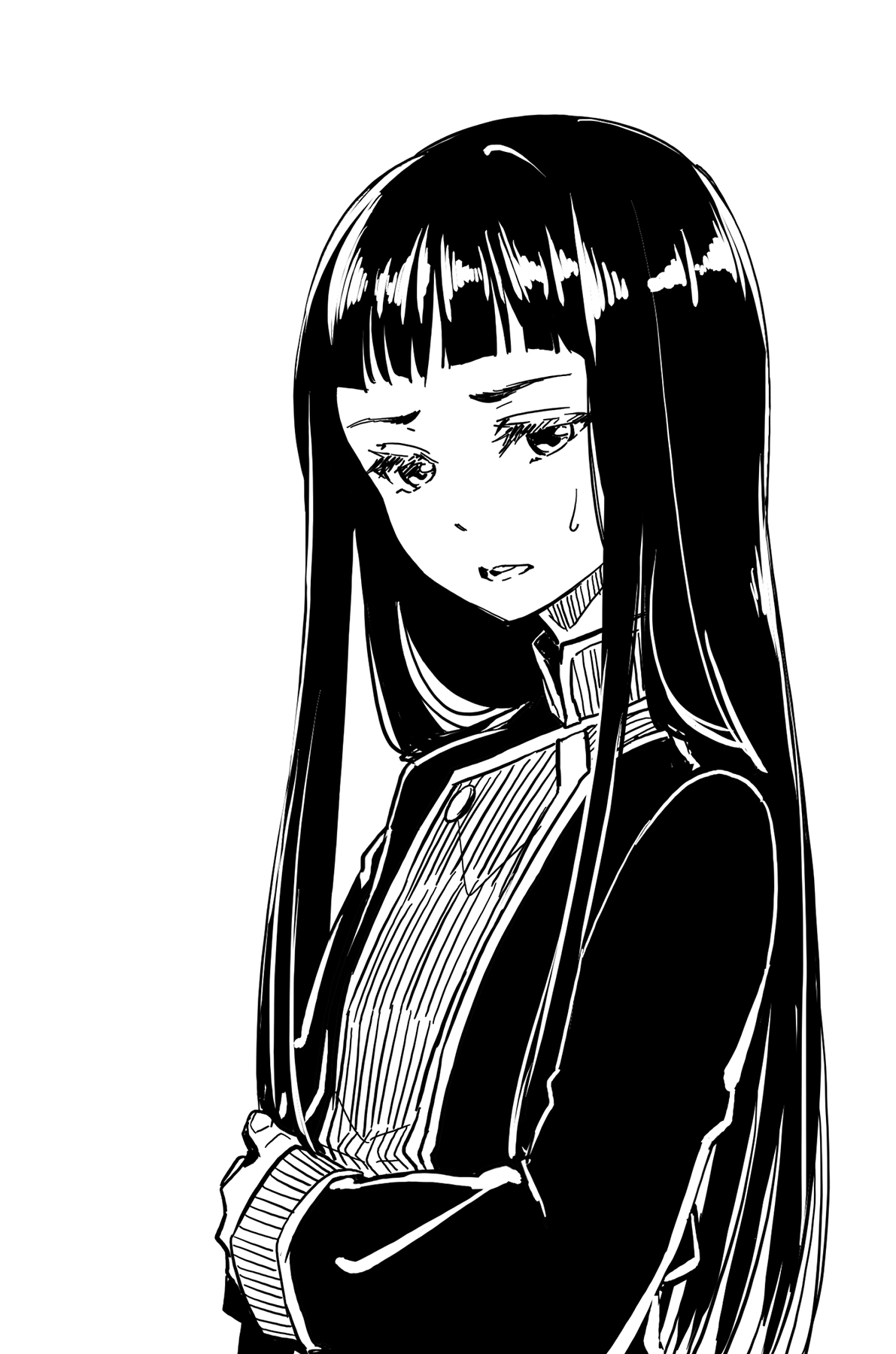
“Look, just saying ‘the Third Division’ like it’s one big group isn’t accurate anymore…” Isotani turned to Muto. “…Do you mind if I explain?”
“Please. In fact, you’d be doing me a favor. There are some things I’m not allowed to tell you myself.”
“Got it.”
I would’ve preferred to hear it from Muto directly, but that might be seen as her leaking confidential information.
Isotani stepping in instead felt like exploiting a loophole, but I realized it was best to keep my mouth shut.
“All right. So the first thing you should know is that, right now, the Third Division is fractured.”
“Oh?”
“There’s the Muroguchi family and the people who want them back in power. In Class A, that’s Obata and Kasahara. The Muroguchi camp makes up about seventy percent of the Third Division’s ranks.”
If I remembered correctly, our class’s number nine was the grandson of General Muroguchi, the former division leader. And number five was loyal to him.
Given the size of the faction, it was probably reasonable to assume that a large portion of it simply wanted to keep away from trouble with the other factions.
“Then there’s the group that wants to rebuild the Third Division without the Muroguchi family. That’s about…twenty percent or so?”
“Sounds about right,” commented Muto.
“Hmm.”
Those would be families from other factions who had ties to the Third Division or were helping with its restructuring. The numbers were small, but since most of the outside supporters would be in that camp, they had a lot of influence.
Thinking about it, it made sense. If external entities were going to back the Third Division anyway, they would want it to be under their own control.
Isotani’s family, along with most of Class A, apparently supported that line of thinking.
“Finally, you’ve got the ‘Forget about family ties right now, we should be chasing military glory’ crowd.”
“Well, that’s something…”
It was hard to say whether it was brave or stupid. From a soldier’s point of view, I guess it was honorable. But politically? Extremely reckless.
“Saori’s family falls in that last group. They don’t meddle in other people’s fights, and they don’t want others meddling in theirs, either. Their stance is to follow whoever comes out on top. That gives them some freedom, since they’re not seen as a threat politically, but it also means they’re kind of isolated. Right?”
“Right,” Muto reluctantly confirmed.
Because her family avoided taking sides, she couldn’t go around telling others what to do.
“I see…”
“I could try voicing some opinions through my family. But if you were to ask me how much that would likely help…”
“It’d be pretty ineffective, yeah,” Isotani said. “Your group’s the one most hungry for military success, after all.”
“…Yes.”
“I see. So that’s how it is…”
From her family’s point of view, what mattered was that someone from the Third Division got results. It didn’t matter who.
That meant they wanted information on the hybrid unit they were hoping to mass-produce, and maybe even on me as the prototype’s pilot. Some of them might well be willing to break into my house to get it.
Given that, what I’d said earlier—that I’d take out anyone who came after me or triggered my traps—had probably come off more as “Set foot near me, and you die.”
That hadn’t been my intention. I just wanted peace and quiet.
But it wasn’t like my choice of words could change the fact that there was real self-interest at play here. If I wasn’t careful, it might end up looking like I had provoked them.
I didn’t think Muto’s family would be the most dangerous. Yikes… I’ll have deal with them first. But how?
This was starting to get too intense for a student like me. I felt like burying my head in my hands.
“Um, I have a suggestion that might help improve the situation. Or rather, a request.”
Just as I was racking my brain over how to persuade Muto’s family, she was the one who spoke up first—and with a favor to ask, no less.
Muto could make my life hell through harassment and pressure if she wanted, without resorting to something as drastic as outright kidnapping. Coming from her of all people, this “request” could only mean one thing.
She’s giving me a favor to call in.
Thank goodness I was classmates with someone so kindhearted.
There was only one way to respond to such a thoughtful offer.
“If there’s anything I can do, I’d be happy to help.”
I couldn’t go around leaking classified information, and honestly, there wasn’t a whole lot I could offer, but I was willing to help out where I was able.
“Then…could you share any kind of trick or technique for operating that mech?”
“Huh?”
She looked so apologetic that I thought she was going to ask for something ridiculous, but that was it?
“Hey!” Isotani snapped.
“I know it’s terribly forward—it’s downright inappropriate of me to ask—but if Keita tells me, then the others wouldn’t have time to bother him anymore… What do you think?”
“Hmm…”
If you couldn’t operate it yourself, it made sense to ask someone who could.
Besides, it wasn’t like my piloting technique was some state secret. In class, we openly discussed and traded thoughts on operating our mechs all the time. I had even explained it to Mogami when he asked, and he’d shared that information with military personnel as well.
The real reason why Muto looked so guilty and Isotani was raising her voice must have been because they thought the mech’s operation was classified.
Maybe if you phrased what I did as “the only way in the world to make that mech work,” then I guess it did sound rather valuable.
Personally, I never had any intention of keeping it secret, though.
Mogami might have been enjoying the Third Division’s quandary, feeling smug that it served them right, but it wasn’t like he actually wanted Japan to lose the war against the monsters.
If more people could pilot the mass-produced versions of his mech, that would just mean I wouldn’t be as important anymore.
By teaching them the ropes, I could gain leverage with the Third Division and the military, and there was a decent chance those mass-produced models would be the ones heading to the front lines instead of me.
Which mattered more, hogging all the glory or staying alive? It was a no-brainer.
Besides, being a glory hound sounded like such a hassle.
In the end, there was only one answer for me to give.
“That’s fine. In fact, I can throw in a few ideas I’ve been working on with the engineers at Mogami Industries. At the very least, if you use those, you won’t have to worry about not being able to get it to move anymore.”
That would make the mech less flexible in other ways, but they could figure that part out on their own.
“You…?” Isotani gawked.
“…Are you sure about this?” Muto asked.
“Yes. Besides, this helps Japan as well.”
“…I’m truly grateful.”
“In return, can I ask you to make sure your people don’t bother me?”
“Of course! I’ll do everything in my power!”
“Perfect. Then we have a deal.”
“…”
Glaring daggers at Muto, Isotani looked like she wanted to say something, but she kept quiet. After all, this deal was between me and Muto. And more importantly, Isotani could hardly argue about it now that I’d said it was for the good of the country.
Just to be clear, I was thinking a few steps ahead here.
The key point was that this deal had been made in the presence of someone who wasn’t affiliated with the Third Division—that is, Isotani. From an outside perspective, it looked like I had only handed over this valuable information to smooth things over and keep the Third Division from retaliating out of spite.
To the Third Division, it would look like some uppity civilian had finally learned his place, which should hopefully ease their frustrations to some extent. Meanwhile, to everyone else, I looked like the poor victim who’d been strong-armed by the Third Division.
That kind of reputation would come in handy for me down the line.
Besides, I was also affected by the mass-produced units being unusable. It was a small price to pay if I thought of it as handing over intelligence I’d already been planning to share in exchange for my safety and future security.
This should do for now. So what should I tell them about first?
Feeling quietly relieved that I had protected both myself and my sister, I began choosing which pieces of information to offer. As I did, I glanced between Muto, who was positively beaming, and Isotani, who hadn’t moved a muscle and looked like she’d bitten into a lemon. Seeing as I was already at it, I figured I might as well share it with her as well.
3
“You used them to gather data. I’ve clearly been underestimating just how devious you are,” Takafumi Mogami muttered after hearing what Keita had generously labeled a report.
“That’s not a very nice way to put it. I only gave them the technology they asked for. You signed off on it, didn’t you?”
“Well, yeah. They took our unit. And on top of that, they got tech we were still debating whether or not to release. We’d better at least get some intel in return, or we’re getting the short end of the stick.”
Keita had called it an “exchange of technology,” but in truth, this was a controlled leak of classified information.
Naturally, leaking anything about the unit required the express permission of Mogami Heavy Industries. Even though Keita had basically just given a few piloting tips, the fact that the information could affect the company’s interests made reporting, consulting, and getting approval an absolute must.
When Keita had initially proposed handing over the techniques, Takafumi had balked.
Unlike Keita, who was still a student and had no interest in military fame, Takafumi was the president of a company. He had a responsibility to maneuver things in such a way that it benefited his business.
Giving away tech for free—especially when safety guarantees were shaky at best—was madness from a business standpoint. Of course Takafumi had pushed back.
That said, the technology required to control the mass-production models was equally valuable to Mogami Heavy Industries, which was working on building a third prototype.
Keita had argued, “Even if the army made them without permission, the mass-produced models still share core systems with ours. If they can collect and return usable data from field tests, isn’t that a good deal?” So Takafumi had agreed, on the condition that any test results be shared with them.
The army, for its part (with the exception of the Third Division), had had no reason to oppose mass-producing units that could take down large-class threats. It also didn’t have any qualms about sharing test data from the mass-produced models with Mogami Heavy Industries.
That same data had also found its way to a bunch of conglomerate-backed firms. That, in turn, had lit a fire under the resident mad-scientist tech teams at those companies—though maybe a little more than anyone had hoped. But that was far outside the jurisdiction of a lone student and a small-company president.
But leaving those sleep-deprived engineers behind for now.
“Look, there it goes.”
On the monitor in front of Keita and Takafumi, the mass-production unit leaped sideways after firing its weapon.
“Well, sure. The real question is what happens next.”
Considering it hadn’t even been able to so much as move before, this was real progress.
Takafumi was already impressed. From his perspective, that leap alone was a win. But Keita, who could already maneuver without any trouble, wasn’t about to let that be the benchmark.
“Maybe you think that’s enough… Oh, it fell over.”
Takafumi chuckled at Keita’s blunt assessment as he watched the unit crash-land.
“A posture control problem? Or fallout from the lighter lower body? What do you think, Mogami?”
“Both. Stability on the bottom’s an issue, for sure, but you can usually compensate a bit with upper-body balance. That one didn’t even try. They’re using the upper body all wrong.”
“Exactly.”
If this had been an actual field test with a real unit, that fall could have meant a dead pilot. Fortunately, they were just watching simulator footage, which gave them the luxury to dissect what had happened without worrying about casualties.
Both Takufumi and Keita came to the same conclusion: pilot error.
“For a first test, though, this isn’t too bad,” Takafumi remarked. “The Command System you came up with did the bare minimum of what we wanted it to.”
“‘Bare minimum’ is right,” Keita murmured.
The Command System—that was the technology Keita had handed over to Saori Muto.
In short, it was a system that performed preset actions when the pilot pressed the corresponding buttons.
Keita himself, with his FromSoft-brain, used this method to control his own hybrid unit. Originally, though, it had come from beast-type models. Those units didn’t carry sidearms or shoulder-mounted weapons, so when a beast-type pilot wanted to shoot, they just imagined pressing a button, and that mental cue pulled the trigger on the gun mounted on the unit’s back.
Based on that, Keita had devised a new system of mental commands: a blue button to make the unit jump left, a red button to make it jump right, and both together to execute a special move. Fixed commands, fixed actions.
For his own unit, he’d added variables. Pressing harder or longer adjusted the speed or hang time, and landings were cushioned by visualizing weight distribution across the joints. But he knew full well that was a personal skill set. He never expected other pilots to match him right from the get-go.
Essentially, this system was meant just to get the thing moving.
Of course, this approach clashed head-on with the established belief that pilots needed to link their nervous systems with the magicite cores to control their mechs. Veteran pilots had pushed back hard. Nonpilots, however, loved it.
And of course they did. For them, whether it was a tank or a fighter jet, you turned the stick, and the machine turned. You pulled the trigger, and it fired a round or missile. That was how weapons worked.
Seen in that light, the ability to give mech units that had been unstable and difficult to operate precise commands like “Move two steps right, shoot forward, then take one step back and shoot again” was a game changer. And since they had functional upper bodies, they could handle tasks like construction or rubble removal as well. Any commander would be thrilled.
Sure, veteran pilots might find the restrictions stifling, but easier coordination with allies was a huge plus.
Of course, once you were fielding multiple units, you would end up with scenes like several four-legged mechs hopping sideways in sync. All it would take was time to refine weapons and tactics to that level of polish.
Probably.
Keita had also proposed a simpler, variant unit that replaced the lower body with tank treads. With that model, the red button would move the mech forward, blue would move it backward, and green would rotate the turret.
There would be no jumping, obviously, but it would simplify movement. Heavier guns could be mounted, and the pilot could focus entirely on aiming and timing. If you let the upper body rotate independently, it would make aiming horizontally that much easier.
The only downsides were that it would basically look like a certain Guntank, and melee combat would be treated as an afterthought.
The last Keita heard, the army was still debating whether to build that version.
In any case, the bottom line was that, thanks to the Command System, even previously immobile units could now perform crude combat maneuvers. That much was a fact.
For Keita, though, the important thing wasn’t that the mass-produced models could move—it was what that movement meant for him.
“You look worried. Something bothering you?” Takafumi asked.
“I was just wondering… Will this be enough to satisfy the Third Division?”
After all, this whole thing had started as a way to appease their jealousy. If they turned around and said, “Sure, it moves, but that’s not good enough!” this entire exercise would have been pointless for Keita.
“Oh, I think it’ll do the trick,” Takafumi replied. “The thing barely moved at all before. Now it’s jumping sideways. They’ll figure it’s just a matter of improving skills from here.”
“Let’s hope so.”
The pilots would be thrown into intensive training, and the mechanical components would need reworking. Combining the control system with other commands, reducing flexibility to boost control—there would be tons of work for pilots, engineers, and officers alike.
Amid all that chaos, who would have time to bother Keita?
That was how Takafumi saw things. But Keita couldn’t shake off a gnawing doubt.
“You’re still feeling anxious, huh?”
“…Yeah. I heard something from someone in the Third Division. The fifth- and ninth-ranked students in class, Kasahara and Obata, have apparently volunteered to pilot the mass-produced units.”
“Oh? Well, I can’t say I’m surprised.”
The Third Division was desperate to rack up military achievements, and the very people who had given them this opportunity were Keita and Takafumi. It was easy enough to guess what Kasahara and Obata had in mind.
If he could do it, maybe we can, too.
If he could take down multiple large-class monsters solo…
If he could achieve glory…
It was little wonder they would think that way. What’s more, it made sense for military commanders to let students test the mass-produced hybrid mechs. Students didn’t have ingrained habits, whereas experienced pilots already had their own units and fighting styles.
The problem was that the students in question were clearly in a rush to prove themselves.
Of course, it was unlikely they would try to interfere with Keita directly, since he was the one who’d provided the technology in the first place. And if they were to plan anything, Saori Muto would likely catch wind of it before anything got off the ground.
That wasn’t what Keita was worried about.
“…Don’t you think they’ll want to take those units into battle as they are now?”
“…Ah. So that’s what it is.”
The recent tests had proven that with the Command System, even the mass-produced models, which had previously been incapable of moving, could now be piloted.
It was obvious what the military’s next move would be—refining the operation of those units and re-creating the firepower and mobility it wanted in the first place. In other words, restoring and testing the second prototype unit.
The problem was, there was a good chance the guys piloting the mechs were thinking, If we can dodge sideways and shoot like Keita, we’re good enough for real-world combat. And if they came to that mistaken conclusion, they’d want to prove it.
If they chose to go into battle of their own free will, it was their own fault if they got themselves killed. It wasn’t Keita’s responsibility. But would the Third Division see it that way? That was the real question. And frankly, it was hard to be optimistic.
If they had that kind of self-restraint, Keita wouldn’t have had to worry about being targeted out of spite in the first place. He could have told Shoko Isotani and Saori Muto his concerns, but they likely would have just laughed at him and told him he was being paranoid.
“There’s a real chance they might do something stupid,” Takafumi answered. “And if they do, you’ll probably have to head into battle, too, as a point of comparison.”
“…I figured.”
“I’m not gonna lie, I’m curious myself. I couldn’t care less about those brats in the Third Division, but I do want to see what your mech can really do. So be ready for it.”
By now, Takafumi understood that Keita’s goal wasn’t fame or promotion but to live a quiet life with his sister. Yet even knowing that, as an engineer and company president, he couldn’t justify letting Unit 1 and its pilot sit on the sidelines.
“Yeah… Guess I’ll hop on the simulator.”
“Good man.”
At least it seemed like he’d managed to avoid the worst-case scenario: being attacked out of petty jealousy. But the next-worst case, being thrown into live combat as part of training, was looking pretty unavoidable.
Faced with that harsh reality, Keita dived back into simulator training to boost his chances of surviving the coming battles.
Interlude: On Demons and Monsters

It had been a few days since someone had come up to Keita to ask him for tips. Each time, he’d hit them with a reply so blunt that even a macho, muscle-bound fire dragon would have been left speechless: “Don’t think. Just push the buttons.”
Now that they had confirmed the mass-produced units could at least clumsily perform combat maneuvers using the Command System, the military had shifted focus, building out simplified command patterns and developing a new operating system. In the past, such systems had always been downplayed because they relied too heavily on the pilot’s own abilities. But not anymore.
Thanks to that, what had started as Press the red button to jump right was expected to evolve into far more complex maneuvers.
That part was fine by Keita. More meat shields…sorry, reliable allies meant less pressure on him.
But reality didn’t care about fairness. For all of Keita’s brilliant ideas, the sheer number of monsters hadn’t changed. Japan was still barely hanging on, fighting to defend its territory. It wasn’t as if better-performing mass-produced units meant he got to sit out the coming battles.
If anything, now that those models were up and running, the message was basically “Good job on those. Now it’s your turn.”
Until now, Takafumi had shielded him by insisting his team needed to check the mech’s growth and condition. But this time, even Takafumi was looking forward to testing it in real combat. As soon as summer break began, there was nothing to stop Keita from being officially deployed back to Kyushu.
The one bit of good news was that his classmates from the Third Division would be too busy training with their own mechs to cause him any trouble, so the chances of Yuna being attacked while he was away were practically zero.
Honestly, that’s the best reward I could ask for.
He really was a simple guy at heart.
Last time, Keita had returned to base immediately after a single skirmish, run a few system checks, submitted a report, and gone back to Tokyo. But this time, they were planning to stay for at least two weeks of military activity.
On the plus side, if I make it through two weeks, I’ll have the rest of summer to relax. I’ve got to survive the first half so I can spend the rest hanging out with Yuna!
Despite their circumstances, the fact was that his sister had been yanked out of her normal life without warning and forced to leave her friends behind. Now, during summer break of all times, she was stuck living alone while her only family member was off at war.
He couldn’t possibly say, “Well, at least she’s safe now, so that’s the only thing that matters,” and actually mean it.
Regardless, blissfully unaware that he was practically waving a death flag with his Once I get back alive, I’m gonna do this and that! attitude, Keita headed off to the monster-infested shores of Kyushu again.
What exactly are monsters, you might ask?
Surprisingly, there’s actually a fair bit known about them thanks to the demon that cooperated with the First Savior Project and a young kid, the linchpin of the Second Savior Project, who quite literally worked themselves to the bone (and then some) to provide information.
Granted, that intel was over a decade old, so there was no guarantee it still held up. But it wasn’t like humanity was completely in the dark, either.
To start with, demonkin were what you got when a human was implanted with some unknown element by a demon, assuming they weren’t completely consumed by it. Physically, they tended to end up with purple-tinged skin, glowing red eyes, and black wings—essentially more or less how people imagined demons to look.
That was no coincidence. Apparently, the person’s subconscious image of demons and demonkin was reflected in the transformation. Unlike monsters, demonkin retained their intelligence and memories from when they were human, and like most people who suddenly gained unprecedented power, they also tended to become incredibly cruel.
In regions under demonic control, humans were treated as both slaves and food. There was no such thing as human rights. Locals were hunted for sport, used as target practice for magic—whatever horrific whims might strike their demon overlords.
In a way, the brutality was similar to what had happened in the Americas or Australia when they were first colonized by Europeans.
But let’s put aside for now how recklessly arrogant demonkin tended to become once they stopped seeing themselves as human.
Unlike demonkin, the monsters they commanded had no intelligence or memories and simply followed the orders of whoever had given them the demonic element with absolute obedience. And if they weren’t given orders, they just wandered around like wild animals.
As mentioned previously, monsters varied in form depending on the concentration of the implanted demonic element and were categorized by size: small, medium, large, and extra-large.
Most monsters couldn’t cross the ocean on their own. However, creatures that were naturally good at swimming could manage it if they tried. Why, then, were they crossing the sea to attack Japan?
Because they’d been ordered to by demons and demonkin.
In which case, what was the motive behind these orders?
Surely, it wasn’t about seizing land or resources. It had been over a century since World War II, and plenty of countries had collapsed since then. The world’s population had dropped dramatically. If the demons wanted land, they could just take over a nearby patch of abandoned territory. There was no need to go all the way across the ocean to take Japan.
So no, their target wasn’t the land or the resources.
It was simply because that was the nature of demons.
More specifically, demons shared a common belief that humans became dangerous when they were too comfortable. So by constantly sending monsters to attack, they were trying to stir up fear, to remind people that nowhere was safe and keep humanity on edge.
They wanted humans to be desperate, with their backs against the wall.
There’s the saying Even a cornered rat will bite a cat. That was precisely what the demons were after.
Unlike demonkin, who enjoyed attacking from a safe distance, demons themselves were obsessed with blood-soaked combat. In a way, they were just like humans; they loved a good, bloody, evenly matched fight.
But for that to happen, the two sides did need to be evenly matched. Which was why the demons were intentionally applying pressure to humanity, especially countries like Japan that were leading the counteroffensive. They wanted humanity to evolve, to sharpen its fangs, so the eventual battle would be worth it.
You might have called them condescending—and that would be accurate.
But they could afford to be condescending because at this point in time, a vast gap still separated humanity and the demonic forces.
Aside from the demons’ overall strategy, demonkin had their own reasons as well.
As mentioned earlier, demonkin had no interest in a fair fight. They preferred to strike from the shadows and crush their enemies without risk. And since most of them had once been humans from the continental nations, they saw Japan as a nation of traitors.
Never mind that it was the continental nations that had cut ties and refused aid. To the demonkin, Japan was supposed to serve them unconditionally. The fact that it didn’t made its people traitors.
That was why they wanted to wipe Japan out—especially now that the country had been developing technology that could potentially destroy them.
Full-scale war, however, was off the table. It was forbidden by their superiors, the demons.
The demonkin found themselves caught in a dilemma. They hated Japan and wanted to see it destroyed, but they couldn’t wage all-out war. And so they came up with a work-around, a plan to keep the country on the ropes and maybe even bring it down eventually without defying the demons.
That plan was simple: Keep attacking. Keep pressuring them constantly.
With Japan forced to fight an endless defensive battle, it was only a matter of time before it burned through its resources and morale. Add to that the internal chaos caused by Symbiosis Faction collaborators—locals who believed peace was possible or just wanted an easy way out—and the country’s ability to resist would crumble.
That part of the plan was working. People were exhausted, and some were so tempted by goods smuggled in from the mainland that they joined the Symbiosis Faction without a second thought.
For now, the military was still holding firm. After all, the collapse of the Third Division had happened overseas, so it hadn’t shaken public confidence in the National Defense Forces just yet.
But how would the military react when the very citizens it was fighting to protect tried to get them to give up?
Would they arrest those protesting the war for dissent?
That was precisely what the demonkin wanted. They would spin the actions of the military as tyrannical.
Would the government ignore the public outcry and double down on the fight against the demonic forces?
The demonkin would be happy with that, too. They would openly mock Japan for prolonging a war its own people were against.
Once the military was in ruins, the demonkin would show the citizens who were so proud of sabotaging their own defenders what life under their rule truly meant.
No matter how it played out, Japan would lose. That was why the demonkin were willing to tolerate the demons’ frustrating command not to go all in.
Of course, that order only applied to full-scale offensives. The current ongoing raids weren’t about to stop anytime soon.
Even if Japan’s National Defense Forces cracked under the pressure, even if Kyushu or the Chugoku region were to fall, the demonkin wouldn’t let up. They would tell their demon superiors, “See? We told you Japan would crumble if we just kept poking.”
But they were in for a rude awakening.
Because soon, they would come face-to-face with the Japanese military’s newest weapon—something that would leave even veteran pilots staring in stunned disbelief, wondering, What the hell is that?
Even the demons, experts on weapons and magicite cores, would be left scratching their heads asking themselves, “How did this happen?” and saying, “I don’t understand.”
It was a nightmare of a machine—humanoid upper body, arachnid lower body—equal parts alien and grotesque, triggering revulsion in friends and foes alike.
The day was close at hand when the world would come to know the name the Black Deviant.
Chapter 6: An Unexpected Offensive

1
There were several reasons why monsters were constantly attacking Japan, but there was one more that had yet to be explained.
What was it? To put it bluntly, population control.
Monsters needed to eat, too. While some could farm fields and such if ordered to do so, very few demonkin actually knew anything about agriculture, fishing, or livestock—or anything involving food production, in fact. More importantly, demonkin weren’t the patient, hardworking type. They hated slow, tedious tasks.
As such, they enslaved the populations of the lands they conquered and forced them to work in the primary industries.
But no matter how much land and how many resources they might have, neither were infinite.
On top of that, smaller monsters acted a lot like wild animals. They could reproduce at an alarming rate.
They were also omnivores that would pick at the crops humans grew—or worse, pick at the humans themselves.
Technically, small monsters served as food for the medium and large ones, so in that sense, they did contribute to the food chain. But to the demonkin—who had human preferences due to their humanlike intelligence—they were nothing more than dumb pets, constantly hungry but of little combat value.
The same went for the medium and large monsters. They also had to eat, and the bigger they were, the more they consumed.
They might have been a force to be reckoned with, but it was tough to maintain a menagerie of large monsters when each one required dozens of tons of food each day.
As such, the demonkin picked the weakest and most inefficient monsters, who consumed too much for what little value they offered, and sent them into battle.
If they drowned on the way over, so be it. But if they managed to swim across the sea and reach Japan, the National Defense Forces would be forced to respond and burn through supplies. And if the monsters managed to take out a few soldiers, then all the better.
Of course, the monsters didn’t know any of this. They just swam as hard as they could. And if there was an enemy waiting for them when they landed, they also fought as hard as they could.
Since the ones that made landfall were eliminated, there were never any survivors left to pass on what they learned. The demonkin didn’t expect them to return, either, so their behavior and tactics never changed.
The monsters always came on land the same way, fought the same way, and died the same way.
That was their fate.
…Until one day, when a newly born demonkin voiced a simple question about the monster hordes preparing to cross the sea.
“Why do they all swim alone? Isn’t that why so many drown? Wouldn’t it make more sense for the big ones to swim slowly, while the medium and small ones ride on their backs or get towed along to save their strength?”
It wasn’t an order, but the suggestion had come from a higher-ranking demonkin. And more importantly, something in the monsters’ instincts clicked. They understood that this plan would help them stay alive and carry out their mission more effectively.
The monsters may not have had intelligence, but deep down, something inside them was screaming, I don’t want to die for nothing. I want to fight like I was ordered to.
From that point on, tank-style transportation tactics—previously a tactic only used by the extra-large monsters—began to spread among the large class as well.
They were like migratory birds flying in formation to manipulate air currents and reduce fatigue.
And what was the result when the invading monsters adopted this simple yet devastatingly effective new mode of travel?
The answer would be revealed just a few days later—when Japan’s Second Division, holding the defensive line across the sea, found out the hard way.
“Impossible! There are too many of them!”
The voice came from somewhere within headquarters, three days after Keita’s arrival in Kyushu. They had just finished their final checks on deployment and weapons, and everything was in place, ready to engage the oncoming wave of monsters.
Since demons had been summoned during World War II, humanity had never developed a surveillance network using satellites—something Keita had taken for granted during his previous life. Instead, monitoring relied heavily on radar from ground-based towers and patrol ships.
And the ratio of boats to towers was about one to nine.
Ideally, the military would have liked to set up proper patrols using multiple ships and trained spotters, but there was a major problem standing in the way. If monsters attacked at sea, the crews would almost certainly be killed after just one or two missions. That risk made it hard to justify sending too many manned patrol ships.
Instead, they placed disposable radar units at key locations and relied on tracking which ones were destroyed, and the ETA and direction of any monster incursions.
The downside to this method was that they couldn’t pinpoint exactly where or when the monsters would land—or how many of them there would be.
Because of that, forces only started moving to intercept once a radar unit was knocked out, heading toward the assumed landing site. They had to finish deploying and preparing for battle before the enemy arrived. It was only then that they finally got a sense of the actual enemy numbers, so it was taken as a given that the monster head count would come in late.
What was more, the detection range of the large-scale radar towers used to scan from land was about three hundred kilometers. That wide net also contributed to miscounts.
It took monsters close to a full day to swim from the mainland, and the military always assumed a decent number of them would drown en route, with expected survival rates calculated based on past encounters.
Naturally, if the sea was calm, fewer would drown, meaning it wasn’t unusual to end up with more monsters than expected making it to shore.
All of this went to say that an experienced commander wouldn’t normally raise their voice just because there were more monsters than initially predicted.
But this wasn’t a normal situation.
“How can there be so many of them?! What’s going on out there?!” Colonel Yuhei Shibano, commanding the interception force, shouted as he stared at the monstrous horde now visible to the naked eye.
He’d understood, of course, that the numbers would fluctuate. That was simply part of the job.
What he couldn’t wrap his head around, however, was that the numbers hadn’t only gone up slightly—they’d exploded. More than that, they had grown even since radar last picked them up.
“I get it if the numbers drop! But why the hell are they going up?!”
The initial radar scans had estimated fifteen large, sixty-two medium, and just under two hundred small monsters—a total of about three hundred.
Even that was the largest force the Second Division had ever seen.
As such, Shibano had already called for reinforcements from nearby units, recalled soldiers who’d been scheduled for leave, and even mobilized prototype weapons that had originally been intended to remain in testing.
He’d scraped together everything he could.
The resulting interception force included twenty standard-type mechs, forty beast types, and around a hundred gunners—troops specialized in using mech artillery.
In terms of conventional forces, they had four hundred tanks and a combined four thousand infantry and artillery troops, which amounted to 50 percent of the Second Division’s total strength. Practically all their mech pilots had been deployed.
That might have seemed like a small number of mechs, but the truth was, that branch of the military was extremely hard to scale up.
Thanks to the Second Savior Project, Japan had boosted its supply of magicite crystals and mech-compatible soldiers—but even so, enrollment at the military academy that Keita attended hovered at around one hundred new students each year.
The Second Savior Project had started fifty years ago, and the First Counteroffensive, which had occurred once a critical mass of personnel had been trained, had only been launched thirty years ago. One hundred soldiers per year for thirty years amounted to three thousand potential pilots. Of those, only about 30 percent were compatible with standard- or beast-type mechs—so roughly nine hundred pilots. The other twenty-one hundred became gunners.
Of course, there were some noncommissioned officers who had never gone to the military academy but still had high magicite compatibility ratings, so the number of pilots and gunners had risen slightly over time. But even with that, the yearly increase never exceeded thirty people. That was the harsh reality.
The pilots and gunners were distributed across the nine divisions, making for around one hundred pilots and two hundred thirty gunners per division.
The Second Division, tasked with defending Kyushu and the Chugoku region, had been allocated more manpower than most. Still, many of the newer pilots had been prioritized for the expeditionary forces—the Third, Fourth, and Fifth Divisions. Factor in retirees, injuries, and combat losses, and the actual number currently deployed in the Second Division was just seventy mech pilots and one hundred and thirty gunners.
All of that was to say that deploying sixty pilots and a hundred gunners for this mission was essentially scraping the bottom of the barrel. That was the largest force they could muster without compromising their ability to respond if more monsters landed somewhere else.
Even so, a force this large would still have a tough time going up against fifteen large-class and sixty-two medium-class enemies.
We can probably win…but not without taking heavy losses among the pilots and gunners.
It wasn’t just Shibano who’d come to that conclusion, but the Second Division’s entire command staff.
Yet as the monsters started coming ashore, all the officers—especially Shibano—were hit with the crushing realization that they had grossly miscalculated.
According to the spotters equipped with long-distance binoculars, the forces coming ashore were far greater than expected. There were ten large, one hundred and thirty-three medium, and over five hundred small enemies.
“How?!”
The number of large-class monsters had gone down, that was true—but everything else had nearly doubled.
It was an unprecedented catastrophe.
“How the hell did we miss this?!”
A swarm of over a hundred medium-class monsters? That kind of thing only ever happened to the Fourth and Fifth Divisions operating on the mainland—and even then, only very rarely. In the event of such a disaster, their forces usually worked alongside local ones. A horde of this scale wasn’t the kind of thing a single division should be dealing with on its own.
And now reports were coming in that several of the large monsters were thirty-meter class—the biggest they got.
“There definitely weren’t this many when we scanned them with radar. And it wasn’t just one radar, either. Multiple radars from multiple angles confirmed the count. There’s no way it should be this wrong. And these thirty-meter ones… I’ve never seen them before. And suddenly, we’re up against more than one? There’s no doubt about it. Demons or demonkin are behind this!”
Shibano desperately tried to make sense of it. If the radar systems weren’t malfunctioning, the most logical conclusion was that demons or demonkin had used some kind of interference to throw off their readings.
But his guess was off the mark.
The real answer was much simpler. The additional medium and small types weren’t some elaborate deception; they just hadn’t been counted because they were riding on top of the large monsters or clustered so closely behind them that the radars mistook the whole mass for a single creature.
As for the sudden appearance of the thirty-meter large-class monsters, that wasn’t some new tactic. Normally, enormous beasts like those used up too much energy while swimming and drowned before they could reach shore. This time, however, the monsters had swum in a coordinated way that conserved their strength, allowing even the largest among them to survive the journey.
“Colonel!”
“Tch!”
Whatever the reason, there were monsters in front of them, and that meant Shibano had to make a choice.
Fight or retreat.
What do I do? What can I do?!
Colonel Shibano, commander of the interception force, was faced with a stark decision.
2
If we fight, can we win? …No.
Shibano ran a simulation in his head. He imagined the moment his deployed units launched an opening barrage—and then in the very next breath, those enemies that had survived the volley returning fire. With a single counterattack from the enemy’s medium-class monsters, the majority of his gunners and artillerymen would be wiped out.
The mechs that the gunners used lacked both armor and mobility. They were built for one thing and one thing only: offense.
Even then, they didn’t have the kind of firepower that could take down a medium-class monster in a single hit. It took several well-placed shots to defeat just one.
This meant that even in a normal battle, any monsters that survived the opening salvo often managed to counterattack, blasting the gunners to oblivion before they could reload.
That was why the Second Division always fielded more gunners than the enemy had monsters, spreading them out in a wide formation and ordering them to fire all at once. The goal was to kill the enemy before they could shoot back. Failing that, they at least tried to scatter the return fire so no one point took the brunt of it.
Today, though, they were outnumbered.
There was no way they could avoid a counterattack.
This isn’t going to be a proper barrage…
Every sniper and artilleryman knew that when you had cover—either natural or armored—you could line up your shot calmly and safely. Out in the open, naked to enemy fire, your accuracy plummeted.
The same went for gunners in fire-support mechs, too.
Even under halfway decent conditions, these units are known for their firepower and poor accuracy. And now I’m supposed to believe they’ll perform well in a situation where they’re bound to get hit back? That’s just wishful thinking.
Shibano trusted his subordinates, as a commander should, but he wasn’t the type to rely on blind faith. He knew the difference between grit and delusion, which was also why he knew that if they engaged now, they would be pointlessly slaughtered.
He wasn’t alone. The mech pilots and gunners who’d scouted the field, as well as the tank crews and infantry who had followed them, all understood the same thing.
If we can’t win, we have to retreat.
His rational side accepted that.
But knowing it and actually doing it were two very different things.
Retreat, sure. But retreat without firing a single shot?
Shibano wasn’t worried about being dragged before a court-martial for desertion. His superiors in the Second Division understood that sometimes, withdrawing to regroup was the smartest move. Strategy over pride.
What he was concerned about was getting everyone out alive.
“Of all strategies, the best is to flee,” Sun Tzu writes in The Art of War. But retreat was one of the hardest maneuvers in warfare—especially when the enemy already had their sights set on you.
Monsters usually have good eyesight. If we can see them, they can damn well see us.
Wishful thinking had no place here. His rational mind kept screaming that.
Turn the formation around and retreat? They’d start shooting before we even moved. Maintain formation under fire? Impossible—the linewould break. And if the small monsters charge while we’re in disarray, it’ll be all over. I want to get the mechs and pilots out safely, at least, but at this rate…
When you hear monsters described as “small class,” you might think they were just cannon fodder—but that wasn’t the case. Even the smaller beasts were still between one to three meters tall. True, they weren’t deadly going up against a trained pilot in a mech one-on-one, and even regular weapons could take them down. The tanks could handle them, too, with some losses.
But that was if you were fighting them with equal numbers. Maybe even one against three.
If five hundred of them swarmed you all at once, not even a veteran pilot would last long. And mechs, being as large and conspicuous as they were, made for prime targets. It was crazy to think you could outrun them without taking damage.
…We need a rear guard.
After his many calculations, Shibano came to a harsh conclusion: They had to retreat. And to do that, they would need a suicide squad to hold the line.
The only ones suitable for that job were the tank and infantry units armed with conventional weapons. However, he wasn’t about to order them to their deaths while he fled to safety. He would stay behind and lead them himself.
Regular weapons can’t penetrate the mana fields of medium- and large-class monsters, so we won’t be able to take them down. But if we can manage to kill enough of the small ones, we should be able to keep casualties to a minimum. We need to call for reinforcements from the other divisions now—the Sixth and Eighth are already on standby to support us. If they prep while we hold the line, we should be able to push them back. But it all depends on how long I can stall the enemy…
That was Colonel Yuhei Shibano. If charging into enemy lines wearing nothing but his underwear stuffed with dynamite could buy his allies five more minutes, then that was what he would do.
“All right. Put me through to the entire army.”
Die with me. For our country’s future.
He was about to send his already demoralized troops straight into hell.
He didn’t want to kill them. He didn’t want them to die. But they had to. He accepted that.
Just as he opened his mouth to issue the order—
“This is Special Ensign Kawakami of Task Unit 2099. Commencing operation on schedule.”
“…What?”
Everyone in the command center, Shibano included, stared in disbelief.
The soldiers in the field were under Shibano’s command. None of them would fire without his explicit orders.
Under normal circumstances, it wouldn’t have been surprising if someone had cracked under pressure and opened fire early, but the resilience and discipline shown by the Second Division was remarkable.
And now, out of nowhere, someone had unilaterally declared an intent to launch an operation.
Anyone here would have been left speechless, not just Shibano.
Who was it who had issued the directive in violation of his orders?
“Task Unit 2099?”
“That’s a training school code. We haven’t deployed any cadets to the field yet…”
“…It’s the prototype. That one.”
“You’re kidding!”
“A cadet disobeyed orders?!”
“The fear must’ve gotten to him!”
The command staff couldn’t be blamed for assuming that. If even the elite soldiers of the Second Division were struggling to keep it together, how could a mere student hold his nerve? But they were wrong.
“…No. Listen to what he said. Commencing operation on schedule.”
“…Ah!”
Keita, a cadet with Task Unit 2099, was technically under Shibano’s command—but his direct superior was the division commander himself. Meaning that if he fired at the designated time, even without a specific order from Shibano, he wasn’t disobeying orders. In fact, not acting on schedule would have been disobedience.
And so, Keita had done what he had to. No matter how scared he was, no matter how hopeless things looked, orders were orders.
If anyone wanted to countermand them, Shibano should have issued new orders in time. But he hadn’t.
Keita was only following protocol, while the rest of the command staff were too stunned to speak.
“What have I done…?”
He should have been protecting this boy, yet his inaction had just gotten him killed.
And he wouldn’t be the only one. Because Shibano hadn’t given the go-ahead to fight or fall back, the rest of the troops were sitting ducks.
It’s all my fault… I should’ve given the order immediately!
Shibano was prepared to die—but only if it meant saving his men. Not like this. He couldn’t let their lives go to waste.
“…Then we’ve got no choice! Let’s take out as many as we can!”
They would suffer massive losses. His hesitation would cost them dearly. But it didn’t matter anymore.
“We’re the elite Second Division, the shield of the nation! We won’t cower behind a child we were meant to protect!”
“Yes, sir!”
As soldiers—as adults—they had a duty to protect him.
If they were going to die, they would do so with purpose.
Shibano had just resolved to give the order when the officers at the command post witnessed something that defied all common sense.
“All units, prepare to— Wait! Thirty-meter-class monster down…? What?!”
“It was the special ensign! The prototype took out a large with a single sniper shot! Wait, another one’s down—twenty-meter class!”
“Huh?”
“After the shot, he dodged the counterfire midair, then returned fire while dodging! After he landed, he shot at them again! He’s still going, jumping back and landing shots! A thirty-meter- and a twenty-five-meter-class monster are both down!”
“What?!”
“Another twenty-five-meter down!”
“…That’s some scary fast shooting…”
“He’s sniping their counterattacks.”
“The enemy can’t hit him! He just accelerated mid-jump!”
“How?!”
“Looks like he’s using an anchor to whip the mech around!”
“Another shot!”
“The monsters are in the middle of attacking, so they can’t dodge or defend. He’s exploiting that opening.”
“Even a large can’t survive a mana-filled, thermite penetrating shell to the head from a 120mm smoothbore cannon.”
“I understand the theory. I just don’t believe it.”
“Twenty-meter class down!”
He’s strong…but more than that, he hasn’t given up, even in this hopeless situation. He’s fighting to win!
“One thirty-meter- and one twenty-meter-class monster both down! Only two ten-meter monsters left of the large class!”
“Just the ten-meter ones? Ah, I see. He’s been prioritizing the biggest targets first.”
It went without saying, but within the large-class category, a ten-meter and a thirty-meter monster were worlds apart. Just as in nature, the principle that more weight equaled more strength applied to monsters as well.
Anyone facing a thirty-meter beast would expect to die. Even Shibano. That was how formidable they were.
And now they were all dead.
The troops were no doubt paralyzed by the mere thought of those thirty-meter behemoths counterattacking—but thanks to the boy, that fear’s gone.
The ten-meter-class monsters certainly weren’t easy pickings, but at least the gunners and artillerymen had experience fighting enemies of that size. They should know how to deal with them.
But if that sniper had already wiped out the larger ones, these two were practically cleanup.
And sure enough…
“Both ten-meter-class monsters down!”
I knew it.
Shibano had to stifle a laugh as the report sounded throughout the room.
“Ten large-class monsters in under ten minutes…”
“Not a scratch. Used up some ammo and probably warped the barrel, but that’s it.”
“What a machine…”
“No, it’s not just the mech. It’s that pilot, too.”
“Right. Only a top-tier pilot in a top-tier mech could’ve pulled that off.”
This battle has done wonders for morale. I understand how they feel. In fact, I’m probably the one most fired up. As a commander, you’re supposed to stay calm at all times—but just this once, I can’t help it!
“…We can win this. I’m not the only one thinking that, am I?”
“No, Colonel!”
The heavy air that had hung over the command center just moments ago had completely lifted.
“That kid—no, the special ensign—took out the large-class threats. He’s probably already moving on to the mediums. And what are we doing? Standing by and watching?”
“No way!”
“Not happening!”
“Let’s go!”
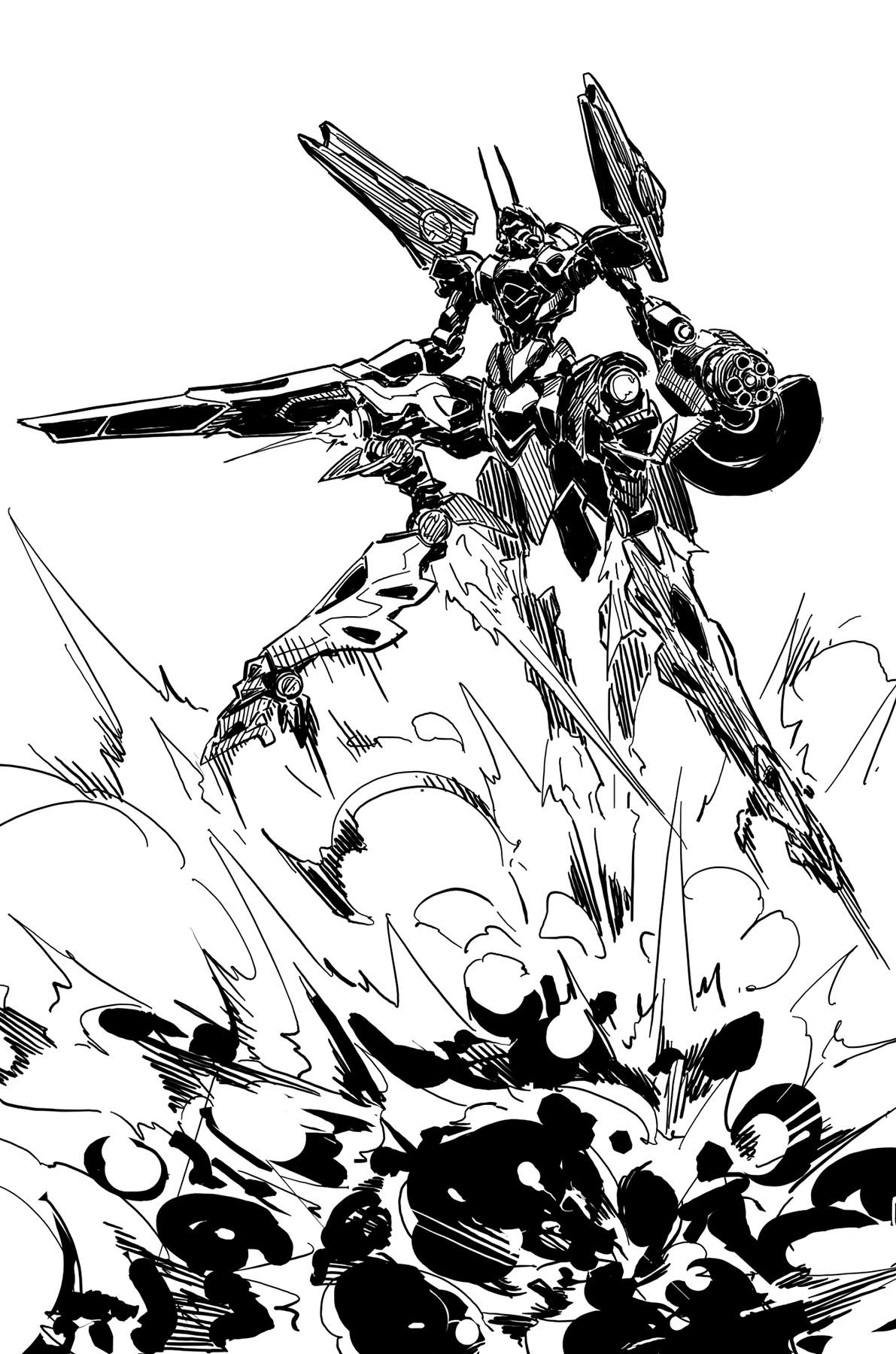
“We’ve seen what he can do. Now it’s time for the Second Division to show our strength!”
“Well said! I know the rest of the frontline troops feel the same!”
“Certainly, sir!”
“Transmit to all units—prepare for assault!”
“Yes, sir!”
Mere minutes earlier, Shibano and the Second Division had been prepared to fall back, sacrificing a rear guard to save the rest of their forces. Now they were charging headlong into a full-scale counterattack.
And just like that, a large-scale counteroffensive—one that no human or demonkin had expected—entered a new phase.
3
A short time earlier.
“M-Major…”
“Yeah. This is impossible.”
The expressions on the pilots’ faces twisted in fear as they watched an unexpectedly large number of monsters try to make landfall. They seemed even more scared than Shibano and the other leaders back at the command center.
Of course they would be. Unlike Shibano—who, as a commander, only rarely came face-to-face with monsters—these pilots fought them firsthand. They understood better than anyone just how terrifying these creatures were.
According to the standard thinking of mech pilots, medium-class monsters were weaker than large ones. The general staff’s combat strength estimate held that one twenty-meter large-class monster was equivalent to ten six-meter medium-class ones.
But ask any pilot with real combat experience which was more terrifying—one large or ten mediums—and they would answer the latter with no hesitation.
Numbers mattered in battle. Numbers were power. That was a simple truth.
For context, the usual kill-to-loss ratio against medium-class monsters was two to one for standard-type mechs and one to two for beast types.
Simply put, one standard-type mech could take down two medium-class monsters, while two beast types could handle one. But looking at that the other way round, it meant that two mediums could take out a single standard type, and one medium could take out two beast types.
Now, take a look at the current situation: one hundred and thirty-three medium-class monsters. Meanwhile, the interception force comprised only twenty standard-type mechs and forty beast types.
Going by the numbers, those twenty standard types could take out forty monsters. The forty beast types could handle twenty. In total, that might be sixty monsters eliminated.
That wasn’t even enough to deal with the sixty-two monsters they had initially been expecting. With several ace pilots and nearly a hundred gunners providing support, they reasoned that might be enough to scrape by, even with a couple of larges thrown into the mix.
But that was before they’d seen how many had actually reached land.
“Ten large and over a hundred mediums…? We’re screwed.”
You didn’t need to know Lanchester’s square law to understand that the initial difference in numbers translated directly into survival odds.
In other words, if sixty mechs went up against sixty-two monsters, it would be a close battle with casualties on both sides. But sixty mechs against one hundred and thirty-three monsters? That was a massacre waiting to happen.
Pile the large-class monsters on top of that, and it was hopeless.
Of course, depending on how they fought, their individual skills, and how well they coordinated, they could inflict some serious damage. But even in the best-case scenario, their intercepting force wouldn’t be able to avoid significant losses.
And if that happened, this battle aside, they wouldn’t be able to mount another similar defense.
…We’re going to have to retreat and leave the tank squads to cover the rear. Which means Colonel Shibano will no doubt stay behind, too.
That was the conclusion Major Yasuaki Sato, commander of the pilot corps, reached after tracing Shibano’s likely line of thought.
If you were outnumbered and couldn’t hope to win, or if you would take unacceptable losses, then all you could do was fall back, regroup, and fight back later. The Second Division alone couldn’t pull that off, but if they brought in help from the other divisions, it was doable. Which meant Shibano’s likely plan was: “Even if we’re wiped out, at least get the pilots and mechs who’ll form the core of the counterattack out of here alive.”
I won’t let his resolve go to waste!
He understood what Shibano must have been thinking: No matter what happens, make sure you get out of here. That was why Sato was already preparing to order a retreat—quietly, without drawing attention. But until the order officially came down from HQ, he couldn’t make a move.
If taking the fall for disobeying orders meant he could save even one more soldier, then he was willing to bear the dishonor of desertion. But there was a time and place for everything.
In this case, if the pilots pulled back too soon, the rear guard left to cover them might panic. And if that happened, the whole force could get wiped out, rear guard and all.
So Sato waited.
For when the rear guard was ready to die to protect the others.
For when the pilots were ready to live with the guilt of abandoning their comrades.
Not yet. Not yet…
“Major!”
“What?!”
It was Captain Kiyota, his second-in-command, who snapped Sato out of his anxious daze.
“Over there! Look!”
“Where…? What the—?!”
Sato turned to where Kiyota was pointing…and saw a four-legged mech firing what looked like a tank cannon from its right arm straight into the advancing monsters.
“Graaah!”
The shell flew in a straight line and slammed into the skull of a ten-meter-class monster. No matter how big one of those creatures was, take out the head, and it was dead. That one wasn’t getting back up.
“One shot? No—wait! Whose squad is that thing with?!”
Sato was stunned by the one-hit kill, but more than that, he realized the pilot had just disobeyed orders. He’d immediately demanded the unit’s affiliation.
Sato was the on-site commander. If the pilot claimed something like “We were ordered to shoot, but the CO froze up,” he could probably overlook it. But as far as HQ was concerned, the current standing order was to wait for the signal and then for all units to fire simultaneously. No matter the excuse, soldiers didn’t get to launch attacks on their own.
Sato was seething with anger until a voice from HQ cut through the tension.
“Message from HQ to all units.”
Here it comes!
“All forces, prepare for combat. Tank squads and gunners, fire on my signal. Pilots, prepare shields to protect the artillery during the counterattack.”
“Huh?”
Wait—this isn’t a retreat? What are they thinking?!
“I’m sure you all saw it! While we’re cowering at the monsters’ sheer numbers, a student—a cadet!—just charged into the fray and took the lead!”
A student…? What are they talking about?
“Major, could that mech be the new prototype they brought in for testing?”
“Prototype? You mean the one that supposedly took down four large-class monsters solo?”
“That’s the one. Rumor has it that it can only be operated by a student who enrolled just this year. It’s a weird design—beast-type legs with a standard-type torso.”
“That thing out there? It’s on a whole different level.”
Sure, it had four legs, but it didn’t have the organic smoothness of a beast-type mech. It looked more like a spider built out of cold machinery. The standard-type torso mounted on it just made it appear even more unnatural.
“What is that?”
“Graaaah!”
As Sato and Kiyota talked, that outlandish mech kept bounding across the battlefield, sniping monster after monster.
“Gyagh!”
“I ask you, can you really turn your back and run while a child fights in your place? I certainly can’t!”
One shot, one kill—well, sometimes two shots—but either way, it kept calmly and cleanly dropping monsters like some grotesque executioner.
“Major!”
“R-right!”
Whatever it looked like, it was definitely on their side.
And piloting it was a student from the academy. A kid.
Once that fact clicked into place, Sato finally understood what Shibano was feeling.
Strategic retreat?
Pull back and fight another day?
Leave a child fighting alone out there?
If he did that, could he really call himself a soldier?
Could he maintain his pride as a mech pilot?
“You’re right. Dammit, you’re right!”
If Shibano hadn’t seen this coming, then the kid’s actions must have caught him off guard, too.
And judging by how that thing moved, it wasn’t panic or fear driving the kid to disobey orders.
No—those were the movements of someone with absolute conviction.
That special kind of certainty only top aces had that said, “I’m not dying out here.”
“Skreee!”
If the monsters tried to shoot, they’d die. If they tried to retaliate, their opponent would already be gone. That thing was hopping around the battlefield taking lives like a grim reaper.
“All units, prepare for combat! Don’t let that student fight alone! Show them what we veterans can do!”
“Yes, sir!”
“Garoh!”
“But no freestyling! Hold your positions until I give the order!”
“Understood, sir!”
If they interfered recklessly, they would just throw off the student’s rhythm. That was why Sato waited for HQ to give the order to attack.
Steady… Steady!
“Bomph!”
Wait! Not yet!
Watching the new prototype slice through the enemy ranks, Sato no longer looked like a man drowning in fear. Now he was barely restraining the burning desire to leap into battle himself.
Chapter 7: Boy of Destiny

1
Needless to say, Keita’s actions weren’t born out of some grim sense of duty like Shibano assumed, nor had he lost control after fear got the better of him.
He’d done it simply because it was the scheduled time for the operation to begin.
“Target confirmed. Moving to eliminate!”
“Bweh!”
For one thing, Keita had just entered the military academy, so he had no clue how many monsters usually showed up during an assault. So even when more than ten large and over a hundred medium-class enemies had appeared, he’d simply thought that was the norm.
If anything, his half-baked knowledge of mech anime led him to think, Compared with the thousands of alien enemies you get in those shows—millions, sometimes—this is nothing.
“Talk about spoiled for choice.”
“Brp!”
Of course, he understood that being outnumbered was dangerous. If HQ had actually ordered him to wipe them all out solo, he probably would have screamed, “Screw that!” and fired a warning shot at the command center.
But right now, there were sixty mech pilots, over a hundred gunners, hundreds of tanks, and thousands of troops. They had more on their side than the enemy did.
What was there to be afraid of?
“Don’t worry, I’ll make it quick!”
“Bwam!”
He did find it odd that, even though the briefing said the others would open with a synchronized barrage before he advanced, no one else was moving. But he figured they must have been prioritizing his test run.
“Doo-doo-doo!”
“Wraaah!”
And if he was the priority, then he might as well focus on the test.
So Keita darted side to side, launching an assault on the monsters.
“No way this latest model’s going to lose! Let’s gooooo!”
“Kadoom!”
Naturally, he targeted the biggest ones first. After all, the whole point of the hybrid unit he was piloting was to take down large-class monsters solo. That was what it was built for, so it would be rude not to use it for that.
So he fired and fired and fired.
“Come and get some!”
“Dwooh!”
The biggest of the large-class monsters were, unsurprisingly, incredibly tough.
They were covered in muscle just to support their massive size—and that wasn’t even taking into account that they were enhanced with mana. Add to that their constant mana field and their firepower, which was capable of vaporizing a mech or tank in one hit, and it was obvious they were no joke.
“You bastards don’t deserve to see another day!”
“Mrrgh!”
They shouldn’t have been easy. But Keita was mowing them down like it was nothing.
Statistically, there was no way he should have been able to dominate like this. And yet he remained untouched while systematically hunting down the large-class monsters.
How? Simple—he and his mech had been growing stronger, and the monsters hadn’t.
“Your aim’s off!”
“Kabrah!”
After the last battle, Keita had trained more in the simulator to get used to the hybrid unit.
And the mech was always stored in his magicite core except during maintenance, so it had been continuously optimizing itself to respond more precisely to his commands.
As a result, its recoil absorption during firing, its landing stability, its shock dampening, and even its aerial control had all improved.
The monsters, though?
Sure, their return fire was fast and accurate. But that was it.
“Good aim. Too bad it’s predictable!”
“Hngh!”
Their shots didn’t track or home in on him; so as long as he moved the moment they fired, he could dodge everything. And since they only attacked after visually confirming their target, they couldn’t react to sudden changes in direction.
Plus, since the monsters lacked any real intelligence, they couldn’t anticipate where their opponent would be with their shots or lay traps. That meant Keita, who was constantly moving midair while firing, was essentially untouchable.
The only real threat was the sheer number of mid-sized monsters. Their suppressive fire might have posed a problem, but even that was failing under the current conditions.
Because Keita was prioritizing the large monsters and wiping them out one by one.
To the mid-sized and small-sized monsters, it was like towering thirty-meter buildings were collapsing right beside them. Sniping was the least of their concerns.
If they were as big as the ones being taken down, they might have been able to ignore the friendly fire and go on fighting. In fact, the larger ones were retaliating against Keita.
But the fact that they were large enough to avoid friendly fire also meant they were easy to see and even easier to hit.
“And you’re the last of the big guys!”
“Dwaoh!”
“Gotcha!”
Ten large-class monsters, each said to be worth ten mediums, were wiped out in under ten minutes.
“Next.”
But Keita wasn’t done. There were still countless mediums and smalls left.
“Hmm. The large monsters’ corpses are making for some nice cover and obstacles.”
The monsters’ ranged attacks were mostly laser-like, straight-line shots. So unless the remaining mediums maneuvered around the corpses, they wouldn’t be able to draw a bead on Keita.
Of course, the same applied to him. He could aim at the large ones because they stood out, but the mediums were all under ten meters tall.
It seemed like his onslaught might be over…but that was assuming Keita could only fire in a straight line.
“This is all part of the plan!”
His hybrid unit wasn’t just armed with a 120mm smoothbore cannon for direct fire—it also had a howitzer for indirect fire.
By design, the howitzer was just a backup weapon meant for thinning out mid-sized and small-sized monsters. But either the engineers had rethought their strategy after it had overperformed in his debut, or the mech itself had leveled up enough from that battle to carry something heavier. In the process, things had gotten a little carried away.
Now the gun prepared by Mogami Heavy Industries was a full-on 155mm heavy howitzer. (For comparison, last time, it had been a “light” 80mm howitzer.)
“I won’t stop firing until the barrel melts!”
The previous howitzer was strong enough to take down mediums. But not only was the caliber bigger on this one, the amount of mana packed into each shell was also on an entirely different level.
The firepower raining down on the monsters, which clustered among the corpses of their larger brethren, was nothing short of catastrophic.
“Time to wipe this place clean of monsters!”
“Groooaaarrr!”
“There we go!” Keita declared as the sky lit up with a relentless barrage of incendiary shells. He fired until the barrel of his howitzer was glowing red-hot.
Watching the monsters writhe in the flames he had unleashed, Keita gave a satisfied nod.
“…”
And so, in less than ten minutes, the black mech had transformed the battlefield into a flaming hellscape, leaving the entire force of onlooking soldiers completely stunned.
“Hmm? Oh, I’m out of ammo. Command, this is Special Ensign Kawakami of Task Unit 2099. Requesting permission to return for resupply.”
“…”
Having expended all his ammo before the gun overheated, he radioed for permission to temporarily withdraw.
He did have close-range weapons, and he understood that testing those was also part of the trial, but even Keita wasn’t crazy enough to jump into a sea of fire just to try them out.
That said, falling back on his own could be seen as desertion, so he’d radioed HQ not to retreat but to return for more munitions.
Still, the expected “Permission granted” didn’t come right away.
“Command, do you copy?”
Did I jump around too much and break the radio? Or is Mogami trying to force a resistance or melee-combat test on me…?
If it was the former, well, accidents happened. You live and learn.
But if it was the second… Screw him.
Keita could only imagine that sadist grinning somewhere in the background.
“Command, please respond.”
If they give me some sort of unfair order, I’m firing a stray shell into HQ.
Even as he suppressed a growing urge to commit a minor war crime, Keita waited for a response. Not that his paranoia was warranted, though—the command center was simply frozen in shock at everything he’d just done.
Thankfully, even the greatest shock faded a little with enough time and repeated prodding.
“…W-we’re reading you! Roger that! We’ll take it from here!”
“Huh? Oh, okay. Got it.”
Unaware of their own mistake, the command center issued new orders.
“All units, attack! Standard models, stay on defense! Beast types, surround the battlefield! Don’t let a single one get away!”
“Roger!”
The interception forces, waiting on standby, swallowed their shock and sprang into action.
High on adrenaline, Command didn’t realize that telling Keita he didn’t need to go back onto the battlefield again meant they had effectively given him permission to reteat.
If Keita had been the type to chase glory, he might have blown up at them and yelled, “Are you trying to hog all the credit?!”
But luckily, he wasn’t like that. Deep down, the only thing he wanted was to live a peaceful life.
“So…they’ve got it from here? Which means I’m done, right?”
What had looked like a hopeless battle to everyone else had just been another test to Keita.
And everything had happened in a mere ten minutes.
For his standpoint, hearing Command say “We’ll take it from here” was like clocking in, doing ten minutes of work, then getting told, “Nice job. Go on home.”
If he was being paid by the hour, he might have complained. But the military paid monthly, with the occasional performance bonus.
“Not sure what’s going on, but lucky me, I guess.”
Officially off duty now, Keita pulled a water bottle from his magicite storage, taking a sip as the battlefield echoed with constant cannon fire and monster screams.
“I never knew how good water tastes when you’re watching other people do all the work,” he murmured under his breath.
2
Just before Keita deployed.
“Impossible! There are too many of them!”
Yeah… I knew it, Takafumi thought in the maintenance hangar set up a short distance from HQ.
He’d been on the battlefield before—that came with the job—but this was his first time taking part in such a massive defense operation. For that reason, he’d assumed battles of this scale were routine for the Second Division.
But when he heard a voice over comms from inside HQ that sounded like something between a scream and a furious shout, he realized he’d been dead wrong.
And of course he was. The enemy numbers had more than doubled from the original estimates—ten large class, one hundred and thirty-three mediums, and over five hundred smalls. There was no way this could be considered normal.
Meanwhile, the defenders only made up about 70 percent of the Second Division’s full strength. Thinking they could win against that horde with a force like this was delusional.
Had the enemy landed in the numbers they’d been expecting, the amassed forces might have been enough. But that hadn’t turned out to be the case.
No one had expected the enemy numbers to increase after initial observations. Nobody had accounted for that.
In a situation like this, unprecedented in every way, only someone with either blind faith or no grip on reality could still say, “We can win this!”
Takafumi wasn’t a dreamer. He might have had his fair share of romantic ideals, but he still accepted reality.
And the reality staring him in the face was total annihilation.
…Where did I go wrong?
He began mentally retracing his decisions over the past few years.
Was it when he accepted the military’s request for technical assistance? Even though testing wasn’t complete, he’d jumped at the chance. With the military’s backing, we’ll finally get to deploy our combat mechs—the culmination of our company’s future—and maybe even get to chase some of our nerdy fantasies, too! That was what he’d thought.
Was it when they’d built a mech that couldn’t even be properly tested without someone like Keita Kawakami, meaning they’d had to drag a student onto the battlefield?
Maybe the real mistake was getting into combat-mech development in the first place. They had only been weapons manufacturers. Had trying to break into this space been an act of hubris?
I don’t want to believe we were wrong from the start, but looking at this…
Seeing the situation in front of him, there was no denying it. He’d messed up.
This is what I get for ignoring my wife and daughter’s objections…
He was filled half with resignation and half regret. Whether it was acceptance or surrender, Takafumi had already made peace with it.
Retreat, or stand and fight—either way, the Second Division was going to suffer massive losses.
Of course, the division had its pride. They wouldn’t leave Keita, who was a student, or himself, a contractor, dangling on the front lines. If anything, they would be given priority in the retreat.
I don’t doubt that. But still…
Even if they tried to pull out, there was no guarantee they would make it to safety in one piece. And even if he survived, he—or rather, Mogami Heavy Industries—would have no future.
The Second Division will have to focus all their resources on rebuilding. They won’t have the time or interest to keep running tests on Mikage.
No matter how good it performed in simulations, without real-world battle data, Mikage would never be officially adopted. And the big players—Yotsubishi and Mito—had no reason to let a newcomer like him get any of the limited combat opportunities.
After all, the last two battles had been exceptions to the rule.
And even those flukes gave us results that made the others wary.
They had only been able to sneak Mikage into a practical combat scenario because nobody had taken them seriously—but not anymore. Now that people knew what the hybrid unit could do, no one was giving Mogami Heavy Industries another chance. After this battle, he would be left with nothing more than a weird, lopsided machine with no usable data.
If that happened, the military would pull the plug on any further tests.
As for Keita, the only pilot who could handle Mikage, the military would no doubt assign him a new mech. Background aside, he had actual combat experience now, so there was no chance they would let him sit idle.
He’s a top candidate. The only reason he wasn’t given a standard Kusanagi model was because I begged the military to let him test Mikage.
When Keita had successfully piloted Mikage in the first test, Takafumi had thought, We did it! This was our last chance, and wenailed it! But that was then. Now he knew the military would never lend Keita out to him again.
And that would be the end.
Crap. What am I gonna do now…?
He had a wife, a daughter, and employees to feed.
Yes, they could go back to making conventional weapons, maybe expand on their powered exoskeleton line, but they weren’t flush with funding. If they couldn’t recoup at least a fraction of what they’d sunk into Mikage’s development, bankruptcy was basically guaranteed.
It was a mistake turning that mech on. I got cocky—kept adding weapons, mods… Now everything’s wasted. Dammit. The banks aren’t gonna keep supporting a company that the military cut loose.
When you were on the rise, bankers were all smiles, begging you to take their money. But stumble just once, and they were as ruthless as any monster. That was how it was.
Yes, it was cold, but they had their own survival to worry about. Takafumi didn’t blame them. He blamed himself for not having planned better.
If we managed to take out one or two large-class monsters like last time, the deal would’ve been settled, and Mikage would have been officially adopted. We were this close, dammit.
He had regrets, more than he could count. He would have to apologize to his wife, his daughter, and his workers. He felt sick just thinking about it. Part of him felt like dying would be easier.
Heck, he even started to wonder, If I died here, would the insurance cover it? They might get a payout… But he shook off the thought. It was too morbid.
He would have been willing to die if it only affected him, but he’d dragged his team into this. And more than that, there was a kid out there, fighting in the mech they had built.
Keita Kawakami was just a teenager. He was talented, yes, but Takafumi had practically forced him into the cockpit. Into war. Keita had told him once how his parents were dead and how he’d joined the military for his little sister’s sake.
And I sent a kid like that into battle for my own selfish reasons… What right do I have to think, Hey, wanna die together so we can collect on insurance? What kind of asshole even jokes about that?
Even as a joke, it was way too far.
My future’s shot. And yeah, part of me thinks dying might be better. But I’m not dragging some kid down with me. If the order to evacuate comes, I’ll follow it. Even if they tell us to fight, I’ll refuse. I’ll make sure he goes home to his sister.
Was it pride? Was it just him refusing to die like an idiot? Even Takafumi didn’t know. But one thing was certain: He wasn’t about to die in vain.
Nonetheless, that didn’t change the fact that his path forward was pitch-black.
“Ugh… What am I gonna do now…?” He let out a sigh, muttering to himself like a man already halfway buried in the ground. “Guess I’ll start prepping, at least…”
Before any order came down from HQ, Takafumi moved to instruct his team to start preparing to retreat. He was ready to take full responsibility, because that was the one thing he could do with pride. To not shame his own convictions. And more importantly, to get his employees, and the boy he’d dragged into war, out alive.
If things went wrong, he might not just lose his insurance—he could end up owing the military a hefty sum of money. Had he said those words aloud, Mogami Heavy Industries’ situation could have become even more desperate.
But as fate would have it, Takafumi never got the chance to issue that order.
Did he lose his nerve?
No. He hadn’t even gotten that far in his thinking.
Was he trying to use death as a way to escape responsibility?
No. His resolve hadn’t wavered.
Had he suddenly seen a glimmer of hope for the future?
No. There was no hope.
The reason Takafumi didn’t issue the retreat order was simple. Someone said something no one could possibly have expected, from a place no one could possibly have anticipated.
“This is Special Ensign Kawakami of Task Unit 2099. Commencing operation on schedule.”
“…The heck?”
There was no tension in his voice, no sense of desperation. The boy spoke in a flat, matter-of-fact tone, as if he was saying, “Lunch break’s over, so I guess I’ll head to class”—or in this case, “It’s time, so I’m carrying on as planned.”
“What the…? Is he…? Wait, no—that’s it!”
Takafumi wasn’t an idiot. Anyone with even a passing knowledge of military procedure could have figured it out.
HQ hasn’t issued new orders! He’s sticking to the plan!
No matter how the situation changed, if no new orders came down from above, soldiers followed the old ones. Even if the enemy had twice the expected numbers, deviating from your instructions wasn’t allowed.
After all, acting on your own was insubordination. And if you were a pilot in a mech like Mikage, that could get you executed.
Dammit! I didn’t think to check on him sooner!
Given Keita’s circumstances, it was obvious. He had to carry out his orders, no matter what. Disobeying wasn’t an option.
Maybe he’d even decided it was better to go down following his orders.
If he died fighting monsters, that would be a death in the line of duty. Whether they bumped him up two ranks posthumously or not, the military would likely pay his sister a sizable sum of money for having sent a student to his grave.
If you’re gonna die anyway, might as well make it count. Anyone would make the same choice. I know I would!
Takafumi understood exactly how Keita felt. After all, he’d been in that same mindset himself just a few moments ago.
And he regretted it deeply. What kind of adult was he, letting a kid he was supposed to be protecting face this? He seriously considered smashing his head into the nearest console.
But that impulse never took hold.
Why? Because once again, the unexpected happened.
“Moving to eliminate!”
“Bweh!”
“Huh?”
“Talk about spoiled for choice.”
“Brp!”
“What is he…? How…?”
What Takafumi saw was a black mech moving with more finesse than he could ever have imagined, taking on a horde of monsters and picking them off like a merciless hunter.
The mech rampaged across the battlefield as if it couldn’t have cared less about the man staring slack-jawed at it from behind the monitor.
“Don’t worry, I’ll make it quick!”
“Bwam!”
“Doo-doo-doo!”
“Wraaah!”
Shot, kill. Shot, kill. Shot, kill.
Every time the mech fired, another monster crumpled to the ground.
“…You gotta be kidding me…”
Before he realized it, only two of the large-class monsters were left. And even those were on the smaller end of the scale, at ten meters tall.
“Don’t tell me he’s actually gonna pull it off!”
It wasn’t just the big ones, either. The medium- and small-class monsters were also getting caught up in the barrage. Though they hadn’t taken direct hits, plenty were still getting destroyed simply by being in the path of the collapsing giants.
“We can win! We can win this!”
Even Takafumi, who wasn’t a military man by any stretch, could feel it. The tide had turned.
And he wasn’t the only one who’d realized.
“All forces, prepare for combat. Tank squads and gunners, fire on my signal. Pilots, prepare shields to protect the artillery during the counterattack. Once we’ve fended them off, move in for the kill!”
The orders from HQ weren’t to retreat. Not this time.
There was no talk of sacrifices, of holding the line while others escaped. There was just one thing they had to do: Finish the job.
There wasn’t a hint of desperation in that voice.
At this point, even Takafumi could tell.
“We’ve done it! We’ve all but won!”
Survival? That was old news.
Casualties? Not anymore.
This was victory. A decisive, overwhelming victory.
An undeniable, spectacular victory delivered by a Monster-Armored Combat Unit built by Mogami Heavy Industries.
Insurance payouts? Compensation? Screw that! We’re still alive! In more ways than one!
With results like this, there was no way the military would drop Mogami now, and the banks would be lining up to lend them money. Heck, they’d probably come on their hands and knees.
“All units, attack! Standard models, stay on defense! Beast types, surround the battlefield! Don’t let a single one get away!”
“Roger!”
“Ha-ha!”
Takafumi couldn’t help but laugh, the despair having vanished from his voice.
After all, what else could you do in this situation? Just ten minutes ago, the future had looked pitch-black. Now it was bright as day.
“Command, this is Special Ensign Kawakami of Task Unit 2099. Requesting permission to return for resupply.”
“Huh? Oh, right, resupply! Okay, everyone, get ready to welcome home the hero! The one who saved our asses!”
“Yes, sir!”
Gone was the grim tension from earlier. Everyone in the hangar responded with bright, energized voices.
We really did it. We actually pulled it off!
Watching them, Takafumi felt it deep in his gut. They’d made it over the hump. The worst was now behind them.
3
“Ha-ha! You crazy bastard, you actually pulled it off!”
“…Sorry, what?”
The moment I returned to the hangar, I was swarmed by an unusually enthusiastic Mogami along with the rest of his engineers.
Frankly, it felt like the whole hangar was throwing a party or something.
Then again, I couldn’t say I didn’t understand why they were so pleased.
Their mech—the one they had poured their sweat and blood into—had just performed flawlessly in live combat.
The very same mech everyone had written off as being impractical and defective. To them, this must have felt like the ultimate comeback. I’d have been thrilled in their position, too.
That part, I understood. But understanding why they felt that way and actually being okay with what was happening were two very different things.
Especially when everyone was ruffling my hair like crazy. Someone was going to have to snap these guys back to reality before this got out of hand.
“Anyway, first things first,” I told them, “let’s prioritize reloading the cannon and checking the gun barrels.”
The legs obviously needed examining; after all that jumping around, there was bound to be some wear and tear. And with the repeated aerial cannon fire, I was sure the upper body had taken a good beating from recoil. But even more urgent was the cannon barrel itself.
It looked fine at first glance, but after firing that many rapid shots, there could be internal warping and even slag forming inside.
“If the barrel’s okay, I can still fight. Please check that before you look at the joints.”
“…”
Mogami and the rest of his team suddenly gave me strange, blank stares.
I was pretty sure I hadn’t said anything odd just now, but all at once, the celebratory mood in the hangar shifted to awkward silence.
Had I said something stupid from a technical perspective?
“…Why the weird looks?”
“Well, it’s just… You know…”
“Know what?”
“Know what? he says! You crushed it out there! Took out ten large-class monsters and a whole bunch of mediums and smalls to boot!”
“Well, yeah, I guess.”
I wasn’t sure I would say I crushed it, but I did do my part.
“Then shouldn’t you be, I don’t know, happy about it?”
“Ah…”
Now I got it.
To them, the battle was already over.
That was why they were celebrating like it was all behind us.
And sure, that was fair. Victory should be celebrated. Those who had contributed deserved recognition.
They were engineers, so they weren’t handing out military rewards. But they could give praise.
I was fully aware that it was their maintenance work that allowed me to perform out there. I would never have denied that. If someone had told me to thank them, I was already planning to do just that.
But, well, you did that after the battle was over.
Right now, it was too early.
“Mogami?”
“Y-yeah?”
This atmosphere wouldn’t do.
I had a feeling that if I didn’t nip this in the bud, we were going to regret it later. I had to put this bluntly.
“It’s not over yet. They’re still fighting the monsters.”
“…!”
“The Second Division is closing in, but the only thing that means is that the enemy is cornered. Who knows what they’ll do? They might go full berserk mode and try to break through the encirclement. Maybe they’ll even try a suicide rush. And if one of them does break through and reaches us, what are we going to say? ‘Oh, we didn’t think there’d be any more fighting, so we didn’t restock shells’? ‘Oops, sorry it blew up, didn’t realize the barrel was warped’? Or do we just blame the Second Division for letting the enemy break through? I suppose it doesn’t matter, because we’d all be dead.”
“That’s…”
“Sorry, I know I sound like I’m getting on my high horse, but this is still a battlefield. As long as the fighting continues, none of us can let our guards down. I don’t know how you feel about it, but I personally have no intention of dying in a place like this.”
Complacency when you thought you had won was how people got killed. Every ancient Chinese tome on military strategy said so.
“…Sorry,” Mogami replied sheepishly. “You’re right, we got carried away.”
“It’s not your fault. Really, I should be the one apologizing to you all for acting like I’m in charge.”
“No, you’re a hundred percent right. The fight’s not over… Hey! You all heard him! Get on the cannon check and reload now!”
“Yes, sir!”
Good. The rest of the engineers had snapped out of it, too.
Now even if something went wrong, at least we wouldn’t just be waiting here to get killed.
“Sorry again,” Mogami apologized. “Honestly, I should’ve been the one telling you to stay sharp.”
“You guys haven’t been in full combat before, right? It’s understandable.”
“True, but still… Anyway, don’t feel like you have to walk on eggshells around me, okay? Not that I’m one to talk.”
“I wasn’t doing that. Just didn’t want to drag it out, is all.”
I would rather we move on. Though if they wanted to feel grateful, I wouldn’t stop them.
“Okay, then. Let’s get back to the maintenance.”
“Thanks.”
This mood was so weird; I really hoped it would change soon.
“Reloading more shells and swapping the barrel won’t take long. If needed, we can just stick a spare one on.”
“…True.”
Now that I thought about it, that seemed obvious. They could simply swap it out, then do maintenance on it later.
In that case, maybe that awkward silence earlier was them being baffled by how overly dramatic I was?
“Of course, it’s always ideal if we don’t need to use spare parts. So if we’ve got time, we’ll do the maintenance work.”
“…Thanks. I appreciate it.”
Now that was what I called being considerate.
“But you know what’s been bugging me? Your legs—or more specifically, your back…”
“Huh? Come again?”
What was he getting at? I wish he’d spit it out already.
“Well, you were flying, right? Moving around midair, up, down, side to side? Changing speeds?”
“…Now that you mention it…”
Yeah, I had been moving around a lot. Boosting my speed, even.
“Wait… You mean you weren’t even aware of it?!”
“…Not really, no.”
Seriously, I’d barely noticed.
“So you also didn’t see that weird light coming out from your legs and back when you changed direction or speed?”
“A weird light?”
“Yeah. Like a greenish-blue, bluish-green glow of some kind.”
“…Oh.”
That wasn’t supposed to happen?
“What’s with that reaction? Do you know something?”
Did I? Maybe. But it couldn’t be… At least, I doubted it. Or rather, I hoped not. But if it wasn’t, there was only one other possibility…
“Maybe it’s…mana? Like demonic energy?”
“Mana?”
“Right. I don’t know the proper term, but it’s the kind of power used by large and mid-sized monsters. Since we’ve defeated a bunch of them, it would make sense that the mech or the magicite core inside it might have absorbed some of that power. Maybe it’s getting released the same way monsters fire their cannons?”
That makes sense, right? Please tell me that makes sense!
“Huh… Well, I can’t say for sure. But you’ve defeated more of them than anyone else I know, so it sounds plausible.”
All right!
“We’ll need to verify it later, but for now, let’s assume that’s what it is. Now, about the flying—”
I had a bad feeling about this. I would have to shut this down fast.
“Those were jumps. Yeah. The mana discharge just extended my airtime and helped me change direction… You thought I was flying? Ha-ha-ha. Good one. The unit doesn’t even have a flight module. You don’t call what a sugar glider does flying, do you? So no, it wasn’t flight. If anything, it was hopping. Or leaping. All right? Leaping, not flying. There’s a big difference.”
“…Why are you trying so hard to sell this?”
Because it was important, okay?
“If someone up top hears we can fly, they’ll try some ridiculous test like making us drop from a kilometer in altitude to see what happens. That’s not good for any of us. You wouldn’t want your mech wrecked in some stupid experiment, would you?”
“Ah. I get you.”
Exactly. Putting the military brass aside, there were people out there who would love to see Mogami fail. We couldn’t afford to give them anything that could lead to unreasonable demands or worse…
“Besides, I don’t even know how I did it. I don’t know how long I can sustain it or how much weight it supports. If I run out of mana halfway through some drop test, that would be a death sentence. I don’t want to die like that. Would you go skydiving without a parachute?”
“O-of course not.”
“Right? So it was a jump. Just report it that way until we’ve done our own testing first.”
“G-got it,” Mogami replied hesitantly. “It was jumping. Definitely not flying.”
“Exactly. Please make sure everyone else is on the same page.”
“Don’t worry. I get it.”
If the others divulged too much, Mogami’s cover story would fall apart. But they would be the ones losing their own test equipment if something went wrong, so I was sure they’d keep it under wraps.
And if someone did leak it? We could always toss them out of a plane without a parachute. Or maybe shoot them out of a cannon. Either way was fine by me.
Anyway, that was something we would deal with if and when we had to.
“Cease fire! Kusanagi squad, engage! Let’s finish this! Yatsufusa and Yoichi squads, hold the perimeter! Don’t let your guards down!”
“Roger!”
“…Looks like it’s almost over.”
“Yeah.”
As expected of the elite Second Division. It sounded like we wouldn’t have any last-minute disasters due to carelessness or overconfidence.
The maintenance and reloading work might have ended up being unnecessary, but that was only because we had stayed alert. After all, it would have been a mistake to relax while the battle was still raging.
If someone complained, I would just tell them it was a valuable opportunity to gain experience doing field maintenance. That would probably work, right?
Gripes from the engineers aside, it looked like my job during this mission was done.
All that was left was to head home and…
“Ah…”
Crap. I’d forgotten something important.
“What’s wrong? You look pale. Did you spot an enemy?”
Mogami scanned the area in a panic, probably thinking I had seen a threat, but everything was fine. There were no enemies. I’d just remembered something.
“…I almost forgot to buy a souvenir for my sister.”
I’d failed to get her anything the last time I was on assignment in Kyushu, and although she hadn’t been mad, she had pouted at me for a little while. That time, I’d been flustered from being so suddenly thrown onto a plane—but this time, I had no excuse.
As her older brother, I couldn’t repeat the same mistake.
“…Huh? You’re making that face over souvenirs? I thought something serious had happened.”
There was a time when I would have shouted, “What’s wrong with buying something for my sister? She’s waiting for me at home!” But not today.
“Tell you what—go and get whatever you want! I’ll cover it!”
…What?
“Whatever I want? That’s what you said, right?”
I’d heard that. He couldn’t take it back now.
“…Within reason.”
“Hmm.”
“Hey, what’s with that grin? Don’t get anything weird, okay?!”
“Ha-ha. Wouldn’t dream of it.”
There was no point buying something outrageous just to get scolded.
…But yeah, I ended up buying a lot.
I did feel a little guilty when I realized it was going to cost tens of thousands of yen, but Mogami didn’t seem to mind. He was the president of his company. Rich people were amazing.
At first, I’d thought this mission was going to ruin my summer break. You want me to go on an expedition? During summer? And leave my sister behind? Are you trying to kill me? But in the end, I’d only worked about ten minutes and scored enough gifts for people back home to fill a whole suitcase. I would say I came out ahead—hit the jackpot, even. They could call me up again anytime.
When I said as much on the plane ride home, Mogami made a face and muttered, “Eat it all, okay?” before handing me his own gift. What was that about?
In any event, I had more important things to focus on.
“Welcome back, Keita!”
“I’m home! And this time, I brought something for you!”
“Yay! I love you!”
“Ha-ha! I know what you’re up to.”
There I was, catching my little sister mid-pounce as she beamed up at me.
Even if that smile was just for the souvenirs, if protecting it meant fighting ten more years, I would gladly do it.
Yeah. I’d better keep giving it my all.
And that was how, in the shining summer of my first year of high school, I reaffirmed my resolve to go on fighting.
Interlude: Debrief

A week had passed since the unprecedented large-scale offensive. After wrapping up both the battlefield cleanup and tactical analysis, General Katsutoshi Ogata, commander of the Second Division, had left Kyushu to deliver his report in person at the National Defense Forces headquarters in Ichigaya, Tokyo.
“I see. So his final tally was ten large classes, nearly fifty mediums, and over a hundred smalls?”
“Yes, ma’am,” Ogata responded. “Technically, the correct procedure would have been to confirm the effects of the incendiary shells before launching a full bombardment, but under the circumstances, he prioritized making sure that no enemy escaped. I’m convinced Colonel Shibano made the right call.”
“Right. Well, we would have to agree there… We don’t intend to downplay individual achievements, but the whole thing would have been pointless if Shibano had let the enemy get away to pad the boy’s kill count. Prioritizing monster elimination was the right choice.”
“Thank you for understanding.”
The figure whom Ogata was bowing to was General Ryoko Asaka, supreme commander at General Headquarters and a member of the imperial family.
Technically, both were of equal rank as generals. However, Asaka’s status as royalty and her position as the head of General Headquarters, as opposed to Ogata’s role as a division commander, meant that etiquette demanded Ogata defer to her.
For context, in the National Defense Forces, the head of General Headquarters and the chief of the general staff were both members of royalty, as was the minister of defense, the highest-ranking military official.
This structure had evolved over time. Each division had essentially become its own faction, heavily tied to its regional base of power. Appointing someone from one of those divisions as supreme commander risked biased decision-making and intrafaction conflict. Past power struggles had worn out even the most senior officers. Eventually, a consensus emerged among the exhausted high-ranking officials—only royalty, who could act with impartiality, should command the entire military. It certainly wasn’t a democratic process, but over time, it had become formal policy.
Of course, even the royals had their biases—favoring the Kanto region, where they lived, and the Kinki region, where the ancient capital Kyoto was. But placing importance on major economic zones like the capital was hardly controversial from a national defense perspective. And more importantly, the royals in these posts were all undeniably competent military administrators. So far, no one had raised any serious complaints.
But military hierarchy and its politics aside.
“I understand your perspective from the field, and we’re not dismissing his accomplishments,” Asaka continued.
“Yes, ma’am.”
“We’re planning to officially make him an ensign, then immediately promote him to special lieutenant.”
“Ensign, ma’am?”
That would mean that after he graduated from the academy, a full promotion to lieutenant was all but guaranteed—an extraordinary decision for someone who was still a student.
“There will be jealousy from the other cadets. But an organization that muddies the line between reward and punishment isn’t healthy. Wouldn’t you agree?”
“Of course. However…”
“Yes?”
“I’m not sure how he himself will take it.”
“Hmm?”
Ogata had no objection to promoting Keita. In fact, considering everything the boy had done, it would have been absurd not to promote him just because he was technically still a student.
The issue wasn’t whether he deserved the promotion.
It was whether he would want it.
From what Colonel Shibano had reported after speaking with Keita postbattle, and from what Takafumi—Keita’s sort-of minder—had observed, he was the type who didn’t like standing out.
“He isn’t like the other students. He isn’t chasing after glory or rank.”
Of course, Keita was human. He wouldn’t mind a promotion. But that didn’t mean he wanted the spotlight that came with it—though at this point, avoiding that spotlight would be practically impossible.
“Then what does he want?”
“Money. And a peaceful life with his younger sister.”
“Well… Given his circumstances, it’s difficult to call that shallow.”
“My thoughts exactly.”
If a prince or a noble officer had said something like that, both Asaka and Ogata would have shot them a contemptuous look, and their career would have been over.
But Keita wasn’t a prince. He wasn’t part of a powerful military family whose influence came from spilling their own blood in battle. He was just an ordinary civilian, thrown into the fight by fate and a knack for piloting.
For a kid who had lost his parents and was trying to raise his little sister on his own, wanting enough money to build a stable life and wishing for peace was normal. In fact, it was the duty of royalty and military officers to provide that kind of stability to someone like him.
Once you saw it that way, it was impossible to hold anything against the boy.
But whether they could give him that was another question entirely.
“I understand the ensign’s wishes. But I’m afraid we can’t grant them. Not at this stage.”
“Understood.”
Keita had the firepower to one-shot large-class monsters, the mobility to dodge their counterattacks, and the reflexes to follow up immediately. And even after all that, after ten large-class monster kills, he could still keep fighting. You didn’t throw away talent like that.
So a peaceful life? That wasn’t happening.
And as for the money—well, that was complicated, too.
Not because they didn’t have money. If throwing billions of yen at Keita was all it would take to keep him in the military, both Asaka and Ogata would happily cough up ten or twenty billion from their personal accounts. Other factions would probably do the same.
After all, it cost twenty billion yen just to build one standard-issue Kusanagi-type unit. Given how much Keita and his hybrid mech had accomplished, his value easily exceeded ten of those.
To military high command, paying even a hundred billion wouldn’t have been unreasonable.
So why not pay him? Because the moment Keita got his hands on that kind of money, there was a real risk he would lose motivation—or worse, leave the military altogether.
The truth was, Keita was only in the academy because he needed the money. If he had enough to put his sister through college and live comfortably, he would have no reason to stay.
And to make things worse, there was no law preventing a student from voluntarily dropping out.
Yes, they could slap a gag order on him. And yes, once he was a commissioned officer, even if he left school, he would be treated as a reservist and could be recalled in the event of an emergency.
But still, a soldier who stepped away from the front lines lost their edge. That was just military fact.
And it wasn’t only the pilot who suffered. The mech did, too.
Even if Keita’s unit was effectively his, official ownership still belonged to the military. If he dropped out, the unit would be wiped and returned to the academy’s arsenal.
But to reset a mech that had killed over ten large monsters and nearly fifty mediums? Anyone with half a brain would know that was madness. No one in the military would want to make such a foolish call.
In that case, maybe the answer was to not pay him?
But that wasn’t right, either.
If they promoted him without offering any financial reward, Keita might feel undervalued. And then what? Another country would no doubt make an offer. His sister’s safety would be guaranteed, and the payout would be massive.
He’d probably take it… Ugh. If we give him the money, he might lose his motivation. If we don’t, someone else might poach him. A kid with no pride as a soldier, no sense of duty as a noble, and this much power… What a nightmare…
“Well, let’s put that aside for now. I’d like to hear what his homeroom teacher, Major Kuga, has to say on the matter.”
“Agreed.”
At that moment, a very unfortunate meeting for Major Shizuka Kuga was officially scheduled.
“Now, regarding your request for personnel support to be dispatched from the other factions…”
“Yes, ma’am!”
“We’re willing to reallocate personnel from the other divisions, starting with the Sixth and the Eighth.”
“Understood!”
Neither Asaka nor Ogata believed the National Defense Forces were so weak that they couldn’t hold the line without Keita.
What had made the last battle so dangerous was that they’d been outnumbered—or at best, evenly matched—and couldn’t risk an all-out counteroffensive from the enemy. That was why Shibano had hesitated.
Their usual strategy of amassing overwhelming numbers and blasting the enemy wasn’t flawed in and of itself. That was a matter of doctrine, not competence.
So when Shibano had proposed pulling in gunners and defenders from other divisions, Ogata had fully backed the plan and brought it to Asaka.
And she’d agreed immediately.
With the Third Division already decimated, she wasn’t about to risk losing the Second because she’d withheld reinforcements.
Besides, once word got out about the scale of the enemy’s assault, many in the other divisions had realized they also needed more real-life combat experience. That was another reason the request for reinforcements had been so readily approved.
Good. Whatever the other divisions’ motives, this ensures he won’t have to charge in alone again, at least.
“So… That’s it for the formalities, yes?”
“Yes, ma’am.” Ogata, visibly relieved that the worst of it was over, let out a quiet sigh.
Seeing that, Asaka finally relaxed her shoulders as well. “Now then, Ogata. There’s something I’ve been dying to ask you.”
“Yes. I think I already know what it is. To tell you the truth, I have no idea, either.”
“Oh? You don’t know? All the more reason to ask, then. This thing… What in the world is it?”
Asaka, reverting to the upperclassman personality Ogata remembered from his time in the academy, pointed to the footage of the battle. To Special Ensign Keita Kawakami’s feats in action.
The hybrid mech he was piloting was doing something clearly, indisputably wrong. Something that defied every bit of conventional military logic.
“…It’s flying, right? I’m not crazy. That thing is definitely flying.”
Yes. It was flying.
A machine that weighed over thirty tonnes.
A black, insect-like beast with four legs and a grotesquely muscular torso, unnerving just to look at, was somehow flying through the air.
“How exactly is it doing that?”
Of course, Asaka had been briefed beforehand. She knew the hybrid unit made frequent use of jumps to facilitate horizontal movement, and she was aware of the provisional adoption of the Command System as an effective method for operating the mass-production model based on it.
But no one had said anything about it extending its airtime by emitting some strange light from its back and legs after jumping, or changing direction midair, or suppressing recoil from its heavy cannon. At the very least, Asaka hadn’t received reports about any of those things.
The first time she’d seen the footage, Asaka hadn’t been able to stop herself from muttering, “What am I even looking at here…?”
It was unfathomable. And Asaka, unable to hold it in, had to react.
Still, Ogata had already been down this road.
“Well, according to Mogami, the hybrid model isn’t equipped with a flight mechanism. And when he confirmed this with Special Ensign Kawakami—excuse me, Ensign Kawakami—he said it was simply employing numerous jumps.”
“Come on. It’s clearly flying.”
“That’s a reasonable impression, but the ensign repeatedly insisted they were jumps. These were his exact words, or so I’m told: ‘Those were jumps. Yeah. The mana discharge just extended my airtime and helped me change direction… You thought I was flying? Ha-ha-ha. Good one. The unit doesn’t even have a flight module. You don’t call what a sugar glider does flying, do you? So no, it wasn’t flight. If anything, it was hopping. Or leaping. All right? Leaping, not flying. There’s a big difference.’”
“He sounds very insistent. Mogami is an engineer—he can’t give up there! Who cares whether it’s leaping or flying? If he’s doing it unconsciously, then it’s instinct, no? What kind of instincts does he have, to move like that?”
“I agree, but I’m not the one you should be asking.”
“…I get that, but come on. There has to be a limit to this.”
Indeed. The logic, bizarre as it was, wasn’t entirely beyond comprehension.
The unit clearly had more than enough power to take down four large and numerous medium and small monsters all on its own, so maybe it did have enough mana stored up to pull off that kind of thing.
It was a strange way to use mana, but if you thought of it as being based on the same principles as how large or mid-sized monsters fired their energy blasts, then it could stand to reason.
But just having mana—or the fact that monsters could do it—didn’t mean pilots could. And more importantly, what kind of mental state did it take to instinctively emit blasts of mana from your back and legs without even thinking?
What were Keita’s mental processes while piloting the unit?
And if that was really the mechanism, then didn’t that mean other units could do the same thing, too?
If so, how, exactly?
Was there a way to stabilize the output?
There were plenty of other things she wanted to question, but Asaka understood that grilling Ogata, who wasn’t directly involved, would get her nowhere.
But she also knew she couldn’t casually summon Keita—a mere student and ensign—when she was royalty, head of General Headquarters, and a full general, especially not just to satisfy her curiosity and nitpick something that had nothing to do with his behavior or performance.
And yet as a soldier with a decent amount of knowledge and experience, she also couldn’t leave it alone.
What do I call this? It’s like emotional indigestion or something. Yes. For now, I’ll have to have Kuga give us a thorough report! She’s probably closest to the situation.
…Later, Major Shizuka Kuga would be saddled with one headache after another simply for being Keita’s homeroom teacher, and she would end up subjecting Class A in its entirety to a special training program. But that’s a story for another time.
Epilogue

1
“Good work. I’ll get straight to the matter at hand.”
“Yes, ma’am. Thank you.”
“Hmm… Based on your performance in the recent defense operation, you’ve been awarded a medal and will be officially commissioned as an ensign. Along with that, you’ll also receive a special bonus that’s normally not given to students. You’ll get the breakdown later, but the money’s already been deposited, so check your account when you get the chance.”
“…A promotion, a medal, and a bonus, huh.”
It was August, around a week after my return from Kyushu.
I had been summoned by the Boss—Major Kuga—and had reported to the staff room first thing in the morning only to be hit with that announcement right off the bat.
The “special bonus” she’d mentioned was basically just a fancy way of saying bonus pay. I didn’t know how many months’ worth it was, but whatever the amount, it was a hundred times better than getting nothing, so no complaints there.
As for the medal, it was probably like one of those old military-service decorations. Some of them even came with another little bonus, so again, I wasn’t complaining.
The problem was the whole “officially commissioned” part.
Even just getting appointed as a special ensign had caused a stir. If I was commissioned as a full officer now, it was going to draw even more attention than last time. Frankly, I could already see it being a huge pain.
What was worse was that I was still technically a student who hadn’t even completed basic military training.
Putting a kid with no real knowledge or experience in a position of responsibility? Basic common sense told you that was wrong.
Even I had my doubts about this promotion. I couldn’t imagine what the actual career soldiers must have been thinking. It was probably enough to make their blood boil.
I really hoped this didn’t end with someone metaphorically shooting me in the back. But when I asked about that…
“Oh, of course. Even though you’re now officially a full ensign, we won’t be putting you in charge of a squad until you’ve completed proper training. You can rest easy on that front.”
“…I see.”
So there wouldn’t be any poor soldiers forced to follow orders from an untrained kid, or students getting shot by those poor soldiers? That was good, at least… Maybe? I wasn’t quite done yet, though.
“I have a question. You mentioned my promotion was based on my performance in the recent operation. Is that the consensus among the higher-ups?”
“Of course it is. Why? Is something bothering you?”
“Not bothering, exactly… To me, it doesn’t seem like that alone is enough to justify promoting me.”
“…Huh?”
The Boss gave me a look that asked if I was out of my mind. Had I really said something that weird?
“I mean, you said it was based on my performance, but the only thing I did was use a prototype unit in a field test arranged by the Second Division against a wave of monsters. I won’t deny that taking down large and mid-sized monsters on my own is noteworthy, but I could only do that because of the unit’s capabilities. Given that, it feels a little off for me to be singled out because I happened to be the test pilot.”
“…Ah. That’s what you mean.”
Right. I wasn’t the one who was impressive; it was the unit that Mogami had built.
Honestly, the mech was so good that anyone could have pulled off the same thing.
If we started promoting every pilot who did what I did, we were going to be swimming in junior officers.
From a military standpoint, churning out officers who hadn’t even completed basic training was a nightmare scenario.
“Of course, I’m not saying I deserve zero credit. I did manage to pilot what most would put down as a freakish prototype and use it to great effect. But is that really enough to warrant officially commissioning a student with no backing or credentials?”
What I was saying was that just because someone could do what I did didn’t mean they should get promoted.
If every person who pulled it off got promoted, that was one thing—but what would happen when someone didn’t get the same treatment? They would end up resenting me for it.
Like, say, Kasahara or Obata. Those two already seemed to have it out for me.
“So with all that in mind, I figure it would make more sense to accept the medal and bonus and leave it at that. Otherwise, it might cause problems down the line.”
“Hmm. I see your point. Leaving aside the overall structure of the military, I agree that the potential for animosity directed at you is a valid concern.”
“…Thank you for your understanding.”
I got the feeling she’d just thrown my point about the formal reasoning out the window, but whatever. The only thing I really cared about was not becoming a target. So long as she was willing to help with that, I wasn’t about to protest.
“All right. I’ll keep that in mind and also recommend to the higher-ups that your position be handled with care. Any other concerns?”
“No. That’s it, ma’am.”
“Good. You’re dismissed.”
“Yes, ma’am. Excuse me.”
After those ups and downs, I’d managed to get promoted and gotten the daughter of a nobleman and an active duty officer like the Boss to back me up. I couldn’t really ask for more than that.
I was sure there would still be problems, but future me could deal with those.
But anyway…
“I wonder how much the bonus ended up being?”
Should I check my balance before heading home, or go get my bankbook first?
That was the real question.
2
“That’s what he said.”
I had been half listening from the corner of the staff room, and wow, talk about a lack of ambition. It went beyond humility; he wasn’t even interested.
“He credits his results to the mech, huh? Well, he’s not wrong. His combat record is thanks to Mikage’s performance. But the fact remains that he’s the only one who can actually pilot the thing right now.”
The theory that anyone could do what he’d done if they just had the same unit had already been blown out of the water. Did Keita not understand that?
“The military command wants Ensign Kawakami to keep piloting it to gather more data.”
“Of course they do. It can take down a horde of monsters—including ten large-class—all on its own. They’d mass-produce it in a heartbeat if they could.”
Which was exactly why they had strong-armed us into giving up our second prototype unit, torn it apart without asking, then slapped together a downgraded version and started mass-producing it. Naturally, all they’d gotten out of that was a pile of half-baked mechs that no one could operate properly. Not that it was my problem. They could deal with the mess they had made themselves.
“Right. I understand.”
At least the major had a decent enough grasp of the situation. She wasn’t shameless enough to say they were doing this for the mass-produced imitation units—not to the man whose prototype had been confiscated. Not out loud, at least. Though it didn’t make much of a difference.
“Anyway, let’s get to the point. I’m guessing you want to stake a claim on the delivery rights for the third unit and beyond?”
“…If I’m being blunt, yes.”
Good. No beating around the bush for once.
I could only hope the rest of the discussion went this smoothly.
“Hmm. We don’t object to supplying the third unit and onward to the First or Second Divisions. But as things stand, I have to say, assembling that third unit is going to be difficult…”
“Why? If it’s funding, I’m sure both divisions would be willing to allocate a substantial budget.”
Ha! Just a while back, we were the ones begging to run tests and offering to pay them for the privilege.
And now they were willing to throw money at us to make the thing. Funny how fast the world could change.
“…President Mogami?”
Oh. Right, we were still in the middle of a negotiation.
“Sorry. Even with the data and funding, we can’t build a new Monster-Armored Combat Unit. You know why, Major.”
“The materials.”
“Exactly. Right now, the materials we need are tied up with the corporations producing the mass-produced hybrid models. We can’t get our hands on what we need, even with money.”
Theirs was a national-level project, after all. It wasn’t only the mechs—their weapons had to be custom-built, too. No matter how much they gathered, it would never be enough. I understood that. But that didn’t make it any less frustrating when none of that material ever made its way over to us.
“So if you want the third unit and up, we’ll need you—the First and Second Divisions—to provide the materials. Shouldn’t be too hard at the moment, right? You guys just got a major haul, after all.”
“You’re referring to the materials recovered during the recent defense operation? Normally, those would be earmarked for the military’s own factories and labs. But in this case…”
“In this case, the haul was unusually large. And let’s not forget who made that possible. Ensign Kawakami and the mech that we at Mogami Heavy Industries built. Emphasize that point to whoever makes the decision, and we should be able to get a decent share, don’t you think?”
If it was just us, they would shut us down with the old national priority excuse. But if the First and Second Divisions pushed for it, that might shift the needle enough.
“Yes. I’d say it should be doable.”
“Perfect.”
Yes! That should secure us a decent supply of materials. Now we just had to build the damn thing.
Heh. When they took the second prototype unit off us, I had been this close to raising hell. But if I could leverage that mess into funding and materials, then I could let it slide…for the most part. Though that didn’t mean I had forgiven them for how they’d gutted our work without permission.
Just you wait, damn military cronies! We’ll build something even stronger than Mikage, with even more backing and better parts, and rub it in your smug faces!
Interlude: Yuna’s Perspective II

I have an older brother.
Actually, he’s all I have.
The people who used to be our parents weren’t blood relatives but researchers who tried to sell us off and got themselves killed for it. We had some so-called relatives after that, but my brother kept his distance, so now it’s just the two of us.
And that’s fine.
In fact, it’s better this way.
He doesn’t know we aren’t related by blood, so he doesn’t think there’s anything weird about us sleeping in the same bed. That’s fine by me.
…He has stopped bathing with me lately, but that’s more him being a gentleman. He’s a gentleman and a genius, to boot.
We were both test subjects from the Third Savior Project, but that had nothing to do with it. My brother would have been a genius no matter what.
He entered the military academy and got promoted practically right away. Then he went to Kyushu on a summer assignment and came back with another promotion.
Two promotions in six months? If that wasn’t genius, then what was?
I even sneaked a peek at the after-action reports to see how amazing he was, and they were seriously impressive. He’d taken down several huge monsters with sniper fire like it was nothing, then torched a bunch of medium and small ones with incendiary rounds. With results like that, no wonder he’d been promoted.
When he came home grinning and shouted, “I got a bonus!” his smile was so bright that it was almost like he was surrounded by a halo.
That said, two million yen? That was it? After everything he’d done?
Like, had those military commanders seen what he’d pulled off? Ten large-class monsters, and tons of smaller ones—all taken down by one pilot! No matter how you looked at it, that kind of success was worth billions, easily.
Yes, he hadn’t done everything on his own. The mech the military provided had helped. So maybe it was a stretch to give him all the credit.
And I knew the military high command had their reasons and their priorities.
Still, I didn’t think it was wrong to say he should be getting paid a lot more.
I might have let a remark slip. “Isn’t that kind of low?” I’d asked, to which Keita replied, “I guess you still don’t get it…” with this disappointed face. But honestly, I think I had a better understanding of the situation than he did.
Not that I was going to tell him that.
Especially since I was doing pretty well for myself, money-wise.
I’d rather not tell him how much I had saved up, because if he found out, he would probably lose all motivation.
Anyway, no matter the reason, seeing my brother, who’d always kept his head down and avoided the spotlight, finally going all out and having fun really made me happy. As his sister, I could only cheer him on.
…Even if it meant weird girls might start buzzing around him.
Even in my class, boys who used to keep their distance were suddenly coming up to me and saying, “Hey, your brother’s kinda amazing, huh?” and girls who used to stay away were like, “You think you could introduce me to him?”
I could only imagine how much worse it was at his school.
Still, it made sense that he was popular. It was only natural. Just like female animals are drawn to strong males, strong guys attract attention.
That said, as his rightful wife, I wasn’t opposed to him having multiple partners.
Just as long as it wasn’t some cold, calculated arrangement from the start.
He isn’t some convenient stud horse, you know?
There was no sign of that happening right now, but I had made it a point to keep a careful watch.
And if, by some chance, he got caught in a honey trap and started thinking some twisted harem fantasy was a good idea, I would personally reset his brain. Take that as a warning.
Anyway…
“Keita! Dinner’s ready!”
“Coming!”
…it was my job to take care of him now that he had returned from Kyushu. And for that, I was cashing in big—he was going to spend the whole summer break doting on me. That was my right as his sister and his future wife.
“Is it good?”
“Yeah! Your cooking is the best, no contest!”
“Hee-hee-hee!”
Nothing beat a straight-up compliment. But dessert was a separate matter, of course.
“So hey, there’s this place that’s supposed to be really good. Think you could come with me sometime? I’d be nervous going alone, and even with friends, it’s kind of scary without an adult…”
Students at the military academy didn’t normally have much free time. My brother was special, though. I knew he was skipping training so his mech could update and grow.
Meaning if I asked like that, there was no way he would turn me down…
“Hmm? Oh yeah, sure. And if some creep tries anything with you, I’ll fill him with autocannon rounds.”
Yay!
“Ha-ha! Maybe a little less violent, but yeah. I’ll feel safe if you’re with me.”
“You bet! I’ll protect you, no matter what.”
“Thanks! I love you, Keita!”
Sweet words, followed by a love attack! I was going to kill him with cuteness!
“Ha-ha. Love you, too, Yuna.”
“…!”
Guh! I wasn’t ready for a direct hit like that!
This was almost too much happiness. But I needed to get used to it, because from now on, things were only going to get better.
First things first, this date has to go perfectly!
That meant no interruptions—somewhere none of my classmates or his classmates would show up. Somewhere he would really enjoy himself…
Ah! Just thinking about it makes me so excited!
And so, while shoving thoughts of future pests to the back of my mind, I made all sorts of plans to spend the rest of summer having a flawless, unforgettable time with my beloved brother.
Afterword

To those of you reading this for the first time, nice to meet you. To everyone else, long time no see.
I’m Hotokeyomo, a humble novelist who spends his days turning the random daydreams that pop into his head into words, much to your possible dismay.
Thank you very much for picking up the first volume of my debut novel, Legend of the Far East’s Savior.
Right off the bat, I have to admit that the person who’s happiest this book actually got published is no doubt me, the author.
This story was born out of my love for certain robot games and robot anime. I wanted to see a mix of a school setting and mech action. But since no one else was making it, well…I just had to write it myself.
Basically, this is a story that runs deep into self-indulgence, even for a web novel—a genre already famous for being a bit self-indulgent.
What’s been a surprise and a blessing is that despite chasing my own satisfaction, the readers ended up loving it even more than I expected.
Because of that, Kadokawa Books reached out, and here we are, officially published. As a writer, that’s honestly pretty emotional for me.
That said, for those of you who have been following the web version, you probably know this wasn’t a smooth journey.
Yes, there has been a new release of a new robot game lately, but that was just the tip of the iceberg. There were some real headaches along the way.
Honestly, if I hadn’t been through something similar before, I probably would have lost it completely. But since that’s not something readers need to worry about, I won’t go on (though I do appreciate the chance to vent a little).
Now, about the story itself. This volume covers just a few months, from before our protagonist, Keita Kawakami, enrolled in high school up to his first summer break.
It might seem like a short period, but it’s a crucial time in anyone’s life—starting high school and that first summer vacation are unforgettable moments.
This volume explored how Keita’s world changes during these months and how he himself grows and evolves. I hope you enjoyed watching it all unfold.
Also, with the book version, I made extensive additions and revisions to the original web novel. So even if you’ve read that version, I think you’ll find plenty that’s new and improved here.
On top of that, I really want you all to check out the amazing work of our illustrator, Kurogin.
You experienced readers can probably tell where the real passion went, right?
Is it the side characters? The protagonist? Nope—it’s the mechs.
Don’t get me wrong, the characters look great, but you can instantly see the extra care and energy put into the machines. I love it! Keep it coming!
If I’m the self-indulgent author, then Kurogin is the equally passionate illustrator.
I have zero artistic talent myself, but just seeing the rough sketches made me think, Wow, you really got into this. The detail is incredible.
So much energy has been poured into this project that I sometimes worry the makers of those famous robot games might get annoyed. But hey, no one loses out when great art gets made, so please keep it up!
That’s enough gushing about the art.
Finally, I want to thank Kadokawa Books for taking the chance on my work, Kurogin for the fantastic illustrations, the editors who worked hard despite their busy schedules, all the readers who supported the web version, and everyone who’s picked up this book. You have my deepest gratitude.
Hotokeyomo