Prologue
Prologue
Summer, 20XX
The weather report that day called the heat “oppressive.” The temperature topped thirty degrees Celsius, and with the high humidity and the urban heat island effect, the city had turned into a blazing furnace. Still, it was Saturday, and the usual weekend crowds flocked to the city center, shopping both inside and outside of the windows.
At 11:50 AM, as the sun reached its zenith and the temperature peaked, a gate to another world suddenly appeared in Ginza, Chuo Ward, Tokyo. From it emerged knights and infantry clad in what appeared to be medieval European armor. And with them came grotesque creatures like orcs, goblins, and trolls straight from the pages of a fantasy tale.
The crowds never stood a chance. Old, young, men, women, shoppers, families, overseas tourists—all were slaughtered. And indeed, slaughter seemed to be their sole purpose. The people who had only ever known peace were trampled underfoot, pierced by spears, and cut down by swords. Bodies littered the streets, screams filled the air, and Ginza was stained blood red. Only one word could describe the scene: hell.
The otherworldly forces piled corpse upon corpse, raising their pitch-black flag atop the mountains of flesh. They then loudly laid claim to this land, in a language no one would have understood had anyone been left alive to hear it.
Later, this first recorded contact between our world and theirs would be called the “Ginza Incident.”
※※※
Hours later, Prime Minister Shigenori Houjou was addressing the Diet.
The land in question does not appear on any map. We do not know what the natural world is like there or what kind of animals inhabit it. We know nothing about what kind of people live there, much less their culture, scientific achievements, religion, or even system of governance.
However, we have arrested many of the perpetrators of this incident. I hesitate to use the term “arrested” because our constitution and laws have no guidelines for a situation like this. Our country doesn’t even have laws on the treatment of prisoners in emergencies. As it stands, they are merely criminals who have violated the penal code.
Therefore, at the risk of overreaching, I’m taking the liberty to consider this “Special Region” a part of Japan. On the other side of the “Gate” is land previously unknown to our country, and that land is inhabited. Even if some sort of government exists on the other side, it cannot be recognized as an independent state until it has negotiated and established borders and diplomatic relations with us. At this stage, they are an armed group of terrorists who have taken the lives of innocent citizens as well as foreign nationals on our soil.
I am aware of the opinion that we should pursue peaceful negotiations with them. However, for that to be possible, they must be willing to negotiate. And how can we achieve that? The reality is, we possess no means of communicating with those on the other side of the Gate. We must bring them to the negotiating table with us, even if we must use force to do so.
To conduct negotiations advantageously, we need to understand our opponent. We’ve already obtained some information from the perpetrators, even though we do not share a common language. But we cannot rely solely on this. Someone must go and witness the situation with their own eyes and ears.
In other words, we need to step beyond the Gate. However, we must be prepared for the dangers of entering what might very well be a premodern civilization that massacres defenseless civilians. We cannot go unarmed, and depending on the situation we find when we arrive, we must be prepared to engage in combat. In uncharted territory, telling ally from enemy must, to some extent, be left to those on the ground.
This is not a decision we take lightly. Some voices in opposition suggest destroying the Gate so it can never be opened again, but can we really guarantee safety simply by closing the door?
As of today, the people of Japan have to live with the anxiety of wondering where another gate might appear. It could be next to your house or in front of your family. And we must also address the issue of compensation for the victims and their families.
If there is a governing body in the special region, if there is someone to be held accountable, we must demand a sincere apology, compensation for the incident, and the handing over of those responsible.
If this other side does not comply, we will capture and judge them ourselves. If there are assets, we will seize them—by force if necessary—to compensate our bereaved families. For their sakes, justice demands this course of action. That is why the Japanese government has decided to dispatch the Self-Defense Forces to the other side of the Gate on a necessary scale. The purpose is to investigate, apprehend those responsible for the Ginza Incident, and enforce compensation.
The Authorization for the Dispatch of Self-Defense Forces to the Special Region was passed by both the House of Representatives and the House of Councilors, despite opposition from some minority parties.
A statement from the US government read, “We will spare no effort in cooperating with the investigation inside the ‘Gate.’”
Prime Minister Houjou responded, “It is not necessary at this moment, but depending on the situation, we might ask for assistance. We will approach you when that time comes.”
Additionally, the Chinese government commented that supernatural phenomena like the Gate should be managed at an international level. In other words, just because the thing appeared within Japan didn’t mean it should be managed solely by one country. According to them, monopolizing its potential benefits would be “unacceptable.”
※※※
“If I may be so bold, this was a tremendous blunder,” the marquis announced. “In the face of this unprecedented disaster, I wish to hear what measures Your Majesty intends to take.”
Marquis Karzel was speaking to Emperor Molt Sol Augustus as he sat on his throne. Karzel’s position as a former consul of the Imperial Senate gave him permission—and indeed, he believed, the duty—to speak bluntly even to those in the highest positions within the assembly.
The assembly hall was dimly lit and austere, its ancient stone construction and lack of decorations lending it an atmosphere of solemnity and solidity. Along the circular walls, three hundred stern faces sat in tiered rows surrounding the throne.
There were several routes to becoming a senator in this nation. One was to be born into a family of power and influence, though not just any one would do. Here in the capital, it was said that you couldn’t throw a stone without hitting a noble. No, noble lineage alone wasn’t enough to secure a prestigious seat in the Senate. You had to come from one of the most powerful, distinguished families known as the “gentes maiores.”
Nobles from less influential families, if blessed with talent and ambition, could choose to pursue a career in the military or the bureaucracy, which would still bring them great honor. In those fields, practical skills were what mattered. Even a third son could advance through talent, diligence, and a bit of luck.
There were six ministerial positions: Chancellor, Home Affairs, Finance, Agriculture, Foreign Affairs, and the Imperial Household. Those who chose the military or bureaucratic path and served as a minister or general would automatically be granted the status of senator upon retiring from their position. Notably, even those of common birth could attain the rank of general. This was because officers were knighted, and as they advanced in rank, they could be ennobled.
Marquis Karzel was born to a baron, a relatively low rank among the nobility. He built his career from there, served as a minister, and eventually earned his seat in the Senate. Self-made senators like him tended to take their positions and responsibilities very seriously—a little too seriously, in the eyes of many of their colleagues. Unfortunately for these detractors, the more such men as Karzel were written off as a nuisance, the sharper and more aggressive their rhetoric became.
“It was clearly a mistake to abduct a few residents from the foreign land, assuming that they were a weak and cowardly people,” Karzel continued. His view—as he had already explained twice today—was that they should have spent more time on reconnaissance, then approached under the flag of diplomacy to determine the other side’s strength as an opponent and potential as an ally.
The consequence of his words going unheeded had been the loss of roughly sixty percent of the Empire’s total military strength. Recovering from this wasn’t impossible, but it would require enormous cost in resources and time. To get through the next few days, the Empire needed to maintain its hegemony with the remaining forty percent of its forces. But how?
Throughout his thirty-year reign, Emperor Molt had practiced a policy of militarism. He resolved conflicts with neighboring countries as well as with his own lords and tribes through intimidation and force, thus imposing peace and stability upon the Empire. Faced with overwhelming military power, no nation dared to resist, and those who did were utterly destroyed. No matter how strongly the lords resented the Empire, it had to be concealed for the sake of their own survival.
Karzel believed that it was this very approach that had made the Empire grow arrogant and imperious. And now that it had lost that dominance, how would its neighbors, the lords and tribes who had been quietly biding their time, react?
“Your Majesty!” the marquis called, waving his hand so that the hem of his toga-like formal attire fluttered. “How do you intend to lead this country?”
As Karzel took his seat, the emperor leaned toward him ever so slightly on the throne. His movements were slow and deliberate, and his unwavering gaze was fixed directly on the critic who had just spoken.
“Marquis… I understand your concerns. It’s true that the damage from this incident has temporarily diminished our military superiority. I imagine you are gripped by fear, losing sleep for worry that foreign nations, lords, and tribes who have harbored hidden resentment will now openly rebel and march on the capital with spears in hand. A pitiful situation indeed,” the emperor said, his mocking tone causing the solemn atmosphere of the assembly to waver with muffled laughter.
“Senators of the Empire,” he continued. “I ask you to remember the Battle of Aktek two hundred and fifty years ago. How did our great ancestors react to news of the total collapse of our army? When the Senators were losing their courage and pride, tempted by a peace tantamount to defeat, what did the women say to them? ‘What of the fifty or sixty thousand we lost? We can bear that number and more,’ said those legendary women. Do you know how they lifted their skirts to show their determination? Such crises have occurred repeatedly throughout the history of our nation. But, by the united efforts of successive emperors, senators, and citizens, we have always faced difficulties head-on and come out stronger for them.”
Solemn nods filled the room. The senators all knew their country’s history, had heard these stories since childhood.
“However,” the emperor went on, “victory in war is never guaranteed. Therefore, I hold no one accountable for our failures this week. If we start blaming the commanders for every defeat, there will be no one left to lead. Surely, no one here intends to waste time with trials while another nation’s army surrounds our capital?”
The senators shook their heads emphatically. If the commanders couldn’t be blamed, neither could the emperor himself. Karzel clicked his tongue in frustration as he realized how skillfully Molt had avoided responsibility. Pursuing the issue any further would be pointless and earn him the title of coward.
“In this expedition,” the emperor continued, “we gathered seasoned soldiers, experienced mages, and the fiercest orcs and goblins. We ensured sufficient supplies and training, with competent commanders to lead it. It was an impeccable arrangement. The commanders, centurions, and soldiers all fulfilled their duties diligently. And yet, it only took seven days from the opening of the Gate to mobilize. But from the onset of the enemy’s serious counterattack, our army was annihilated within two days.”
“This is only speculation because so few have returned alive, but we believe that most of our soldiers are either dead or captured. What’s more, the Gate itself has been taken. Even if we wanted to close it, the enemy controls Alnus Hill, blocking our approach. We sent thousands of cavalry in an attempt to reclaim it. However, the hill is now covered with the corpses of men and horses. I speak plainly when I say there is a sea of blood at its base.”
“Senator Godasen, a practitioner of magic, told me of his experience when he encountered the enemy. He said, ‘Do you understand the power of the enemy’s weapons? They make this sound from a distance—Pa-pa-pa!—and our allies fall bleeding to the ground. I have never seen such amazing magic.’ He told me he and his unit were swept away like dead leaves, unable to even reach halfway up the hill. When he finally realized it, silence had enveloped the area, with no movement except his own. The ground was covered with the bodies of men and horses for as far as he could see.”
The emperor spoke with his eyes closed. “The enemy has already infiltrated our side. They seem to be building a fortress around the Gate now, but a full-scale invasion is inevitable. We must face both the otherworldly enemies on Alnus Hill and the surrounding nations.”
“We must fight!” The bald-headed Count Podawan bellowed, rising to his feet and bowing before the emperor. “In times of distress such as this, an aggressive offensive is the only solution. Gather all the forces we have left, no matter where they are, and crush the rebellious traitors and vassal states. With that momentum, defeat the invaders on Alnus Hill! Then, we again march beyond the Gate!”
The senators met Podawan’s passionate call to action with shrugs and shakes of their heads. “If it were that easy, we wouldn’t be here right now,” one muttered. He didn’t need to say what everyone else was thinking: Recalling all of the Empire’s scattered forces would leave the nation open to attack on any border.
Insults were hurled toward the count, and the assembly descended into chaos. But Podawan didn’t back down. Instead, he shouted that all traitors should be slaughtered, their women and children enslaved, and their towns turned into ruins so no more enemies would emerge from the Gate. As unrealistic as his ideas sounded, they weren’t without precedent in the Empire.
In times long past, when the Empire had been a much smaller territory with enemies on all sides, it ensured its safety by conquering each enemy nation one by one. It enslaved their inhabitants, destroyed their cities, burned their forests, and salted their farmlands to create barren wastelands, leaving a buffer of empty land.
“But…” came a hesitant voice from the other side of the room, “even if we could do that, how exactly are we supposed to defeat the enemy at Alnus? Using brute force would only lead to another disaster like Godasen’s.”
Count Podawan grimaced. “W-Well… we could gather troops from our vassal states. Collect them all, no excuses. That would give us a force of about a hundred thousand. Even if they’re weak, they can serve as cannon fodder. Use them as shields, and then storm the hill!”
“Do you really think they’ll obey such a summons?” Marquis Karzel challenged, casting a disgusted glance at Count Podawan. “On what grounds will you demand their troops? Do you expect them to send soldiers just because we’ve lost half our army? They’ll laugh at us.”
“Then what do you suggest we do?!” Count Podawan shouted.
“Shut up, you war-crazed fool!” Marquis Karzel retorted.
Not only was this exchange a waste of time, but it was about to break into an all-out brawl. Those who retained some sanity knew this couldn’t go on, but they couldn’t find a way to bring order to the chaotic meeting.
Then, Emperor Mort stood up. Seeing him about to speak, the quarreling senators fell silent.
“Count Podawan’s words were somewhat crude, but they were insightful.”
Podawan bowed respectfully. The senators began to regain their composure, eager to hear what the emperor would say next.
“Now, what should we do? Sit back and watch while the situation worsens? That is certainly an option, but not one I can accept. Therefore, we must fight. We will take Count Podawan’s suggestion, gathering troops from our vassal states and neighbors. Send envoys to each country and request reinforcements to repel the invaders threatening the continent. We’ll assemble an allied army and attack Alnus Hill.”
Murmurs rose from one side of the hall to the other.
“You speak of the Allied Kingdoms?” Senator Lucius questioned.
Two hundred years ago, nomadic horsemen from a great eastern empire had invaded, prompting the kingdoms of the continent to unite and fight back. Once enemies, these nations could no longer afford internal conflicts in the face of such an invasion. The image of kings and knights flying different banners, riding side by side to confront the invaders, had been synonymous with heroism ever since.
“In that case, it does provide justification.”
“But still, isn’t that too much?”
Indeed. Wasn’t it the Empire that opened the Gate and invaded first? The emperor’s words reversed the roles. To invade and then ask for reinforcements under the guise of protecting the continent from an otherworldly invasion was shamelessly audacious, though no one dared to voice this.
If the entire continent of Falmart was under threat, the nations would no doubt send their armies. The key was not the truth, but how it was conveyed.
“Your Majesty, won’t the foothills of Alnus be filled with the corpses of men and horses?” asked Marquis Karzel.
“I pray for victory,” Emperor Molt said with a shrug. “But in war, nothing is certain. The allied army may be annihilated. Were that to happen… it would be unfortunate. However, the Empire will continue to lead the nations, unify them, and send more armies to confront the invaders.”
If all the nations lost their military strength in equal measure, the Empire’s relative superiority would remain.
“This is my plan for the current situation,” said Emperor Molt. “Is that acceptable, Marquis Karzel?”
The emperor’s decision was made.
Karzel was in a daze, wondering about the fate of all those soldiers. He and the rest of the Doves were left behind as the other members of the Senate gave deep bows to the emperor before solemnly beginning the process of selecting envoys to the various nations.
※※※
Flares shot into the sky, slicing through the pitch-black night and brilliantly illuminating the land below. The enemy, who called themselves the Kodu Lino Gwaban Army of the Allied Kingdoms, began their charge.
Under the glow of the artificial lights and flares, the mass of horsemen and infantry surging from the foothills slowly came into view. Heavy cavalry led the charge, followed by hordes of monsters, filling the ground as they advanced. Behind them marched human soldiers with rectangular shields held up in formation.
Above them were flocks of monstrous birds and their riders. They moved too quickly to count, but they must have numbered over ten thousand.
A lookout grabbed her radio and shouted, “The ground is three parts land, seven parts enemy! The ground is three parts land and seven parts enemy!!”
Quietly, steadily, hostility surged forward.
Responding to the outpost’s alert, the JGSDF (Japan Ground Self-Defense Force) Special Region Expeditionary Force, Fifth Combat Group, Company 502, ran through the trenches. They jumped into the designated rifle emplacements in Sector Two, aiming their guns at assigned areas.
The staff officers of the Ground SDF had faced considerable challenges in organizing this dispatch force to the Special Region. After all, the enemy was from a completely different civilization. No one had experience facing foes clad in armor and wielding spears, let alone dealing with magical and fantastical creatures. And so, they sought inspiration from novels and movies.
At the post exchange, the hottest items were all kinds of media—old and new alike—depicting the JSDF being sent back in time to the Sengoku period. And in a scene both laughable and bewildering, senior officers had begun forming lines at bookstores in Akihabara, seeking fantasy movies and anime.
There were even rumors that renowned anime directors and novelists, such as Mr. M and Mr. T, had been summoned to the JSDF headquarters in Ichigaya for their expert opinions.
Upon reaching a certain conclusion, the JSDF extracted the equivalent of three divisions’ worth of forces from various units across the nation. This unique formation concentrated officers ranked from first lieutenant to captain and non-commissioned officers ranked sergeant first class and above.
The stated reason was the need for on-site commanders to exercise the advanced judgment the Prime Minister had ordered: to discern ally from enemy in this uncharted territory.
Everyone could tell that there was more to it. For example, much of the equipment assembled for the Special Region Deployment Unit was strangely old. The rifles the soldiers carried were Type 64s, and the tanks they drove were 74s—both had been gradually disappearing from the front lines for years now, replaced by shinier, more efficient models.
The most senior sergeant major, with his characteristically sharp tongue, referred to this as a “stock clearance sale.” There was, of course, some truth to this. But the Type 64 rifles had been chosen because the 5.56mm bullets of the Type 89s couldn’t stop the heavy orcs charging with spears. Additionally, many reports indicated that the bayonets of the Type 89 rifles got stuck in the enemy’s armor or chainmail, making them difficult to withdraw.
Moreover, it was anticipated that, depending on the situation, there might be instances where the soldiers would have to abandon their equipment and retreat. Since they couldn’t easily discard equipment costing hundreds of millions of yen per unit, they gathered equipment that was either scheduled for disposal, already disposed of but still in storage due to procedural delays, or otherwise deemed expendable.
Soldiers with Type 64 rifles set up their bipods, adjusted their sights, and set their gas regulators for use with the distributed ammunition’s standard powder charge.
Some soldiers wielded the Sumitomo Minimi machine gun, feeding in linked ammunition belts. But the sergeants and officers successfully petitioned to keep the Type 62 machine gun out of the Special Region, fearing its notorious unreliability would get them killed. After all, its unofficial nickname was the “single-shot machine gun.”
Anti-aircraft artillery, including the Skysweeper, the 35mm twin-barrel anti-aircraft gun, L90, and the 40mm self-propelled anti-aircraft gun, M42—both new and antique—aimed their barrels at the monstrous birds approaching from the sky.
Another flare was launched. Light rained from above, silhouetting the enemy against the night sky. As the enemy troops quickened their pace, their footsteps became a steady rumble.
Rifle selectors were switched from “safe” to “semi-automatic.”
Through the earphones, the commander’s voice could be heard.
“Don’t panic. Don’t shoot yet.”
The JSDF soldiers waited with bated breath as the enemy drew nearer. This was their third time defending this location, which was apparently called “Alnus Hill.” Of course, they had prevailed both times before, causing the enemy significant defeats.
Spears, bows, swords, and armor were the standard equipment in this other world. The enemy’s tactics inevitably involved organizing into formations and charging en masse. Occasionally, their attacks made use of fire or explosives (which the Japanese soldiers thought of, not incorrectly, as magic), but these had a short range and seemed to be quite limited, making them not much of a threat. No matter how numerous the enemy, they were no match for the JSDF’s modern firearms and artillery.
The scene was reminiscent of Akira Kurosawa’s film Kagemusha, when the Takeda cavalry is decimated in front of the Oda and Tokugawa arquebus units. But in this case, the results were even more striking, with the bodies of horses and men literally covering the foot of the hill.
Yet once again, this army of another world was attempting to reclaim the hill. And once again, the JSDF remained to defend it. All because of the Gate, through which the enemy forces had poured into Ginza. To prevent another horrific tragedy like that, the Gate could absolutely not be allowed to fall into enemy hands.
Finally, the armies met. Perhaps learning from their previous two attempts, the enemy had chosen a night assault this time. Visibility was especially poor with no moonlight, and nighttime brought the possibility of lapses in vigilance—this was the sense in their world, and it did have merit.
Unfortunately for them, when the next flare was launched, the soldiers of the allied army were illuminated clearly.
“Fire!”
Tokyo, and indeed all of Japan, operates around the clock. Hardly knowing the difference between day and night, the lined-up muzzles greeted them with a steady stream of gunfire.
Chapter 01
Chapter 01
Youji Itami, a 33-year-old first lieutenant, was an otaku. He had considered himself one in the past, remained one in the present, and was confident that he would continue to be one in the future.
Now, he wasn’t the creative kind of otaku who wrote fan fiction, drew manga, composed Vocaloid songs, or lovingly crafted figurines and ball-jointed dolls. Nor was he the type to post critiques or evaluations of others’ creations on forums. Instead, Itami was a passive consumer otaku who simply devoured manga and novels.
He hadn’t missed a single summer or winter convention for self-published works, and although he had never been to the Yasukuni Shrine, he visited Nakano and Akihabara every weekend. His bookshelves were lined with doujinshi, and on a wall in his apartment hung a signed sketch by Rumiko Takahashi, obtained in his junior high days. Legal codes, manuals, and military-related books remained pristinely unopened, tied with vinyl cords and shoved into the closet.
Given his tendencies, his attitude toward work lacked enthusiasm. He wouldn’t hesitate to apply for leave, saying, “There’s an event that day,” even if he had scheduled training.
“I work to live for my hobbies,” he was fond of saying. “So, if you asked me to choose between work and hobbies, I’d prioritize my hobbies.”
It might seem surprising that someone like him ended up as a Self-Defense Force officer, but that was just how things had turned out.
His life up to this point could be aptly described as, “Eat, sleep, play, with just a little bit of life in between.” In a manga he used to love, someone once said, “You live your life in between your breaks,” and it fit him perfectly. Whether for this reason or not, he chose a public high school with a low acceptance rate, passed the entrance exam with minimal studying, and spent his days engrossed in manga and novels in the anime and manga club. A few times during his three years there, he lined up early at the cinema for a new movie release.
For university, Itami chose a newly established department with a seemingly low acceptance rate and, again, passed the entrance exam without much studying. He continued to watch anime and read manga and light novels daily, all while maintaining a perfect attendance record.
His professors held him in reasonably high regard. “Well, it’s Itami, so it’s okay,” they would say, giving him passing grades and allowing him to graduate at the end of four years.
Itami had little interest in visiting companies, so when his fellow students started talking about job hunting, he instead knocked on the door of a JSDF local liaison office (now the Local Cooperation Headquarters) somewhere in Tokyo.
“Who made this guy an officer?” someone once said in reaction to Itami’s utter lack of interest in national defense and his apathetic job performance.
Frustrated by this very thing, Itami’s superior summarily assigned him to the notorious Ranger Courses with the words, “Go and get some proper training.”
Although his superior wasn’t in the least surprised when Itami called him and expressed his desire to quit, this left the man in a tough spot. He’d tried nearly everything to encourage and motivate Itami, but nothing seemed to work. But if words alone could have solved the issue, it wouldn’t have been such a struggle from the start. Exhausted and at his wits’ end, he finally muttered, “If you quit now, you won’t get the year-end holidays.”1
“Okay then, I’ll give it a shot,” Itami replied simply.
His superior could never understand what exactly in his words had had the desired effect.
One summer day, Itami was waiting at Shimbashi Station for the Yurikamome train, on his way to an event somewhere in Tokyo, when something extraordinary happened in the city. This was what later became known as the Ginza Incident.
One moment he was looking up at the sky, and the next moment he was looking at a gigantic gate. As he watched open-mouthed, an army of humans and grotesque monsters poured out.
The government came to refer to the area beyond the “Gate” as the Special Region, but Itami instantly knew what it was: another world.
Damn! If that stays, they’ll cancel the summer doujinshi convention.
His actions following this realization were so significant that even the major progressive newspapers had to feature him on the front page. Kasumigaseki and Nagatacho were also attacked, and government officials and politicians were running around in utter confusion. The JSDF was undeployed due to a lack of orders, the government district south of Sakuradamon Station was leveled, the command system was left in shambles, and the police were unable to respond effectively—all these circumstances painted a dire picture.
Amid this chaos, Itami grabbed a nearby police officer and pointed west.
“Take everyone and evacuate them to the Imperial Palace!”
“That’s impossible,” the officer scoffed. The guy had likely never stepped foot inside the Imperial Palace. Nevertheless, back when it had been known as Edo Castle, the palace had been designed for this very purpose: to shelter thousands and protect them from medieval-level armies. What’s more, since the people weren’t surrounded, there was no need to barricade themselves inside. Evacuees could simply escape westward from the Hanzou-mon gate.
Although it would be a sharp deviation from the chain of command, Itami realized that it would fall to him to protect these civilians. Thankfully, the nearby police officers and the evacuees both cooperated as he led the way to the Imperial Palace. Although the Imperial Household Agency police initially kicked up a fuss about it, they quieted down with a single word from the “distinguished person” residing in the palace.
Built by the Tokugawa shogunate, Edo Castle had never before seen actual combat. Several centuries later, in the modern Heisei era, it was finally proving its worth as a fortress.
Later that day, the defense of the Nijubashi moat would be taken over by the First and Fourth Riot Police Units, which had deployed from Ichigaya on their own initiative. Everyone acknowledged that the few hours before their arrival, during which Itami’s efforts saved thousands, were crucial. As a result, Itami received a commendation from the Minister of Defense and was promoted to first lieutenant.
His new posting was in the Special Region Deployment Unit.
It was the morning after the third attack, and dawn revealed a field strewn with the bodies of men, horses, and monsters. There were even wyverns among the fallen. Even if the saying was true that a dragon’s scales were harder than iron, the 40mm armor-piercing rounds from the anti-aircraft guns had brought the creatures down.
It’s like an entire city’s been wiped out, Itami thought as he surveyed the scene.
In the Ginza Incident, the enemy had numbered around sixty thousand. Between the second attack and last night’s third assault, another sixty thousand had been killed or wounded—not counting orcs, goblins, and other monsters. The enemy had lost around one hundred twenty thousand human troops. Itami wondered what they planned to do now.
He also had no way of knowing the population here; the JSDF had only secured the area around the Gate and hadn’t ventured into the world beyond. However, common sense suggested that losing tens of thousands of troops would be catastrophic for any tribe or nation.
Some of the fallen soldiers looked like kids. Whether they were actually children or a youthful-looking race was unclear. But if this nation was in fact sending children to the battlefield, it had to be in its final throes.
Itami could tell as much even with his limited perspective, so the other officers had to be thinking the same.
Whatever the next step was—advancing and securing a specific area, continuing to hold just the area around the Gate, or attempting negotiations—the Japanese forces didn’t have nearly enough information yet to plan for it. Fortunately, the OH-1 helicopters provided aerial photographs that allowed them to create maps of the surrounding land. Once the airstrip was operational, they would be able to deploy reconnaissance drones. Therefore, the logical next step was to investigate the inhabitants: their population, ethnicities, industries, religions, political systems, and values.
How would they conduct this investigation? Naturally, by direct observation.
“That might be a good idea,” Itami mused.
“What do you mean by ‘might’? You’re going,” Major Higaki said wearily to his rather dense subordinate.
Itami tilted his head in confusion. He was just a first lieutenant assigned to the Fifth Combat Group as an extra officer, a tag-along. He got the importance of the reconnaissance mission, but he had no subordinates to carry it out.
“Are you saying I should go alone?” Itami asked. He wondered if that might actually be quite relaxing.
“Of course not. We’re forming six deep reconnaissance teams,” Higaki explained. “You’ll be commanding the third team. Make contact with the locals in your assigned area, understand their situation, and, if possible, establish friendly relations that will support future activities.”
“Well, if you say so.”
Itami scratched the back of his head and shrugged, accepting his new role as the leader of the third reconnaissance team.
The White House, United States of America
“Mr. President, this is the sixth report regarding the Gate that appeared in Tokyo.”
President Diller picked up a crispy, well-browned slice of toast with butter and jam, took a bite, and accepted the report from his competent staff member. He skimmed through the first few pages before casually tossing it onto the table.
“Assistant Secretary Clearon, according to this report, the Japanese military has finally crossed to the other side but has walled themselves in around the Gate, hiding like a turtle. Is that correct?”
“Exactly, sir. The Self-Defense Forces have fortified their defenses and are not moving.”
Clearon’s correction of the term “military” to “Self-Defense Forces” was so subtle that the President didn’t seem to notice or mind.
“Hmm… An overwhelming technological gap. Highly trained, competent soldiers. What could they possibly be waiting for? I’d like to hear your thoughts on this.”
“Mr. President, allow me to explain. Japan’s learned from its past wars. No matter how powerful their forces are, they don’t have the personnel to control and dominate vast territory. Their only viable strategy is to clearly understand the political situation in the Special Region and focus on key points. This is evident from the unusually large number of mid-level officers in the Special Region Deployment Unit. Now that they’ve secured the Gate, they’re dispatching small units across the Special Region for intelligence-gathering and propaganda efforts.”
The President wiped the butter from his mouth with a napkin and glanced at his subordinate.
“So, you are saying that the current stance of the Japanese military is due to their assessment of the situation in the Special Region?”
“Exactly, Mr. President. Prime Minister Houjou is a cautious man who doesn’t rush results,” Clearon replied.
The President sipped his coffee, thinking over his adviser’s words. He had made a good point. Politically, Houjou had no reason to rush; the prime minister had enjoyed unprecedented approval ratings thanks to his strong stance following the Ginza Incident, stabilizing his administration.
In contrast, President Diller’s approval ratings had been plummeting. He needed to show the American people some concrete results, and he needed to do it yesterday.
“Assistant Secretary, the land beyond the Gate is a new frontier,” President Diller stated.
“Indeed, Mr. President.”
“Imagine the potential that lies there.”
Untapped resources. Economic advantages arising from the overwhelming technological gap. Unpolluted nature.
All the things a large capitalist economy wants, and quite likely in great abundance.
Diller had read an analysis of the weapons used in the attack on Tokyo. It said that the mineral resources on the other side of the Gate were almost identical to those on Earth. The authors had even speculated that rare metals and elements might be much more abundant in the Special Region.
The technological disparity was evident in the types and structures of their weapons. Although their intricate craftsmanship bordered on art, these people were pre-industrial, with no standards or uniformity in their materials or construction.
The tactics of knights clad in such armaments would allow the Earth’s military forces to infer their social structure and production capacity. What’s more, Diller knew that fantastical creatures, animals, and demi-humans had come through the Gate. The genetic information of those beings could be a treasure trove for researchers in the life sciences industry.
The most critical element was the Gate itself. Scientists the world over had been talking nonstop about this seemingly supernatural phenomenon.
“Rest assured, Mr. President,” Clearon said, “Japan is a strong ally. Not just economically, we share the same values. If there’s any profit to be made from the Gate, they’ll make sure our corporations have access to it as well. We should put all our resources toward helping them succeed.”
“That won’t be enough,” the President said with a sigh.
“The EU’s already launched similar initiatives. And there’s China, Russia, and a handful of developing countries—they’ve all begun covert activities aimed at profiting from the Gate.”
“The issue is how much stake we can secure,” Diller pointed out. “That’s what President Diller needs to show the public as a tangible achievement. So, shouldn’t our country be more actively involved? From the perspective of the US-Japan alliance, we could consider deploying the army.”
Clearon shook his head regretfully.
“Our forces are already overwhelmed with the Middle East alone. We don’t have the capacity to get involved in other conflicts. And besides, what comes out of that Gate isn’t guaranteed to be good. If they are a pre-industrial society, and we want to… ‘tame’ them to get them on our side, that’ll take decades, not to mention millions of dollars and a whole lot of personnel. We can’t just exploit them like it’s the 1700s.”
The President let out a deep sigh. Things were turning out very differently from how he’d hoped.
“From the report, it sounds like the battles on the other side of the Gate were extremely intense. Is that correct?” he asked.
“It seems an extraordinary amount of ammunition was used. Things have settled down recently, though. The JSDF will maintain their position, and they excel in defensive equipment and training.”
“Hmm. So, what should our response be?”
“For now, supporting Japan with the procurement of weapons and ammo should suffice. We can manage that just by reaching out to our defense contractors. We should also propose a joint academic investigation of the Special Region to send our people beyond the Gate. As for other actions, it’ll depend on the situation.”
If the US supported Japan too enthusiastically, it could risk getting entangled in something messy, the kind that could turn at the drop of a hat.
Many countries recognized Japan’s justification for advancing its Self-Defense Forces into the Special Region, but others, like China and South Korea, had loudly condemned it as a resurgence of militarism and an act of invasion. Of course, it was unclear whether Japan could have taken any action that would have earned the praise of those detractors, but their opinions mattered nonetheless. If Japan appeared to be monopolizing the profits from the Gate, other countries might join in the criticism. The US being labeled an accomplice was the last thing they wanted.
“Leave taking these risks to Japan,” Diller remarked.
According to the Assistant Secretary’s plan, if things went awry, the US could step in and help calm things down, possibly with the help of the UN.
President Diller remained dissatisfied. Japan was managing well on its own and was unlikely to come running to the US for help. Diller needed to show tangible results to the American public. Yet he couldn’t dismiss the Assistant Secretary’s concerns entirely.
The President clicked his tongue, nodded, and shifted the discussion to the next agenda item.
The appearance of the Gate was a historical event on the level of Christopher Columbus’s “discovery” of the New World. Just as his voyage propelled Spain to a global empire, the existence of the Gate was sure to make empires today. Every government around the world understood this, which is why Japan’s actions within the Gate were being closely watched.
Ura Bianca (Imperial Palace)
Every day, hundreds of lords and nobles made their way to the imperial palace of Emperor Molt. Senators, nobles, and courtiers gathered, participating enthusiastically in a variety of ceremonies. There was elegant dancing, indulgence in gourmet food, gambling, romantic dalliances, and occasionally, discussions of a political nature in the assembly hall. Decisions, such as whether to dispatch the army, could be made based on the number of foxes caught during a hunt.
The recent string of defeats had sufficiently demoralized the courtiers and nobles. The once-glittering artworks suddenly seemed more faded than ever, and the vibrant music sounded hollow.
Every child in the Empire knew that the splendor of Emperor Molt’s reign, the foundation of his hegemonic power on the continent, rested on two pillars: formidable military power and immense wealth.
One of those pillars had crumbled.
Many of the military officers and nobles who frequented the court had been sent to the front lines. Very few had returned. Members of the nobility had never attended so many funerals, had never consoled so many widows. The emperor himself was in mourning, and the palace remained quiet and subdued with all the usual events canceled.
“Your Majesty, the losses of the Allied Kingdoms’ army are immense,” reported Count Marcus, the Minister of Internal Affairs. “The dead and the missing number around sixty thousand. Including those wounded and unable to return to service, we’ve estimated our losses could reach one hundred thousand. What remains of the army has lost cohesion and seems to be scattering. Each nation’s forces are retreating to their homelands.”
It went without saying that these numbers didn’t include the orcs, goblins, trolls, and other monsters—the less intelligent among the demi-humans, which were considered beasts of burden.
The emperor lazily shifted in his seat. “Hmm, it’s going as planned. The senators will be relieved, after being so frightened by a minor loss.”
Marcus cleared his throat. “However, we are concerned about the movements of the enemy that emerged from the Gate.”
“I think you worry too much,” Molt remarked.
“I believe it’s in my nature to be cautious; I have not attained the magnanimity that Your Majesty possesses.”
“Very well, let’s reassure our ministers. It’s not a difficult task. The distance from Alnus Hill to here is vast. We can use the extent of the Empire’s territory as a bastion against them.”
“If the enemy starts to move, order all towns and villages from Alnus to the capital to be burned down,” Molt continued. “Poison the wells and water sources, and transport all food down to the last grain of wheat. Without supplies, any army will be stranded, trapped in a scorched land. No matter how powerful their forces or how superior their magic, they will eventually falter if they can’t maintain their supply lines.”
Without local resources, the enemy would have to transport food from their homeland—a heavy burden even if they used horses. And the further they pushed toward the capital, the greater the strain would become. Conversely, the Imperial Army would only gain from the enemy closing in. By building strongholds in strategic locations and forcing the enemy to bleed, the Empire would slow their momentum and make them wither away.
It was a straightforward and effective strategy seen in any world: Make the enemy advance a long distance, then strike when they’re exhausted. However, scorching one’s own territory had severe and lasting consequences. Such disregard for the people’s livelihoods would surely alienate the populace. They would remember—for generations—how it felt to be hungry, thirsty, abandoned, and betrayed. Because of that, politics shouldn’t easily permit such actions. However…
“Tax revenue may drop for a while,” Count Marcus whispered. It was the closest he could come to the truth.
“It can’t be helped,” Emperor Molt said with a grave shake of his head. “Perhaps we can cancel a few garden parties. And we can postpone the construction of the summer palace.”
In a powerful empire, public sentiment and harm to its people mattered little.
“I suspect Marquis Karzel will be quite vocal about this,” Marcus said.
Molt scoffed. “You think I’ll lose sleep over his mental state?”
“With all due respect… there’s some movement among certain senators to issue a state of emergency,” Marcus replied cautiously.
The Senate’s final recommendation was considered the ultimate decision-making power in the Empire. If the Senate declared it, not even the emperor could ignore it. Several past emperors had been deposed following such a recommendation.
“Interesting,” Molt said. “Let them discuss for a while. It might be a good opportunity to round up anyone who would align with a plot like that. Have the Vigilants investigate.”
Count Marcus was taken aback for a moment, but then quickly gave a deep bow of acknowledgment.
The emperor’s weapon against the Senate’s final recommendation was the charge of treason. Essentially, he had just ordered the fabrication of evidence under the guise of gathering it.
“There are many who mistake their privileges as senators for rights,” the emperor muttered. “It’s quite a bothersome error that we must correct.”
Sensing he was about to be dismissed, Count Marcus bowed once more. But the serene air was broken by a voice as clear and resonant as a bell ringing through the court’s grand hall.
“Your Majesty!” called out Piña Co Lada.
The girl who stepped briskly before the emperor was a princess. Her fiery red hair stood like a flame against her porcelain skin and white silk garments, and when she knelt, it was a flawless courtly gesture of grace.
“What is it?” Molt inquired.
“Your Majesty, what are you doing here while our country is at war? Have you grown senile?” Her serene, elegant face belied the sting of her words.
Here’s someone else mistaking benefits for rights, Emperor Molt thought with a small, bitter smile. The princess’s sharp tongue was nothing new.
Marcus turned to Piña. “Your Highness, what business do you have that disturbs His Majesty’s peace?”
The emperor’s third daughter was renowned across the nation for her stunning beauty, said to rival any masterpiece of art, when she was seated and smiling, at least. But she was equally famous for her sharp tongue, capable of making a weak-willed man faint on the spot.
“Of course, it’s about the bandits occupying Alnus Hill,” Piña Co Lada answered. “I’ve heard that Alnus Hill is still in enemy hands. Seeing Your Majesty so tranquil, I can’t help but think you must be unaware of what’s happened to the Allied Kingdoms’ army. Marcus, have you not reported these things to His Majesty?”
“I did report them, Your Highness,” Marcus said. “Despite significant sacrifices, our armies successfully repelled the enemy’s invasion of our continent. It was a fierce and valiant assault that left the enemy terrified. As we speak, they hole themselves up in fortifications, like hibernating bears. Enemies like that pose no threat to us.”
Piña turned away from Marcus with a huff, then spoke again to her father.
“I’m not a child, you know; I know the saying ‘it’s all in how you say it.’ However, even with that knowledge, I never knew how to turn total annihilation and catastrophic defeat into victory.”
“It’s the truth,” Marcus insisted.
“So, the truth is sacrificed, and history is written with lies?”
Marcus kept his composure. “Even if you say that, I have no way to respond.”
“You treacherous minister!” Piña shouted. “Alnus Hill, our sacred ground, is still in their hands! What ‘success’ could you possibly be referring to? The truth is that the hill is completely covered in corpses. Our corpses!”
“Well, I suppose there were losses…” Marcus conceded.
“And what are we to do next?” Piña Co Lada demanded.
Marcus began to explain the process, from recruiting soldiers to training and deploying them, in a casual tone, completely dismissing the reality of the deaths he was sanctioning.
Piña clicked her tongue. Anyone with basic military knowledge already knew everything he was saying. “Do you have any idea how many years it will take if we start now? Do you think our enemies will just sit and wait for us to raise more men?”
“Princess, I’m well aware of the complexity of this problem. However, having lost soldiers, we have no choice but to continue rebuilding the army, even if it is a slow process. The other nations that suffered losses are in the same position. Even if we gather the armies again, the time required to rebuild the military will be proportional to national power. Other nations’ military reconstruction won’t be faster than ours.”
At these words, Piña's face turned pale. “So, we’re just going to take our time, are we? Then there’s no way we can stop the invasion!”
The emperor sighed, lifting a hand to halt the verbal sparring between the two. His daughter had always had a tendency to stir up trouble. It was common among those who didn’t bear responsibility. They offered up plenty of problems but no solutions. And when Piña did have ideas, they were often fantastical and unacceptable to those who valued tradition and formality. Then, when something went wrong, she would blame others, pushing those who did carry responsibility until they cried out, “Then what should we do?!”
Considering the current situation, as Count Marcus had said, the only option was to methodically rebuild the military. Buying time for this was the essence of politics and diplomacy, and it was why the decimation of the other nations’ forces within the alliance had been a calculated success.
The emperor sighed wearily, then addressed his daughter. “If you feel so strongly, Piña, I must take your words into consideration.”
“Yes, Your Majesty,” the princess replied.
“However, there’s too much we don’t know about the enemy. This is an opportune moment, so why not go and see for yourself?”
“Me?” Piña asked, surprised.
“Yes, you. While the Imperial Army is rebuilding, we have a shortage of scouts. We can’t afford to pull soldiers from their posts across the country. And as Count Marcus mentioned, it will take time before any new recruits are ready for deployment. In fact, your knights are the only ones with sufficient training who happen to be available. That is, if you’re ready to do more than just play soldier.”
Facing the emperor’s challenging gaze, Piña pressed her lips together tightly.
The journey to Alnus Hill—a dangerous frontline where over ten thousand soldiers had perished—would take ten days on horseback. To go there with only her knights… It was a daunting thought. And this would be no glorious battle, but a tedious reconnaissance mission.
Putting her father’s condescending last few words aside, Piña should have felt honored to receive a mission, but she’d hoped for a different mission. And her knights had no real combat experience. Were they really the Empire’s best option?
As the emperor gazed at her, his eyes seemed to say, “If you don’t like it, stay out of the way.”
“Well? Will you accept this mission?” he asked.
Piña gritted her teeth, but then raised her head, her decision made.
“I accept,” she said, then performed a formal bow to her father.
“Very well. I expect good results,” Molt said.
“Then, father, I shall depart,” Piña replied, turning her back to the throne.
Chapter 02
Chapter 02
“The sky is so blue. This really is another world,” Itami murmured.
A large cloud floated lazily in the clear sky, with no utility poles or power lines to block the view. From horizon to horizon, there was only sky.
“You know, you can find scenery like this in Hokkaido too,” said Sergeant Kurata. He was from the Nayoro garrison in Hokkaido.
“I imagined giant walking trees, fire-breathing dragons, or fairies flying around,” he continued. “But in the villages we’ve passed through so far, it’s just been humans. Even the livestock look exactly like cows and sheep. Pretty disappointing.”
The twenty-one-year-old Kurata had just completed the General Ground Self-Defense Force Candidate Course. He’d started to speak more casually as soon as he realized Itami’s relaxed attitude toward ranks.
Against the backdrop of the blue sky, drab olive military vehicles drove in formation across the green grasslands. Leading the convoy was a Type 73 light truck, followed by a high-mobility vehicle (HMV) and a light armored vehicle (LAV).
The first two vehicles were essentially like Jeeps, while the third was more of an armored car. Itami was riding in the second vehicle, the HMV.
Arrayed across the back seat were the members of his Third Reconnaissance Team. The convoy of three vehicles, totaling twelve members, comprised the entire recon team’s strength.
Sergeant Major Kuwahara leaned forward toward the driver’s seat.
“Hey, Kurata. We’ll be coming up on a small river in a bit.” On his lap rested a map, hand-drawn from aerial photographs, and a compass. “Turn right and follow it. Then, you’ll see a forest. That’s the forest the chief of Coda mentioned.”
Kuwahara, who had risen from the rank of private, was turning fifty this year. He’d spent decades as an instructor in the education unit and had earned the nickname “Pops” from new recruits who had come to fear and respect him. Kurata had even received his basic training under the man’s guidance at the Takeyama garrison.
Since there were no satellites in this world (at least, not yet), GPS was unavailable, meaning navigation relied entirely on maps and compasses. Seasoned veterans were better at this, so Itami had entrusted the operation of the team entirely to Kuwahara.
“First Lieutenant Itami, I suggest we stop before reaching the forest,” Kuwahara said. “Let’s camp there.”
Itami turned around and replied, “Agreed.”
Kuwahara gave a slight nod and picked up the microphone of the radio. Meanwhile, Kurata glanced in the rearview mirror to see how closely the LAV was following.
“Lieutenant Itami, aren’t we going to move in all at once?” he asked.
“If we go into the forest now, it’ll be nightfall before we know it,” Itami explained. “I don’t want to spend the night in a forest where we have no idea what kind of animals might be prowling. Besides, if there is a village, they might get scared to see us coming at night. We’re supposed to be the JSDF that the people love; we can’t go around intimidating them.”
This was also why Itami had decided to enter the forest with only a small group. The purpose of this reconnaissance mission was to interact with the residents and investigate the local sentiment. Helicopters would have been faster, but wouldn’t have allowed them to engage with the locals.
Their objective, their policy, was to avoid resorting to violence or raising tensions as much as possible.
Itami’s team had already passed through three settlements, interacting with the residents of each one. So far, they’d all been of the opinion that wars were something for the lords to worry about. And to Itami’s pleasant surprise, they’d had no particular ill will toward him and his team. So, he figured, why complicate matters by doing anything unnecessary?
“All right,” Itami said, pulling a black leather notebook from his chest pocket and opening it to a list of phrases in a different language. Everything on the page had come from linguists who’d studied the prisoners from the Ginza Incident.
“Savarl, Har, Uguru?” Itami recited. (Translation: Hello, how are you?)
“You sound like a robot,” Kurata said. “How about you take some language lessons in town?”
“Shut up!” Itami snapped, smacking Kurata’s helmeted head.
When the Third Recon Team reached the edge of the forest, the first thing they noticed was the black smoke billowing into the sky.
“It’s burning,” Kurata murmured.
“Yeah, and pretty intensely too,” Itami responded, looking up at the smoke. He could even see flames rising between the trees.
“The might of nature,” Kurata said.
“More like a monster movie,” Kuwahara added, handing the binoculars to Itami and pointing slightly to the right.
“Whoa!” Itami exclaimed, following Kuwahara’s gaze with the binoculars.
A massive creature that resembled a Tyrannosaurus rex with bat-like wings was spewing flames at the ground.
“A single-headed King Ghidorah?” Kuwahara wondered aloud.
“What an old-school reference, Pops,” Kurata laughed. “That’s an ancient dragon.”
Kuwahara, being from a generation that associated the word “dragon” with Bruce Lee, couldn’t quite follow the conversation.
Ahead, the Type 73 truck stopped, and a petite female soldier came running toward Itami’s vehicle. His team included two women, since they didn’t know whether local cultural norms might affect how female residents responded to male soldiers.
“First Lieutenant Itami, what should we do? We can’t just stay here,” said Sergeant First Class Kuribayashi.
Male JSDF members tended to ask if her equipment was too heavy for her—she was so small, it looked like the gear was carrying her rather than the other way around. However, underestimating her due to her size was a mistake; she was a formidable fighter with a badge in hand-to-hand combat.
“Do you think that dragon has a habit of setting fire to empty forests?” Itami asked.
Kuribayashi briefly wondered why in the world she’d been asked for her opinion, but she wasn’t the type to say “I don’t know.” In a biting tone, she replied, “If you’re interested in the dragon’s habits, why don’t you go see what it’s attacking yourself, Lieutenant?”
“I’m scared to go alone, Kuribayashi-chan. Will you come with me?”
“No, thank you.”
“Oh, okay,” Itami said, scratching his head vigorously. He thought for a minute, then added, “It’s probably attacking the settlement. Let’s find a good place to hide and observe for a while. Once the dragon leaves, we’ll go into the forest. If there are any survivors, try to rescue them.”
Night fell, and the trees cast long shadows in the glow of the flames. But black smoke billowed thickly, obstructing visibility. Fortunately, rain began to fall around midnight. Finally, by dawn, the fire was out, and the team could enter the forest.
All the leaves had burned away, and the trees that still stood had turned to charcoal. Smoke still rose sporadically from the scorched ground, which retained enough heat to warm the insides of their half boots.
“It would be a miracle if anyone survived,” Kurata remarked grimly.
Itami nodded. They had to at least check the area where they believed the settlement had been. After pressing on for about two hours, they reached a clearing. If the forest hadn’t burned, the team would have taken at least half a day to get this far.
The first thing they noticed was the burned-out husks of buildings. Upon closer inspection—though it was obvious even from a distance—they saw several charred figures lying on the ground. They looked more like charred mummies than statues.
“Lieutenant, are those—” Kurata began.
“Don’t say it, Kurata,” Itami interrupted.
“I think I’m going to puke,” Kurata said, pressing his stomach as he scanned the area for something to distract his eyes.
The team walked slowly through the remains of the settlement, their guard raised as if under threat of attack. Not a single building had been left intact. Structures that had been built on stone foundations were burned down, with roof tiles reduced to rubble.
“Master Sergeant Nishina, Katsumoto, take Totsu and check the east side. Kurata, Kuribayashi, we’ll search the west side,” Itami ordered.
“Search for what?” Kuribayashi asked.
“Uh… survivors, I guess,” Itami replied, shrugging.
An hour later, they concluded that there were no survivors in the settlement. Itami sat down heavily beside a well, wiping the sweat from his brow with a towel. His subordinates walked around, looking for anything that might provide clues about the lives of the people who had once been there.
Kuribayashi approached, carrying a clipboard under her arm.
“Lieutenant, this settlement had three big buildings and about twenty-nine smaller ones. We’ve only confirmed twenty-seven bodies, which seems too few. It’s possible that most of the people were trapped under the rubble when the buildings collapsed and burned.”
“Even if we assume three people per household, thirty houses would mean around ninety people. Including the larger houses, at least a hundred people must have lived here. Were they all wiped out? Or are some hiding somewhere?” Itami wondered.
“In any case, it’s terrible.”
“Yeah. We need to report that dragons in this world sometimes attack settlements.”
“In the battle at the Gate, some of the enemies were apparently riding dragons. They were much smaller, but their scales couldn’t be penetrated by 7.62mm rounds. Even the soft parts of their bellies required 12.7mm armor-piercing rounds to be affected.”
Itami’s eyes went wide. He’d heard rumors that the remains of dragons had been collected and the durability of their scales tested, but he hadn’t known the results. He did know that under the right conditions, 7.62mm rounds could penetrate 10mm steel plates. This meant that dragon scales were even harder.
“They’re like small armored vehicles,” he said.
“Yes.”
Itami took a sip from his canteen and noticed it was nearly empty. When he shook it, it gave a faint sloshing sound. Glancing around, he saw a well just behind him with a wooden bucket sitting next to it. Itami tied the bucket to the rope and began lowering it into the well.
“We also need to investigate where the dragons are nesting and their areas of activity,” he added as the bucket went down.
Suddenly, a high-pitched sound echoed from the well.
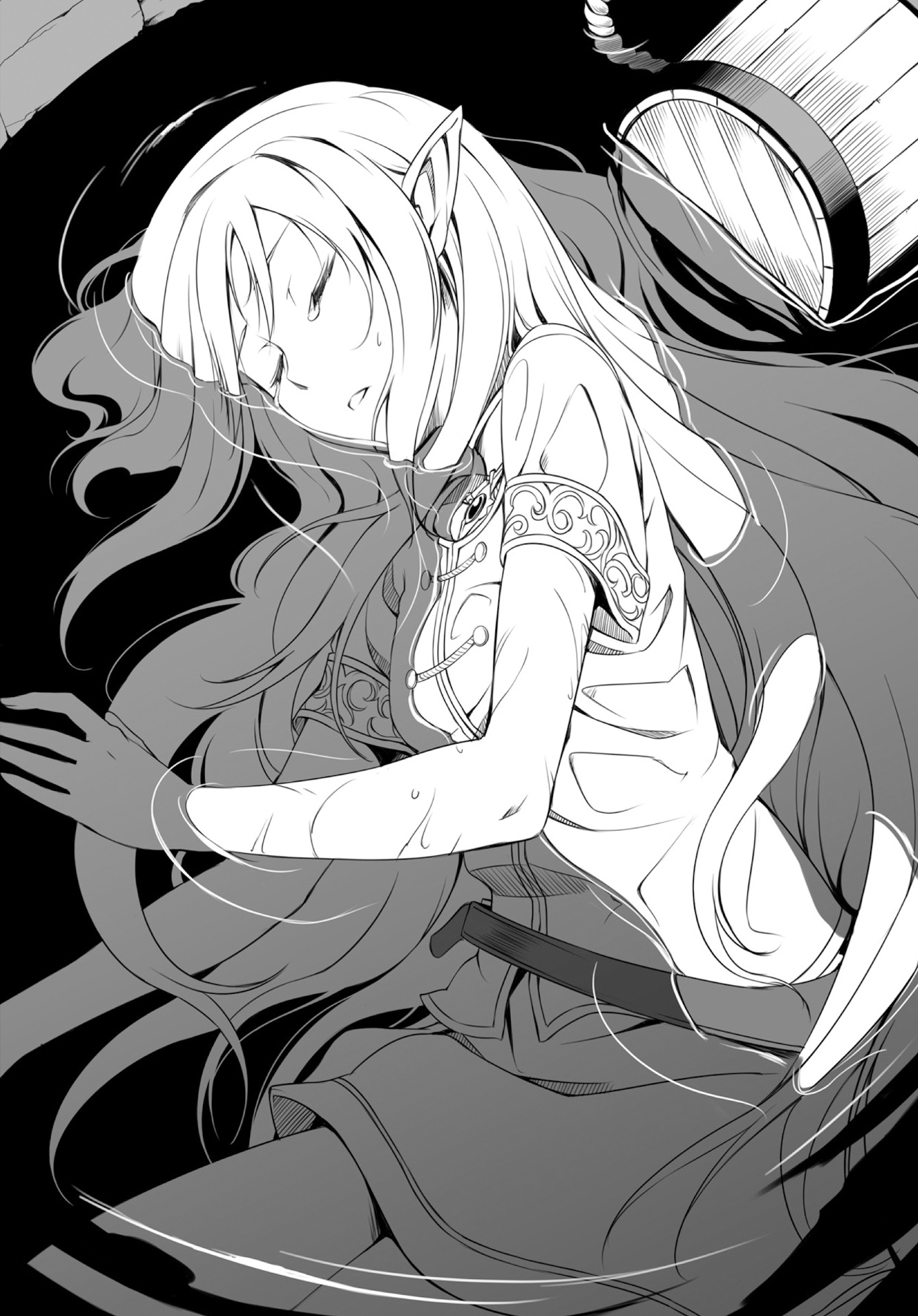
“Huh?” Itami muttered.
Buckets should splash when they hit water, Itami thought, peering into the well. Curious, Kuribayashi also looked down.
Both were very surprised to see a young girl with long blonde hair floating in the water, with a large bump on her forehead.
※※※
“Wake up, Tuka.”
The girl’s gentle dream was interrupted by her father’s voice.
“Father? What’s wrong? I was sound asleep,” Tuka said, rubbing her eyes as she sat up.
The living room was bathed in warm sunlight. Her head was still a bit foggy, but it didn’t take her long to notice the unusually stern expression on her father’s face. Outside, the sounds of hurried footsteps and chaotic noise filled the air. It sounded like something serious was happening throughout the village.
“What—” Tuka began, but in the next second she realized the answer herself.
Silhouetted in her window was the massive form of an ancient dragon. She’d never seen one herself before—dragons didn’t live anywhere near here, after all—but she recognized it from her father’s natural history lessons.
“Is that… a fire dragon?” she asked.
“Yes,” her father replied.
Tuka then noticed that he held a bow—a common sight among elvenkind. Her father reached into a cabinet where they kept valuables and took out arrows made of mithril silver and phoenix feathers.
He’s going to fight?! Tuka thought, suddenly alarmed.
She instinctively reached for her own beloved bow and arrows, but her father stopped her with a firm “No.”
“Why?” Tuka asked.
“You need to leave,” her father said sternly.
“I want to fight too!” Tuka protested.
“No. If something were to happen to you, I’d never be able to face your mother.”
Tuka’s late mother only came up when her father desperately needed her to comply. But Tuka had grown too old for that to work anymore. She smiled.
“Running won’t help if we’re dealing with a fire dragon,” she said. “Besides, the more people we have, the better our chances.”
Fire dragons were known to have a taste for the flesh of elves and humans alike. If they didn’t kill the fire dragon here, it would be sure to track them down wherever they fled. And for a creature like that, the distance an elf could run was negligible.
Outside, the warriors loosed their arrows into the sky, and spirits of wind and water were summoned. The attack on the fire dragon had begun in full force, but the elves’ efforts seemed to have little effect.
While they struggled, the fire dragon’s breath of flames burned down houses with brutal efficiency. Women and children trying to escape were engulfed in flames, their dying screams piercing Tuka’s ears.
“We’re not safe here. We need to get outside,” her father said, pulling her by the hand as she tightly clutched her bow and arrows.
All around them, screams echoed like silk being torn.
When Tuka stepped through the door, she saw her childhood friend about to be caught in the dragon’s jaws.
“Yuno!” Tuka cried.
Acting on instinct, Tuka quickly nocked an arrow. Although she was young, she was an elf, and it was said that every elf was born with a bow in hand. Her skill was undeniable.
She drew the bow with all her might, aimed, and let the arrow fly. But it bounced harmlessly off the dragon’s scales.
The others weren’t faring any better. All around her, elven warriors showered the dragon with arrows, but none of them had managed to inflict even a single wound.
After crushing and swallowing Yuno, the fire dragon turned its vertical pupils toward Tuka.
“Y-Yuno… Yuno…” Tuka stammered. She understood she was its next victim, but her legs refused to move. Her mouth couldn’t even scream.
It was said that meeting a dragon’s gaze could shatter one’s soul. Perhaps that was why the very thought of fleeing had abandoned her.
“No! Tuka!” her father shouted as he nocked an arrow and called upon the wind spirits.
“Acute-hno unjhy Oslash-dfi jopo-auml yuml-uya whqolgn!”
With the help of the spirits, a blinding arrow of light shot straight into the dragon’s eye.
Its roar shook the air so violently it seemed it would tear apart everything around. Writhing in pain, the fire dragon took to the sky.
“Aim for the eyes!” The message was quickly passed from one archer to the next.
Arrows were soon finding the dragon’s head. But hitting its eyes while it was airborne proved extremely challenging even for the skilled elven archers.
Having recovered, the dragon now had its sights set on the elf who had wounded it—Tuka’s father, Hodrew. It unleashed massive columns of flame on every house it could see, then slashed at the elven warriors with its sharp claws and fangs, scattering them. It swatted them aside, crushed them underfoot, and tore them apart with its jaws.
“Run, Tuka!” Hodrew commanded, but his daughter was still frozen in shock.
Tuka’s gentle, sweet father had never so much as raised his voice at her, let alone lifted a hand against her. However, in this dire moment, when only fierceness and violent intensity could save the day, he showed a side of stern determination.
Just as the dragon’s jaws were about to close around his daughter, Hodrew threw himself at Tuka, pushing her out of harm’s way. He then thrust his rapier into the dragon’s maw.
With Tuka in hand, he started running.
“They’re coming!” he shouted.
The warriors’ calls to the spirits were like a choir. Arrows were loosed in volleys, some finding their mark between the dragon’s scales, others piercing its mouth or the bases of its claws.
The dragon advanced, undeterred.
Hodrew’s tone was urgent as he spoke to Tuka. “You need to hide here. Understand?”
With that, he threw her into the well.
In the last moment before she was falling, Tuka saw the enormous jaws of the fire dragon open wide behind her father, its sharp teeth gleaming.
How long did she stay at the bottom of the well? She heard the sound of the flames consuming her village and the forest. Embers drifted down into the well, losing their glow long before they reached her. She heard the voices of the warriors, their angry shouts and screams of pain. The cold water reaching up to her waist made her shiver. She was terrified, horrified, and anxious, unable to stop her tears.
Suddenly, the forest was quiet, and all that Tuka could hear was her own breathing, the beating of her heart, and the gentle splash of the water. The once-blue sky had turned black, yet the area around the well was strangely illuminated by the flames that continued to burn her home.
She was already completely soaked by the time she realized that it was raining. Water ran down her face and into her eyes, but she couldn’t tear her gaze away from the sky.
“Hey, Tuka. Are you alright?”
Over and over, she pictured her father’s face appearing in that circle of burning darkness at the top of the well. But no matter how long she waited, no voice called out to her. The horrible thought that everyone might be dead crept into her mind, threatening to tear her heart apart.
“Father… please help me,” Tuka whispered.
Eventually, the sky began to lighten. The well water was freezing, and Tuka was too cold, tired, and hungry to stand any longer. Overwhelmed by despair and sorrow, all her willpower drained away.
Is this how I’m going to die?
Strangely, she wasn’t afraid. On the contrary, dying seemed inviting. Death would free her from the fear and anxiety, from the sadness of loneliness, and from the agony of her situation. How else could her suffering end?
Suddenly, Tuka thought she heard a voice—a real voice—from above. She looked up and… was it a bucket that filled her view? It was hard to tell against the brightness of the sky.
A high-pitched “clink” echoed, followed by a sharp, stinging pain in her nose as if she had inhaled a strong spice. Sparks filled her vision.
“Ugh…” she groaned, and her consciousness began to fade.
“Are you okay? Wake up! Open your eyes!” someone shouted.
Tuka felt her cheeks being lightly slapped. A voice was calling to her, but it sounded distant. Through her hazy vision, she saw a face peering down at her, one that somewhat resembled her father’s.
“Fa…ther…” Tuka murmured.
※※※
“It’s an elf, Lieutenant,” Kurata noted.
“An elf, indeed,” agreed Itami.
“And a blonde elf at that. This gives me hope!”
“Are you a fan of elves?”
“No, sir. I prefer someone with a bit more allure. But since there are elves, there’s a chance we could meet seductive witches, chaste succubi, hot-blooded vampire girls, or pure-hearted beast girls, right? I wouldn’t mind some witty banter with a wolf girl either!”
Imagining characters from adult doujinshi, Itami felt a certain fear of what such beings would be like in real life. He thought of how actresses with makeup reminiscent of Tezuka’s great manga characters in musicals might serve as a good comparison for beast girls. Like Kurata had said, if seductive witches or vampires really existed, they would certainly be fascinating.
“Well, the chances of that happening have probably increased,” Itami conceded.
“No, they’re definitely out there!” Kurata insisted, clenching his fist with fervor.
Itami decided he’d give his support from a distance. “Well, good luck.”
Kuribayashi and Sergeant First Class Kurokawa—a qualified nurse and the other female member of the recon team—were removing the girl’s wet clothes and wrapping her in a blanket. She looked to be about sixteen.
The men in the unit kept their distance, knowing that any attempt to watch would be met with a swift and certain punishment from Kuribayashi.
Left with nothing else to do, Itami started to clean up the ropes and other gear they had used to descend into the well. His half boots made a squishing sound with every step.
Other team members were busy with their tasks, using portable shovels to dig simple burial holes or recording the state of the village by sifting through the rubble. They gathered the charred remnants of furniture and other household items, as well as bows and arrows, documenting them with videos and photos to bring back as data.
Itami sat down and turned his boots upside down to pour the water out. Though reluctant to put them back on while they were still wet, he couldn’t go barefoot, so he stuffed some newspaper from his pack into the boots to absorb as much water as possible. He wrung out his socks as well before putting them back on.
Just then, Sergeant Kurokawa approached. She saluted Itami, who returned the gesture. But since Itami was barely 170 centimeters tall, he had to look up at Kurokawa, who stood at a towering 190 centimeters.
Kurokawa and the much shorter Kuribayashi were often referred to as the “mismatched WACs” of the Third Reconnaissance Team due to their contrasting heights.
“Her body temperature has returned to normal for now,” Kurokawa reported in her usual calm and professional tone. “The bump on her forehead might look comically large now, but it should disappear soon. I think she’ll be fine, but what shall we do next? We can’t stay here forever, but it also feels wrong to leave the girl here alone.”
The contrast between the brave, short-tempered Kuribayashi and the towering, gentle Kurokawa was striking.
“Given that this village seems to be completely destroyed, we can’t just abandon someone we’ve rescued. In that case, we’ll take her with us for protection,” Itami decided.
Kurokawa smiled warmly. There was something about her presence that made time seem to slow down.
“I thought you might say that, Lieutenant,” she said.
“Because I’m a decent human being?” Itami asked.
“Who can say? It would probably be impolite to suggest it’s because of your special interests or because the girl is an elf,” Kurokawa said with a twitch of a smile.
Itami felt a bead of sweat roll from his forehead down his cheek, along his throat, and under his collar, disappearing beneath his clothes.
Under the original plan, they were supposed to visit two or three more settlements. However, it wouldn’t be practical to travel around with the rescued elven girl. Thus, Itami decided to retrace their route and return to Alnus Base. When they contacted headquarters for permission, the response was along the lines of, “Sure, come back quickly.”
“Sergeant Major Kuwahara, we’ll proceed as planned. First, let’s head back to Coda Village,” Itami said, climbing into the front passenger seat of the HMV.
Kurata took the wheel, while Kuwahara managed overall command from the back seat. Kurokawa joined them to care for their patient.
And so, the Third Reconnaissance Team set off again. The return journey was just as peaceful as the outward journey had been. The sky was endlessly clear and blue, and the vast land spread out before them like a postcard. It was hard to believe that a dragon had darkened the skies and wiped out an entire settlement just that morning.
They traveled for nearly half a day. Unlike before, they were moving at a fast clip. It almost felt like a retreat, but they were kicking up far too much dust to be stealthy.
“I hope a dragon doesn’t show up,” Kurata muttered from the driver’s seat.
“Come on, don’t jinx it,” Itami groaned, unable to resist.
The road was unpaved, and the suspension couldn’t absorb all the bumps, causing the vehicle to jolt violently.
Kurokawa pondered aloud as she checked the rescued girl’s vitals. “What’s the normal blood pressure for an elf? What about pulse?” she asked.
Itami furrowed his brow. “Is she going to be okay?”
“Well, her breathing is steady, and her blood pressure, pulse, and temperature are stable, although if she were a human, they would be low. She’s not sweating much, which is a good sign. She seems fine to me.”
Itami thought the best course of action would be to find some locals as soon as possible to get advice on how to care for the elven girl.
The people of Coda Village greeted the team with a sense of indifference, neither welcoming nor disliking their return. Itami approached the village chief and, using a dictionary, stumbled his way through explaining that they had found a settlement in the forest as instructed, but it had already been attacked and burned down by a dragon.
“The entire village, destroyed?! A tragedy!” the chief exclaimed.
Itami flipped through his small dictionary, carefully selecting words. “Um, we went to the forest. Big bird, there. Forest burned. Village burned,” he explained, drawing a picture of a dragon to make up for his limited vocabulary.
The elder’s face paled when he saw the drawing. “This… this is an ancient dragon. And a fire dragon at that.”
Itami added the term for “ancient dragon” to his dictionary, noting its pronunciation in Roman letters.
“Dragon, fire, breathes. Many people burned,” he said.
“They weren’t people, they were elves. The ones living there were elves,” the village chief corrected, repeating the word “re-namu” several times. Itami added this term to the “e” section of his dictionary: “Elf/re-namu.”
“Yes, many elves were killed,” Itami confirmed.
“I see. Thank you for telling us. We need to warn the other villages around us right away. A dragon that’s tasted elf and human flesh will return to attack villages and towns when it’s hungry again,” the village chief said, gripping Itami’s hand in gratitude. He then called out to his family and others to spread the word.
News of the dragon attack on the elf settlement sent the villagers running in a panic.
“We rescued one girl,” Itami mentioned.
The village chief looked up, intrigued. Itami led him to the HMV, where the unconscious blonde girl lay.
“Such a shame,” the chief said again, gently stroking the girl’s golden hair. “The entire village was destroyed, and this one girl has been left the sole survivor.” Although they were of different races, Itami had gathered that Coda Village had been on good terms with the elven settlement.
Elves protected the forest and would assist hunters who ventured too deep, offering help if they were injured or lost, sometimes even providing shelter and guiding them back. Other than that, however, the two races left each other alone. Their relationship was one of mutual respect and distance.
“Um… this girl, you protect, in the village…” Itami began.
The village chief understood but shook his head. “Our customs are very different. It would be best for her to be in the care of fellow elves. Besides, we need to flee this village.”
“Abandon the village?” Itami asked.
“Yes, we must escape. If you hadn’t warned us, we wouldn’t have had time to flee. We might have even been completely wiped out. We are truly grateful to you.”
Chapter 03
Chapter 03
In a small clearing within the forest, a tiny house stood slightly apart from Coda Village. The house was a modest single-story building, about the size of two six-tatami rooms (approximately 2DK2). There were two windows just large enough to let in light and air, as there was no glass in this world.
The walls, made of sun-dried bricks, were covered in ivy. Sunlight filtered softly through the tree canopy, lending the surroundings a charming and quaint atmosphere. A donkey cart was parked in front of the house, piled high with wooden boxes, sacks, and bundles of books tied with string. The donkey grazed a few feet away, oblivious to the immense load it would soon be burdened with.
In front of this mountain of belongings stood a platinum-blonde girl, about fourteen or fifteen years old, dressed in a simple tunic. She was struggling to find a way to add a large bundle of books to the already overloaded cart.
“Professor, there’s nowhere to put any more,” the girl said calmly, addressing the house.
An elderly man with white hair and a long beard leaned out of a window, his brows furrowed in concern. “Are you sure there’s no way to make it work, Lelei?”
Lelei responded matter-of-factly, “The best things to leave behind would be the koam fruit and rokude pear seeds. At least they won’t spoil.”
Without waiting for the professor, she removed a few sacks from the cart. Koam fruit and rokude pear seeds were valuable for treating certain high-fever illnesses, but such conditions were rare, and they could be replaced. What they needed to prioritize were the irreplaceable books.
The old man came out and took one of the sacks, slumping his shoulders. “The fire dragon’s activity was supposed to come fifty years later. Why now?”
News of the attack on the elven village had spread rapidly through Coda Village. Normally, the villagers would have fled immediately, taking only what they could carry. However, thanks to the early warning, they’d been given time to gather their belongings. Now, the entire village was bustling with preparations to evacuate.
Grumbling, the old man took the sack back into the house to stash it in a hidden compartment under the bed. Meanwhile, Lelei hitched the donkey to the cart.
“Quickly, Professor. Get on top,” Lelei urged.
“What? I’m not indulging in such childish whims! If I’m going to ride, I want someone like your sister, with her… curves…” the old man retorted.
Lelei silently fixed him with a cold stare, then began hurling solidified air at him. Though the air masses were like rubber balls, they hurt when thrown repeatedly.
“Stop it! Magic is sacred!” the old man scolded. “You shouldn’t use it for such selfish reasons… Hey, I said stop!” He cleared his throat. “Even though we’ve been given some time, we can’t afford to dawdle. We should leave soon.”
“I know. That’s why I wish you wouldn’t joke around so much,” Lelei said, her gaze as icy as ever.
The old man clambered into the cart next to Lelei, using his staff for support.
“Jokes serve as a form of entertainment in close relationships such as friendships, parent-child dynamics, and romantic partnerships,” Lelei explained. “However, when the content is sexual, the recipient needs to have the maturity to handle it. Generally, early teenage girls do not have the emotional capacity to laugh off sexual jokes. In such cases, they could potentially destroy the relationship. This is something that adults are expected to understand.”
The old man sighed deeply at his apprentice’s words. “I’m so tired. I don’t want to get old…”
“That statement contradicts objective facts. Professor is more tenacious than a cockroach,” Lelei retorted.
“And his apprentice is quite disrespectful,” the professor grumbled.
“You are the main influence in my life, having educated me since childhood. This result is entirely of your own making,” Lelei responded bluntly.
She gave the donkey a gentle whip to get it moving. The donkey tried its best to move forward, but the cart didn’t budge under the heavy load.
The professor was silent.
“…Ahem. It seems we have too much cargo,” he finally admitted.
“As expected. You were the one who insisted on loading the cart anyway, Professor,” Lelei pointed out.
The professor could say nothing in response.
Without a word, Lelei jumped off. She seemed to think that walking would be better than sitting in an immobile cart.
“Oh! Lelei is such a considerate girl. If she were always like this, she would have many suitors. It’s such a shame. Truly a shame,” the old man said, taking the reins. He gave the donkey another whip, but it still couldn’t move.
Lelei glanced at the wheels; they were a third of the way buried in the ground. “Professor, if you need help getting off the cart, just say so,” she offered.
“Don’t worry. We have this, don’t we?” The old man raised his staff.
“Magic is sacred,” Lelei intoned in perfect mimicry of his familiar nagging. “It should not be misused. It is not for personal gain or convenience…”
“We’re wizards!” The old man tried to justify himself, sweating cartoonishly. “We don’t need to walk like ordinary people.”
Lelei’s cold, unsympathetic gaze didn’t soften. The professor stood frozen with his mouth open in an “o” shape, unable to recite the spell.
He seemed to be grappling with his dignity as an educator and other internal conflicts. Perhaps he just needed a moment before making his next move. Eventually, he turned to Lelei with a look of helplessness plastered on his face.
“I’m sorry,” he finally said.
“It’s fine. I know that’s just the kind of person you are,” Lelei replied, blunt as ever.
With magic lightening the load, the donkey had no problem pulling the heavily loaded cart. And so, Lelei and her master left the place they’d called home for many years.
Plodding along through the village, they saw lots of other people loading up their possessions. Some used farm wagons or carts, while others tied their possessions directly onto the backs of their horses. Lelei observed these villagers intently, as if studying them.
The old man spoke up. “You’re a wise girl. Everyone must seem foolish in your eyes.”
“The sudden appearance of a fire dragon has forced them to abandon their lives and evacuate. But it’s natural for people to want to bring as much as they can to ensure a better life in the place they go,” Lelei responded.
“What you call natural for people is, in the end, foolishness,” the old man countered.
Lelei remained silent. She couldn’t deny her master’s words.
If people truly valued their lives, they would use the time they have to get as far away as possible, she thought. They thought they had the luxury of time, so they were spending it packing their belongings, delaying their departure. Even worse, heavy loads slowed their movement. By the time the dragon found them and they abandoned their carts on the roadside to run, it would be too late.
Why do people cling to life so desperately? Everyone will die eventually. It’s only a matter of time. What meaning is there in trying to extend such a fleeting existence?
Lelei’s reasoning was as cold and logical as ever. And the professor often had no words to guide her otherwise.
As they approached the village center, they were finally halted by a traffic jam of carts.
The professor called out to an approaching villager, his frustration evident. “What’s going on up ahead?!”
“Ah, Professor Kato and Lelei. We’ve got a tough situation on our hands. An overloaded cart broke its axle and is blocking the road. Everyone’s trying to clear it, but it’ll take a while.”
Turning back to find another route was impossible, as the carts behind them were packed too close to allow reversing.
As her master and the villager conversed, Lelei’s attention was drawn to the sight of unfamiliar men approaching from behind, speaking in a language she’d never heard before.
“Helping with the evacuation is part of our job,” one of them said. “Let’s get the broken-down cart out of the road! Itami, get the village chief’s approval for our deployment. Totsu, tell the people behind us about the traffic jam and direct them to alternate routes. Use gestures if you can’t communicate with words! Kurokawa, check for any injuries at the accident site.”
The men wore various shades of green mixed with brown in a camouflaged pattern. There were also a couple of women among them. From their helmets, Lelei thought they looked like soldiers, but lacking armor.
She watched as the men and women quickly followed the orders given by the older man, running with impressive speed. The clear chain of command and their disciplined movements suggested a military organization, one that contained its formidable violence within the bounds of strict regulation.
“Professor, I’m going to check it out,” Lelei announced, jumping off the cart.
About fifteen carts ahead, she saw the overturned cart causing the blockage. Its broken axle had caused it to tip over. Nearby, a horse was thrashing wildly, foaming at the mouth as it tried to get up, while scattered goods and fallen villagers—a man and a mother with her child—added to the chaos. The frantic horse made it impossible for the villagers to approach and help.
“Hey, it’s dangerous. Stay back,” one of the men in green uniforms said. Although Lelei didn’t understand the words, his gestures made the message clear.
As soon as Lelei noticed the injured mother and child, all thoughts of safety vanished. She ran over to them, ignoring the thrashing horse.
“They’re still alive,” she said, first checking on the child who looked a little younger than her, around ten years old. She seemed to have hit her head and was pale, limp, and drenched in sweat, her body cooling rapidly. The woman appeared to be unconscious but otherwise not seriously injured.
“Lelei?! What are you doing?! What happened?” a voice called out. It was the village chief, accompanied by one of the green strangers.
“Chief, there was an accident,” Lelei explained. “Probably a combination of the cart being too old and too full. This child is in danger, but the parents seem to be okay. The horse can’t be saved.”
“Is Professor Kato around?” the village chief asked.
“He’s in the cart back there, growing rather impatient. I came to see if I could help.”
Looking around, Lelei saw a tall woman in a green uniform examining the child, communicating her observations to someone else. The woman’s methodical approach suggested formal medical training. Next to the chief, a man in his thirties seemed to have taken charge of the overall evacuation efforts.
Suddenly, a scream pierced the air.
“Watch out!!!”
Bang! Bang! Bang!
The sudden bursts of sound startled Lelei, and she turned to see the thrashing horse collapse, narrowly missing her. Had she been just a little closer, the animal would have crushed her.
Lelei realized that the people in green uniforms had done something to protect her from the horse.
※※※
The armies that had gathered from across the continent to support the Empire vanished overnight. This would have made the front pages in Japan, but in this world, or “Special Region,” the fate of armies had little relevance to the common folk. The outcome of a war meant only a change in rulers, which didn’t significantly impact their lives.
This indifference stemmed from a continuous state of warfare. Countries were perpetually at war, territories were constantly being seized and lost, and lords frequently changed along with the flags they represented. Such instability prevented the cultivation of what we would call patriotism. In this world, unless the very land they lived on became a battlefield or their family members were drafted as soldiers, the common people rarely paid attention to the state of their country.
This had begun to change in recent times, primarily due to the increase in banditry. Although there were soldiers and knights, maintaining public order wasn’t in their job description. Instead, knights and nobles collected taxes, essentially robbing the people under the guise of legality, while bandits stole without such pretense and were met with little resistance from the knights.
Even when soldiers or knights did deal with bandits, it was like a shepherd driving away a wolf to protect his sheep—an act of convenience rather than duty. And the sheep were expected to be grateful. If said bandits were armed or desperate, the knights were unlikely to put their lives at risk.
Of course, this situation wasn’t unique to this world; even in historical Japan, villages would sometimes have to hire their own protectors, as depicted in movies where seven samurai were enlisted to defend a village from bandits because the local lords were unreliable.
With so many local knights and soldiers otherwise occupied or already dead, the bandits were having a heyday. Everything they used to do covertly could now be carried out in broad daylight. And, unfortunately for them and their victims, most bandits lacked the intelligence to avoid destroying their sources of plunder. Consequently, their methods often became brutal and destructive.
One such example involved a family fleeing a village due to a nearby dragon sighting.
The man had hitched a cart to his plow horse, loaded it with everything his family owned, and set off from the village with his 32-year-old wife and 15-year-old daughter. It was common to move in caravans when making such an escape, not unlike how herbivores like buffalo or zebras travel in herds for survival. However, this man had thought: Wouldn’t traveling in a large group be like waving a giant white flag to the dragon? And so, his family left alone, despite his neighbors’ warnings.
The bandits came on the second evening after they’d left the village. The man whipped the plow horse desperately, but the overloaded cart was slow and sluggish. It seemed like only seconds before the family was completely surrounded by the mounted bandits. The man was dead seconds later, and the bandits took everything—his belongings, his wife, and his daughter.
As darkness fell, the dozen or so outlaws gathered around a fire, reveling in the joy of their spoils. How lucky, they thought, that this catch included food as well as valuables. After all, one couldn’t eat precious gems. They filled their bellies with the stolen food, and the leaders, having satisfied their lusts with the mother and daughter, were now enjoying their drinks in high spirits.
“Boss, it’s from Coda Village,” one of the bandits reported. They’d heard the village had evacuated due to the appearance of a fire dragon. Burdened with their belongings, the villagers were slow-moving and posed little threat. The whole lot of them would be an easy target.
The bandit chief grinned at the suggestion. It was indeed a good idea. However, he had one concern.
“We don’t have enough men,” the chief said.
His crew numbered fewer than twenty; a caravan made up of an entire village would be much too large a target.
“Exactly,” his subordinate agreed. “That’s why we need to spread the word and gather more men. Then we can pull off big jobs we never could have dreamed of before.”
The boss scratched his chin, pondering this. He had been seeking an opportunity to recruit more followers. With enough numbers, they could target villages and towns, maybe even drive out a local lord and rule the place themselves. From being mere bandits to rulers—it was a tantalizing dream, and it had never felt so close.
Until the end of his life, the nameless bandit leader allowed himself to indulge in the dream. Whether that was a blessing or a curse remains uncertain, as that end came a moment later.
With a sudden thud, his head fell from his shoulders and rolled across the ground, stopping near the campfire. The sharp smell of burning hair filled the air as it singed.
It’s believed that a person retains consciousness for a few seconds after decapitation. If that’s true, he would have experienced his head rolling on the ground. His vision would spin, and before he could comprehend what had happened, he would have seen his (former) body crumple, blood spurting from the neck. And in his rapidly darkening vision, he would glimpse Death, her long black hair drenched in the man’s red blood.
Everyone who laid eyes on the girl had the same initial impression: “black.” Her pale white skin contrasted starkly with her jet-black hair, black clothes, and eyes as deep and dark as a bottomless abyss.
With a swift whoosh, another bandit’s head flew off. The weapon in her hand was a massive halberd, a heavy axe-like blade on a long pole—certainly not a weapon suited for a girl so petite or wearing a frilly dress. Yet she wielded it masterfully with slender arms and delicate fingers.
With a heavy thud, she rested the iron axe on her shoulder and let out a soft huff of breath.
Corpses of bandits lay scattered around her. She lifted her skirt slightly and gave a graceful curtsy.
“Thank you ever so much for tonight, gentlemen,” she said, her voice dripping with mockery. She looked about thirteen years old, and her elegant and refined movements hinted at a noble upbringing. Her face bore a serene smile, but her eyes were cold as darkness itself—portals to a deep, endless void.
“I am ever so grateful for your generous sacrifice of life,” she continued, her tone almost sweet. “I offer my gratitude on behalf of the Ultimate God. He is very pleased with your conduct and has decided to call you to His side.”
“Wh-What?! Who the hell are you?!” shouted one of the surviving bandits, his voice a brave act of defiance against the terror that gripped his insides.
The girl giggled adorably. “Me?” “I am Rory Mercury, apostle of Emroy, the God of Darkness.”
“You are dressed like one of Emroy’s priests. You can’t be… Rory the Reaper, of the Twelve Apostles?” one of the bandits stammered.
“Oh my, you’ve heard of me? Well, that’s correct. Hehe…” Rory giggled.
At her laugh, the remaining bandits abandoned their loot and ran for their lives, screaming in despair.
“You’ve got to be kidding! We can’t fight an apostle!”
They screamed their souls and lives out, desperately trying to escape the jaws of death.
“Oh no, you mustn’t run away,” Rory said, leaping after them.
Agile as a ferocious predator, she brought the massive iron weapon—far heavier than her own body—down on the fleeing bandits.
The halberd smashed a bandit’s head like a watermelon, scattering minced flesh all around.
“Ahh, ah… Ahh,” babbled another survivor, paralyzed with fear, as Rory stood before him. She lifted the weapon onto her shoulder and, only wobbling slightly, raised it high. Her white skin was stained red with blood.
“He has spoken: All humans must die. You cannot escape death,” Rory said, bringing down the axe and cutting off the bandit’s final scream.
“Huff, huff, huff… Why is a worshiper of Emroy here?” wondered one of the fleeing bandits.
In the distance, he heard his comrades’ dying screams. Another life had been claimed by the Reaper.
“Damn it, damn it!”
He ran through the night-dark wilderness. There were no paths here—only hollows, rocks, thorns, and obstructive shrubs. He stumbled, crawled, and struggled through mud and sweat, skinning his body and tearing his clothes.
Another scream echoed behind him.
He slipped and fell into a mud hole, striking the ground with his fists.
“Damn it, damn it, damn it! Why me?!”
“Oh my, haven’t you had enough fun?” Rory’s footsteps were too soft for him to hear, but at the sound of a bell he looked up. There, standing against the silver moon, was the black-clad girl.
“Didn’t you have a good time? Didn’t you kill people?” Rory asked.
With a swift motion, she thrust the halberd into the ground between the man’s legs, narrowly missing his crotch.
“Ah, ahh! I-I didn’t do anything yet!”
“Oh?”
“It’s true! I just joined them! This was my first job! I haven’t even touched a woman yet! They said I was a newbie and had to wait my turn.”
“Hmm?” Rory leaned in, actually looking at the man for the first time. “All your friends have already been summoned by Emroy. Aren’t you lonely being the only one left?” The question came with a chilling smile.
The man shook his head violently. “No, no, not lonely at all!”
“But it doesn’t feel good being left out, does it?”
“Please, please leave me out!”
Rory looked down at him with eyes as cold and sharp as the blade of her halberd.
“What should I do with you…” she mused aloud, then suddenly clapped her hands. “Oh, I have a good idea. If you haven’t done anything yet, you can start now.” Rory grabbed his leg, almost playfully but with enough strength to hoist the man up as if he weighed nothing. She began dragging him across the rough ground like a ragdoll.
“Ouch, stop! Ugh, it hurts!” he cried as rocks and gravel tore at his skin.
“Do you prefer the mother or the daughter?” Rory asked, her tone almost sing-song.
“No, stop it! Please, no!” he gasped, struggling in vain.
“Don’t be shy. This is your last chance, after all. I’ll even ask them to entertain you,” Rory added, swinging him around and throwing him beside the bodies of the mother and daughter.
“Go on. It’s your turn,” Rory urged.
The man shook his head frantically, his entire body trembling. The woman and girl lay motionless, arms spread above their heads, legs splayed open, bearing the brutal evidence of their assault. Both had stopped breathing.
“Oh dear, it seems they’ve already been summoned as well,” Rory said, looking at the lifeless bodies with feigned sympathy.
She bowed slightly to the mother and daughter, then turned her chilling smile back to the man.
“But you should go ahead anyway.”
As the man wet himself in terror and a puddle formed beneath him, Rory’s dark eyes seemed to pierce through his very soul.
Chapter 04
Chapter 04
The young outlaw continued to beg for mercy, tears streaming down his face. Crawling on the ground, he clasped his hands as if in prayer, his pleas mingling with tears and snot. He insisted that he hadn’t yet committed any direct crimes, that his hands were still clean. He explained that he’d turned to banditry out of sheer desperation, that he would turn over a new leaf and live honestly from now on, he promised!
Rory sighed, turning her face away in disgust. The sight of his disgrace made her feel as though she, too, were being tainted.
Killing people, Rory knew deep down it was not inherently a sin. What mattered were the reasons and how it was done. Such was the teaching of the god she served.
What was wrong with bandits and thieves stealing from others? What was wrong with soldiers or executioners killing enemies or condemned prisoners? These actions were not evil in and of themselves.
Emroy did not speak of good and evil. He accepted the nature of all people, respecting the professions people chose to survive and the paths they were led down. Thus, if one were a bandit, one should be proud of it. Of course, those who chose the life of a bandit or soldier should also be prepared to face death in battle or judgment.
If this man had faced Rory with pride as a bandit, she might have shown him some respect. As an emissary of her god, she might even have loved him for his resolve.
Unfortunately, his attitude was intolerable. His claim that he hadn’t yet dirtied his hands was unacceptable. By participating in banditry and being part of a violent group, whether or not he had personally committed acts of violence was irrelevant.
Equally unacceptable was his excuse that poverty had left him no choice but to turn to banditry. If he couldn’t survive, he should have starved to death.
There were those who, lacking ability and forsaken by luck, chose to live as beggars or street people rather than harm others. Rory admired that kind of resolve and loved those who displayed such pride. But this man was despicable as a human and lowly as a man. He had no worth. His pitiful display made the apostle of darkness contort her beautiful features in disdain.
Her voice stern and commanding, Rory told the man to dig graves, three of them. When he protested that he had no tools, Rory reminded him that his mother had given him two hands. And so, with no other choice, the young man began to claw at the earth in the wasteland.
The land was not like a sandbox or a cultivated field; it was tough and unforgiving. His nails soon began to tear off, and his skin shredded. When he paused to ease the pain, the massive halberd struck the ground near his toes, gouging the earth and reminding him of the terror he faced.
For a while, the fear was strong enough to make him forget his agony. Furiously, he clawed at the rocky and weed-strewn ground, desperate to dig the holes. Eventually, he had buried the father, then the mother, and lastly the daughter.
By the time he finished covering the girl’s grave with soil scooped up by his now numb hands, the sun had already risen, and the forest was bathed in gentle light.
Secretly, the man had hoped that if he worked hard enough, he would earn his release. He wanted so badly to believe it. He couldn’t help but believe it. Dehydrated, starving, exhausted, and again feeling the pain from his hands, he turned to Rory and hesitantly asked, “Is this enough?”
To his surprise, the apostle of death was… praying. She knelt on one knee, hands clasped together, praying fervently. Enveloped in the sunlight, she looked noble and mystical, a sight that took his breath away.
In the daylight, her black dress resembled mourning clothes, and her long black hair cascaded beautifully down her back. Her porcelain skin contrasted with her lips painted in a blood-red, almost black hue. Even in prayer, she smiled coldly.
When her prayer ended, Rory stood slowly, raising her halberd. And to the man who stood paralyzed with fear, she swung her symbol of faith and divine love.
※※※
Tuka Luna Marceau—the eldest daughter of Hodrew, an elf residing in Coan Forest—believed she was dreaming.
Her vision was hazy, as if shrouded in cold mist. A part of her mind registered the shapes of humans moving around, but Tuka couldn’t put two thoughts together to grasp or analyze what was happening. All she could do was take in the images and sounds entering her senses.
Clouds floating in the sky and the landscapes she glimpsed moved by intermittently. They would stop and then start moving again. Her body swayed with these movements.
It seemed she was lying in some sort of cart. The cart would move, then stop. Then move again, and stop once more.
As her mind slowly began to clear, she found herself looking out the cart’s window. Humans carried loads, walking with expressions of fatigue and urgency, as if driven by something. Loaded carts clattered by noisily.
The cart moved again, then stopped after a while. The dark walls were torn open, letting in light from outside.
So bright…
Suddenly, Tuka’s blurry vision was obscured by a dark silhouette.
“How’s the girl doing?” Itami asked.
Two people outside her field of vision were conversing with each other, but she couldn’t for the life of her figure out what they were saying.
“How’s the girl doing, Kuro-chan?” Itami repeated.
“Lieutenant Itami… She’s regaining consciousness very slowly. She’s starting to open her eyes,” Kuro responded.
A beautiful girl whose skin seemed to have been crafted with the utmost passion and moe spirit3 by a renowned sculptor lay weakly. She appeared to be in her teens. Her flowing hair was like golden threads, and through her slightly open eyelids, one could glimpse her sapphire-like eyes.
Itami gazed at the elven woman, contemplating the difficulties ahead.
Her fever had subsided, and her heart rate, respiratory rate, and blood pressure had stabilized. Even so, she wasn’t out of the woods yet and would require careful monitoring.
“This line of refugees is moving slower than a snail. Problems are popping up one after another, and the number of stragglers and wounded keeps increasing. Evacuation is so exhausting,” Itami lamented.
For Itami, who lived by the motto “Eat, sleep, play, and live life in between,” not knowing how long the current situation would last was nothing short of torture.
Fatigue. Grim expressions. Hunger and thirst. The wailing of infants. Adults were losing their patience and becoming irritable. Blood was spilled accidentally. The scorching sun blazed overhead. Mud clung relentlessly to shoes and pants.
A wagon was stuck in the mire, unable to move. A family was sitting down beside it, and the villagers lacked the mental and physical strength to help. Onlookers were indifferent and left the stragglers to fend for themselves. A father offered his baby to a passing cart, pleading, “At least save my child…”
Falling behind the caravan meant certain death. Food and water were scarce, while carnivores and bandits abounded. Surviving on one’s own here was almost impossible.
Abandonment was the norm. Life and death were separated here. That was the law of nature.
“Someone, help!”
There was no power in that prayer.
“Someone, help.”
God did not save. God did not extend a hand. God simply existed.
“Someone… anyone.”
God only commanded like a tyrant, ordering death.
It was up to the people to save each other.
Men in green clothes gathered around the immobilized wagon, telling the family that there was hope if it was just a matter of a broken wheel.
“Ready? Push!” “Push with all your might! Show some grit!!!”
Everyone put their strength into the command. When the cart was finally freed from the mire and able to move again, the men returned to their strange horseless carts. They didn’t even wait for a word of thanks.
The villagers wondered, “Who are they?”
They weren’t soldiers of this country, nor were they fellow villagers. They would casually appear, warn of approaching dangers, and then help with evacuation. And they weren’t just generous; they had strange, overly kind smiles plastered on their faces, leaving a strong impression on some of the villagers.
Still, when the carts broke under the weight of the load, they were ruthless.
Accompanied by the leader of the men in green, the village chief approached the families standing dumbfounded in front of their broken carts and persuaded them to leave the carts, taking only what they could carry on their backs.
The idea of abandoning their belongings was unthinkable to the villagers. They were their food and wealth, and it was essential for survival. How were they supposed to live without them? Even so, the chief insisted, in a way that suggested he was reluctantly relaying some message from the men in green.
To add insult to injury, he made the villagers set fire to their abandoned possessions. “Leave no regrets,” he said. And it made sense, in a way. With their possessions burning, they had no choice but to start walking. But what about tomorrow, or the day after? With no hope in sight, they had no choice but to walk on, tearfully.
The caravan had split into two lines, one of carts and one of people on foot. As the hours passed, the line of people on foot grew while the line of carts diminished.
“Why do you make them set their belongings on fire?” Kurokawa asked Itami.
“In front of their stuff, they won’t move at all,” Itami replied. “What else can we do?”
“Can’t we get more vehicles to help?” Kurokawa suggested.
With the transport capacity of the Self-Defense Forces, it would be easy to move these villagers along with their possessions. However…
Itami scratched the back of his head, looking troubled. “This place is technically behind enemy lines. We could force our way through, but if a small group like ours were let through and then a bigger force started moving deep into their territory, the enemy would be forced to react. Accidental clashes. Unplanned expansion of the front lines. Gradual deployment of forces. A rapidly escalating conflict. Villagers getting caught in the crossfire… Just thinking about it gives me chills.”
Kurokawa gave a wry smile at Itami’s words. It was clear that, this time, he had at least consulted the higher-ups.
“So, we help out as much as we can. That’s all we can do,” Itami concluded.
Kurokawa had no choice but to nod in agreement.
The caravan of refugees from Coda Village passed through that location just as the sun was about to reach its zenith.
An HMV from the Third Recon Team led the caravan, but it wasn’t going much faster than walking pace. After all, the caravan consisted of villagers on foot or carts pulled by donkeys and farm horses.
“Sure, but… can’t we move a little faster?” Kurata complained. “The last time I drove this slow was when I first started driving school.”
If he stepped on the accelerator like he wanted to, he would immediately outdistance the caravan. Instead, he was barely touching the gas pedal, relying on the car’s idle to move along and gently resting his hands on the steering wheel to keep it steady.
In the rearview mirror, a child was clinging to the backrest, looking ahead. The cargo bed of the HMV was already full of the injured and children too tired to move. The Type 73 truck right behind them was also carrying injured people and pregnant women in its narrow bed. Of course, the dangerous weapons, ammunition, and food had been transferred to the LAVs.
Itami checked the map and scanned the horizon with his binoculars, right to left. He compared the terrain and their current position, calculated the distance they had traveled, and estimated the remaining distance. Information on not just the route but also the elevation differences, rivers, and vegetation was important.
“There are an awful lot of crows flying around,” Kurata remarked.
“Yeah, there are,” Itami replied absentmindedly, turning his binoculars forward again. Sitting on the roadside was a lone girl, surrounded by crows.
“A Gothic Lolita girl?” Kurata asked in surprise.
It was an increasingly common style at events or in bustling districts like Harajuku. There were many theories about the movement’s origin, but Itami recognized the girl’s outfit as Gothic Lolita.
She appeared to be about twelve to fourteen years old, a true young beauty, and her obsidian eyes were fixed intently in their direction.
“Wow. A life-sized ball-jointed doll?” Kurata sighed as he peered through his binoculars.
The girl looked so inorganic and perfectly crafted that she really could have been made in a factory.
As much as Kurata wanted him to, Itami couldn’t just drive up to her to take a closer look. The caravan was moving as slowly as the general line at the entrance to a doujinshi sale event. It would probably take a whole five minutes just for the HMV to reach the girl at this pace.
Instead, Itami decided to send Katsumoto and Higashi ahead on foot to talk to her. Judging by her attire, it seemed more plausible that she was a Japanese civilian abducted during the Ginza Incident, rather than a local.
Even though Katsumoto and Higashi tried to engage her, Itami could see they weren’t having much luck. It was like rookie police officers trying to question a runaway girl who was ignoring them.
When the caravan finally reached the girl, she stood up as if she had been waiting all this time just for them. She brushed the dust off her skirt, then effortlessly picked up a large iron halberd and began walking alongside the HMV.
“Hello. Where are you coming from and where are you going?” she asked in the local language.
Of course, Itami and his team were nowhere near fluent enough to respond properly. The extent of their communication was still broken phrases out of a makeshift dictionary. Both Higashi and Katsumoto shrugged and began walking again.
The communication gap was bridged by a boy of about seven years old, who had been sitting between Kurata and Itami in the spacious seats of the HMV, looking ahead.
“We’re from Coda Village, big sis,” the boy said.
“Really? And who are these strangely dressed people?” she asked.
“I don’t know much about them, but they helped us. They’re good people,” the boy replied.
The girl walked around the HMV, inspecting it curiously.
“So, you’re not being taken against your will?” she asked.
“No. A fire dragon came, so we all ran away,” the boy explained.
Itami and his team could only listen with the typical Japanese expression of understanding, yet not understanding a conversation between foreigners.
Itami instructed Higashi and Katsumoto to care for the villagers at the back of the line, deciding that he would gather information directly from the girl himself. While he waited for a pause in the conversation she was having with the young boy, he consulted his phrasebook.
“How does this thing move?” the girl asked.
“I wish I knew. We can’t talk with these people very much… But compared to the cart, the ride is really smooth!” the boy replied.
“Really? It’s a smooth ride?” she responded.
Before anyone could stop her, the Gothic Lolita girl jumped through the open passenger door of the HMV, climbing over Itami’s lap.
The HMV was made to accommodate ten adults. The front seats faced forward, and the rear seats were arranged to face the center from both sides, leaving ample space in the middle for equipment. Here, with no laws about seatbelts, it could theoretically fit close to twenty children.
The vehicle was already crowded with children, the elderly, and luggage, resembling a train car during rush hour. The villagers certainly didn’t take too well to this girl suddenly trying to get in too with a simple, “Excuse me.” Although they didn’t openly complain, their faces clearly showed annoyance.
“Hey, hey, it’s cramped here, big sis,” one child protested.
“Just a moment,” she replied, pulling her long, heavy halberd in after her. Awkwardly, she tried a variety of vertical and horizontal positions to get the thing to fit, bumping it against people’s heads and faces. Eventually, everyone had to shift uncomfortably, making room for the halberd on the floor of the vehicle.
All the while, Itami tried to stop her but was hesitant to touch her, fearing accusations of harassment. It didn’t help that he couldn’t speak her language. He tried shouting several things in Japanese, including “Wait a minute!”, “Don’t go touching everything!”, “Hands off the rifle and the fire extinguisher!”, “Get off!”, and “You can’t bring weapons onboard!”, but it was like he was talking to a wall.
Next, the girl looked around for a place to sit. Finding none, she chose to sit on the lap of the man who seemed to have the best seat at the front—Itami.
“Wait a minute…” Itami tried again, hardly believing this was happening to him and at a loss as to how to handle it.
A low-level conflict broke out, with Itami trying to push her off while she stubbornly clung to her spot.
“###, &&&!!!!!!!” “$$$, @@@!!!”
After a lot of complaints, resistance, and forceful exchanges without understanding each other’s language, Itami eventually shifted to the side, sharing half of his seat with the girl, and the two settled into the reluctant compromise.
Chapter 05
Chapter 05
The Self-Defense Forces prioritized the safety of their personnel. As a result, when deployed overseas, they first established a strong, fortified camp, using it as a base of operations and retreating there during dangerous situations to carry out their missions. A recent example of this approach could be seen in Samawah, Iraq.
Learning from the old military’s disregard for human life, and with domestic political considerations and disaster relief missions focused on saving lives, the JSDF had carefully instilled this ethos into its troops.
Another priority, for the Special Region Dispatch Unit in particular, was defense. Their homeland lay on the other side of the Gate, and it had to be protected at all costs. Therefore, the mission of the Special Region Dispatch Unit in this world was to guard the Gate. That meant occupying Alnus Hill and securing a safe zone around it through both military and political means. Mapping from aerial photographs and sending personnel to survey the surrounding areas were all part of this mission.
Fortress construction, although considered a relic of the last century, had also been added to their tasks. This was not field fortification with earth and barbed wire, but permanent defensive structures made of reinforced concrete.
About three weeks after the area around the Gate had been secured, the round-the-clock efforts of the engineering unit had transformed Alnus Hill into a strong fortification. The structure reflected the meticulous personality of the staff involved, forming a perfectly geometric star shape.
Most people who saw aerial photos of this fort compared it to the star-shaped fortress in Hakodate. The more serious of the JSDF officers would delve into military history, discussing the advantages and disadvantages of such a design for both defense and attack strategies.
Some slightly eccentric enthusiasts would smile and mention that it looked like a magic circle. Indeed, people with no ill intentions nor any connection to magic or mysticism had constructed this hexagram around the Gate and Alnus Hill with such scale and precision that any magic practitioners who saw it would be driven mad.
※※※
Now, switching scenes.
The high-mobility vehicle, the Type 73 truck, and the LAV roared their engines and sped through the sand, kicking up dust. The women, children, and elderly inside were tossed around by the sharp turns and sudden accelerations, bumping their bodies and heads but gritting their teeth and holding on.
Through the windows, they saw the fleeing people of Coda Village. And above them, a dark shadow loomed in the sky.
It was the fire dragon.
Three days after evacuating the village, just when they thought they had safely left the dragon’s territory, it appeared as if out of nowhere and attacked its fleeing prey.
There was a reason why the dragon had come this far. The residents of Coda Village and the surrounding villages, upon hearing news of the dragon’s appearance, had all evacuated at once, leaving the dragon unable to find any humans or elves near its nest to prey on. Relying on a faint scent, the dragon had ventured far from its lair to an area where it thought it would find humans. It targeted the unlucky villagers of Coda, whose large quantities of luggage slowed them down.
“Fighting monsters is a JSDF tradition in movies, but I never thought we’d start here!” Sergeant Kuwahara shouted. He turned to Kurata, commanding, “Run, run!” His adrenaline-charged voice sounded almost joyous.
The fire dragon honed in on one villager who had collapsed and wasn’t moving. Seeing this, Itami shouted at the LAV running alongside them.
“Suppress it! Light armor open fire!” he commanded.
Private Sasagawa on the LAV pulled the lever of the .50 caliber machine gun with all his might, producing a sound like a jackhammer at a construction site. The massive shells spilled out of the cartridge catcher and rolled across the hood with a sharp metallic clatter as the 12.7mm bullets struck the dragon’s back, sending up sparks.
The dragon’s tough scales completely deflected the heavy machine gun bullets.
“It’s not working at all!” Sasagawa shouted.
“Doesn’t matter! Keep hitting it! Shoot, shoot, shoot!” Itami yelled back.
BB pellets from a toy air gun might not kill, but being pelted with them was still unpleasant. Itami figured that in the same way, a living creature covered in armor tough enough to deflect bullets must still be able to feel them. And so, he ordered his men to keep firing relentlessly.
The muzzles of the Type 64 rifles pointed at the fire dragon and bombarded it, flames spreading from the flash suppressors like flower petals. The dragon showed signs of irritation, and its attack faltered for a moment, causing it to miss the panicking farmer it had been aiming for.
The dragon shook its head in frustration. An arrow embedded in its crushed eye accentuated its fierce appearance, like a scar on a gangster’s face. The creature spewed flames like a flamethrower but couldn’t hit the vehicles darting around it.
“Look! Fire dragon! Look!” came a girl’s voice from behind.
Itami turned to see a flash of golden hair in the sunlight. The pale-faced elf girl pointed to her own brilliant eyes with her slender fingers, repeatedly shouting, “Look!”
Although he didn’t understand what she was saying, understanding dawned on Itami. “Aim for its eyes!” he called to his team.
The troops began targeting the dragon’s head and face. The fire dragon clearly didn’t like this, as it turned its head away and halted its movements.
“Katsumoto, Panzerfaust!” Itami shouted.
From inside the LAV, Katsumoto pulled out a 110mm portable anti-tank weapon, the Panzerfaust 3. This weapon, capable of penetrating 700mm of iron plating (though calling something that thick a “plate” might be a stretch), had devastating destructive power for a portable firearm.
Katsumoto swapped places with Sasagawa, who had been manning the heavy machine gun, and leaned out from the upper hatch.
The Panzerfaust was heavy at the front and unwieldy. Moreover, in the safety-conscious JSDF, one didn’t fire immediately after taking aim.
“Rear safety check,” Katsumoto called out.
Everyone muttered, “Just shoot already,” but recalling their training, they resigned themselves with, “Well, this is the JSDF…”
While Katsumoto aimed, the fire dragon twisted its body and tried to escape into the air. The LAV’s rapid acceleration caused Katsumoto to lose his target in the sights.
“Damn it! Stop shaking, Higashi!” Katsumoto yelled.
“Don’t give me orders I can’t follow!” Higashi retorted.
Thinking it was impossible to fire accurately while moving, Katsumoto aimed the tube at the fire dragon. He knew that due to the sudden braking and the gun jerking (caused by pulling the trigger too hard and shaking the entire gun, making it miss), the Panzerfaust would miss the moment he pulled the trigger.
The counter-mass was ejected backward. The warhead accelerated forward.
The fire dragon spread its wings, trying to stabilize itself. As it tried to leap away from the incoming warhead, it suddenly tripped and fell.
In front of the monster, a halberd was stuck in the ground.
From inside the HMV, the Gothic Lolita girl had sliced through the tarp covering the cargo bed and thrown the halberd. Its handle had tripped the fire dragon, an animal not used to moving on the ground.
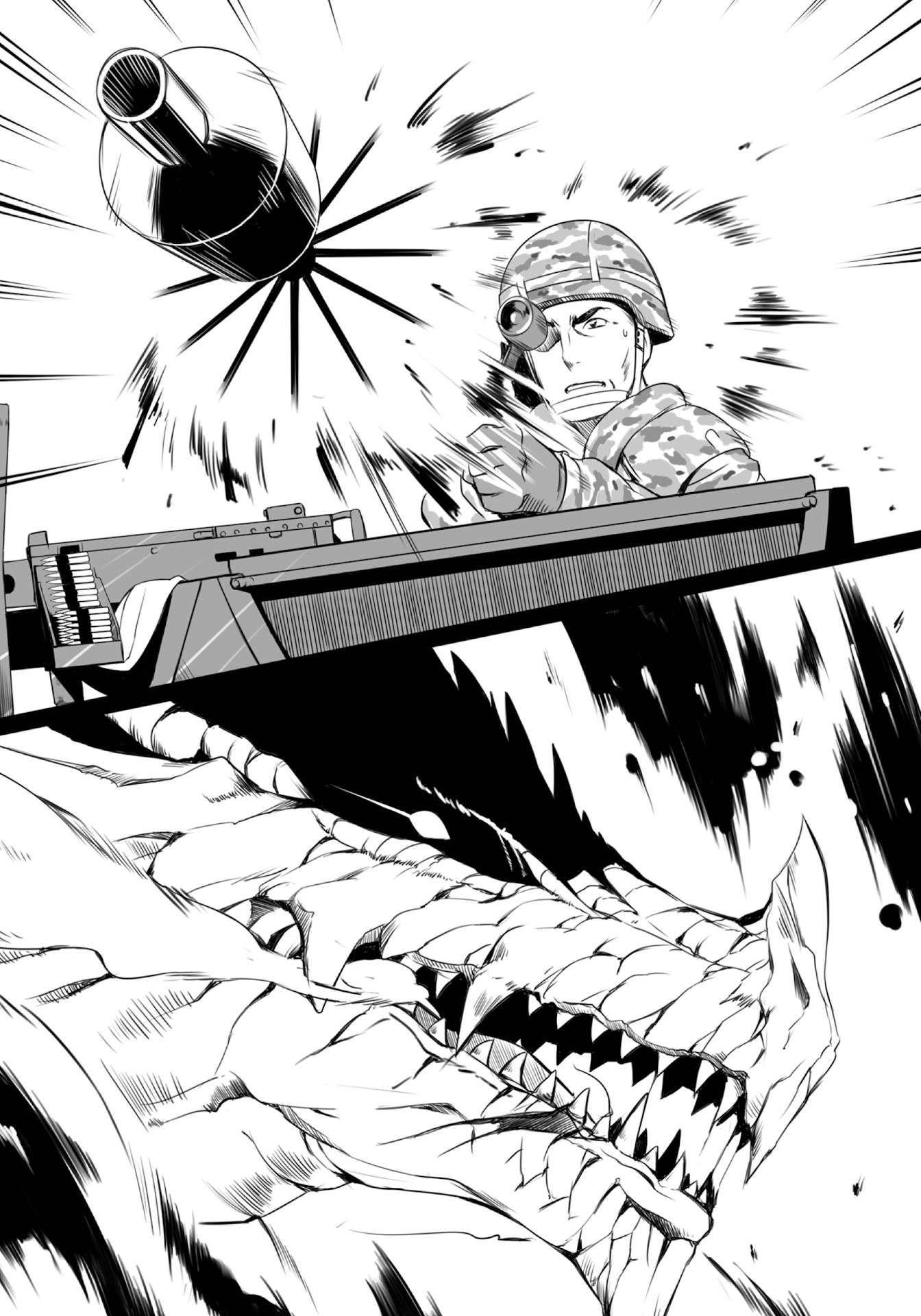
The fire dragon fell onto the warhead that should have missed. The metal jet produced by the Munroe effect was difficult to block, even with the dragon’s tough scales, and the creature’s armor was eroded by the liner exceeding the Hugoniot elastic limit, creating a hole.
A massive chunk had been gouged out of its left shoulder along with the left arm.
A scream that shook the air. A roar that sent chills down the spine.
The dragon’s roar, like its piercing gaze, shook the very souls of everyone present and shattered their courage. Villagers and soldiers alike were frozen in terror.
In that brief moment where all attacks had paused, the fire dragon took to the sky. It spread its wings and, despite its jerky movements, gradually gained altitude. The JSDF personnel could only watch in silence as it flew away.
※※※
No one who hadn’t been there believed that the fire dragon had been repelled.
It had become commonly accepted that dragon slayers who could do the job single-handedly only existed in fairy tales. Defeating a bear or buffalo bare-handed might have been possible with enough training, but the idea of taking down a griffon, a saber-toothed tiger, or even a mammoth in the same way was utterly impossible. For similar reasons, facing an ancient dragon was considered suicidal.
Even a group of knights clad in magical armor and weapons, supported by wizards, priests, elven archers, or spirit callers, would find it impossible to defeat an ancient dragon. The creatures were synonymous with disaster, like a typhoon or an earthquake. What’s more, the fire dragon’s activity was seemingly fifty years ahead of schedule.
When rumors of “We couldn’t defeat it, but we succeeded in repelling it” came not just from one place but from various directions, people began to wonder if it might actually be true. Nevertheless, rumors tended to grow with exaggeration.
Maybe it was a dragon, people thought, but could it really have been a fire dragon? A large subspecies, sure, but probably a limbless wyrm or a newborn.
Even subspecies that had aged could grow as large as ancient dragons, and newborn dragons were still much larger and more dangerous than pterosaurs. Thus, repelling such a creature could be considered a feat akin to “dragon slaying.” The fact that a quarter of the refugees were missing or dead was seen as “remarkably fortunate under the circumstances.”
That’s how death was understood in this world. Wandering into the forest could result in death, as could accidentally falling into a river while playing. Both were attributed to personal carelessness or fate. Peace and safety weren’t taken for granted, so people praised those who managed to fend off death with their human abilities, especially in the form of a dragon-shaped disaster. Everyone would naturally begin to ask, “So, who is this great hero?”
※※※
There were three main ways the survivors of Coda Village managed their lives afterward:
The first group relied on acquaintances or relatives living nearby. These individuals were considered quite fortunate. With the support and connections of friends or family, they were able to secure a place to live and find job opportunities.
The second group, which made up the majority, had to live as refugees in unfamiliar lands. Finding housing and work without any connections was incredibly challenging, and the uncertainty of their future was overwhelming. However, they considered themselves lucky to have survived and suppressed their anxiety, scattering across the Empire while praying for continued good fortune.
As they left, they shook hands with Itami and the JSDF members, expressing their gratitude over and over.
To the refugees, these military people were a mystery. Despite having no obligation or debt to them, they’d not only helped them evacuate; they’d even fought the fire dragon.
From their appearance and inability to communicate, it was clear that they were neither a knight order nor a clergy group belonging to any country. If they were a foreign army, slaughter and looting would be expected, but they did none of that. And they definitely weren’t bandits.
The most logical conclusion was that they were a group of foreign mercenaries traveling in search of an employer. The fact that nations and nobles had recently been gathering soldiers supported this idea. However, if they were a mercenary group, it was inconceivable that they would work for others without any gain. This made the villagers anxious about when and what kind of compensation the foreigners would demand.
Yet they never asked for anything, even at the very end. On the contrary, despite having achieved commendable feats that people would be telling stories about for generations, they appeared dejected, as if they’d lost a battle. They buried and mourned the dead, even holding a brief funeral service thanks to the presence of a priest. Some villagers were so moved when shaking hands with them at parting that they shed tears.
Seeing the Self-Defense Forces waving until they were out of sight, the former residents of Coda Village couldn’t help but smile. Their dedication and selfless support were truly appreciated. But before long, someone voiced the question that was on everyone’s mind.
“They can’t expect to keep going on good deeds alone… can they?”
“Now’s not the time to worry about other people,” one villager pointed out. “We need to figure out what we’ll do next.”
“True…”
“Well, no matter how foolish the lords and nobles are, they can’t ignore people as skilled as that. After all, they fought the fire dragon—the fire dragon—to a draw.”
“I guess so. But knowing what nobles are like, I can’t help but wonder if those guys will be taken advantage of and get ripped off.”
And so, they gave thanks to their respective gods, hoping that this peculiar mercenary group with their strange clothes and values would find a conscientious employer.
Incidentally, the good fortune of the Coda Village residents didn’t end there.
As they traveled, people everywhere asked for their testimony. “Is it true that the dragon was repelled?” they asked.
“Yes, it was a fire dragon. I saw it with my own eyes. Don’t look at me like I’m stupid… You want to know who did it? The guys in green, mottled clothes. Of course, they were human, not elves or dwarves. Probably from the East. They didn’t understand us very well, but they didn’t seem dumb. They were trying hard to learn our language. They were good people and helped us evacuate. And for free! I’m telling the truth!”
None of the villagers were bards, and their words were simple and minimally descriptive. But their firsthand experiences and the scenes they’d witnessed needed no heroic embellishment. Listeners’ imaginations were stirred, and even better, the villagers could answer their questions about what actually happened.
When they told of the moment the dragon’s arm was blown off, everyone listening with bated breath would gasp.
“That’s incredible!”
Eventually, the foreigners who had refused any reward and departed with cheerful smiles became legendary figures among the people, like characters from heroic tales that wouldn’t even appear in contemporary anime.
In taverns and on street corners, people would ask the refugees, “Hey, you came from Coda Village, right?” Inevitably, they would be asked to recount their experiences. The words spoken by each mouth differed, and the depictions of what was seen by each eye varied, creating an unusually three-dimensional narrative.
In this way, the refugees became storytellers, and they had no trouble finding food on their long journeys.
※※※
“What do you think, Knight Norma?”
Hamilton Uno Ror, a junior knight holding the position of adjutant military officer at the court, was seeking the opinion of her senior colleague regarding the rumors she’d been hearing around the city.
She and several other knights, along with their attendants, occupied a corner of a bustling tavern. The establishment was rather dirty, and the tables were close together. One had to shout just to be heard by the person sitting next to them, so the group sat shoulder to shoulder, bumping elbows as they reached for their food and drank from their cups.
A waitress from Coda Village was carrying a tray of drinks around the tavern. She took orders, delivered meals, and recounted her experiences when asked, earning a few tips in the process.
Knight Norma scowled in frustration, making his neatly trimmed beard turn downward.
The princess’s knights of the Order of the Rose were supposed to be ornamental figures in the court, the farthest from actual combat. Right now, they should have been enjoying fine dining with esteemed ladies and young noblewomen in the pristine, elegant palace. But instead, this adjutant military officer found himself consuming rustic dishes and murky liquor. It may have been part of his mission, but that didn’t mean he had to enjoy it.
How did it come to this?
Norma struggled to suppress the urge to curse his master. Given that the order to reconnoiter the Alnus region came directly from His Majesty the emperor, the mission itself was unavoidable. However, Her Highness should have let the entire knight order accompany her, enjoying the journey gracefully with attendants at their service. Instead, the spoiled princess had ordered a small reconnaissance party, leaving the main force far behind. As a result, only four adjutant officers—including Norma himself—and a few attendants were present to protect this princess. Moreover, they had to conceal their identities, don tattered clothes, and subsist on coarse black bread and questionable wine.
Norma waved to the waitress for more drinks and sighed as he observed his junior, who seemed unbothered by the situation. Hamilton waited with an innocent expression for Norma’s response. Reluctantly, Norma decided to answer.
“Well, I don’t think they’re lying. Their accounts are consistent, and I have a hard time believing they could all get their stories straight. But the idea of a fire dragon still seems a bit far-fetched.”
“But when everyone is saying the same thing, I feel like it’s worth believing,” Hamilton replied.
The waitress placed a bottle of wine on the table with a thud. “It’s all true, knights,” she said. “It was a fire dragon.”
Knight Norma Co Igloo chuckled. “Ha, ha, ha, sorry, but you can’t fool me.”
They must have confused it with some other type of dragon. After all, the term “dragon” applied to all kinds, like ancient dragons, newborn dragons, limbless wyrms, and winged dragons.
The waitress pouted, clearly offended.
“Oh, please don’t be upset. I believe you. Would you tell us more about it?” Hamilton asked, handing over several copper coins—a generous tip.
The waitress’s mood immediately brightened. She smiled sweetly, suddenly appearing much younger than her worn-out clothes suggested. “Thank you, young knight. Since you’ve been so generous, I’ll tell you a special story.”
With that, Meliza began her tale.
As news of the fire dragon’s appearance spread, Coda Village was thrown into chaos like a struck hornet’s nest. The blacksmith’s wife went straight to Meliza. She wasn’t home, but the two had spent enough afternoons trading gossip together that she knew exactly where to find her.
“Meliza! Meliza! It’s terrible!” she cried, approaching the woman hanging out laundry on the clothesline.
Meliza sent her son running to inform her husband, who was working in the fields, while she began hurriedly packing their belongings. Her husband got home minutes later, out of breath, and shouted, “Are you safe?!” He had somehow misunderstood, thinking their village had been the one attacked.
Seeing his unharmed wife, he collapsed with relief. But Meliza reminded him that even though they were safe for now, the real danger was still to come. She urged him to start packing immediately.
They loaded their farm cart with the household’s supply of food and water jars. They also packed utensils, some clothes, and their meager savings, which had taken years to amass. The cart quickly filled up.
With the donkey pulling the cart and her son and husband pushing it from behind, they made their way toward the village center, where they found the roads already congested with carts and foot traffic.
One cart, weighed down far too heavily, had broken down and blocked the road.
Precious time was lost. They managed to leave the village, but by then, the sun was sinking in the western sky.
They made camp at nightfall and continued their journey at sunrise. Among the refugees, some moved slowly and some moved quickly. After three days, the families with the elderly and children began to fall further behind, stretching the caravan so long that one could no longer see from back to front.
At times, carts would get stuck in the mud and block the path. Shouts and curses flew as people demanded that the cart be moved and called for others to help. Tempers flared, leading to fights. Other carts overturned on the rutted roads, scattering belongings everywhere. Children wailed and women despaired, collapsing in hopelessness.
However, help had come from an unexpected source.
“They were wearing mottled green clothes,” Meliza recalled. “There were twelve of them in total, including two women.” Her voice carried not just to the knights but beyond. The whole tavern had become silent without anyone realizing it. This was the first time Meliza had shared any details about the people in green, so everyone was listening intently.
“What did the women look like?” Norma asked, his curiosity piqued.
“Why are men only interested in that?” Meliza sniffed. “Well, there was a tall woman. She wore a helmet during the day, so I couldn’t see her well, but I caught a glimpse at camp one night. Her hair was tied like a horse’s tail, and when she let it down, even I was captivated. Hmm, how should I describe it… Raven-black with a sheen? Her glossy black hair was so beautiful. If I could speak her language, I would’ve asked her how she kept it so bright and lush. She had a slender figure too, the kind of exotic beauty you’d imagine.”
By now, the other men had perked up their ears too.
“Oh, and what about the other one?” Norma pressed on.
“She was like a cat. Petite, with chestnut-colored hair cut short like a man. She was lively and caring, and the children adored her. She was also incredibly strong, and the men were quite scared of her. When my husband started a fight with Mor, she came over, swung her leg so fast you could barely see it, and knocked both men down in no time.”
The men’s interest waned instantly, and a certain deflated air settled over the room. It seemed that her story, particularly about the second woman, didn’t sit well with the men. Their attitudes changed, however, once she continued speaking.
“Her figure was something else. She was petite, like I mentioned, but her chest was as prominent as a cow’s. Honestly, I was envious. And yet, her waist was slim and tight, which I couldn’t stand. Her face was more cute than beautiful.”
“Whoa!” the men cheered.
Of course… Meliza clicked her tongue in irritation. While it was good that the customers were pleased, it irked her as a woman.
“Anyway, despite everything, we managed to keep going. But then it came,” Meliza continued.
The villagers were running low on water and couldn’t get enough to eat. They pressed on with sheer willpower despite that, but they had reached their limit. Those who could still move did so, while those who couldn’t just collapsed where they were.
“The people in green clothes put the very old and the very young who couldn’t move on these carts that didn’t have horses… But they couldn’t take everyone,” Meliza added, her voice tinged with sorrow. “I thought we were done for. I prayed to the gods to at least save my son. But it was no use. They say there are gods, and maybe there are, but they certainly don’t help us. From now on, no matter how desperate I get, I’ll never rely on the gods again.”
Meliza recounted when, on the third day, the clear sky suddenly turned dark. Everyone looked up, expecting a rainstorm, only to freeze in terror.
“A red dragon, with legs, arms, and wings like a bat. It was enormous, covering the sky.”
The dragon swooped down. It happened so fast; in the next instant, all that remained of Mor and his wife were their lower bodies lying on the ground.
Before anyone could comprehend what was happening, the villagers started to flee. Grabbing their children and abandoning their belongings, they ran for their lives. As the heavy carts were abandoned on the rough road, however, many overturned and crushed some villagers beneath them.
As they fled, the fire dragon scorched everything around it and devoured the charred remains.
“All we could do was run, scattering every which way like spiders,” Meliza said. “The dragon crushed villagers and ate them, like a child stomping on an anthill. All we felt was despair. But then,” and here her voice grew calm, “the people in green came.”
They moved incredibly fast—faster than horses—with carts that seemed to fly. The people in green wielded staffs and began attacking the dragon with magic.
The dragon’s scales made it impervious to their spells, but the people in green didn’t give up. They kept moving around, distracting the dragon so we could escape. Thanks to them, many more of us survived.
The fire dragon retaliated against the people in green, but their swift carts made them impossible to catch. Again and again, the dragon shot flames at them, but they dodged out of the way every time.
Even so, the fire dragon gradually became accustomed to their speed. The people in green, who could only attack from a distance with their magic, eventually found themselves at a disadvantage.
“But then… their leader shouted something. And finally, it came out,” Meliza continued.
“It? What do you mean?” a knight asked.
“A gigantic magic staff. We’ve been calling it the ‘Iron Giant.’ I heard the incantation clearly. It sounded something like ‘koho no azankaku.’ There was an incredible noise, and the fire dragon’s arm was blown off.”
This, of course, marked the moment when the “invincible” fire dragon was defeated. The monster let out a thunderous cry and took to the sky, wounded and disgraced.
As Meliza’s story ended, the crowd fell into a silent reverie.
“The Iron Giant…” The sheer magnitude of the name left some of them astonished.
Once the usual hustle and bustle returned to the tavern, the knights began to exchange their impressions.
“In any case, they’re remarkable people. They seem like mercenaries from a foreign land, but with such skills and spirit, I would definitely want them on our side. What do you think, Princess?” one of the knights asked.
Princess Piña Co Lada, who had been about to bite into a piece of ma-nuga meat, placed it back on her plate. The dish consisted of minced meat wrapped around a livestock thigh bone and smoked, something like our sausages or ham. It was meant to be cooked over an open flame and eaten by hand.
She reached for her drink and spoke.
“I’m interested in the weapons these people used to repel a limbless wyrm.”
She’d sensed a connection between the testimony of Coda Village’s refugees and Senator Godasen’s account “When the enemy infantry made a ‘pa-pa-pa’ sound from afar, our men bled and fell.” She wondered if the destruction of the Allied Kingdoms’ army at Alnus Hill might also be related to these magical weapons.
“Waitress?” Piña called Meliza over, waving her hand. “You said these people wielded staffs made of something like iron. They shot out fire with a popping sound, correct?”
Though slightly irked by the way she’d been summoned, Meliza decided to answer honestly, out of respect for the young female knight who’d generously tipped her.
“From what I saw, they were magical weapons,” she replied.
“And the staff they used on the limbless wyrm… was it the same as the ‘Iron Giant’? Can you describe its shape as closely as possible?” Piña asked.
“It was a fire dragon,” Meliza corrected, then gave a sly grin and looked around at the men present. “It looked exactly like a man’s thing. Oh, don’t pretend you’re too innocent to get what I mean. Well, maybe a well-bred lady like you might not be able to picture it, but any woman who’s been with a man would describe it the same way. Though I doubt any man around here has something that black and thick, let alone big enough to carry under his arm.”
Laughing crudely, Meliza walked off to take orders at the next table.
Not quite understanding, Piña looked around at the men for clarification. However, they all awkwardly averted their eyes. Finally, her gaze landed on Hamilton.
“You have a fiancé, don’t you?” Piña asked.
Clearly not expecting to be put on the spot, Hamilton spat out the soup in her mouth and frantically shook her head, waving her hands.
“Y-Yes, I do, but… I’m still a maiden! I can’t possibly talk about those kinds of things!… Oh.”
All the men turned their gazes toward her.
“Oh, ‘those kinds of things,’ huh?” Pina’s mischievous gaze pierced her.
Hamilton blushed furiously and looked down, shrinking into herself.
Chapter 06
Chapter 06
As for the third of the three paths that the refugees took…
The last option was to follow Itami and the JSDF team. Out of all the refugees, only twenty-three chose this option. Setting off after an unknown armed group was a lot like jumping into the abyss. For all they knew, they could be stripped of everything and sold into slavery. However, they had no other choice. They were children who’d lost their parents to the fire dragon, adults who’d lost their families, and injured or sick individuals who would likely face a slow death if left alone.
Of course, there were others too. For instance, Kato the mage and his apprentice, who were deeply interested in the Self-Defense Force, as well as a worshiper from the Temple of Emroy. But most of them had nowhere else to go and didn’t know how to answer when asked, “Where do you want to go? We’ll take you there.”
When Itami asked the village chief how far they should take these people, the chief responded with a phrase that sounded like “leave it to the gods.”
Puzzled, he asked again. And again.
Even if the words weren’t perfectly understood, the nuance came through. Itami understood phrases like “there’s no one responsible,” “you can go anywhere,” and “do as you please.” He sighed deeply.
Finally, just as the chief was getting into a cart with his family and preparing to say goodbye to Itami, he said, “I understand well that your people are full of chivalry and compassion. From your perspective, we may seem heartless. But we’re just trying to protect ourselves and our families… Please understand, even if it seems like greed to you.”
With that, the village chief left without looking back.
Itami and his team were stunned by his irresponsibility, and those left behind understood that they had been abandoned.
In the back of the high-mobility vehicle were the orphans, the injured, the elf girl… all looking at Itami. Their eyes were filled with anxiety, wondering what decision he would make. Lacking the words to communicate, they tried to read every subtle change in his expression. Among them were the curious eyes of the Gothic Lolita girl.
Itami seemed much less burdened by the situation than expected.
“Don’t worry, just leave it to us,” Itami said with a carefree smile, causing the group to breathe a collective sigh of relief.
His mission was to investigate the inhabitants of this world, to interact with them, build relationships, and gather necessary materials and information to gain knowledge about this world. From that perspective, gaining residents who’d chosen to follow him of their own initiative was a major success.
From an official standpoint, this was a major problem. Anyone wondering what that problem could be would not be suited to becoming a bureaucrat, nor would they want to be. Bureaucrats disliked people who made such broad interpretations.
“You, you, you…”
Major Higaki buried his head in his hands, unable to comprehend what his subordinate had done.
The officers of the reconnaissance teams were equally stunned as they observed the refugees in the car parked in front of the barracks, looking around curiously at all the technology and structures they’d never seen before.
“Who said you could bring them?!” Higaki demanded.
“Huh? Did I do something wrong?” Itami replied, scratching the back of his head sheepishly.
After a moment of hesitation, Higaki ordered, “Follow me,” and left the office.
※※※
“General… We’ve compiled the initial reports from the reconnaissance teams dispatched to various areas,” the staff officer reported.
“Oh!” Lieutenant General Hazama responded cheerfully.
Hazama had graduated from the Philosophy Department of the University of Tokyo, a school notoriously difficult to get into. Despite this, he joined the JGSDF as a private and steadily rose through the ranks to become a lieutenant general. He was one of those people where every chapter in his life story was one of remarkable achievement. There were many shortcuts to success, but Hazama always preferred the long way around. He might be compared to those rare individuals who completely fill the “valid vehicle categories” section of their driver’s license—a classic self-made man.
Removing his reading glasses, Hazama shifted his gaze from the pile of documents on his desk to First Lieutenant Yanagida.
Yanagida had graduated with excellent grades from the National Defense Academy, and his everyday behavior exuded an elite consciousness that others found quite irritating. However, he seemed to be the only person unable to hold his head up high in front of Hazama. The rumor was that Yanagida had taken the University of Tokyo entrance exam and failed.
People use various yardsticks to measure themselves and others: educational background, career, practical ability, and—if you’re in the JSDF—your prowess as a warrior. Humans almost instinctively look for areas where they excel over others. So, what do you do when you meet someone who surpasses you in every aspect? Ideally, you just unconditionally admire them and think, This person is amazing.
In Yanagida’s case, his self-esteem was too high. Perhaps it was due to some unfortunate childhood experience or how he’d been raised. Unable to straightforwardly admire someone superior to himself in every way, he ended up resenting and hating them from the bottom of his heart.
“What did you find out?” Hazama asked, lightly brushing his salt-and-pepper crew cut as he leaned back in his chair. The cheap office chair creaked in protest. Hazama had no idea that Yanagida harbored a grudge against him; he merely thought of the guy as a bit of a troublemaker and was cautious whenever he had to deal with him.
“There are several valuable reports, but they’re just materials. Drawing hasty conclusions would be—” Yanagida began.
“Of course. Proceed carefully,” Hazama interrupted.
Hazama didn’t expect to understand everything from a little reconnaissance. He just hoped to grasp the basics about the people living in this land.
Having good relations with the locals was crucial for the safety of the unit, and it deeply affected Japan’s evaluation and political influence in the Special Region. It was essential to understand the local norms as well as what the residents considered just or unjust to avoid fostering resentment and resistance movements. For example, in Islamic cultures, people disliked dogs, and adult men were expected to have beards.
“All the teams are struggling with the language barrier, but most managed to have peaceful initial contacts. The locals appear human, and their primary industries are agriculture and forestry. The population of each settlement doesn’t seem very large. In a settlement of about five hundred that the Sixth Reconnaissance Team visited, there was something like a general store. It sold clothing, tools, agricultural implements, and household items like lamps for lighting… Here’s a list of the items and their prices. I’ve attached photos as well.”
Yanagida placed a stack of photocopies on the desk. Hazama couldn’t help admiring the guy’s exceptional competence—he had truly left nothing out.
As Hazama flipped through the pages, he saw comments from the survey team members along with each photo. The report looked like a mail-order catalog. However, he knew how valuable this information was for understanding the real state of the local economy. It would be sent immediately to the other side of the Gate—what the JSDF had come to call the “mainland”—and serve as precious data for government think tanks to analyze.
“Also, we’ve not yet received any reports that can give us an idea about the greater political system,” Yanagida added. “It seems that every settlement has someone we might call a village chief, who organizes the residents.”
“The question is how those village chiefs are chosen,” Hazama pondered.
If they could understand this, they might be able to infer whether the mainstream political system in this world was democratic, oligarchic, or dictatorial.
Yanagida let out an exaggerated sigh and murmured about the difficulties of the investigation. “It would be great if we could invite some of the residents here…” he suggested.
“Bringing them here when we can’t communicate with them properly might cause problems later,” Hazama said, shaking his head. “The last thing we need is them accusing us of kidnapping or taking them against their will.”
“About that…” Yanagida began, sensing that the groundwork had been laid for the main topic he wanted to discuss. Hazama, too, had understood from the flow of the conversation that his subordinate wanted to talk about this.
“Conveniently, Itami’s team is escorting refugees from Coda Village,” Yanagida continued.
“Oh, that’s the place where they said a dragon appeared, right?” Hazama recalled.
“Yes, exactly.”
Hazama and the other senior officers still thought of the dragon sighting as equivalent to encountering a bear or a shark. Evacuating your whole village over such an event seemed a bit of an overreaction to them. But they’d shrugged it off, supposing that people simply did things differently here.
It’s not that they’d never heard of a dragon attack; the enemy had used flying dragons in their initial attack on Alnus Hill. However, anti-aircraft weapons had made quick work of them.
“So, how about we let the refugees stay here?” Yanagida suggested. “That way, we can explain to everyone that it’s a necessary measure. The residents themselves would be grateful and wouldn’t think they’re being held captive.”
They could build a refugee camp near Alnus Hill to house the villagers. If they considered the current evacuation as a temporary measure due to the appearance of dangerous creatures, the benefits of cooperating with various research and investigations would be greater for both parties. Regular communication would go a long way toward solving the language problem, and it would undoubtedly yield valuable political and economic information about the Special Region.
Yanagida was under intense pressure from Ichigaya and the Prime Minister’s Office to produce results that would help them understand local internal affairs, and he explained as much to Hazama.
Hazama drummed his fingers on the desk. “What about during combat?” he asked. “Even though enemy armed groups are mostly inactive, this place is still a potential target for their attacks. We also can’t ignore how the enemy might treat any locals who’ve had contact with us.”
History was full of examples of countries slaughtering their own citizens for interacting with foreigners or people of different faiths.
“In case the enemy does approach, we should house them here to keep them safe,” Yanagida said. “While it’s not our concern if the enemy mistreats or massacres the local population, we can’t exactly turn a blind eye either.”
Hazama frowned but agreed with the idea; in fact, he’d already been considering it himself. His displeasure stemmed from Yanagida’s bluntness.
Unfortunately, the limitations of one person’s perspective could lead to details being overlooked and mistakes being made. Even if they decided to house the locals within the fortifications, so much could go wrong, such as enemy agents infiltrating the refugee group to attempt sabotage. But, as Yanagida pointed out, keeping the locals at a distance to avoid risks wasn’t a viable solution either.
To bring the hostile forces that had invaded Ginza to the negotiating table and force them to bow down, they needed to understand the region’s realities, the local politics, and how this world functioned.
Hazama was about to instruct a review of the handling of refugees during combat when a voice at the door called, “I’m coming in.”
Hazama’s door was always left open; a sign on it read, “No knocking required. Please come in.”
“I have a report.” The voice belonged to Higaki. “The Third Reconnaissance Team is back. But… well, Itami…”
It seemed the decision of whether to accept the refugees had been made rather more quickly than expected.
※※※
“Hey, Itami.”
Earlier that evening, Itami stopped when he heard Yanagida’s voice calling him. For a good hour, he had endured the sarcastic remarks and lectures of his superiors, maintaining a blank expression and letting the words pass through him like arrows through a cloud. The meeting, which felt more like an interrogation, eventually concluded with the decision that “since they’ve already been brought here, there’s nothing we can do.”
They would report to Ichigaya—the Ministry of Defense—that they had taken in refugees who were too sick, elderly, or young to fend for themselves. Though there was a chance of some backlash, they decided to push through with the justification of “humanitarian considerations.”
“In exchange, they’re your responsibility,” Higaki added.
This didn’t mean that Itami had to support the refugees out of his own pocket, but rather that he had to handle any paperwork and procedures related to taking care of them. There was nothing he could do but accept.
As Itami walked down the dark hallway to the stairs, he contemplated the logistics of arranging food and shelter for the refugees. He could ask the rations team to provide meals, though they would likely be military rations for the time being. The bigger issue was finding sleeping arrangements. The barracks weren’t finished yet, and even the troops were using prefabricated buildings. He might have to borrow tents… And he didn’t even want to think about the tedious paperwork that would surely be involved.
When he heard his name, he turned around with a sigh.
A man sat on a bench in the near darkness, his face illuminated by the glow of a cigarette. Wisps of smoke rose toward the ceiling, escaping from a smile that was both sinister and smug.
It was First Lieutenant Yanagida.
“You did this on purpose, didn’t you?” Yanagida accused.
“What are you talking about?” Itami replied.
Although Yanagida was younger and the same rank as Itami, he technically had seniority over Itami since he’d been promoted first. This was probably a big reason why Itami didn’t like him much, but Itami’s approach to dealing with people he didn’t like was to avoid them as much as possible, staying polite to avoid unnecessary friction and hopefully fade from their memory.
“Don’t play dumb,” Yanagida said sharply. “Everyone knows. Up until now, you’ve never missed your regular reports, but now you’re claiming ‘communication issues’? Who’s going to believe that? You probably thought they’d tell you to dump the refugees somewhere.”
“No, no, it’s not like that. I mean, we’re in another world, you know? The ionosphere… magnetic storms… things don’t always go as planned. I wonder how the sunspots of this world are… ha, ha, ha,” Itami laughed nervously, scratching the back of his head.
“Hmph. Dodging the issue, are we? Honestly…” Yanagida took a drag from his cigarette, exhaling a sigh along with the smoke. “Well, we had to interact with the locals more closely sooner or later. The schedule’s just gotten moved up, I guess. The higher-ups are fine with it, but for us behind the scenes, it’s a mess. All our plans have been screwed up.”
To Itami, Yanagida’s words hinted at a sly attempt to exploit his situation.
“I’ll repay the favor in due time,” Itami muttered.
Pressing his cigarette into the ashtray, Yanagida shrugged. “That’s not enough. Not nearly enough.”
“You’re kind of petty, aren’t you? Trying to use this to get something out of me?”
Yanagida rose to his feet, smirking. “Let’s have a talk, out by the river.”
Outside, sunset was painting the western sky in hues of red. The two men stood facing each other in the drying yard of the temporary barracks dubbed West No. 2.
Yanagida leaned against the fence and lit another cigarette. “From the information we’ve gathered so far, it’s clear this world is a treasure trove. The genetic sequences of the creatures here are very similar to ours, probably close enough to interbreed. How they figured that out, I’ll leave to the scientists, but it means we can live here. We’re standing on this world’s soil, breathing its air. We’re bringing food from the other side of the Gate, but if the creatures here can eat our food without any issues, we can eventually consider eating what this world has to offer.”
Itami nodded. He also knew this world suffered from no pollution or environmental contamination. The land was vast, with rich and diverse plant life. Most notably, it was predicted that metals and earth elements considered rare in our world could be found in significant quantities. This world’s level of civilization was at such an obvious disadvantage compared to Earth.
The fact that the only connecting point had happened to open in Japan was both a blessing and a curse. In the stock markets of New York, London, and Shanghai, resource development companies with close ties to Japan were hitting record highs. The prices of oil and minerals were gradually falling. Politicians in Nagatacho were holding daily study sessions with key members of the Japan Business Federation. The Ministry of Foreign Affairs was busy with contacts from the US and EU member nations.
At the same time, the Japanese government was struggling to handle the situation. Countries like China and Russia were beginning to coordinate with other resource-exporting nations, suggesting that the area around the Gate should be managed internationally. When it came to issues like whaling, Japan could assert that it was protecting traditional food culture, even if it meant facing opposition worldwide. But in economics, it wouldn’t be strong enough to stand firm against half the world.
Itami, he could almost hear the politicians in Nagatacho asking him, Does this other world hold enough value to warrant making enemies of half the world?
Itami shrugged. “You know that whoever has the resources has the power. No matter how many Tibetans or Uighurs the People’s Liberation Army kills, no matter if they poison frozen dumplings, or if the Russians unilaterally break natural gas extraction contracts after taking money, or if they carve out South Ossetia from Georgia, things still go their way in the end. It’s because they have what everyone wants. To put it bluntly, even if we were against the entire world, if we could get enough from this world for Japan to sustain itself, we could afford to act more assertively.”
“Itami, I understand how much you care about your country,” Yanagida said. “Truly patriotic. I should learn from you. But, you know, everyone has their roles. Honestly, hearing about the current international situation doesn’t resonate with me. All I’m thinking about right now is finding beds and food for the kids you brought. What do the opinions of other countries have to do with my job?”
“Like I said, Itami, we need to find out whether this land holds value, as quickly as possible. Or rather, we need to find out where the value lies. Regardless of whether this world becomes Japan’s territory or falls under UN joint management, whoever holds the information on where things are has an overwhelming advantage. You’re the closest to having that information, while other reconnaissance teams have only scratched the surface by checking what’s sold in villages and learning a few more words, you’ve built trust with the locals. You could find out where things are produced, what’s buried where, how things are distributed…”
“Wait a minute, Yanagida. Do you think we can just sit those kids down and ask them where all the gold, silver, and oil are? I’m embarrassed to admit this, but I was terrible at geography. If someone like me—who at least went to school—doesn’t know, how would kids from a world without formal education know about resources outside their home village? I guarantee you they have no clue.”
Even as Itami argued, he wondered about the platinum-blonde girl with the cart full of books and her elderly master. Maybe it would be more efficient to have a linguist translate their books.
“But you can find people who do know and get that information. That’s crucial,” Yanagida insisted.
Itami couldn’t argue with that.
“Itami, you’re going to be given significant freedom of movement soon. The specifics of your mission will depend on the bureaucrats’ writing skills, but no matter the wording in the orders, the ultimate goal remains the same.”
“Sounds great,” Itami said sarcastically, clicking his tongue.
“Hmph. You’ve been living the easy life off the taxpayers’ money. When the time comes, you can’t say, ‘I don’t want to’ or ‘I can’t do it.’ You’ll have to work hard.”
With that, Yanagida flicked his cigarette out of the drying yard and walked away.
※※※
Even if you can’t foresee the future, diligently tackling the necessary tasks one by one gradually brings things into shape. The final product may be random, unplanned, and lacking in cohesion, but for those living within it, it becomes a familiar part of their daily life.
For now, arrange meals. For now, set up tents for shelter. For now, have the injured and sick seen by the medical officer. For now, find clothes for them. Communicate with the elderly and older children among the refugees to help take care of the younger ones.
By piling up these “for nows” over a few days, you eventually reach a point where things start to resemble order. But people can’t live in tents forever, especially children and old people.
The refugee camp, which would include real houses with walls and roofs, came as a joint proposal from Kurokawa and Kuribayashi to Itami. They suggested building it two kilometers south of Alnus Hill, in the forest. There was initially talk of setting up the camp on the hillside for convenience, but the risk of getting caught up in combat was too high.
Of course, the actual construction would be done by the facilities unit. However, drafting the documents and preparing materials, consumables, and budget plans became Itami’s job. With advice from Master Sergeant Nishina, who was well-versed in paperwork, and despite nitpicky comments from Yanagida about even his punctuation, Itami managed to get the necessary approvals. The day after submitting the paperwork, he was so exhausted that he spent the entire day in bed.
“If this were a job for a public servant in an office, they could handle it with one hand,” said Nishina, making Itami grateful he hadn’t chosen a bureaucratic career.
“We’re national civil servants all the same, but having ‘special’ in your title makes all the difference,” Itami mused, although he couldn’t be sure if he was speaking aloud or dreaming it. “I’m lucky to be a special civil servant.”
Preparation took an inordinate amount of effort, but once they got started, the JSDF worked quickly. They swiftly cleared the forest, leveled the ground with heavy machinery, and lined up simple, roofed houses.
Lelei could only watch with her mouth agape at the incredible scene unfolding before her.
“Finally, we can unload the carts. I’m going to bed,” the professor grumbled in a tone of resignation before disappearing into the tent. Lelei couldn’t agree more.
A cart that ran faster than a horse without being pulled by one.
A magical staff that could repel a fire dragon.
A massive fortress built on Alnus Hill.
A giant iron dragonfly flying through the sky with a deafening roar.
A saw that could fell a giant tree in moments; a task that would take a woodcutter half a day.
A metal vehicle with a huge shovel that could do the work of a hundred laborers.
And the technology to construct houses in the blink of an eye.
Lelei was exhausted from all the astonishment. She envied the children and elders who didn’t realize how astonishing it all was and could marvel at everything more straightforwardly.
Tuka also watched the workers in awe. She had fully recovered and was now dressed in soft, form-fitting clothes they had given her (she later learned they were called jeans and a T-shirt). “Father would be so disappointed if I missed such an incredible sight. I’ll have to tell him later,” she mused.
Lelei envied her, too. She wanted to forget what she’d seen, crawl into bed, and find some peace of mind. She understood the elf’s reaction; it was only natural that a guardian of the forest would be awed by such marvels. But for someone like Lelei, who had chosen to live as a sage, the inexplicable simply couldn’t be left unexplained. Conquering the mysteries of the world with intellect was both her pride and ambition.
Determined not to be overwhelmed, she pressed forward. But when she tried to approach the moving iron vehicles, the workers glared at her with stern faces, shouting what she guessed was a warning of danger.
She moved to the edge of the worksite, where a vehicle was emitting the fragrant smell of cooking smoke, and began to observe its structure. This she could understand just by looking.
The concept of a portable stove… now that was quite impressive. Not only would the military benefit, but merchants who traveled long distances in caravans would appreciate it too. After all, setting up a stove for a camp took considerable effort.
As Lelei stood in front of the cooking vehicle, a man working nearby smiled and said something.
“Just wait a bit. It’ll be ready soon.”
Unfortunately, all Lelei could understand was that he was kindly trying to convey something to her.
To their credit, the foreigners seemed to be trying to learn her language. They went out of their way to have conversations with her, repeating words until they got the pronunciation somewhat right. Thanks to these efforts, they could communicate a bit, though awkwardly. However, waiting for them to learn her language would take far too long. To understand their tools, techniques, and thoughts, she needed to learn their language, which she resolved to do right then and there.
Corporal Furuta smiled as he demonstrated his knife skills. He’d been a chef at a high-end Japanese restaurant, only joining the JSDF to save money to open his own restaurant. The severance pay he would receive after his term would be crucial funding for that goal.
A girl pointed at a pile of ingredients.
“Hmm?” Furuta responded.
“Uma-seu seru?” Lelei asked.
Pointing to a daikon radish, she said something over and over. This soon grew irritating, and when Furuta responded, “It’s daikon. Daikon,” his tone was a bit curt.
Oops. I should be gentler, he immediately realized.
“Daikon?” Lelei repeated.
“Yes, daikon,” Furuta said as he began peeling the daikon.
The plan for today was to serve a single dish of sashimi, considered the epitome of Japanese cuisine. And when it came to sashimi garnishes, daikon radish was the obvious choice.
While the culture of eating raw fish is now globally popular, it took a long time to be accepted. In the West, eating raw fish was once considered barbaric.
I wonder how it will go over in this world, Furuta thought as he began to teach the platinum-blonde girl his language.
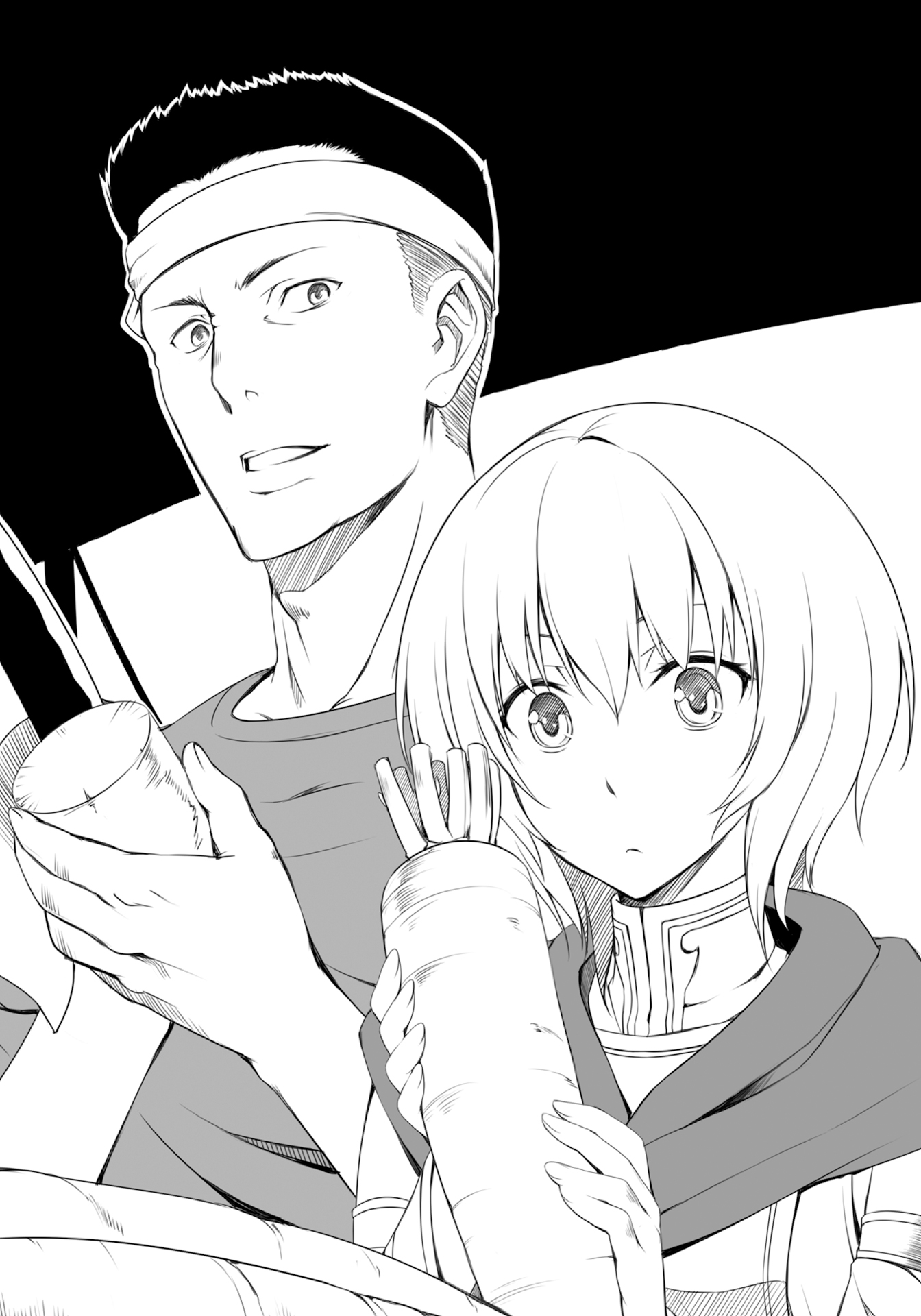
“Da-i-ko-n,” Lelei repeated, tilting her head in thought. She inferred that the word “yes” before “daikon” must signify affirmation.
There was no doubt. The name of this vegetable was “daikon.”
“Da-i-ko-n,” Lelei said again.
The man smiled, nodded vigorously, and said, “Sou, sono touri.” (Yes, that’s right.)
He proceeded to skillfully shave the vegetable called daikon into thin slices that looked like bandages. Observing his impressive knife skills, Lelei wondered if all the men in this world were such adept cooks.
Thus, the sage Lelei La Lalena began her rapid journey of learning Japanese, albeit with a few small misunderstandings along the way.
Chapter 07
Chapter 07
In the end, the three attacks on Alnus Hill by the Allied Kingdoms’ army amounted to something far less than a battle. It was more like a mass suicide, as if they had blindly marched forward off a cliff. The main reason for this disastrous outcome was that the Empire had given them absolutely no information about the enemy.
At the time, the Allied Kingdoms’ army was composed of soldiers from 21 countries, including the principalities. In total, the troops numbered about one hundred thousand. It truly was a spectacular sight, all those soldiers from distant lands gathering in one place to fight.
There were lightly armed cavalry riding horses bareback; heavily armored cavalry with horses covered in thick iron armor; dragon knights riding wyverns soaring through the sky; massive war elephants shaking the ground with each step; small but tough soldiers from the southern countries; heavily armed infantry with square iron shields; pikemen with long spears, standing in rows like trees in a forest; crossbows, catapults, and ballistae packed densely together. Some countries even had armored orcs and goblins, using them like the Empire’s warhorses. Each contingent seemed to be competing to show off the splendor of its distinct military attire.
With such a grand army—numbering three hundred thousand according to their claims—advancing and filling the land and sky, victory seemed certain. After all, though Alnus Hill was a sacred site, it was still just a barren, gently sloping hill. It had no forests or dense woods to obstruct the view, no large rivers to block the path, and no steep cliffs.
Even though the enemy occupied the high ground of the hilltop, the terrain offered them little advantage. Furthermore, according to the Empire’s reports, the otherworldly soldiers had dug holes and trenches in the ground and surrounded themselves with what appeared to be flimsy wire fences that could be cut with a single swing of an axe.
If they’d built an underground fortress like the ones dwarves made, the winners would simply be the side with the greatest number. However, there was a severe lack of dwarves among the enemy, so completing something like that with only human hands would be impossible in only a month or two.
Such were the thoughts of King Duran of Elbe as he brushed back his graying hair, pondering the true intentions of Emperor Molt Sol Augustus.
The Empire’s army was the most powerful on the continent; crushing such a minor foe should have been simple for them, with no need to get other nations involved. In other words, the motive for this assembly of the Allied Kingdoms seemed more political than military.
Perhaps by gathering all the rulers here, the emperor hoped to demonstrate his authority to both domestic and foreign audiences. However, he could have achieved that goal by simply holding a ceremonial audience with the kings. Assembling a massive force of one hundred thousand troops without a significant reason seemed illogical. The cost of feeding these soldiers alone would be enormous.
Another possibility was that this massive force was intended to attack another country. However, Molt had said he needed the Allied Kingdoms’ army to defend the continent. An offensive mission would be unjustified.
“How shall we attack, Lord Duran?”
Normally, such a question from Duke Ligu would be a serious matter to discuss in the war council. However, given the massive force they possessed, detailed tactics seemed unnecessary. With such a large army, the strategists thought, small-scale tactics would be pointless. Anything the enemy could try would be like throwing an egg against a rock.
Instead, Duke Ligu seemed to be teasing Duran for being so worried.
“Lord Ligu, I would ask you to consider this seriously,” Duran replied.
“If I were to attack with just my army, I would need to think about formations and tactics,” the duke responded. “But reports suggest the enemy numbers barely exceed ten thousand. If our information is correct, we outnumber them thirty to one. If we attack all at once, the battle will be over before they know what hit them. Anything we need to know about the enemy, we can learn once we’ve joined up with the Imperial forces facing them on the hill.”
“I suppose so,” Duran admitted.
“You’re quite a nervous man for your age,” Ligu chided him, but the words barely registered. Duran was caught in a mental deadlock.
Mobilizing such a large army took a considerable amount of time. Not only were the roads of this continent not built for it, but the sheer size of the force itself was a hindrance. It took nearly half a day for the rearmost units to start moving after the vanguard set out. Constructing encampments also proved to be a lengthy process, doubling the journey from ten to twenty days. Nevertheless, the Allied Kingdoms’ army continued marching until Alnus Hill was within sight.
They began to encircle it as planned, positioning themselves at what they considered a safe distance from the enemy.
Much to their regret, this “safe distance” had been calculated using the known ranges of magically enhanced arrows, crossbows, and catapults. Moreover, the trenches and rifle pits on the hillside were expertly camouflaged, which meant the Japanese had even more forces that the Allied Kingdoms didn’t know about.
As a result, the four thousand soldiers of the Alguna Kingdom’s army, who had the bad luck of being positioned at the front lines, walked straight into a trap. The absence of the Imperial Army near the hill contributed to their miscalculation. Had they already been defeated? If so, then any surviving soldiers needed to be rescued. Such was the rationale that led the King of Alguna to advance his troops toward the hill.
The Kingdom of Alguna was a small, unremarkable nation with an economy centered on agriculture and livestock. Its lack of distinguishing features had helped it avoid annexation by its neighbors, including the Empire. Its military was fairly typical, consisting of orcs and goblins who were armed with crude axes and used as cannon fodder, followed by heavily armored infantry, archers, a few cavalry, and mages.
Their standard battle strategy involved spreading out archers to shoot arrows while unleashing fierce orcs and goblins to disrupt the enemy lines. Heavily armored infantry would form a shield wall and advance in tight formation to engage the main force. If enough mages were available, a magical exchange would take place at this stage. Finally, the cavalry would charge through the path cleared by the infantry to secure victory.
All of this meant that the Algunan army had no idea what was happening to them when they met a coordinated barrage from the Ground Self-Defense Force’s artillery units—a bombardment with the orchestrated precision of a stage performance.
It was said that the artillery units of the GSDF worked with such precision that they could create an image of Mount Fuji in the sky with smoke trails. Within moments, high-explosive shells were landing almost simultaneously across a broad area.
The result was annihilation. The victims were the vanguard of the Allied Kingdoms’ army: Alguna at the front with Mudwan behind them. Together, they totaled about ten thousand troops.
The bombardment had been meticulously planned, with the targets positioned within the kill zone before the attack commenced. The initial salvo alone concluded the first engagement.
※※※
“I was in the middle of the formation. At first, I thought Alnus Hill had erupted. Have you ever seen a volcano erupt, Princess? I have, once, when I was a child in my mountainous homeland. An explosion so massive it seemed like the mountain itself had blown up. This explosion was just as tremendous. There was no earthquake preceding it, just a deafening noise and then an enormous blast. I thought my heart would leap out of my chest from the shock. And it happened only once.”
“We stopped and strained our eyes to see what had happened. But smoke blocked the view ahead. I don’t know how long it took for the smoke to clear. It seemed like a long time, but it might not have been that long. Eventually, it cleared.”
“And then we saw the land; it looked like an enormous field that had just been plowed, covered with the bodies of Algunan and Mudwan soldiers. Like a crude paella, with grains of rice and ingredients strewn around…”
King Duran lay back on his sickbed, closing his eyes as he recalled the gruesome scene. Beside him, a nursing sister was feeding him paella, but he turned his face away. He couldn’t stomach the stuff after the mental image he’d just created.
“What happened to the kings of those countries?” Piña asked.
Duran shook his head. “It was terrible…”
After several days of searching the villages around Alnus for the Allied Kingdoms’ army, Piña confirmed that the soldiers had lost cohesion and been forced to retreat to their homelands. The defeated soldiers barely survived the journey, and only because the enemy had chosen not to give chase. Piña knew that their long march home would have been fraught with hardships worse than the battle itself. Many of them had been buried by local farmers along the way.
She had eventually heard a rumor that a person of noble status was being cared for at a monastery dedicated to the god Hoboro. Rushing to the place, she’d discovered that it was the King of Elbe.
As soon as Piña identified herself, she was led inside, where she saw Duran lying on a sickbed. He was missing both his arm and leg on the left side. His salt-and-pepper hair had gone entirely white, quite likely due to the stress brought on by the battle and his injuries.
In his condition, a long journey was out of the question. Most of his soldiers had scattered, and he had sent the few remaining loyal ones home to report what had happened. However, he was lying in a small rural monastery with no doctors and not nearly enough food. This wasn’t recovery; it was slowly wasting away.
The moment Piña entered the room, she was hit with the stench of pus from the stump of the king’s lost limbs. His face was ashen, and his eyes were dark with circles. It was clear he didn’t have very long to live.
“I’m sure you can tell my condition just by looking at me… During the third major assault, I advanced with my men to the middle of the hill. We were blocked by iron thorns. As we struggled to get through, lights rained down on us like a storm. We were blown away in an instant,” Duran recounted.
“Your Majesty, I’ll send word to the capital right away,” Piña offered. “We’ll arrange for a doctor and a carriage. Please stay with us. I know you’ll get your strength back.”
Despite being a princess of the hegemonic Empire, Piña observed court protocol, recognizing King Duran as her superior. She knelt, took his remaining right hand, and bowed.
Duran shook his head. “I apologize, Princess, but I don’t intend to rely on the Empire. Besides, I don’t have much time left.”
“Why is that?” Piña asked.
“I’ve been wondering all this time: Why did the emperor summon the Allied Kingdoms’ army for this battle? I finally understand. Molt knew this would happen. Most likely, the Imperial Army suffered the same kind of defeat. The rest of us were a nuisance to him, a threat. In other words, the emperor left us to be dealt with by the enemy.”
Duran’s voice was filled with anger, practically spitting the word “emperor” without a hint of respect. He was a dying man, and he would tell it like it was.
“You can’t feign ignorance, Princess,” he went on. “You were part of the Imperial Army. You must have known what happened when they fought the enemy at Alnus.”
“It’s true, I was aware of the Imperial Army’s defeat,” Piña replied. “But I didn’t know that the nobles were sent to Alnus without being told what kind of enemy awaited them.”
“Begone,” Duran commanded. “Don’t stand behind us clad in false armor, wielding a deceitful sword. The Allied Kingdoms’ army fought to the last to defend this continent. But our greatest enemy—the Empire itself—was hiding at our backs all along. I’ll ask you one more time: Leave.”
“Your Majesty… I won’t ask you to calm down. But please, at least tell me about the enemy. What magic and tactics do they use? Your experience in battle against them is valuable. Won’t you share it with us?” Piña pleaded.
Duran shook his head. “You’ll get nothing from me. We sacrificed ourselves to learn what we did. If you want to know, go to Alnus Hill yourself. Maybe the enemy will teach you too, in exchange for the blood and flesh of your soldiers.”
Piña was desperate. Her father had underestimated the enemy. He believed that the difference in combat power could be offset by strategy and cunning. But Pina had a concern—no, a premonition. There was a fundamental disparity in strength between them and the enemy, and if they didn’t find out soon what made the enemy special, the Empire would face a decisive defeat.
The sound of clenching teeth accompanied the Imperial Princess’s fierce gaze.
“That will not do. One way or another, you’re going to tell me. If you refuse to speak, I’ll consider the Kingdom of Elbe itself as collateral. Should Your Majesty pass to the underworld without saying anything, I will lead my soldiers to invade Elbe, and turn it entirely into scorched earth.”
“Wh-What?!” Duran stammered. “You take my soldiers, my retainers, my life, and now my land and family too? Well, like father, like daughter, I guess. All right then, do as you wish. My life is already forfeit. Whether my homeland is annexed by the Empire and becomes a province sooner or later is of no concern to me. With the sound of the grim reaper’s footsteps in my ears, it matters not. I will wait for my family in the underworld. And when you and the emperor join me, I’ll be laughing.”
“Are you getting desperate as you stare death in the face? The Empire will never lose,” Piña declared, standing up and looking down at the dying king.
Duran drew himself up, wincing a little at the pain but still spitting out his next words.
“With strength, with power, you can do anything. That’s the way of the world. But know this: We still have our pride. If it’s trampled on, we will retaliate. You should expect no less. The enemy at Alnus is a formidable army, wielding weapons and tactics that crushed us like insects before gods. The Empire that has brought this enemy to our lands will meet the same fate. Whatever strength you think you have that lets you do as you please, know that the enemy at Alnus is even stronger. The Imperial Army is a paper tiger before them. When the time comes, and you finally realize that and ask for help, no one will come to save you. You’ll reap what you’ve sown!”
The king gave a loud, shuddering breath as he sank back onto his sickbed.
Piña had no more words. Even with power and might, it was difficult to break down the fortress of a person’s inner will. Piña could have done it, of course, but it would have left the king dead.
Besides her anger at the obstinate Duran, she felt resentment toward the emperor who had driven the nobles to such estrangement.
As Piña left Duran’s room, a voice called out from behind.
“Princess… please don’t say you’re going to charge Alnus with the knights.”
Pina sighed heavily. “Hamilton, do you take me for a fool?”
“No, I don’t. But it felt like you were about to shout ‘Follow me!’ and dash off.”
If I were going to dash off, it would be back home, not toward Alnus, she thought. But voicing that would have been inappropriate.
Standing before Hamilton, who at that moment resembled a handsome young nobleman, Piña was suddenly struck by the urge to verify if she was indeed a woman. She lightly tapped Hamilton’s flat chest with the back of her hand, finding a slight softness.
She was immediately embarrassed by her own lack of restraint. Must be the stress, she thought. I’m just looking for release.
“Well, fine,” Piña said as if nothing had happened. “Whether we charge or not, I need to go to Alnus at least once. I want to see the enemy with my own eyes.”
“But, Princess… Isn’t that dangerous with a group this small?” Hamilton asked.
“To be honest, yes, it is dangerous. So, you’d better protect me,” Piña replied. Without waiting for a response, she turned and walked out of the monastery.
Zhongnanhai, Beijing, People’s Republic of China
On President Dong Dechou desk sat a hefty bundle of documents, filled with horizontal simplified Chinese characters. Delivered straight from the Central Strategy and Intelligence Bureau of the Communist Party, it was plainly labeled “Twenty-Fourth Far East Intelligence Report.”
Dechou lowered his gaze to the report. Although it was titled “Far East Intelligence,” the majority of its content focused on Japan, and the Special Region in particular.
“The Special Region, huh…” the president muttered to himself.
At first, he’d thought the whole thing was a joke. He was grudgingly aware of the significant influence of Japanese anime culture worldwide—even his son watched it in secret. Therefore, when reports came in about a “gate” opening in Ginza that led to another world, from which fantastical creatures and medieval knights emerged…
After cross-referencing the actual news footage and reports from embassy staff, there was no denying the truth. The president’s next reaction was one of mild sympathy: “What an unfortunate disaster for Japan.” But once the Self-Defense Forces had repelled the invading forces from the Gate, the possibilities of what lay beyond became glaringly obvious.
There were predictions of a vast continent and nearly untouched resources on the other side. However, the notion that these should become Japanese property was unacceptable; wrong, even. True, Japan was a small, resource-poor country, but it was already a developed and wealthy nation.
In contrast, these resources were exactly what China needed. With a population of 1.3 billion and growing, providing a prosperous life for everyone would require immense resources and expansive land. Regardless of international condemnation, ensuring the nation’s future and rich livelihoods for its people meant securing enough resources and energy for everyone.
If the Gate had opened in Beijing, the problem would have already been resolved. Sending thousands or even millions to develop and settle the Special Region would lighten China’s burden and allow self-sufficiency in resources on the other side of the Gate. This would eliminate the need for aggressive tactics or the risk of harsh international criticism. But the Gate was in Japan, and correcting this misfortune was no easy task.
Dechou skimmed through the document, then sighed. “As long as the Gate’s in Tokyo, there aren’t many options available to us,” he mused. “The main focus is on securing our share of the development of the Special Region.”
“We can’t allow Japan to monopolize it,” his secretary said, nodding.
“Exactly. That’s why we need to impose tariffs on everything the Japanese government does in the Special Region,” Tai decided.
“Of course,” the secretary replied.
“We’ll engage in a balanced negotiation approach, advocating for what we must while maintaining a facade of friendship with Japan. Ideally, we would send nearly half our population to the Special Region.”
“Are you thinking of creating another China inside the Special Region?”
“If it came to that, it would be a welcome development,” the president replied, smiling as he placed the report into his desk drawer.
At some point in the past few days, there had been a subtle shift in the tone of TV and newspaper commentary. Documentaries on public broadcasting channels began focusing on historical events where dominant civilizations oppressed and wiped out weaker indigenous populations. They highlighted the history of the Aboriginal people during the colonization of Australia by British convicts, the fall of the Inca Empire to the Spanish, and the destruction of Carthage by Rome.
All of this was purposeful, of course. In everything from variety shows, dramas, and quiz shows to weekly magazines and newspapers, subtly crafted messages were disseminated to influence public consciousness. Each narrative depicted the tragic suffering of the oppressed. Gradually, viewers were led to sympathize with the weak, and to conclude that the powerful must be restrained and made rational. Images of children dying from famine in Africa now prompted introspection: Are we becoming the oppressors?
What exactly was the JSDF doing on the other side of the Gate? Ostensibly, engaging the enemy in combat. And those battles beyond the Gate were attracting more and more public attention. However, there had been no significant updates, only reports that the Gate had been secured and enemy invasions repelled. The lack of casualties among the Japanese military made people overlook the enemy’s losses and the impact on civilians beyond the Gate.
In the Diet, an opposition lawmaker questioned the government, and the Deputy Minister of Defense responded to her query.
“In three battles, the enemy has suffered approximately sixty thousand casualties. There have been no civilian casualties due to our engagements.”
The opposition lawmakers were left speechless.
Essentially, the enemy had launched reckless attacks against well-defended positions, like a reverse scenario of the Battle of 203 Hill during the Russo-Japanese War. The enemy was simply foolish.
Most citizens, however, couldn’t comprehend why the lawmakers were so surprised. In war, deaths were inevitable. It was as simple as the losers dying more than the winners, wasn’t it? Many citizens, driven by anger from the Ginza Incident, accepted this as a matter of course. However, for those who considered themselves more rational than the general public or who prided themselves on their empathy and “goodness,” this number was intolerable.
“Ground Self-Defense Force Blunder? 130 Civilian Casualties!”
“Deputy Minister’s Statements Suspected False!”
“Unknown Battle in the Special Region: Are There Truly No Non-Combatant Casualties Among the Vast Enemy Dead?”
Headlines like these soon adorned the front pages of newspapers like Mainichi and Asahi.
Journalists from TV and newspapers swarmed the Ministry of Defense and the Prime Minister’s Residence, directing a barrage of microphones and cameras at the Prime Minister and the Minister of Defense.
With Prime Minister Houjou having recently retired, it fell to the newly appointed Prime Minister Motoi Shinzou to face the reporters’ harsh questions.
When a series of scandals erupted involving corruption among cabinet members and deputy ministers, Prime Minister Shinzou was repeatedly held responsible as the one who had appointed them. His answers naturally became cautious, and this was reported as “struggling to respond” or “hesitant,” further tanking his approval ratings.
In the Diet, the opposition began pressing the issue.
During budget committee sessions, ruling and opposition lawmakers faced off against cabinet members and ministry deputies.
Each time an opposition lawmaker stood up and posed a question, the relevant minister or deputy would step forward to respond.
“The civilian casualties reported this time were not caused by combat with armed forces in the Special Region, but disaster,” the Deputy Minister of Defense replied to one question.
“What kind of disaster are you referring to?” asked another opposition member. “How is it related to the Self-Defense Forces?”
“The disaster in question was caused by a dangerous beast. Reports describe it as a creature comparable to a monster from a movie. The JSDF’s reconnaissance team engaged with the creature to rescue civilians under attack.”
“Wait a moment. A monster? Are you saying creatures like that exist in the Special Region?”
“Not exactly a monster, but something very similar. It’s officially classified as a Special Region Class A Beast, commonly referred to as a ‘dragon.’ But if it pleases the committee, we can use the term ‘monster’ here. We’ve received samples of the creature’s remains.”
“That’s quite a tall tale, but if we accept that, are you saying this incident involved non-combatants caught in the crossfire between the JSDF and these so-called ‘monsters’?”
“No, that’s incorrect. All casualties were caused by the monster. The Self-Defense Forces used their weapons to defend and rescue non-combatants who were under its attack.”
“Deputy Minister, you previously stated that there were no non-combatant casualties. Now we hear about this incident with numerous casualties. Why was this not disclosed earlier?”
“During the previous inquiry, I understood the question to be about attacks by armed forces on our military securing the Gate and whether there were non-combatant casualties in those engagements.”
“I understand about the fatalities now. Given the scale of this disaster, future incidents should be reported promptly. Also, what happened to the civilians rescued by the JSDF?”
“They’re reported to have evacuated to nearby villages and towns. Initially, they abandoned their villages when the monster appeared and were attacked while evacuating.”
“I see. So, all survivors managed to evacuate. Do you have information about their current situation?”
“No, we only control a small area around the Gate. We can’t confirm the conditions of the evacuees. However, injured people, the elderly, and unaccompanied children deemed unable to live independently have been taken into the care of the Self-Defense Forces.”
“I see, there are civilians involved,” the opposition lawmaker said, then shifted focus. “Chairman?”
“Without hearing directly from those involved, we can’t verify the truth of those reports. The Special Region is too dangerous for reporters or lawmakers like us to enter.”
“Given this situation, it’s difficult for us to simply take the government’s unilateral report at face value. Therefore, we would like to summon the involved soldiers and the disaster victims as witnesses…”
Other members of the opposition quickly rallied behind this proposal. If the government had nothing to hide, there should be no reason to refuse their request.
The Prime Minister’s Office and the ruling party, weary of the relentless scrutiny from the opposition and the media, decided that if this could clarify the truth and deflect criticism, it was worth doing. And so, they arranged for the field commander and several local representatives to be brought over to Earth’s side of the Gate.
Chapter 08
Chapter 08
Now, let’s talk about the field commander.
Itami sat diagonally across from the operations training officer, ignoring the man’s frosty stare while reading his favorite web novel on his cell phone.
It was only recently that mobile phones had become usable on this side of the Gate. Before the shared cell tower was installed, he’d had to cross back through the Gate and go all the way to Ginza during his breaks.
“So many updates since the last time I checked. Oh, I need to save this one for later…” Itami muttered to himself.
Unlike the novels lined up in bookstores, web novels came in every genre imaginable, including both original and fan works. The sheer quantity was overwhelming. Reading everything was an impossible task, but finding a good story felt like hitting the jackpot. If a story didn’t grab Itami within a few lines, he’d quickly move on to another one.
Sometimes he’d find out about a great story through forums, only to find that it had already disappeared from the internet. These disappearances saddened him, especially when it was a favorite of his that he could no longer revisit.
“Hey, Lieutenant, are you listening?”
Itami tried his best to ignore the clear female voice calling from diagonally behind him. He intended to avoid anything related to work while he was on his break. However, the throat-clearing sounds from the operations training officer (essentially the company staff officer) prevented Itami from getting immersed in his novel. At times like these, he wished he had a private office.
“Lieutenant,” came the voice again.
“Gah!” Itami exclaimed.
It was an ordinary voice in both tone and volume, but it sent a sharp pain through Itami’s calf. Could sound harm a person? In this world, did sound have offensive capabilities?
As he turned around, he saw Kuribayashi and Kurokawa looking at him with disgust. It turned out that the source of the sharp pain in Itami’s calf was the toe of Kuribayashi’s combat boot.
A martial artist’s body was itself a weapon, and Kuribayashi had the badge to prove it. Itami wondered if this kind of brute force against someone who wasn’t resisting was allowed. As he glanced at the operations training officer who should have witnessed this, he saw the man looking out the window, his face a mask of serenity. It seemed Itami had no allies here.
“Could you listen to us, please?” Kurokawa asked.
“Me?” Itami asked, but he closed his cell phone and tossed it into the desk drawer. He turned around in his chair and leaned back, causing it to creak. “I’m not sure how I can help you anyway,” he muttered, his voice weary and resigned. “But what’s up?”
“It’s about Tuka,” Kurokawa said. She was referring to Tuka Luna Marceau, a blonde, blue-eyed elf girl and one of the refugees the Third Recon Team was protecting.
“What about her?” Itami asked.
“Well… She’s been acting strange.”
Kurokawa explained that the elf always requested food for two people. The same went for clothing and other supplies—she always requested two sets. She also used a room meant for two people by herself.
Everyone had initially assumed that it might be a cultural thing and kept silent. But the more they got to know the refugees, the less likely it seemed.
“Maybe she’s just greedy? Or maybe it’s some weird elf thing?” Itami suggested.
“No, it’s not that. When I say she asks for food for two people, I mean she demands two sets of utensils and dishes for two people,” Kuribayashi explained, flipping through her notes.
“Feeding someone else? Maybe hiding a pet?” Itami suggested.
“She always throws one meal away, untouched. And for clothes, she always requests extra men’s clothing,” Kurokawa clarified.
This piqued Itami’s curiosity. A faint headache stirred memories he thought he had buried deep.
“Hmm. Did you ask her about it?” he inquired.
“We couldn’t communicate well, so we asked Lelei to help us, as she knows their language best. We had her ask, ‘Why do you leave food?’”
“And?”
“Her response was ‘I don’t know,’ ‘during meals,’ and ‘not here.’”
Silence filled the room. The idea that she might be living with “someone” crossed Itami’s mind.
“Maybe she has an imaginary boyfriend or something?” Itami joked, but Kurokawa and Kuribayashi didn’t laugh.
“Honestly, I hope that’s all it is,” Kurokawa muttered.
“Have you asked a medical officer?” Itami asked.
“We don’t have a psychiatrist here. And there’s a possibility that she’s mourning by treating a deceased family member as if they were still alive. We can’t just decide what is and isn’t normal for her.”
“Then, how about asking Lelei’s mentor, Professor Kato? The old man might know something.”
“We did ask, and he shares our view. According to Professor Kato, Tuka is an exceptionally rare type among the elves. The words he used were ‘uncommon’ and ‘unknown.’”
With limited vocabulary, nuanced explanations were difficult. Phrases like “I don’t understand,” “I lack information,” or “I can’t speculate” all turned into “I don’t know.”
We really need to find a better way to communicate, Itami thought, not for the first time.
“She truly is a fairy-tale elf,” he mused, his curiosity piqued. But her mental state was more pressing. “We need to talk to her more. We need to figure out if she genuinely believes someone’s still there or if she knows they’re gone but pretends otherwise.”
“Of course, but it’s been a challenge. She hasn’t opened up to us much,” Kurokawa admitted.
Itami nodded, pondering the situation. Kurokawa of the Third Recon’s “mismatched WACs” was immensely popular with the refugee children. Even the troublesome black-clad priestess girl (whom Lelei described as “not a child—older, much older”) would almost always listen to her.
Itami turned his gaze to Kuribayashi.
“I don’t have that kind of rapport. And besides, I can’t do counseling. I don’t understand psychology,” she admitted.
Indeed, Itami thought, this petite, busty, muscle-brained girl was better suited for solving problems with her fists. Expecting her to handle delicate issues of the heart was like asking someone to perform brain surgery with a saw.
Itami nodded again. “Got it. I’ll talk to her later. Though I can’t promise it’ll go any better.”
“The children have been picking up Japanese lately. They’re probably learning our language faster than we’re learning theirs,” Kurokawa added.
Itami was about to point out that Tuka wasn’t a child, but before he could, Sergeant Major Kuwabara’s voice echoed from the hallway.
“Commander, it’s time. Kurokawa, Kuribayashi, you two come as well.”
“Yes, sir,” they replied promptly, heading out to the hallway.
“Prepare the weapons!” With this command, the members of the 502nd Squadron formed lines by platoon and headed into the armory. They systematically took out rifles, bayonets, and pistols from the neatly arranged gun racks. The Third Recon members joined the queue and retrieved their weapons from the armory.
Once outside the building, they adjusted the flash suppressors on their Type 64 rifles, giving them a full turn to ensure they were tightly secured. The suppressors had been loosened before the rifles were stored to prevent the seating rings from wearing out. This adjustment also tightened the bipods and bayonet latches that had been loose.
Next, they used black vinyl tape to secure various parts of the rifles to prevent them from falling off. As this was a real combat situation, bayonet fighting remained a possibility, and meticulous preparation was essential.
They set up the bipods and arranged their rifles in rows, attaching bayonets to their belts. The bayonets were already sharpened for combat, with serrated edges that seemed to cut even better. The soldiers sat down and began loading the distributed ammunition into their magazines. Each soldier received six magazines, each holding 20 rounds for a total of 120 rounds per person. Even hand grenades were distributed.
Sergeant Furuta, responsible for the 5.56mm Minimi machine gun, carefully folded and loaded the linked metal belt ammunition into the box magazine. Katsumoto was loading the Panzerfaust 3—a 110mm anti-tank weapon—onto the LAV. This weapon was crucial for effectively attacking the Class A Beasts, commonly referred to as dragons, which led to an increase in its carriage.
Sasagawa was operating the 12.7mm heavy machine gun, also mounted on the LAV. The ammo belts had a high proportion of black-tipped armor-piercing rounds. After loading the spare ammunition and various supplies, everyone carried their weapons and confirmed their formations.
At Sergeant Major Kuwahara’s command, they practiced forming ranks swiftly, moving horizontally, vertically, and into square formations. They practiced quickly spreading out or clustering together, ensuring each member knew their designated direction of watch. They also reviewed who would cover for anyone missing and how to handle various situations, despite each person already understanding these protocols. Having this down by heart was key to staying alive.
This meticulous preparation might have been a result of studying various TV dramas featuring JSDF soldiers in otherworldly settings. These dramas often showed that the most common reason well-armed soldiers were defeated was being isolated and surrounded by countless enemies. And so, careful coordination and mutual support were emphasized as fundamental principles.
With their preparations complete, Itami and his team lined up and, at Itami’s command, attached magazines to their rifles. They checked for loaded rounds, chambered them, and set the selector switch to “safe.”
“You know, supposedly, in the Maritime Self-Defense Force they say, ‘Prepare for battle!’ or something…” Itami’s casual remark broke the tense atmosphere, causing everyone to relax.
“Isn’t that a line from an anime?”
“Anyway, once we leave the camp gate, we’re in a danger zone. Stay alert,” Itami said.
Thus, they set out from Alnus Hill toward the refugee camp lined with temporary housing.
The refugee camp hosted twenty-five residents: twenty-three from Coda, one from an elven settlement, and one black-clad priestess who had joined them along the way. The structures in the camp were essentially prefabricated buildings designed to accommodate ten four-person families, anticipating potential future growth. Although the residents had no familial or kinship ties with each other, they had already formed a tight community where adults looked after children, and the older kids ones cared for the younger ones.
The camp lacked electricity, gas, and running water, but its residents didn’t even know to expect those things. The children fetched water from a nearby spring using jugs. Waste was disposed of in pits dug at the edge of the camp, with lime powder used for sanitation. Drinking water was brought in bottles by Itami’s team.
The camp provided food for three meals a day, with Third Recon supplying lunch and dinner. For breakfast, ingredients were delivered, and the residents cooked for themselves. This often wasn’t enough to fill them up, so the able-bodied among them foraged for edible plants in the forest. Lunch mainly consisted of Type II combat rations, while dinner was cooked on makeshift stoves within the camp, with Sergeant Furuta and the children often working together.
Itami’s team could have supplied all three meals, of course, but they wanted to encourage self-sufficiency among the refugees. The support from the JSDF focused on assisting self-help efforts, a principle rooted in their operations since their deployment in Iraq. They hoped that eventually the refugees would be cooking all their own meals and possibly finding work to support themselves; at least for food and clothing, if not housing.
Still, the camp couldn’t push its residents too hard. The demographic included two elderly women, one elderly man, two middle-aged women with injuries, one middle-aged injured man, and nineteen children. The three middle-aged individuals, suffering from fractures and other injuries, could help look after the younger children but were likely unable to work.
Through conversations with Lelei, which had been getting easier every day, they’d found out that three of the nineteen “children” were not actually children: the black-clad priestess, the elf girl Tuka, and Lelei herself.
Determining the ages of the three non-kids proved tricky, the priestess especially so. According to Lelei, “Not a child. Older, older than older, much older.” When Itami attempted to get a specific number through interpretation, the usually expressionless Lelei showed a rare moment of reluctance, her face stiff as she shook her head vehemently.
Lelei herself was fifteen years old, considered an adult in this world. Tuka was one hundred and sixty-five.
Obtaining even these numbers should have been easy, but the process was surprisingly arduous. In Lelei’s case, she communicated her age by forming an OK sign with her thumb and index finger while holding up her middle finger, then making a thumbs-up sign. This represented fifteen, but the gesture was different from what was familiar in Japan. The team had to establish a shared understanding by using pebbles to represent numbers: one pebble for one finger, five pebbles for a thumbs-up, and ten for a circle formed with the thumb and index finger.
With this system, one could count up to sixty-nine using one hand, and seemingly higher if needed. However, its practical use here was limited, and Lelei quickly learned to count in Japanese to speed things along.
When Itami and his team arrived at the camp, they were greeted by Lelei and the children. When Kurokawa appeared, however, the younger children flocked to her. The team unloaded drinking water, food, medicine, combat rations, and daily necessities.
In exchange, an older boy loaded two white canvas bags into the vehicle—they were roughly the size of pillows and looked quite heavy. Lelei and Tuka also climbed into the high-mobility vehicle. Lelei carried a dull-colored staff, and wore leather sandals and a garment of light brown fabric that looked like a poncho with Incan-style patterns.
In stark contrast, Tuka wore a green T-shirt, skinny jeans, and basketball shoes. If it weren’t for her pointed ears and the bow and arrows she carried, she could easily have been mistaken for a high school girl from the American West Coast.
The boy who had carried the bags returned to the refugee camp, where the older boys and girls were busy working. At the base of Alnus Hill lay numerous carcasses of downed wyverns. According to Mr. Kato, wyvern claws and scales were incredibly tough and quite valuable for their use in constructing high-grade weapons. At his encouragement, the children had been collecting the decaying corpses, painstakingly stripping off the scales and claws, cleaning off the meat and grime, and drying them. Today was the first time that Lelei and Tuka would take these materials to town to sell. If this venture could generate a steady income, it might become a sustainable business, aiding in the refugees’ self-sufficiency.
The priestess named Rory had also joined the group, for reasons unknown to Itami. She wore her usual black Gothic Lolita dress and carried a heavy-looking halberd. For Third Recon, this trip was an opportunity to observe commercial transactions and gather intelligence on the townspeople’s reactions. They were also carrying several product samples from Yanagida to see what local merchants might be interested in.
Meanwhile, the JSDF buried the bodies from the Allied Kingdoms’ attack as well as the Imperial Army from earlier, along with their armor, weapons, and wallets. Collecting these items could have resulted in a substantial fortune—soldiers in this world carried their salaries on them, and there were high-ranking knights and nobles among the dead. However, ethical considerations prevented the JSDF from touching them. This decision unintentionally caused a small economic disruption for the Empire and surrounding nations due to the sudden disappearance of a large amount of currency, but this impact would only become clear later.
The JSDF had also gathered as many riderless horses as possible, fearing complaints from animal welfare groups. However, feeding the massive number of horses would become a serious problem once fodder from the enemy’s abandoned supplies ran out. The area around Alnus was barren, with no pasture for grazing.
Before he quite realized it, Itami had found himself tasked with finding new owners for the horses.
Now, as for the dragon scales entrusted to Lelei and the others, they had about two hundred scales from two wyverns, along with three dragon claws. And this was even after removing the damaged, broken, and unusable pieces.
The thought of harvesting scales from all the wyvern corpses scattered around Alnus Hill made both the refugees and Professor Kato dizzy with anticipation. Initially, the refugees had been overwhelmed by the directive to “be self-sufficient”; after all, they were all elderly, injured, or children, and they couldn’t cultivate fields, cut wood, or hunt effectively on their own.
Lelei and Tuka had even considered selling themselves out of desperation. However, when they were told that they would receive assistance and were given the right to collect valuable items from the wyvern corpses, it felt like they were being told to grab as much treasure as they could. Their initial reaction was disbelief. “Is this really okay?” they asked each other.
Unfortunately, village life was all they’d ever known, and their imagination was limited to thinking about how the treasure could help them buy necessities and new clothes. Taking any more than that seemed plain unnecessary.
There were several types of dragon scales, their market value determined by grade and condition. The highest grade came from ancient dragons, whose pristine scales could fetch as much as ten swani gold coins each. A suit of armor made from the red scales of a fire dragon, though extremely difficult to craft, would be considered a legendary artifact worth enough to buy a country—if such an item even existed.
The next most valuable scales came from the newborn dragons. However, even those kinds of scales were almost never found on the market. As previously explained, dragons weren’t hunted by humans. When humans did come into possession of such scales, it was because the dragon had shed them during molting. Some legends and myths featured armor made from dragon scales, with some actual pieces enshrined in temples dedicated to war gods.
As for wyverns, nations that employed dragon riders in their militaries could obtain their scales more consistently. Additionally, since wyvern scales were relatively small, their market value was significantly lower, typically ranging from thirty to seventy silver denarii coins per scale. One denarius alone was enough to feed a person modestly for five days. In other words, Lelei and her companions selling two hundred wyvern scales would make them quite wealthy.
Of course, selling such a large quantity required selecting the buyers carefully. Lelei wanted to choose a well-known, reputable merchant to ensure a safe cash transaction; however, she wasn’t sure whether such a merchant would take a young girl like her seriously. On the other hand, smaller merchants might not have the funds and could request credit, which Lelei, despite being a sage, was not comfortable with.
Fortunately, her mentor Kato had an old friend who was a merchant, albeit located somewhat far away. Lelei planned to visit this merchant, trusting that the dependable JSDF members would accompany her for the journey. She looked over at Itami and his team for reassurance.
“Hmm? What is it?” Itami asked, noticing her gaze.
Lelei, maintaining her usual expressionless face, said something along the lines of, “Nothing…”
“So, where is this Ludoe person’s shop?” asked Tuka, prompting Lelei to give her the necessary details.
“Italica. The Thessalia Highway to the west, the Romalia foothills,” Sergeant Kuwahara noted, marking the identified locations on the topographic map. This mission had yielded quite a few place names from Lelei, nearly completing the map of the area around Alnus.
“I see. Appia Highway, Romalia River, Crepas Plain, and the Duma Mountains…” Kuwahara mused.
Lelei was fascinated by the foreigners’ map. The maps she was used to depicted mountains, rivers, and lakes with only approximate positions, but this map was meticulously detailed. She eagerly pointed out locations she recognized and provided their names.
She was also particularly intrigued by the compass. The fifty-year-old Kuwahara eagerly taught Lelei how to use it, feeling almost fatherly toward her. Of course, in the moving vehicle, the direction constantly changed, and the needle jumped every which way, making accurate use nearly impossible. Not to mention that he had no idea what the declination—the discrepancy between magnetic north and true north—was in this world.
“So, the strict sergeant they call ‘the Ogre’ has a soft spot for cute girls, huh?” Kurata muttered, glancing at Kuwahara in the rearview mirror. He still remembered his days as a general enlisted candidate student, when the old man had made him run with a rifle in the High Port position (imagine carrying a four-kilogram iron dumbbell in front of you while running a marathon). Seeing Kuwahara’s grandfatherly demeanor melted away those old resentments.
Rory and Tuka were chatting about something. Their rapid conversation in the local language was incomprehensible to Itami and his team, but it was clear that Tuka was being teased, as she eventually pouted and fell silent. Rory grinned mischievously and glanced at Kurokawa, about to say something, but Tuka’s face and long ears turned red as she tried to stop her.
“What’s going on here?” Itami wondered.
Rory chuckled. Tuka may have been 165 years old, but Rory’s age of “older, older, and even older,” as Lelei put it, really did make the elf girl seem like a child in comparison.
“Lieutenant Itami, we’ve got smoke. Ahead and to the right,” Kurata said, pointing.
Seconds later, the same report came over the radio from the lead vehicle.
Itami looked through binoculars in the direction of the smoke, but it was still too far away to make out anything definitive about its source. He had the convoy stop.
“Kurata, does this road pass near the source of the smoke?” Itami asked, his voice calm but laced with concern.
“It seems like we’re heading straight for it,” Kurata replied, pointing at the map.
Itami sighed. “I don’t like this. This is the second time we’ve seen smoke ahead. It’s giving me a bad feeling.”
Next, Itami sought Kurosawa’s opinion. Referring to a topographic map, Kurosawa noted that the town labeled “Italica” was in the vicinity of where the smoke seemed to be coming from. Naturally, the convoy heading along the Thessalia highway was headed toward Italica.
Itami then handed the binoculars to Lelei and asked what she thought. Lelei initially held the binoculars backward and frowned, but quickly realized her mistake, corrected the binoculars, and looked ahead.
“That’s smoke,” Lelei said in Japanese.
“And what’s causing the smoke?” Itami asked, his eyes narrowing with suspicion.
Astute as always, Lelei immediately understood Itami’s question.
“Not from burning fields; it’s the wrong season. This is something man-made. Maybe a file? But it’s too big,” Lelei explained thoughtfully.
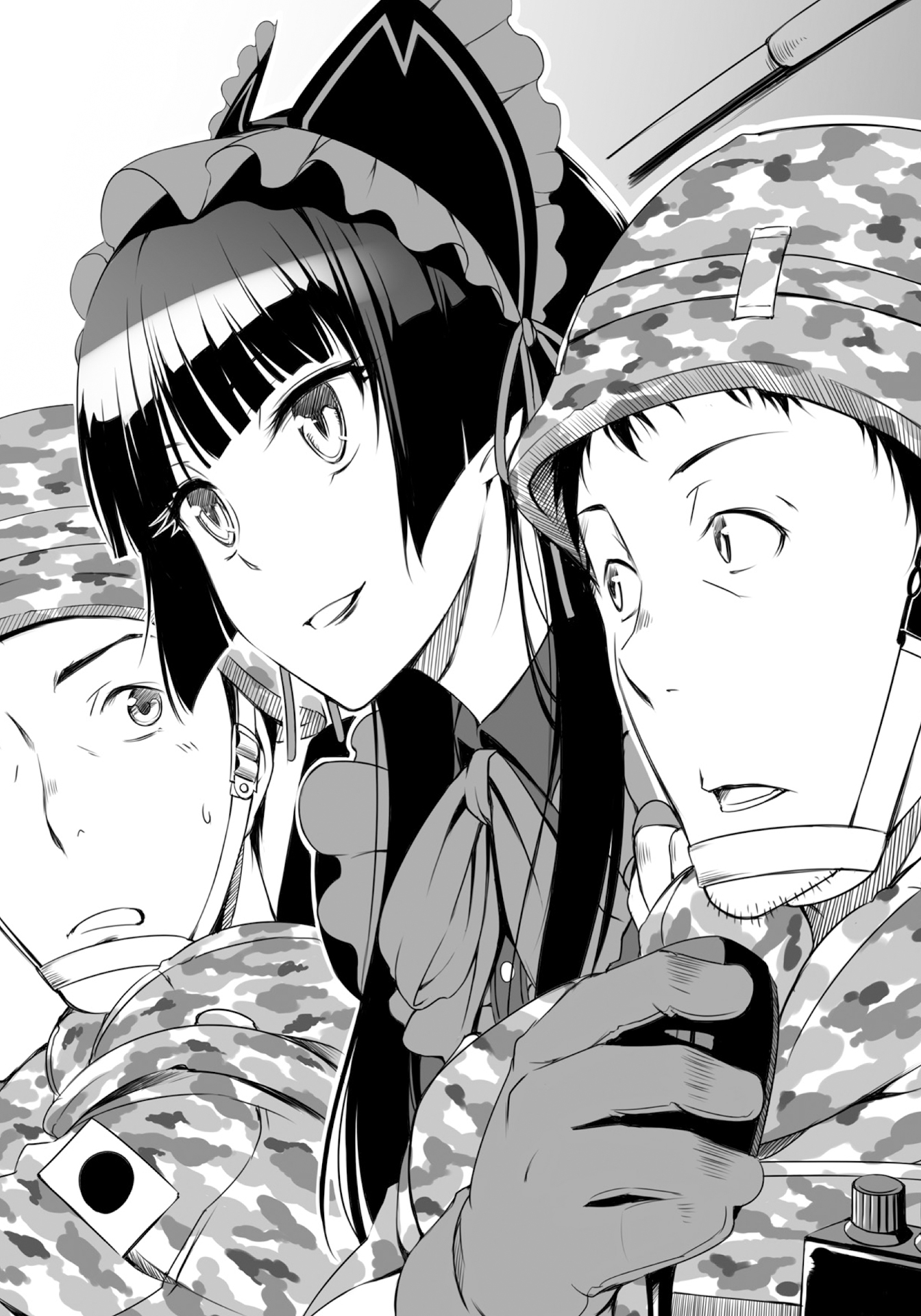
“It’s not ‘file,’ it’s ‘fire.’” Itami corrected, then pondered before giving orders. “Stay vigilant and get closer to the town. Don’t neglect aerial surveillance!”
Kuwahara and Kurokawa grabbed their rifles, scanning their respective sides. Tuka lined up beside Kurokawa while Lelei stood with Kuwahara, all staying watchful. Finally, the convoy began moving again.
Rory leaned between Itami and Kurata, a mysteriously alluring smile on her face as she murmured, “I smell blood.”
※※※
The town of Italica was built around 200 years ago by the lord of the time, who constructed his castle and gathered merchants, enclosing them within the castle walls to create a fortress city.
Back then, Italica thrived as both a political center and a crucial junction of the Thessalia Highway and Appia Road. However, as the Empire expanded and the borders moved further away, its political significance waned, and it settled into its role as a mid-sized regional trading city. Italica had no particular specialties but served as a hub for sending agricultural products, livestock, and handmade goods, such as textiles, from the surrounding areas to the imperial capital.
The city was currently the territory of Count Formal, an imperial noble. Count Formal had three daughters: Airi and Rui, both already married off, and Myui, the youngest. Count Formal had planned for Myui to marry and become his heir when she came of age. However, the war had begun while she was still single, and both Count Formal and his wife died in an accident.
The count’s eldest daughter, Airi, married into House Rowen, and his second daughter, Rui, into House Mizuna. According to Imperial law, this gave them less right to inheritance than Myui. However, as she was only eleven, a conflict arose over who would become her guardian and thus hold actual power.
The debates between Airi and Riu gradually turned from heated discussion to ugly verbal abuse. Myui, caught in the middle, could only fret. The quarrel transcended words, escalating into scratching and hair-pulling. When the women’s husbands tried to intervene, a major uproar resulted, culminating in a small-scale conflict between the soldiers of the Rowen and Mizuna families.
Fortunately, the conflict between the two sides didn’t escalate indefinitely. One reason was that neither side had many troops, and another was that the husbands weren’t as hot-headed as their wives.
Security within Count Formal’s territory was strictly maintained by the former retainers of House Formal and the soldiers of Rowen and Mizuna. Commerce was protected, and the livelihoods of the residents were almost guaranteed. Everyone understood that Italica’s value lay in trade; if the area fell into ruin, everyone was going down together.
Thus, the situation became a stalemate.
The sisters’ dispute moved to the imperial court, and everyone expected that the emperor would eventually appoint a guardian for Myui.
Unfortunately, the Empire’s expedition to another world greatly complicated the situation.
When the heads of Rowen and Mizuna were killed in action, Airi and Rui lost the right to be involved with the Formal territory. The Rowen and Mizuna soldiers withdrew, leaving only Myui and the Formals’ former retainers behind.
The young countess had no power to lead the retainers, and the administration of the territory fell into inertia. Honest retainers existed, but there were just as many self-serving ones. Corruption quickly grew rampant, and lawlessness spread.
The people’s hearts wavered, and public order went downhill fast.
Disbanded soldiers turned to banditry, and ruffians began frequently attacking merchants traveling within the territory, causing trade to halt and Italica’s logistics to stagnate.
It wasn’t long before these bandits and ruffians formed groups and began boldly raiding villages, realizing the potential for much greater reward with very little risk. Groups grew into gangs dozens strong. Eventually, they totaled in the hundreds. Until one day, the town of Italica itself was attacked by such a bandit army.
※※※
Piña, positioned on top of the city gate, fired several arrows at the retreating bandits before lowering her bow with a heavy sigh.
Around her, some of the wounded soldiers were slowly getting up while others lay bleeding on the ground. Arrows were embedded in the stone walls, and smoke rose around them. Citizens stood all around, armed with farming tools and sticks.
Outside the city gate, the bodies of bandits, defending soldiers, and horses lay scattered like a child’s discarded toys.
“Norma! Hamilton! Are you hurt?” Pina called out.
Norma, who had been guarding the fence inside the breached gate, was leaning on his sword, thrust into the ground like a cane. Breathing heavily, he raised his hand slightly to show he was unharmed. Even so, his armor was pierced with arrows and pockmarked with sword cuts.
Hamilton was already sitting down, legs splayed out, barely supporting herself with her arms held back. She looked as if she might collapse backward at any moment. Her sword lay discarded by her side.
“Hahh… Somehow… still alive,” Norma gasped.
“Princess, I’m hurt that you didn’t even mention my name,” another voice called out.
“Gray! I didn’t ask because I knew you were fine,” Piña retorted.
“Should I be pleased or saddened by that, I wonder?”
Gray rested his sword on his shoulder. A stocky and tough-looking man in his forties, he showed no signs of fatigue. If not for his blood-stained sword, one might think he had hidden somewhere during the battle. But anyone who knew Gray Aldo, a seasoned knight from humble origins, knew that he’d never shy away from a fight.
Most of Piña’s knights were of noble birth and lacked real combat experience, so seasoned soldiers like Gray had been promoted to form the backbone of the unit.
In the Empire, the path for a soldier to become a knight or officer was narrow. However, once achieved, there was no discrimination in treatment. Nobles prided themselves on having the same capabilities as veteran soldiers promoted by merit. If a knight of noble origins did look down on merit-based officers, everyone assumed it was because they lacked confidence in their own abilities.
“Princess, why are we dealing with bandits in a place like this?” Hamilton asked. She knew her tone made the question sound like an accusation, but she couldn’t hold back.
“We had no choice!” Piña answered. “We thought the otherworldly army was planning to capture Italica! You all agreed, didn’t you?”
Piña and her group had just completed their survey around Alnus and were about to move onto the hill itself when a rumor reached them: a large armed group was in Count Formal’s territory, and Italica was likely to be attacked.
Upon hearing this, Piña had assumed that the otherworldly army occupying Alnus was finally starting its invasion. Maybe, she surmised, they were planning to send a detachment to subdue the surrounding territories and encircle the imperial capital.
Piña’s preferences might have also swayed her assessment of the situation. She preferred a glorious field battle for her first campaign over a mundane reconnaissance mission. Although the Empire had suffered a crushing defeat in the battle for the hill, a field battle would be different; she just knew it. And so, she postponed the Alnus Hill reconnaissance and ordered the majority of her knights to move to Italica, while she and a few others went on ahead.
Regardless of what strategy you were going to employ, it was crucial to know the enemy’s size and strength. If the enemy force was small, Piña figured they could defend Italica while having her knights attack from the rear, creating a pincer movement.
Surprisingly, upon arriving in Italica, she found that the town was being attacked by a large group of bandits. Moreover, most of these bandits were defeated soldiers from the “former” coalition of kingdoms.
The current head of House Formal, responsible for defending Italica, was the eleven-year-old Myui. She couldn’t possibly command the battle, and the soldiers’ morale had hit rock bottom. Many had deserted, leaving the remaining force critically low.
As disheartening as this was, Piña couldn’t just stand by and watch the town be ravaged by bandits. She barged into the Formal residence, revealed her identity, took command of the soldiers, and began directing the defense of Italica.
“If we can hold out for three days, my knights will get here,” Piña assured them. She didn’t mention that three days was the very, very soonest her knights might arrive.
Believing the princess’s words, the townspeople and soldiers fought valiantly. But because the attacking bandits were disgraced soldiers, they were still skilled in siege warfare.
Although the town wasn’t fully besieged, the supposedly strong city gates were breached; at one point, the enemy had almost stormed into the town. It was only thanks to the citizens and their farm implements that they survived the first day.
The physical and emotional damage was immense. The already small number of soldiers dwindled further, and many of the brave militia members had died. Those who remained were wounded and exhausted. Morale was at an all-time low, and Piña couldn’t think of a single way to lift their spirits.
Such was the unfortunate outcome of Piña Co Lada’s first campaign.
Chapter 09
Chapter 09
Piña Co Lada was born to Emperor Molt Sol Augustus and his concubine, Countess Neryl. Piña was the third daughter and the fifth overall of the emperor’s eight officially recognized children, though it was believed that with bastards included, the real number ranged from twelve to fifteen.
As an officially recognized daughter of the emperor, Piña did have a claim to the throne. However, she was rarely considered an actual heir, as she was only tenth in line when including the emperor’s brothers who ranked above her. Upon reaching an appropriate age, she was expected to marry into a foreign royal family or a prominent domestic noble family while bringing a dowry with her, and lead a discreet yet elegant and leisurely life.
Thus, Piña’s prominence in the court’s social circles had less to do with her political standing and more with her personality. As a child, she had been a troublemaker—irritable, restless, and prone to extreme behavior and pranks.
She began to calm down around the age of twelve when she started a “Knight Club” with the children of other nobles. The rumor was that she’d been inspired by an opera featuring only female actors. Although there was no way to prove this, it was clear that something had happened around that time to influence her.
Piña took over an old but sturdy building on the outskirts of the imperial capital and began living there with her club members, initiating what seemed to be her version of military training. Since all her trainees were aged between eleven and fourteen, it was more like playing house and pretending to be soldiers, leading to repeated failures in every aspect of daily life. Despite this, for the children, everything in those days sparkled with a sense of novelty and adventure.
It wasn’t long before a few adults, concerned for the children’s well-being, came to check on them. But seeing the children having such fun, they realized their concerns were unfounded. “They’ll come home soon, once they get bored and miss us,” the parents said.
Indeed, scarcely 72 hours after the children had left, they returned home with smiles. Their parents greeted them warmly, asking, “Did you have fun?”
Piña, however, was just getting started. She possessed an uncanny ability to assess the capabilities of herself and her companions; she even seemed to know that her friends would get bored after two days and want to go home at three hours past noon. She let them leave, so that they’d come away thinking, That was fun!
One week later, the second Knight Club was held. They used the same building as before for their barracks, but this time they involved cooks and servants in their play, significantly improving their living conditions. Seeing this, both the children and their parents were quite relieved.
Although everyone thought of it as nothing more than child’s play, Knight Club was getting closer and closer to actual military training. Parents began saying things like, “The children seem more active,” “They’re getting stronger and healthier,” “They’ve stopped being picky eaters,” “They’ve become more disciplined,” and “They’ve become more sociable and have good friends.” The princess’s club was unilaterally considered a positive influence. With each new week of activity, nobles offered donations and facilities, creating an atmosphere that encouraged participation among noble society.
The group of friends Piña gathered during this period was known as the first class. They had created rules and regulations, oaths for members, a variety of ceremonies, and a ranking system. All of these became the norms in their daily lives.
Two years after the establishment of the Knight Club, and in the year Piña turned fourteen, the training camps often went on for two to three months. Academics were not neglected as part of this training; several court scholars were invited to the barracks to teach. From this point, parents began to see the Knight Club less as “play” and more as a form of “youth education.”
Even if Piña’s work had stopped there, it would still have been considered a meaningful contribution to the educational history of the Empire. It fostered independence, disciplined living, respect for elders, and care for the young. It was almost like a family, as trainees chose partners to form sworn sibling relationships with through a special ceremony. This knightly ethos was viewed favorably by the adults.
Around this time, similar youth organizations began to crop up in various places. These groups would continue to this day, inheriting the ideals of the Knight Club from that period. However, Piña remained committed to developing her organization as a military force.
When Piña was fifteen, she invited external instructors. She had seen how her students’ physical strength had increased through their military training, and how they had become accustomed to basic training in swordsmanship, archery, and horseback riding.
It was hard to know how the officers and non-commissioned officers felt when they received orders to serve as instructors for the Knight Club. It might have been a decent gig for those nearing retirement, but for the young officers and NCOs with promising futures, being assigned to “the princess’s playtime” was likely cause for disappointment and dismay.
Perhaps for that very reason, they conducted not just serious but genuine military training for the members of the Knight Club. They did this, thinking, “They can’t keep doing this forever.” But that was exactly what Piña wanted.
The officers seemed to expect the children to give up, tired of such rigorous training. However, Piña knew that the majority of her companions could endure and overcome.
Thus, the Knight Club’s military nature became clear. Both their classroom learning and field training were on par with that of the actual military, and due to their inherent qualities—Piña selected her friends well—the members of the Knight Club grew into excellent soldiers.
When Piña was sixteen, a significant event occurred that redefined the direction of the Knight Club: most of the club’s male members graduated.
For young nobles not of the established elite, their future lay in either the military or the bureaucracy. There was no reason for the young men who belonged to the Knight Club not to aspire to become soldiers, nor did Piña have the means or right to stop them.
She bid farewell to the first generation of young men with the words, “I hope you become soldiers who are not ashamed to have belonged to the Knight Club.”
With that, the core members of the Knight Club became predominantly female. Of course, many female members also left the club, driven by their parents’ wishes for them to start bridal training.
New members continued to join. The club was beginning to look more and more like a junior officer school, and it was expanding as increasing numbers of noble children aspired to join.
Three years later, many male soldiers who had come from Piña’s club were excelling as young officers in the field, catching the attention of senior officers.
※※※
“Princess… Um, just a little… Just a little rest, please?”
An elderly representative of the townspeople cautiously approached Piña, who was overseeing the work.
It was clear that everyone was exhausted, and Piña understood their feelings. However, they urgently needed to bury the dead, extinguish the fires in the homes and bell towers, repair the gate and fences, and clean their weapons.
Knowing the importance of these tasks, Piña knew she had to make herself appear stern and displeased in front of the old man.
“The bandits haven’t given up yet,” she told him. “Once they regroup, they’ll attack again. If you think you can defend against them with a broken gate and collapsed fences, then go ahead and rest.”
“B-But…”
Piña understood that to this man, she probably seemed like a tyrant imposing unreasonable demands. From their different perspectives, they saw different things, so expecting him and the others to understand might be asking too much. She had no choice.
“I’m not asking you for a favor,” Piña commanded flatly, then turned to her knight. “How’s the gate, Gray? Can it be fixed?”
“From my assessment, Princess, it’s impossible. The hinges are completely mangled,” he sighed.
“Then what should we do?”
“We might as well seal it off completely.”
The small door beside the gate could be used for minor activities. Given the situation, there would be no carts or wagons coming and going for trade. There was also no reason to open the gate to launch an attack from inside, so sealing the gate wouldn’t be a problem for defense.
“Not a bad idea,” Piña agreed. “Do it.”
Gray led the townspeople in gathering wood and sturdy furniture to pile up where the gate had once stood.
“That’ll burn, won’t it? Isn’t that a problem?” Piña asked.
Gray simply shrugged and suggested that if it caught fire, they should just keep adding more flammable material.
Piña nodded, understanding his point. A blazing inferno could serve as a highly effective barrier. Turning back, she lifted her gaze to the top of the city wall, where soldiers with bows and crossbows kept a vigilant watch.
“Norma! How’s it going over there?” she called out.
“So far, no sign of the enemy!” Norma shouted back.
“Stay alert. We don’t know when they might attack again.”
Norma nodded and, without wiping the blood trickling from his forehead, ordered the soldiers under his command to keep watch.
“Hey, are you all hungry?” a new voice called. “I’ve brought food!”
A cart holding a large pot arrived, pushed by maids from the count’s household. The meal consisted of thick porridge made from barley cooked in milk and black bread. Neither was particularly tasty, but hunger was the best seasoning.
Even Piña felt her hunger pangs stirred by the smell of food. As urgent as the repairs were, she knew that continuing to work on an empty stomach would only hurt her team’s efficiency. She ordered everyone to take turns eating while continuing their work. She decided to have some as well, dragging her tired and hungry body toward Count Formal’s mansion.
With most of the men, including the guards, out defending the city walls, the mansion was unusually quiet. When Piña walked through the gate, no one came to greet her.
The place wasn’t completely empty. As she approached the courtyard, Piña heard the din of conversation grow louder. It looked like every maid who worked at the mansion was out here, cooking more pots of barley porridge or baking more loaves of black bread.
Inside the mansion itself, the elderly butler and the venerable head maid stepped up to greet her.
“Welcome back, Your Highness,” the old butler said.
“Ah, I’m sorry, but could I have some food and something to drink?” Piña asked, sinking into a sofa as if it were her own home.
The butler handed her a silver cup filled with wine.
“Your Highness, it seems we managed to hold them off,” he said.
“Not yet. They’ll be back soon,” Piña replied.
“Is there no way to avoid fighting them? Can’t we negotiate?”
“Avoiding conflict is simple. Just open the gates and surrender everything—people, wealth, food, everything—to them.”
For a moment, the butler looked immensely relieved. It was clear he wanted nothing more than to avoid conflict.
“In exchange, everything will be taken,” Piña went on. “They’ll kill the men and take the young women as slaves—oh, but they’ll certainly violate them first. I’m sure these bandits will swarm all over an exceptional beauty like me. Maybe I could handle one or two, but against fifty or a hundred? I can’t guarantee I’d keep my sanity. By the way, how is Lady Myui, the count’s daughter?”
“Lady Myui is only eleven years old!”
“There may be perverts who like girls that young… No, there definitely are. Shall we pray to the gods that there aren’t any among the enemy as we open our gates to them?”
The old butler wiped the sweat from his forehead and groaned. “Please, Your Highness, don’t torment us any further.”
“Then the only choice is to fight. Seeking peace through surrender is one path, but it leads to destruction. War’s abhorrent, but if all you think about is avoiding it, you’ll lose everything. We need to grit our teeth and stand our ground.”
Piña turned her attention to the wine. She downed it in one gulp, wiped her mouth, and let out a deep sigh before reaching for the barley porridge and bread brought in by the head maid. But after one bite, she frowned.
“The taste and quantity are unsatisfactory,” she said.
The maid shook her head firmly.
“Apologies, Your Highness, but remember: When you’re exhausted, your stomach is tired too. Eating rich food will only harm your health.”
Piña had to admit that the woman had a point. Come to think of it, the maids of the castle were working steadily and keeping a level head even in this dire situation. She didn’t recall ordering them to do so… so whose instructions were they following? The butler was too scared to do anything, as evidenced by the current conversation. It must have been the old maid then.
She turned to the elderly woman. “Have you experienced something like this before?”
“Once upon a time, I lived in the city of Rosa.”
Piña nodded with understanding. Rosa had been invaded by the Empire about thirty years ago. Although they’d managed to repel the Imperial Army, political defeat had led to annexation, and the place had been left a ruin.
When the maid said she’d lived in Rosa, she must have meant during that battle. War wasn’t just about exchanging arrows, swords, and magic; it was also about encouraging soldiers, maintaining weapons, managing food supplies, and ensuring that meals were prepared without fail.
In this sense, the old maid was a proven asset in real combat. With the head of the count’s household being so young and completely unreliable, she was clearly the reason the rest of the staff remained unshaken.
On the older woman’s advice, Piña stopped eating when she was about eighty percent full. She wiped her mouth with a napkin.
“Then, I’ll rest in the guest room. If there are any urgent messages, let them come straight to my room,” she instructed the maid. On a sudden whim, she added with a mischievous smile, “And if I refuse to wake up?”
The old maid gave her a fierce smile and replied, “I’ll pour water over your head and drag you out of bed, Your Highness.”
Piña laughed heartily as she made her way toward the guest room. “Then I suppose I’ll make sure to wake up.”
In the end, the maid got to keep her promise.
After wiping the cold water off her face with a cloth, Piña quickly donned her armor over her wet clothes.
“What happened?!” she shouted. “Is it the enemy?!”
Gray, who had come to inform her of the sudden situation, couldn’t help but feel a certain allure from the princess with her wet red hair disheveled, but he hid his feelings as he reported. “It’s hard to say whether they’re enemies or allies. I think you should come and see for yourself.”
When Piña reached the city’s walls, she saw soldiers and townspeople ready for battle, peering out from behind the crenellations and through gaps in the barricades to catch a glimpse of what was happening.
“Princess, you can get a good view here,” said one of the pitchfork-wielding farmers, making room for her next to a gap in the barricade.
Peering through, she saw three four-wheeled carts stopped on the road. However, there were no horses or oxen to pull them—at least none that she could see in her narrow field of view.
Piña knew about the siege weapon called the “wooden armored vehicle,” which concealed horses or oxen and soldiers inside large boxes to approach the walls of a city. But the canopies of two of the three carts seemed to be made of cloth or leather. While these structures might be safe from arrows, boiling water, and molten lead, they would collapse under the weight of something as heavy as a boulder.
She was most worried about the vehicle at the rear, which looked to be clad entirely in iron.
Inside this ironclad vehicle were people. The roof was equipped with what Pina thought might be a ballista, suggesting that it was designed to launch attacks even while approaching the walls and avoiding arrows.
Even the most advanced weapon couldn’t conquer a city by itself. To be effective, it required soldiers to shoot arrows and climb the walls like a swarm of ants. Piña couldn’t see any other soldiers, nor any sign that they intended to destroy the barricade built where the gate once stood.
If the purpose was to lower the defenders’ morale with a display of powerful weapons, she would have expected them to put on some form of demonstration. But they were just sitting there. So why were they here?
“Norma?!” Piña called out.
The knight didn’t even need Piña to voice her question before answering. “There are no other enemies.”
Inside the ironclad vehicle were soldiers dressed in camouflage clothing of deep green mixed with brown and light green, and wearing helmets covered in the same pattern. They held objects that were hard to distinguish as either weapons or staffs. From their stern expressions and sharp gazes, however, it was clear they were formidable and not to be underestimated.
“Who are you?! If you’re not enemies, show yourselves!” Norma’s voice rang out loud and clear from atop the city wall.
Everyone from Italica’s soldiers and townspeople to Piña herself held their breath, waiting to see what would happen.
After a short wait, the rear door of the ironclad vehicle opened, and a girl stepped out. Piña guessed she was around thirteen or fourteen years old, but her robe and staff immediately marked her as a mage.
What’s more, the staff was long and made of a dusky-colored oak, indicating she was a formal mage of the Lindon School. This young mage would be skilled at performing both offensive magic and combat spells.
Piña clicked her tongue in frustration. They’d only managed to hold the city as well as they had because the bandits lacked a mage in the previous attack. If the enemy had added a mage to their ranks…
Next to descend from the wooden vehicle was a girl of about sixteen, wearing unfamiliar attire. Her outfit clung tightly to her skin, clearly revealing her slender figure. The thin clothing even exposed glimpses of her white abdomen and back, which would undoubtedly be a distraction for the men.
As a woman, Piña instinctively understood that this design was intentional.
The problem was that this girl had pointed ears like bamboo shoots. She was an elf, and a blonde-haired, blue-eyed one at that.
This was bad. Not only did they have a mage, but they also had an elf. Elves, without exception, were exceptional spirit users. They were especially known for employing wind spirits to unleash lightning magic powerful enough to decimate an entire army. The combination of a Lindon School mage and an elven spirit caller was not one Piña wanted to face on the battlefield, even with her knights.
Their guard was down at this moment—the best chance to take them both down simultaneously. A well-aimed shot with a crossbow might do the trick.
As Piña considered ways to eliminate the two, the next person to emerge made her wet clothes feel icy cold.
It was a young girl clad in a jet-black priestly robe adorned with layers of frills and embroidered with silk thread. She wore a headdress of black lace that covered her black hair.
“Th-That’s Rory… Rory Mercury,” Piña stammered.
That girl was an apostle of Emroy, the god of death, judgment, madness, and war.
Piña wasn’t sure how many others had encountered Emroy’s apostles before, but she’d had the “pleasure” of meeting many of them at state ceremonies—as emperor, her father also served as the highest state priest, and often invited apostles to meet and dine with him.
“Is that the infamous Rory the Reaper? This is my first time seeing her, but she doesn’t look any more imposing than the lady of this mansion,” one of the soldiers murmured.
Indeed, compared to the mage and the elf, Rory seemed small and childlike. However, she effortlessly wielded a halberd almost as heavy as her own body, driving it into the ground with impressive strength.
“Don’t let her looks fool you,” Piña warned. “She’s a monster over nine hundred years old.”
An ageless, immortal demigod who had been walking the earth before the Empire even existed—that was what an apostle was. And to think that Rory was the second youngest of the Twelve…
An apostle, a mage, and an elven spirit user—if these three were truly their enemies, Piña thought she might as well give up now and start planning her escape.
“But would an apostle of Emroy side with bandits?” Gray asked.
Piña shook her head. “You never know with them.”
Human standards didn’t apply to apostles. They were completely indifferent to the authority of the emperor, the Senate, the law, and the very concept of justice. It was no exaggeration to say that they held those things in contempt.
When Piña next spoke, her voice was laced with despair. “The gods don’t care if you live righteously or wickedly. They’ll curse you and ruin your life with misfortune on a whim. Good people get ill, while tyrants who indulge in violence live to see their great-grandchildren. It doesn’t matter who worships them or what prayers they offer. We humans will never understand the gods. Maybe their values are beyond us… or maybe they’re just capricious.”
Gray groaned, wiping the sweat from his forehead. “If the priests heard what you’re saying, it would be a disaster.”
“Indeed,” Piña agreed. “After all, they’re in the temples as the representatives of the gods’ will. Saying that the gods’ will is incomprehensible and almost random would undermine the priests’ very existence. They wouldn’t like that at all.”
In a polytheistic world, there was no distinction between good and evil among the deities. There were no heresy trials. If you disliked a particular god, you could simply convert to another. However, religious organizations like the priesthood held significant power through their ties to politics. Disparaging a god could lead to retaliatory actions or harassment, which was easily justified as divine retribution. Though these were ultimately the actions of humans, their connection to faith often led to them being perceived as “the hammer of the gods.”
“I-I didn’t hear anything,” Gray said, trembling as he turned away and raised his hands. The man was quite devout.
Piña only laughed before directing her gaze back through the gap in the wall.
“Oh… They’re coming!”
It was the mage girl.
Chapter 10
Chapter 10
In the city of Italica, menace was brewing like a storm. The area outside its gates would normally be bustling with merchants processing customs and payment procedures as carts and wagons moved to and fro. But today, it lay in ruins. In place of the usual activity, a makeshift barricade of hastily gathered materials like wood and furniture had been piled high.
On the city’s stone walls, which stood as tall as a three-story building, a line of defending soldiers stood ready with bows and crossbows aimed outward. There were even mechanical repeating crossbows capable of firing multiple arrows at once, and piles of rubble and stones sat ready to be thrown down on the imminent invaders.
Some things on the wall didn’t resemble weapons at first glance, such as a large steaming pot set over a fire. If this were by a river or at a campsite, one might think the people of Italica were preparing for a leisurely meal. But atop the city walls, this was no casual cooking setup.
“I hope we don’t get doused with boiling water,” Kurata muttered from the driver’s seat of the HMV.
You’ve got to be kidding, Itami thought. Boiling water may have been a slapstick gag in old TV shows, but in reality, it was as lethal as a chemical weapon. If the initial shock from the heat didn’t kill you, you’d be in agony for a very, very long time.
Severe burns could cause continuous exudation of fluids due to serous inflammation, leading to massive fluid loss. If that didn’t prove fatal, bacterial infections would set in due to the loss of skin, leading to necrosis and sepsis. Even if someone survived, they’d be left with lifelong pain and limitations from keloids and contractures.
If Itami had known that the pot contained not boiling water but molten lead, he would have immediately ordered everyone to run as fast as they could. He had once seen someone attempt suicide by setting themselves on fire with kerosene; he would never forget the unbearable agony they were left in from surviving the attempt.
The weapons wielded by Italica’s defenders looked far different from those used by Itami and his team: sharp, hot, and lethal, exuding an aura of menace befitting the term “deadly weapons.”
The phrase “killing intent” made frequent appearances in TV shows, dramas, novels, and manga, but Itami had never before felt such a thing in real life. Perhaps masters of certain martial arts could sense or emit it, but in reality, what people perceived was the pain they imagined from what they could see—the unpleasant feeling of not wanting to be hurt or burned, and the tension of being watched and faced with hostility.
This anxious feeling could be described as being “blown by the winds of cowardice,” and Itami was in just such a state when he heard a sharp voice from above.
“Who goes there?! If you’re not enemies, show yourselves!”
Even if Itami still couldn’t understand the exact words, he got the gist. He quickly turned to Lelei.
“Sounds like we’re not welcome here. Should we try another place? I mean, these people seem busy, and it doesn’t look like we can conduct any leisurely business here. I don’t know what they’re fighting, but I don’t want to get involved. My top priority will always be our safety. What do you think?”
From the driver’s seat, Kurata muttered, “Sure seems like a warm welcome to me.”
Sergeant Kuwahara’s tense voice came over the radio: “Do not engage from our side. Avoid doing anything that could be interpreted as hostile.”
Both men held their rifles at the ready, aiming cautiously outside.
Lelei, however, was just as calm as ever when she said, “I reject that proposal.”
“How else are we going to get through this gate?” Itami asked.
“There are other entrances. Italica is built on flat land and has gates on all four sides. If the other gates are intact, we can get in through them,” Lelei explained.
Of course.Should have known the city would have more than one entrance.
“Wait here, Itami. I’ll negotiate,” Lelei said, standing up.
Tuka quickly reached out a hand to stop her. “Wait a moment.” Although not overtaken by fear like Itami, she also wondered why they needed to try so hard to enter a city that was already at war. The risk of getting involved was too high. As soon as they went through that gate, she knew, the city’s problem would become their problem.
“Whether we can go in or not isn’t the issue,” Lelei answered. “I want to make it clear that we’re not enemies. If we leave now, we risk being mistaken for hostile forces. Regardless of whether we visit this city again or go to another, that kind of misinformation might spread and make things much harder for us moving forward.”
“But aren’t we involving these people in our problems?” Tuka said, glancing at Itami and Kurokawa. “They’ve helped us without asking for anything in return. We can’t drag them into danger.”
“That’s exactly why we need to go in,” Lelei insisted. “We owe Itami and his team. I don’t want them to be mistaken for enemies or have their reputation tarnished because of us.”
“This is… for Itami’s sake?” Tuka asked.
“That’s right. No one else but Itami could be associated with such a distinct vehicle.”
With that reasoning, Tuka couldn’t help but nod in agreement. “All right, but we can’t let you go alone. And if we’re going outside, we’ll need protection from arrows.”
The elf girl began chanting a spell in the language of the spirits, and suddenly, there was a gentle breeze. She, Lelei, and Rory stepped out of the vehicle.
“Itami, you stay here,” Lelei instructed again as the three of them slowly approached the gate.
All the while, the defending soldiers’ bows and crossbows tracked them. Itami found it impossible to relax, even though he was only doing as he’d been told. Words like “as an adult, as a man, as a soldier, as a human” kept marching through his mind.
After a moment of hesitation, Itami decided he couldn’t just sit and shake with fear. His sense of pride and duty compelled him to act.
Of course, most adults wouldn’t bring up their pride; instead, just chalk their actions up to duty. But Itami was more straightforward, so much so that he even muttered out loud, “I hate being scared, but I hate looking pathetic even more…”
After a loud click of his tongue, he left his Type 64 rifle in the vehicle and, adjusting the heavy Type 2 bulletproof vest, stepped outside. Their personal equipment was based on the Japanese Iraq Reconstruction and Support Group.
While he wasn’t completely unarmed—he had a pistol holstered on his thigh—he decided it was better not to carry something that looked too much like a weapon.
“I’m going too. I mean, I can’t not go. Please, let me go.”
“No one said you couldn’t.”
Itami chose not to think about who had uttered that blunt remark, though it was definitely a woman’s voice.
After a few awkward seconds, he told Sergeant Kuwahara, “I’m counting on you. If anything happens, come help us right away.” He then jogged to catch up with Lelei and the others.
※※※
Piña was being forced to make a quick decision, one fraught with risk and uncertainty, and with very little solid information.
“Gray? What should we do?” she asked.
Even the battle-hardened Gray couldn’t provide a clear answer to her question. No one could guarantee the outcome. The pressure of the decision felt like a physical weight on her shoulders.
So, this is what they mean when they say it’s lonely at the top, Piña realized.
The soldiers were all waiting for Piña’s decision, weapons at the ready. The archers’ hands trembled as they drew their bows. Farmers clutched their pitchforks and shovels. The fates of Italica’s soldiers and citizens alike rested on her judgment.
First, she needed to determine if the apostle of Emroy, the elf, and the mage were allied with the bandits. She sorely hoped the answer was no.
Otherwise, surely, they would have participated in the initial attack, and Italica would have fallen by now.
Fortunately, it wasn’t certain that they had been with the bandits from the beginning. They might have stayed neutral and only joined the winning side once it was made clear. The fact that they hadn’t been involved in the initial attack was not a strong enough reason to believe they weren’t friends with the bandits now.
Though if they weren’t bandits, why had Rory and her companions come to Italica? What reason could they possibly have for visiting a city waging a war?
Should she outright refuse them entry into the town? Even that much could push them to side with the enemy.
If they weren’t enemies, Piña would very much like to welcome them. If she could recruit Rory and her companions as allies, they would serve as powerful reinforcements and would surely boost morale to a level of assured victory.
Piña was keenly aware that she lacked the charisma needed to instill that kind of confidence in her troops. Without a belief in victory, some of the citizens might desert. And once one person fled, it would create a domino effect, leading to chaos and ultimately playing into the bandits’ hands.
Regardless of why Rory and her companions had come, if Piña could persuade them to help, she could tell the residents of Italica, “Reinforcements are here!”
No, there was no time for persuasion. She had to make these people into allies, or refuse them entry altogether.
As her thoughts raced in circles, unable to reach a decision, there was a sudden knock on the small side gate.
Her breath caught.
Swallowing hard, Piña made her decision. She would take the risk and bring them into the fold. Gathering every ounce of her resolve, she removed the three bolts and swung open the side gate with gusto.
“Welcome!” Pina exclaimed.
A dull thud and a strange sensation brought her back to reality. She saw Rory, the elf girl, and the mage looking down at a man who had fallen on his back just outside the gate. The man appeared to have lost consciousness; his eyes had rolled back in his head.
Slowly, the somewhat cold stares of the three women turned toward Piña.
“Could it be… Did I do that?” Piña asked hesitantly.
The white mage girl, the black priestess girl, and the blonde elf girl all nodded in unison.
Thankfully, they understood that it was an accident, so instead of blaming or getting angry at Piña, Lelei and Rory focused on helping the unconscious Itami. Since this was a fully grown man plus equipment, they enlisted Piña to help carry him inside.
To improve his breathing, they first removed what seemed to be a helmet. Next, they attempted to loosen his clothes, but the jacket, which they’d thought was made of fabric, was actually armor with hard metal plates. Struggling with the various straps, pouches, and other unfamiliar items attached all over his body, they managed only to open his collar.
Rory lent her lap as a pillow, while Tuka took out the canteen that was attached to Itami’s waist.
Curious folks gathered around, asking, “What’s going on? What happened?” The tension had dissipated, and everyone was in spectator mode.
The flustered, panicking Piña could only stammer, “A-Ah, um…”
Lelei began examining Itami as best as she could with her limited medical knowledge. She checked his pupils for signs of concussion; inspected his mouth, nose, and ears for bleeding or injuries; and palpated his neck, face, and head for any external wounds. Confirming that there were no obvious abnormalities, she finally breathed a sigh of relief.
Only then did she direct a critical look at Piña. “What were you thinking?!”
However, the first words of reproach came not from Lelei but Tuka. As she poured water from Itami’s canteen over his head, she said matter-of-factly, “Before you open a door, you should always be aware that someone might be standing on the other side, whether it’s a human, elf, dwarf, or kobold. Your negligence is inexcusable.”
In her rage, Tuka went so far as to say, “You’re worse than a goblin!” which was a significant breach of etiquette. However, Piña was fully aware that the incident was due to her carelessness, so she felt nothing but remorse and displayed a humility quite unbefitting of a princess.
When someone is extremely angry, those around them either get equally worked up or become excessively calm. In this case, Lelei chose the latter. She realized that they had inadvertently entered the town of Italica.
There were three loud clunks as the side gate was closed and bolted securely. Looking around, Lelei noticed that they were surrounded by soldiers and citizens. She instinctively exchanged glances with Rory, who just gave her a mischievous smile.
Itami took several minutes to regain consciousness. As he rubbed his aching jaw, he opened his eyes to see Rory’s upside-down face filling his vision. Her black hair hung down, prickling his face.
Despite her youthful appearance, this priestess had the playful demeanor of an experienced adult woman, enjoying the ambiguity between jest and seriousness. Her hand cradled Itami’s head on her lap, and her jet-black eyes had a strangely alluring quality.
“Oh, you’re awake,” Rory said. Though it was in the language of this world, the context and her bell-like voice made it easy for Itami to understand.
“Do you remember what happened?” Rory asked.
Itami nodded. He recalled the door of the side gate suddenly closing in on him, striking his face and jaw, and the subsequent pain and darkness. It seemed he had been unconscious for a while.
Though Rory’s face filled most of his vision, around the edges, Itami saw dozens of people watching him closely. Lelei was there too, and she looked worried.
He also heard Tuka, seemingly shouting insults at someone. When you’re studying a foreign language intensively, there comes a moment when you suddenly understand what people around you are saying without needing to translate. It happens when neural pathways are formed in the brain’s language center. Apparently, the blow to Itami’s jaw had triggered this effect.
Itami struggled slightly to sit up, weighed down by the Type 2 bulletproof vest. For some reason, his upper body was soaking wet.
Seeing him moving, Tuka stopped hurling insults and turned to Itami. “Are you okay?” she asked.
“Yeah… That was embarrassing,” Itami said as he zipped up his jacket and fastened the buttons on his bulletproof vest. He took the helmet from Lelei, put it back on, and began adjusting his disheveled gear.
The squad communication radio crackled to life with a call from Sergeant Kuwahara. Itami pressed the push-to-talk switch on his chest to respond.
“First Lieutenant, are you alright? We were worried.”
“Somehow, yeah. I seem to have been knocked out for a bit,” Itami replied.
“If you’d taken any longer to respond, we were about to send in the team.”
Itami was beyond grateful that that hadn’t happened. Suffering casualties and creating grudges over such a ridiculous accident would have been nothing but a waste. Kuwahara must have considered this, which was why he’d waited. But Itami was learning just how tough it could be to balance rescuing captured comrades and avoiding unnecessary combat.
“I’ll assess the situation and get back to you. Stand by for now,” Itami said.
“Roger,” Kuwahara replied.
“So, who’s going to explain what’s going on?” Itami asked, looking at the people gathered around him.
Rory glanced at Tuka, who looked at Lelei. Lelei, in turn, looked at Piña, who cast a pleading look around her. Finally, everyone averted their gaze, leaving Piña looking helpless and embarrassed.
The atmosphere in the air had changed; it was rather warm, cozy, and—one might even say—laid-back.
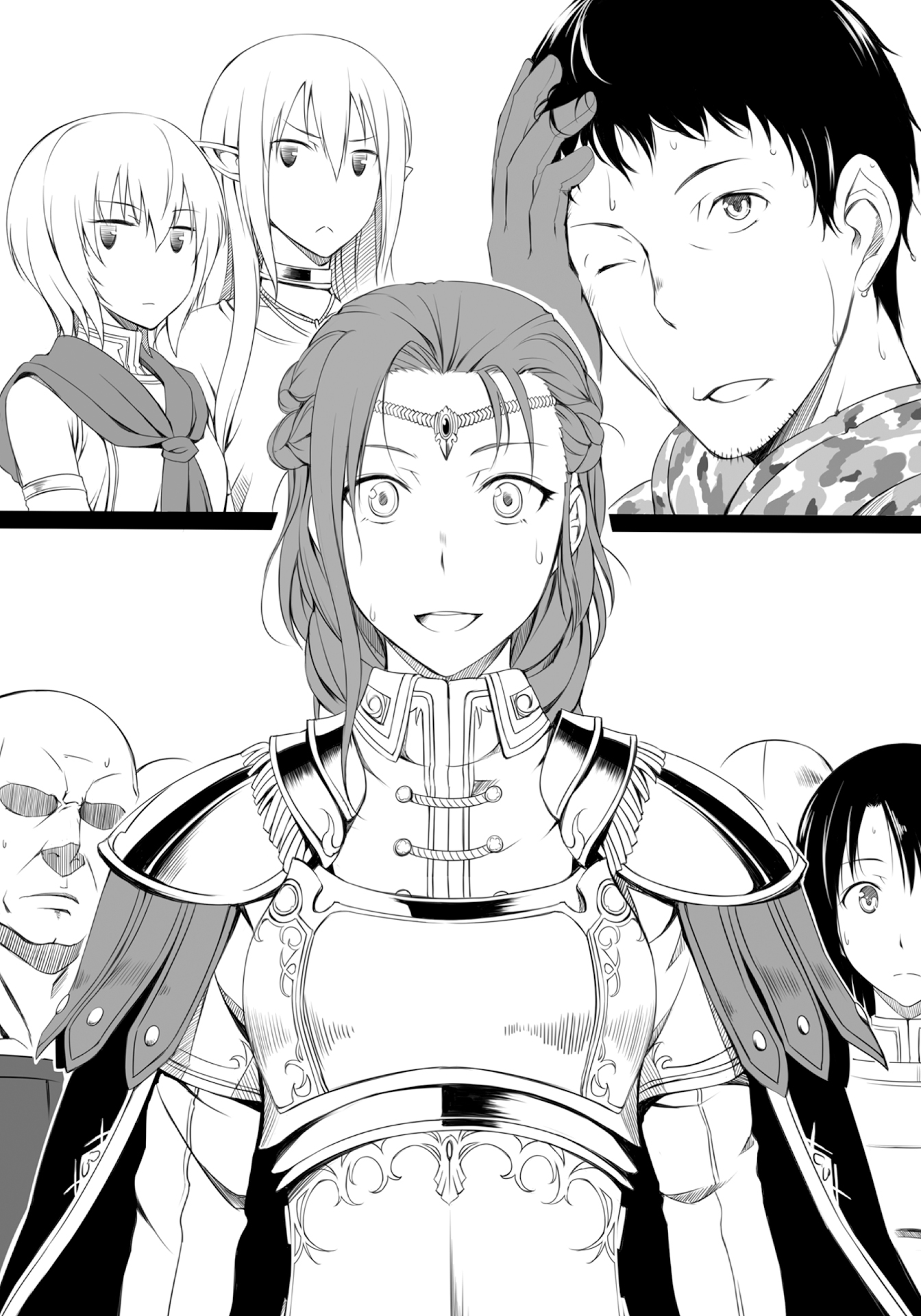
Chapter 11
Chapter 11
At the headquarters of the Ground Self-Defense Force’s Special Region Dispatch Unit, senior officers were engaged in a heated debate, their voices raised in anger. It looked like a brawl could break out at any moment.
Watching his subordinates’ passionate arguing, Hazama realized that they must have been feeling pent up and frustrated for some time. And it was only natural; although they’d crossed over to the other side of the Gate, there wasn’t much for them to do.
Their current tasks included defending the base, dispatching small recon teams to gather and organize information, and making adjustments to operational policies and unit action standards based on collected data. In short, it was mostly just a lot of desk work.
Even when it came to base defense, there’d only been a few instances of actual combat, and now there were no signs of hostile forces at all. It was as if the enemy had completely disappeared, leaving the area deserted.
As a result, their daily activities focused on perimeter security, building and repairing fortifications, and maintenance.
The Fifth Combat Group was responsible for the fortifications, while the First and Fourth, as strike units, spent their days performing endless training exercises within and around the base.
The Second and Third Combat Groups hadn’t crossed through the Gate yet, and the Sixth and beyond hadn’t even finished their formation.
This delay wasn’t due to inefficiency but rather the Ministry of Defense’s deliberate pacing. The bureaucrats believed there was no need to mobilize the full force immediately since they weren’t planning an offensive. This approach was influenced by “budgetary concerns,” a fact that the uniformed personnel had to accept without complaint.
In this atmosphere of frustration, rumors of a certain reconnaissance team’s exploits—fighting a dragon and saving a village’s residents—became a source of envy for many of the troops.
If they’d been back home in Japan, enjoying peace, they might have been able to endure spending every day in idleness. However, this side of the Gate was supposed to be a battlefield. The Fifth Combat Group, including the Artillery and Anti-Aircraft Artillery units, prided itself on its achievements in battle. The Infantry units spoke passionately about the tension before a firefight and the sensation of pulling the trigger. The Engineering Corps members, tasked with constructing fortifications and airstrips, were covered in mud every day.
Seeing their comrades assigned active missions and thriving made those without assignments feel a sense of shame and frustration. It gnawed at the members of the First and Fourth Combat Groups, who were quietly but surely becoming demoralized by their daily idleness. This feeling of stagnation was also spreading among the officers responsible for these troops.
Then came the request for reinforcements from Itami. The officers were beside themselves with excitement as soon as they caught wind of it.
The key points of Itami’s request for reinforcements were as follows:
The entire region, including the city of Italica, has been suffering for nearly a month from attacks by groups detached from the command structure of the “enemy armed forces,” resulting in looting, assault, arson, and indiscriminate killings. According to reports, multiple settlements have been affected, with numerous casualties.
The town visited by the Third Reconnaissance Team is currently under attack. Despite the desperate defense efforts of the local guards and citizens, the damage is extensive. A large-scale second wave of attacks is imminent.
City representative Piña Co Lada has requested our cooperation in maintaining security. We request support in providing it.
These detached groups, commonly referred to as “bandits,” possess equipment considered advanced for the Special Region. There are over six hundred such bandits, including cavalry, infantry, and archers. The presence of individuals among them with special abilities, referred to as “mages,” is uncertain.
There is no law enforcement organization in the area capable of dealing with the bandits. The representative of the local administrative authority, House Formal, has requested reinforcements from higher authorities, but it will take at least three days for them to arrive.
In other words, there was now a perfectly justifiable reason to take down some despicable villains and save innocent civilians. It was an unparalleled opportunity for the soldiers to both burn off some steam and gain valuable experience.
The field officers were in an uproar, their boots echoing through the halls as they all rushed to gather at General Hazama’s office.
Realizing that the debate was getting nowhere, Colonel Kamo—commander of the First Combat Group—stepped forward.
“Please, let me handle this!” he urged, appealing directly to Hazama.
The First Combat Group was a composite force built around an infantry regiment, including field artillery, anti-aircraft artillery, tanks, engineering, communications, medical, ordnance, and supply units. While “combat group” might be an unfamiliar term, it was essentially a reorganization of units, typically divided by specialty for training and management purposes, into a more combat-effective formation.
“My 101st Company is already organized as an augmented infantry company,” Kamo continued. “We’ve already gathered the troops! We can deploy today.”
Lieutenant Colonel Tsuge stepped forward from behind Kamo, adding his own comments, much to the annoyance of the soldiers who had been hastily mustered. These soldiers were likely now fully armed and rushing to assemble in the parade ground, uncertain if they would be deployed.
Next came Colonel Kengun. “No, that’s no good. Moving on the ground will take too long. My unit can get there quickly. Commander, please use my Fourth Combat Group.”
The Fourth Combat Group was organized as an air mobile force, similar to an air cavalry unit in the US Army, capable of rapid deployment by helicopter.
“We’ve even got loudspeakers, a sound system, and Wagner CDs ready,” added Lieutenant Colonel Youga from the 401st Company.
“Perfect, Lieutenant Colonel Youga,” praised Kengun, clearly eager to join the mission.
Hazama pinched the bridge of his nose and massaged it. What has gotten into these guys? he wondered. Maybe they’ve been possessed by the spirit of Colonel Kilgore from Apocalypse Now?Or perhaps their brains have rotted.
Nevertheless, it was imperative to send reinforcements quickly. In that case, the Fourth Combat Group was the best choice due to its rapid deployment capabilities. It wasn’t because they were the living embodiment of Colonel Kilgore, but because it was the practical choice. Hazama explained this unnecessary detail before giving the order to Kengun.
To see the expressions of Colonel Kamo, Lieutenant Colonel Tsuge, and the other officers, one would have thought the world had just ended. The only ones who couldn’t hide their joy were Kengun and Youga.
“Which orchestra performed the music?” Hazama asked.
“The Warsaw Philharmonic, of course,” Youga replied.
As he watched the two leave, Hazama could already picture what would unfold in the next few hours.
※※※
AH-1 Cobra and UH-1J helicopters flew in a large formation at NOE (Nap-of-the-Earth), their loudspeakers blasting Wagner’s “Ride of the Valkyries” across the sky.
The bandits scattered in confusion.
What appeared in the sky was the wing of death.
Even though no anti-aircraft missiles were launched, the helicopters released flares, creating parabolic trails of light that resembled angel wings.
To the locals, this was nothing short of the descent of angels or goddesses of war.
Rockets launched from the AH-1 Cobras, flames licking the ground below.
Gunfire rained down from the sky, mowing down the bandits.
With an aerial view and no blind spots, the troops could complete the sweep of the bandits without even landing.
Another, less optimistic way witnesses described the scene was apocalyptic, like hell on earth.
Meanwhile, Italica was hard at work repairing the city walls and fortifications.
Knowing that the rumored “green-clad soldiers” had arrived as reinforcements—bringing with them the Apostle of Emroy, an elven spirit user, and a mage—the citizens were filled with courage, and the soldiers’ morale soared.
“If they can repel a fire dragon, these rogue soldiers should be no problem,” people told each other. Although there were only twelve soldiers in green, they were armed with “iron weapons,” and everyone in Italica believed they could manage as long as they fought a little longer with the strange soldiers at their side.
Finally, despair gave way to hope and optimism. No one wanted to abandon their family homes and flee. If they could defend it, they wanted to protect their city. Itami and his team became their beacon of hope.
Oddly, Piña had tasked Itami with defending the southern gate, a critical position on the front lines. He couldn’t move freely to assist others as needed.
According to her explanation, the southern gate had already been breached once before. Most of its defensive structures were destroyed, and repairs were still in progress, making it the most vulnerable point. In the coming battle, it was expected to be the site of the fiercest fighting. The people of Italica had previously managed to fend off an incursion using makeshift earthworks and fences on the inside, but the battle turned into a chaotic melee that resulted in numerous casualties. At the moment, every able-bodied person was working frantically to repair the fences and reinforce the earthworks.
Itami couldn’t help wondering if it would be effective to concentrate their forces on the primary defense line formed by the city walls and the gate. However, Piña had insisted on a two-stage defense: first holding off the enemy at the gate and walls, and then, if those were breached, making a stand inside the fences. It seemed she was preparing for the possibility of the gate being breached right from the start.
This difference in strategy might be due to Itami’s belief that they should fend off the enemy until reinforcements arrive, while Piña, not expecting immediate reinforcements, aimed to inflict maximum casualties on the enemy to diminish their will to fight. Realizing that Piña’s strategy could work well if executed correctly, Itami decided not to interfere.
Standing with his team atop the city gate, Itami looked down at the beautiful stone-built city bathed in the crimson hues of the setting sun. Medieval Europe must have looked something like this.
Italica was considered a regional city, but its population was over five thousand. The streets were lined with shops and inns extending in all directions from the intersection of the Thessalia and Appia highways. Behind these commercial areas were warehouses, stables, and residential quarters for mercantile workers.
To the north, Count Formal’s grand mansion rose up from the forest, the centerpiece of a high-class neighborhood with wealthy merchants’ residences all around. Behind the forest, the city’s northern edge was naturally defended by steep cliffs, with only one wall across the valley where the road extended. To the east, west, and south, high stone walls encircled the city.
Beyond those walls, the highways stretched to the horizon, flanked by farmland, fallow land covered with grass, shrubs, forests, and a few shanties. Beyond that…
Itami’s binoculars picked up a few people advancing slowly on horseback—bandit scouts, likely assessing the defenses. Further in the distance, almost to the horizon, he could see the main body of the bandit forces.
“We’re going to face their attack head-on,” Kuwahara remarked.
Itami nodded, acknowledging the possibility.
The bandits didn’t have the option of a siege attack. They simply lacked the numbers to encircle the city, nor did they have the time to commit to a prolonged siege. For the same reasons, tactics like digging under the walls or advancing under cover via parallel trenches wouldn’t work.
This left the bandits with only one viable course: a direct assault with a determined point of attack. However, this wouldn’t be a straightforward brute-force attack relying on sheer numbers. Instead, the attackers’ advantage lay in their ability to choose the time and place of their assault. They could exploit this freedom by launching a feint to concentrate the defenders in one spot, then striking where the defenses were weakest.
In such a scenario, the primary target for either a diversion or the main assault would likely be a vulnerable point in the defenses.
“I see,” Itami began thinking aloud. “Making the defenses at the south gate appear especially weak is…”
Creating a weak point in the long defensive line might be a tactic to focus the enemy’s attack on a specific area. This made Piña’s strategy more understandable. In the last battle, they had unintentionally created what looked like an easy breach point. When the bandits launched a full-scale attack, they would retreat to the more fortified secondary defense line, forcing a war of attrition that they couldn’t sustain. Indeed, when the enemy had breached the gate and pushed their main force through, they found the interior defenses stronger than expected, leading to significant losses and a forced retreat.
As both armies were relatively small compared to the size of the city, such a defensive strategy was understandable. Piña had probably placed Itami and his small team at the vulnerable south gate as bait to draw the enemy to this decisive point. It also explained her dedication to reinforcing the fences and earthworks behind the gate.
But will they fall for the same trick twice? Itami wondered. Surely the bandits were smart enough to change their strategy after an initial failure and would think twice about directly attacking the weakest-looking point.
Moreover, this tactic had a significant flaw.
“Furuta! Machine gun here. Higashi, rifles here,” Kuwahara ordered, swiftly assigning positions and coverage areas for the team.
Carefully, the soldiers placed their bipod-mounted Type 64 rifles in the gaps of the stone crenellations.
They would be firing down from the height of a three-story building. If they let the enemy get too close, arrows would start raining down in return. To avoid this, they planned to set up a final protective line outside archer range, using distinct landmarks as reference points. The sun had almost dropped below the horizon, and Kuribayashi was distributing individual night vision devices to the troops. Kurokawa was assigned to guard the vehicles and equipment.
Behind Itami and his team, the citizens of Italica gathered with farm tools and sticks, anxiously waiting for instructions. Nishina approached them, using a phrasebook and a mix of gestures to instruct them to fill and carry sandbags. He also had them clear away wooden objects and makeshift torches that could become fire hazards. Although puzzled about the lack of lighting, the townspeople set to work.
Rory, who had been watching the preparations with Lelei and Tuka, turned to Itami. “Hey? Why are you siding with the Empire? I thought they were your enemy.”
“To protect these people,” Itami replied, adjusting his night vision device on his helmet.
Rory grinned. “Are you serious?”
“That’s what we’re supposed to do,” Itami said in a playful tone.
Rory shrugged, unimpressed by the answer. By the logic of “the enemy of my enemy is my friend,” Itami should have sided with the bandits. But perhaps it wasn’t that simple.
Piña, as a princess of the Empire, was defending Count Formal’s territory and thus Italica. She had negotiated—or more like commanded—Itami and his team to cooperate. Rory had been so displeased with Piña’s attitude during the negotiations that she’d considered walking out.
In the end, Itami had agreed to protect the people of Italica. On the surface, their goal of defending Italica aligned, allowing them to fight together. But Rory couldn’t understand why Itami would accept this princess’s command, especially when it meant being used as cannon fodder at the heavily attacked south gate.
“Are you curious about my reasons?” Itami asked.
Still struggling with the night vision device, he handed his helmet to Rory to hold so he could use both hands to attach it properly. Due to their height difference, it looked as if Itami were bowing his head in reverence to the death god.
“Emroy is the god of war,” Rory said. “He doesn’t disapprove of killing, but He heavily scrutinizes the motives behind it. Lies and deceit will taint your soul.”
Having finally attached the night vision device, Itami reached for his helmet, but Rory held it back. She gestured for him to bend down, then placed the helmet on his head herself.
Itami smiled, a gesture that seemed particularly meaningful to Rory. “To protect the townspeople. That’s no lie,” he stated firmly.
“Really?” Rory questioned, clearly not believing him yet.
“Really. Although there is another reason…” Itami added.
Rory peered into Itami’s eyes, seeking the truth.
“We need to show the princess that it’s more beneficial to get along with us than to fight us.”
Rory smiled wickedly, understanding Itami’s words in her own way.
“I like it. I really do,” she said.
Rory envisioned instilling fear into the princess’s soul, showing her their fierce combat skills until she trembled at the very mention of the JSDF. If they could do that, of course, the princess would prefer to be in their good graces.
“In that case, I definitely want to help. And it will be refreshing to run wild after so long,” Rory said, curtsying gracefully as if greeting a dance partner.
※※※
The battle began just before dawn when, from the depths of the dark, bandit archers launched flaming arrows toward the east gate.
At the command of Norma Co Igloo, the guards and militia defending the gate returned fire. Though the militia consisted mostly of farmers and young men who had never held a bow before, their arrows still served to keep the enemy in check, some even hitting and wounding them.
An even exchange of arrows continued for a time. Soldiers, farmers, and bandits alike fell with pained groans.
Then, weaving through the gaps between the archers, infantry clad in sturdy armor and carrying large shields began advancing toward the city walls. Their shields varied in size and shape—some round, some rectangular—highlighting their diverse backgrounds from various nations.
In response, local merchants, older children, and other citizens hurled stones, dropped rocks, and poured molten lead and boiling water. These measures proved far more effective and destructive than the unreliable arrows.
Beneath the wall, the bandits who used their shields to form a protective barrier above their heads struggled to dodge the rain of projectiles as they made their way to the gate. Wounded by arrows, crushed by falling rocks, struck unconscious by stones, and scalded by boiling liquids, they persisted with a determination that could only be fueled by vengeance.
For these bandits—survivors of the Allied Kingdoms’ defeated army—the battle at Alnus had not been a war. They had faced an unseen enemy, unable to comprehend what was happening while their comrades fell around them. They seethed with anger toward the Empire that had not prepared them for such an enemy, and they cursed the incompetent leaders who had driven them to senseless deaths. They had lost their officers, their comrades, and their supplies, but had survived by clinging to life in any way they could. With nowhere to return to, they had turned to a life of banditry, gathering others in similar dire straits and growing in number until they reached this day.
Their violence was driven by a bitter sense of injustice. This was a form of misdirected rage, an attempt to experience what they had missed at Alnus: the visceral thrill of war. For them, war was about cutting down enemies with swords, shooting arrows, setting fires, and trampling underfoot. War was about committing atrocities and being able to engage in the primal, bloody act of combat.
Now, the very act of fighting had become their goal. They sought a war they could understand—one where they could indulge in clear acts of killing and the simple reality of death. They longed for the tangible feeling of stabbing, slashing, and being cut down in return. It was the luxury of this physical struggle, denied to their fallen comrades, that they now sought.
Several ladders were placed against the city walls, and bandits began to climb, covering themselves with their shields. A few were taken down by arrows, but most reached the top of the wall.
A brave farmer swung his axe, breaking ladders even as he took arrows.
“Well done!” cheered the attacking bandits in admiration of his bravery as they fired more arrows at him.
Their ladder wobbled and fell to the ground along with the soldiers, scattering bodies with its violent impact. The farmer followed, embracing the earth.
The falling ladder was met with cheers, a frenzied celebration that would have fit in well at a festival. Soldiers outside the wall banged their shields with swords, singing hymns to Emroy at the top of their lungs in each of their native languages. The fervor of battle was an offering to the god of war, and the bonfire of combat burned fiercely, fueled by the souls of fallen warriors. Flaming arrows engulfed the bell tower, casting a red glow against the dark night.
Rory Mercury, the apostle of Emroy, endured the scene. She hugged herself tightly, beads of sweat forming on her forehead.
“W-Why?” she muttered.
The battle’s malevolent energy seeped into her flesh, invading her mind.
“Weren’t they supposed to attack here?” Rory muttered aloud, her voice strained.
The flames of war ignited a fervor within her, a sweet impulse rising from her core, coursing up her spine. Unable to bear it, her limbs moved of their own accord, thrashing as if in a frenzied dance.
“Aah, ugh,” Rory gasped.
An overwhelming wave of pleasure surged through her, causing her to contort in the darkness as if dancing.
Alarmed, Itami tried to rush to her but found himself stopped by Lelei and Tuka.
“She’s an apostle…” Lelei said.
Though Itami didn’t fully understand, it was evident that Rory’s torment was linked to her nature. Lelei went on to explain that the effect grew more intense the closer Rory got to a battlefield; at least it was still manageable where she stood. But if she were in the thick of the battle, she would rampage, killing anyone perceived as an enemy, unable to stop herself. No one would be able to restrain her, not even herself. Lelei’s words sent chills down Itami’s spine.
“If they’re bandits, they should stick to raiding villages! Trying to take down a whole city is far too audacious!” Knight Norma yelled. But he’d realized that something was off: the arrows loosed at the bandits were no longer reaching their targets. Even amateur archers didn’t miss their marks every time. It was almost as if a wind spirit was shielding the enemy…
Could there be a spirit caller on their side?
Norma drew his sword and struck down a bandit—a southern soldier—who had made it to the top of the wall. The soldier fell backward and crashed onto the ground below. But only a second later, a bearded, axe-wielding northern bandit charged forward in his place. Norma parried the axe strike, only to face a barrage of attacks from bandits armed with spears, clubs, morning stars, dual swords, and scimitars. It was suddenly as if the defenders were trying to stop a flood with their hands. Norma found himself engulfed by the enemy.
The bandits poured over the walls, their momentum forcing Italica’s defenders to retreat, unable to hold their ground.
It was here that Piña’s strategy began to show its flaws. She had expected the first defensive line at the gate to fall, but it was crumbling too quickly. The walls were already a battleground, with guards and militiamen being driven back.
“Our side’s too fragile. Their morale should have been high,” Piña muttered.
She had also expected the enemy to attack more carefully, cautious of Italica’s strategy. Instead, they’d rushed in recklessly. Experienced soldiers pushed forward with sheer force, ignoring all notions of tactics or planning.
Even the militia and guards who were supposed to be defending Italica had been hesitant from the start. As a result, they couldn’t hold off the enemy or wear them down as much as Piña had hoped.
All in all, the battle was still more or less going according to plan. Piña understood that reality often deviated from theoretical planning. This discrepancy in the present moment caused her some discomfort, but she focused on her belief that the enemy’s main target was the eastern gate. She decided to move the main force to the fortifications she had prepared inside that gate.
The east gate, just like the other three, had double defenses with ramparts and fences inside. While this setup might sound robust, the reality was that the outer defenses were meant to be sacrificial, a line intended to slow down the enemy but ultimately be overrun. In the first battle, the common folk hadn’t grasped this strategy, but now it was clear. Those stationed at the outer defenses knew they were being sacrificed. How many could continue to fight knowing they were abandoned?
As more and more allies gathered behind the ramparts and fences, those on the front lines were left to fend for themselves. They could see their comrades being slaughtered, stoking the fires of hopelessness. Some fighters abandoned strategy and swung their swords in wild desperation, but they quickly grew exhausted and were mowed down by the enemy.
“Where are the people in the green uniforms?! Where’s the support?!” they cried out, knowing deep down that help wouldn’t come. The JSDF soldiers stationed at the southern gate were surely doomed as well.
Thus, the citizens watched as the last defender of the east gate fell and the massacre unfolded. However, the victorious bandits didn’t immediately charge further into the town. Instead, they celebrated their bloody victory with shouts and thrusts of their weapons into the air. They took their time in opening wide the gates for their cavalry.
Hooves clattering against the ground, their horses dragged the bodies of the fallen. They began to toss the corpses of civilians, including children and women who had thrown stones, into the gate’s courtyard.
The heads of farmers and craftsmen came next, followed by dismembered arms and legs tossed over the fence. The townspeople, who had been waiting for the enemy to rush in, watched as the bodies of their friends, relatives, parents, and children piled up before them. They faced the fence, clenching their teeth, crying out, and supporting their despairing friends. The bandits mocked them, hurling insults and calling them cowards who hid behind fences.
The bandits played with the corpses like toys. How could the militia—mere farmers and merchants armed with weapons—endure this sight?
“Dammit!!!”
A hot-headed young man holding a pitchfork leaped over the fence. Several people ran after him to stop him, but just as many decided to join in, all of them charging out from the fortifications. Momentum took over, and everyone followed suit. The battle within the gate was now going very much against Piña’s intentions, and her strategy was falling apart.
Rory’s anguished cries grew louder. Her breathing was labored, her hair disheveled, and her body arched. She clutched her head as if to tear it apart, moaning in torment. She stomped and kicked the ground, gasping like one possessed by a fever. She scratched at herself, and her face contorted. She was a puppet forced to dance by a curse, her body convulsing and twitching, her limbs flailing.
She couldn’t stop herself; the dance of madness, the dance of curses, was painful but all too beautiful. Lelei had explained to Itami that the souls of fallen soldiers on the battlefield were drawn to Rory’s body and then summoned to Emroy. Depending on the nature of the souls and the fervor of battle they’d had in their final moments, passing through Rory could have an effect on her like a potent drug, bringing her both pain and ecstasy.
If only she could give in to the madness entirely, she would find relief. If only she could fully surrender to the frenzy. But she couldn’t, and it was that frustration which tormented her most.
“No, I can’t! I’ll go mad if this goes on!!” Rory screamed, a violent wail rising from deep within her throat.
Totsu, who had been listening, muttered, “Shit, I’m getting hard.”
“Don’t say it. Me too…” another soldier admitted.
Though the apostle herself was not to their proclivities, the associations her cries evoked were clear. Her voice and rhythm were undeniably seductive.
※※※
Kengun spun around to nod at Captain Youga, responding simply, “Leave it to the captain.”
The soldiers inside the helicopter were preparing, attaching magazines to their rifles.
“Two minutes to landing!” Youga announced.
He cranked the volume on the stereo system, filling the cabin with music. The orchestral arrangement depicted the gallop of celestial steeds, leading into a main theme with triumphant trumpets, evoking the image of eight Valkyries riding into battle.
One soldier who had finished preparing his weapon mimicked a film scene by placing his helmet below him.
"'Why do all you guys sit on your helmets?'" recited his colleague.
"'So we don't get our balls blown off.'"
※※※
Swords clashed, sending sprays of blood and fragments of flesh into the air. Heads split like melons on a beach, and the sounds of battle rang out like hammers at a construction site. Cries of death, groans of pain, shouts of rage, and fierce battle cries filled the air.
People collided like crowds during rush hour at a train station, each too absorbed in the chaos to pay attention to anything but the enemy before them. Some collapsed, crawling away in hopes of finding safety, only to be trampled by horses. Bodies and limbs littered the ground, and the cobblestones were painted dark red with blood.
Amid this carnage, the sound of rotor blades cut through the air, but the combatants were too engrossed in their struggle to hear it. A horn’s call and a woman’s voice singing across the sky went unnoticed.
Then, time seemed to stop.
Leaping over the embankment and the fence, she landed with a force that threw both men and horses, friends and foes, to the side. A clear space formed around her, a void in the carnage. And in that instant, everything came to a halt.
The sheer power and impact silenced the battlefield, leaving only the orchestra’s music to dominate the air.
“Ho-jo to-ho! Ho-jo to-ho! Ho-jo to-ho!”
All eyes turned to the pitch-black newcomer.
“Ho-jo to-ho! Ho-jo to-ho! Ho-jo to-ho!”
It was a girl, clad in a black priestly robe adorned with layers of frills.
“Ho-jo to-ho! Ho-jo to-ho! Ho-jo to-ho!”
She knelt on both knees, placed her left hand on the ground, and with her right hand grasped a halberd slung over her back. As she raised her head, her eyes gleamed with divine madness, and her black hair shone with an ominous yet holy radiance.
Then, accompanied by a fanfare and the mocking laughter of a goddess, the gate exploded into flames.
Chapter 12
Chapter 12
A formation of three UH-1J helicopters passed overhead, raining gunfire upon the bandits outside the gate. At the same time, they meticulously dropped grenades, embodying the thorough and methodical nature of the Japan Ground Self-Defense Force.
The attack was a relentless series of waves from multiple directions. From east to west, followed by another formation from southeast to northwest, then northeast to southwest, each formation would circle back to its attack position. The continuous onslaught left the ground thoroughly covered, ensuring that any moving targets were annihilated.
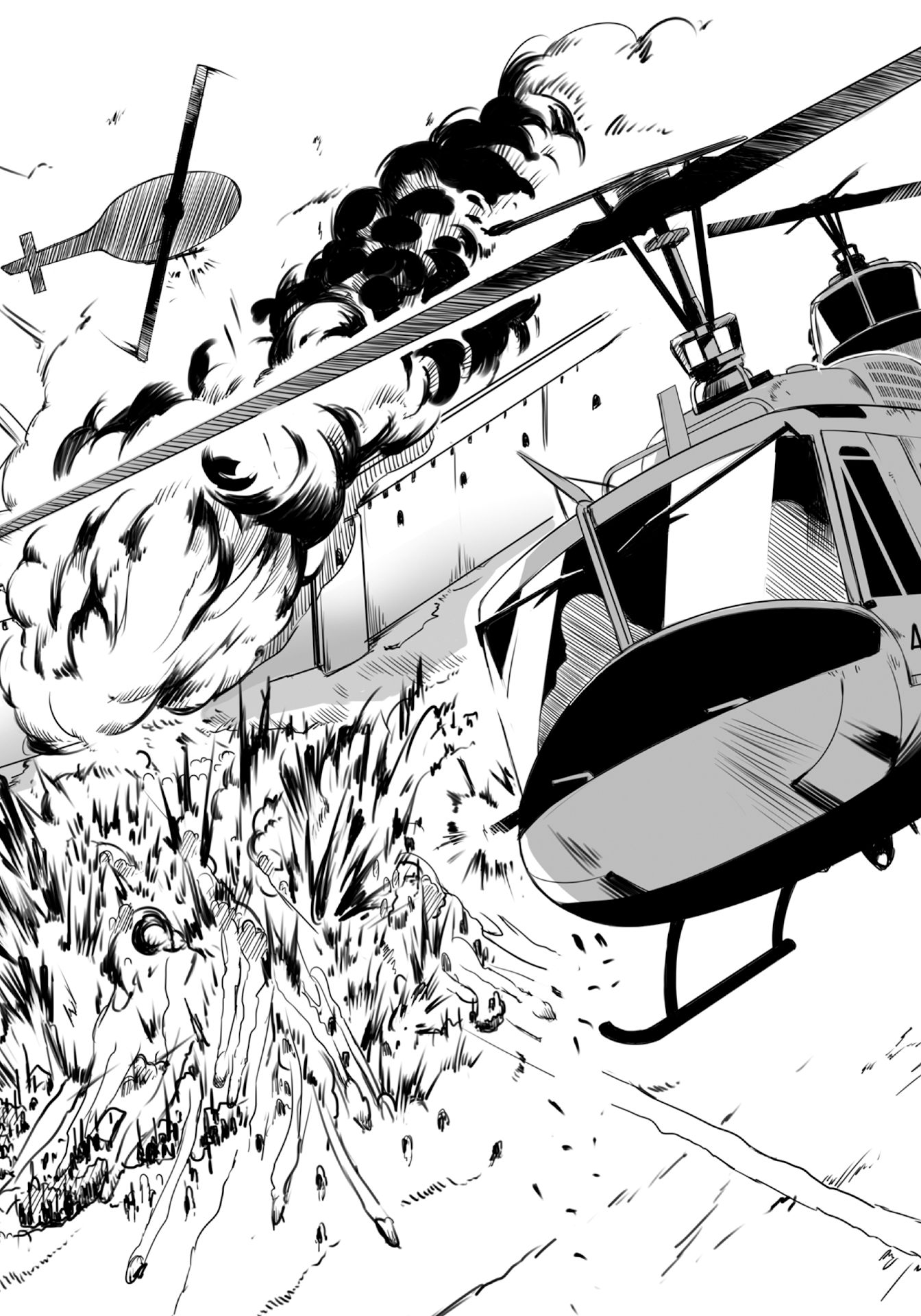
The bandits scattered like spiders, trying desperately to escape. But whether they ran on foot or horseback, there was no relief. The tables had turned as the marauders, who had once killed, plundered, and ravaged, were now ravaged by the bullets from overhead.
The bravest of them tried to shoot arrows at the helicopters. However, their projectiles lacked power and fell short; even the few that reached their target had no more impact than pebbles.
In the helicopter, a soldier aimed his rifle, aligning the sight with a bandit’s head, and began calculating the helicopter’s speed and the bandit’s movement.
“Muzzle aligned, target acquired, steady aim…” he murmured, pulling the trigger with precisely 2.7 kilograms of pressure.
Three shots went off.
As he felt the recoil against his shoulder, he was oddly fascinated by the fact that he didn’t have to worry about collecting the shell casings, which were falling and landing near the fallen bandits.
※※※
The rising sun and the crimson flames engulfing the city gate of Italica each cast their glow on the fully armed soldiers being torn apart, all surrounded by the terrifying mechanical sound of helicopters. The fierce, unrelenting cacophony was completely unlike the flight of birds or anything else the bandits had heard before. Bullets came like hail, turning marble walls into Swiss cheese.
On horseback, Piña had been shouting commands until her voice went raw. But the sudden onslaught left her speechless, her face etched with shock as she witnessed the devastation. The helicopters with their rotating blades looked like steel-winged beasts dominating the sky.
While dragons were known for their aerial combat, what Piña saw was different—and far more menacing. Attacks from dragonback were more personal, involving arrows, spears, and swords. But this was absolute, one-sided destruction. The steel steeds spat fire, annihilating everything from human flesh to stone.
A horse’s head exploded, taking down people around it.
“Ho-jo to-ho! Ho-jo to-ho! Hei-a ha! Hei-a ha!”
A symphony of death. Piña had experienced all kinds of music during her time at court, but never had she heard such a beautiful and majestic performance. The horns, bassoons, and assorted orchestral instruments joined with the powerful voices of the singers to fill the battlefield with a deathly accompaniment. The endlessly edited masterpiece of the orchestra’s finest moments repeatedly flowed into Pina’s ears.
“Ho-jo to-ho! Ho-jo to-ho! Hei-a ha! Hei-a ha!”
Piña felt a shiver run down her spine, as if an icy sword had been thrust into her back. In an instant, everything was crushed by an absolute violence beyond human resistance. This mingled sensation of negative and positive emotions violently shook her body and spirit.
“Ho-jo to-ho! Ho-jo to-ho! Hei-a ha! Hei-a ha!”
Piña’s soul was battered by the relentless iron strikes from all sides. She was overwhelmed by a sense of utter helplessness, realizing how worthless and insignificant humans were.
“Hei-a ha! Hei-a ha!”
Until now, enemies had always been tangible, life-sized threats. But this was clearly different. She couldn’t bear to look at it directly, nor could she avert her eyes from it.
“Ha! ha! ha! ha! ha! ha! ha! ha! ha! ha! ha! ha! ha! ha!! Ha! ha! ha! ha! ha! ha! ha! ha! ha! ha! ha! ha! ha! ha! ha! ha!!!”
The female voice singing the Valkyries’ laughter completely shattered Piña. Her pride, honor, and everything she had ever considered valuable were instantly denied.
How puny humans are! The incomprehensible lyrics seemed to speak to her. Powerless, miserable, and pathetic! What is your power and authority worth? Everything you’ve built over generations, we can destroy in an instant if we so desire!
With tears streaming down her face, Pina felt the goddess’s disdain. At the same time, she recognized the existence of something far greater than herself—something immensely powerful and radiant. What surged within her heart was respect and awe, but along with it came the despair of realizing that these revered beings were entirely beyond her reach. The declaration that she could never become like them was a crippling blow, erasing the admiration and inspiration she’d held for the opera that had once defined her future.
“Damn it! Rory just rushed into the middle of the enemy!” Itami’s geeky side knew that Rory was strong beyond his wildest imagination, but his practical and realistic side couldn’t fully accept that the flamboyant, small-framed girl could be that powerful. Within this inner conflict, his concern for her grew, fueled by the short time they’d spent together and the bond that had formed. He couldn’t bear the idea of leaving her behind.
Itami jumped out of the truck and ordered, “Fix bayonets!” He attached the bayonet to his rifle, followed by Kuribayashi and Tomita, all three tapping the hilts twice with their palms to ensure they were fixed properly. They exchanged glances and switched their safety catches from “safe” to “auto.”
“Don’t fall behind!” Itami instructed as they began to move forward.
Kuribayashi charged ahead like a bullet.
“Shit, that woman is crazy,” Itami and Tomita both muttered as they pushed through the crowd to keep up with her.
“Charge forward!” Itami called.
They advanced a few steps, aimed their rifles, and fired short bursts. Moving further, they fired from the hip, repeating the actions drilled into them through countless training sessions. Several bandits fell, spraying blood as they went down.
Meanwhile, Rory was a whirlwind of destruction, swinging and slamming her halberd with an artful fluidity. There was no sign of danger in her movements, only the lightness of a hip-hop routine. Already, corpses were piling up around her.
The bandits tried to use their shields to push her back, to shove and strike, thrusting their swords over the tops. They even aimed for her shins with the edges of their shields. But Rory lightly stepped back, then brought her halberd down like she was splitting firewood, cleaving through metal and flesh.
Any enemy attempting to flank her found the blunted spike of her halberd waiting. Without even looking, she would thrust it into their bellies. When spears came at her from any direction, she used her weapon like a vaulting pole, leaping into the air to avoid them.
Rory’s black skirt billowed out like a black rose in bloom, revealing garter belts and shorts as her shapely legs moved with the grace of synchronized swimming. Using the momentum of her spin, she brought her halberd around in a wide arc, decapitating bandits with the ease of a propeller chopping through the air. Blood sprayed like a fountain, splashing the Reaper’s face.
A heavy sword wielded with the combined strength of fear, hatred, and murderous intent came down toward Rory’s head. But her clear gaze spotted a hair-thin opening, causing the desperate blow to miss.
Rory grasped the hem of her skirt and sidestepped the charging bandit like a matador. Kuribayashi then joined the fray, letting out a battle cry as she lunged with her bayonet and impaled an attacker from behind.
As fast as recoil from gunfire, Kuribayashi pulled out the bayonet embedded in her enemy, slashing diagonally at another one behind her.
Stab, stab!
She then switched stances and used the buttstock for a sideways strike.
Thud!
She jammed the rifle’s muzzle into the fallen enemy’s face and pulled the trigger.
Another enemy slashed at her, but she blocked with her rifle. The bipod flew off and the bottom cover dented, but she didn’t miss a beat as she swept the enemy’s legs. The fallen man’s nose was crushed under her boot, even through his helmet. The broken bipod clattered to the ground.
“Damn it,” Kuribayashi groaned, recalling the weapons sergeant’s face. But this was why she’d brought the Type 64 rifle instead of the Type 89. “Disposable, disposable,” she reminded herself, gripping the rifle again.
A few months ago, Kuribayashi would never have guessed she’d be involved in this kind of brutal, primitive melee combat. And yet, she excelled at it. Small and nimble as a cat, she evaded and overwhelmed the enemy time and time again. When they tried to keep their distance, she fired short bursts. When her ammo ran out, she threw grenades over their heads, then used the enemy bodies as effective shields. The explosions startled the bandits, breaking their formation as they tried to regroup.
She quickly drew her pistol, firing three shots without hesitation. The wooden shields splintered, and the third shot struck home. Rory charged through the breach, widening the opening with her halberd. Kuribayashi reloaded her rifle.
Itami and Tomita, knowing they had to keep the women in check, focused on protecting their backs. They used rifles, pistols, and bayonets to keep the enemy from flanking them. As they watched from a slight distance, they were impressed by the women’s combat prowess, especially Rory’s invincibility. Their expressions showed exhilaration that didn’t belong on the battlefield, possibly from adrenaline or sheer enjoyment of the fight.
Kuribayashi and Rory showed such remarkable coordination that it was hard to believe their attacks were improvised. They stabbed with bayonets, slammed with the halberd, fired and threw grenades, swung the halberd’s shaft, kicked, and punched, pushing the enemy back.
Reloading was a challenge. When Kuribayashi ran out of ammo, she yelled, “Commander! Rifle!”
Itami tossed his rifle to her. In return, he received Kuribayashi’s nearly broken one.
In the midst of the chaotic battle, Italica’s guards and militiamen noticed the enemy’s sudden loss of momentum. With this first chance to look around, they saw Itami and his group.
“It’s the Apostle of Emroy! The people in green have come to help!” they shouted, gradually restoring order and forming a united front. As they did, they finally became aware of the explosions and the orchestral music filling the air.
“Führet die Mähren fern voneinander, bis unsrer Helden Haß sich gelegt! Der Helden Grimm büßte schon die Graue! Ha ha ha ha ha ha ha ha ha! Ha ha ha ha ha ha ha ha ha! Ha ha ha ha ha ha ha ha ha!”
Just then, the combat helicopters emerged, cutting through the black smoke that filled the sky. The sight brought a hush over both sides as they looked and pointed up at these “steel pegasi” descending from the heavens.
The AH-1 Cobra’s 20mm M197 Gatling gun aimed at the enemies clustered around Rory and her group. Itami and Tomita exchanged glances and nodded. Itami grabbed Rory, and Tomita grabbed Kuribayashi by the neck, lifting them from behind and shouting, “Fall back, fall back!” as they retreated.
The moment they were clear, the Gatling gun fired at a rate of 680 to 750 rounds per minute, instantly turning the remaining enemy troops into minced meat. The Cobra descended, raining bullets in a final act of destruction.
The flames of battle were extinguished in an instant by this deluge. Before long, the gunfire and the orchestral music also came to an end, leaving only the sound of the rotors and the smoldering ruins.
UH-1J helicopters gathered and hovered above, surveying the aftermath.
Ropes dropped from the helicopters, and JSDF soldiers began rappelling down one after another in an impressive show of agility and coordination. They secured the area and searched for survivors, both friend and foe. No one dared to casually refer to them as “the people in green” anymore. These were clearly professional soldiers, commanding respect. When asked who they were, Tomita simply answered, “The Self-Defense Forces.”
Rory held her hair against the strong rotor wind and kept her skirt from flying up as she surveyed the area. There were no enemies left standing near her. Suddenly, she realized she was being held up by someone. The left arm supporting her had moved from under her armpit to her chest, and the gloved hand was pressing against her modest right breast. Rory Mercury’s lips curled into a mischievous grin, revealing a sharp canine.
※※※
Piña stood before Itami, Rory, Tuka, and Lelei, struggling to find the right words. Just yesterday, she had summoned these four and commanded their cooperation from a position of authority. Reclining in her chair like a true noble, elegantly sipping tea, she had addressed important matters as if they were trivial tasks.
Today, however, she felt utterly defeated and humiliated. Yes, they had driven off the bandits, and the people of Italica were beyond grateful for their victory and survival. Of course, they would need time to mourn their lost loved ones and to rebuild their homes and villages, but for now, they deserved to celebrate.
Piña, too, should have been celebrating, but she was completely overwhelmed by misery. This didn’t feel like a victory at all. The only real victors were Rory and the people who called themselves the “Self-Defense Forces” or “JSDF.”
These formidable enemies, who had unjustly occupied the sacred grounds of Alnus with their steel steeds and devastating magical firepower, had effortlessly obliterated the bandits that Piña had struggled to deal with. If they were to turn their might against her and Italica, there would be nothing she could do. The princess of the Empire and the countess of the Formal earldom would become their captives, and the Empire’s granary would fall into enemy hands.
What would the people do? Would they resist? No, they would likely rejoice, welcoming the Self-Defense Forces with cheers. After all, it was the JSDF who had secured their victory. Former residents of the village of Coda already spoke highly of these honorable “people in green.”
The common folk were oblivious to political intricacies and easily swayed by their immediate benefits. If the JSDF demanded the city’s surrender, Piña would have no choice but to kneel before them, begging for mercy and asking for the safety of herself and Countess Myui. Could she, proud princess of the Empire, beg for mercy like a lowly tavern wench clinging to a man’s sleeve?
Piña gritted her teeth. In her current state, if they demanded that she kiss their feet, she might just do it. She felt utterly defeated, her confidence shattered. She waited in fear for Itami and his men to make their demands.
As she waited, her vision gradually cleared, revealing the reality around her. Her ears began to pick up snippets of conversation, bringing her back to the present.
“We need to respect the rights of the prisoners,” Hamilton said. She stood beside Piña, with Lelei translating her words to Colonel Kengun. Normally, Itami would translate, but the vocabulary in this discussion was too complex.
Colonel Kengun, standing at attention, nodded in agreement. “I understand your need for labor to rebuild Italica. While it may not be your custom, we’re requesting a guarantee of humane treatment for the prisoners. For our purposes, we only need a few individuals to obtain information from. We’re hoping to take three to five prisoners back with us. Will you agree to that?”
“I don’t fully understand the term ‘humane,’” Hamilton began to reply. Lelei was sweating for once as she tried to convey the meaning.
According to Lelei’s interpretation, “humane treatment” was understood as “to treat them without hindrance, as one would a friend, relative, or acquaintance.”
Hamilton furrowed her brows, her voice rising in anger. “My friends and relatives would never assault peaceful towns and villages, killing people and looting!”
Piña interjected to calm her.
“Very well. We shall take it to mean that they will not be harshly treated. Your contribution to this victory is significant, so I’m not opposed to accepting your terms.”
Hamilton seemed relieved that Piña had finally broken her silence.
Lelei and Hazama exchanged a few words before Lelei translated.
“If you understand it in that sense, then that will be sufficient.”
Piña had a sudden moment of clarity, and she tried to gather her thoughts.
Where am I? What am I doing right now?
She quickly assessed the situation with her knowledge and interpretative skills.
Who is this man?
The man standing before Piña was a mature, warrior-like figure. He wore the mottled green uniform of the JSDF but carried an air that distinguished him from the rank-and-file soldiers.
Though his demeanor was gentle, his forehead bore deep wrinkles, and his sturdy cheeks spoke of a life of overcoming numerous hardships. His confident posture was a testament to his accumulated experience and proven abilities—qualities Piña herself longed for but lacked.
He must be their leader.
Piña found herself seated languidly in a chair as the acting lord of House Formal. Beside her sat Countess Myui, flanked by the steward and the head maid.
Hamilton, sporting a large bandage across her forehead and several others around her body, had tirelessly held the fort while Piña was in a daze. She’d had to speak, negotiate, and make decisions on behalf of the princess.
Piña decided to choose her next words carefully in order to fully grasp the situation.
What exactly are we promising them?
She gestured for Hamilton to come closer. The bandaged girl leaned in.
“Ah, Lady Piña, you’ve returned to us. We were worried.”
“Sorry for causing you concern.”
Piña then instructed her to review the terms they were discussing once more.
“Ahem. Let’s reconfirm the terms,” Hamilton announced clearly, listing the conditions.
“First, the JSDF shall select and take three to five prisoners from those captured during this battle. All rights and privileges associated with these prisoners are to be held by the JSDF. Countess Myui Formal and the Empire agree not to treat the prisoners harshly.”
“Second, Countess Formal and Imperial Princess Piña Co Lada will act as intermediaries for emissaries from Japan to the emperor and Senate, ensuring their safety during their stay and travels. Countess Formal and Princess Piña will bear the cost of up to one hundred swani for their stay, with further expenses to be negotiated.”
“Third, the Alnus Cooperative, supported by the JSDF, will be exempt from all taxes on trade within Formal territory and the city of Italica, including tariffs, sales tax, and currency exchange fees.”
“Fourth, following the enactment of this agreement, the JSDF under Commander Kengun will promptly leave Formal territory, except for small units and the Alnus Cooperative, which will remain for communication purposes.”
“Fifth, this agreement is valid for one year and will automatically renew unless contested by either party.”
“In the name of Count Formal’s daughter Myui and the Imperial Princess Piña Co Lada, we swear this agreement on the third day of the month of Mists, in the year 687 of the Imperial calendar.”
Hamilton finished reading and handed the parchment to Piña, who read it over several times and still could find no fault with it. In fact, she wondered how they had secured such favorable terms. The JSDF demanded little as victors.
Facilitating emissaries was cumbersome, and the expense of one hundred swani was significant but manageable. If this was all they required, it was a bargain.
Hamilton must have worked hard for this outcome. Piña prided herself on assessing people’s abilities, but she had clearly underestimated Hamilton Uno Ror’s negotiation skills. How had she managed to make the overwhelmingly powerful enemy relinquish their rights as victors so willingly? Had she used magic, or perhaps her feminine charms?
Regardless, if the Foreign Affairs Bureau learned of this, they would no doubt seek to welcome Hamilton into their ranks on the spot. Her negotiation skills would be invaluable to the Knights of the Rose.
With these thoughts in mind, Piña signed the parchment and sealed it with her ring.
Myui, who sat obediently beside the princess, was also asked to sign and seal the document. Hamilton stepped forward, presenting the parchment to Hazama. After Lelei and Tuka confirmed it with nods, Hazama signed in kanji.
For some reason, Rory turned away in a huff, refusing to participate. Itami, sporting an inexplicable dark bruise around his right eye, stood idly by.
Two copies of the agreement were made. While the second was being prepared, the first was returned to Piña. As she reviewed it, Hazama’s signature caught her eye. The angular characters seemed oddly rigid to her.
The agreement took effect immediately, and the 401st Company flew away. The townspeople, busy with the aftermath of the battle, paused to wave until the helicopters disappeared from view.
Lelei, Tuka, and Rory headed to Ludoe’s shop to finalize their business deal. Being tax-exempt ensured substantial profits, making any merchant eager to engage with them. Moreover, with Professor Kato’s introduction, negotiations progressed smoothly.
They successfully traded two hundred dragon scales for four thousand silver denarii coins and two hundred gold sinku coins. However, paying four thousand silver coins in cash proved impossible. Despite Ludoe’s efforts, the recent raids in Formal territory had stalled trade in Italica. Additionally, a currency shortage in the Empire and surrounding areas meant that Ludoe could only gather a thousand silver coins.
Ultimately, they agreed to discount the price down to three thousand silver coins, accepting a draft for the remaining two thousand. In return, Lelei tasked Ludoe with an unusual job: gathering market price information from a variety of regions. She requested detailed and extensive data on as many items as possible.
Ludoe couldn’t help but laugh at the request. Unlike retail sales to ordinary citizens, price information among merchants was a critical weapon for negotiations. No merchant would bluntly ask for or share such information. However, Lelei, being the amateur merchant that she was, didn’t know the market prices. It was precisely this ignorance that led her to seek out the information, aiming for a broader and more extensive collection, and she was willing to pay for it.
“A thousand silver coins, huh?” Ludoe mused, shaking his head in disbelief.
No one had ever paid such a sum for information before, but once a price was set, it became a business opportunity. And since it was the beloved disciple of the wise Kato asking, it seemed quite a lucrative opportunity indeed. Besides, providing high-quality goods and services had always been Ludoe’s way.
Thus, Ludoe promised to exhaust every avenue to gather the requested information, committing to the task wholeheartedly.
To be continued in the next volume.
Afterword
Afterword
Thank you very much, not only for picking up Gate: Thus the JSDF Fought There! 1. Encounter Arc (Part 1) but also for reading it. I truly appreciate it.
This novel is a story where an otaku shines on the stages of military and fantasy. I doubt anyone would think about joining the JSDF after reading this, but just in case you decide to take the entrance exam, never say you were inspired by this book during the interview. You’ll probably fail. Similarly, don’t go overboard with lofty aspirations. Don’t try to win the interviewers over by saying things you don’t genuinely believe, like protecting democracy or the nation. They can usually see through it. Take it from someone who’s gone through six job applications (including the JSDF). An interview is a chance to showcase your intent and attitude.
If you can convey that you chose this path for your own reasons, it will leave a good impression on the interviewers. In extreme cases, even saying “to make a living” is acceptable as long as you convey a strong determination that this is the only path for you.
The protagonist of this story, Youji Itami, lives his life for his hobbies. During his interview, Itami would probably answer the motivation question like this:
“I want to protect a peaceful life where I can read manga every day… etc.” Or “So that our freedom of expression isn’t threatened… etc.”
The interviewers likely felt his genuine intent through his passionate explanation. However, their biggest failure was not understanding the unspoken part. Because of this, the JSDF ended up with a hopelessly lazy person like Itami.
That said, Itami hasn’t forgotten his obligations to his country and the JSDF that supports him. Even though he slacks off during peacetime, he works properly when needed. That’s why when he’s thrown into the “Special Region,” he begins to perform remarkably.
For those entering the world of Gate through this paperback, I hope you enjoy Itami’s adventures. For readers who have been following the series through the hardcovers and manga, I hope you continue to enjoy Kurojishi-sama’s illustrations.
Thank you, and I hope you enjoy the journey.
Back Matter
Author: Takumi Yanai (やない たくみ)
Based in Tokyo, Japan. After serving as a Self-Defense Force officer, he started his own business in 2006. While managing his business, he actively engaged in writing on the internet and made his publishing debut in April 2010 with Gate: JSDF Kanochi nite, Kaku Tatakaeri 1. Sekai no Chuushin de, which became a bestselling series with a total of 3.5 million copies sold. His other works include Hyoufuu no Kurukka: Yuki no Yousei to Shiroi Shinigami (AlphaPolis Bunko) and the Sengoku Sniper series (Kodansha Bunko).
Illustrations: Kurojishi (くろじし)
Born on February 2, originally from Kumamoto Prefecture and currently residing in Tokyo. An illustrator who started freelancing in February 2012 after changing jobs multiple times. Prefers indoor activities, with hobbies including gaming and watching movies. Recently, they have been getting into foreign dramas.
Footers
Thank you all
Thank you for reaching the end of GATE - Thus the JSDF Fought There! Volume 1! We hope you've enjoyed following Yoji Itami’s journey and the unprecedented encounter between modern military force and this medieval fantasy world. Your support means the world to us!
To help us bring you more fantastic stories, please share your thoughts on Amazon. Your reviews not only let us know what you liked (or didn't!) but also help us decide which light novels to bring to you next.
Click Here
Curious about what else we offer? Scan the QR code to discover our diverse range of light novels and many more to come!


Thank you for reading!
Stay tuned for upcoming releases and share your experience in our social media:
- Discord
Need a break from social media? We've got you covered! Sign up for our newsletter and we'll send you a recap with relevant news.
Sign Up